Challenges of BIPV Application in Malaysian
Construction Industry :
A Case Study in Batu Pahat
Aaron Yap Boon Kian
1, Goh Kai Chen
2Faculty of Technology Management and Business University Tun Hussein Onn Malaysia
86400, Parit Raja, Batu Pahat, Johor [email protected] 1
Abstract—Malaysian government has actively been promoting use of environmental friendly material and green technologies for construction. One key area in green technology is Building Integrated Photovoltaic (BIPV). However, there are still plenty of drawbacks in the application of BIPV from going into full swing such as less encouragement in lower levels especially the construction industry, lack of coordination and consistency in policy and framework, inadequate investment in technical research and development, incomplete and unhealthy financing and investment system, high initial cost of investment and unproven and risky perception of BIPV. The purpose of this paper is to study the current perspective of Malaysian construction industry stakeholders, namely key professionals and developers on the application of BIPV. The scope of this study is around Batu Pahat. This paper employs various approaches such as semi-structured interview and analyzing by thematic map. The respondents are local key professionals and developers in the Batu Pahat district. The results show a positive outcome from the respondent and there are a few key solutions voiced out by these respondents that could help BIPV to be one of the sustainable developments for Malaysian construction in the future.
Keywords— BIPV, solar energy, green building, Malaysia
I.
Introduction
Malaysia strongly relied on natural gas and coal as the main supply for generation of electricity. Malaysia electricity consumption is estimated at 100.99 TWh in 2009 and electricity production is 105.08 TWh in 2009 [1]. Most of the electricity produced are from liquefied natural gas and coal which stands approximately at 45% and 36% of the total electricity produced [2]. The Malaysian government subsidizes the price of gas up to 74% to maintain the electricity tariff rate at 31.31 cent/kWh so that the public will not be burdened to pay the electricity bill. Coal, on the other hand operates on a high level due to instability of natural gas price. Malaysia used up to 19 million tonne
metric to generate electricity, importing the highest amount of 76.7% from Indonesia, 12.3% from South Africa and 11.0% from Australia [3]. With the ever increasing electricity consumption, depleting fossil fuel and large carbon emission from fossil fuel [2], Malaysia is imperatively looking into long term alternative renewable energy, one part of it is the building- integrated photovoltaic (BIPV).
Malaysia has a potential to generate from photovoltaic (PV) up to 6500MW capacity due to its tropical climate and with the locality near the equator, Malaysia enjoys an average of sunshine approximately five hours per day [2]. As part of the renewable energy initiative by the government under the 8th, 9th and 10th Malaysia plan, the government has set up Malaysian Building Integrated Photovoltaic (MBIPV) wing and Sustainable Energy Development Authority of Malaysia (SEDA Malaysia) under the Sustainable Energy Development Authority Act 2011 [Act 726] with aim to encourage building-integrated photovoltaic (BIPV) [4].
However, there are still plenty of drawbacks in the application of BIPV from going into full swing such as less encouragement in lower levels especially the construction industry, lack of coordination and consistency in policy and framework, inadequate investment in technical research and development, incomplete and unhealthy financing and investment system [5], high initial cost of investment and unproven and risky perception of BIPV [6] [7], as per the “law of receding horizons” which is the phenomenon reflective of the general orientation towards financial and economic accounting to gauge project viability and prospects [8]. Nevertheless this orientation may change through time and increasing availability of information that could revolutionize perception on application of BIPV.
This could be done by setting up interview with key professionals and developers to get their input on the application of BIPV.
II.
Research Methodology
Semi-structured interview
The developers and key professionals in Batu Pahat are being identified from secondary sources for the interviews. The participants are recruited based on the criteria mention and contact information is being obtained from secondary data and researcher‟s personal acquaintance. Participants who agreed to accept the interview is scheduled date of appointment for the interview. During the interview, informed consent and verification form is filled in by the participants. The participant is verbally confirmed for permission on the audio electronic recording device that will be used for transcript purposes. An interview guide is presented for the ease of participants together with the objective of the research and the computer simulated graphical findings. Non verbal body language will also be observed and narrative recording is also used through writing on the interview guide by the researcher.
„Purposive sampling‟ is used; where selection of the participants based on purpose of this research is taken. The scope is in Batu Pahat; therefore the participants recruited are professional who have set up their office within the Batu Pahat district. The research location is scoped down to Batu Pahat due to time frame limitation and the limited research data available at the present area of research.
There are four participants identified and recruited for the interview. The background information is collected before the interview for verification purposes; however the interviewee background information is not disclosed in this research to protect the anonymity of the interviewee. The participants wanted to remain anonymous and keeping minimal disclosure of themselves, the background of the participants are roughly stated at the beginning of the interview. The participants consist of housing marketing manager, development project coordinator, an engineer lecturing in a local university and a chartered valuer, all of which have extensive knowledge on the BIPV industry. All of the participants fulfill the requirement of working or having an office in Batu Pahat district.
III.
Results and discussion
Key professionals and developers perspectives
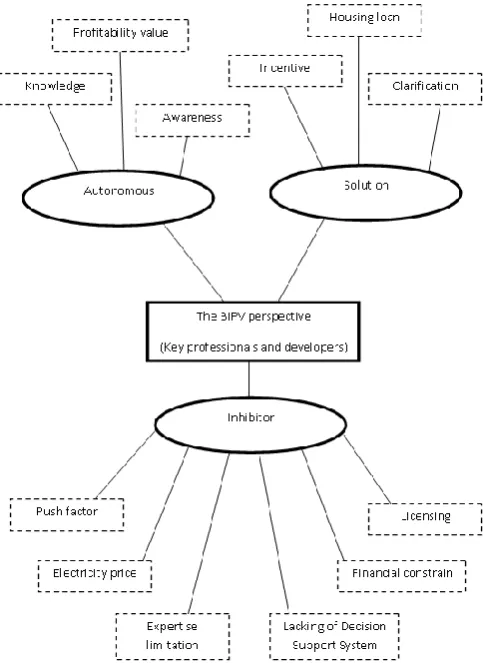
There are three themes identified which are “inhibitor”, “autonomous” and “solution” as shown in Figure 3.1. The theme “inhibitor” refers to the preventive factors that obstruct the BIPV from fully developed to be used commonly. The theme “autonomous” refers to the independent factor which will not affect the result in any
[image:2.595.318.560.78.410.2]way. The theme “solution” is the best way to resolve and tackle the problem.
Figure 3.1: Thematic map
Theme 1: Inhibitor
The first theme “inhibitor” is a preventive factor which the respondents think that it can hinders the development of BIPV currently and in future. It links to six sub-themes such “expertise limitation”, “electricity price”, “push factor”, “licensing”, “financial constrain” and “lacking of decision support system”.
Respondent Sub Theme
“If the seminar is locally in
Batu Pahat , I think my
company would be interested to join…” (Respondent 1)
Maybe there is a request…perhaps a big amount request we will find out more... for now it is in
KL and JB...” (Respondent
2)
Expertise limitation
Respondent Subtheme
“The electricity price is still
cheap right now… There is
additional cost for license
and paperwork burdens…”
(Respondent 1)
“It is costly… and the
electricity still cheap…”
(Respondent 2)
“TNB has its own subsidiary company for solar to monopoly and protect TNB
market…perhaps housing
size matter and also the
licensing…” (Respondent
3)
“The cost is very expensive
for BIPV including the
license and paperwork…”
(Respondent 4)
Two subthemes that could be extracted out from the response given which are
Electricity price and
Financial constrain. The heavily subsidized electricity price makes electricity cheaper to be consumed and not invest into BIPV which has high initial cost of investment with low monetary returns in proportion to the cheap electricity [6] [7].
Licensing is another subtheme that is a preventive factor that hinders BIPV development due to lack of coordination and consistency in policy and framework [5]. Licensing for BIPV is a hassle and difficult to get beside the additional incurring cost for just the procurement of the license as mentioned by the respondent 1, 3 and 4.
“…no initiative although
the government has policies…will be good if
there is a push factor…”
(Respondent 1)
“There is not much
promotion towards us
(developers) for now…” (Respondent 2)
“…its costly and
government push factors”
(Respondent 3)
“It is not well
publicized…”(Respondent
4)
Push Factor
All four respondents concurs to that there is no push factor from the government with regards to usage of BIPV and implementation of BIPV related policies
because of less
encouragement in lower levels especially the construction industry and lack of coordination and consistency in policy and framework[5].
“No but it’ll be good to
have one…the buyers are
convince seeing the figures and charts better…” (Respondent 1)
“No there is not any and
there is no request for it yet…” (Respondent 2)
“No… but I have tried building one for an assignment…has too many assumption still… need a
comprehensive one… mine
is on installation cost only…” (Respondent 3)
“No there isn’t any that I
have heard of…”
(Respondent 4)
Lacking of decision support system
The inadequate investment in technical and research development[5] includes the lacking of decision support system that can assist providing a better picture of BIPV and influence the financial decision to investment into BIPV. All four respondents have not seen any comprehensive decision support system that is available in the market to help them and their potential clients in this matter.
Theme 2: Autonomous
The second theme is “autonomous” because it is an independent factor which does not have impact on the results for BIPV development. However, the respondent still recognize this as an independent variable and respond to it unanimously stating it has impacts towards individually rather than in general overall opinion. This theme covers three subthemes which are “awareness”, “knowledge” and “profitability value”.
Respondent Subtheme
All four respondents are in
unison agreement when asked on whether the awareness, knowledge and profitability value is part of the factor. However, the respondent hinted that its more to interest based individually.
currently is more to the aesthetic side of it rather than the functionality because it gives not much return on investment.
Theme 3: Solution
The second theme is “solution” because the respondent‟s best recommended way that can be done to help solve the in most of the inhibitor‟s problem. There are three sub-themes under this theme which are “incentives”, “clarification” and “housing loan”.
Respondent Subtheme
“If there is a more visible
incentive such as tax
reduction and rebates that
can be easily obtain why not? The end user will get the benefit at the end of the day…” (Participant 1)
“…perhaps the government can give better incentive to
stimulate the market…tax
reduction and rebates can
be a factor… not only for
developers but also house end user… (Participant 3)
“If there is intervention from the government like criteria in GBI reshuffle, it would look promising…and perhaps a clearer rule and regulations from TNB and the government…” (Participant 4)
The respondents felt that the government should intervene and offer a better package of economic
incentive to make it more lucrative towards the developers who will also benefit from it with regards to usage of BIPV compared to the existing economic incentive which only barely benefit the consumer [7] [9]. Besides that, the government can pull the heavy subsidy out from fossil fuel to generate electricity and invest into this incentive package [7]. This will help dispel the lack of encouragement in the lower levels especially to the construction industry, besides giving a more proportionate cost and return on investment of BIPV [5].
“A more clear way and
easier for application for BIPV…” (Participant 1)
“The government should give more clear regulations
and benefit…” (Participant 2)
“The current incentive and procedure are quite blurry…perhaps a clear one
as a start…” (Participant 3)
“If there is intervention from
Better clarification is needed to be done in the procedures, rules and regulation on procurement of the BIPV. The respondents have given a positive suggestion to solve the lack of coordination and consistency in policy and framework [5]. This will smoothen up the process of procuring BIPV and also benefit the construction industry as less time is need to be spent to get the procurement paperwork to
the government like criteria in GBI reshuffle, it would look promising…and
perhaps a clearer rule and regulations from TNB and
the government…”
(Participant 4)
be done hence cost saving and increment of efficiency for the developers.
“It is covered by the bank loan and has benefit to the end user, it’s possible normally for projects like bungalow because there is a bigger margin of profit compare to terrace or double semi-D houses…”” (Participant 1)
“Yes it is possible…”
(Participant 2)
“It can be covered by the
bank loan if it is a
fixture…” (Participant 4)
The respondents mentioned that it is possible to obtain a the bank housing loan for financing the BIPV together with the house but provided the BIPV is a permanent fixture to the house. This will help solve the incomplete and unhealthy financing and investment system plus bringing down the high initial cost to an affordable level while having a proportionate return on investment to the client.
IV.
Discussion and
Recommendation
The result from Theme 1 confirms the initial drawbacks still remains the primary concern of all the respondents. Feedback such as the concerns electricity price, push factor and lacking of support systems are some major concerns. However, the respondents gave some positive feedbacks in Theme 3 on how should BIPV be that could be very promising in helping the development of BIPV comprehensively so that the potential of BIPV can be fully tapped and utilize to create a sustainable development for Malaysian construction in the future.
The approach to recommended key professionals should be those key decision makers in the top managerial level because they are the ones who make the final decision in any developer firm of whether to support of BIPV or not. However their busy schedule to run the company is a prohibiting factor to the approach. Besides that, a more comprehensive model can be built as a complete decision support system with the latest approaches and analysis to get a more definite answer to the actual reliability and ROI of BIPV.
criteria Green Building Index evaluation of a building. There is very limit data to could be access for heat insulation and heat deflection of PV modules in the market which focus more on cost and efficiency. Maintenance for the lifespan of the PV modules is a new field of research that could be explored in future when application is in full swing.
V.
Conclusion
As a whole, the research is being handled with success and is able to achieve the aim of this paper. There are some setbacks such as the number of respondents that responds in the stipulated time frame and the limitations in available data due to inadequate research in this field; however the data obtained is sufficient for analysis and discussion to fulfill the objective proposed. In conclusion, the Malaysian construction industry stakeholders and the government must cooperated and have to be more committed in overcoming these current challenges and in helping to develop BIPV comprehensively so that the potential of BIPV can be fully tapped and utilize to create a sustainable development for construction in the future.
Acknowledgment
This paper was made possible with the contribution of all key professional who have contribute the data and information to ensure this research to be carried out with success
References
[1] World Bank. (2010). Malaysia: Country’s data .
Retrieved March 07, 2012, from
http://api.worldbank.org/datafiles/MYS_Country_MetaData _en_EXCEL.xls
[2] Asia Pacific Energy Research Center (APERC). (2009).
APEC Energy Demand and Supply Outlook: 4th Edition (Volume 1&2). Retrieved March 01, 2012, from
http://publications.apec.org/publication-detail.php?pub_id=946
[3] Suruhanjaya Tenaga. (2010). “Laporan Tahunan 2010”
Retrieved March 12, 2012, from
http://www.st.gov.my/v4/index.php?option=com_phocadow
nload&view=category&id=9%3Aannual-reports&Itemid=4241&lang=en
[4] Malaysian Building Integrated Photovoltaic (MBIPV) (2005). Malaysian Building Integrated Photovoltaic (MBIPV) Project. Retrieved March 01, 2012, from
http://www.mbipv.net.my/
[5] Fayaz H., Rahim, N. A., Saidur, R., Solangi, K. H., Naiz, H., Hossain, M.S. (2011). Solar Energy Policy: Malaysia vs Developed Countries. 2011 IEEE Conference on Clean
Energy and Technology CET Retrieved March 12, 2012 from
http://ieeexplore.ieee.org/xpl/freeabs_all.jsp?arnumber=604 1512
[6] Isa, A.M.; Magori, H.; Niimura, T.; Yokoyama, R (2010). “Multi-Criteria Generation Optimal Mix Planning for Malaysia Additional Capacity”, in International Journal of Energy and Environment, issue 4, vol 4, pp 221-228. [7] Solangi, K. H., Lwin,T. N. W., Rahim, N. A., Hossain, M.S,
Saidur, R., Fayaz H. (2011). “Development of Solar Energy
and Present Policies in Malaysia”, in IEEE Conference on Clean Energy and Technology CET. pp. 115-120.
[8] Fridley, D. (2010). “Nine Challenges of Alternative
Energy”. In Post Carbon Reader:Managing the 21st Century‟s Sustainability Crises. Retrieved March 12, 2012 from
http://www.postcarbon.org/Reader/PCReader-Fridley-Alternatives.pdf