International Journal of Emerging Technology and Advanced Engineering
Website: www.ijetae.com (ISSN 2250-2459, ISO 9001:2008 Certified Journal, Volume 5, Issue 2, February 2015)
384
Selection of Refrigerant for Air Conditioning System Using
MCDM-TOPSIS Approach
A. K. Tripathi
1, S. Dubey
2, V. K. Pandey
3, S. K. Tiwari
41,2Jawahar Lal Nehru College of Technology, Rewa, India
3NRI Group of Institutions, Bhopal, India
4
Jaypee University of Engineering Technology, Guna, India
Abstract— The Air conditioning system satisfies the various
space conditions required for the comfort and industrial air conditioning. Now days demand for AC system applications are increasing and include the areas of application like apartment buildings, banks, office buildings, industrial plants, schools, restaurants etc. This growing demand for air conditioning system forced manufactures to develop such system which is able to compete in the global market and satisfy the user requirements as well as environmental conditions. A refrigerant plays important role to produce desired cooling effects in AC system as required for providing comfort conditions. Currently numerous refrigerants are available in the market having their own merits and demerits so appropriate selection of refrigerant is very essential. An MCDM-TOPSIS Approach is used to select the appropriate refrigerant including the criteria for selection as Ozone upon Ozone Depletion Potential (ODP), Global Warming Potential (GWP), Latent heat of vaporization (LHVP) and COP (Coefficient of Performance) values.
Keywords—Air Conditioning, MCDM TOPSIS,
Refrigerant, Relative Important Matrix
I. INTRODUCTION
Today we see development in every aspect of society and economy improves the living standard of people hence higher living conditions are demanded, so it is crucial to pay attention for treating indoor air for comfort of occupants. Brar (2012) proposed in his study that air conditioning is combined process that performs many functions simultaneously. It conditions the air, transport it introduce it to the conditioned space. There are many types of AC systems classified as centralized system and decentralized system which may differs from their size, construction and operating characteristics. The Refrigerant is a substance which is capable of absorbing heat from other substance (Ice- Water- Air- Brine Solution). An ideal refrigerant possesses some distinct properties (i.e. High Latent Heat of Vaporization, High Density of Suction Gas, Non- Corrosive, Non- Toxic, Non- Inflammable, Low cost, Ease of leak Detection, Environment Friendly, Ozone friendly and easily available) which make it suitable for using it in AC system.
The refrigerants available in the market used in AC systems are R-134a, R-22, R-12, R-417, R-410, R-11 etc. Robert (2012) presented a set of results from laboratory and field testing of refrigerant R-417a and founded it as a suitable refrigerant for replacement of R-22 which has more COP value and eco- friendly. A Review of Alternative to R134a (CH3CH2F) Refrigerant is done by (Verma, Satsangi and Chaturani, 2013) for selection of eco- friendly refrigerant. Agrawal (2013) makes the comparison between different available refrigerants on the basis of their physical chemical, environment and safety properties. Bhagale and Agrawal (2004) as used MCDM-TOPSIS approach for the selection of robot including criteria as complexities, features, reliability, availability etc. Adhikari and Roy (2013) used MCDM- TOPSIS for selection of hydro turbine blade and material. Brar (2012) used TOPSIS approach for selection of suitable air conditioning system.
II. MCDM-TOPSIS APPROACH
Technique for order preferences by similarity to ideal solution (TOPSIS) procedure is carried out in following steps as given by (Brar, 2012 and Adhikari and Roy, 2013, Fazlollahtabar et al., 2011),
A. Elimination search
A shortlist of air conditioning refrigerant alternatives
formed as a result of ‘elimination search’ has to be further filtered to find out the best solution out of all i.e. an optimal air conditioning refrigerant. Hence these available alternatives are ranked in order of preference to select an optimal one.
B. Decision Matrix
Firstly all of the information available from the mini database about these satisfying solutions is represented in the matrix form. Such a matrix is termed as decision matrix, ‘D‘. Each row of the matrix is allocated to one alternative air conditioning system and each column to one
attribute. Therefore an element dij of the decision matrix,
'D' represents the value of jth attribute in non-normalized
International Journal of Emerging Technology and Advanced Engineering
Website: www.ijetae.com (ISSN 2250-2459, ISO 9001:2008 Certified Journal, Volume 5, Issue 2, February 2015)
385
Thus if there are 'm'short-listed alternatives with
‘n’pertinent attributes, the decision matrix is an m x n
matrix.
C. Normalized Matrix
As the elements in each column of matrix, ‘D' have different units and scales, it is necessary to normalize their values. Thus normalized matrix, ‘N' is constructed to have the dimensionless magnitudes of all the attributes of air conditioning refrigerant on common scale of 0 to 1, which allows the comparison across the attributes. Each element
nij of the normalized matrix, ‘N' can be calculated as,
(1)
Where dij is an element of the decision matrix, 'D'.
D. Relative Importance Matrix
In this step, the relative importance matrix ‘R’ of size n
x n is formed to incorporate the relative importance of the
attributes over other for a given application. An element rij
of matrix ‘R‘represents the relative importance of the ith
attribute over the jth attribute and is defined as,
rij = (2)
The relative importance of one attribute with respect to another for a given application can be obtained from the user or the group of experts specialized in a particular
application. The information about the pair-wise
comparison of attributes for a particular application is stored in this relative importance matrix ‘R‘, with all its diagonal elements as unity.
E. Eigen Value Formulation and Weight Matrix
Due to human inconsistencies, the information stored in the ‘R‘matrix on a pair-wise basis cannot be used directly. It must be modified into a form that gives the relative weights of all attributes taken together so that the sum of all the weight is equal to unity. Thus Eigen value formulation is used to find weight vector matrix, ‘W’and is expressed as
RW = λW (3)
Where, W = {w1, w2, w3………...wn}
T, and λ is the
Eigen values.
Eq. (3) can be expressed
(R-λI)W=0 (4)
To avoid the trivial solution, we have
Det (R-λI) = 0 (5)
The solution of Eq. (5) gives the set of ‘n’ Eigen values
(λ1, λ2,…, λn). The solution of Eq. (4) for the maximum
Eigen value 'λmax' gives the weight matrix, ‗'W' and the
expression is given as
(R-λI)W = 0 (6)
F. Weighted Normalized Decision Matrix
In this step the weighted normalized decision matrix, 'V' is obtained by incorporating the information stored in the weight matrix, ‘W‘into the normalized matrix, ‘N‘. A true comparable value of each attribute is given by this weighted normalized matrix and is defined as
V = [vi j], where vi j = wj x ni j, (7)
Where i = 1, 2,….,m; j = 1,2,….,n
G. Hypothetical Best and Worst Solution
The hypothetical best solution (HBS) and hypothetical worst solution (HWS) are determined by choosing the maximum and minimum values of attributes from ‘V‘matrix as,
HBS = A* = vi j max, for benefit attributes
(Larger the better type), or = vi j min, for cost attributes
(Smaller the better type), and (8)
HWS = Aˉ = vi j min, for benefit attributes
(Larger the better type), or
= vi j max, for cost attributes
(Smaller the better type) (9)
Where i = 1, 2,…,m and j = 1,2,…,n. Hence,
A* = (V*1, V*2,…., V*n)
Aˉ = (Vˉ1, Vˉ2,...., Vˉn)
H. Determination of Separation Measures
The TOPSIS procedure is based on the concept that the
chosen option should be nearest to the HBS and farthest
from the HWS. The separation measure of top ranked air
conditioningrefrigerant ensures that it is closest to the HBS
(best possible air conditioning system) and farthest from
the HWS (worst possible air conditioning system). If Si*
and Siˉ are separation measures from HBS and HWS,
respectively. Then, the separation of each alternative from
theHBS is given by,
Si* = [ ] ½ (i = 1, 2, 3…, m) (10)
And separation measure from HWS is given by
International Journal of Emerging Technology and Advanced Engineering
Website: www.ijetae.com (ISSN 2250-2459, ISO 9001:2008 Certified Journal, Volume 5, Issue 2, February 2015)
386 I. Determination of Suitability Index
The suitability index, ‘C*‘is a measure of the suitability of the air conditioning system for the chosen application on the basis of attributes considered. It is defined as the relative closeness to the HBS, and is expressed as
C* = Siˉ / (Si* + Siˉ), i = 1, 2………… m (12)
An air conditioning refrigerant with largest C* is preferable.
J. Establishing an Order of Preference
The air conditioning system with highest value of C* will be given highest rank, and so on. In this way the preference order for the available alternative air conditioning systems is obtained by arranging them in decreasing order of their corresponding C* values.
III. SELECTION OF REFRIGERANT
The above technique MCDM- TOPSIS is used for selection of refrigerant based upon attributes like Ozone Depletion Potential (ODP), Global Warming Potential (GWP), Latent heat of vaporization (LHVP) and COP (Coefficient of Performance) values. Attributes for candidate refrigerants are given in following table-1. The selection procedure of refrigerant is carried out in following steps of MCDM-TOPSIS-:
[image:3.612.326.521.142.575.2] [image:3.612.58.278.486.657.2]A. Step- I
TABLE II
ATTRIBUTES FOR CANDIDATE REFRIGERANTS
Refrigerant ODP GWP LHVP COP
R-134a 0 1300 209.5 4.61
R-22 0.5 1500 218.1 4.66
R-12 1 8500 159 1.70
R-417 0 1500 218 5.21
R-410 0 1610 217 4.5
R-11 1 4000 195.7 5.09
B. Step- II
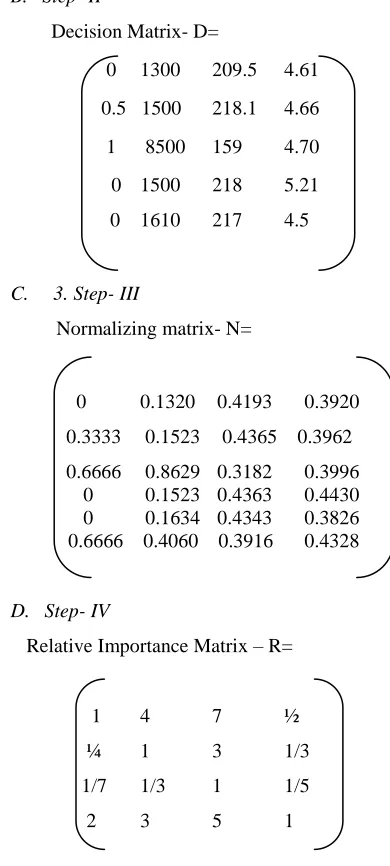
Decision Matrix- D=
0 1300 209.5 4.61
0.5 1500 218.1 4.66
1 8500 159 4.70
0 1500 218 5.21
0 1610 217 4.5
C. 3. Step- III
Normalizing matrix- N=
0 0.1320 0.4193 0.3920
0.3333 0.1523 0.4365 0.3962
0.6666 0.8629 0.3182 0.3996
0 0.1523 0.4363 0.4430
0 0.1634 0.4343 0.3826
0.6666 0.4060 0.3916 0.4328
D. Step- IV
Relative Importance Matrix – R=
1 4 7 ½
¼ 1 3 1/3
1/7 1/3 1 1/5
2 3 5 1
Weights for each alternative can be calculated by calculating the square of Eigen vectors corresponding to maximum Eigen value (λmax = 4.1690), which is equals to
International Journal of Emerging Technology and Advanced Engineering
Website: www.ijetae.com (ISSN 2250-2459, ISO 9001:2008 Certified Journal, Volume 5, Issue 2, February 2015)
387
E. Step-V
Weight Normalizing Matrix- V=
0 0.0064 0.0040 0.2213
0.1257 0.0074 0.0042 0.2236
0.2513 0.0419 0.0030 0.2256
0 0.0074 0.0042 0.2501
0 0.0128 0.0041 0.2160
0.2513 0.0319 0.0037 0.2443
F. Step- VI
Hypothetical Best and Worst Solution
V*= (0, 0.0064, 0.0042, 0.2501)
V‾= (0.2513, 0.0419, 0.0030, 0.2160)
G. Step- VII
Determination of separation Measure-
S1*= 0.0288 S1‾= 0.2538
S2*= 0.1284 S2‾= 0.1304
S3*= 0.2549 S3‾= 0.0396
S4*= 0.0010 S4‾=0.2559
S5*= 0.0346 S5‾=0.2529
S6*=0.2526 S6‾= 0.0300
H. Step- VIII
Determination of suitability Index-
C1*= 0.8980
C2*= 0.5038
C3*= 0.1344
C4*= 0.9961
C5*=0.8796
C6*= 0.1061
I. Step- IX
Ranking of alternatives
Alternative Ranking
R-417 1
R134a 2
R-410 3
R-22 4
R-12 5
R-11 6
J. Step- X
Final Selection- R-417, which is best refrigerant among all available refrigerants.
[image:4.612.314.571.434.582.2]IV. COSTING OF MCDMTOPSIS IMPLEMENTATION
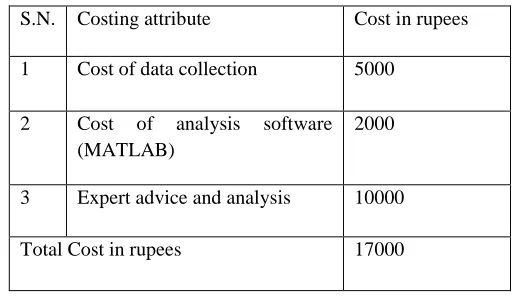
Table 2 shows the cost of implementation of TOPSIS for the selection of the alternative refrigerant for Air-Conditioning system.
TABLE II
COST OF IMPLEMENTATION OF TOPSIS
S.N. Costing attribute Cost in rupees
1 Cost of data collection 5000
2 Cost of analysis software
(MATLAB)
2000
3 Expert advice and analysis 10000
Total Cost in rupees 17000
V. RESULT AND DISCUSSION
In available alternatives of refrigerants, considering criteria as Ozone upon Ozone Depletion Potential (ODP), Global Warming Potential (GWP), Latent heat of
vaporization (LHVP) and COP (Coefficient of
International Journal of Emerging Technology and Advanced Engineering
Website: www.ijetae.com (ISSN 2250-2459, ISO 9001:2008 Certified Journal, Volume 5, Issue 2, February 2015)
388
The use of this refrigerant may gives more COP value, Negligible Ozone layer depletion potential; less global warming effects etc. in our further study we apply this technique and others like AHP, VICKOR, and ElECTRA for suitable selection of AC system and refrigerants considering more attributes.
Acknowledgement
This paper is revised and extended version of paper presented in International Conference on Industrial Engineering (ICIE, 2013), SVNIT, Surat, Gujarat,
November 20-22, INDIA.
REFERENCES
[1] [Online]http://www.google.co.in/#bav=on.2,or.r_qf.&fp=ca8f6e1b0 505218a&q=comparison+of+different+refrigerants+by%2B+alka+b ani+agrawal (August,5th,2014)
[2] Adhikari, P., Roy, P.K. (2013), ‘Selection of Hydro-Turbine Blade Material: Application of Fuzzy Logic (MCDA)’, International Journal of Engineering Research and Applications, Vol. 3, No.1, pp. 426-430.
[3] Bhagale, P.P., Agrawal, V.P. (2004), ‘Attribute based specification, Comparison and Selection of a Robot’, Mechanism and Machine Theory.
[4] Brar, J.S. (2012), ‘Study, Modelling, Analysis, Evaluation, Selection and Performance improvements of air conditioning system’, M. Tech Thesis, Thapar University, Patiala, India.
[5] Roberts, N.A. (2012), ‘Use of R-417a in Refrigeration and Air Conditioning Applications’, Rodia Organic fine limited Avonmouth, Bristol, U.K.
[6] Verma, J.K., Satsangi, A., Chaturani V. (2013), ‘A Review of Alternative to R134a (CH3CH2F) Refrigerant’, International Journal of Emerging Technology and Advanced Engineering, Vol. 3, No.1, pp. 300-304.