International Journal of Emerging Technology and Advanced Engineering
Website: www.ijetae.com (ISSN 2250-2459, ISO 9001:2008 Certified Journal, Volume 6, Issue 8, August 2016)
15
Application of the Method of Polynomial Approximation for
the Determining the "Optimal" Coefficient of the
Mathematical Model of Corrosive Destruction. Algorithm 2
George Filatov
Professor, Doctor of Techn. Sciences, Dnepropetrovsk State Agrarian-Economic University
Abstract − In this paper is adduced the method of polynomial approximation for the determination of the “optimal” coefficient of influence of stress-strain state (SSS) of the design on the rate of corrosion at its optimal designing. Is offered to approximate dependence, in which the coefficient of influence of SSS of structure on the rate of corrosion is the function of the stiffness of parameters of optimized design.
Keywords — Corrosive destruction, Evolutionary Theory, Identification, Mathematical Models, Optimal Designing, Polynomial Approximation.
I. INTRODUCTION
In the previous article [5] was considered the algorithm of polynomial approximation, in which the geometric parameters of the optimized design, in particular, its stiffness, depend on the value of the coefficient of influence of the stress-strain state (SSS) of the structure on the rate of corrosion. This algorithm has been designated as “Algorithm 1”. It was noted that this method for a large number of control variables is very cumbersome, as for each optimized parameter it will necessary to perform an own approximation.
In this paper, we propose an algorithm that will avoid the difficulties mentioned above and solve the problem set out above.
As in previous article [5] we illustrate the using of second algorithm of polynomial approximation for the determining of the "optimal" coefficient of influence of the SSS on the rate of corrosion process by the example of optimal designing of thin-walled circular cylindrical shell of radius
R
and wall thickness
(Fig. 1). The shell is filled with gas, whose pressure is equalq
. The shell experiences the action of aggressive environment in form of hydrogen embrittlement and corrosion on the inside surface of the wall (Fig.1). The process of corrosion damage is described by using of several mathematical models of corrosion destruction: the mathematical model of Ovchinnikov I.G. MMSS [5], the description of which is given in [1], and the mathematical model of Verhulst [5]. The description of combined use of these models is adduced in the paper [4]. In paper [4] is adduced the formulation of the task of optimal designing of shell considering of hydrogen embrittlement of material.Fig.1 The thin-walled shell
II.THE ILLUSTRATION OF APPLICATION SECOND
ALGORITHM OF METHOD OF POLYNOMIAL
APPROXIMATION
Algorithm 2. The polynomial approximation of the coefficient of the influence of SSS on the rate of corrosion as the function of stiffness of optimized structure.
We introduce the approximating polynomial:
nm m i
i
d
A
d
A
A
d
d
A
0
1
2 2
....
, (1)Let us take as a deviation
A
from
exp on the multitude of pointsA
1,
A
2,...,
A
m the next square approximation:
ni
i i
A
S
1
2 exp
, (2)International Journal of Emerging Technology and Advanced Engineering
Website: www.ijetae.com (ISSN 2250-2459, ISO 9001:2008 Certified Journal, Volume 6, Issue 8, August 2016)
16
The coefficients in expression (1) are selected in such a way that the value of S was the lowest.Assume that the approximating polynomial for the determining of coefficient is by the test identification from different starting points becomes:
22 1
0
d
A
id
A
id
A
(3)The search of the roots approximating polynomial (3) performed using the method of random search SGEF [7]. To do this, we introduce the notation:
0
1
d
x
;x
2
d
1;x
3
d
2 and we formulate a mathematical programming problem: find a vector
x
1,
x
2,
x
3
X
, that delivers a minimum for the functional:
ni
i i
i
x
A
A
A
x
x
S
1
2 2
3 2
1
min
X
(4)
at the performance of restrictions:
x
x
x
x
;
i
1
,
2
,
3
;
j
1
,
2
,...,
6
g
j i i i (5) [image:2.595.194.404.542.734.2]In the Table 1 shows the results of the solution of mathematical programming problem (4)-(5).
Table 1
The values of the coefficients of approximating polynomial, the calculated value and the coefficient of influence of SSS on the rate of corrosion rate on the rate of corrosion
№
Starting points The coefficients of approximating polynomial
A
i(%)A
(sm2)
id
0d
1d
21 2309,34 0,1667274
0,04631835 0,0000052504 0,00000009443
0,162 2,75
2 1976,50 0,1061461 0,116 -9,54
3 1646,78 0,0844576 0,081 4,60
4 1307,56 0,0588444 0,054 8,48
5 1134,58 0,0423870 0,044 -4,22
6 1065,51 0,0396290 0,041 3,57
To determine the coefficients of the polynomial (3) let us select the values of objective function out of the search trajectory (Table 2 [4]).
These values of objective function are listed in Table 1.
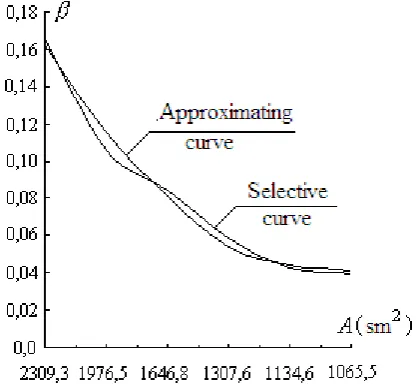
Fig.2. The approximation of selective curve with the help of second-degree polynomial
International Journal of Emerging Technology and Advanced Engineering
Website: www.ijetae.com (ISSN 2250-2459, ISO 9001:2008 Certified Journal, Volume 6, Issue 8, August 2016)
17
Because of the proximity of selective ("experimental") and approximating curves in subsequent calculations we shall use an approximating curve. Take the derivative of the function (3) and equate to zero by:0
2
21
d
d
A
dA
d
. (6)
Deciding the equation (6) with respect to
A
, we obtain:588
,
605
0000000443
,
0
2
0000521504
,
0
2
21
d
d
A
sm2Substituting this value of the cross section of the shell stiffness in the expression (1), we determine the extreme
value of coefficient of influence of SSS on rate of corrosion:
A
d
0
d
1A
d
2A
2
0
,
04631835
0
,
0000521504
588
,
605
0
,
0000000443
588
,
605
2
0
,
03097
.
Let us perform the optimization of the shell with this coefficient ratio and some specifying identifications.
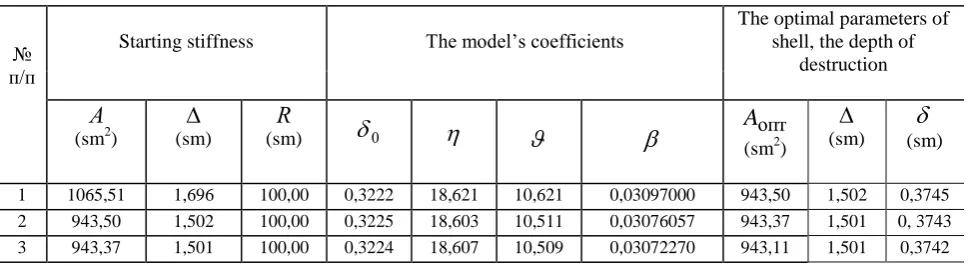
[image:3.595.57.544.375.508.2]The results are given in Table 2.
Table 2
Theresults of specifying identifications and optimal parameters of shell
№ п/п
Starting stiffness The model’s coefficients
The optimal parameters of shell, the depth of
destruction
A
(sm2)
(sm)R
(sm)
0
A
опт(sm2)
(sm)
(sm)1 1065,51 1,696 100,00 0,3222 18,621 10,621 0,03097000 943,50 1,502 0,3745 2 943,50 1,502 100,00 0,3225 18,603 10,511 0,03076057 943,37 1,501 0, 3743 3 943,37 1,501 100,00 0,3224 18,607 10,509 0,03072270 943,11 1,501 0,3742
The result that is shown in Table 2 in the last line, is almost identical with the results obtained previously by multiple identification and have adduced in Table 3 [5].
The considered method of polynomial approximation is useful in the event that construction has a large number of parameters to be optimized, since it does not require their preliminary approximation. However, when it is used is required the careful approximation of dependence of the function of influence of SSS on the rate of corrosion from the stiffness of structure.
Let us apply the method of successive approximations that has been described at using the algorithm 1.
At the beginning, let us describe the behavior of the function of influence of SSS on the rate of corrosion from the stiffness of the cross section of the shell with the help of a polynomial of the third degree:
33 2 2 1
0
d
A
d
A
d
A
d
A
(7)Introducing the notation:
x
1
d
0;x
2
d
1;2 3
d
x
andx
4
d
3 deciding the problem of mathematical programming:
ni
i i
i
i
x
A
x
A
A
A
x
x
S
1
2 3
4 2 3 2
1
min
X
(8)
at the execution of restrictions:
x
x
x
x
;
i
1
,
2
,...,
4
;
j
1
,
2
,...,
8
g
j i i i(9)
International Journal of Emerging Technology and Advanced Engineering
Website: www.ijetae.com (ISSN 2250-2459, ISO 9001:2008 Certified Journal, Volume 6, Issue 8, August 2016)
[image:4.595.50.548.167.319.2]18
Table 3
The values of the coefficients of the approximating polynomial and the calculated value of the coefficient of the influence of SSS on the rate of corrosion
№ Starting points
The coefficients of polynomial
A
i(%)A
(sm2)
i1 2309,34 0,1667274 0,164 1,84
2 1976,50 0,1061461
0
d
= 0,02052301 0,115 8,183 1646,78 0,0844576
1
d
= 0,0000076611118 0,079 6,034 1307,56 0,0588444
2
d
=0,0000000009456436 0,054 8,235 1134,58 0,0423870
3
d
=0,000000000009776864 0,045 5,486 1065,51 0,0396290 0,042 4,94
Now, solving the problem of optimal design, instead of execution at each step of the procedure of identification of the mathematical model we will calculate the value of coefficient of influence of SSS on the rate of corrosive process with the help of expression (7).
For the coefficients of a mathematical model, we take the average value calculated on a sample of the values of these coefficients.
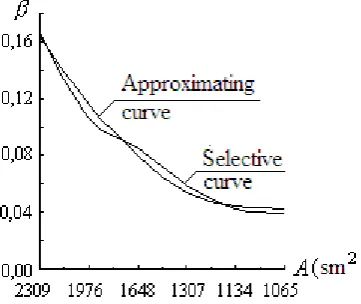
Extrapolating the approximating curve shown in Fig. 3. We determine the cross sectional area of the shell
A=
1000
sm2 and compute the coefficient of the influence of SSS on the rate of corrosion:
A
d
0
d
1A
d
2A
2
d
3A
3
2
,
052301
10
2
7
,
6611118
10
6
1000
9
,
456436
10
10
1000
2
9
,
7767864
10
12
1000
3
0
,
03889841
[image:4.595.206.387.480.632.2]The optimization results are recorded in Table 4.
Fig.3. The approximation of selective curve with the help of third-degree polynomial
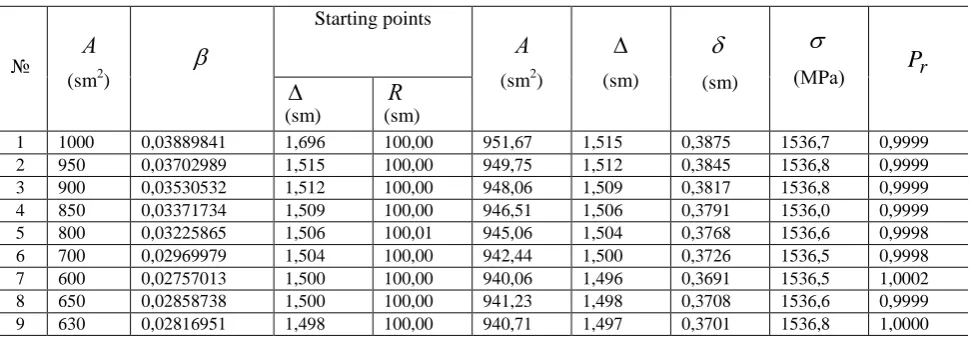
Substituting in expression (7) the value of cross-sectional area of shell listed in the second column of Table 4, we calculate the value of coefficient of influence of SSS on the rate of corrosion
and then with this coefficient we execute the optimization of shell and carry out the check the shell strength under the plastic and brittle fracture.As seen from the Table 4 at A600sm2 the shell strength under brittle fracture is not satisfied (Pr 1). Therefore we accept A650см2
and carry out the appropriate calculations. The results are recorded in Table 4. The strength of the shell under the brittle fracture is not broken. We accept A630см2
International Journal of Emerging Technology and Advanced Engineering
Website: www.ijetae.com (ISSN 2250-2459, ISO 9001:2008 Certified Journal, Volume 6, Issue 8, August 2016)
[image:5.595.57.543.156.326.2]19
Table 4
The results of successive approximations to the "optimal" value of coefficient of the influence of SSS on the rate of corrosion
№
A
(sm2)
Starting points
A
(sm2)
(sm)
(sm)
(МPа)
P
r
(sm)
R
(sm)1 1000 0,03889841 1,696 100,00 951,67 1,515 0,3875 1536,7 0,9999 2 950 0,03702989 1,515 100,00 949,75 1,512 0,3845 1536,8 0,9999 3 900 0,03530532 1,512 100,00 948,06 1,509 0,3817 1536,8 0,9999 4 850 0,03371734 1,509 100,00 946,51 1,506 0,3791 1536,0 0,9999 5 800 0,03225865 1,506 100,01 945,06 1,504 0,3768 1536,6 0,9998 6 700 0,02969979 1,504 100,00 942,44 1,500 0,3726 1536,5 0,9998 7 600 0,02757013 1,500 100,00 940,06 1,496 0,3691 1536,5 1,0002 8 650 0,02858738 1,500 100,00 941,23 1,498 0,3708 1536,6 0,9999 9 630 0,02816951 1,498 100,00 940,71 1,497 0,3701 1536,8 1,0000
The resulting solution of the problem is not optimal, but it defines the area that is close to the point of extreme.
[image:5.595.54.542.401.473.2]Let us carry out from found points the specifying identifications and the search of optimal solutions. The results are listed in Table 5.
Table 5
The optimal parameters of shell and a corresponding "best" set of coefficients of mathematical models of corrosive destruction.
The optimal parameters of shell The model’s coefficients The depth of corrosive destruction
A
(sm2)h
(sm)R
(см)
0
t(sm)
(sm)
(sm)940,71 1,497 100,00 0,3227 18,603 10,496 0,0303989 0,3225 0,0519 0,3744
Consider the optimal designing of statically determinate welded I-beam, which is interact with an aggressive media (Fig.1 [4]). As a mathematical model of corrosion damage we accept Ovchinnikov's model (1) [4].
The welded I-beam is subjected by corrosion caused by the environment and by the SSS influence on the corrosion rate. For a description of the corrosion process will take two models: Verhulst’s model [5] and Ovchinnikov's model in the form of:
y
t
t
k
j
J
M
E
t
t
j
k
k k z
j
j
,
1
,
2
,...,
1
exp
1
1 12
max p
0
0
,
(10)Where the first term describes corrosion of unstrained metal (3) [5], the second term takes into account the impact of SSS on the rate of corrosive process (3) [4].
The description of coefficients and the terms in equation (10) are given in paper [5].
For identification of the mathematical model (10) we take the functional:
y
t
t
j
n
k
j
J
M
E
t
J
j
k
k k z
j e
j
,
1
,
2
,...,
;
1
,
2
,...,
1
exp
1
2
1
1 2
max p
0
0
,(11)
,
International Journal of Emerging Technology and Advanced Engineering
Website: www.ijetae.com (ISSN 2250-2459, ISO 9001:2008 Certified Journal, Volume 6, Issue 8, August 2016)
[image:6.595.55.539.159.208.2]20
Table 6
The data of experimental studies of wellded I-beam is influenced by an aggressive environment
Observing time (years)
0,0000 0,1643 0,5753 1,0219 1,4410 2,0191 2,4602 2,957 3,2000 The depth of corrosive damage (sm)
0,0062 0,03186 0,0890 0,2571 0,3030 0,3254 0,5596 0,3813 0,3940
The task of identifying the model (10) we solve as the mathematical programming problem. For this purpose, we introduce a vector of control variables, where:
x
1,
x
2,
x
3,
x
4
X
, где:x
1
0,x
2
,x
3
andx
4
.The problem of mathematical programming is formulated as follows: find a minimum of the functional:
y
t t
j n k j
J M
E x
t x x
x J
j
k
k k z
j э
,..., 2 , 1 ; ,..., 2 , 1 , 1
exp 1
2
1
1 2
max p 4
0 3 2
1
X
(12)
at the execution of restrictions
:
1 10
;
2
1 10
;
1
x
x
g
x
x
g
X
X
(13)
For solve the problem of mathematical programming (12)-(13) we use the method of random search SGEF at the following initial data:
M
p
561
,
79
кНм;5
10
1
,
2
E
МПа; n = 9;x
1
1
,
0
,
x
1
0
,
0
. In the first stage of research we choose a point in the space of permitted parameters with coordinates:02
,
0
0
d
m;h
0
0
,
85
m;a
0
0
,
03
m;4
,
0
0
b
m and for this point we execute the identification of the mathematical model. As a result, we obtain the following coefficients model:
0
0
,
3251
,635
,
18
,
10
,
399
,
0
,
2690313
.Then, from a point with coordinates adduced above we execute the optimization of I-beam. The statement of the problem of optimal design of welded I-beam as the mathematical programming problem, is formulated in paper [3] equations (15)-(22). Also in paper [4] are shown the initial data, under which performs the optimization, the geometric constraints on variables and time of corrosion.
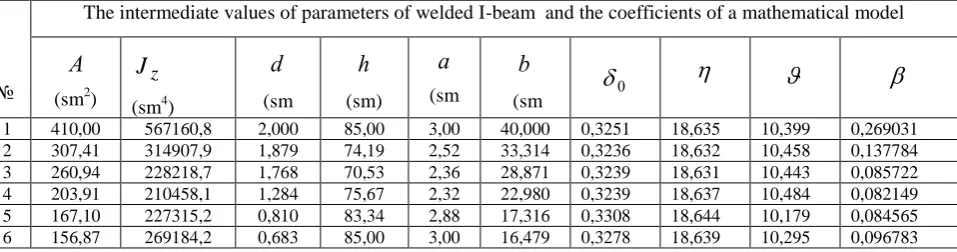
[image:6.595.62.541.584.710.2]In the search process of optimal solution on the search trajectory were chosen 6 intermediate points in order of descending of objective function and the results of selection were listed in Table 7. For each of the intermediate points was performed the identification of the mathematical model (10) and the model coefficients were entered in Table 7.
Table 7
Selected results of optimal design of the I-beam
№
The intermediate values of parameters of welded I-beam and the coefficients of a mathematical model
A
(sm2)z
J
(sm4)
d
(smh
(sm)a
(smb
(sm 0
International Journal of Emerging Technology and Advanced Engineering
Website: www.ijetae.com (ISSN 2250-2459, ISO 9001:2008 Certified Journal, Volume 6, Issue 8, August 2016)
21
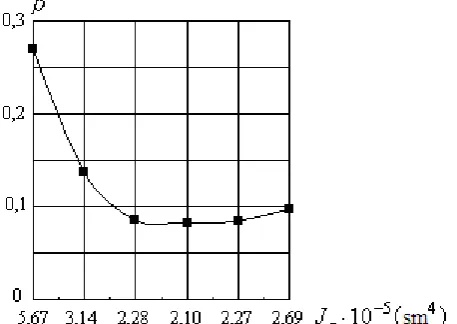
In Fig. 4 is a plot of the dependence of sample values of the function of SSS influence on the rate of corrosive process from the moments of inertia of the cross section of the I-beam.The graph shows that the influence of SSS on the first search step decreases, following in accordance with Theorem 1 [2]. behind the change in the stiffness of the
cross section of I-beam, and then begin to increase in proportion to an increase of the stiffness of the cross section.
[image:7.595.204.433.223.385.2]The minimum value of the function of SSS influence on the corrosion rate is within the range of changes in the stiffness of the cross-section.
Fig. 4. The graph of the dependence of influence function of SSS on the rate of corrosion process from the values of moments of inertia of I-beam cross-section
The graph shows that the mathematical minimum of SSS influence on the rate of corrosion is between the third and fourth values of the stiffness of the cross-section of the optimized I-beam (Table 5). We approximate the curve shown in Fig. 4 polynomial and let us determine the value of coefficient of influence of SSS on the rate of corrosion and the corresponding value of the stiffness of the cross-section of I-beam. As an approximating polynomial we choose a third-degree polynomial:
33 2 2 1
0
a
a
a
a
. (14) We investigate the process of finding the "optimal" value coefficient of influence of SSS on the rate of corrosive process in more detail.Let us carry transfer from the table 4 intermediate states of beams and adduce in Table 5 the corresponding to these states the values of moments of inertia, the sizes of the optimized cross-sections of the I-beam and the corresponding values of coefficients of mathematical model of corrosive destruction (10).
The coefficients of the polynomial (14) we will search by solving the following problem: find a minimum of the functional:
ni
i z i
J
S
1
2
. (15)Introducing the notations: 3
4 2 3 1 2 0
1
a
;
x
a
;
x
a
;
x
a
x
, formulatethe mathematical programming problem: find a vector
x
1,
x
2,
x
3,
x
4
X
, which minimizes the functional:
ni
z
J
x
x
x
x
S
1
2 3
4 2 3 2
1
X
(16)
at the execution of restrictions:
x
x
x
;
i
1
,
2
,...,
3
;
j
1
,
2
,...,
6
g
jX
i i i . (17)The search of coefficients of approximating polynomial (14) is performed using the method of
International Journal of Emerging Technology and Advanced Engineering
Website: www.ijetae.com (ISSN 2250-2459, ISO 9001:2008 Certified Journal, Volume 6, Issue 8, August 2016)
[image:8.595.57.543.167.327.2]22
Table 5
The values of coefficients of approximating polynomial and the values of estimated coefficients of indluence of SSS on the rate of corrosive process
№
Starting points
The coefficients of polynomial
i(%)z
J
(sm
4)
i1 567160,8 0,2690313 0,269084 0,02
2 314907,9 0,1377836
0
a
= 160830,2 0,135592 1,593 228218,7 0,0857222
1
a
= 18723,49 0,085028 0,814 210458,1 0,0821492
2
a
= 11490850,0 0,076538 6,835 227315,2 0,0845652
3
a
=21591050,0 0,084176 0,46 [image:8.595.224.388.349.526.2]6 269184,2 0,0967832 0,104729 8,21
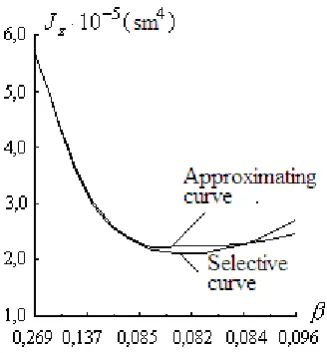
Fig. 5 shows the sampling and approximating curves.
Fig.5. The approximation of selective curve with the help of third-degree polynomial
Introducing the notation
x
1
, we are solving the problem of determining the coefficient of influence of SSS on the rate of corrosion
as the problem of mathematical programming: find a minimum of the function
33 2 1 2 1 1
0
a
x
a
x
a
x
1a
(18)at the execution of restrictions:
1 1 1
1
x
x
x
g
X
. (19)Solving the problem (18)-(19) relatively to the coefficient
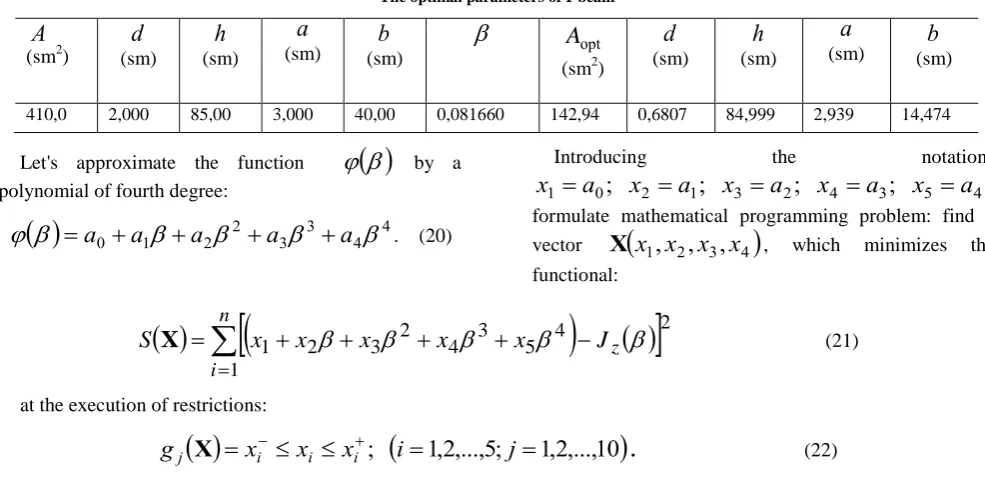
we determine extreme value081659605
,
0
. Substituting this value of coefficient
to formula (14), we find the value of the moment of inertia corresponding to the value of this coefficient
:J
z
224168
,
6
sm4.International Journal of Emerging Technology and Advanced Engineering
Website: www.ijetae.com (ISSN 2250-2459, ISO 9001:2008 Certified Journal, Volume 6, Issue 8, August 2016)
[image:9.595.49.542.150.391.2]23
Table 6
The optimal parameters of I-beam
A
(sm2)
d
(sm)h
(sm)a
(sm) (sm)
b
A
оpt (sm2)d
(sm)h
(sm)a
(sm) (sm)
b
410,0 2,000 85,00 3,000 40,00 0,081660 142,94 0,6807 84,999 2,939 14,474
Let's approximate the function
by a polynomial of fourth degree:
44 3 3 2 2 1
0
a
a
a
a
a
. (20)Introducing the notations 4 5 3 4 2 3 1 2 0
1
a
;
x
a
;
x
a
;
x
a
;
x
a
x
,formulate mathematical programming problem: find a vector
X
x
1,
x
2,
x
3,
x
4
, which minimizes the functional:
ni
z
J
x
x
x
x
x
S
1
2 4
5 3 4 2 3 2
1
X
(21)
at the execution of restrictions:
x
x
x
;
i
1
,
2
,...,
5
;
j
1
,
2
,...,
10
g
jX
i i i.
(22) [image:9.595.56.543.442.602.2]The problem (21), (22) is solved by random search. approximation results are recorded in Table 7.
Table 7
The values of coefficients of approximating polynomial and the values of estimated coefficients of indluence of SSS on the rate of corrosive process
№
Starting points
The coefficients of polynomial
i (%)z
J
(sm4)
i1 567160,8 0,2690313 0,269084 0,06
2 314907,9 0,1377836
0
a
= 88329,01 0,135592 1,963 228218,7 0,0857222
1
a
= 1573479,0 0,085028 0,614 210458,1 0,0821492
2
a
= 922593,4 0,076538 6,185 227315,2 0,0845652
3
a
=594312,1 0,084176 0,146 269184,2 0,0967832
4
a
= 3493,871 0,104729 7,60Just as in the previous case, we introduce the notation
1
x
and we solve the problem of mathematical programming relative coefficient
: find a minimum of the function:
41 4 3 3 2 1 2 1 1 0
1
a
x
x
a
x
a
x
a
a
(23)at the execution of restrictions:
1 1 1
1
x
x
x
g
X
. (24)The extreme value of the coefficient
by solving the problem (23)-(24), we obtain equal
0
,
07897616
. From equation (20) we find the moment of inertia of the cross section of the optimized I-beam corresponding to the value of the coefficient
:J
z
218057
,
76
sm4. From any point of the parameter space we perform optimization of the I-beam with the coefficient of07897616
,
0
International Journal of Emerging Technology and Advanced Engineering
Website: www.ijetae.com (ISSN 2250-2459, ISO 9001:2008 Certified Journal, Volume 6, Issue 8, August 2016)
[image:10.595.57.534.159.208.2]24
Table 8
The optimal parameters of I-beam
A
(sm2)
d
(sm)h
(sm)a
(sm) (sm)
b
A
оpt (sm2)d
(sm)h
(sm)a
(sm) (sm)
b
410,0 2,000 85,00 3,000 40,00 0,078976 142,79 0,6814 84,999 2,932 14,472
As calculations have shown the approximation of selective curve by the polynomial higher degree allows you to get a lower value for the coefficient of influence pof SSS on the rate of corrosion, and, therefore, easier the optimal project.
To summarize, we will formulate a methodology to optimize the parameters of constructions interacting with aggressive media, using mathematical models that take into account the influence of SSS on the rate of corrosive process:
1. For an arbitrary starting point of the region of permitted parameters is performed identification the mathematical model of corrosive damage on the experimental data, for the mathematical model are determined the coefficients, the mathematical programming problem is formulated and is performed the search of optimal solutions.
2. On the next step out search trajectory is performed the selection of several intermediate points in descending order of the objective function. For each of these points is performed the identification. The found design parameters and coefficients of the mathematical models create the base selection. Selective curve constructed according to the basic selection, binds the function of SSS influence on the rate of corrosive process with the parameters of stiffness of design. 3. We describe the basic curve by the polynomial of the
second or higher degree, and using the analytical or numerical methods we determine the coefficients of polynomial.
4. We formulate the problem of mathematical programming, in which the criterion of quality is either a function of influence of SSS on the rate of corrosion (Algorithm 1), or the coefficient of the influence of SSS on the rate of corrosion is the function of parameters of optimization in a view of the integral value of the objective function (method 2). The area of permitted parameters is defined by functional and geometric constraints. Solving the problem of mathematical programming, we define the corresponding coefficients of a mathematical model. In some cases, to calculate the value of SSS influence coefficient it is necessary to investigate the dependence obtained with the help of polynomial approximation by analytical methods.
5.Knowing the "optimal" value of coefficients that take into account the influence of SSS on the rate of the corrosive process, we determine the optimum parameters of design.
6.Using the results of optimization as a starting point, we carry out additional identifications of the mathematical model for this point and we set the final values of the coefficients of a mathematical model. 7.From any point of the parameter space is searched for
the best solution, which is taken as final.
REFERENCES
[1] Petrov, V.V Calculation of structural elements, interacting with aggressive media [Text]: monograph / I.G.Ovchinnikov, Yu.M.Shihov. − Saratov: Saratov State University. 1987. − 288 p.
[2] Filatov G.V. The Foundations of the Evolutionary Theory of Identification of Mathematical Models of Corrosion Destruction at the Optimal Planning of Constructions [Text] // G.V. Filatov / −
International Journal of Emerging Technology & Advanced Engineering, Volume 6, Issue 3, March 2016, p.p.166-180. [3] Filatov G.V. The Numerical Experimental Verification of
Evolutionary Theory of Identification of Mathematical Models of Corrosive Destruction under Stress. Compressed Shell [Text] // G.V. Filatov / − International Journal of Emerging Technology & Advanced Engineering, Volume 6, Issue 4, April 2016, p.p.1-9. [4] Filatov G.V.Application of Evolutional Theory of Identification
of Mathematical Models of Corrosive Destruction at Optimum Designing of Weld-fabricated I-beam [Text] // G.V. Filatov / −
International Journal of Emerging Technology & Advanced Engineering, Volume 6, Issue 5, May 2016, p.p.222-236. [5] Filatov G.V.Optimal design of structures by the combined use of
mathematical models of corrosion destruction [Text] // G.V. Filatov / − International Journal of Emerging Technology & Advanced Engineering, Volume 6, Issue 6, June, 2016, p.p.6-15. [6] The methods of Polynomial Approximation for the Determining
the "Optimal" Coefficients of the infiuence of Stress-Strained State on the rate of Corrosion. Algorithm 1 [Text] // G.V. Filatov / − International Journal of Emerging Technology & Advanced Engineering, Volume 6, Issue 7, July, 2016, p.p..
[7] Filatov, G.V. Stochastic method of search of global extreme function with the guided scopes of interval of the optimized parameters. In monograph “Application of random search method to optimization constructions. Book 1”. The methods and algorithms of random search. The optimal planning of the cored sysеms” / [Text] / G.V Filatov. − Saarbrucken: LAP LAMBERT Academic Publishing, 2014. − 184p.