Copyright © 2017, Scholarly Research Journal for Interdisciplinary Studies
CONSTRUCTIVIST BASED PEDAGOGY FOR ACADEMIC IMPROVEMENT AT
ELEMENTARY LEVEL
Neha Gupta1 & Harish Kumar2
1
Research scholar of AIE, Amity University, Sector 125, Noida, Uttar Pradesh 201313, India
2
Associate Professor and Offg Head ,AIBAS, Amity University, Sector 125, Noida, Uttar
Pradesh 201313, India
This study is aimed to evaluate the difference in academic achievement of students after the Constructivist training of the teachers. For this purpose, two Government schools from Delhi were selected randomly. From these two schools, a sample of 40 students was selected randomly. Pre and post -test data was collected by administering achievement test on the students, It was found that there was significant difference in the achievement scores of the students who were taught by Constructivist trained and Conventional approach by the teachers. Empirical findings revealed that training of Constructivism brought an improvement in the achievement score in social science subject.
Keywords: Constructivism, Achievement, Training, Teachers, Students.
1. Introduction
Constructivism is a theory of learning which advocates that we learn from experiences or
learning by doing. Its central idea is that human learning is constructed, that learners
construct new knowledge upon the foundation of previous learning.
Earlier researches also focused on teacher strategies or teacher activities in the classroom. Till
the 1970s, teachers were considered the main actors in the classroom and little attention was
paid to how pupils engage in classroom learning and how students thinking, experiences and
learning strategies contribute to learning. By the 1980s, many researchers had recognized that
in order to understand the effects of classroom teaching upon pupil’s achievements, one need
to understand the pupils thought processes. However, the studies conducted on pupils,
thought processes during this period also focused on teachers and as Wittrock (1986) pointed
out, most of the studies on pupils thought processes studied the effects of teachers and
instructions upon student’s perceptions, achievements, attitudes, metacognitive processes,
motivation and understanding.
Teachers were still seen as the main actors in the classroom and effects of their teaching on
pupils learning were studied. The extent to which pupils are aware of their own learning
Copyright © 2017, Scholarly Research Journal for Interdisciplinary Studies
strategies also seems to be related to the effectiveness of their learning. Wang and Palincsor
(1989) summarized the research finding in this area as follows:
Research suggests that the amount of effort that students are willing to put into learning
activity and their degree of persistence is determined by their expectations regarding success
and failure, the value they give to the activity and the extent to which they believe that their
own strategic effort influences the outcome. An increase in a student’s sense of personal
control can lead, in turn, to greater self-responsibility, achievement, motivational and
learning.
Achievement of students
Achievement tests, as the name signifies, are used for measuring the amount of success or
achievement of any individual in a specific field or area of accomplishment. In the school
situation, an achievement test is used as a tool for measuring the nature and extent of students
learning in a particular subject or a group of subjects. How far a particular student has been
able to learn and acquire or has been benefitted from the learning experiences given to him is
ascertained with the helpof these tests. An achievement test in Social Studies is essentially a
tool or device of measurement that helps in ascertaining quantity and quality of learning
attained in the subject of social studies after a period of instruction by measuring the present
ability of the student concerned.
Here, in this research, achievement test was used to see the difference in the achievement
level of students, before and after the training of Constructivism to the teachers and between
the results of Conventional and Constructivist trained teachers.
2. Rationale of the study
It is proclaimed by researchers that achievement is one of the most important components to
evaluate the success of teaching-learning process. Therefore, it can be said thatstudent’s
achievement is based on teacher’s effectiveness of teaching. Thereby, the present study has
been carried out to see the differences in the academic achievement of the students, taught by
Constructivist trained and Conventional approach teachers.
The study of such aim is needed because today also, teachers in majority are applying
traditional approach of teaching to their teaching methods. Whereas, NCF 2005, has also
recommended that the teachers of our nation should shift their teaching approach from
Copyright © 2017, Scholarly Research Journal for Interdisciplinary Studies
In Constructivist approach, the role of teacher is that of a facilitator and students themselves
learns to construct knowledge and this kind of knowledge is long term and does not fades
away easily from memory of a child.
Hence, in the present study, Researcher imparted the training to the teachers, based on
Constructivist approach. In order to see the difference in Constructivist and Conventional
approach, the effect has been studied with the help of achievement scores of the students.
Therefore, it can be said that the present research work is one of the few works in this area of
research, where it has been analysed whether the Constructivist approach of learning to
students will bring an upliftmentof Achievement scores, if compared to the Conventional
approach of learning.
3. Objectives of the Study
1. To study the pre and post achievement test scores of students taught through
Constructivist approach.
2. To study the pre and post achievement test scores of students taught through
Conventional approach.
3. To compare the scores of students taught through Constructivist approach and
conventional approach.
4.Hypothesis of the study
The following null hypotheses have been formulated and tested.
1. There is no significant difference in the pre and post achievement test scores of
students taught by Constructivist trained teachers.
2. There is no significant difference in the pre and post achievement test scores of
students taught by Conventional approach teachers.
3. There is no significant difference in the pre achievement test scores of students taught
by Constructivist trained and Conventional approach teachers.
4. There is no significant difference in the post achievement test scores of students
taught by Constructivist trained and Conventional approach teachers.
5. Methodology
Two Government schools from Delhi were selected using the technique of ‘draw of lots’.
From these two schools, a sample of 40 students was selected randomly. A sample of 20
students from each school was selected. 20 students were taught by conventionally trained
teacher and 20 by constructivist trained teacher. Pre and post test data was collected by
Copyright © 2017, Scholarly Research Journal for Interdisciplinary Studies
the researcher. The students were chosen from the class in which the in-service teachers were
teaching. An objective type test, consisting of 40 multiple choice questions of 40 marks each
was administered.
6. Results and Discussion
1. There is no significant difference in the pre and post achievement test scores of
[image:4.595.71.519.121.460.2]students taught by Constructivist trained teachers.
Table 1: Pre and Post Achievement Mean Scores of ConstructivistGroup
Variable N Mean S.D df t value Result
Pre achievement
test scores
20 20.35 5.556 38 7.139* Significant
difference
Post achievement
test scores
20 32.75 5.428
Note: * p˃ 0.01
Chart 1: Pre and Post Achievement Mean scores of ConstructivistGroup
Table 1shows that the pre and post mean score of achievement taught through Constructivist
teaching is 20.35 and 32.75 respectively. Calculated t value is 7.139, which is more than the
table value 2.71. Therefore, the null hypothesis that there is no significant difference in the
score of pre test and post test of achievement taught through constructivist training is
rejected. Henceforth, it can be concluded that the students achievement enhanced
significantly after the students were taught through constructivist teaching.
2. There is no significant difference in the pre and post achievement test scores of
[image:4.595.107.481.656.735.2]students taught by Conventional approach teachers.
Table 2: Pre and Post Achievement Mean scores of ConventionalGroup
Variable N Mean S.D df t
value
Result
Pre achievement test scores
20 20.70 6.148 38
1.147* No Significant difference Post achievement test
scores
20 23.00 6.521
Note: * P ˂ 0.01
0 10 20 30 40
Mean S.D
Pre achievement test scores
Copyright © 2017, Scholarly Research Journal for Interdisciplinary Studies Chart 2: Pre and Post Achievement Mean scores of Conventional Group
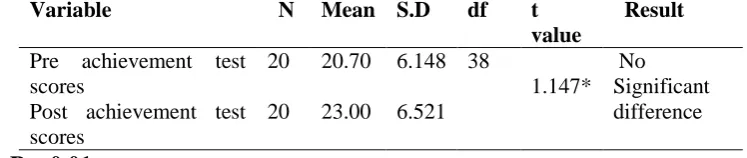
Table 2 represents that the pre and post mean score of achievement taught through
Conventional teaching is 20.70 and 23.00 respectively. Calculated t value is 1.14, which is
less than the table value 2.71. Therefore, the null hypothesis that there is no significant
difference in the score of pre test and post test of achievement taught through conventional
method is accepted. Henceforth, it can be concluded that the student’s achievement did not
saw any significant difference in the pre and post phase of conventional teaching.
3. There is no significant difference in the pre achievement test scores of students
[image:5.595.94.489.95.255.2]taught by Constructivist trained and Conventional approach teachers.
Table 3: Pre Achievement Mean scores of Conventional and Constructivist
group
Variable Compared
group of
students
N
Mean S.D df t
value
Result
Achievement
Pre test
scores
Conventional 20 20.70 6.148 38 0.188* No
Significant difference
Constructivist 20 20.35 5.556
Note: * p ˂ 0.01
Chart 3: Pre Achievement Mean scores of Conventional and Constructivist
group
0 5 10 15 20 25
Mean S.D
Pre achievement test scores
Post achievement test scores
0 10 20 30 40
Mean scores on Achievement test
Standard deviation score on Achievement test
Conventional group
[image:5.595.71.499.455.747.2]Copyright © 2017, Scholarly Research Journal for Interdisciplinary Studies
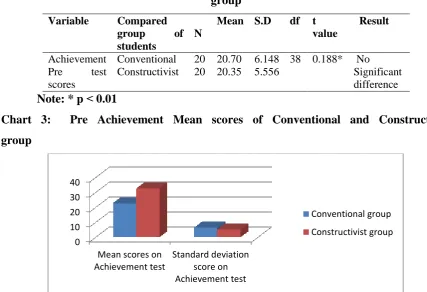
Table 3 depicts that the pre mean score of achievement taught through Conventional teaching
and Constructivist teaching is 20.70 and 20.35 respectively. Calculated t value is 0.188,
which is less than the table value 2.71. Therefore, the null hypothesis that there is no
significant difference in the mean score of achievement of pre test score of control and
experimental group is accepted. Henceforth, it can be concluded that the student’s
achievement did not saw any significant difference in the pre phase scores of conventional
and constructivist teaching.
4. There is no significant difference in the post achievement test scores of students
[image:6.595.75.511.235.564.2]taught by Constructivist trained and Conventional approach teachers.
Table 4: Post Achievement Mean scores of Conventional and Constructivist group
Variable Compared
group
N Mean S.D df t
value
Result
Achievement
post test
scores
Conventional 20 23.00 6.521 38
5.139*
Significant difference
Constructivist 20 32.75 5.428
Note: * p ˃ 0.01
Chart 4: Post Achievement Mean scores of Conventional and Constructivist Group
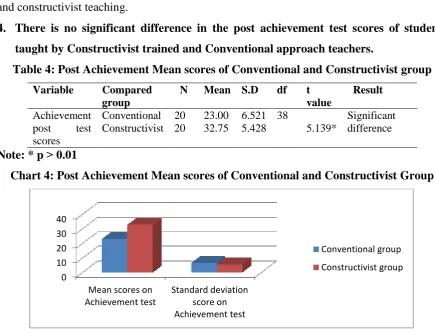
Table 4 represents that the post mean score of achievement taught through Conventional
teaching and Constructivist teaching is 23.00 and 32.75 respectively. Calculated t value is
5.139, which is more than the table value 2.71. Therefore, the null hypothesis that there is no
significant difference in the mean score of achievement of post test score of control and
experimental group is rejected. Henceforth, it can be concluded that the student’s
achievement saw significant difference in the post phase scores of conventional and
constructivist teaching.
0 10 20 30 40
Mean scores on Achievement test
Standard deviation score on Achievement test
Conventional group
Copyright © 2017, Scholarly Research Journal for Interdisciplinary Studies 7. Conclusion
From the above findings, it can be concluded that the teacher’s undergone constructivist
training approach brought a significant upgradation in the academic achievement of the
students.It would not be wrong to say that the Constructivist training has helped the teachers
in enhancing their teaching skills, which result in the improvement of achievement scores of
the students. It has also been found that conventional approach teachers student perform low
on achievement test as compared toconstructivist trained teacher.
Hence, it can be rightly said that if the teachers are trained with Constructivist teaching
approach, there can be significant increase in the academic level of the students.After the
outcomes of this research, the researcher wants to suggest that the government should take
initiatives towards this purpose of initiating the teacher’s growth by organising refresher
courses of such kind.The purpose of teaching-learning ie.the overall development of the
students can only be achieved, if the teachers are fully equipped. If teachers are trained with
today’s pace of development in education, student’s growth in academics will be inevitable.
8. References
National Curriculum Framework – 2005, NCERT, New Delhi. NCERT Text books For Classes VI in Social Science.
Naik, G. Pandu -2007 HRD Solutions for Excellence Training and development, Text, Research and cases, Excel book, First Edition, New Delhi.
Rodwell J.(1988) ‘ Activity- Based Training Design’, Tj International Ltd, Padstow, Cornwall. Best B.(2009) Secondary Teacher’s Pocketbook.
Ayaz, Mehmet Fatih; Sekerci, Hanifi. (2015). The Effects of the Constructivist Learning Approach on Student's Academic Achievement: A Meta-Analysis Study,TOJET, Vol.14 (4), 143-156. Uwalaka, A. J.; Offorma, G. C.(2015). Effect of Constructivist Teaching Method on Students'
Achievement in French Listening Comprehension in Owerri North LGA of Imo State, Nigeria,Journal of Education and Practice, Vol. 6 (26), 52-56.
Asha, Intisar K.; Al Hawi, Asma M. (2016). TheImpact of Cooperative Learning on Developing the Sixth Grade Students Decision-Making Skill and Academic Achievement,Journal of Education and Practice, Vol.7 (10), 60-70.