S T U D Y P R O T O C O L
Open Access
Stimulant Reduction Intervention using Dosed
Exercise (STRIDE) - CTN 0037: Study protocol for a
randomized controlled trial
Madhukar H Trivedi
1*, Tracy L Greer
1, Bruce D Grannemann
1, Timothy S Church
2, Eugene Somoza
3,
Steven N Blair
4,5, Jose Szapocznik
6, Mark Stoutenberg
6, Chad Rethorst
1, Diane Warden
1, Kolette M Ring
1,
Robrina Walker
1, David W Morris
1, Andrzej S Kosinski
7, Tiffany Kyle
8, Bess Marcus
9, Becca Crowell
10, Neal Oden
11and Edward Nunes
12Abstract
Background:There is a need for novel approaches to the treatment of stimulant abuse and dependence. Clinical data examining the use of exercise as a treatment for the abuse of nicotine, alcohol, and other substances suggest that exercise may be a beneficial treatment for stimulant abuse, with direct effects on decreased use and craving. In addition, exercise has the potential to improve other health domains that may be adversely affected by
stimulant use or its treatment, such as sleep disturbance, cognitive function, mood, weight gain, quality of life, and anhedonia, since it has been shown to improve many of these domains in a number of other clinical disorders. Furthermore, neurobiological evidence provides plausible mechanisms by which exercise could positively affect treatment outcomes. The current manuscript presents the rationale, design considerations, and study design of the National Institute on Drug Abuse (NIDA) Clinical Trials Network (CTN) CTN-0037 Stimulant Reduction Intervention using Dosed Exercise (STRIDE) study.
Methods/Design:STRIDE is a multisite randomized clinical trial that compares exercise to health education as potential treatments for stimulant abuse or dependence. This study will evaluate individuals diagnosed with stimulant abuse or dependence who are receiving treatment in a residential setting. Three hundred and thirty eligible and interested participants who provide informed consent will be randomized to one of two treatment arms: Vigorous Intensity High Dose Exercise Augmentation (DEI) or Health Education Intervention Augmentation (HEI). Both groups will receive TAU (i.e., usual care). The treatment arms are structured such that the quantity of visits is similar to allow for equivalent contact between groups. In both arms, participants will begin with supervised sessions 3 times per week during the 12-week acute phase of the study. Supervised sessions will be conducted as one-on-one (i.e., individual) sessions, although other participants may be exercising at the same time. Following the 12-week acute phase, participants will begin a 6-month continuation phase during which time they will attend one weekly supervised DEI or HEI session.
Clinical Trials Registry:ClinicalTrials.gov, NCT01141608
http://clinicaltrials.gov/ct2/show/NCT01141608?term=Stimulant+Reduction+Intervention+using+Dosed +Exercise&rank=1
Keywords:stimulant abuse, stimulant dependence, exercise, health education, behavioral intervention
* Correspondence: [email protected]
1
The University of Texas Southwestern Medical Center at Dallas, 5323 Harry Hines Blvd., Dallas, Texas, 75390-9119, USA
Full list of author information is available at the end of the article
Background
There is a need for novel approaches to the treatment of stimulant use disorders. Stimulant use disorders are chronic, relapsing illnesses with few highly efficacious treatments [1]. In control conditions (Treatment as Usual; TAU) for substance use disorders, typically only about 13% of participants achieve abstinence [1]. Abstinence rates for treatments designed to augment TAU vary widely - ranging from 14-60%[2-5] - depending on the outcome variable and primary endpoint selected. Currently, the best treatments for cocaine and other stimulant use disorders are behavioral treatments that combine cognitive beha-vioral therapy (CBT) with contingency management [1,6]. However, it is clear that new treatments are still needed for stimulant abuse and dependence.
Exercise is a promising new treatment option for stimu-lant abuse and dependence. Randomized controlled trials examining exercise to improve outcomes in smoking ces-sation provide some of the most convincing support for investigating the use of exercise (and most frequently, vigorous intensity exercise) to improve outcomes in stimu-lant abuse [7-11]. While randomized controlled trials in patients abusing substances other than tobacco or alcohol are not yet available, some studies report benefits such as increased abstinence and reduced substance use that are associated with the use of exercise [12-14]. Furthermore, in a post hoc analysis of data from 187 participants in two randomized trials evaluating contingency management for the treatment of substance abuse disorders [15,16], partici-pants who reported engaging in exercise-related activities had an increased length of abstinence [17]. In a recent pilot study of moderate-intensity aerobic exercise added to treatment for 16 individuals with substance dependence, percent days abstinent significantly increased from base-line, and 66.7% of the sample had been continuously absti-nent at the end of a 12-week intervention [18].
Exercise may also provide additional health benefits and functional improvements for stimulant users. Exer-cise has been shown to reduce depression and anxiety during alcohol treatment [19-21], as well as smoking ces-sation treatment [22-24]. Exercise is also associated with improved quality of life [25] and sleep [26], both of which are disrupted by stimulant use even after absti-nence is achieved [27,28]. In addition, concern about weight gain following cessation of abused substances may increase risk of substance use relapse [29-31], and regular exercise may prevent or reduce post cessation weight gain. Furthermore, Greenwood et al. [32] has demon-strated improvements in hippocampal-dependent contex-tual learning and memory in rats with exercise. Similar results have been found for exercise-induced hippocam-pal neurogenesis and improvements in spatial memory in rats and mice [33-35]. Since substance abuse has been
associated with memory impairments that are influenced by hippocampal function [36], exercise may be associated with improved memory for these individuals.
Exercise may improve outcomes through any of several possible mechanisms. Exercise is likely to impact the underlying biology of addicted persons, as well as act as a behavioral treatment intervention. Summarizing studies of the effect of exercise on neurotransmitters [37] con-clude that exercise results in changes in synthesis and metabolism within central dopaminergic, noradrenergic, and serotonergic systems, all of which are implicated in addiction. Additional biological effects of exercise may include decreased reactivity to stress [38] and decreased use of substances as a way of coping with stress [39]. Exercise-induced improvements in self-efficacy [40,41] may be another mechanism for improving outcomes. It has also been suggested that exercise may be a distraction [42], allowing attention to be diverted from urges to use substances [43] or a positive lifestyle change that can substitute for use of substances [44,45].
The current paper provides a description of the design of the Stimulant Reduction Intervention using Dosed Exercise (STRIDE) study, a multisite randomized, con-trolled trial aimed at comparing the augmentation of treatment as usual with either an exercise or health edu-cation intervention in a stimulant abusing population. If exercise is found to improve outcomes for substance use disorders, the public health significance would be substantial. A novel, low cost treatment would be avail-able for substance users that could assist with both acute treatment and reducing long-term relapse.
There were several challenges in the design of such a trial, such as: 1) determining the appropriate comparison group, 2) selecting the appropriate primary outcome, and 3) selecting the appropriate setting for the conduct of the study. These challenges were enhanced by the fact that there are no standardized designs that have focused on how best to assess the effects of augmentation treatments, particularly those that take into account patients’ transi-tion from residential to intensive outpatient and longer term treatment. This problem is compounded by the fact that there is no agreed upon single outcome to best assess the effectiveness of a treatment for stimulant abuse [46]. This manuscript provides a general description of the STRIDE trial and how the particular issues associated with this type of study were addressed.
Methods/Design Overview
methamphetamine, amphetamine or other stimulant, except caffeine or nicotine, as defined by the Diagnostic and Statistical Manual of Mental Disorders, Fourth Edition, Text Revision [DSM-IV-TR]) who are receiving treatment in a residential setting. Three hundred and thirty eligible and interested participants who provide informed consent will be randomized to one of two treatment arms: Vigorous Intensity High Dose Exercise Augmentation (DEI) or Health Education Intervention Augmentation (HEI). Both groups will receive TAU (i.e., usual care). The study intervention begins while partici-pants are receiving treatment in a program with a resi-dential stay. The treatment arms are structured such that the quantity of visits is similar to allow for equiva-lent contact between groups. In both arms, participants will begin with supervised sessions 3 times per week during the 12-week acute phase of the study. Supervised sessions will be conducted as one-on-one (i.e., indivi-dual) sessions, although other participants may be exer-cising at the same time. Following the 12-week acute phase, participants will begin a 6-month continuation phase during which time they will attend one weekly supervised DEI or HEI session. The study design is dis-played in Figure 1. A Data and Safety Monitoring Board assembled by NIDA approved the final study design and will be providing ongoing monitoring throughout imple-mentation of the trial.
Study Sites
This study is being conducted on the National Drug Abuse Treatment Clinical Trials Network (CTN). Partici-pating sites are CTN Community Treatment Programs (CTPs) meeting site characteristics identified based on the requirements of the study protocol [47]. Each site is partnered with a Regional Research and Training Center (RRTC), an academic institution led by a substance use researcher. The RRTC helps guide the conduct of the study at the site. The site characteristics include: 1) a treatment program with a residential component and length of stay generally between 21 and 30 days; 2) no formal exercise program that includes more than an hour a week of exercise, or willingness to exclude participants from the program; 3) availability of community outpati-ent treatmoutpati-ent at or near the residoutpati-ential setting where the study is located so that it is feasible for participants to return to the study site to complete study activities for the full 9 months of the study; 4) a sufficient number of clients admitted to residential treatment per month who might be eligible to participate in the study; and 5) ade-quate space to accommodate study staff and activities. Sites were selected in two groups based on survey responses, phone interviews, and site visits. Four Wave 1 sites were identified and approved to begin the study about 6 months earlier than the five Wave 2 sites. This
model allows for early identification and resolution of any operational issues in the conduct of the study.
Aims
The primary aim of STRIDE is to compare percent days of abstinence between the DEI and HEI groups based on stimulant use during the 12-week acute phase. It is hypothesized that DEI will be associated with signifi-cantly greater (p< 0.05) percent days of abstinence than HEI as measured by a corrected Timeline Followback. Timeline Followback (TLFB)[48,49] is collected as described by Sobell and with the aid of a Substance Use Diary. Additionally, a urine drug screen is collected three times per week to improve the accuracy of and correct the self-report data from the TLFB at the time of data analysis based on an algorithm [50].
Secondary aims of STRIDE are: 1) to compare time to relapse (defined as second positive urine test [for stimu-lants] and use of drugs (assessed via TLFB) between the DEI and HEI groups; 2) to evaluate withdrawal symptoms between the DEI and HEI groups; 3) to evaluate drug use and related outcomes for other substances (categorized as alcohol, cannabinoids, nicotine, opioids, or sedative/ hypnotic/anxiolytics); 4) to compare time to dropout from substance abuse treatment between the DEI and HEI groups; 5) to evaluate drug use and related outcomes during the entire course of the study (i.e., randomization to 9 months). Finally, as an exploratory aim, we will attempt to determine if there are additional health bene-fits to using exercise augmentation in the treatment of substance use disorders. Specifically, we will examine the effects of exercise augmentation on sleep, cognitive func-tion, mood, quality of life, anhedonia, and weight gain compared to HEI over the course of the 12-week acute phase and over the 9-month study period.
Eligibility Criteria
that contraindicate exercise, opiate dependence, psycho-sis, or other psychiatric issue(s) that poses a safety risk, pregnancy, or concomitant treatment with beta blockers or opioid replacement therapy (e.g., methadone or bupenorphine).
Exercise Intervention Intervention Overview
Participants in DEI will perform their exercise sessions on a Life Fitness 95T-seriesTreadmill (Schiller Park, IL). Prescribed exercise doses and intensities will be ramped over the initial 3 weeks of the study to allow for a gradual familiarization to the study protocol and the accompany-ing physical demands (see Table 1). Exercise intensity will be based on a percentage of the maximum heart rate (HR) achieved during the baseline maximal exercise test. The 12 kilocalories*kilogram of bodyweight-1* week-1 (KKW) weekly exercise dose was chosen to approximate public health dose guidelines http://www.health.gov/ paguidelines (i.e., approximately 30-50 min, 3-5 days per
week). Participants will be scheduled to complete their weekly exercise dose over three exercise sessions. How-ever, additional exercise sessions can be scheduled for those needing more than three sessions per week to achieve their target dose.
Exercise Sessions
[image:4.595.57.542.88.476.2]During the supervised exercise sessions, participants will perform an active warm-up for 5 minutes prior to initia-tion of the exercise prescripinitia-tion. Polar RS 400 HR moni-tors (Kempele, Finland) will be used to continuously monitor participants’ heart rate (HR) throughout the
Figure 1STRIDE Design Schematic.
Table 1 Ramping Schedule for Exercise Dose and Intensity
Week No. Exercise Dose (KKW)
Exercise Intensity (% HRmax)
1 6 50 - 60
2 9 60 - 70
[image:4.595.305.539.669.731.2]exercise session to ensure that they are within their tar-get HR zone (i.e., 70-85% of an individual’s HRmax).
Typically, participants can achieve a HR of 70-85% by either walking briskly at an incline or by running at zero incline. The speed and/or grade of the treadmill will be continually adjusted to maintain participant HR within the target HR zone while allowing the partici-pants some flexibility in customizing their exercise ses-sion. A global Rating of Perceived Exertion (RPE), assessed using Borg’s RPE scale, will be taken at the conclusion of each exercise session. At the completion of the exercise session, participants will perform an active cool down (0 grade and 50-70% of speed) until their HR returns to within 15% of their resting value. Participants will then be led through a 5-10 minute stretching routine.
During the continuation phase, participants will com-plete one supervised exercise session per week at the CTP exercise facility with the remainder of their exercise dose to be completed in unsupervised exercise sessions. Exercise Facilitators will aid the participant in identifying a safe location for completing their unsupervised sessions, scheduling these sessions, and planning other practical concerns related to engaging in exercise during the continuation phase. Participants will also receive assistance in developing measured exercise courses to allow for estimates of time and distance covered at each unsupervised session. Participants will record a global RPE score at the end of each unsupervised exercise session.
Exercise Safety
Those who are not safe to exercise, including those with greater than Stage 1 hypertension will not be rando-mized. Prior to each exercise session, participants will sit undisturbed for 5 minutes before assessment of their resting heart rate and blood pressure (BP). If a partici-pant’s resting HR is≥100, it will be re-measured after an additional 5-minute rest period. If a participant’s resting HR remains≥100, the exercise session will be resched-uled for another day. Likewise, if a participant’s resting BP is≥160/100, it will be re-measured after an additional 5-minute rest period. If a participant’s resting BP remains
≥160/100, the exercise session will be rescheduled for another day. During the session, BP will be assessed after 5 minutes to monitor for adverse responses to the onset of the exercise. BP will continue to be monitored if an exaggerated acute response is observed (i.e., SBP > 200 mmHg). The exercise session will be halted if an extreme BP response (SBP > 250 mmHg or remains unchanged despite an increase in workload, or DBP increase > 15 mmHg) is observed. Following the cool down, a final BP will be taken before the participant is cleared to leave the facility. Guidelines are also present for referral to
appropriate medical care and additional physician clear-ance based on blood pressure readings.
Health Education Intervention
The health education intervention is structured to provide equivalent contact time to that of the exercise intervention. During the acute phase, participants will complete three supervised sessions per week. Visits will be weekly during the continuation phase. During HEI sessions participants will view educational items such as didactic presentations, readings, Web sites, and audio or video materials. Instruc-tional topics include areas such as healthy eating, preven-tive health care and recommended health screenings, accessing health care resources, and other health-related topics that are relevant to adults with substance use disor-ders. Exercise and topics central to substance use treatment (e.g., coping with cravings, relapse prevention) are not included to prevent intervention contamination and not change TAU, respectively. Participants will be encouraged to suggest topics of interest to help maintain their involve-ment and engageinvolve-ment in the sessions throughout the dura-tion of the study. The HEI program is modeled after similar programs that have been used successfully as control groups in clinical trials examining exercise as an intervention [7,52,53].
Behavioral Adherence Program
sessions and are able to continue using the Web site dur-ing home-based sessions if they have access to the Internet.
Study Assessments
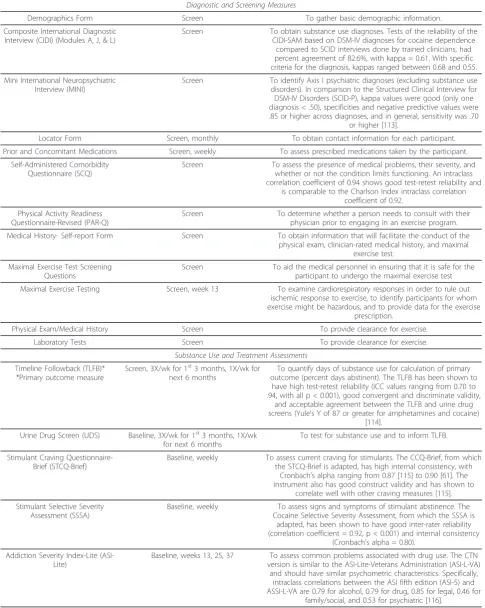
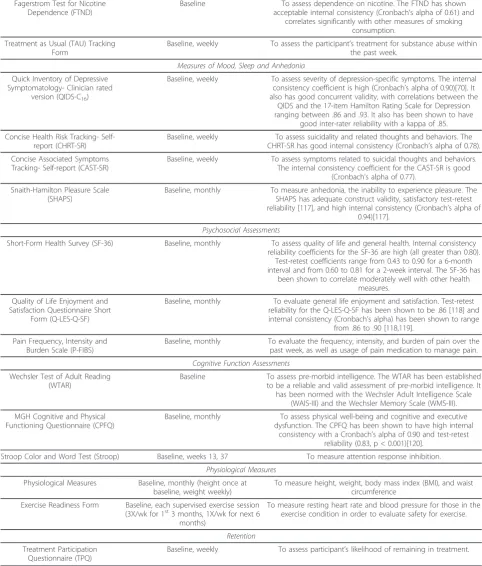
Table 2 summarizes the assessments used throughout the study, their main purpose, their frequency of admin-istration, and psychometric properties if available.
Diagnostic and Screening Assessments
At screening, standard demographic information will be collected from all participants (e.g., gender, race, ethnicity, etc.). Contact information will be obtained and updated monthly and additionally as needed. DSM-IV-TR alcohol and substance abuse and dependence will be assessed with the substance use modules of the World Health Organiza-tion (WHO) Composite InternaOrganiza-tional Diagnostic Interview (CIDI) (Version 2.1)[55,56]. Additional DSM-IV Axis I diagnostic information will be obtained using the MINI International Neuropsychiatric Interview (MINI)[57].
Medical Evaluation
Medical history will be obtained using a self-report medi-cal history form designed to collect information about his-tory and/or treatment of medical conditions, such as heart disease, high blood pressure, diabetes, and cancer. The form also assesses allergies, past surgeries, tobacco and alcohol use, family history of medical conditions, medical symptoms over the past 30 days, and prior and concomi-tant medications. Additionally, participants will complete the Self-Administered Comorbidity Questionnaire (SCQ) [58] and the Physical Activity Readiness Questionnaire (PAR-Q)[59]. Medical personnel will conduct a medical history and physical exam, and laboratory tests (chemistry, hematology, lipid profile, and urinalysis) will be obtained as part of the medical screening process.
Maximal exercise testing will be conducted during the screening process to examine cardiorespiratory responses in order to rule out ischemic response to exercise (with its implications of cardiovascular disease), to identify par-ticipants for whom exercise might be hazardous, and to provide data for the exercise prescription. The test will be repeated at the end of the 12-week acute phase (or during an early termination visit). A trained technician will process the test data and a report will be generated that contains the following information: 1) participant’s symptoms before, during, and after testing; 2) maximal heart rate achieved and percent of predicted maximal heart rate achieved; 3) time on treadmill and estimated maximal metabolic equivalent (METS) achieved; and 4) ECG interpretation. A designated medical staff member will be responsible for reviewing the participant’s medical history and evaluating results from the medical exam, maximal testing, and lab results to determine whether or not the participant is medically cleared to exercise.
Eligible participants complete a comprehensive base-line assessment. Since there are numerous basebase-line assessments, these may be distributed over more than one day if necessary. The frequency and type of ongoing assessments are equivalent in both groups, with the exception of blood pressure and heart rate obtained for exercise participants prior to every supervised exercise session. Descriptions of ongoing study assessments are described by category below (as well as in Table 2).
Substance Use and Treatment Assessments
The Timeline Followback [48,49] and Substance Use Diary (SUD) will be used to acquire information on alco-hol and drug use, including cocaine and other stimulants. The TLFB is a semi-structured interview that uses a calendar to prompt participants to provide retrospective estimates of their daily drug use over a specified period of time that can vary up to 12 months before the inter-view date. The measure provides prompts to facilitate accurate recollection of use behavior. The SUD, a pocket calendar given to participants at the beginning of the study to prospectively record substance use, will assist with accurate recall when completing the TLFB at each study visit.
Qualitative urine drug screens (UDS) will be conducted at baseline, three times a week in the first 12 weeks, and once a week in the subsequent 6 months. The screen will test for the following substances: marijuana, cocaine, opi-ates, amphetamine, methamphetamine, benzodiazepines, barbiturates, methadone, methylenedioxymethampheta-mine (MDMA, Ecstasy), and oxycodone. UDSs will also be used to corroborate information on the TLFB.
The Addiction Severity Index-Lite (ASI-Lite) will be administered by research staff to examine multiple domains that are commonly affected by substance use, including medical, employment/self-support, alcohol/drug use, legal status, family/social, and psychiatric status [60]. Stimulant craving (cocaine, methamphetamine, and other stimulants) will be assessed using the Stimulant Craving Questionnaire-Brief (STCQ-Brief; adapted from Sussner et al. [61] and derived from the 10-item Cocaine Craving Questionnaire-Brief and the original 46-item Cocaine Craving Questionnaire-Now [62]). Signs and symptoms of stimulant (cocaine, methamphetamine, and other stimu-lants) abstinence will be evaluated using the Stimulant Selective Severity Assessment (SSSA; adapted from Kamp-man et al. [63]). Baseline nicotine dependence will be eval-uated using the Fagerstrom Test for Nicotine Dependence (FTND)[64,65] and number of cigarettes smoked per day will be captured on the TLFB.
Mood and Functional Measures
Table 2 STRIDE Assessments
Assessment Frequency Purpose and Psychometrics
Diagnostic and Screening Measures
Demographics Form Screen To gather basic demographic information.
Composite International Diagnostic Interview (CIDI) (Modules A, J, & L)
Screen To obtain substance use diagnoses. Tests of the reliability of the CIDI-SAM based on DSM-IV diagnoses for cocaine dependence
compared to SCID interviews done by trained clinicians, had percent agreement of 82.6%, with kappa = 0.61. With specific criteria for the diagnosis, kappas ranged between 0.68 and 0.55.
Mini International Neuropsychiatric Interview (MINI)
Screen To identify Axis I psychiatric diagnoses (excluding substance use disorders). In comparison to the Structured Clinical Interview for DSM-IV Disorders (SCID-P), kappa values were good (only one diagnosis < .50), specificities and negative predictive values were .85 or higher across diagnoses, and in general, sensitivity was .70
or higher [113].
Locator Form Screen, monthly To obtain contact information for each participant.
Prior and Concomitant Medications Screen, weekly To assess prescribed medications taken by the participant.
Self-Administered Comorbidity Questionnaire (SCQ)
Screen To assess the presence of medical problems, their severity, and whether or not the condition limits functioning. An intraclass correlation coefficient of 0.94 shows good test-retest reliability and
is comparable to the Charlson Index intraclass correlation coefficient of 0.92.
Physical Activity Readiness Questionnaire-Revised (PAR-Q)
Screen To determine whether a person needs to consult with their physician prior to engaging in an exercise program.
Medical History- Self-report Form Screen To obtain information that will facilitate the conduct of the physical exam, clinician-rated medical history, and maximal
exercise test.
Maximal Exercise Test Screening Questions
Screen To aid the medical personnel in ensuring that it is safe for the participant to undergo the maximal exercise test
Maximal Exercise Testing Screen, week 13 To examine cardiorespiratory responses in order to rule out ischemic response to exercise, to identify participants for whom exercise might be hazardous, and to provide data for the exercise
prescription.
Physical Exam/Medical History Screen To provide clearance for exercise.
Laboratory Tests Screen To provide clearance for exercise.
Substance Use and Treatment Assessments
Timeline Followback (TLFB)* *Primary outcome measure
Screen, 3X/wk for 1st3 months, 1X/wk for
next 6 months
To quantify days of substance use for calculation of primary outcome (percent days abstinent). The TLFB has been shown to
have high test-retest reliability (ICC values ranging from 0.70 to .94, with all p < 0.001), good convergent and discriminate validity,
and acceptable agreement between the TLFB and urine drug screens (Yule’s Y of 87 or greater for amphetamines and cocaine)
[114].
Urine Drug Screen (UDS) Baseline, 3X/wk for 1st3 months, 1X/wk
for next 6 months
To test for substance use and to inform TLFB.
Stimulant Craving Questionnaire-Brief (STCQ-Questionnaire-Brief)
Baseline, weekly To assess current craving for stimulants. The CCQ-Brief, from which the STCQ-Brief is adapted, has high internal consistency, with
Cronbach’s alpha ranging from 0.87 [115] to 0.90 [61]. The instrument also has good construct validity and has shown to
correlate well with other craving measures [115].
Stimulant Selective Severity Assessment (SSSA)
Baseline, weekly To assess signs and symptoms of stimulant abstinence. The Cocaine Selective Severity Assessment, from which the SSSA is
adapted, has been shown to have good inter-rater reliability (correlation coefficient = 0.92, p < 0.001) and internal consistency
(Cronbach’s alpha = 0.80).
Addiction Severity Index-Lite (ASI-Lite)
Baseline, weeks 13, 25, 37 To assess common problems associated with drug use. The CTN version is similar to the ASI-Lite-Veterans Administration (ASI-L-VA)
and should have similar psychometric characteristics. Specifically, intraclass correlations between the ASI fifth edition (ASI-5) and ASSI-L-VA are 0.79 for alcohol, 0.79 for drug, 0.85 for legal, 0.46 for
Pleasure Scale (SHAPS)[71] will be used to measure anhedonia. Suicidality and related symptoms will be evaluated throughout the study using the Concise
[image:8.595.56.539.106.673.2]Health Risk Tracking - Self-Report (CHRT-SR), and the Concise Associated Symptoms Tracking - Self-Report (CAST-SR).
Table 2 STRIDE Assessments(Continued)
Fagerstrom Test for Nicotine Dependence (FTND)
Baseline To assess dependence on nicotine. The FTND has shown acceptable internal consistency (Cronbach’s alpha of 0.61) and
correlates significantly with other measures of smoking consumption.
Treatment as Usual (TAU) Tracking Form
Baseline, weekly To assess the participant’s treatment for substance abuse within the past week.
Measures of Mood, Sleep and Anhedonia
Quick Inventory of Depressive Symptomatology- Clinician rated
version (QIDS-C16)
Baseline, weekly To assess severity of depression-specific symptoms. The internal consistency coefficient is high (Cronbach’s alpha of 0.90)[70]. It also has good concurrent validity, with correlations between the
QIDS and the 17-item Hamilton Rating Scale for Depression ranging between .86 and .93. It also has been shown to have
good inter-rater reliability with a kappa of .85.
Concise Health Risk Tracking- Self-report (CHRT-SR)
Baseline, weekly To assess suicidality and related thoughts and behaviors. The CHRT-SR has good internal consistency (Cronbach’s alpha of 0.78).
Concise Associated Symptoms Tracking- Self-report (CAST-SR)
Baseline, weekly To assess symptoms related to suicidal thoughts and behaviors. The internal consistency coefficient for the CAST-SR is good
(Cronbach’s alpha of 0.77).
Snaith-Hamilton Pleasure Scale (SHAPS)
Baseline, monthly To measure anhedonia, the inability to experience pleasure. The SHAPS has adequate construct validity, satisfactory test-retest reliability [117], and high internal consistency (Cronbach’s alpha of
0.94)[117].
Psychosocial Assessments
Short-Form Health Survey (SF-36) Baseline, monthly To assess quality of life and general health. Internal consistency reliability coefficients for the SF-36 are high (all greater than 0.80).
Test-retest coefficients range from 0.43 to 0.90 for a 6-month interval and from 0.60 to 0.81 for a 2-week interval. The SF-36 has
been shown to correlate moderately well with other health measures.
Quality of Life Enjoyment and Satisfaction Questionnaire Short
Form (Q-LES-Q-SF)
Baseline, monthly To evaluate general life enjoyment and satisfaction. Test-retest reliability for the Q-LES-Q-SF has been shown to be .86 [118] and internal consistency (Cronbach’s alpha) has been shown to range
from .86 to .90 [118,119].
Pain Frequency, Intensity and Burden Scale (P-FIBS)
Baseline, monthly To evaluate the frequency, intensity, and burden of pain over the past week, as well as usage of pain medication to manage pain.
Cognitive Function Assessments
Wechsler Test of Adult Reading (WTAR)
Baseline To assess pre-morbid intelligence. The WTAR has been established to be a reliable and valid assessment of pre-morbid intelligence. It
has been normed with the Wechsler Adult Intelligence Scale (WAIS-III) and the Wechsler Memory Scale (WMS-III).
MGH Cognitive and Physical Functioning Questionnaire (CPFQ)
Baseline, monthly To assess physical well-being and cognitive and executive dysfunction. The CPFQ has been shown to have high internal
consistency with a Cronbach’s alpha of 0.90 and test-retest reliability (0.83, p < 0.001)[120].
Stroop Color and Word Test (Stroop) Baseline, weeks 13, 37 To measure attention response inhibition.
Physiological Measures
Physiological Measures Baseline, monthly (height once at baseline, weight weekly)
To measure height, weight, body mass index (BMI), and waist circumference
Exercise Readiness Form Baseline, each supervised exercise session (3X/wk for 1st3 months, 1X/wk for next 6
months)
To measure resting heart rate and blood pressure for those in the exercise condition in order to evaluate safety for exercise.
Retention
Treatment Participation Questionnaire (TPQ)
Psychosocial assessments will include the Quality of Life Enjoyment and Satisfaction Questionnaire Short Form (Q-LES-Q-SF [72]), the Short-Form Health Survey (SF-36 [73,74]), and the Pain Frequency, Intensity and Burden Scale (P-FIBS). Assessments of cognitive func-tion will include the Stroop Color and Word Test [75,76], a measure of attention response inhibition, and the MGH Cognitive and Physical Functioning Question-naire (CPFQ [77]), a measure of subjective cognitive function. The Wechsler Test of Adult Reading (WTAR [78]) will be administered at baseline to assess premor-bid intelligence.
Fitness and Physiological Measures
Physiological measures include height, weight, body mass index (BMI), and waist circumference. For those partici-pants in the exercise intervention, resting heart rate and blood pressure will be obtained prior to each exercise session using the Exercise Readiness Form in order to evaluate safety to exercise. Resting heart rate and blood pressure will be obtained for all participants during the maximal exercise test. The maximal exercise will be repeated at week 13 to assess change in fitness.
Retention
The Treatment Participation Questionnaire (TPQ), a five-item self-report that assesses the participant’s likelihood of remaining in treatment for substance abuse and continu-ing to attend study visits, will be administered at baseline and then weekly thereafter. Since this study is designed as an intent-to-treat study, subjects will be encouraged to complete assessments regardless of their status in their treatment programs or their engagement in the study intervention.
Analytic Methods
The primary analysis will compare the primary outcome between the two treatments taking into account possible variability in the overall level of abstinence between sites. More specifically, we use a mixed normal model with a fixed treatment effect and random terms for site and error. The model considers treatment effect to be the same in each site. P-value less than 0.05 will be considered statistically significant. The assumed treatment effect
μVIHD-μHECis 0.15. The error standard deviationsis
con-sidered to be in the range between 0.40 and 0.45, and abstinence status within participant is assumed to be cor-related across days. The primary endpoint will be analyzed on an intent-to-treat basis, meaning that participants’data will be analyzed according to the group they were rando-mized to, regardless of the subsequent sequence of events (e.g., noncompliance to the intervention).
Even though the overall level of outcome may differ across sites (i.e.ssite> 0), the primary analysis removes this variation by adjusting for site in the model. Hence, initial sample size computations are based on value of error standard deviationsand the sample size estimates
are based on a two sample t-test formula. A treatment effect that varies across sites may contribute additional variation and simulations with primary analysis per-formed for each simulation were used to investigate this possibility. Based on these simulations, and as an addi-tional precaution, we increased initial sample size by 10% to attempt to take into consideration potential treatment effect variability. Based on these considerations, we proposed the trial to enroll 330 participants. Clearly, the proposed sample size depends on accurate estimation of variability s. We propose to reassess this variability midway through the study, i.e., after approximately 165 participants have enrolled and completed the acute phase of the trial, and may readjust needed sample size if the variance assumption proves incorrect.
Rationale for Key Study Design Choices Population
For this study, we chose to specifically evaluate individuals with stimulant abuse or dependence. This decision was made in order to reduce heterogeneity of the sample with respect to drug use, since this is an early efficacy trial with a new intervention in a substance using population.
Setting
This study is designed to start while participants are in a residential setting and continues as participants transition into outpatient and other community care. Starting treat-ment in the residential setting was chosen to maximize the availability of participants to be present for the initial evaluation and training of the exercise intervention. Given the dose and intensity of exercise selected for this study, it is critical that participants be consistent in attending supervised sessions, particularly as they are first learning how to implement the exercise protocol, how to use all related equipment, and how to collect and record all exer-cise-related data. A transition to outpatient care is a typical occurrence in the treatment of substance use disorders. This study is designed to evaluate participants as they transition to the next phase of care. While the decision to begin in a residential setting could result in somewhat less generalizability of findings, since this is an early efficacy study, we determined that it was more important to ensure that our study population was present to receive sufficient training and supervision in the exercise interven-tion and to maximize adherence during this time.
Study Duration
Exercise Intervention
One of the major hurdles in successfully conducting exercise trials has been the inconsistency of type, dose, and intensity of exercise achieved. We elected to define exercise type, dose and intensity in this study to mini-mize variability and to achieve pre-specified targets for both dose and intensity.
Type
We selected the use of aerobic exercise in this trial. While there is some evidence that other types of exer-cise (e.g., weight training) may be beneficial to indivi-duals with other disorders, such as depression, the preponderance of existing evidence supports the use of aerobic exercise. Furthermore, aerobic exercise has been used in previous interventions involving substance abuse disorders [7-11,18].
Dose
A 12 KKW dose of exercise was selected for this study for the following reasons: 1) it is consistent with U.S. 2008 Physical Activity Guidelines http://www.health.gov/ paguidelines, as well as prior recommendations from groups such as the Centers for Disease Control and Pre-vention and ACSM [79-83], the NIH Consensus panel [45,79,80,82-86], and the U.S. Surgeon General (U.S. Department of Health and Human Services [87]); 2) it has been used in previous studies involving physical activity interventions in smokers [7,9], and in other disor-ders such as depression [54,88-91], it is consistent with doses associated with biological changes that we hypothesize will impact stimulant use such as alterations of the serotonergic [92-94] and endocannabinoid systems [95], attenuated stress responses [96,97], and increases in release of BDNF [98].
Intensity
An intensity range of 70-85% of an individual’s HRmaxwas
selected for this study. This intensity is above the sug-gested minimum intensity of 50% of HRmaxand within the
currently recommended training intensity guidelines for producing physiological adaptations and benefits [51]. Although higher exercise intensities may produce greater changes in outcomes at a constant dose, for this efficacy trial we want to be certain that we are well within standard exercising ranges for both dose and intensity. By selecting a range of 70-85% of HRmax, we have allowed for some
exercising flexibility to increase comfort, while ensuring that all participants are exercising above the minimum recommended threshold.
Alternatively, we could have allowed participants to select their own exercise intensity (i.e., self-selected intensity based on rating of perceived exertion) as long as they achieved the target dose. While this approach would allow significantly greater flexibility for participants, it would likely lead to greater variations in exercise inten-sity. Another alternative would be to have a fixed exercise
intensity (i.e., 80% HRmax) to maximize the
standardiza-tion of the exercise intervenstandardiza-tion. However, a fixed inten-sity would allow little flexibility for participants to find a comfortable exercise level and may, therefore, result in poor adherence and increased drop-outs.
Frequency
In this study, we recommend that participants complete their prescribed weekly exercise dose over three exercise sessions per week. However, we will allow up to two additional sessions per week in order to accommodate variations in baseline fitness levels. Individuals who are more unfit will have a relatively low caloric expenditure rate when exercising within their relative intensity range (as demonstrated by elevated HRs at low treadmill set-tings). This will require them to exercise for a greater duration to achieve their weekly exercise dose than indi-viduals who have higher baseline fitness levels. For exam-ple, a participant exercising at 70% of their HRmaxmight
require 150 min/week (50 min/session for three sessions/ week) to achieve the 12 KKW dose, whereas a less fit par-ticipant might require 240 min/week to achieve the same 12 KKW dose due to differences in exercise efficiency and their individual responses to exercise. Therefore, it benefits the second participant to divide their exercise dose among four or five sessions, thereby increasing the feasibility of completing each exercise session and achiev-ing the weekly exercise dose.
Control Group
in the control condition, as in the exercise intervention. HEI, as opposed to TAU alone, is also intended to ensure continued participant engagement in the study and thus minimize dropouts that might occur if attention in the two groups were not equivalent. Other possible active con-trol conditions (e.g., resistance training, relaxation, yoga, or meditation) have the potential for efficacy, and in fact some have shown efficacy both in substance use and in other disorders (e.g., depression [101]). Thus, the use of an active comparator would make it difficult to see a treat-ment effect, so these alternative active control conditions are not ideal comparators for an efficacy study of exercise.
Primary Outcome
The rationale for the outcome for the current study design was driven by the desire to provide a meaningful clinical outcome that would allow for the ready comparison of the effectiveness of this treatment. In addition, it was impor-tant that this outcome be suitable for an intent-to-treat study such that all available data could be utilized for ana-lysis. We decided upon an approach that integrates the strengths of multiple measures and allows for data collec-tion over an extended time period [46]. We chose to assess percent days abstinent as measured by self-report using the Timeline Followback. Some studies have shown that this approach has been shown to correlate well with objec-tive measures of use such as urine drug screen [102-104]. Disadvantages of the TLFB include potential inaccuracy due to memory errors and bias and deliberate and denial-based distortions of reported substance use. As a result, two additional tools have been added to the data collection process. The Substance Use Diary, which will aid with recall during the TLFB assessment, has been shown to improve the accuracy of the TLFB [105]. The diary can be completed in real time in between study visits to help par-ticipants maintain an accurate accounting of their usage of stimulants, and will be particularly helpful in situations where missed visits occur that result in greater amounts of time to recall. Finally, to further improve the validity of the TLFB, results will be confirmed with urine drug screens collected 3 times per week and an algorithm will be employed at the time of data analysis to reconcile dis-crepancies between the TLFB and the urine drug screens for the primary outcome.
Choice of the TLFB self-report measure was consis-tent with several elements of our study design. Our study intervention will be conducted over a 9-month period during which time participants will not only tran-sition from residential to outpatient treatment, but they are expected to come to the study site 3 times a week for the first 12 weeks and once a week for the following 24 weeks. Stimulant abusing patients are known to be inconsistent in their attendance at treatment and study visits [1]. This visit schedule therefore poses a serious
challenge to the use of a sole objective measure such as UDS to define abstinent and non-abstinent days and would likely result in considerable missing data. To decrease the potential for missing data due to the short half-life of stimulants, urine drug screens are often obtained 3 times per week, but this frequency of assess-ment would be very difficult to maintain over a 9-month duration. The TLFB, on the other hand, allows for data to be collected on all days, since the interviewer prompts the participant to recall use for all days since the last study visit.
Discussion
The STRIDE study aims to address the need for novel treatments in stimulant use disorders. Studies demon-strating the effectiveness of exercise in the treatment of nicotine dependence and alcohol abuse suggest that exer-cise augmentation of treatment as usual may be effica-cious in increasing abstinence from stimulant use. The potential effects of exercise on the underlying biological mechanisms of stimulant addiction further support the use of exercise in the treatment of stimulant abuse. Finally, exercise may provide additional health benefits. Stimulant use is detrimental to a number of health domains including sleep [106,107], cognitive function [36], and mood [108], while exercise results in improve-ment of sleep quality [26,109], cognitive function [110], and mood [89,94,111,112].
Several study design features help accurately assess the efficacy and effectiveness of exercise augmentation for stimulant abuse and dependence. First, the exercise type, dose, and intensity are precisely defined to reduce varia-bility. In addition, this dose of exercise is congruent with current health recommendations and should be sufficient to alter the hypothesized biological underpinnings of sti-mulant dependence. Second, a comprehensive behavioral intervention program will be implemented to facilitate and monitor adherence to the two interventions. Facilita-tors will provide participants with adherence feedback and support the participant in addressing barriers to adherence. Finally, the use of a health education interven-tion control group will provide balanced facilitator atten-tion across the two intervenatten-tions. Health educaatten-tion groups have proved to be ineffective in previous trials [7,52,53,99], yet demonstrate high levels of adherence and will provide equivalent facilitator contact.
of exercise in the reduction in use of other illicit sub-stances. In addition, new studies that examine the use of exercise during different phases of treatment are needed. For example, exercise may prove to be effective in redu-cing symptoms of withdrawal but not in increasing long-term abstinence, or vice versa. Finally, future stu-dies should aim to identify the biological mechanisms responsible for reductions in substance use.
Acknowledgements and funding
We are particularly grateful to our Protocol Development Team, which guided the STRIDE Study design and includes Steven N. Blair, P.E.D.; Dan G. Blazer, M.D., M.P.H., Ph.D.; Kathleen Brady, M.D., Ph.D.; Timothy Church, M.D., M.P.H., Ph.D.; Tracy L. Greer, Ph.D.; Petra Jacobs, M.D.; Eve Jelstrom, CRNA, M. B.A.; Andrzej Kosinski, Ph.D.; Michael Levy, Ph.D.; Tiffany L. Linkovich Kyle, Ph. D.; David Liu, M.D.; Yuliya Lokhnygina, Ph.D.; Bess H. Marcus, Ph.D.; Edward V. Nunes, M.D.; John P. Rotrosen, M.D.; Jeffrey T. Sharp, M.S.; Eugene Somoza, M.D., Ph.D.; Michele M. Straus, RPh, M.S.; Jose Szapocznik, Ph.D.; Madhukar H. Trivedi, M.D.; Paul Wakim, Ph.D.; and Diane Warden, M.B.A., Ph.D.
We are also greatly appreciative of the RRTC personnel from the Ohio Valley Node and Florida Node of the Clinical Trials Network, who were
instrumental in the development of this trial, sharing valuable knowledge and expertise with this team. We also appreciate the expertise and guidance of the STRIDE Executive Committee which includes Colleen Allen, M.P.H., CCRA; Steven N. Blair, P.E.D.; Jack Chally, M.B.A.; Timothy Church, M.D., M.P.H., Ph.D.; Becca Crowell, M.Ed., Ed.S.; Eve Jelstrom, CRNA, M.B.A.; Tracy L. Greer, Ph.D.; Tiffany L. Linkovich Kyle, Ph.D.; David Liu, M.D.; Bess H. Marcus, Ph.D.; Edward V. Nunes, M.D.; Neal Oden Ph.D.; John P. Rotrosen, M.D.; Eugene Somoza, M.D., Ph.D.; James L. Sorensen, Ph.D.; Michele M. Straus, RPh, M.S.; Madhukar H. Trivedi, M.D.; Paul Van Veldhuisen, Ph.D.; Diane Warden, M.B.A., Ph.D.; and Jeremy Wolff, B.A.
We are also very grateful to Barbara Henry for her assistance in preparing the manuscript prior to submission and to Carol A. Tamminga, M.D., Communities Foundation of Texas, Inc. Chair in Brain Science, and Chair, Department of Psychiatry, University of Texas Southwestern Medical Center for administrative support.
This work was supported by the National Institute on Drug Abuse through the Clinical Trials Network for the Texas Node [3U10DA020024-06S1], Madhukar H. Trivedi, M.D., Principal Investigator; and the Stimulant Reduction Intervention using Dosed Exercise (STRIDE) study [2U10DA020024-06], Madhukar H. Trivedi, M.D., Lead Investigator.
Author details 1
The University of Texas Southwestern Medical Center at Dallas, 5323 Harry Hines Blvd., Dallas, Texas, 75390-9119, USA.2Preventive Medicine Laboratory,
Pennington Biomedical Research Center, 6400 Perkins Rd, Baton Rouge, LA, 70808, USA.3Cincinnati Addictions Research Center (CinARC); Department of
Psychiatry, University of Cincinnati College of Medicine, 260 Stetson St., Cincinnati, OH, 45219, USA.4Department of Exercise Science, University of
South Carolina, 514 Main Street, Columbia, SC, 29208 USA.5Department of Epidemiology and Biostatistics, University of South Carolina, 800 Sumter Street, Columbia, SC, 29208, USA.6Department of Epidemiology and Public
Health, University of Miami, Miller School of Medicine, 1120 NW 14thStreet,
Miami, 33136 FL, USA.7Department of Biostatistics and Bioinformatics, Duke
University Medical Center, Duke Clinical Research Institute, P. O. Box 17969, Durham, NC 27715, USA.8The Center for Drug-Free Living, 3670 Maguire
Boulevard, Orlando, FL, 32853, USA.9Department of Family and Preventive Medicine, The University of California, San Diego, 9500 Gilman Drive, 0622, La Jolla, California., 92093-0622, USA.10Nexus Recovery Center, Inc., 8733 La Prada Dr. Dallas, Texas, 75228, USA.11The EMMES Corporation, 401 N.
Washington St., Rockville, MD, 20850, USA.12New York State Psychiatric
Institute/Department of Psychiatry, College of Physicians and Surgeons of Columbia University, 1051 Riverside Drive, Unit 69, New York, NY 10032, USA.
Authors’contributions
MHT, TLG, and BDG designed the trial, with substantial input from ES, JS, EN, DW, TSC, SNB, TK, BHM, and BC. ASK and NO calculated power and developed plans for statistical analyses. MHT, TLG, BDG, DW, and KMR
formalized the procedures for study implementation, with substantial contributions from RW, DWM, ES, and EN on the selection, administration, and training of study assessments. Participant eligibility and recruitment procedures were developed by BDG, TLG, DW, RW, DM, TK, and BC. BDG, DW, TLG, and KMR determined site selection criteria with substantial input from TK and BC. CR, MS, TSC, TLG, BHM, MHT, and SNB developed the exercise intervention. KMR, CR, MS, TSC, TLG, BHM, MHT, and SNB developed the health education intervention. BDG, TLG, MHT, CR, DW, SNB, and KMR developed the behavioral adherence program. All authors contributed to revisions of the manuscript prior to submission and read and approved the final manuscript.
Competing interests
Madhukar H. Trivedi, M.D. is a consultant to or on speaker bureaus for Abbott Laboratories, Inc., Abdi Ibrahim, Akzo (Organon Pharmaceuticals Inc.), AstraZeneca, Bristol-Myers Squibb Company, Cephalon, Inc., Cyberonics Inc., Eli Lilly & Company, Evotec, Fabre Kramer Pharmaceuticals, Inc., Forest Pharmaceuticals, GlaxoSmithKline, Janssen Pharmaceutica Products, LP, Johnson & Johnson PRD, Meade Johnson, Medtronic, Neuronetics, Otsuka Pharmaceuticals, Parke-Davis Pharmaceuticals, Inc., Pfizer Inc., Sepracor, SHIRE Development, Solvay Pharmaceuticals, VantagePoint, and Wyeth-Ayerst Laboratories. He receives research support from the Agency for Healthcare Research and Quality (AHRQ), Corcept Therapeutics, Inc., Cyberonics, Inc., Merck, National Alliance for Research in Schizophrenia and Depression, National Institute of Mental Health, National Institute on Drug Abuse, Novartis, Pharmacia & Upjohn, Predix Pharmaceuticals (Epix), Solvay Pharmaceuticals, Inc., and Targacept.
Tracy L. Greer Ph.D. has received research support from the National Alliance for Research in Schizophrenia and Depression.
Bruce D. Grannemann, M.A. declares that there is no conflict of interest. Timothy S. Church, M.D., Ph.D., M.P.H. declares that there is no conflict of interest.
Eugene Somoza, M.D., Ph.D. declares that there is no conflict of interest. Steven N. Blair, P.E.D. declares that there is no conflict of interest. Jose Szapocznik, Ph.D. declares that there is no conflict of interest. Mark Stoutenberg, Ph.D. declares that there is no conflict of interest. Chad Rethorst, Ph.D. declares that there is no conflict of interest. Diane Warden, Ph.D., M.B.A. has owned stock in Bristol Myers Squibb and Pfizer, Inc. in the last 5 years and has received funding from the National Alliance for Research in Schizophrenia and Depression.
David W. Morris, Ph.D. declares that there is no conflict of interest. Andrzej S. Kosinski, Ph.D. declares that there is no conflict of interest. Tiffany Kyle, Ph.D. declares that there is no conflict of interest. Bess Marcus, Ph.D. declares that there is no conflict of interest. Becca Crowell, M.Ed., Ed.S. declares that there is no conflict of interest. Neal Oden, Ph.D. declares that there is no conflict of interest. Edward Nunes, M.D. has received funding from NIDA for grants K24DA022412 (PI: Nunes) and U10DA13035 (PI: Nunes).
Received: 29 July 2011 Accepted: 19 September 2011 Published: 19 September 2011
References
1. Dutra L, Stathopoulou G, Basden SL, Leyro TM, Powers MB, Otto MW:A metaanalytic review of psychosocial interventions for substance user disorders.American Journal of Psychiatry2008,165:179-187.
2. Ball SA, Martino S, Nich C, Frankforter TL, Van Horn D, Crits-Christoph P, Woody GE, Obert JL, Farentinos C, Carroll KM:Site matters: Multisite randomized trial of motivational enhancement therapy in community drug abuse clinics.Journal of Consulting and Clinical Psychology2007, 75:556-567.
3. Carroll KM, Ball SA, Nich C:Motivational interviewing to improvement treatment engagement and outcome in individuals seeking treatment for substance abuse: A multisite effectiveness study.Drug and Alcohol Dependence2006,80:301-312.
4. Rawson RA, McCann MJ, Flammino F, Shoptaw S, Miotto K, Reiber C, Ling W:A comparison of contingency management and cognitive behavioral approaches for stimulant-dependent individuals.Addiction
2006,101:267-274.
Combination treatment with nefazodone and cognitive-behavioral therapy for relapse prevention in alcohol-dependent men: A randomized controlled study.Journal of Clinical Psychiatry2004, 65:1406-1413.
6. Vocci FJ, Montoya ID:Psychological treatments for stimulant misuse, comparing and contrasting those for amphetamine dependence and those for cocaine dependence.Current Opinion in Psychiatry2009, 22(3):263-268.
7. Marcus BH, Albrecht AE, King TK, Parisi AF, Pinto BM, Roberts M:Exercise effects on withdrawal and mood among women attempting smoking cessation.Archives of Internal Medicine1999,159:1229-1234.
8. Marcus BH, Albrecht AE, Niaura RS, Abrams DB, Thompson PD:Usefulness of physical exercise for maintaining smoking cessation in women.
American Journal of Cardiology1991,68:406-407.
9. Marcus BH, Albrecht AE, Niaura RS, Taylor ER, Simkin LF, Feder SI:Exercise enhances the maintenance of smoking cessation in women.Addictive Behaviors1995,20:87-95.
10. Marcus BH, Lewis BA, Hogan J, King TK, Albrecht AE, Bock BC, Parisi AF, Niaura RS, Abrams DB:The efficacy of moderate-intensity exercise as an aid for smoking cessation in women: a randomized controlled trial.
Nicotine & Tobacco Research2005,7:871-880.
11. Martin JE, Calfas KJ, Patten CA, Polarek M, Hofstetter CR, Noto J, Beach D: Prospective evaluation of three smoking interventions in 205 recovering alcoholics: One-year results of project SCRAP-Tobacco.Journal of Consulting and Clinical Psychology1997,65:190-194.
12. Sinyor D, Brown T, Rostant L, Seraganian P:The role of a physical fitness program in the treatment of alcoholism.Journal of Studies on Alcohol
1982,43:380-386.
13. Collingwood TR, Reynolds R, Kohl HW, Smith W, Sloan S:Physical fitness effects on substance abuse risk factors and use patterns.Journal of Drug Education1991,21:73-84.
14. Collingwood TR, Sunderlin J, Kohl HW:The use of a staff training model for implementing fitness programming to prevent substance abuse with at-risk youth.American Journal of Health Promotion1994,9:20-23, 33. 15. Petry NM, Alessi SM, Marx J, Austin M, Tardiff M:Vouchers versus prizes:
Contingency management treatment of substance abusers in community settings.Journal of Consulting and Clinical Psychology2005, 73:1005-1014.
16. Petry NM, Tedford J, Austin M, Nich C, Carroll KM, Rounsaville BJ:Prize reinforcement contingency management for treatment of cocaine abusers: How low can we go and with whom?Addiction2004, 99:349-360.
17. Weinstock J, Barry D, Petry NM:Exercise-related activities are associated with positive outcome in contingency management treatment for substance use disorders.Addictive Behaviors2008,3(8):1072-1075. 18. Brown RA, Abrantes AM, Read JP, Marcus BH, Jakicic J, Strong DR, Oakley JR,
Ramsey SE, Kahler CW, Stuart GG, Dubreuil ME, Gordon AA:A pilot study of aerobic exercise as an adjunctive treatment for drug dependence.
Mental Health and Physical Activity2010,3:27-34.
19. Frankel A, Murphy J:Physical fitness and personality in alcoholism.
Quarterly Journal of Studies on Alcohol1974,35:1272-1278.
20. Palmer J, Palmer LK, Michiels K, Thigpen B:Effects of type of exercise on depression in recovering substance abusers.Perceptual and Motor Skills
1995,80:523-530.
21. Palmer J, Vacc N, Epstein J:Adult inpatient alcoholics: Physical exercise as a treatment intervention.Journal of Studies on Alcohol and Drugs1988, 49:418-421.
22. Bock BC, Marcus BH, King TK, Borrelli B, Roberts MR:Exercise effects on withdrawal and mood among women attempting smoking cessation.
Addictive Behaviors1999,24:399-410.
23. Kawachi I, Troisi RJ, Rotnitsky AG, Coakley EH, Colditz MD:Can physical activity minimize weight gain in women after smoking cessation?
American Journal of Public Health1996,86:999-1004.
24. Taylor CB, Sallis JF, Needle R:The relation of physical activity and exercise to mental health.Public Health Reports1985,100:195-201.
25. Martin CK, Church TS, Thompson AM, Earnest CP, Blair SN:Exercise dose and quality of life.Archives of Internal Medicine2009,169:269-278. 26. Youngstedt SD:Effects of exercise on sleep.Clinical Sports Medicine2005,
24(2):355-365, xi.
27. Borders TF, Booth BM, Falck RS, Leukefeld C, Wang J, Carlson RG: Longitudinal changes in drug use severity and physical health-related
quality of life among untreated stimulant users.Addictive Behaviors2009, 34:959-964.
28. Morgan PT, Pace-Schott EF, Sahul ZH, Coric V, Stickgold R, Malison RT: Sleep, sleep-dependent procedural learning and vigilance in chronic cocaine users: Evidence for occult insomnia.Drug and Alcohol Dependence2006,82:238-249.
29. Cowan J, Devine C:Food, eating, and weight concerns of men in recovery from substance addiction.Appetite2008,50:33-42.
30. Hodgkins CC, Cahill KS, Seraphine AE, Frost-Pineda K, Gold MS:Adolescent drug addiction treatment and weight gain.Journal of Addictive Disorders
2004,23:55-66.
31. Hodgkins CC, Jacobs WS, Gold MS:Weight gain after adolescent drug addiction treatment and supervised abstinence.Psychiatric Annals2003, 33:112-116.
32. Greenwood BN, Strong PV, Foley TE, Fleshner M:A behavioral analysis of the impact of voluntary physical activity on hippocampus-dependent contextual conditioning.Hippocampus2009,19:988-1001.
33. Clark PJ, Brzezinska WJ, Thomas MW, Ryzhenko NA, Toshkov SA, Rhodes JS: Intact neurogenesis is required for benefits of exercise on spatial memory but not motor performance or contextual fear conditioning in C57BL/6J mice.Neuroscience2008,155:1048-1058.
34. Gomez-Pinilla F, Vaynman S, Ying Z:Brain-derived neurotrophic factor functions as a metabotrophin to mediate the effects of exercise on cognition.European Journal of Neuroscience2008,28:2278-2287. 35. Wojtowicz JM, Askew ML, Winocur G:The effects of running and of
inhibiting adult neurogenesis on learning and memory in rats.European Journal of Neuroscience2008,27:1494-1502.
36. Bolla KI, Rothman R, Cadet JL:Dose-related neurobehavioral effects of chronic cocaine use.Journal of Neuropsychiatry and Clinical Neurosciences
1999,11:361-369.
37. Meeusen R:Exercise and the brain: insight in new therapeutic modalities.Annals of Transplantation2005,10:49-51.
38. Crews DJ, Landers DM:A meta-analytic review of aerobic fitness and reactivity to psychosocial stressors.Medicine & Science in Sports & Exercise
1987,19(5 suppl):S114-120.
39. Rejeski WJ, Gregg E, Thompson A, Berry M:The effects of varying doses of acute aerobic exercise on psychophysiological stress responses in highly trained cyclists.Journal of Sport & Exercise Psychology1991,13:188-199. 40. McAuley E, Courneya KS, Lettunich J:Effects of acute and long-term
exercise on self-efficacy responses in sedentary, middle-aged males and females.The Gerontologist1991,31:534-542.
41. Williams PA, Cash TF:A controlled study of the effects of circuit weight training on body image. Paper presented at the Annual meeting of the Association for the Advancement of Behavior Therapy, Toronto, Ontario. 1999.
42. Breus MJ, O’Connor PJ:Exercise induced anxiolysis: a test of the“time out”hypothesis in high-anxious females.Medicine & Science in Sports & Exercise1998,30:1107-1112.
43. Ussher M, Sampuran AK, Doshi R, West R, Drummond DC:Acute effect of a brief bout of exercise on alcohol urges.Addiction2004,99:1542-1547. 44. Marlatt GA, Gordon JR:Relapse prevention: Maintenance strategies in the
treatment of addictive behaviors.New York: Guilford Press; 1985. 45. Smith E, Meyers RJ, eds:The community reinforcement approach.New
York: Guilford Press; 1995.
46. Trivedi MH, Greer TL, Potter JS, Grannemann BD, Nunes EV, Rethorst CD, Warden D, Ring KM, Somoza E:Determining the primary endpoint for a stimulant abuse trial: Lessons learned from STRIDE (CTN 0037).The American Journal of Drug and Alcohol Abuse2011,37:339-349. 47. Warden D, Trivedi MH, Greer TL, Nunes EV, Grannemann BD, Horigian VE,
Somoza E, Ring KM, Kyle T, Szapocznik J:Rationale and methods for site selection for a trial using a novel intervention to treat stimulant abuse.
Contemporary Clinical Trials.
48. Sobell LC, Sobell MB, eds:Timeline follow-back: A technique for assessing self-reported alcohol consumption.Totowa: Humana Press; 1992. 49. Sobell LC, Sobell MB:Timeline Followback user’s guide: A calendar
method for assessing alcohol and drug use.Toronto: Addiction Research Foundation; 1996.
50. Oden NL, VanVeldhuisen PC, Wakim PG, Trivedi MH, Somoza E, Lewis D: Power of automated algorithms for combining Time-Line Follow-Back and urine drug screening test results in stimulant-abuse clinical trials.
51. ACSM’s Guidelines for Exercise Testing and Prescription. Lippincott Williams & WIlkins;, 8 2010.
52. Rejeski WJ, Fielding RA, Blair SN, Guralnik JM, Gill TM, Hadley EC, King AC, Kritchevsky SB, Miller ME, Newman AB, Pahor M:The lifestyle interventions and independence for elders (LIFE) pilot study: Design and methods.
Contemporary Clinical Trials2005,26:141-154.
53. LIFE Study Investigators, Pahor M, Blair SN, Espeland M, Fielding R, Gill TM, Guralnik JM, Hadley EC, King AC, Kritchevsky SB, Maraldi C, Miller ME, Newman AB, Rejeski WJ, Romashkan S, Studenski S:Effects of a physical activity intervention on measures of physical performance: Results of the lifestyle interventions and independence for Elders Pilot (LIFE-P) study.The Journals of Gerontology, Biological Sciences and Medical Sciences: Series A2006,61:1157-1165.
54. Trivedi MH, Greer TL, Grannemann BD, Church TS, Galper DI, Sunderajan P, Wisniewski SR, Chambliss HO, Jordan AN, Finley C, Carmody TJ:TREAD: Treatment with exercise augmentation for depression: Study rationale and design.Clinical Trials2006,3:291-305.
55. Robins LN, Wing J, Wittchen HU, Helzer JE, Babor TF, Burke J, Farmer A, Jablensky A, Pickens R, Regier DA, Sartorius N, Towle LH:The Composite International Diagnostic Interview: An epidemiologic instrument suitable for use in conjunction with different diagnostic systems and in different cultures.Archives of General Psychiatry1988,45:1069-1077.
56. WHO:Composite International Diagnostic Interview, version 2.1.Geneva: World Health Organization; 1997.
57. Sheehan DV, Lecrubier Y, Harnett-Sheehan K, Janavs J, Weiller E, Keskiner A, Schinka J, Knapp E, Sheehan MF, Dunbar GC:Reliability and validity of the MINI International Neuropsychiatric Interview (M.I.N.I.): According to the SCID-P.European Psychiatry1997,12:232-241.
58. Sangha O, Stucki G, Liang MH, Fossel AH, Katz JN:The Self-Administered Comorbidity Questionnaire: A new method to assess comorbidity for clinical and health services research.Arthritis & Rheumatism2003,49:156-163. 59. Canadian Society for Exercise Physiology (CSEP):Physical Activity
Readiness Questionnaire (PAR-Q).2002 [http://www.csep.ca/forms.asp]. 60. McLellan AT, Luborsky L, Woody GE, O’Brien CP:An improved diagnostic
evaluation instrument for substance abuse patients. The Addiction Severity Index.Journal of Nervous and Mental Disease1980,168:26-33. 61. Sussner BD, Smelson DA, Rodrigues S, Kline A, Losonczy M, Ziedonis D:The
validity and reliability of a brief measure of cocaine craving.Drug and Alcohol Dependence2006,83:233-237.
62. Tiffany ST, Carter BL:Is craving the source of compulsive drug use?
Journal of Psychopharmacology1998,12:23-30.
63. Kampman KM, Volpicelli JR, McGinnis DE, Alterman AI, Weinrieb RM, D’Angelo L, Epperson LE:Reliability and validity of the Cocaine Selective Severity Assessment.Addictive Behaviors1998,23:449-461.
64. Heatherton TF, Kozlowski LT, Frecker RC, Fagerstrom K:The Fagerstrom test for nicotine dependence: a revision of the Fagerstrom tolerance questionnaire.British Journal of Addiction1999,86:1119-1127. 65. Kozlowski LT, Porter CQ, Orleans CT, Pope MA, Heatherton T:Predicting
smoking cessation with self-reported measures of nicotine dependence: FTQ, FTND, and HIS.Drug and Alcohol Dependence1994,34:211-216. 66. Rush AJ, Bernstein IH, Trivedi MH, Carmody TJ, Wisniewski S, Mundt JC,
Shores-Wilson K, Biggs MM, Woo A, Nierenberg AA, Fava M:An evaluation of the quick inventory of depressive symptomatology and the Hamilton rating scale for depression: A sequenced treatment alternatives to relieve depression trial report.Biological Psychiatry2006,59:493-501. 67. Rush AJ, Carmody TJ, Ibrahim HM, Trivedi MH, Biggs MM, Shores-Wilson K,
Crismon ML, Toprac MG, Kashner TM:Comparison of self-report and clinician ratings on two inventories of depressive symptomatology.
Psychiatric Services2008,57:829-837.
68. Rush AJ, Carmody TJ, Reimitz PE:The Inventory of Depressive Symptomatology (IDS): Clinician (IDS-C) and Self-Report (SR) rating of depressive symptoms.International Journal of Methods in Psychiatric Research2000,9:45-59.
69. Rush AJ, Trivedi MH, Ibrahim HM, Carmody TJ, Arnow B, Klein DN, Markoqitz JC, Ninan PT, Kornstein S, Manber R, Thase ME, Kocsis JH, Keller MB:The 16-Item Quick Inventory of Depressive Symptomatology (QIDS), clinician rating (QIDS-C), and self-report (QIDS-SR): a
psychometric evaluation in patients with chronic major depression.
Biological Psychiatry2003,54:573-583.
70. Trivedi MH, Rush AJ, Ibrahim HM, Carmody TJ, Biggs MM, Suppes T, Crismon ML, Shores-Wilson K, Toprac MG, Dennehy EB, Witte B, Kashner TM:
The Inventory of Depressive Symptomatology, Clinician Rating (IDS-C) and Self-Report (IDS-SR), and the Quick Inventory of Depressive Symptomatology, Clinician Rating (QIDS-C) and Self-Report (QIDS-SR) in public sector patients with mood disorders, a psychometric evaluation.
Psychological Medicine2004,34:73-82.
71. Snaith RP, Hamilton M, Humayan A, Hargreaves D, Trigwell P:A scale for the assessment of hedonic tone: The Snaith-Hamilton Pleasure Scale.
British Journal of Psychiatry1995,167:99-103.
72. Endicott J, Nee J, Harrison W, Blumenthal R:Quality of Life Enjoyment and Satisfaction Questionnaire: a new measure.Psychopharmacology Bulletin
1993,29:321-326.
73. Ware JE:Conceptualization and measurement of health-related quality of life: comments on an evolving field.Archives of Physical Medicine and Rehabilitation2003,84(4 Suppl 2):S43-51.
74. Ware JE, Snow KK, Kosinski M, Gandek B:SF-36 Health Survey Manual and Interpretation Guide.Boston: New England Medical Center, The Health Institute; 1993.
75. Golden CJ:Stroop Color and Word Test: A manual for clinical and experimental uses.Wood Dale: Stoelting Co; 1978.
76. Stroop JR:Studies of interference in serial verbal reactions.Journal of Experimental Psychology1935,18:643-662.
77. Fava M, Graves LM, Benazzi F, Scalia MJ, Iosifescu DV, Alpert JE,
Papakostas GI:A cross-sectional study of the prevalence of cognitive and physical symptoms during long-term antidepressant treatment.Journal of Clinical Psychiatry2006,67:1754-1759.
78. Wechsler D:Wechsler test of adult reading.San Antonio: Psychological Corporation; 2001.
79. Haskell WL, Lee IM, Pate RR, Powell KE, Blair SN, Franklin BA, Macera CA, Heath GW, Thompson PD, Bauman A:American College of Sports Medicine; American Heart Association. Physical activity and public health: Updated recommendation for adults from the American College of Sports Medicine and the American Heart Association.Circulation2007, 116:1081-1093.
80. Haskell WL, Lee IM, Pate RR, Powell KE, Blair SN, Franklin BA, Macera CA, Heath GW, Thompson PD, Bauman A:Physical activity and public health: Updated recommendation for adults from the American College of Sports Medicine and the American Heart Association.Medicine & Science in Sports & Exercise2007,39:1423-1434.
81. Pate RR, Pratt M, Blair SN, Haskell WL, Macera CA, Bouchard C, Buchner D, Ettinger W, Heath GW, King AC:Physical activity and public health. A recommendation from the Centers for Disease Control and Prevention and the American College of Sports Medicine.Journal of the American Medical Association1995,273:402-407.
82. Nelson ME, Rejeski WJ, Blair SN, Duncan PW, Judge JO, King AC, Macera CA, Castaneda-Sceppa C:American College of Sports Medicine; American Heart Association. Physical activity and public health in older adults: Recommendation from the American College of Sports Medicine and the American Heart Association.Circulation2007,116:1094-1105. 83. Nelson ME, Rejeski WJ, Blair SN, Duncan PW, Judge JO, King AC, Macera CA,
Castaneda-Sceppa C:Physical activity and public health in older adults: recommendation from the American College of Sports Medicine and the American Heart Association.Medicine & Science in Sports & Exercise2007, 39:1435-1445.
84. NIH Consensus Development Panel on Physical Activity and Cardiovascular Health:Physical activity and cardiovascular health.Journal of the American Medical Association1996,276:241-246.
85. Fletcher GF, Balady G, Froelicher VF, Harley LH, Haskell WL, Pollock ML: Exercise standards. A statement for healthcare professionals from the American Heart Association. Writing Group.Circulation1995,91:580-615. 86. Smith SC, Blair SN, Criqui MH, Fletcher GF, Fuster V, Gersh BJ, Gotto AM,
Gould KL, Greenland P, Grundy SM:AHA consensus panel statement. Preventing heart attack and death in patients with coronary disease. The Secondary Prevention Panel.Journal of the American College of Cardiology1995,26:292-294.
87. US Department of Health and Human Services (USDHHS):Physical activity and health: A report of the Surgeon General.US Department of Health and Human Services, Centers for Disease Control and Prevention, National Center for Chronic Disease Prevention and Health Promotion1996 [http:// www.cdc.gov/nccdphp/sgr/contents.htm].