3D OBJECT SYMMETRY MEASUREMENT USING
EXTENDED GAUSSIAN IMAGE
1
ABDELALIM SADIQ, 2YOUNESS TABII
1
Department of computer sciences, Faculty of sciences Ibn Tofail, KENITRA, MOROCCO
2
ENSA, Abdelmalek Essaadi University, TETOUAN, MOROCCO
E-mail: [email protected], [email protected]
ABSTRACT
In this paper, we state a new way for measuring symmetry of three-dimensional graphic object. The idea is based on the representation of three-dimensional objects by their Extended Gaussian Image (EGI). The EGI is constructed by mapping each surface normal of any object to the Gaussian sphere. The Gaussian sphere is presented by icosahedrons and 60 rotations are applied. An experimental evaluation demonstrates the satisfactory performance of our approach on a fifty three-dimensional models database.
Keywords: 3D Object, Extended Gaussian Image, Similarity Measure, Icosahedrons, Gaussian Sphere.
1. INTRODUCTION
For a few years, we have attended a proliferation of the three-dimensional graphic objects. Many tools of digitized and constructed 3D objects, 3D graphic accelerated hardware, Web3D and so one are getting more and more popular. Therefore, 3D objects can be digitized and modeled easier, faster and less expensive. Also, through the Internet [1], users can download a large number of free 3D models from all over the world. This leads to the necessities of new technique to index, retrieve, cluster and classify 3D object for matching patterns in a straightforward manner.
In many works, symmetry is widely studied from various aspects and used as a powerful feature which facilitates a three-dimensional object detection and recognition.
Symmetry is defined as the study of a space that is invariant under a given transformation group [2]. It plays an important role in describing the geometry and the appearance of an object. However, exact symmetry does not exist in real objects and one has to deal with approximate symmetries.
In this paper, we are interested in 3D object symmetry measurement that we will use as descriptor to retrieve similar object. We investigate the use of the extended Gaussian image to construct
and view the 3D orientation histogram used for 3D object symmetry detection.
This paper is organized in the following way: Section 2 gives a brief survey of previous work.
2. RELATED WORK
In the literature, there has been intensive research on symmetry applied in mathematics, image processing and computer vision domains
For example, Chafik et al [3] propose framework for analyzing symmetry of 2D and 3D objects using elastic deformations of their boundaries. The basic idea is to define spaces of elastic shapes and to compute shortest (geodesic) paths between the objects and their reflections using a Riemannian structure.
Changming Sun and Jamie Sherrah [4] investigate the use of the extended Gaussian image for detecting symmetry in 3D objects. The EGI is sampled at regular surface patches to give the object’s orientation histogram. After the orientation histogram has been obtained, it is tested for symmetry without further consideration of the original image.
Ja´skowski et al [9] introduces a numerical, continuous measure of symmetry for 3D stick creatures and solid 3D objects.
In [8] Heijmans et al investigate symmetry measures for convex shapes which are invariant under line reflections and rotations. They propose efficient algorithms for the computation of rotation and reflection invariant symmetry measures for convex polygons.
Kazhdan et al [9] represent the shape of a 3D model with a spherical function that associates continuous measures of reflective invariance of a 3D model with respect to every plane through its center of mass.
3. OVERVIEW OF THE APPROACH
The continuous symmetry measure is defined by Hagit et al in [13], as the minimum effort required to transform a given shape into a symmetric shape. To measure this effort, we investigate the use of the extended Gaussian image defined by Horn in [14]. The extended Gaussian image of an object records the variation of surface area with surface orientation. It takes the form of a set of vectors, one for each facet parallel to the outer normal of the facet. The EGI is not affected by translation. Rotation of object induces an equal rotation of the EGI [15].
A three-dimensional object is fully specified by the volume and orientation of its facets. This provides a compact representation on the unit sphere named Gaussian Sphere of 3D object: every facet is given by a point on the unit sphere having the same unit normal as the corresponding facet. A weight is assigned to such a point which equals the volume of tetrahedron composed by the corresponding facet and gravity center of object.
3.1 Transforming 3D object to its EGI
Let the Gaussian sphere S be a regular icosahedrons in the three-dimensional Euclidean space. The icosahedrons is a regular convex polyhedron, composed of 20 facets, each an equilateral triangle, with five such triangles meeting at each vertex. Clearly, it follows that it has 12 vertices and 30 edges.
Let A be a three-dimensional object, F its surface composed of a set of triangular facets F=∑ Fi. One can associate a point on the Gaussian sphere S
with a given facet on the surface of A, by finding the facet on the sphere which has the same surface
normal. Thus it is possible to map information associated with facets on the surface on points on the Gaussian sphere.
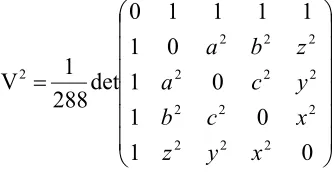
[image:2.595.327.494.416.503.2]The information assigned to such a point equals to the volume of tetrahedron composed by the corresponding facet and gravity center of object. This volume is calculated using Cayley-Menger determinants (equation 1). These determinants are used to calculate the volume of tetrahedron based on its edges.
Figure 1: Example Of Tetrahedron
=
0
1
0
1
0
1
0
1
1
1
1
1
0
det
288
1
V
2 2 2
2 2
2
2 2 2
2 2 2
2
x
y
z
x
c
b
y
c
a
z
b
a
(1)
We define this correspondence between surface F
of three-dimensional object A and Gaussian sphere
S, named Gauss application by:
)
,
(
)
,
(
F
:
N
j j i
i
v
S
T
V
F
f
S
a
→
(2)
Where (Fi, i∈{1,…n}) triangular facets of A,
3.2 Symmetry group
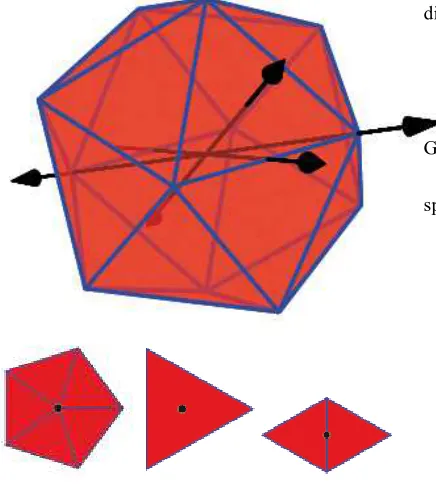
[image:3.595.93.311.212.455.2]Regular icosahedrons, used as Gaussian sphere, have a symmetry group of order 120, out of which 60 are orientation-preserving or rotational symmetries (figure 2):
Figure 2 : Different Rotation Axis Preserving Icosahedrons Orientation
The symmetry group can be divided into four conjugacy classes:
The identity
Rotating the icosahedrons by angles
of
5
8
5
6
,
5
4
,
5
2
π
π
π
π
or
about any axisjoining the extreme opposite vertices Rotating the icosahedrons by angles
of
3
4
3
2
π
π
or
about any axis joining
the centers of opposite faces Rotating the icosahedrons by angles of
π
about any axis joining the midpoints of opposite edgesWe also note that the number of such axes of rotation is six for the first type, ten for the second and fifteen for the third. Including the identity, the order of this rotation group thus comes out to be:
60
1
1
*
15
2
*
10
4
*
6
+
+
+
=
(3)
Now we apply different rotation to Gaussian sphere S. The new Gaussian sphere is the permutation representation corresponding to the each rotation. It has same number of facets and different orientations, (equation 4):
)
,
(
)
,
(
i jR i
i
v
R
g
T
v
T
S
⊗
=
(4)
Where R is the type of rotation we to apply to Gaussian sphere.
We define the different rotations of Gaussian sphere are:
• The identity of Gaussian sphere
S
g
1=
1
⊗
(5)• Rotation around an axis through the extreme opposite vertices.
⊗
=
⊗
=
⊗
=
⊗
=
S
g
S
g
S
g
S
g
5
8
5
6
5
4
5
2
5 4 3 2
π
π
π
π
(6)
We have six axes possible, so we get twenty four Gaussian spheres (g2, g3… g25).
• Rotation around an axis through the centers of opposite faces
⊗
=
⊗
=
S
g
S
g
3
4
3
2
27 26
π
π
(7)
We have ten axes possible, so we get twenty Gaussian spheres (g26, g27… g45).
• Rotation around an axis through the midpoints of opposite edges
S
g
46=
π
⊗
(8)
We have fifteen axes possible, so we get fifteen Gaussian spheres (g46, g47… g60).
Using the latest equation (8) we measure the reflective symmetry about fifteen axes.
To make a model of Gaussian sphere invariant under all the symmetries of icosahedrons, we mix the sixty Gaussian spheres by adding values of volume correspond to each facet.
∑
==
601
)
,
(
)
,
(
i
i i I i
i
V
g
T
v
T
G
(9).
3.3 Continuous symmetry measurement
As defined in [13], the continuous symmetry measure is the minimum effort required to transform a given shape into a symmetric shape. So, we must calculate the effort to transform the initial Gaussian image
S(T
i,
v
i)
to the finale symmetricone G(Ti,Vi).
For this end, we use a metric Match Distance [18,19]. This distance is a special case for one- dimensional histograms with equal areas of the EMD (the Earth Mover’s Distance, (equation 10) which reflects the minimal amount of work that must be performed to transform one distribution into the other by moving “distribution mass” around [16,17].
∑ ∑
∑ ∑
= = = =
=
mi n
j ij m
i n
j
ij ij
f
f
d
Q
P
EMD
1 1 1 1
)
,
(
(10)
The match distance between two one-dimensional histograms is defined as the L1 distance between their corresponding cumulative histograms (equation 11):
(
)
i iM
H
K
h
k
d
^ ^
,
=
∑
−
(11)
Where
ĥi = ∑
j ≤ ih
j is the cumulativehistogram of {hi}, and similarly for {ki}.
4. EXPERIMENTAL RESULTS
To evaluate our algorithm, described in the previous sections, we use C and Opengl.
We tested on a 3D model database containing 54 models arranged by the judgment of two adults into eight classes.
The classes are the following: Airplane class -Class A- (8 airplanes objects), Divers class --Class M-(5 misc objects), Echec class -Class P- (7 chess pieces objects), Human class -Class H- (8 humans objects), Poisson class -Class F- (6 fishes objects), Quadru class -Class Q- (7 quadrupeds objects), Voiture class -Class C- (8 cars objects) and Vase class -Class V- (6 Vase objects). The first seven classes have been collected from the 3DCafe [20] and the last class is composed of three-dimensional models of Moroccan traditional vases.
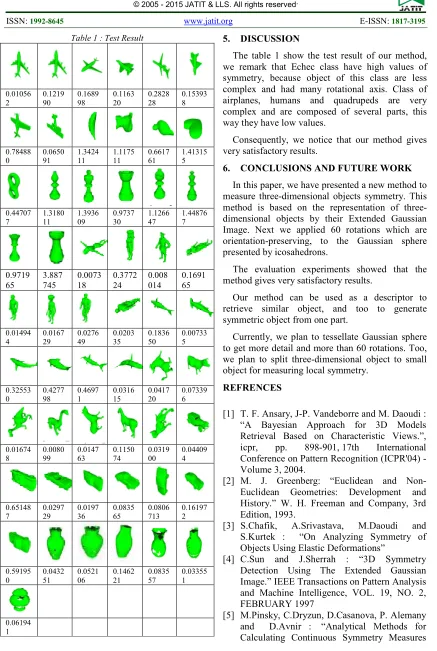
Table 1 : Test Result
0.01056 2
0.1219 90
0.1689 98
0.1163 20
0.2828 28
0.15393 8
0.78488 0
0.0650 91
1.3424 11
1.1175 11
0.6617 61
1.41315 5
0.44707 7
1.3180 11
1.3936 09
0.9737 30
1.1266 47
1.44876 7
0.9719 65
3.887 745
0.0073 18
0.3772 24
0.008 014
0.1691 65
0.01494 4
0.0167 29
0.0276 49
0.0203 35
0.1836 50
0.00733 5
0.32553 0
0.4277 98
0.4697 1
0.0316 15
0.0417 20
0.07339 6
0.01674 8
0.0080 99
0.0147 63
0.1150 74
0.0319 00
0.04409 4
0.65148 7
0.0297 29
0.0197 36
0.0835 65
0.0806 713
0.16197 2
0.59195 0
0.0432 51
0.0521 06
0.1462 21
0.0835 57
0.03355 1
0.06194 1
5. DISCUSSION
The table 1 show the test result of our method, we remark that Echec class have high values of symmetry, because object of this class are less complex and had many rotational axis. Class of airplanes, humans and quadrupeds are very complex and are composed of several parts, this way they have low values.
Consequently, we notice that our method gives very satisfactory results.
6. CONCLUSIONS AND FUTURE WORK
In this paper, we have presented a new method to measure three-dimensional objects symmetry. This method is based on the representation of three-dimensional objects by their Extended Gaussian Image. Next we applied 60 rotations which are orientation-preserving, to the Gaussian sphere presented by icosahedrons.
The evaluation experiments showed that the method gives very satisfactory results.
Our method can be used as a descriptor to retrieve similar object, and too to generate symmetric object from one part.
Currently, we plan to tessellate Gaussian sphere to get more detail and more than 60 rotations. Too, we plan to split three-dimensional object to small object for measuring local symmetry.
REFRENCES
[1] T. F. Ansary, J-P. Vandeborre and M. Daoudi : “A Bayesian Approach for 3D Models Retrieval Based on Characteristic Views.”, icpr, pp. 898-901, 17th International Conference on Pattern Recognition (ICPR'04) - Volume 3, 2004.
[2] M. J. Greenberg: “Euclidean and Non-Euclidean Geometries: Development and History.” W. H. Freeman and Company, 3rd Edition, 1993.
[3] S.Chafik, A.Srivastava, M.Daoudi and S.Kurtek : “On Analyzing Symmetry of Objects Using Elastic Deformations”
[4] C.Sun and J.Sherrah : “3D Symmetry Detection Using The Extended Gaussian Image.” IEEE Transactions on Pattern Analysis and Machine Intelligence, VOL. 19, NO. 2, FEBRUARY 1997
and the Chirality Measure.” Published online 16 May 2008 in Wiley InterScience
[6] D. Avenir, H.Zabrodsky and P.G.Mezey : “Symmetry and Chirality: Continuous Measures”
[7] H.Zabrodsky, Sh.Peleg, and D.Avnir “Symmetry as a Continuous Feature.” IEEE Transaction on Pattern Analyses and Machine Intelligence. Vol 17, No 1 December 1995 [8] Henk J.A.M. Heijmans, Member, IEEE, and
Alexander V. Tuzikov : “Similarity and Symmetry Measures for ConvexShapes Using Minkowski Addition.” IEEE Transactions on Pattern Analysis and Machine Intelligence, VOL. 20, NO. 9, SEPTEMBER 1998
[9] M.Kazhdan, B.Chazelle, D.Dobkin, T.Funkhouser, and S.Rusinkiewicz : “A Reflective Symmetry Descriptor for 3D Models.”
[10] W.Ja´skowski and M.Komosinski : “The Numerical Measure of Symmetry for 3D Stick Creatures.”
[11] A.Berner, M.Wand, N.J. Mitra, D.Mewes and H.Seidel : “Shape Analysis with Subspace Symmetries.”
[12] H.Hel-Or and D.Avnir : “Computational Aspects in Image Analysis of Symmetry and of its Perception.” Symmetry Culture and Science 1999, 4th Int. Conf. of the Interdisciplinary Study of Symmetry ISIS98
[13] H.Zabarodsky, and D. ALGOM : “Continuous Symmetry: a Model for Human Figural Perception.” Spatial Vision, Vol. 8, No. 4, pp. 455-467 (1994).
[14] B.K.P.Horn : “Extended Gaussian Images”, Proc. IEEE72, pp. 1671-1686, 1984.
[15] H. Zouaki : “Representation and Geometric Computation Using The Extended Gaussian Image.
[16] Y. Rubner, C. Tomasi and Leonidas J. Guibas: “ A Metric for Distributions with Applications to Image Databases”, Proc. Of the 1998 IEEE International Conference on Computer Vision, Bombay, India.
[17] Y. Rubner, C. Tomasi and Leonidas J. Guibas: “The Earth Mover’s Distance as a Metric for Image Retrieval”, International Journal of Computer Vision 40(2), 99–121, 2000, Kluwer Academic Publishers. Manufactured in The Netherlands
[18] Shen, H.C. andWong, A.K.C.. “Generalized texture representation and metric. Compute”r, Vision, Graphics, and Image Processing, 23:187–206. 1983
[19] Werman, M., Peleg, S., and Rosenfeld, A. “A distance metric for multi-dimensional histograms.” Computer, Vision, Graphics, and Image Processing, 32:328–336. 1985.