ISSN: 1992-8645 www.jatit.org E-ISSN: 1817-3195
W-LEACH-MOBILE: AN ENHANCED MOBILE PROTOCOL
WITH A DECENTRALIZED WAY IN WIRELESS SENSOR
NETWORK
1 ABDELHALIM HNINI, 2MOHAMMED FIHRI, 3ABDELLAH EZZATI, 4ABDEMAJID
HAJAMI, 5MOHAMED HANINI
LAVETE Laboratory, Department of mathematics and informatics, Faculty of Science and Technology, Settat, Morocco
E-mail: {1hninihalim,2fihrimohammed,3abdezzati,4abdelmajidhajami,5haninimohamed}@gmail.com
ABSTRACT
A group of Wireless mobile nodes and a base station constitute a typical ad-hoc network. This group is Wireless Sensor Network. Each node has a random mobilization and a limited energy. Their battery’s powers play an important role to extend lifespan. This problem is solved by hierarchical protocols, but they are not effective with mobility. Random mobility generates the packets loss. To manage these packets, there are two protocols proposed to control node mobility; namely LEACH-mobile and CBR Mobile. In this work, we have ameliorated the W-LEACH protocol to a new one called W-LEACH-Mobile in two ways. In the first one, we have invested the idea proposed by W-LEACH to increase network life time in a decentralized manner. In the Second, we have managed packets loss generated with node mobility. Finally, we compare this new protocol with LEACH and LEACH-Mobile protocols in terms of energy deception, and with LEACH, W-LEACH and W-LEACH-Decentralized in terms of packets loss.
Keywords: W-LEACH, LEACH-Mobile, W-LEACH-Mobile, WSN.
1. INTRODUCTION
Wireless sensor networks are known in different fields such as environment, medical applications, and industrial monitoring. A WSN (wireless sensor network) is formed by a base station (BS) and a lot of nodes distributed over a large area. The base station accumulates data which is sent and sensed by each node. These sensor nodes are inaccessible to the users; therefore the replacement of these nodes is not possible. The secret to improve their performance is the energy efficiency. To increase
the lifetime of the network, the energy
consumption, that combines sensing,
communication and data processing, should be balanced between all sensor nodes.
Hierarchical technique is an efficient way to decrease the energy consumption. This technique is called clustering. Low Energy Adaptive Clustering Hierarchy (LEACH)[1][2][3] extends the network lifetime, but it is ineffective with mobility. There is another version developed of LEACH named LEACH-Mobile [4] that can support the frequent mobility, in terms of packets loss [16][17]. Another type existing called CBR-Mobile [5][6][7] can also manage the packets loss. Also improved studies
based both on LEACH-Mobile and CBR-Mobile are presented in [8][9][10][11].
W-LEACH [12] or Weighted LEACH is a centralized algorithm. As LEACH, W-LEACH consists of a setup phase and a steady state phase. In the first phase, W-LEACH chooses a number of live sensors based on a weight value to be CHs. After that, the clusters are formed such that each sensor is assigned to its nearest CH. In the steady state phase, LEACH requires each CH to aggregate data from all sensors in its cluster. W-LEACH selects only a fraction of sensors in each cluster to transmit data to their CH. Candidates for sending data to CHs are selected according to their weight. The W-LEACH has some advantages in what concerns the energy recovery but it does not consider the influence mobility of sensor nodes after the setup phase. Also W-LEACH protocol can accompany a lot of data loss because the sensor node can be deployed in a noisy environment.
ISSN: 1992-8645 www.jatit.org E-ISSN: 1817-3195
2. LEACH ALGORITHM
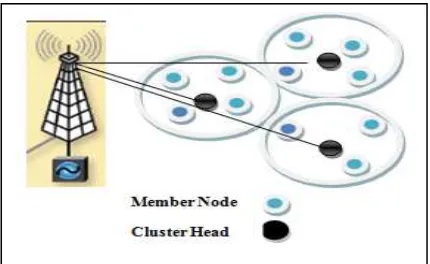
Low Energy Adaptive Clustering Hierarchy Aggregation (LEACH) algorithm is a data aggregation algorithm that equilibrates the energy deception among nodes. The LEACH is discovered by Heinzelman in order to increase the network lifetime and decrease the consumption of the energy, [1][2]. In LEACH, every node sends data to a cluster head. This CH transmits data collected from its nodes, which belong to the respective cluster, to the base station. The role of the cluster head changes periodically this is presented in Figure 1.
The communication time is divided into rounds. Each round time contains two phases called, a setup phase and a steady state phase.
In the setup phase, cluster heads are selected and clusters are formed. Each sensor is elected to be a cluster head with a probability, and only one CH is elected in one cluster based on a threshold:
) 1 (
. 0
)) p 1 mod p(r -(1
p
= T(n)
∈otherwise G n if
Where p is the desired percentage of CHs (determined a priori), r is the current round, and G
is the set of nodes that have not been CHs in the last 1/P rounds. That can extend the network lifetime because of the current CH is not selected in the next round until all the other sensors in the network become CHs.
In the steady state phase, cluster LEACH is based on Time Division Multiple Accesses (TDMA) to communicate and transmit data [1][13]. The same is presented in figure 2, where the round is divided to frame times. Every frame is subdivided to time Slot which corresponds to one node member to send its data to CH.
There is a modified version of LEACH named as the LEACH-C [2], it differs at the election of CHs. LEACH is known as decentralized, but LEACH-C is centralized. Every round, the base station chooses the nodes to be CHs. it is based on node locations.
The Figure 3 presents nodes repartition in LEACH and LEACH-C aggregation algorithm.
3. LEACH MOBILE AND CBR-MOBILE
ALGORITHMS
[image:2.612.83.298.283.415.2]Another study which is interested in mobility and packets loss has improved LEACH protocol. These protocols adapt TDMA time to support mobile sensors in WSN as LEACH-Mobile[4] and CBR-Mobile [5][6][7]. LEACH protocol with mobility frequency of sensor node doesn’t guarantee the data reception to CH. In LEACH-Mobile, the basic idea
[image:2.612.311.524.297.445.2]Figure 3: nodes repartition Figure 1 : Clustering in LEACH
[image:2.612.89.528.612.708.2]ISSN: 1992-8645 www.jatit.org E-ISSN: 1817-3195 is that CHs confirm that they have received all data
sent by mobile nodes. This proposed scheme assumes that every node has data to send necessarily at its time slot allocated in TDMA schedule [4].
The setup phase is like in LEACH, the differences begin in study state phase. After the cluster head is selected, it will create a time division multiple accesses (TDMA) schedule and send it to all its member nodes.
A member node waits to receive a data request message from its CH. If it receives this message, it sends the data back to the cluster head. If not, it goes to a sleep mode until the next allocated time slot in the next frame [4] [5].
Until the end of the frame, CH marks each member node which hasn’t received its data. If it doesn’t receive data again, the CH removes this member node from this cluster. This member node at its role assumes that it’s out cluster and sends a joint message to join a CH again.
CBR-Mobile WSN is an advanced version of LEACH-Mobile. In CBR Mobile-WSN, the sensor node does not need to wait for two consecutive failure frames from cluster head to make decision but directly decides that it has moved out of its cluster after one frame. Thus, it reduces data loss by sending a joint message to a new cluster head.
4. W-LEACH
This protocol, and others like EEDBC-M [9], [12] are based on the weight of density and energy to extend network lifetime. In W-LEACH, the base station is based on node location to acknowledge node density. It divides member nodes on two groups: A group where nodes send data and another group where the rest of the nodes remain asleep. This steady phase increases energy dissipation but makes decision to remain in a sleep mode with a centralized manner i.e. by the base station [12].
5. W-LEACH-DECENTRALIZED
It is an improved study of LEACH. In W-LEACH Decentralized [13] member nodes remain in sleep mode with a decentralized manner. Each member can make a decision to remain asleep if it has a lot of neighbors. This decision taken by each sensor is based on a limited number of neighboring which are next to this member node with a determinate distance [13].
LEACH decentralized as in LEACH and W-LEACH contains two phases. Just before the
beginning of data transmission, each node, which is not a cluster-head, can determine its neighboring and the distance corresponding to each neighbor based on the flow of communication to form its cluster. By doing this, we can define node density metric and each node controls itself to decide its status as being in an active state or they remain in a sleep state during this round according to the number of close neighboring nodes with a determined distance.
W-LEACH decentralized is based on the sensor density and chooses only a fraction of sensors in each cluster to send data in the round. Furthermore, this algorithm compared with W-LEACH increases network lifetime but this protocol is very low in packet loss generated by node mobility.
6. PROPOSED PROTOCOL: W-LEACH
MOBILE
In W-LEACH Decentralized, we have weighted LEACH to extend network lifetime with a decentralized meaner. We develop this protocol to be complete in a mobile environment, reduce packet loss and guarantee data received by CH.
6.1. W-LEACH Mobile Detail And Algorithm
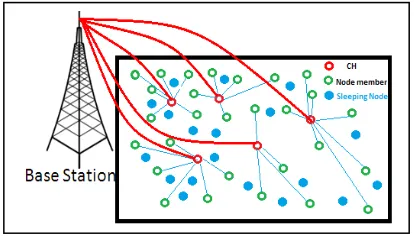
[image:3.612.312.519.577.695.2]Like LEACH and LEACH descendents, we divide communication time in two phases: Setup phase where CHs are selected and clusters are formed. In the second phase, each node which is not a CH determines its neighbors and its distance as in W-LEACH Decentralized. In this round, each node manages itself to choose its state to be active to be able to transmit its data or remain to sleep state. After that, we find three classes of nodes in the zone: node is CH, active member node and member node in sleep state as presented in the following figure 4. So active member nodes transmit their data according to TDMA technique, they used message data received to assure its transmission data to CH.
ISSN: 1992-8645 www.jatit.org E-ISSN: 1817-3195
Setup phase
Steady State Phase
Algorithm
Algorithm
Algorithm
Algorithm
Figure 5(b) : W-LEACH-Mobile algorithm in Cluster Head node
Algorithm
MN1
Algorithm
Algorithm
MN3
Algorithm
MN3
Setup phase
Steady State Phase
Figure 5(a) : W-LEACH-Mobile algorithm in member node In our protocol, we assume that all active member
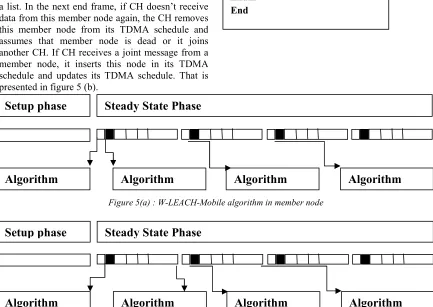
nodes have sent data to CH necessarily at its time slot allocated in TDMA schedule. During steady-state phase, each member active node wakes up at the beginning of its timeslot and waits for data request message sent from the cluster head. If this node receives data request message, it can send the data back to the cluster head. If not, it goes to sleep state until the next allocated time slot in the next frame. Figure 5 (a) presents this algorithm.
In the next frame, if it doesn’t receive request message again, this active node sends a joint message to the nearby cluster head. The cluster head transmits the request message for data transmission to their active member nodes according to TDMA schedule at each time slots. In the end of each frame, if it doesn’t receive data from a member node it marks this member node in a list. In the next end frame, if CH doesn’t receive data from this member node again, the CH removes this member node from its TDMA schedule and assumes that member node is dead or it joins another CH. If CH receives a joint message from a member node, it inserts this node in its TDMA schedule and updates its TDMA schedule. That is presented in figure 5 (b).
Algorithm MN1
di distance corresponding to node i
Nl number limit
Dl distance limit
Cpt 0
Began Foreash i
IF (di<Dl)
Cpt Cpt+1
EndIF End Foreash IF( Cpt>Nl) Go To Sleep mode
Else
Wait For Data-req-message
[image:4.612.91.524.306.613.2]ISSN: 1992-8645 www.jatit.org E-ISSN: 1817-3195
7. PERFORMANCE PARAMETERS
MODEL
In this section we define the parameters used to evaluate the performance of the studied protocol. Hence we will propose to study the life time
network which is defined according to the number of alive nodes, the number of packets lost and the consumed energy.
7.1. Energy Dissipation Model
In the evaluation of the protocols, the energy model is based on the model used in [18], the impact of the proposed protocol on this model is presented below.
In our model, we assume that there are N nodes uniformly distributed in an area of interest MxM. If the number of cluster is C, then there is N/C on average by cluster nodes.
Each CH consumes energy for receiving data from the nodes and to transmit the aggregated data to the base station. Therefore, the energy consumed in CH for k bits information during a single round is: (2) loss E + ] 4 toBS mpl.d k. elec [k.E + ] elec 1).k.E -C N ( . [(x% = CH
E + ε
As there is only a fraction of x% of total member that alive, the rest are in sleep mode.
Where ( / -1)* * is the energy of data
aggregation from nodes in the cluster, Eelec is the
electronic energy for transmission / receipt, ε l is
the amplification factor corresponding to the long spans.
Eloss denotes the additional energy consumed by the control packet loss; it is calculated by the expression: (3) ] k.ε.εamps 1).[k.E -C N ( . x% =
Eloss elec+ 2toCH
Where, εamps is the amplification factor corresponding to the short range.
On the other hand, the expression of the energy consumed by a node member (not CH) is given by:
(4) amps.d k. k.E =
ENM elec+ ε 2toCH
Hence, using formula (2), (3) and (4), the total energy E C consumed by one cluster in a round can be expressed by the equation:
(5) E .E C N x%. E =
EC CH+ NM+ loss
7.2. Packet loss model Algorithm CH2
Began
Confirm recv-list
IF (no Data For node i)
IF ( i Є list Err)
Remove node i from TDMA
Else Mark Err i
Insert node i in list Err
End IF End IF
IF (message = recv-Join-ack-msg)
Send CH advertisement msg
End IF End Algorithm CH1 Began Send Data-req-msg End Algorithm MN3 Began
Wait For Data-Req-message
IF( message = recv-Data-Req)
Send Data back to CH
Else
If(message = recv CH advertisement msg)
Send registration msg
End IF Send Join-ack-msg End IF End Algorithm MN2 Began
IF (message = recv Data-Req)
Send Data back to CH
Else
Wait until next time
ISSN: 1992-8645 www.jatit.org E-ISSN: 1817-3195 During a round in the network lifetime, the
number of packet loss is defined as the number of packets that are note delivered succefully to destination among either the packets generated by members’ nodes in the cluster or packets generated or aggregated in the CH. The lower the number of packet lost, better is the performance of the protocol.
The number of packet lost is determined by the equation:
) 6 ( P
P = N
C N
1 i
r i s
lost
∑
=
−
Where i s
P
is the number of packets sent by the
ith node in the cluster, and the
P
r is the total packetreceived in the base station from the CH.
An efficient performance parameter is the ratio of number of packet loss per number of packet received, which can expressed by the following equation:
) 7 ( =
r 1
r C N
i
r i s
P P P
∑
=
−
8. SIMULATION RESULTS
In this section, to evaluate W-LEACH Mobile performances, we use NS 2.34[14][15] simulator to implement W-LEACH Mobile; and we compare the proposed protocol with others variants of LEACH in terms of remaining energy, network lifetime and packet loss.
8.1. Simulation Setup
In our simulation, we use a network size of 100 m x100 m, a base station located at point (70,200). The initial energy of each sensor node is set to 2J. We test the algorithm with various total nodes: N=100 and N=150 the comparative results were the average of 10 runs matching each test.
8.2. Remaining Energy
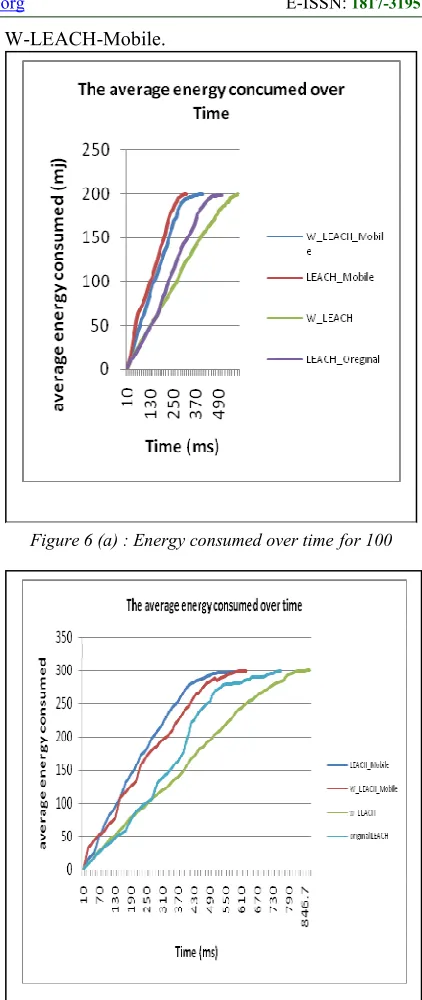
In this section the consumed energy in the proposed protocol is compared to LEACH-Mobile protocol. Figure 6(a) and figure 6 (b) below show the energy consumed of the protocol over time. LEACH-Mobile consumes more energy because
W-LEACH-Mobile.
8.3. Network Lifetime
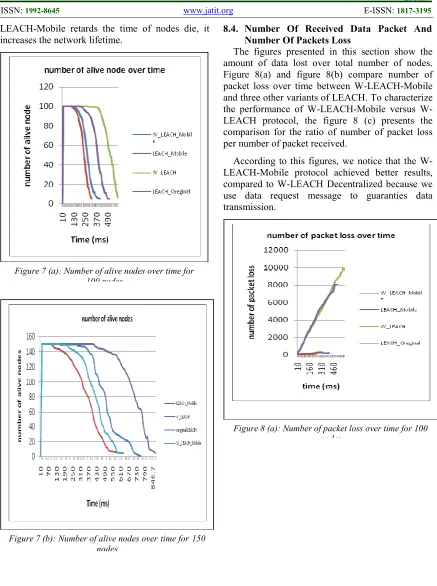
Maximizing network lifetime is an important issue in the design of routing protocols for Wireless Sensor Networks. In this work, the evaluation of Network lifetime is based on the number of alive nodes.
The following figures show the comparison between W-LEACH-Mobile and LEACH-Mobile in term of network life time. We notice that
W-Figure 6 (b): Energy consumed over time for 150
nodes
[image:6.612.311.522.80.580.2]ISSN: 1992-8645 www.jatit.org E-ISSN: 1817-3195 LEACH-Mobile retards the time of nodes die, it
increases the network lifetime.
8.4. Number Of Received Data Packet And
Number Of Packets Loss
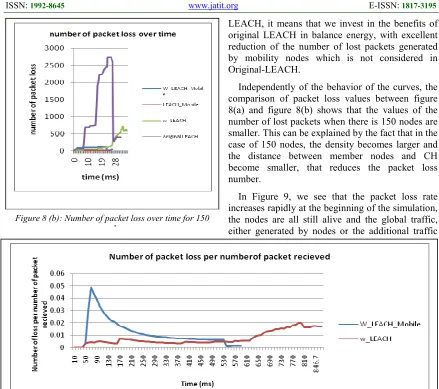
The figures presented in this section show the amount of data lost over total number of nodes. Figure 8(a) and figure 8(b) compare number of packet loss over time between W-LEACH-Mobile and three other variants of LEACH. To characterize the performance of LEACH-Mobile versus W-LEACH protocol, the figure 8 (c) presents the comparison for the ratio of number of packet loss per number of packet received.
According to this figures, we notice that the W-LEACH-Mobile protocol achieved better results, compared to W-LEACH Decentralized because we use data request message to guaranties data
transmission.
Figure 8 (a): Number of packet loss over time for 100 nodes
Figure 7 (b): Number of alive nodes over time for 150 nodes
[image:7.612.90.527.71.657.2]ISSN: 1992-8645 www.jatit.org E-ISSN: 1817-3195
Figure 9: Number of packet loss per number of packet received
8.5. Results Interpretation
According to the simulation results, we can conclude the following interpretation:
After the comparison between the different graphs, the protocol W_LEACH_Mobile is more
efficient than Original-LEACH and
W_LEACH_Decentralized in terms of the number of packets loss, this is from the technical control loss packet used by the proposed protocol.
In terms of the energy consumption during the simulation time W_LEACH_Mobile performs better than LEACH-Mobile. This is because when using W_LEACH_Mobile, in each round a set of nodes remains in sleep mode until the end of round run. Moreover, the energy consumption is close when comparing our protocol with
Original-LEACH, it means that we invest in the benefits of original LEACH in balance energy, with excellent reduction of the number of lost packets generated by mobility nodes which is not considered in Original-LEACH.
Independently of the behavior of the curves, the comparison of packet loss values between figure 8(a) and figure 8(b) shows that the values of the number of lost packets when there is 150 nodes are smaller. This can be explained by the fact that in the case of 150 nodes, the density becomes larger and the distance between member nodes and CH become smaller, that reduces the packet loss number.
In Figure 9, we see that the packet loss rate increases rapidly at the beginning of the simulation, the nodes are all still alive and the global traffic, either generated by nodes or the additional traffic
generated by W-LEACH-Mobile, is very large.
In network stability period, the loss rate of packets with the proposed protocol begins to decrease rapidly because of control adopted by the protocol, and it becomes towards the end of the network lifetime lower than the ratio of packet lost
for W-LEACH protocol.
9. CONCLUSION
In this paper, we have presented W-LEACH- Mobile; a mobility decentralized protocol for wireless sensor network to support typical mobile environment with no knowledge of locations of mobile nodes; this is according to the advantages of W_LEACH_Decentralized protocol.
The simulation results show that the proposed protocol is reducing the number of lost packets Figure 8 (b): Number of packet loss over time for 150
[image:8.612.86.523.316.489.2]ISSN: 1992-8645 www.jatit.org E-ISSN: 1817-3195 generated by the random mobility of nodes
compared to W-LEACH Decentralized. This is due to the fact that W-LEACH-Mobile is a protocol that controls lost packets generated by the mobility of nodes, and it sets up a request packet message during the process of continuous transmission of each packet of data.
Our simulation results show also that the performance characteristics of the two protocols W-LEACH-Mobile and W-LEACH-Decentralized are better than respectively LEACH-Mobile and LEACH in terms of network life time. Indeed, W-LEACH-Mobile has a mechanism to keep a set of nodes dormant, and this extends the network lifetime.
REFERENCE:
[1] W. Heinzelman, A. Chandrakasan, And H.
Balakrishnan, “Energy-efficient
communication protocol for wireless
microsensor networks”, the 33rd Hawaii International Conference on System Sciences (HICSS ’00), Maui, HI, USA, 2000.
[2] W. B. Heinzelman, A. Chandrakasan, and H.
Balakrishnan, “An application specific protocol architecture for wireless microsensor networks,” IEEE Transactions on Wireless Communications, vol. 1, pp. 660–670, Oct. 2002.
[3] Pragati, Rajender Nath, “ Performance
evaluation of AODV, LEACH, TORA
protocols through simulation”, International journal of advanced research in computer science and software engineering, Vol. 2, Issue 7, July 2012
[4] Kim, D.S.; Chung, Y.J. Self-Organization
routing protocol supporting mobile nodes for wireless sensor network, First International
Multi-Symposiums on Computer and
Computational Sciences (IMSCCS 06),
Hanzhou, Zhejiang, 2006, vol. 2, pp. 622 - 626.
[5] S SamerA. B.Awwad · CheeKyun Ng ·
NorK.Noordin · Mohd. Fadlee A. Rasid, “Cluster based routing protocol for mobile nodes in wireless sensor network,” in Proc. of
Int’l Symposium on Collaborative
Technologies and Systems 2009, CTS’09, pp. 18-22, May 2009.
[6] SamerA. B.Awwad · CheeKyun Ng ·
NorK.Noordin · Mohd. Fadlee A. Rasid, “Cluster Based Routing protocol for Mobile Nodes in Wireless Sensor Network”, Wireless Pers Commun (2011) 61:251–281.
[7] Samer A. B. Awwad, Chee Kyun Ng* and Nor
K. Noordin, “Cluster Based Routing Protocol with Adaptive Scheduling.for Mobility and Energy Awareness in Wireless Sensor”, Proceedings of the Asia-P acific Advanced Network 2010 v. 30, p. 57-65.
[8] D. Saranya, T Parameswaran and C
Palanisamy, “MMBC: An Energy Efficient Protocol for Wireless Sensor Networks”, International Journal of Communications and Engineering Vol. 06, No.6, Issue: 01 March2012, pp: 114 – 120.
[9] R.U.Anitha,
Dr.P.Kamalakkannan,”EEDBC-M: Enhancement of Leach-Mobile protocol with Energy Efficient Density-based Clustering for Mobile Sensor Networks (MSNs)”,
International Journal of Computer
Applications(IJCA), Volume 74– No.14, ISSN: 0975 – 8887, pp 19-27, July 2013.
[10]G. Santhosh Kumar, V. Paul M V , and K.
Poulose Jacob, “Mobility Metric based LEACH-Mobile Protocol” 16th International Conference on Advanced Computing and Communications, 2008. ADCOM pp. 248 – 253.
[11]Karim, L.; Nasser, N. "Energy Efficient and
Fault Tolerant Routing Protocol for Mobile Sensor Network",Communications (ICC), 2011
IEEE International Conference on, On
page(s):1-5.
[12]Hanady M. Abdulsalam, Layla K. Kamel
“W-LEACH: Weighted Low Energy Adaptive Clustering Hierarchy Aggregation Algorithm
for Data Streams in Wireless Sensor
Networks”, ICDM Workshops 2010: 1-8
[13]Abdelhalim HNINI,Abdellah EZZATI,
Mohammed FIHRI, Abdelmajid HAJAMI, “W-LEACH Decentralized: Weighted LEACH with a Decentralized way”, IOSR Journal of Computer Engineering (IOSR-JCE, Volume 16, Issue 2, Ver. VII (Mar-Apr. 2014), PP 32-39.
[14]Kevin Fall , Kannan Varadhan “The ns
Manual” MIT, November 4, 2011.
[15]W. Heinzelman "The MIT uAMPS ns Code
Extensions, Version 1.0," MIT, August 2000.
[16]Priti Kumari, M. P Singh, Prabhat Kumar
ISSN: 1992-8645 www.jatit.org E-ISSN: 1817-3195
[17]Raed M. Bani Hani, Abdalraheem A. Ijjeh, “A
Survey on LEACH-Based Energy Aware Protocols for Wireless Sensor Networks”, Journal of Communications Vol. 8, No. 3, March 2013.
[18]Y. Li, N. Yu and et al., "Enhancing the