ISSN: 1992-8645 www.jatit.org E-ISSN: 1817-3195
115
FACE RECOGNITION AGAINST VARYING LIGHTING
CONDITIONS USING ORIENTED PHASE CONGRUENCY
IMAGE FEATURES
1HENDRA KUSUMA, 2WIRAWAN, 3ADI SOEPRIJANTO
1,2,3
Department of Electrical Engineering, Institut Teknologi Sepuluh Nopember SURABAYA, INDONESIA, 60111
E-mail: [email protected], [email protected], [email protected]
ABSTRACT
Although face recognition has become a topic of active research in recent decades, an accurate face recognition is still a tough job and still struggle with its performance especially if it is unconstrained lighting variations. The external conditions present during the facial image acquisition stage deeply influence the appearance of a face in the acquired image and hence affect the performance of the recognition system. This paper presents an efficient method for robust face recognition against varying lighting condition by using Oriented Phase Congruency features. The extracted features, derived from the Gabor Phase Congruency response are concatenated to construct a feature vector to be used for classification by Subspace LDA. We demonstrate the effectiveness and superiority of our proposed method by conducting some experiments on Yale B face databases and our proposed method shows robust face recognition performance in the presence of severe lighting changes.
Keywords: Face Representation, Varying Lighting Conditions, Oriented Gabor Phase Congruency Features, Gabor Phase High Energized Point, Subspace LDA.
1. INTRODUCTION
Among the different biometric technologies presented in the literature, face recognition has captured a great deal of both public and private institutions attention over the last few years. Due to its non-intrusive nature, automatic face recognition is becoming a very active research topic [1]. There are many different industrial applications interested in face recognition, mostly related to security and safety, In the last two decades, various approaches have been proposed for face image recognition and substantial progress has been made. Nevertheless, further research is still needed to make face recognition systems more robust under uncontrolled circumstances particularly those imposed on varying illumination. Numerous approaches to achieve illumination invariant face recognition have been proposed in the literature. As identified in a number of surveys [2] [3] [4].
In this paper, we propose a method of face recognition under varying lighting conditions by using phase congruency features, that first introduced by Kovesi 1999 [5] from the Gabor phase congruency model. The phase congruency feature vectors are extracted from points with high information content of the face image. The
proposed phase congruency feature extraction algorithm has two main steps, i.e. feature point localization and, feature vector computation.
The remainder of this paper is organized as follows: Section 2 describes the related work. Section 3 presents the proposed framework, i.e. Gabor phase congruency feature extraction and selection. The experimental results and discussions are given in Section 4. Finally, the conclusion is described in Section 5.
2. RELATED WORK
Lighting variations problem that occur in an uncontrolled environment is one of the main problems in face recognition. Such variations in the face appearance can be much larger than the variation caused by personal identity [6]. Several research works have been published in literature for illumination robust face recognition.
ISSN: 1992-8645 www.jatit.org E-ISSN: 1817-3195
116
is defined as, ̅ , | , |
, ∈ , | , | , where I(x,y) is the image intensity, is the gradient operator, W(x, y) is a local window centered at
(x,y), and c is a constant value to avoid dividing by zero. Illumination insensitive face recognition by using a method based on Symmetric Shape from Shading was presented by Zhao and Chellappa [9]. The symmetry of every face and the shape similarity among all faces are utilized. Marcel et al., [10] introduces local binary patterns. Liu, 2006 [11], Štruc & Pavešic, 2009 [12] proposed Gabor wavelet based features which are less sensitive to the influence of illumination. Sanderson and Paliwal 2003[13], proposed a feature extraction technique called DCT-mod2, at which first applies the Discrete Cosine Transform (DCT) to sub-regions (or blocks) of facial images to extract several feature sets of DCT coefficients, and then compensates for illumination induced appearance changes by replacing the coefficients most affected by illumination variations with the corresponding vertical and horizontal delta coefficients. Basically illumination invariance can be achieved by finding features or face representations that are stable under different illumination conditions.
3. PROPOSED FRAMEWORK
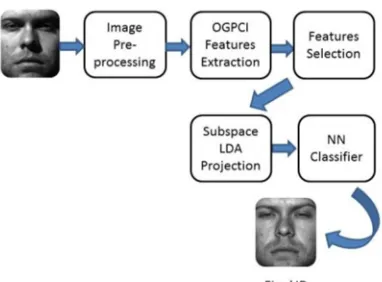
[image:2.612.99.290.526.667.2]The components of our proposed face recognition system is described in this section in detail, i.e. Oriented Gabor Phase Congruency features, high-energized Gabor phase congruency points selections, Subspace LDA dimensionality reduction and nearest neighbor recognition. The stages of processing are illustrated in Fig. 1.
Figure 1: The Block Diagram of face recognition system
Note that prior to the experiments, all images are subjected to a pre-processing procedure such as undergoing geometric and photometric normalization and cropped to 128x128 pixels.
3.1. Gabor Filter Construction
The Gabor filters, have been considered as a very useful tool in computer vision and image analysis due to its optimal localization properties in both spatial analysis and frequency domain [14][15][16][17]. In the spatial domain, the family of 2D Gabor filters can be defined as follows [11] [12][14] [18],
, , !" ⁄ $ ⁄ $ !%& $ (1)
' ()* + , *-. + , ' / *-. + ,
()* + , 1 123 ⁄2 ⁄&, + 5 6 8⁄ .
Where u and ν define the scale and orientation of the Gabor kernels. The parameters κ and η determine the ratio between the centre frequency and the size of the Gaussian envelope. Commonly the values of the parameters κandηare set to κ = η = √2. fmax denotes the maximum frequency of the filters and generally is set to fmax = 0.25. Many face recognition studies use five different scales,
9 ∈ :0,1,2,3,4? and eight orientations, 5 ∈
:0,1, … ,7?. which results in a filter bank of 40 Gabor filters [11][12][18].
3.2. Gabor Features Representation
The Gabor features are the result of convolving the image I(x, y) with a bank of Gabor filters of different scales and orientations
, , . Computationally, the feature extraction
procedure can be written as,
B , , C , ∗ , , (2)
Where * denotes the convolution operator and
B , , represents the complex convolution
output which can be decomposed into its real
E , , and imaginary parts F, , as
follows:
E , , G!H , , I and
F, , CJH , , I (3)
ISSN: 1992-8645 www.jatit.org E-ISSN: 1817-3195
117
K , , LE&, , , B ,& ,
M , , tan"Q RS ,, ,, (4)
Hence The Gabor features is essentially the concatenated selected pixels of the 40 modulus-of-convolution images obtained by convolving the input image with those 40 Gabor kernels. The selected pixels can be found from downsampling procedure or from high-energized points/pixels.
Most of the face recognition techniques found in the literature get rid of the phase information of the filtering output and retain only the magnitude information for the Gabor face representation. According to Opeinheim and Lim [19], phase component is more important than the magnitude component in the reconstruction process of an image from its Fourier domain. There is also physiological evidence, showing that human visual system responds strongly to the points in an image where the phase information is highly ordered.
3.3. The Oriented Gabor Phase Congruency Representation
Kovesi [5] developed The original 2D phase congruency model with the goal of robust edge and corner detection in digital images. Phase congruency provides a measure that is independent of the overall magnitude of the signal making it invariant to variations in image illumination as well as contrast independent. Oriented Gabor phase congruency patterns (OGPCPs) are proposed by Štruc et al., [12] with a few modifications of Kovesi's original phase congruency model and the OGPCPs for the v-th orientation can be computed as follow,
TUVWVX Y, Z ∑ \],XY,Z ∆∅],XY,Z `ab
]cb
∑`ab] \],XY,Z d (5)
∆∅],X Y, Z efg h∅],X Y, Z / ∅iX Y, Z j
/ kglm h∅],X Y, Z / ∅iX Y, Z jk (6)
Note that ϵ denotes a small constant that prevents division by zero, ∆∅],X Y, Z is the phase deviation measure as shown by equation (6).
∅],X Y, Z denotes the phase angle of the Gabor
filter (with a centre frequency fu and orientation θv) at the spatial location (x,y), while ∅iX Y, Z represents the mean phase angle at the v-th orientation. Take into account that since the OGPCPs as defined by Eq. (5) and (6) do not
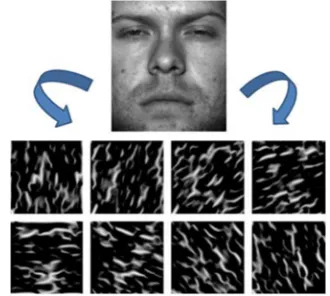
[image:3.612.333.498.171.319.2]depend on the magnitude of the filter responses hence they represent illumination invariant (and contrast independent). This speciallity makes the OGPCPs a very suitable image representation for face recognition. The examples of the OGPCPs for a sample face image are shown in Fig. 2.
Figure 2: An example of The OGPCPs: the original image (upper), the OGPCPs (for 8 orientations)
3.4. The Gabor Phase Congruency Feature Vectors
The Gabor phase congruency feature vector for a given face image can be computed by using equations (5) and (6) for v orientations and u
scales. To alleviate the high dimensional problem, the points in OGPCPs are selected to be feature points based on the high information content of the face image or high-energized points in a W x W
window. Points with high-energized are found by searching the pixels in a sliding window [20][21]. The Window size (W x W) must be small enough to capture the important features and large enough to avoid redundancy information. A W = 7 i.e. 7×7 window is used to search feature points on Gabor filter responses.
3.5. Subspace LDA
ISSN: 1992-8645 www.jatit.org E-ISSN: 1817-3195
118 good generalization, which is usually not available for face recognition applications. To address such Small Sample Size (SSS) problems, Zhao et al (1998) perform PCA to reduce feature dimension before LDA projection.
PCA aims to find a set of projection vectors that map the original D-dimensional image space into a DPCA - dimensional feature space, in which DPCA << D. In PCA, the N images of the training set are converted to N column vectors xi of length D equal to the number of pixels in the images. If their mean is Yi then the total scatter is given by the D x D matrix, i.e.
no ∑qprQ Yp/ Yi Yp/ Yio (7)
PCA attempts to find a set of orthonormal eigenvectors, {sb, st,…, suvwx} of yz, to form the projection matrix {|}K = [sb, st, …, suvwx] corresponding to the ~|}K largest eigenvalues. The new feature vector Z•∈ €•‚ƒ„ can be obtained by,
Z• …†‡ˆ‰ Y•, . 1,2, … , Š (8)
LDA aims to find the optimal set of discriminant vectors that maps the original D -dimensional image space into a ~Œ~K-dimensional feature space (~Œ~K≪D ) such that images from different classes are more separated and images of the same class are more compact. LDA then aims to find a projection matrix W which maximizes the quotient of the determinants of Sband Sw [19][20],
… arg J• ‘’|•““n”•‘
–—’| (9)
where Sband Sw are the between-class scatter and within-class scatter respectively. Consider a C class problem and let Nc be the number of samples in class c , a set of M training patterns from the C
class can be defined as : , ( 1, 2, … , }; ™
1, 2, … , Š?, š ∑‡ Š
rQ . The Sb and Sw of a training set can be computed as :
n’ Q
‡∑
Q q›
‡
rQ ∑qrQ› / œ / œ o (10)
n• Q
‡∑‡rQœ / œ œ / œ o (11)
where μ is the mean of the whole training set, and μc is the mean for the class c. It was shown in [14] that the projection matrix Wcan be computed from the eigenvectors of Sw-1Sb. The major drawback of applying LDAfor the face recognition task is that it may encounter the so-called small sample size
(SSS) problem. It is because the high dimensionality of the feature vector, Sw is usually does not have inverse (Sw is singular). To overcome this problem, a two-phase framework PCA plus LDA [15]. The original feature vectors are first projected to a lower dimensional space by PCA as defined in equ. (8), and secondly it applies the LDA-based algorithm in the reduced subspace to get the optimal projection matrix. Let WPCA be the projection matrix from the original image space to the PCA subspace, the LDA projection matrix WLDA is thus composed of the eigenvectors of
…†‡ˆo n’…†‡ˆ "Q …†‡ˆo n•…†‡ˆ . The final
projection matrix W subspace LDA can thus be obtained by :
…ž •žŸ3 ¡•ˆ …†‡ˆ¢ …¡•ˆ (12)
Note that the rank of Sb ≤ C −1, while the rank of
Sw ≤ M-C . As a result, it is suggested that the dimension of the PCA subspace should be M-C
[15]. Therefore a reduced face feature vector
Z•∈ €•£¤„ are given as follows,
Z• …ž •žŸ3 ¡•ˆ‰ Y•, . 1,2, … , Š (13)
4. EXPERIMENTS, RESULTS AND DISCUSSION
To illustrate the effectiveness of the proposed method, we used publicly available databases containing large illumination variations i.e Yale-B database. We first briefly introduce the Yale-B database employed in the assessment and then the actual experiments.
4.1. Yale-B Database
ISSN: 1992-8645 www.jatit.org E-ISSN: 1817-3195
[image:5.612.89.301.139.246.2]119 images. Some examples of the images are shown in figure 3.
Figure 3: Sample images from the YaleB database
4.2. Experimental Settings
Preprocessing procedure is very important step prior to the experiments, all images were subjected to geometric and photometric normalization to counter the effects of pose and to normalize intensity, as well as local shadowing. First all images were converted to 8 bit gray-scale, aligned and then cropped to a standard size of 128 × 128 pixels in accordance with the given eye coordinates supplied with the original datasets. This is to ensure that all images have uniform size and shape.
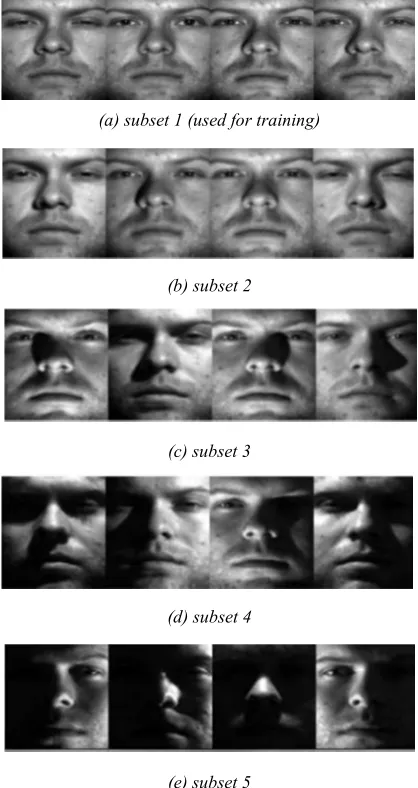
After the cropping procedures, all the 640 images were processed with histogram equalization and were distributed into five subsets depending on the extremity in illumination. The first image subset, denoted as S1 (with the most controlled-like conditions) was used for training and enrollment, while the remaining subsets (S2, S3, S4 and S5) were employed for testing. Note that the conditions got more extreme for the image subsets two (S2) to five (S5). Figure 4 shows some examples of the preprocessed five subsets facial images S1 to S5. Also all the images then were further normalized to zero-means and unit variance.
The tests are performed using Subspace LDA (i.e. PCA+LDA) with various number of eigenvectors used. The number of training images per individual are 12 but we used only 7 and 5. In [22] it has been argued that the Subspace LDA method performs best with the angle or cosine distance, therefore classification was performed using a nearest neighbor classifier and a cosine - based distance measure, which is defined as,
¥¦ž Y, Z Y“Z
§Y“YZ“Z (14)
To construct The Oriented Gabor Phase Congruency Feature, we use five filter scales (u =5) and eight filter orientations (v = 8). These number of scales and orientations, i.e. u = 5 and v = 8, was
(a) subset 1 (used for training)
(b) subset 2
(c) subset 3
(d) subset 4
[image:5.612.313.522.154.548.2](e) subset 5
Figure 4 : Examples of the preprocessed images from the five subsets of the YaleB database
chosen based on other Gabor filter based methods presented in the literature. [12][15][16]
4.3. Experimental Results
ISSN: 1992-8645 www.jatit.org E-ISSN: 1817-3195
120 number of images per individual (class) i.e, 7 and 5 images per individual in training sets (S1). We also evaluated the impact of the number of filter scales u
[image:6.612.307.521.173.290.2]in the Gabor filter bank on the performance of the subspace LDA technique applied to the phase
Figure 5 : Rank one recognition rates (%) on the Yale-B database for 7 training images, u = 5 and v = 8
[image:6.612.90.296.480.602.2]Figure 6 : Rank one recognition rates (%) on the Yale-B database for 7 training images, u = 4 and v = 8
Figure 7 : Rank one recognition rates (%) on the Yale-B database for 7 training images, u = 3 and v = 8
congruency feature vectors. We fixed the orientation of the filter bank to v = 8 and vary the value of the filter scales from u = 3 to u = 5.
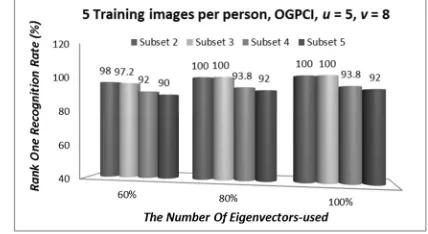
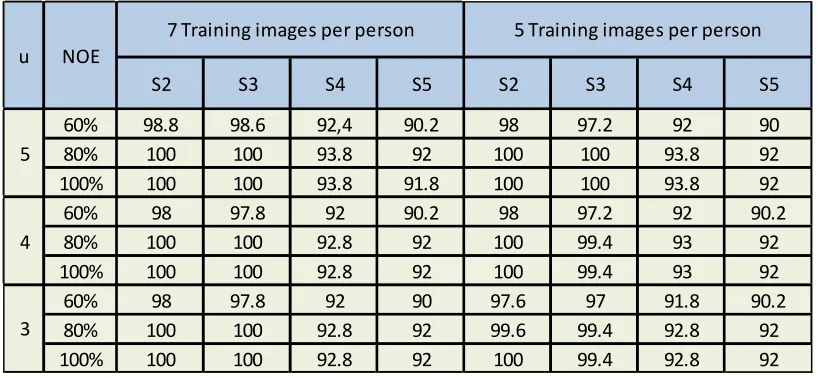
Table 1 and Figures 5 to 10 present the results of the experiments in the form of rank one recognition rates for the Yale-B database.
4.4. Discussion
From the series of experimental results presented in previous section, we found that the Subspace LDA combined with the Gabor phase congruency features that we proposed, ensured the
Figure 8 : Rank one recognition rates (%) on the Yale-B database for 5 training images, u = 5 and v = 8
Figure 9 : Rank one recognition rates (%) on the Yale-B database for 5 training images, u = 4 and v = 8
Figure10: Rank one recognition rates (%) on the Yale-B database for 5 training images, u = 3 and v = 8
[image:6.612.315.522.493.611.2]ISSN: 1992-8645 www.jatit.org E-ISSN: 1817-3195
121 person i.e., 7 and 5 images respectively does not much influence the recognition rate.
[image:7.612.102.511.205.394.2]A number of studies from the literature [12][15][16], that utilized the Gabor magnitude based for face recognition require 40 Gabor filters, i.e., filters with five scales and eight orientations, to achieve their optimal performance. We investigated
Table 1: Rank one recognition rates (%) on the Yale-B database for different numbers of filter OGPC scales
the impact of reducing the number filter scale on the performance of our proposed method and we found that there is no significant different in employing 5 or 4 as well as 3 filter scales. This fact makes our proposed methods outstandingly faster than the Gabor magnitude based methods.
5. CONCLUSION
In this paper an efficient approach for face recognition is presented. OGPCPs is used for finding feature points, then the peak selection algorithm is applied on these feature points, to form the feature vectors. These vectors are then classified using Subspace LDA. To achieve optimal face recognition performance, the Gabor phase congruency features based methods presented in this paper, require only 24 Gabor filter banks ( three scales and eight orientations). The feasibility of the proposed face recognition approach was assessed on publicly available database, i.e. Yale B database, and from the experiment results, our proposed method shows a promising face recognition performance, especially to ensure a robust recognition performance in the presence of extreme lighting changes. We can achieve outstanding recognition accuracy which are, 100%,
100%, 92.8%, 92% for subset 2, 3, 4 and 5 respectively.
REFRENCES:
[1] Zhao, W., Chellappa, R., Rosenfeld, A, Phillips, P.J., “Face Recognition: A Literature Survey”. ACM Computing Surveys, 2003, pp. 399-458. [2] Heusch, G., Cardinaux, F., and Marcel S. “Lighting Normalization Algorithms for Face Verification”. IDIAP-com, March 2005. [3] Chen, W., Er, M.J., and Wu, S. “Illumination
Compensation and Normalization for Robust Face Recognition Using Discrete Cosine Transform in Logarithmic Domain”. IEEE Transactions on Systems, Man and Cybernetics – part B, 36(2), 2006, pp. 458-466.
[4] Zou, X.. Kittler, J., and Messer, K., "Illumination Invariant Face Recognition: A Survey," Biometrics: Theory, Applications, and Systems”, BTAS2007. First IEEE International Conference on, Crystal City, VA, 27-29 Sept. 2007, pp. 1-8.
S2 S3 S4 S5 S2 S3 S4 S5
60% 98.8 98.6 92,4 90.2 98 97.2 92 90
80% 100 100 93.8 92 100 100 93.8 92
100% 100 100 93.8 91.8 100 100 93.8 92
60% 98 97.8 92 90.2 98 97.2 92 90.2
80% 100 100 92.8 92 100 99.4 93 92
100% 100 100 92.8 92 100 99.4 93 92
60% 98 97.8 92 90 97.6 97 91.8 90.2
80% 100 100 92.8 92 99.6 99.4 92.8 92
100% 100 100 92.8 92 100 99.4 92.8 92
4
3
5 Training images per person 7 Training images per person
u NOE
ISSN: 1992-8645 www.jatit.org E-ISSN: 1817-3195
122 [5] Kovesi, B. “Image Features from Phase
Congruency”, Videre: Journal of Computer Vision Research, Vol. 1, No. 3, 1999, pp. 1-26. [6] Adini, Y., Moses, Y., and Ullman, S., “Face
Recognition: The Problem of Compensating for Changes in Illumination Direction”, IEEE Transactions on Pattern Analysis and Machine Intelligence, 19 (7), 1997, pp. 721-732. [7] Gao, Y., and Leung, M., “Face recognition
using line edge map”, IEEE Trans. on PAMI, vol. 24, no. 6, 2002, pp. 764–779.
[8] Wei, S., and Lai, S., “Robust face recognition under lighting variations”, Proc. ICPR, 2004. [9] Zhao, W., and Chellappa, R,. “
Illumination-insensitive face recognition using symmetric shape from shading”, Proc. IEEE Computer Society Conf on CVPR, volume 4, 2000, pp. 286-293.
[10] Marcel, S., Rodriguez, Y., and Heusch, G., “On the recent use of local binary patterns for face authentication,” Int. J. Image and Video Processing Special Issue on Facial Image Processing, 2007.
[11] Liu, C., “ Capitalize on Dimensionality Increasing Techniques for Improving Face Recognition Grand Challenge Performance”, IEEE Transactions on Pattern Analysis and Machine Intelligence, 28(5), 2006, pp.725-737. [12] Struc, V., and Pavesic, N., “From Gabor Magnitude to Gabor Phase Features: Tackling the Problem of Face Recognition under Severe Illumination Changes”, Face Recognition, Milos Oravec, InTech, http://www. intechopen.com/books/face-recognition/, 2010. [13] Sanderson, C., Paliwal, K.K., “Fast features for face authentication under illumination direction changes”, Pattern Recognition Letters, Volume 24, Issue 14, October 2003, pp. 2409-2419. [14] Liu, C., Wechsler, H., “Independent
Compo-nent Analysis of Gabor Features for Face recognition”, IEEE Trans. Neural Networks, Vol. 14, 2003, pp. 919-928.
[15] Liu, C., Wechsler, H., “Gabor Feature Based Classification Using the EnhancedFisher Linear Discriminant Model for Face Recognition”, IEEE Trans. Image Processing, Vol. 11, 2002, pp. 467-476
[16] Huang, L.L., Shimizu, A., Kobatake, H., “Classification-Based Face Detection Using Gabor Filter Features”, Proceedings of Fifth IEEE International Conference on Automatic Face and Gesture Recognition, Seoul, Korea, 2004, pp. 397-402.
[17] Kyrki, V., Kamarainen, J.K., Kalviainen, H., “Simple Gabor feature space for invariant object recognition”, Pattern Recognition Letters, Vol. 25, 2004, pp. 311-318.
[18] Shen, L., and Bai, L., “A review of Gabor wavelets for face recognition,” Pattern Analysis and Applications, vol. 9, no. 2, 2006, pp. 273–292.
[19] Oppenheim, A.V., Lim, J.S., ”The importance of phase in signals”, IEEE Proceedings, v 69, May 1981, pp. 529-541.
[20] Kepenekci, B., “Face recognition using Gabor wavelet transform”. M.S. thesis, Dept. of electrical and electronic engineering, The Middle Ease Technical University, 2001. [21] Kusuma H, Wirawan W, Soeprijanto A.
“Gabor-based face recognition with illumination variation using subspace-linear discriminant analysis”, TELKOMNIKA (Telecommunication Computing Electronics and Control). Mar 2012; 10(1): pp. 119-28. [22] Beveridge, J., She. K., “Fall 2001 Update to