ENERGY EFFICIENT MAC PROTOCOL WITH
FAIR-SCHEDULING TECHNIQUE IN MANET
1P. SIVANESAN, 2S. THANGAVEL
1
Assoc. Prof., Department of Information Technology, MAM College of Engineering, INDIA 621105
2
Prof., Department of Electrical and Electronics Engineering, KSR College of Technology, INDIA 637215
E-mail: [email protected] , [email protected]
ABSTRACT
In Mobile Ad hoc Networks (MANETs), achieving fairness and increasing channel utilization are the important design goals of scheduling.However, these two goals contradict with each other. In this paper, a fair-scheduling technique for inelastic traffic flows in MANET is proposed. The network traffic is differentiated into two categories as elastic and inelastic flows. In this technique, data packets of inelastic flows are prioritized over data packets of elastic flows. Utility function is estimated for considering channel utilization and channel state information along with delay of data packets. When more than a data packet of inelastic flows compete in scheduling, packet with high (upper bound) on delay field is prioritized and scheduled. The proposed technique is validated through simulation results. It is proved that the proposed technique offers fairness in scheduling network traffic.
Keywords: Channel utilization, Fair-scheduling, MAC, MANET, Prioritized.
1. INTRODUCTION
1.1 Mobile Ad hoc Networks (MANETs)
A self-governing system with a set of mobile nodes that are permitted to move randomly in the network is defined as a Mobile Ad hoc Network (MANET). Since, the network lacks centralized database or communication infrastructure, every node forwards the data packet to the destination through a multi hop radio link [1].
The ability of MANET to operate without the need of any fixed infrastructure leads to many appealing applications such as military, disaster recovery, trucks, airplanes, ships etc [2].
1.2 Fair Scheduling in MANET
The task of scheduling is to decide on the processing of next appropriate packet in the queue such that it enhances the end-to-end performance even when the network traffic load is high [3]. In Time Division Multiple Access (TDMA) method, time slots are used to transmit and receive data. Here, the basic unit of scheduling is a frame [1].
With reference to the Open Systems Interconnection (OSI) model, the scheduler is situated connecting the routing agent and the Medium Access Control (MAC) layer. Packet scheduling determines which flow must be serviced among the group of waiting flows. Packet scheduling plays a vital role in offering Quality of
Service (QoS) guarantees. However, it is challenged due to mobility and dynamic nature of the nodes [4].
In MANET, an ideal scheduling algorithm should be adapted with dynamic changing of topology and limited bandwidth [4]. Since, wireless networks become predominant it is anticipated to sustain various services such as best effort and real-time traffic. These networks have to meet with QoS requirements like minimum bandwidth and maximum delay limitations while still maintaining network queues stable and enhancing network throughput [5].
In mobile wireless ad hoc networks, scheduling medium access is a demanding process as a result of node’s mobility, limited availability and constrained bandwidth. Using TDMA networks, each node is allocated with a fixed length of time slot to transmit data. However, this method is applicable only when the network size is small and nodes are aware of network connectivity [6].
In ad hoc network, an ideal fair scheduling algorithm for network layer requires the following characteristics [7],
• Fairly allocate network layer resources among
various flows in order to meet the fairness in allocation.
• An ideal fair scheduling algorithm should be well-suited to all routing algorithms
• It must enhance the overall network throughput.
• The scheduling algorithm should remain stable in high load situation and it must be adaptable to total network delay.
1.3 Issues of Scheduling in MANET
Achieving fair bandwidth allocation and increasing channel utilization are the important design goals of packet scheduling in mobile ad hoc networks. Nonetheless, these two goals are contradict each other. Some of the challenges of scheduling in MANET are listed below,
• Scheduling becomes more complex task when it is performed along with power control issues, for nodes in ad hoc network can communicate with several other nodes simultaneously [9].
• Accomplishing bandwidth maximization and fairness at hand is a difficult problem in MANET as it uses shared-medium. Apart from this, issues such as distributed nature of packet scheduling, spatial channel reuse and location-dependent contention among flows complicate scheduling in MANET [8].
• Typically, during scheduling, in order to achieve high throughput some data flows are delayed, which causes unfairness in flows [8]. • Stringent battery power, hidden terminal
problem and error susceptible communication channel are the other different factors that affect scheduling and end-to-end packet delivery in MANET [10].
1.4 Problem Identification
In our previous work [17], an energy efficient MAC protocol in MANET was proposed based on channel utilization and queue size. In this protocol, the source that desires to transmit the data packet to its destination node, appends its queue state and channel utilization with request to send (RTS) frame and transmits it to the destination utilizing the utility function. After the destination verifies the RTS frame for error, its sends the clear to send (CTS) frame along with queue state and channel utilization information to source node using utility function. Upon receiving CTS frame, the source transmits the data packet to the destination node.
In this paper, it is intended to propose a fair-scheduling technique for inelastic traffic flows in MANET.
2. RELATED WORKS
Sang-Chul Kim [1] has introduced an energy efficient scheduling algorithm for cluster based mobile wireless networks. Their algorithm has utilized the adaptive low transmission power schedule strategy in TDMA based ad hoc MAC protocol. In their algorithm, transmission power is calculated by estimating the distance between Cluster Head (CH) and non-CH (NCH) nodes and as a result path-loss is gradually reduced. Further, they have proposed a scheme for interference avoidance. Using this, when neighbor clusters transmit packets, the total energy dissipation is minimized and it increases the utilization of time slot in each ad hoc node.
Juan Jos´e Jaramillo and R. Srikant [5] have presented an optimal scheduling scheme for fair resource allocation in ad hoc network with elastic and inelastic traffic. Their model integrates the QoS requirements of packets with deadlines in the optimization framework. Thus, their technique provides a solution for both congestion control and scheduling scheme that fairly allocates resources to satisfy requirements of both elastic and inelastic flows. Their algorithm has been derived through a dual decomposition approach.
A fair data flows scheduling schema for multi hop wireless ad hoc networks is proposed in [7]. Their main objective is to allocate bandwidth fairly among different contention traffic flows. They have used a novel History Based Priority Queuing (HBPQ) algorithm for scheduling different traffic flows. Their HBPQ makes use of satisfaction function to calculate user’s satisfaction and then attempts to bring close to the satisfaction of users. According to this technique, every data packet is allocated with the services based on its experienced traffic load in traveled path.
Joint per-flow scheduling and routing technique in wireless multihop networks is proposed in [11] by Dimitrios J. Vergados et al. Their scheduling and routing algorithm routes the flows in a manner that stays away from congested area with limited availability. Instead of assigning slots to links or nodes, their scheduling mechanism assigns to flows. It fairly assigns slots and assures the fairness in allocation does not lead to underutilization.
scheduling optimization framework in wireless ad
hoc networks. They have developed their optimization framework with the objective of assuring fairness of the cumulative data rates. Their scheduling algorithm is asymptotically stable. Making use of stochastic process analysis, they have proved that the cumulative rates generated by the framework converge to the unique limit point of an ordinary differential equation. Their scheme can also be enhanced for throughput maximization and max-min fairness schemes.
Vijay S Rao et al. [13] have proposed a maximizing the fair allocation of opportunistic spectrum for Cognitive Radios (CRs) ad hoc networks. Initially, they have addressed the issue of fairness in a CR ad hoc network and then designed a novel distributed heuristics to allocate spectrum fairly. They have framed the problem of fair allocation of channels in a CR ad hoc network in a time slotted framework. They have proposed their scheme with the intention of all transmitter-receiver pairs should approximately be allocated with the same percentage of access to the medium over sufficient time.
3. PROPOSED SOLUTION
3.1 Overview
In this paper a fair-scheduling technique for inelastic traffic flows in MANET is proposed. The data traffic is differentiated into two categories as elastic and inelastic traffic considering their application requirements. The proposed technique prioritizes data packets of inelastic flow over data packets of elastic flow. This is achieved as inelastic flow requires maximum delay requirements. Utility function of nodes is measured considering channel utilization, channel state information and packet delay value. When data packets arrive at the scheduler it initially differentiates them according to the type of flow it belongs. Data packets of inelastic flows are sorted as per their delay field in utility function. The data packet with high delay value is prioritized and scheduled first.
3.2 Estimation of Metrics
3.2.1 Estimation of Channel Utilization
Let dist(t) be the interval time of Distributed Inter-Frame Spacing (DIFS) and s(t) be the interval time of Short Inter-Frame Spacing (SIFS). Let r(t) be the delay of RTS packet and c(t) represents the delay of CTS packet. Let d(t) and a(t) represents the delay of data packet and Acknowledgement Frame (ACK) respectively.
Let DDIFS, DSIFS, DRTS, DCTS, Dd, DACK be the
delay components of DIFS, SIFS, RTS, CTS, data and ACK packets respectively.
The channel utilization of a network per second is computed using the following components [14].
a) The time taken for transmission and management of the data packets and control frames.
b) The total number of delay components such as DIFS and SIFS.
The estimation of above components and estimation of channel utilization based on these components are illustrated below.
The channel busy time (Tchb) for a data frame (d)
is calculated using equation (1).
Tchb (d) = DDIFS + Dd (z,σ) (1)
where z = size of data frame (in bytes)
σ
= rate at which the data is transmitted.DDIFS = delay component
Tchb of the RTS frames and Tchb of the CTS
frames are calculated by using equation (2) and (3).
Tchb (RTS) = DRTS (2)
Tchb (CTS) = DSIFS + DCTS (3)
Tchb of the ACK frames is given using equation
(4).
Tchb (ACK) = DSIFS + DACK (4)
If RTS, CTS, ACK and data packets are encountered during the interval t, the total Tchb is
given using the following equation (5).
Tchb (t) = (r (t) * Tchb (RTS)) + (c (t) * Tchb (CTS)) +
(a (t) * Tchb (ACK)) + (d (t) * Tchb (d)) (5)
Thus, the channel utilization at time t, is given using equation (6).
CU (t) =
*
100
10
)
(
6
t
T
chb
(6)
3.2.2 Estimation of Channel State Information
Prx =
τ
σ
σ
β
α
*
)
*
*
4
(
*
*
*
*
*
2
2
d
h
h
P
rx tx
tx (7)
where Pt = transmitted power
α
= transmitter gainβ
= receiver gain htx = transmitter heighthrx = receiver height
σ
= wavelengthd = distance among the transmitter and receiver
τ
= system lossBased on the estimation of signal strength, SNR is computed using equation (8).
SNR = log10(Ptx) – log10(Prx) dB (8)
3.2.3 Estimation of Flow Delay
The proposed technique estimates the packet delay by calculating the time difference when the packet is transmitted from source destination. Let tPi be the time the data packet Pi is transmitted at
the source and rPi be the time the data packet Pi is
received at the destination. Now, the packet delay of data packet Pi is computed as,
i i
i tP rP
P = −
(9) Thus, flow’s delay ( fD) is the average of its packet’s delay. Accordingly, the network’s delay (nD) is the sum of fDof all active flows in the network. It can be given as,
nD
=∑
=
n
i i
D
f
1where, fi =ActiveFlow
(10)
3.2.4 Estimation of Utility Function
In this paper, It is enhanced the utility function to prioritize the data flows while scheduling. Considering channel state information, cost factor and flow delay, the transmitter node estimates the utility function[17]. Once the utility function is estimated, by looking at the delay field of a flow, the scheduler prioritizes the inelastic flows, which will be discussed in later section. Thus, the utility function helps in prioritizing inelastic flows and improves network fairness [16].
According to Shannon’s capacity, the utility function for an active link i is defined as
UFi = ln (1 + SNRi)- CFi Ptxi + fiD i = 1, 2,…,n.
(11) where Ptxi = transmission power of the node
Ptx-i = transmission power of all links other
than i. ∆
=
[Ptx1, …., Ptxi-1, Ptxi+1, …. Ptxn ]i
SNR= Signal to Noise Ratio (SNR) received at the
receiver node.
CFi = cost factor representing the specific
amount of power consumption. fiD
= flow’s delay
3.3 Network Model
Consider the network as a directed graph G(N,L) where represents the set of nodes and L denotes the set of directional links. Let n1, n2 … N be the set of
mobile nodes and L1, L2…L be the set of links that
connect the network.
Network traffic is considered as the mixture of both elastic and inelastic traffic flows. It is supposed that traffic flows are described and differentiated as elastic and inelastic by the application corresponding to its requirements.
3.4 Scheduling Scheme
In this technique, data flows transmitted over the communication channel of MANET are divided into two categories as elastic and inelastic traffic flows. An inelastic traffic denotes important applications such as real-time traffic, delay adaptive traffic and rate adaptive traffic. Therefore, it has stringent maximum per flow packet delay requirements. On the other hand, an elastic flow does not require any delay requirements. Since, they are elastic flows; they are able to reduce their transmission rate and they can tolerate packet delays and packet losses elegantly.
During the phase of scheduling, the time is split into slots. A set of ‘t’ successive time slots constitutes a frame. The scheduling technique presupposes that data packets arrive only at the beginning of a frame and flows that contain inelastic packets have ‘t’ time slots as their deadline.
Take into account that Fainas the number of
inelastic packets enters at each link and it can be represented as,
(
in i)
in Fa L
Fa = where Li∈L
(12) Here, Fainis the random variable with mean
λand variance σ2.
In a given frame, assume Faeas the number of
which is independent of different frames and arrival
of data packets. The vector ‘ch’ represents the total number of packets that can be successfully transmitted on link Li in a given frame. It is
symbolized as,
(
ch)
L Lch i
i
L ∈
=
(13)
At time T, for a link Li∈L, consider shas a possible schedule that denotes,
(
sh
in Li Tsh
eLi T)
sh
), ( ),
(
,
=
(14) Where, inL T eL T
i i
sh
sh
), ( ),
(
,
denote the possiblenumber of inelastic and elastic packets that can be scheduled at link Li∈L in timeslot T. Therefore, if
T L e T L
in i i
sh
sh
), ( ),
(
+
> 0 then the link Li isscheduled to transmit data in timeslot (T) and also when
sh
inL Tsh
eL T), 1 ( ), 1
(
+
> 0 andT L e T L
in
sh
sh
), 2 ( ), 2
(
+
> 0, then the links L1 and L2can be scheduled and transmitted at the same time without intruding each other.
3.4.1 Fair-Scheduling Technique for Inelastic Traffic Flows in MANET
In this fair scheduling technique, inelastic flows are prioritized over elastic flows.
Once a packet of a flow is transmitted to the destination, the utility function is computed. While packets are arriving, the scheduler looks for the type of flow (elastic (or) inelastic). If the packet belongs to elastic flow, the scheduler allocates time slots according to its feasibility. On the other hand, if the packet belongs to inelastic flow, then immediately the scheduler checks the delay field in utility function. The scheduler gives high priority to them.
When more than one packet belongs to inelastic flow, the scheduler sort the packets based on their delay field. Packets with high delay value are placed in front line of the queue. Since, inelastic flows necessitate maximum delay requirements they are scheduled first by the scheduler when comparing elastic flows. When more than a packet belongs to inelastic flow, then the packet with high delay field is scheduled first.
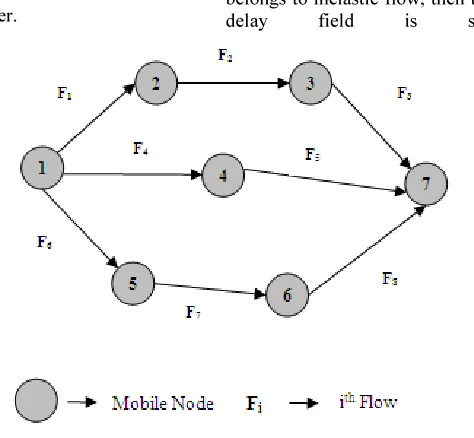
[image:5.595.192.429.380.599.2].
Figure 1: Connected Network
Consider the connected MANET network given in figure1. The network includes seven mobile nodes namely 1, 2… 7 and eight data flows such as
F1, F2… F8. Every flow transmits different data
Table 1: Elastic and Inelastic Flows
Data Packets Flow Id Type of Flow
dP1
dP2, dP3
dP4, dP5, dP6
dP7 dP8 dP9 dP10, dP11
dP12
F1
F2
F3
F4 F5 F6 F7 F8
Elastic Inelastic Inelastic Inelastic Elastic Elastic Inelastic
Elastic
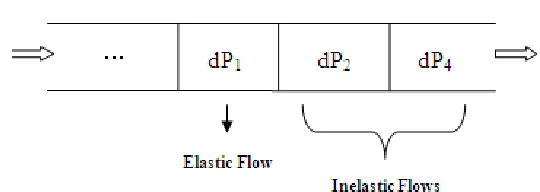
Assume that at time ‘t’, dP1 of F1, dP2 of F2 and
dP4 of F3 arrive the scheduling queue. Once the data
packets are reached the queue, the scheduler overseers the data packets in order to discover the type of flow. From Table1, it is understood that dP1
belongs to elastic flow and dP2 and dP4 correspond
to inelastic flows. Therefore, the scheduler prioritizes dP2 and dP4 over dP1. Since, dP2 and dP4
belong to inelastic flows; the scheduler checks for the delay field of dP2 and dP4 from their utility
functions. It is supposed that dP4 has high delay
value than dP2. Therefore, dP4 is scheduled first,
then dP2 is scheduled and finally dP1 is scheduled
finally. The described process is illustrated in figure 2.
.
Figure 2: Prioritized Flow Scheduling.
The proposed fair-scheduling algorithm for inelastic traffic flows in MANET is described below in algorithm1.
Algorithm-1
1. Let Fel denoes elastic flow and Fin represents
inelastic flow
2. Assume N as the total number of nodes in the
network
3. Let dPi be the ith data packet i = 1, 2 … n
4. Nodes n1, n2… N are initialized in the network
5. Data flows are described as Fel and Fin
considering application requirements
6. Utility function of nodes are calculated as per
equation (11)
7. At time ‘t’, dP’s of different flows are transmitted
over the communication channel
8. Transmitted dP’s reach the scheduling queue
9. The scheduler differentiates dP’s according to
their type of flow they belong
10. If (flow (dPi) = Fin) then
10.1 The dPi is prioritized over other data packets
11. If (dPi = 1) then
11.1 The scheduler schedules dPi with requiring
timeslots
12. Else if (dPi > 1) then
13. The scheduler looks utility function of nodes and
discovers delay value
14. dP’s are sorted according to their delay value
15. dPi that has high delay value is allocated first
16. Else if (flow (dPi) = Fel) then
16.1 The scheduler looks for other dP’s that
correspond to inelastic flow
17. If (There is no inelastic flow data packets) then
18. dP of elastic flow is scheduled
19. Else
20. dP is scheduled with minimum requirements
21. End if
4. SIMULATION RESULTS
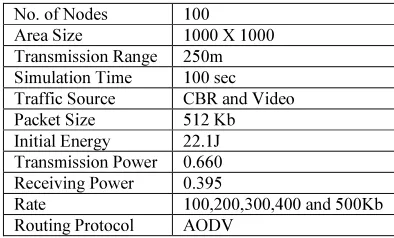
[image:6.595.159.429.367.463.2]The Network Simulator (NS-2) is used to
simulate the proposed architecture. In the simulation, 100 mobile nodes move in a 1000 meter x 1000 meter region for 100 seconds of simulation time. All nodes have the same transmission range of 250 meters. The simulated traffic is Constant Bit Rate (CBR) and Video.
[image:7.595.80.512.57.667.2]The simulation settings and parameters are summarized in table.
Table 2: Simulation Parameters
No. of Nodes 100 Area Size 1000 X 1000 Transmission Range 250m Simulation Time 100 sec Traffic Source CBR and Video Packet Size 512 Kb Initial Energy 22.1J Transmission Power 0.660 Receiving Power 0.395
Rate 100,200,300,400 and 500Kb Routing Protocol AODV
4.2 Performance Metrics
The proposed Energy Efficient MAC protocol With Fair-Scheduling Technique (EEMACFS) is compared with the Optimal scheduling for Fair Resource Allocation (OSFRA) technique [5]. The performance is evaluated mainly, according to the following metrics.
Packet Delivery Ratio: It is the ratio between
the number of packets received and the number of packets sent.
Packet Drop: It refers the average number of
packets dropped during the transmission
Fairness: It is the bandwidth received by each
flow per total available bandwidth.
Throughput: It is the total number of packets
received by the receiver.
Delay: It is the amount of time taken by the
nodes to transmit the packets to the receiver.
Residual Energy: Average energy remaining
on nodes
4.3 Results
The transmission rate of both the CBR and Video traffic is varied as 100, 200, 300, 400 and 500Kb.
Rate Vs Fairness
0 0.5 1 1.5
100 200 300 400 500
Rate(Kb)
M
b
/s EEMACFS
[image:7.595.89.286.258.377.2]OSFRA
Figure 3: Rate Vs Received Bandwidth
Rate Vs Delay
0 10 20 30
100 200 300 400 500
Rate(Kb)
D
e
la
y
(S
e
c
)
EEMACFS
OSFRA
Figure 4: Rate Vs Delay
Rate Vs DeliveryRatio
0 0.2 0.4 0.6 0.8 1
100 200 300 400 500
Rate(Kb)
Del
iver
y
Rat
io
EEMACFS
OSFRA
Figure 5: Rate Vs Delivery Ratio
Rate Vs Drop
0 5000 10000 15000
100 200 300 400 500
Rate(Kb)
P
kt
s EEMACFS
OSFRA
Rate Vs ResidualEnergy
0 5 10 15 20
100 200 300 400 500
Rate(Kb)
E
n
e
rg
y
(J
)
EEMACFS
[image:8.595.89.292.105.385.2]OSFRA
Figure 7: Rate Vs Residual Energy
Rate Vs Throughput
0 5000 10000 15000
100 200 300 400 500
Rate(Kb)
T
h
ro
u
g
h
p
u
t
EEMACFS
OSFRA
Figure 8: Rate Vs Throughput
Figure 3 shows the fairness of EEMACFS and OSFRA techniques for different transmission rate scenario. It is shown that the fairness of EEMACFS approach has 79% of higher than OSFRA approach. Figure 4 shows the delay of EEMACFS and OSFRA techniques for different transmission rate scenario. The delay of EEMACFS approach has 61% of less than OSFRA approach.
Figure 5 shows the delivery ratio of EEMACFS and OSFRA techniques for different transmission rate scenario. The delivery ratio of EEMACFS approach has 73% of higher than OSFRA approach. Figure 6 shows the packet drop of EEMACFS and OSFRA techniques for different transmission rate scenario. The packet drop of EEMACFS approach has 67% of less than OSFRA approach.
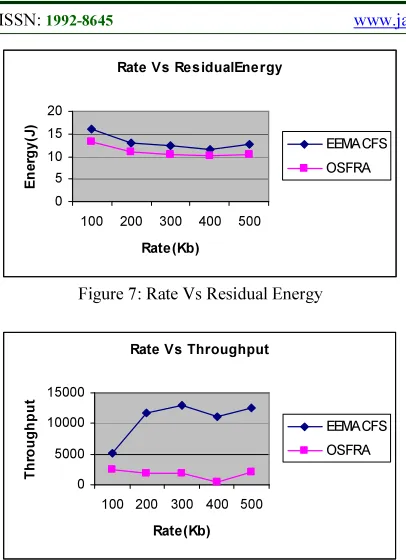
Figure 7 shows the residual energy of EEMACFS and OSFRA techniques for different transmission rate scenario. The residual energy of EEMACFS approach has 16% of higher than OSFRA approach. Figure 8 shows the throughput of EEMACFS and OSFRA techniques for different transmission rate scenario. It is shown that the throughput of EEMACFS approach has 81% of higher than OSFRA approach.
5. CONCLUSION
In this paper, it is put forwarded fair-scheduling technique for inelastic traffic flows in MANET. In
this technique, data packets of inelastic flows are prioritized over data packets of elastic flows. Utility function is estimated considering channel utilization, channel state information along with delay of data packets. When data packets arrives the scheduler, it initially differentiates them according to the type of flow it belongs. Data packets of inelastic flows are sorted as per their delay field in utility function. The data packet with high delay value is prioritized and scheduled first. The proposed technique is validated through simulation results. By simulation results, it is shown that the proposed technique attains better fairness with reduced delay and energy consumption.
REFERENCES:
[1] Sang-Chul Kim, “An Energy Efficient Scheduling Algorithm for Cluster- Based Mobile Wireless Networks”, Proceedings of IEEE Fourth International Conference on Ubiquitous and Future Networks, Phuket, Thailand, July 4-6, 2012 , pp. 357-362.
[2] Nur Idawati Md Enzai, Farhat Anwar and Omer Mahmoud, “Evaluation Study of QoS-Enabled AODV”, Proceedings of IEEE International Conference on Computer and Communication Engineering, Kuala Lumpur, Malaysia, May 13-15, 2008, pp. 1254-1259. [3] Kanika Garg and RishiPal Singh, “Scheduling
Algorithms in Mobile Ad hoc Networks”,
International Journal of Computer Science & Applications , Vol. 1, No. 5, 2012, pp. 16-24. [4] Nur Idawati Md Enzai, Siti Sara Rais and
Rosheila Darus, “An Overview of Scheduling Algorithms in Mobile Ad-hoc Networks”,
Proceedings of IEEE International Conference on Computer Applications and Industrial Electronics, Kuala Lumpur, Malaysia, December 5-8, 2010, pp. 120-124.
[5] Juan Jos´e Jaramillo and R. Srikant, “Optimal Scheduling for Fair Resource Allocation in Ad hoc Networks with Elastic and Inelastic Traffic”, Proceedings of IEEE INFOCOM Conference, San Diego, California, USA, March 14-19, 2010, pp. 1-9.
[6] Yiming Liu, Victor O. K. Li, Ka-Cheong Leung, and Lin Zhang, “Topology-Transparent Distributed Multicast and Broadcast Scheduling in Mobile Ad hoc Networks”,
[7] Hamidreza Salarian and Pejman Khadivi, “Fair
Data Flows Scheduling Schema for Multi hop Wireless Ad hoc Networks”, Proceedings of 16th Asia-Pacific Conference on Communications, Auckland, 31 October -3 November, 2010, pp. 503-508.
[8] Tao Ma, Xinming Zhang and Guoliang Chen, “A Maximal Clique Based Packet Scheduling Algorithm in Mobile Ad hoc Networks”,
Proceedings of Springer International Conference on Networking, Caribbean, French, March - 4, 2012, pp. 690-695.
[9] Sneha S.Tirth, S.M.Jagade & Shilpa Sapatnekar,
“Scheduling Techniques for MANET with CDMA Protocol”, Proceedings of Engineering Innovation and Technology Conference, Nagpur, India, July 1, 2012, pp-64-68.
[10] D. Anitha, and Dr.M.Punithavalli, “Secure MANET Communication Using Cluster Based Multicast with Fair Key and Resource Scheduler” International Journal of Computer Science and Networks, Vol. 2, No. 1, 2013, pp. 125-134.
[11] Dimitrios J. Vergados, Aggeliki Sgora, Dimitrios D. Vergados and Periklis Chatzimisios, “Joint Per-Flow Scheduling and Routing in Wireless Multi hop Networks”,
Proceedings of IEEE Symposium on Computers and Communications, Kerkyra, Greece, 28 June -1 July, 2011, pp. 213-217. [12] Dang-Quang Bui and Won-Joo Hwang,
“Proportionally Quasi-Fair Scheduling Optimization in Wireless Ad hoc Networks”,
Proceedings of IEEE Advanced Information Networking and Applications Conference, Fukuoka, Japan, March 26-29, 2012, pp. 641-648.
[13] Vijay S Rao, R Venkatesha Prasad, R Muralishankar, and I.G.M.M. Niemegeer, “Maximizing the Fair Allocation of Opportunistic Spectrum for CR Ad hoc Networks”, Proceedings of IEEE Global Telecommunications Conference, Houston, TX, USA , December 5-9, 2011, pp. 1-5. [14] Amit P. Jardosh Krishna N. Ramachandran
Kevin C. Almeroth Elizabeth M. Belding-Royer, “Understanding Congestion in IEEE 802.11b Wireless Networks”, Proceeding of the 5th ACM SIGCOMM conference on Internet Measurement, Berkeley, CA, USA , October 19, 2010, pp. 1-25.
[15] Jagadeesh Kumar, S.J.K. and T. Purusothaman, “A Cross Layer Frame Work for Enhanced Quality of Service Provisioning
in Worldwide Interoperability for Microwave Access Networks”, Journal of Computer Science, Vol. 8, No.1, 2012, pp 420-424. [16] Fan Wang, Ossama Younis and Marwan
Krunz, “Throughput-oriented MAC for mobile ad hoc networks: A game-theoretic approach”,
Ad hoc networks, Vol. 7, No. 1, 2009, pp. 98– 117.
[17] P.Sivanesan and Dr.S.Thangavel, “Achieving Energy Efficient MAC protocol for MANETs by Channel Utilization and Queue Size”,