A MODEL OF THE REUSE OF THE PROFILES OF
LEARNERS
1ADIL JEGHAL, 2LAHCEN OUGHDIR, 3HAMID TAIRI, 4ANAS EL AFFAR
1,3 LIIAN, Department of Informatics Faculty of Science Dhar-Mahraz P.B 1796 Atlas-Fez 2,4LIMAO
,
Department of Mathematics, Physics and Informatics Polydisciplinary Faculty -TazaUniversity of Sidi Mohamed Ben Abdellah – Fez - Morocco
E-mail: [email protected], [email protected], [email protected],
ABSTRACT
The use of learner profiles is one of the ways to adapt learning to the learners’ specifics, as the computing environments for Human Learning (EIAH) allow users to view the learner profiles and perform activities on their visualizations. We are interested in the reuse of heterogeneous profiles coming from different platforms. Our goal is to propose models and tools to enable or to allow the reuse of external profiles. In this article we present a state of the art on the existing models and our proposed model.
Keywords: CSCW Profiles, EIAH, Online Learning, IMS LIP, PAPI Learner, FOAF.
1. INTRODUCTION
A learner’s profile is a set of information used to represent a learner. We can create a profile manually as paper-pencil or using a system (EIAH). Our research is based on the reuse of learner’s profiles in order to adapt the learning into the needs of learners, but before we come to this step the profiles must be normalized in order to facilitate their reuse. For this we launched the project 2CVPR (creation, conversion and viewing of profiles for reuse), which aims to develop a system that allows teachers to convert profiles from another system, as well as view these profiles to facilitate their use to adapt the learning. In the following of this article we present the first phase of the project CVPR regarding to the proposal of our model that we will use later in our system to represent a learner profile.
2. STUDY OF THE EXISTENCE
In our issue of the reuse of profiles we need to do a study on the subject profile and the deferent models of profile’s representation that exists in the literature.
2.1 Definition
A learner profile evokes something that is obtained after analyzing the results of a learner; it is also a range of information that describes the knowledge and skills as well as its process, behavior, motivations... We can consider a learner profile as a picture of a learner at a given time. A
learner profile represents a range of information about a learner or a group of learners, collected or deducted at the end of one or more educational activities. The information contained in the profile of the learner can be related to knowledge, skills, concepts, behavior, or even meta-cognitive information (Jean-Daudias, 2009a). [1]
2.2 Standards and data models of existing
profiles
There are different standards for modeling profiles:
2.2.1 IMS LIP
LMS Learner Information Package is defined in a XML structure for a learner data exchange between several systems including management systems learning [2]. The purpose of this standard is to facilitate the exchange of a learner information between educational systems, learning management systems ...
IMS LIP is structured in eleven basic categories: • The identification: elements to identify such as name, address, email address, ...
• The Goal: information on the goals of the learner . • Qualification, Certification and Licensing: diplomas awarded to a learner.
• The Activity: activities related to the work and training of the learner.
• Transcript: data on the content of the learner training.
• Affiliation: Description of the organization associated to the learner.
• Accessibility: the preferences of the learner or the tutor, its languages, and its possible disabilities. • Security: data security of a person, such as passwords and access rights.
• Relationship: Description of relationships between data structures to store the data of the learner used in this model.
2.2.2 PAPI Learner
PAPI Learner (Public and private information) [5] is a standard proposed by the Learner Model Working Group of the IEEE group, which describes the information of useful learner for
communication between cooperative systems. Six types of information are defined by the
standard, which also make possible the extension of each one of them. In the PAPI model, a learner profile is defined by:
• Personal information about the learner. • Relational information.
• The information security.
• Information on the performance of the learner. • The portfolio information.
• Information related to the preferences of the learner.
2.2.3 FOAF
FOAF (Friend Of A Friend) is based on an RDF that is defined in the framework of an open source project, to describe people and their relationships with each other. [4] FOAF distinguishes five categories to describe a profile: FOAF includes a basic description such as name, e-mail, images. Personal Information describes personal
information such as blog, interests, publications and relationships to other profiles who know this person. Online Accounts defines the information on the projects, groups or organizations in which the person is a member. Documents and Images describe the documents and images related to the learner.
2.2.4 Jean Daubias Model
According to Jean Daubias a learner profile is defined from 20 different sizes [1]:
• Subject: human actor concerned by the profile. • Collaboration: the activities of the learner are they made individually or collectively.
• Distance: these activities are performed in the presence of learners or remotely.
• Discipline: Discipline of the information contained in the profile.
• Level: educational level of the subject. • Initiator: human actor at the origin of decision profile creation.
• Creator: actor constituting the profile. • Recipient: Actor that is exploiting the profile. • Time: consideration of time.
• Evolution: scalability profiles.
• Type: The type of information contained in the profile.
• Nature: nature of the information contained in the profile.
• Valuation: type of scale used to assess.
• Internal representation: representation used by the system to manipulate profiles.
• External representation: representation used by the system to store the profile.
• Visualization: representation used to present the profile to its recipients.
• Standard: educational norm or standard respected. • Format: storage format of the profile.
• Platform: compatible informatics platform. • Device: type of visualization device of the profile.
3. PROPOSED MODEL TO DEFINE A
LEARNER PROFILE
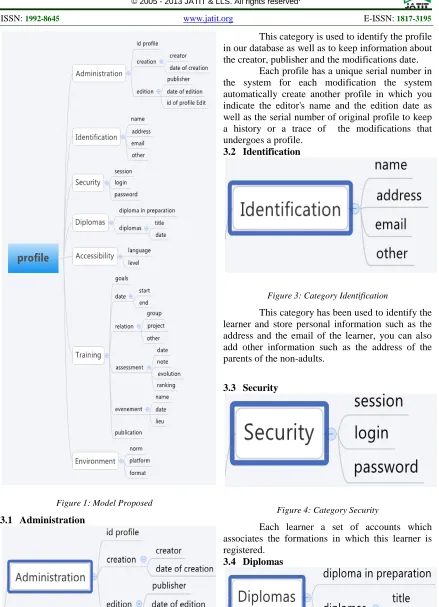
Our goal is to propose a model that exploits the benefits of the existing standards. Based on the study we did on the deferent existing models, we made a model by combining the advantages of other models and adding what is missing.
Figure 1: Model Proposed
3.1 Administration
Figure 2: Category Administration
This category is used to identify the profile in our database as well as to keep information about the creator, publisher and the modifications date.
Each profile has a unique serial number in the system for each modification the system automatically create another profile in which you indicate the editor's name and the edition date as well as the serial number of original profile to keep a history or a trace of the modifications that undergoes a profile.
3.2 Identification
Figure 3: Category Identification
This category has been used to identify the learner and store personal information such as the address and the email of the learner, you can also add other information such as the address of the parents of the non-adults.
3.3 Security
Figure 4: Category Security
Each learner a set of accounts which associates the formations in which this learner is registered.
3.4 Diplomas
By using this class to represent information regarding the educational level of the learner, the diploma is indicated during the preparation as well as other diplomas already obtained and the date of obtaining, you can even add a mention for obtaining for each diploma.
[image:4.612.315.526.163.259.2]3.5 Accessibility
Figure 6: Category Accessibility
This category is used to get an idea on the languages that a learner knows to avoid the assignment of training that takes place in languages he doesn’t know.
[image:4.612.93.302.329.633.2]3.6 Training
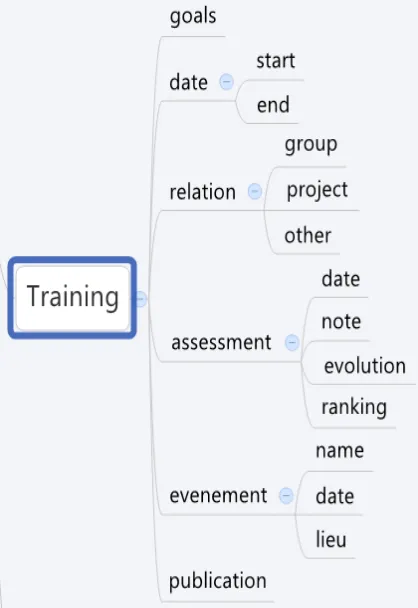
Figure 7: Category Training
In this category all information regarding training are almost gathered, we start with the goal, the start date and the end date of training to get an idea about the duration of training, then in the relationship subcategory we represent the collaborative work of the learner (group project ...), the subcategory assessment is used to assess a
learner, we indicate their notes, rating and evolution (we take on consideration the last note and the current note), subcategory event is like a calendar that shows the events in which the learner will participate, subcategory publication is optional.
[image:4.612.324.525.418.736.2]3.7 Environment
Figure 8: Category Environment
This category is used to represent information about system EIAH and the respected norm during the profile creation is the storage format, in our case we have chosen to store the created profiles with our system as XML files.
4. REPRESENTATION AND DATA
STORAGE
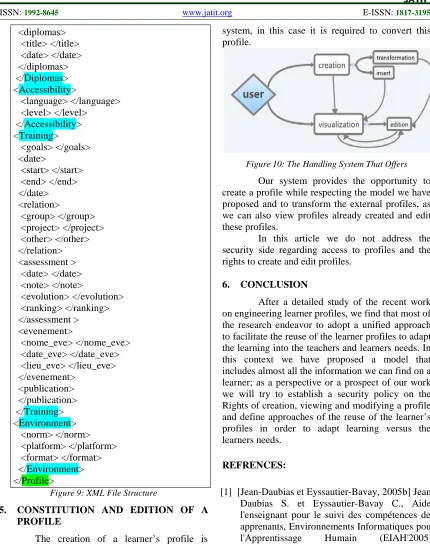
To make the created profiles with our system portable and usable by other system, we have chosen to use the XML standard to represent and store the profiles of the learners.
<Profile> <Administration> <Id> </Id> <creation>
<creator> </creator>
<dateof_creation > </date_of_creation > </creation>
<edition>
<publisher > </publisher >
<date_of_edition > </date_of_edition> <id_of_profile_Edit> </id_of_profile_Edit> </edition>
</Administration> <Identification> <name> </name> <address> </address> <email> </email> <other> </other> </Identification> <Security>
<session> </session> <login> </login>
<password> </password> </Security>
<Diplomas>
<diplomas> <title> </title> <date> </date> </diplomas> </Diplomas> <Accessibility> <language> </language> <level> </level> </Accessibility> <Training> <goals> </goals> <date> <start> </start> <end> </end> </date> <relation> <group> </group> <project> </project> <other> </other> </relation> <assessment > <date> </date> <note> </note> <evolution> </evolution> <ranking> </ranking> </assessment > <evenement> <nome_eve> </nome_eve> <date_eve> </date_eve> <lieu_eve> </lieu_eve> </evenement> <publication> </publication> </Training> <Environment> <norm> </norm> <platform> </platform> <format> </format> </Environment> </Profile>
Figure 9: XML File Structure
5. CONSTITUTION AND EDITION OF A
PROFILE
The creation of a learner’s profile is divided into two phases:
1st phase: collection of information We may collect information manually with a questionnaires or using a computer system in which the learner describes all the informations that will help us to create the profile.
2nd phase insertion of information
The information we want to insert can be from our system as they can be from another
[image:5.612.91.521.69.613.2]system, in this case it is required to convert this profile.
Figure 10: The Handling System That Offers
Our system provides the opportunity to create a profile while respecting the model we have proposed and to transform the external profiles, as we can also view profiles already created and edit these profiles.
In this article we do not address the security side regarding access to profiles and the rights to create and edit profiles.
6. CONCLUSION
After a detailed study of the recent work on engineering learner profiles, we find that most of the research endeavor to adopt a unified approach to facilitate the reuse of the learner profiles to adapt the learning into the teachers and learners needs. In this context we have proposed a model that includes almost all the information we can find on a learner; as a perspective or a prospect of our work we will try to establish a security policy on the Rights of creation, viewing and modifying a profile and define approaches of the reuse of the learner’s profiles in order to adapt learning versus the learners needs.
REFRENCES:
[1] [Daubias et Eyssautier-Bavay, 2005b] Jean-Daubias S. et Eyssautier-Bavay C., Aider l'enseignant pour le suivi des compétences des apprenants, Environnements Informatiques pour l'Apprentissage Humain (EIAH'2005), Montpellier, France, pp. 353-358, 2005b.
[2] CEN (2009). Learning Technologies Standards Observatory.
[3] PAPI (200). Public and private Information; IEEE 200, Draft Standard for Learning Technologiy.
[5] [jean-Daubias, 2011b] Jean-Daubias S. ACUTE4profils, un modèle de cycle de vie des profils d’apprenants, EIAH 2001- Environnements Informatique pour l’Apprentissage Humain, Mons, Belgique, pp. 75-78, 2011b.
[6] [Eyssautier-Bavay et Jean-Daubias,2011] Eyssautier-Bavay c. , Jean-Daubias S. , PMDL : a modeling langauge to harmonize heterogenous learners profiles, ED-MEDIA 2011 – World Conference on Educational Multimedia, Hypermedia & Telecommunication ,2011.