TM
The Datapoint Marketing
Newsletter
"Out-thinking our cOllIpetition to help your ClistO/llers out-think theirs"
No.26 CONFIDENTIAL - FOR DA T APOINT USE ONL Y September 1980
Announcement Package for
931
0/9320
Drives and Systems
Some information on the various
systems is included here to assist in
MODEL 1514 1515 1816 1817 1818 1819 1820 9310 9320
PROCESSOR 60K 1500 60K 1500 64K 1800 128K 1800 64K 1800 128K 1800 128K 1800
N/A
N/A
* four-port comm adaptor
What's in a System?
All of the systems below contain a single diskette drive. This is the standard drive for each processor, single density for the 1500, dual density for the 1800. Both processors can support up to four of the
9310/9320 disk drives for a total of 40MB of storage. (Who said the 1500 doesn't have enough storage?). The 9310 and 9320 drives can be mixed in a system, the only difference between them being the integral FPCA in the 9320. This is a four-port comm adaptor, not eight-port like a 9462. It is powered by the 9320, however, and does not require a 9022 power supply.
The 0506 upgrade kit will convert a 9310 drive to a 9320 drive. It consists of the FPCA which can be installed in the field. So your customer doesn't have to get the FPCA on his initial order if he doesn't need it right off the bat.
Continued on page 2
your marketing of this product. First is model codes and descriptions:
INTEGRAL
DISKETTE DISK FPCA *
.25MB 10MB No
.25MB 10MB Yes
.5MB 10MB No
.5MB 10MB No
.5MB 10MB Yes
.5MB 10MB Yes
.5MB 10MB No (R'II,i),al
N/A
10MB NoN/
A
10MB YesIt's here! The 10MB disk cartridge drive for 1500 and 1800 processors may now be ordered. All of you are probably aware of the fact that this drive is manufactured by Honeywell Bull in France, imported by us, and assembled at our plant in Sunnyvale.
You should also realize that we are in the standard production ramp-up period with this product. What you may not be aware of is the popularity of this product--everybody wants one.
The initial plan was to have the shipments controlled during the first quarter of availability, but that is not going to be the case now. It is going to be simply FIFO -- first in, first out. So the earlier you get your order in, the earlier you will get it shipped. Special cases such as key accounts or customer satisfaction situations will be handled in the usual manner for these types of orders -- through the RM and the OPS Area Director. You can check with your RM to find out what the lead times are going to be initially.
Some additional Model Codes of interest to you are:
MODEL DESCRIPTION
80501 10MB removable cartridge 0506 9310 to 9320 upgrade kit
(adds the FPCA to the 9310)
PRICE $250 $850
INST
N/A
$150MAINT
N/
A
$8(See Figure E for pricing of drives and various systems and components)
2
Continued
He can order the 0506 kit at a later
time and then have the
OATASHARE® capability when he
really needs it. As an example, say that
your account needs a 1514 today but
may need a 1515 at some later date. He
can order the 1514 now and upgrade
later to a 1515 with the upgrade kit.
Same holds true for the 18xx
con-figurations.
DATASHARE
and the FPCA
The 1515, 1818, and 1819 contain
an integral FPCA and thereby support OAT ASHARE systems. The 1515 runs OS41500 which is a modified version
of OS42200. (See Figure A for major differences between OS41500 and OS5). OS41500 will support up to four
stations with the console optionally
serving as port 1. OS5 version 3 runs
on the 1818 and 1819 and will support up to five stations on the 1818 (the console plus four tubes), and up to nine stations on the 1819 (the console plus eight tubes) with the addition of a second 9320 drive. Since the 9320
contains only four ports, a second 9320
is required to configure the additional four stations.
OS5 will support a 9462 MPCA in conjunction with a 9310 drive. This
configuration would be desirable in a
situation where a customer has
previously purchased an 1800, 9462, and 9022 power supply and wishes to
upgrade to a 9310 drive.
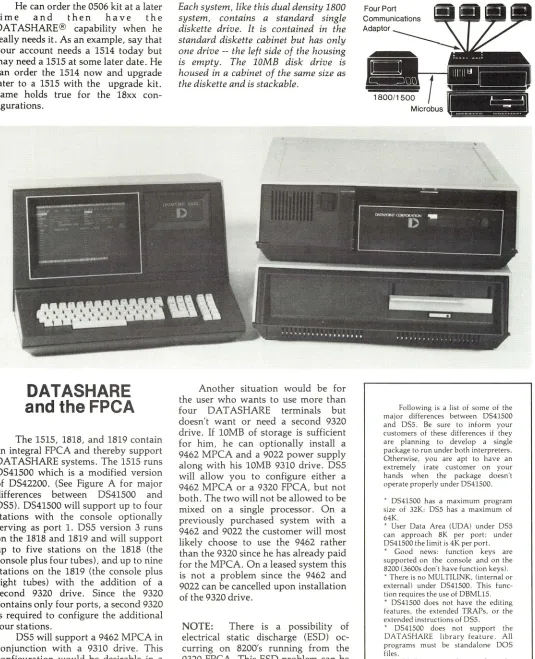
Each system, like this dual density 1800 system, contains a standard single diskette drive. It is contained in the standard diskette cabinet but has only
one drive -- the left side of the housing
is empty. The 10MB disk drive is
housed in a cabinet of the same size as the diskette and is stackable.
Another situation would be for the user who wants to use more than
four OAT ASHARE terminals but doesn't want or need a second 9320 drive. If 10MB of storage is sufficient for him, he can optionally install a 9462 MPCA and a 9022 power supply along with his 10MB 9310 drive. OS5 will allow you to configure either a 9462 MPCA or a 9320 FPCA, but not both. The two will not be allowed to be
mixed on a single processor. On a previously purchased system with a 9462 and 9022 the customer will most likely choose to use the 9462 rather
than the 9320 since he has already paid for the MPCA. On a leased system this
is not a problem since the 9462 and 9022 can be cancelled upon installation of the 9320 drive.
NOTE: There is a possibility of electrical static discharge (ESO)
oc-curring on 8200's running from the 9320 FPCA. This ESO problem can be minimized by using the three pair
shielded cable (Model Code 3449) instead of the standard three twisted pair cable (Model Code 3452).
For il1lernaluse olily
Four Port Communications
Adaptor
Microbus
8200's
Following is a list of some of the major differences between OS41500
and OS5. Be sure to inform your
customers of these differences if they
are planning to develop a single
package to run under both interpreters.
Otherwise, you are apt to have an
extremely i rate customer on your
hands when the package doesn't
operate properly under OS41500.
• OS41500 has a maximum program size of 32K; OSS has a maximum of 64K.
* User Data Area (UOA) under OS5 can approach 8K per port; under OS41500 the limit is 4K per port.
* Good news: function keys are
supported on the console and on the
8200 (3600s don't have function keys).
* There is no MUL TrUNK, (internal or
external) under OS41500. This
func-tion requires the use of OBMLl5.
* OS41500 does not have the editing
features, the extended TRAPs, or the
extended instructions of OS5.
* OS41500 does not support the
OAT ASHARE library feature. All
programs must be standalone DOS files.
* Highlighting is implemented on the
[image:2.612.43.578.44.703.2]console only.
How to Make Your
Diskette System
Grow Up
So far we have been discussing systems. Now let's talk upgrades. To upgrade an existing 1800, simply order a 9310 or 9320 drive (depending on whether or not you need the integral FPCA). A 1500 must have 60K of
memory, so a 1532 must also get the memory expansion kit (model code
6674) in addition to the 9310/9320 drive. A 1536 requires only the 9310/9320 since it is already at 60K. Extension drives are the 9310/9320 drives. Same drive, same price. There is no difference between the initial drive and add-on extensions. But 9310 drives can be added on to a 9320 with
no problem, so you don't have to pay for the FPCA if you don't need it on
extension drives. And remember that the 9310 can also be field upgraded to a 9320.
The 9310/9320 upgrade drives do not include the single diskette drive. The upgrades utilize the existing double diskette drives on the basic system. There is no way to order the
single diskette as an upgrade either -- it
is only available on the system
con-figurations, such as the 1515 and 1818. So the upgraded 1500 and 1800 diskette systems will consist of the 10MB disk cartridge drive and the standard two-drive diskette module.
To upgrade an existing 64K 1800 to 128K, order the 64K memory ex-pansion kit (model code 0542) at a one -time cost of $1500. This is a new product. Monthly maintenance is $8 and installation is $125.
Now is as good a time as any to mention that every 9310/9320 drive is shipped with one model 80501 removable disk cartridge. This includes all of the systems as well as the upgrade/extension drives. So, if your customer wants only one cartridge, you don't have to order any.
What about
Diskettes?
Let's discuss the relationship between the diskettes and the disks. This relationship differs on the 1500 and the 1800 processors. Both processors require a diskette to Boot
from. The ROM Boot has not changed, and therefore it still looks for a diskette. Once the diskette is Booted, the new Boot routine looks for the presence of an on-line active 9310/9320 drive. If one is found, it then becomes the Booted drive and becomes logical drive 0 (zero). This is where the 1500 and the 1800 begin to differ.
The 9310/9320 drive on a 1500 runs DOS.H just like the diskette. As a result, the diskettes are treated as on-line storage in addition to the disk. This means that a 1514 or 1515 system
will have 10.25MB of storage--10MB of disk plus .25MB of diskette. An upgraded 1532 or 1536 will have 10.5MB of storage. Programs and data may reside on the disk or the diskette as needed by the user and are accessible from all languages. Data files may be transferred between the media via the COPY command as in the case of diskette-to-diskette transfers.
The 1800 runs DOS.G on the diskettes and DOS.D on the 9310/9320
disks. This prevents the diskettes from
being on-line with the disk drives. Files may be transferred between the disks and the diskettes by using COPYFILE. After the 9310/9320 is Booted, the diskettes "go away" from the system. They effectively become a backup
media only.
1500 REMAP
An additional feature on the 1500 is a utility called REMAP. This allows the user to logically remap the drive assignments to any desirable con-figuration. For example, the default drive assignment is for the 9310/9320 to be drives 0-3 and the diskettes to be drives 12 and 13. This allows for three 9310/9320 drives (as 0 through ll) and four diskettes (as 12 through 15). But that is awkward to deal with since 4 through II are unused on a single-drive system. So the user can REMAP them to assign the diskettes as drives 4 and 5, thereby using contiguous drive numbers. It is also used to MAP out the diskettes when a fourth disk drive is installed. The configuration will remain until REMAP is run again or until the processor is Booted. REMAP is chain compatible, making it relatively simple and fool-proof for use by unskilled operators in remote sites.
For ill/emu/use ollil'
How to Do
Disk Backups
There are two new utilities called LOAD15 and LOAD18, for use on the 1500 and 1800 processors, respectively. These allow backup of the 9310/9320 drive to diskette. The 9310/9320 drive
is divided into four logical drives of 2.5MB each (that's not bad though, because you get 1024 file names instead of 256). LOAD15 and LOAD18 backup an entire logical drive (2.5MB)
onto diskettes. It will span diskettes, serially marking them as it goes. To backup one logical drive, you will need
ten diskettes on a 1500 and five
diskettes on an 1800. The execution time for these utilities is three and a
half (3112) minutes per diskette. These diskettes are in a unique, compressed
format usable only by the respective
LOAD utility to restore a disk drive.
These two utilities work on a logical DRIVE basis and perform a
mirror-image backup of the disk.
Another method of accomplishing
backup is on a logical FILE basis. In a
normal production environment the
only data that you really need to backup is the volatile data files. The actual programs (DBC files), System
files, Utility files, Index files (1151 files)
and the like do not change or do not need to be backed up on a regular basis. So you can use the COpy utility on the 1500 or the COPYFILE utility on
the 1800 to copy these data files on a file-by-file basis to diskette for backup.
The LOAD procedure can be used one
time to create a complete backup of all programs and System files, and the production backup can be done through the COPY or COPYFILE routine. This will provide a practical means of obtaining a backup of the data files while significantly reducing the amount of time required to perform that function in comparison to the LOAD routine.
Something to be aware of: DC-CONV18, DCDFMT18, DCDFMTl5 are not supported on the 9310/9320
drives. Any user wanting to utilize these utilities must have a two-diskette drive system. On the 1800 it must run under DOS.G in a diskette-only en-vironment. So don't order one of the seven system configurations if these utilities are to be used. Order a 1500 or 1800 diskette system with an add-on 9310/9320 drive.
4
1800 as ARCTM AP
Did you notice that the 1800 uses OOS.O with a 9310/9320? What possibilities does that hold? For one thing, it means that the 10MB of data is treated as local on-line storage if the 1800 is on an ARC system (they're all OOS.O). This is an economical means of providing local storage on an ARC system. Perhaps you have a prospect or a customer that wanted that capability but balked at the price of the system that was previously required to do it. With the 1816 there is an ex-tremely attractive solution to the
problem of local storage on an ARC system -- 10MB of data in an
easy-to-use, compact drive that spins up and
down in approximately 10 seconds.
1800 FP in a
" Little"
ARC System
But then why do we have that
1820 system without the FPCA but
with a RIM? Could that possibly be a
File Processor? No way, right? Wrong!
The 128K 1800 with a 9310/9320 drive
and an external Rim can function as a
File Processor on an ARC system. But what could you possibly do with it,
you ask. Well, it could function as an
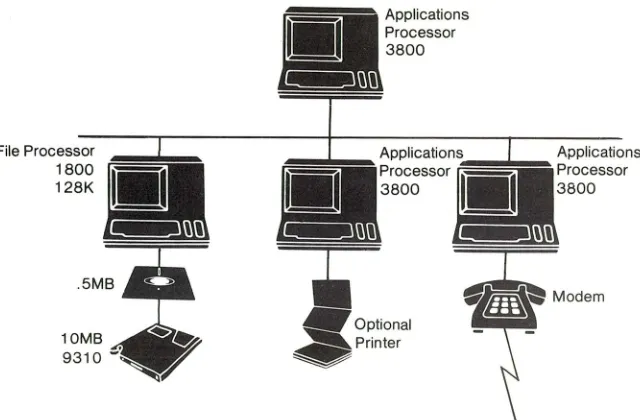
FP in an introductory ARC system
with three or four 3800 processors. This makes a perfect introductory ARC system, or a small clustered word
processing system, for that user who
doesn't need a whole lot of horsepower right now but doesn't want to be locked out of an upgrade path later.
With this configuration he buys what
he needs today with the option of expanding it later into whatever configuration he might need. This makes the ARC building block ap-proach even more versatile than ever by taking it another step lower in price and performance, opening up a whole new market that you couldn't satisfy before.
And the beauty of this approach is that when you expand later on and add a 6600 FP, the 1820 can become an AP
with local storage or can remain as a secondary, or auxiliary, FP in the same ARC system.(See Figure B for system configuration) .
File Processor
1800 128K
10MB 9310
Figure B --1800 as FP in Small ARC or
Clustered Word Processing System
This is still an 1800 processor,
about 113 the speed of a 6600 FP. But
in a small ARC system running lEaS
and jobs that are not lIO bound, it should function satisfactorily. Ben-chmark figures on this configuration
will be distributed later as soon as they are completed. What you have here is a good introductory ARC system at a
low price with great upgrade potential.
180
0
L
ocal FP in
a
"B
i
g"
AR
C Sy
stem
Another use for an 1820 FP would
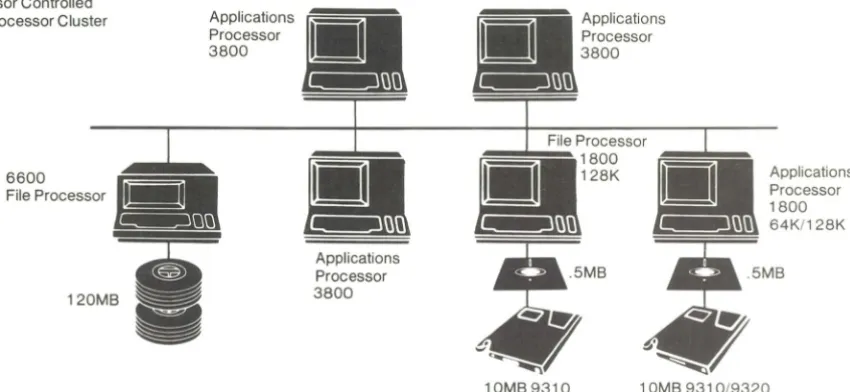
be as a sub-FP, or local FP, in a larger ARC system. With the advent of lEaS on ARC, the storage requirements are going to increase dramatically. Every document entered by every user on the ARC system would have to be on-line at all times on the central FP. That
could rapidly grow into a large storage
requirement involving several File
Processors. But the judicious allocation
For infernal use only
of a few 1820s in the office area could
reduce that requirement significantly.
By giving each of several office areas
their "own" 1820, the users would have
direct control over which lEOS
document libraries were available at
any time. They could easily pop disk
cartridges in and out as needed and put
a virtually unlimited storage
requirement on removable cartridges
instead of on-line File Processor
storage. They would still have access
to the central FP for software and
storage, but would have their own
local dedicated FP for their own
storage needs. Nifty idea, isn't it? (See
Figure C for system configuration).
And don't forget the program-mers. With their own 1820 they could
ensure that software under
develop-ment would in no way affect the
production software. They could
retain copies of production data files
on the 1820 for test purposes and not
worry about blowing up the system.
Software and data files could be moved
from the central FP to the 1820 with the
COPY command at will. They could
create their own sub-ARC within an
ARC for test purposes by simply
running MOUNT on drives from the
1820 only. And the same 1820 could be
used as an AP by simply Booting it and
running MOUNT to access the central
FP. Talk about versatility! This is the answer to every development
[image:4.612.225.545.60.270.2]\' I
\
File Processor Controlled
by Three-processor Cluster Applications Processor
3800
Applications Processor
3800
6600
[image:5.615.82.507.62.258.2]File Processor
Figure C -- Using an 1800 as a
Locally-Controlled Database
Software
and
Documentation
There are only a few new pieces of software on the 9310/9320 drives. The
1500 uses DOS.H 2.5, the 1800 uses DOS.D 2.6 (ordered on dual-density
diskettes and loaded onto the
9310/9320). The 1800 uses DS5 version 3. Following are the new software
items with model codes:
Model Users Description Code Price Guide Price
DS41500 LOAD15 LOAD18 DOS.H2.5 DOS.D2.6
20727 $15 50482 $4.00 20726 $15 50497 $1.50 40426 $15 50498 $1.50 40279 $15 50308 $9.00 40427 $15 50432 $15.00
Additional pieces of literature that you might be interested in are the product spec, GODE, and flysheet. A copy of the product spec and the GODE are included in the shipping list of every drive. Model codes and prices are:
Model
Description Code Price
9310/9320 Product
Specification 60876 $1.50
9310/9320 GODE 60910 $1.00
9310/9320 Flysheet 60918 $0.50
Applications Processor
3800
1 OMS 931 0
The 80501 disk cartridges are
shipped in virgin condition--they are
not formatted. DOSGEN will need to
be run on them before they can be
used. All software will be distributed on diskette and loaded onto the disk at the user's site. The 1500 systems use
DOSGEN under DOS.H 2.5 to prepare
the disk cartridges. The 1800 systems
use a new utility called GEN9320, which is included with DOS.D 2.6 on
dual density diskettes. All seven
system configurations will include in
their shipping lists all of the software
1 OMS 931 0/9320
Applications Processor
1800 64K/128K
related to the 9310/9320 drives. For upgrades the software must be ordered separately since there is no way of determining on which processor a
9310/9320 drive will be installed. The LOAD15 and LOAD18 utility programs are not included on any of the system diskette packages and must therefore must be ordered separately when ordering an upgrade drive. They
are, however, included in the shipping lists of the seven system con-figurations.
OATAPOINT 9310/9320 CARTRIDGE DISK DRIVE
6
DATASHARE
Benchmarks
Some preliminary OAT ASHARE benchmarks were run on 1515 and 1818 systems to get a feel for the relative performance of the two
systems. These benchmarks were designed in a manner that tended to "break" the system, not as a "real
world" environment. The same tests
were made about a year ago on other OAT ASHARE systems, so we were
able to give you side-by-side
per-formance factors for most systems in
[image:6.615.29.383.593.726.2]comparison to the 9320 systems. (See
Figure 0 for benchmark timing
results. )
Basically, what the benchmarks illustrate is that the 1818 appears to
outperform a 3800 running the same
applications under OAT ASHARE. The
1818 is, however, slower than a 5500--no big surprise.
The benchmark results show that
the 1800 has a performance edge on the
1500 under OAT ASHARE. But then the 1800 has a similar edge in most
areas of performance. It is, after all,
"big brother" to the 1500. As more
ports were added to the configurations,
the 1800 showed a slightly greater
performance than the 1500. But the
1500 functions quite well in a OAT ASHARE environment with two
or three ports. If you are going to need
more ports than that or if you need a parallel 110 bus, go with the 1800. Otherwise the 1515 makes a beautiful
small OAT ASHARE system at only
$17,630.
The tests used here were run in
April 1979 on all of the listed systems
with the exception of the 1515 and 1818
systems. The times stated were ob-tained at that time. The tests were run just recently on the 1515 and 1818 to
obtain their times. All of the systems are listed here in an effort to provide
Test "A"
D~sK Act1Vl.ty
Processor Software Low Med H~ h
1170 0541170 4.05 3.90 5.67
2200 0542200 2.43 3.62 5.39
1800
Diskette 0551800 1. 55 2.99 5.28
3800 ARC/0551800 1. 50 2.59 3.41
5500 ARC/0555500 1. 42 1. 66 2.43
6600 ARC/0556600 1. 43 1. 61 2.35
6600 ARC/OS55500 1. 44 1. 66 2.37
1515 0541500 2.38 3.98 5.93
1818 055 3.1 1. 55 2.48
Figure D --Benchmark Timing Results
you with a comparative chart to determine proper placement of the 1515 and 1818 OAT ASHARE systems.
Three tests were run with different configurations. Test "A" was
con-figured with three ports running key data entry. Low disk activity was based on 200 records of 20 bytes each being keyed in and sequentially written to disk. Medium disk activity was the same thing plus a single ISAM read of a
SO byte record for each record written. High disk activity was again the same thing plus 3 ISAM reads of a SO byte record for each record written.
Test "B" is identical to Test "A"
except that a fourth task was brought up. This task was strictly a number crunching program. The effect of this program is to tie up the background in OATASHARE with heavy processor activity.
Test "C" is identical to Test "A"
except this time the fourth test is doing a display loop. The effect of this program is to load down OAT ASHARE's foreground activity.
In each test the first port of 200 writes concluded the test.
The figures given are the average times in seconds per record for each of the various systems.
3.19
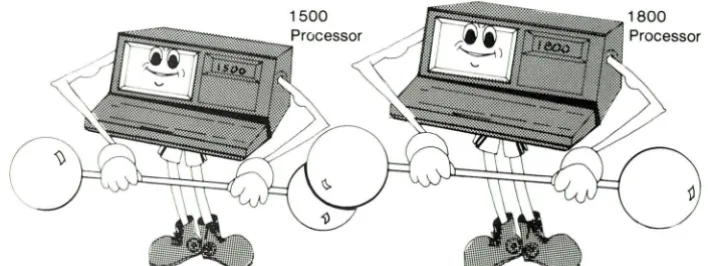
The 1800 is the "Big Brother" to the 1500, showing
slightly greater performance than the 1500.
For inlernal lise onlv
Test "B" Test "C" D1Sk ACt1Vl.ty Dl.sk Activity
Low Me H~g Low Med H[g):l
5.16 6.12 7.98 4.13 3.89 5.95
2.45 3.57 5.34 2.49 3.72 5.62 1. 75 4.24 7.61 1. 63 3.33 6.11
1. 66 3.35 5.49 1. 61 2.75 3.82 1. 61 2.30 3.67 1. 4 7 1. 68 2.47
1. 57 2.17 3.22 1. 4 3 1.72 2.28
1. 56 2.32 3.61 1.43 1. 6 3 2.29
2.35 4.15 6.13 2.67 4.42 6.41
1. 75 3.32 4.67 1.65 2.72 3.57
"Real World" 1500
DATASHARE
Benchmarks
In a separate benchmark the 1500 was tested in a manner that more closely resembled a production en-vironment. OS41500 was configured with four ports, port one being on the console. User data area was evenly divided among the four ports. The situation emulated was that of a user with two ports performing an order entry function on a regular basis, and two ports executing an occasional inquiry-only function on an irregular basis. The order entry function was simulated by running the OAT ASHARE Super Demo package on the console and an 8200 terminal. The two inquiry stations were not implemented, but the configuration was such that the overhead was there in OS41500, which still polled them.
The console and the 8200 were both running through the full gamut of the Super Demo package while the other two phantom ports were idle. The response time experienced on the active ports was quite satisfactory.
There was little or no degradation on either port due to the activities on the
IEOS
on
the
Mighty
9320
Benchmarks were also run for
lEaS on 1500 and 1800 systems
configured with the 9310/9320 drive. The results were extremely pleasing to those people considering running lEaS on either of those two processors. The 1515 had performance just under that of a 3800. The 1818 performance was
virtually equal to that of the 3800. This
just serves to prove that both of these systems can serve quite satisfactorily as stand alone lEaS Word Processing stations in addition to performing their normal Data Processing functions.
Don't forget that the 9310/9320
drives are daisy chained along the diskette micro-bus on both the 1500
and 1800 processors. There is no
parallel 110 bus on the 1500. So if a
customer needs a parallel 110 device
(such as a printer or tape drive), the
1500 cannot be used. That would
require the 1800. The gains made with
the 9310/9320 drive are greatly
enhanced storage capacity, improved
110 speed, and DATA SHARE
capability on the 1500. A great system
--in the Datapoint tradition!
That pretty much gives you all of
the information available on the
9310/9320 drive. You should be able to answer any and all questions that will
be presented in a marketing situation.
You have waited a long time for this product, and now it's here. There should be absolutely no problem in marketing it -- the marketplace has
been demanding this enhancement and
is eagerly awaiting its availabilty. This
drive will give you whole new markets
that you couldn't approach before, and
give both the 1500 and 1800 processors an extremely attractive and positive upgrade path like never before. It's here, it's official, it's available, it's highly marketable.
Any questions pertaining to these products can be directed to Product Marketing, Small Systems, at ex-tension 7583.
Figure E--Pricing Chart
MOIJEL COIJE 8.
DESCIlIPTION
2.J..lJl
10MB CAATRIUG~ DISK ~OR
1500 Oil 1800, WITHOUT
4-POrtT COMM. AUAPTOR
OIY 1-3 OIY 4-10
OTY 11-25
OTY 26-50 OTY 51+
£.12Q $10,400 59,880 $9,360 $8,840 58,320
10MB CARTrtIUGE DISK fOR
1500 OR 1800, WITH
4-PORT COMM. AUAPTOR OIY 1-3
OIY 4-10 OTY 11-25
OTY 26-50
OTY 51+
lill
$10,950
$ 10,400 59,B55
$9,308
$8,760
1500 PROC., 60K MEMORY, .25MB SINGLE DISKETTE
DRIVE, 9310 CARTRIDGE
DISK DRIVE OTY J-3 OTY 4-10
OTY 11-25
OTY 26-50
OTY 5J+
.l5...L2
$17,160 $16,300
$15,444
$14,566 $13,726
1500 PROC., 60 K MEMORY,
.25MB SINGLE DISKETTE DRIVE, 9320 CARTRIDGE DISK DIlIVE
OTY 1-3 OTY 4-10
OTY 11-25
OTY 26-50 OTY 51 +
l.llli! $17,630 $16,750 SI5,867 $14,966 $14,104
1600 PROC., 60K MEMORY, .5MB SINGLE DISKETTE DRIVE, 93JO CARTRIDGE DISK OOIVE
OTY 1-3 OTY 4-10
OTY 11-25 OTY 26-50 OTY 51+
S20,280 $J9,266 5.16,252 $17,236 S 16,224 LIST PIlICI: LI:ASE I-YIl
$10,400 $460
S I 0,950 $480
$17,160 $790
SI7,630 $610
$20,260 $830
'
..6.11
l800 PROC., 126K MEMORY, $21,560 $865
.5MB SINGLE DISKETTE DRIVE, 9310 CARTRIDGE DISK DRIVE
OTY 1-3 OTY 4-10 DIY 11-25
OTY 26-50 OTY 51+
JJlJJl 521,580 $20,500 $19,425 S16,3~5 $17,265
1600 PRoe., 60K MEMORY, .5MB SINGLE DISKETTE DRIVE, 9320 CARTRIDGE
DISK DIliVE
OTY J-3
DIY 4-10
OTY 11-25
OTY 26-50
DIY 51+ lill2 $20,750 $.19,713 $16,675 $17,638 $16,600
1800 PROC., 128K MEMORY,
.5MB SINGLE DISKETTE
DRIVE, 9320 CAIlTRIDGE DISK rniVE
OIY 1-3
OIY 4-10
OTY 11-25 OTY 26-50 OTY 51+ .LllZ.O.
S22,050 S20,950
$19,845
518,745 SI7,640
1800 PRoe., 128K MEMORY, .5MB SINGLE DISKETTE DrtiVE 9310 CART~IOGE
UISK, IlIM OTY 1-3
ory 4-10
ory 11-25
OTt 26-50
OIY 51+
$22,050
520.950
519,845 $1 e, 745
517,640
520,750 S850
S22,050 5905
$22,050 5905
F(}r illiemai 11.1(' ()lIil'
LI:ASI: ~-Yli $390 $407 $673 $690 $733 $778 $750 $795 S795 LEASE 3-YR
S34U $355 S565 S600 $650 $687 S665 $ 702 $702 $575 S600 $966 $1015 SI036
$ II 06
$1063
$ II 32
$ II 32
~AINT INSTL
S80 $ I 75
$ 80 5175
$143 5250
$ 15 I 5250
$170 $250
$178 5250
$178 $250
$186 $250
$186 5250
(f)
~
til::J CD
»
-....j 0 ::J f\) C~
0 (]l -i::J 0 ~
o
·
til Ia~
-is"
Z
co"
A x Q. til ::J ~ UJ ... A -....j 0 ... 0(]l
-CO<
'
Z
f\) CO
CO ~