Kate Finley. Tagging Feminist Books: Implications for Subject Access. A Master‘s Paper for the M.S. in L.S degree. August, 2011. 32 pages. Advisor: Ryan Shaw
Library of Congress Subject Headings (LCSH) have received much criticism over the years. In particular, the controlled vocabulary‘s treatment of women and feminism has been heavily analyzed. Although progress has been made in this area in recent years, much of feminism remains outside the border of LCSH coverage. Additional strides toward optimal subject description of feminist materials can be made through the
combination of LCSH headings and folksonomies in online library catalogs. In this study, for a sample of 20 books, a comparison was made between terms offered by
LibraryThing tags for these books and terms available in LCSH for describing them. Results indicate that tags found in folksonomies can often fill omissions in LCSH coverage of feminist materials.
Headings:
Folksonomy
Library of Congress Subject Headings/Evaluation Subject cataloging/Evaluation
TAGGING FEMINIST BOOKS: IMPLICATIONS FOR SUBJECT ACCESS
by Kate Finley
A Master‘s paper submitted to the faculty of the School of Information and Library Science of the University of North Carolina at Chapel Hill
in partial fulfillment of the requirements for the degree of Master of Science in
Library Science.
Chapel Hill, North Carolina July 2011
Approved by
Table of Contents
Introduction 2
Literature Review 3
Methodology 8
Results 11
Conclusion 19
Appendix: Sample List 22
References 24
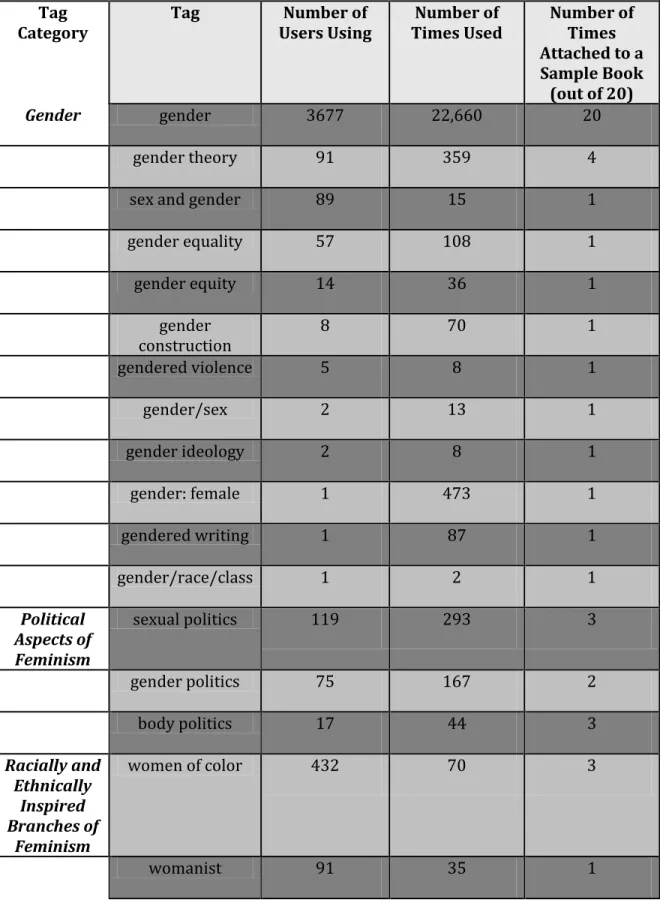
Table 1: Significant Tags Discussed in Paper 27
Introduction
In the time elapsing since their release, Library of Congress Subject Headings (LCSH) have been the subject of much criticism from the library community. This criticism has been directed toward the controlled vocabulary‘s inability to adequately describe resources dealing with issues of race, ethnicity, and religion; alternative sexualities and gender expressions; women; and more. This insufficient descriptive power has taken the form of both a lack of appropriate headings and the existence of headings which are actually offensive to those belonging to the groups noted above. This descriptive insufficiency in terms of a lack of adequate headings for describing feminist materials in particular will be the focus of this study.
Gerhard, Su, & Rubens (1998) have stated that LCSH‘s difficulty in providing proper descriptive headings for feminist materials is due to the interdisciplinary nature of feminism. Rather than dealing simply with women, feminism or women‘s studies
―provides fundamentally new, integrative approaches to many established topics‖ (Gerhard, Su, & Rubens, p. 130, 1998). The lack of Library of Congress (LC) headings available for these materials means that often excessively general, and therefore
insufficient, headings must be applied (Gerhard, Su, & Rubens, 1998).
for terminology change to LC, in recent years Lau, Steele, Spiteri, and others have presented a more creative solution which involves not change to LCSH itself but rather adaptation from outside the system (Adler, 2009). This solution involves the description of library materials through a combination of traditional subject vocabularies, such as LCSH, and folksonomies.
Literature Review
Of early criticisms of LCSH, Berman‘s is the most well-known. In 1971, he published the seminal Prejudices and Antipathies: A Tract on the LC Subject Heads Concerning People, a work which shone a light on the considerable problems with existing subject headings due to their often offensive coverage of people outside of the white, male, middle-class, Christian norm. Within this work, he devoted an entire chapter to ―Man, Woman, Sex,‖ in which he examined numerous problematic headings,
subdivisions, and cross-references that existed at that time, such as the heading reading ―Women as accountants [architects, artists, astronauts, soldiers, etc.],‖ which insinuated that women being in these professions was unnatural in some way, and the
cross-reference leading one from the ―Abortion‖ subject heading to the ―Infanticide‖ and ―Offenses against the person‖ headings (Berman; p. 174, 176; 1971.).
in the traditionally accepted rational male perspective (Olson, 2007). Olson (p. 62, 2000) has also had much to say regarding the content of LCSH‘s coverage of feminist materials, including the following regarding LCSH‘s inability to adequately provide coverage of feminist topics:
If feminism is frozen in the amber of history or relegated to the fringes of
otherness, then it is safely differentiated from topics to be treated seriously. This kind of distortion makes it easier to ignore topics that are outside of the cultural mainstream, just as exclusion makes topics invisible and marginalization sets them aside.
In terms of solutions to this problem, Capek and others have come up with entirely new vocabularies specially designed for the description of materials related to women and feminism. Capek‘s (1987) A Women’s Thesaurus: An Index of Language Used to Describe and Locate Information By and About Women is a prime example of this sort of vocabulary. The thesaurus contains over 5000 subject terms, many of which are not included as part of LCSH, such as ―patriarchal religion‖ and ―images of girls‖ (Capek; p. 232, 344; 1987). Some of these terms, such as ―sisterhood,‖ are ones which were identified as significant tags during this study (Capek, p. 433, 1987).
effort. Also, as Olson (2007) has noted, the problem of hierarchy is not eliminated with alternative vocabularies such as Capek‘s Thesaurus.
Even a controlled vocabulary more responsive than LCSH to the necessity of changes and additions to its terms would be hard pressed to provide adequate subject access consistently to all topics, as societal thought and the words and phrases used to represent this thought are ever-changing. Adler (2009) has gone into detail regarding the lengthy nature of the process by which changes to controlled vocabularies such as LCSH are made. In order to request a change to an existing heading or an addition to the
vocabulary, a librarian must complete an often laborious proposal proving ―literary warrant‖ for the heading (Adler, p. 313, 2009). Even after this prolonged process,
applications are apparently regularly rejected (Adler, 2009). This lengthy change process means that official vocabularies are often unable to stay current.
In view of the problems associated not only with LCSH but also with other standardized vocabularies which have been introduced as alternatives, it seems clear that perhaps the problem lies with the fact that subject terms are originating from authoritative sources rather than from users themselves. The following statement is an excellent
presentation of this idea:
Standards have authority, afforded to them by aggregations of ‗expert‘ input and consensus. But the question then becomes who is left out of these expert circles? Who is left out of the dialogue and the negotiation of these standardized
Perhaps then, the solution must come from outside of the system. It is here where folksonomies come into the picture. Folksonomies can be defined as the application by users of tags, or labels, of their own creation to resources in an online environment (Steele, 2009). In view of the above-described problems with controlled vocabularies, it is evident that folksonomies have a number of advantages over controlled vocabularies in describing library materials. As Lau (p. 8, 2008) has noted, ―folksonomic categories are comparatively more comprehensive than standardized classification in that the former emerges from pluralized user experiences, rather than from artificial and prescribed cleavages that carry the potential to fail in capturing important nuances of information.‖ Additionally, because of the somewhat limitless nature of tags, in addition to increased coverage in terms of topic, folksonomies offer the possibility of increased ways in which to describe concepts. As Veres (2006) has noted, tags can contain parts of speech, such as adjectives and verbs, which are not traditionally used by standardized classification systems. Additionally, Golder and Huberman (2008) found in their study of Del.icio.us tags that tagging practices among users in a single environment can eventually move toward the consistency seen in controlled vocabularies.
as use of recognized spellings and utilization of single terms, she also found that there was room for improvement in terms of things such as abbreviations and homographs.
Some studies have compared the merits of folksonomies and controlled
vocabularies as pertaining to the description of materials in a particular subject area. The most notable of these is perhaps a study carried out by Adler (2009) which explored the impact that this kind of integration could have on the description of transgender-related resources. In the study, for a number of books, metadata created for these materials by users in LibraryThing was compared to LCSH headings in the books‘ corresponding records in WorldCat. Although the specific terms which were identified as being provided by user tags but not by LCSH were few (only ―Drag queens‖ and
―Genderqueers‖), the possible impact on the description of transgender materials seems substantial (Adler, p. 310, 2009).
Considering the mixed quality of the terms contained by both standardized vocabularies and folksonomies, Lau (2008) and others have suggested that the perfect solution to the problem of subject access is a combination in library catalogs of these two forms of subject description. Lau (p. 9, 2008) stated that
Classification need not privilege standardization over folksonomy, or vice versa. Perhaps a happy medium could be reached through a marriage of the two, taking the benefits of both and using them to improve the organization of information and how users retrieve it…perhaps this marriage of the two can be articulated in systems that acknowledge the validity of both, and aim to incorporate the two alongside each other.
which allows libraries to import LibraryThing data, including tags users have assigned to books on the LibraryThing site, into their online catalogs (Rethlefsen, 2007).
The second option is to create a tagging system with the catalog itself. The most notable example of this option is PennTags, the tagging system available to users of the University of Pennsylvania‘s online catalog (Rethlefsen, 2007). Although this second option certainly provides a more seamless experience for users, there are downfalls associated with it as well. For example, the tagging in this kind of system is only carried out on a local scale, as only users of the particular library at hand utilize the tagging feature (Steele, 2009). Although a local focus such as this might be advantageous for some libraries, many libraries may want to be able to benefit from the ―mass tagging‖ done on a site such as LibraryThing (Rethlefsen, p. 28, 2007). Furthermore, some, including LibraryThing founder Tim Spalding, believe that users simply do not feel an impulse to tag books in library catalogs. (Rethlefsen, 2007). It is uncertain then, whether this second option will ever be truly viable.
Methodology
Considering the preceding discussion, the following questions can be asked: Can folksonomic terms provide representation of the content of feminist works in a way which cannot be achieved by terms available in LCSH, as was the case for the
In order to do so, a methodology has been used which is modeled in part after that utilized in the Adler study. As with that study, this study involves the comparison of user-generated metadata with LC headings, although this study is of course focused on
feminist materials rather than on materials dealing with gender identity. Also, although the Adler study involved comparison of LibraryThing tags for monographs with LC headings on the monograph‘s WorldCat records, this study instead entails a direct comparison between LibraryThing tags and headings available in the 32nd edition of LCSH.
of the number of times the tag has been used to describe it. It is these tag clouds and tag pages which were observed in order to gain the data gathered for this study.
Within LibraryThing‘s folksonomy, it is clear that there are bound to be tags which are identical in terms of concept representation but dissimilar in terms of format. LibraryThing bridges differences in capitalization, language, spelling, abbreviations, and so on in order to group terms together which are representative of the same concept. LibraryThing refers to these variations as ―aliases,‖ and users have collocated a large number of them. For each of these tag groups, a main tag has been selected which represents the alias group as a whole. It is this tag which appears at the top of an individual tag page. All works appended with any of the tags in an alias group are collocated. For example, ―Feminism,‖ ―feminism,‖ ―FEMINISM,‖ and ―feminisme‖ are considered to be aliases by LibraryThing, and are represented by the main tag
―feminism.‖
In order to construct this study‘s sample, the LibraryThing page for the ―feminism‖ tag and its aliases was observed. Navigating through this list, books were checked for inclusion in the Women‘s Studies: Core Books list (Association of College and Research Libraries – Women‘s Studies Section, 2011). The top 20 books on the ―feminism‖ tag page meeting this criterion were taken in order to create the sample. Each book selected for the sample had, at the time of data collection, a minimum of 241
―members,‖ the term LibraryThing uses to refer to those users who have included a particular book in his or her library.
archaeology, ecofeminism, feminist pedagogy, Latin American women, and transnational feminism (Association of College and Research Libraries – Women‘s Studies Section, 2011). The method of sample creation explained above has allowed for a sample in which books on a number of these sub-lists are included. Additionally, it has allowed the sample to be populated by both books which are older and more well-established, and may therefore be well-known to perhaps even those not particularly interested in feminism, such as Kingston‘s The Woman Warrior: Memoirs of a Girlhood Among Ghosts, as well as newer and perhaps lesser-known works such as Valenti‘s The Purity Myth: How America’s Obsession with Virginity is Hurting Young Women.
Each book‘s tag cloud was studied in order to determine if any tags exist there which represent aspects of the item for which there are no LC headings available to describe. Each tag found meeting this criterion was deemed ―significant.‖ For each of these tags, the number of times which the tag has been applied in LibraryThing overall as well as how many users have utilized the tag in LibraryThing was taken note of in order to quantify the strength of that tag.
The data collected using this methodology took place during the month of June, 2011. The time of data collection is important to note since the use of LibraryThing tags and even the existence of these tags are subject to change, depending on actions carried out by users, such as deletion of or alterations made to tags as well as deactivation of accounts.
Results
significant to the thrust of the study. While some of these tags point to deficiencies in LCSH which have been addressed by previous studies, others represent deficits which have not been heavily attended to in the literature. Use frequency varies widely for these tags, but although some have been infrequently used to describe books in LibraryThing, the fact that they have simply been introduced into LibraryThing‘s subject vocabulary is noteworthy. The average number of significant tags found in a book‘s LibraryThing tag cloud was 5.7.
As data collection for this study progressed, it became clear that many of the significant tags being found provide coverage in one of several concept categories. Those categories which were found to contain at least three tags will be discussed here, and are as follows: gender, political aspects of feminism, racially and ethnically inspired
branches of feminism, other domains of feminism, and feminism geared specifically toward girls as opposed to women. The term LibraryThing has selected to represent a group of tag aliases is what will be utilized in this section when discussing each group of aliases. A list of the tags discussed in this section, as well as more detailed information regarding those tags, can be viewed in Table 1: Significant Tags Discussed in Paper. Gender
From these culturally caused differences stem the differential in experiences of men and women and a reason for the existence of feminism (Archer & Lloyd, 2002).
LCSH does provide terms covering gender-related concepts, such as ―gender-based analysis,‖ ―gender identity,‖ and ―gender mainstreaming.‖ Regrettably, a simple ―Gender‖ heading is not among these. Only the clearly unrelated ―Gender (Musical instrument)‖ and ―Gender (Grammar),‖ meant only for use in describing materials dealing with language, are available. LCSH does include a ―Gender‖ subdivision, but it can only be used ―as a topical subdivision under individual languages and groups of languages.‖ When looking for terms which include the word ―gender‖ in LCSH, one is met with a number of ―SEE‖ references. Most notably, one is directed from ―Gender (Sex)‖ to ―Sex.‖ Other redirections include ―Gender differences‖ to ―Sex differences,‖ ―Gender discrimination‖ to ―Sex discrimination,‖ and ―Gender role‖ to ―Sex role.‖ There is thus not adequate coverage in LCSH of the distinction between gender and sex.
Additionally, although headings such as ―Gender-based analysis‖ are quality inclusions, they may be too specific for some materials (Library of Congress. Subject Cataloging Division). A simple ―Gender‖ heading appears to be much needed.
―gendered violence.‖ Although the hierarchical LCSH heading ―Women—Violence against‖ is available, as well as simple topical headings referring to more specific instances of violence against women, such as ―Abused women‖ or ―Abused wives,‖ as well as the heading ―Abusive men,‖ the ―gendered violence‖ tag implies a perspective on violence against women informed by the societal factors influencing violence perpetrated by men against women (Library of Congress. Subject Cataloging Division). Several other gender-specific tags were observed during the study, including ―gender equality,‖
―gender equity,‖ ―gender/race/class,‖ ―gender theory,‖ and ―gendered writing.‖ Political Aspects of Feminism
Three concepts dealing specifically with the political side of feminism were found to be represented by tags in this study. Millet (p. xix, 1971/2000), in her groundbreaking work Sexual Politics, notes that ―sex has a frequently neglected political aspect,‖ or that it is highly influenced by patriarchy. The concept has clearly been in existence for quite some time, and in LC‘s online catalog, a title keyword search for the term ―sexual politics‖ yields over 200 entries. Despite this clear literary warrant, however, LCSH contains no heading representative of this concept. For a few of the books in this study‘s sample, though, ―sexual politics‖ was used as a tag.
to be able to convey any gender, no matter one‘s biological sex. When cataloging items containing coverage of concepts such as these, one could perhaps use the ―Political aspects‖ subdivision in combination with topical terms such as ―Sex‖ or ―Human body,‖ but it would clearly be optimal to be able to use the phrasing utilized within the feminist community (Library of Congress. Subject Cataloging Division). As with ―sexual
politics,‖ ―body politics‖ and ―gender politics‖ were each found as tags for a small number of books in the sample.
Racially and Ethnically Inspired Branches of Feminism
Although society at large often views feminism as a monolithic movement, it is in fact multifaceted, containing numerous subgroups with varying agendas and beliefs. However, this limited societal view is reflected in the headings available in LCSH for describing works dealing with the various branches of feminism. Olson (p. 62, 2000) outlined the problem best when speaking of the topical heading ―Feminism‖ and the few branch-specific headings offered by LCSH:
The picture of Feminism that arises from the LCSH heading and its references is of a dated white, middle-class, liberal movement with a few in-your-face splinter groups. The most prominent streams of contemporary feminism are not represented. This view of feminism is so homogenized that the main heading by itself has over a thousand entries in the Library of Congress catalogue.
a racially inspired branch of feminism (Library of Congress. Subject Cataloging Division, 2010). This single inclusion makes clear the fact that LC‘s coverage of racial and ethnic divisions of feminism remains far from comprehensive.
While LCSH‘s inclusion of the term ―womanism‖ is notable, the term fails to be adequately granular. This is firstly because, despite womanism‘s roots in thought regarding the black female experience, it is now more expansive, inclusive of many women of color. Additionally, womanism‘s borders expand beyond the realms of feminism, encompassing thought on all other forms of oppression in addition to that of women. So, while womanism may appear to be simply the ―black version‖ of feminism, the movement has a much broader meaning (Phillips, 2006). Therefore, tags observed during the study such as ―Chicana feminism,‖ ―Black feminism,‖ ―Black Women‘s Studies,‖ ―black feminist theory,‖ and even ―black lesbian feminism‖ certainly provide this needed granularity. These terms are additionally helpful since they are more specific and therefore more understandable for the general public, which may not be familiar with subtleties such as the distinction between womanism and black feminism, for instance. The word ―womanism‖ alone does not reveal a connection with women of color, and may even sound strange to those unfamiliar with the vagaries of feminism. A system in which both LC‘s ―Womanism‖ and these specific terms are included would be ideal.
describing works containing information about the actual people who populate these groups (Library of Congress. Subject Cataloging Division, 2010). In Library of Congress‘s catalog, for example, the book entitled We Don’t Need Another Wave:
Dispatches from the Next Generation of Feminists, a work which explores the viewpoints of numerous young feminists, has been accurately cataloged with the ―Feminists‖
heading.
The only headings LCSH contains which refer to specific groups of feminists as divided by race or ethnicity are ―African American feminists‖ and ―Hispanic American feminists‖ (Library of Congress. Subject Cataloging Division). There is an obvious American bias to these terms, and although they could be appropriately used for materials dealing specifically with these subgroups, works with a broader focus cannot be covered with a single heading. Tags such as ―feminists of color‖ and ―women of color‖ were found during the study, and could certainly rectify LCSH‘s lack of generality in this area. Further along this line, the tag ―womanist‖ was also uncovered during the study. Despite the existence of the term ―Womanism‖ in LCSH, a heading representative of individuals within the movement does not exist, and so this tag also fills in a clear gap in the existing LCSH vocabulary (Library of Congress. Subject Cataloging Division).
Additionally representative of the viewpoints of women of color within feminism is the tag ―intersectionality,‖ also found during the study and not included as a term in LCSH (Library of Congress. Subject Cataloging Division). Intersectionality is a feminist concept which refers to the combined effects of sexism and racism on women of color, and was coined by Crenshaw. Crenshaw‘s use of the term includes a 1991 study
women. Regarding this topic, Crenshaw (p. 1244) stated that ―…because of their intersectional identity as both women and of color within discourses that are shaped to respond to one or the other, women of color are marginalized within both.‖ LC‘s failure to incorporate this significant term, despite the substantial period of time in which it has been in use by feminists, is a reflection of the marginalization of women of color of which Crenshaw was speaking.
Other Branches of Feminism
Other facets of feminism were found to be represented by tags as well. As with the above-discussed tag category, it must be noted that LCSH does provide several headings which satisfy the need for heading coverage of various facets of feminism: ―Bisexual feminism,‖ ―Ecofeminism,‖ ―Hip-hop feminism,‖ ―Lesbian feminism,‖ and ―Socialist feminism‖ (Library of Congress. Subject Cataloging Division, 2010). However, tags found during the study identify feminist branches which are equally deserving of subject coverage: ―Radical feminism,‖ ―Transnational feminism,‖ ―Global feminism,‖ and ―Postmodern feminism.‖ In the case of transnational, or global, feminism, LCSH does provide the topical subdivisions ―International cooperation‖ and ―Cross-cultural studies,‖ which can be used alongside the topical term ―Feminism,‖ but these headings don‘t quite capture the desired representation of global-minded feminism. Feminism Geared Toward Girls
notably, ―Girl Studies.‖ The LCSH-like hierarchical structure of ―Girl Culture – 20th Century‖ is interesting to note.
Girl studies is a burgeoning subfield of feminism which got its start during the 1990s. Up until that time girl-specific research had been marginalized within the field of feminism, and Kearney (2009) noted that since its establishment as a specific area of scholarship within feminism, Girls Studies has exploded in a way, with the number of publications specific to this area increasing exponentially each year. Kearney (p. 22, 2009) made the importance of this area of feminism clear when she stated that ―it is important to remember…that even though more girls are asserting themselves publicly – providing real evidence that ‗girl power‘ is not just a marketing slogan – girls cannot on their own make the world a more respectful place for female youth.‖ Expansion of subject vocabulary in order to extend coverage to Girl Studies, and therefore increasing subject access to materials within this domain, is certainly one way in which adults can act as ―allies‖ to girls, an action Kearney (p. 22, 2009) recommends.
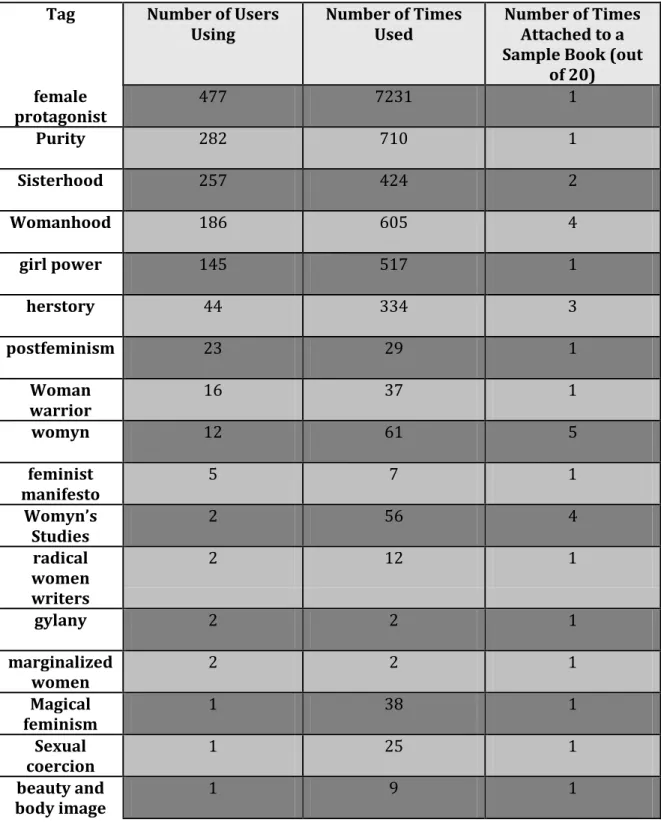
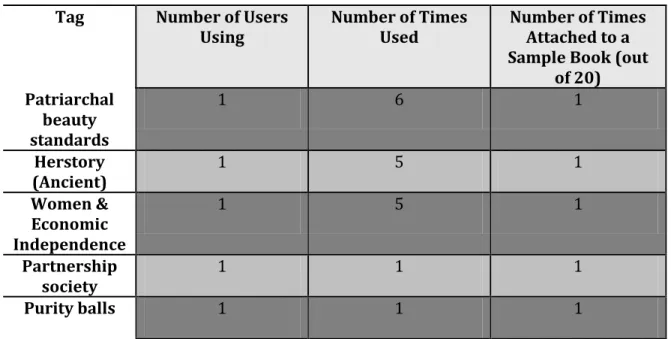
A number of other significant tags, which could not be easily categorized within any of the groups outlined above, were observed during this study. Although these tags are noteworthy in that they, like the tags explored above, remedy current holes in LCSH‘s feminist-related vocabulary, they will not be examined in detail in this paper. Since these remaining tags are certainly worthy of mention though, a number of them have been selected for inclusion in Table 2: Selected Other Significant Tags.
Conclusion
would be significantly helpful in increasing subject access to feminist materials. The same may be true for other subject areas as well, and so it would be highly beneficial for more studies to be carried out which are similar to this study but specific to other subject areas.
It is still uncertain whether tagging in library catalogs will become as ubiquitous as it is in popular social cataloging websites such as LibraryThing. However, it is clear from this study that a strong folksonomy, at least as far as feminist materials are
concerned, exists in LibraryThing. Why not take advantage of these significant terms? It therefore appears that at present a commendable way to make use of folksonomy in order to improve subject access to feminist materials in library catalogs is to import existing LibraryThing terms into library catalogs through the use of LibraryThing for Libraries.
However, it is clear from issues detected in tags observed during the study that implementation of systems of this sort would present metadata quality problems which would need to be dealt with. For example, many of the tags which were observed during the study were riddled with spelling or other errors, or were too personal in meaning to have any significance for other users. These tag problems fall under the umbrella of what Lau (2008, p. 8) refers to as ―metanoise.‖
completely resolved though, it is clear that after tags are imported into library catalogs, assistance from catalogers in eliminating these metadata quality issues would be beneficial. However, although LibraryThing for Libraries does solve some quality
problems by eliminating overly personal tags before allowing libraries to import tags, the system presently does not allow users or catalogers to edit any of the tags imported or add their own tags from within the library catalog. Perhaps eventually, both empowerment of catalog users to create and edit tags and the possibility of assistance from catalogers in achieving metadata quality will be present within catalogs utilizing services such as LibraryThing for Libraries.
Appendix: Books Included in Sample
Angier, N. (1999). Woman: An intimate geography. New York: Anchor Books. Anzaldúa, G. (1987). Boderlands: La frontera. San Francisco: Aunt Lute Books.
Baumgardner, J. (2000). Manifesta: Young women, feminism, and the future. New York: Farrar, Straus and Giroux.
Bordo, S. (1993). Unbearable weight: Feminism, Western culture, and the body. Brumberg, J. J. (1998). The body project: An intimate history of American girls.
Berkeley: University of California Press.
Butler, J. (1990). Gender trouble: Feminism and the subversion of identity. New York: Routledge.
Butler, J. (1993). Bodies that matter: On the discursive limits of sex. New York: Routledge.
Collins, P. H. (1990). Black feminist thought: Knowledge, consciousness, and the politics of empowerment. New York: Routledge.
Douglas, S. J. (1994). Where the girls are: Growing up female with the mass media. New York: Three Rivers Press.
Eisler, R. (1988). The chalice and the blade: Our history, our future. San Francisco: HarperSanFrancisco.
Gilligan, C. (1982). In a different voice: Psychological theory and women’s development. Cambridge: Harvard University Press.
Kingston, M. H. (1976). The woman warrior: Memoirs of a girlhood among ghosts. New York: Vintage Books.
Lorde, A. (1984). Sister outsider: Essays and speeches. Berkeley: The Crossing Press. Pipher, M. (1994). Reviving Ophelia: Saving the selves of adolescent girls. New York: G.
P. Putnam Sons.
Starhawk. (1979). The Spiral Dance: A Rebirth of the Ancient Religion of the Goddess. San Francisco: HarperCollinsSanFrancisco.
Stone, M. (1976). When God was a woman. San Diego: Harvest Books.
Valenti, J. (2009). The purity myth: how America’s obsession with virginity is hurting young women. Berkeley: Seal Press.
References
Adler, M. (2009). Transcending library catalogs: A comparative study of controlled terms in Library of Congress Subject Headings and user-generated tags in LibraryThing for transgender books. Journal of Web Librarianship, 3(4), 309-331. doi:
10.1080/19322900903341099
Archer, J. & Lloyd, B. B. (2002). Sex and gender (2nd ed.). Cambridge: Cambridge University Press.
Association of College and Research Libraries – Women‘s Studies Section. (2011). Women‘s studies: Core books. Retrieved from
http://digicoll.library.wisc.edu/ACRLWSS/About.html
Beauvoir, S. de. (1953/1983). The second sex. New York: Alfred A. Knopf.
Berman, S. (1971). Prejudices and antipathies: A tract on the LC Subject Headings concerning people. Jefferson, NC: McFarland and Company.
Capek, M. E. S. (Ed.). (1987). A women’s thesaurus.New York: Harper and Row. Crenshaw, K. (1991). Mapping the margins: Intersectionality, identity politics, and violence against women of color. Stanford Law Review, 43(6), 1241-1299. Retrieved from http://www.jstor.org/pss/1229039
Gerhard, K., Su, M. C., & Rubens, C. C. (1998). An empirical examination of subject headings for women‘s studies core materials. College and Research Libraries, 59(3), 129-137. Retrieved from
Golder, S. A., & Huberman, B. A. (2008). The structure of collaborative tagging systems. Retrieved from http://www.hpl.hp.com/research/idl/papers/tags/tags.pdf
Kearney, M. C. (2009). Coalescing: The development of girls‘ studies. National Women’s Studies Association (NWSA) Journal, 21(1), 1-28.
Lau, A. J. (2008). Burning down the shelf: Standardized classification, folksonomies, and ontological politics. Interactions: UCLA Journal of Education and Information Studies, 1-12.
Library of Congress. Subject Cataloging Division. (2010). Library of Congress Subject Headings. (32nd ed.) Washington: Library of Congress.
Millett, K. (1971/2000). Sexual politics. Urbana: University of Illinois Press.
Olson, H. A. (2000). Difference, culture and change: The untapped potential of LCSH. Cataloging and Classification Quarterly, 29(1), 53-71. doi:
10.1300/J104v29n01_04
Olson, H. A. (2007). How we construct subjects: A feminist analysis. Library Trends, 56(2), 509-541. doi: 10.1353/lib.2008.0007
Peterson, E. (2008). Parallel systems: The coexistence of subject cataloging and folksonomy. Library Philosophy and Practice, 1-5. Retrieved from
http://www.webpages.uidaho.edu.libproxy.lib.unc.edu/~mbolin/e-peterson3.pdf Phillips, L. (2006). The Womanist reader. New York: Routledge.
Schlyter, A. (2010). Introduction. In A. Schlyter (Ed.), Body politics and women citizens: African experiences (11-24). Stockholm, Swedish International Development Corporation.
Schwartz, C. (2008). Thesauri and facets and tags, oh my! A look at three decades in subject analysis. Library Trends, 56(4), 830-842.
Spiteri, L. F. (2007). The structure and form of folksonomy tags: The road to the public library catalog. Information Technology and Libraries, 26(3), 13-25.
Steele, T. (2009). The new cooperative cataloging. Library Hi Tech, 27(1), 68-77. Retrieved from http://www.emeraldinsight.com/journals.htm?issn=0737-8831 Veres, C. (2006). The Language of folksonomies: What tags reveal about user
classification. In C. Kop, G. Fliedl, H.C. Mayr, and E. Métais (Eds.), Lecture Notes in Computer Science. vol. 3999, Natural Language Processing and Information Systems (p. 58-69). Berlin/Heidelberg: Springer.
Table 1: Significant Tags Discussed in Paper Tag
Category
Tag Number of
Users Using
Number of Times Used
Number of Times Attached to a Sample Book
(out of 20)
Gender gender 3677 22,660 20
gender theory 91 359 4
sex and gender 89 15 1
gender equality 57 108 1
gender equity 14 36 1
gender
construction 8 70 1
gendered violence 5 8 1
gender/sex 2 13 1
gender ideology 2 8 1
gender: female 1 473 1
gendered writing 1 87 1
gender/race/class 1 2 1
Political Aspects of Feminism
sexual politics 119 293 3
gender politics 75 167 2
body politics 17 44 3
Racially and Ethnically
Inspired Branches of
Feminism
women of color 432 70 3
Table 1: Significant Tags Discussed in Paper, continued
Tag Category Tag Number of
Times Used Users Using Number of Number of Times Attached to a Sample Book (out of 20)
intersectionality 84 21 3
black feminism 39 113 3
black feminist
theory 7 12 2
Black Women’s
Studies 5 84 2
Chicana
feminism 4 16 1
feminists of
color 2 8 1
black lesbian
feminism 1 6 1
Other Branches of
Feminism
radical
feminism 158 54 2
transnational
feminism 85 6 1
global feminism 64 12 1
postmodern
feminism 3 3 1
Feminism for
Girls girlhood 246 81 3
girl culture 80 10 4
girl studies 68 2 5
Girl Culture – 20th Century
12 1 2
young feminist 3 3 1
Table 2: Selected Other Significant Tags
Tag Number of Users
Using
Number of Times Used
Number of Times Attached to a Sample Book (out
of 20) female
protagonist 477 7231 1
Purity 282 710 1
Sisterhood 257 424 2
Womanhood 186 605 4
girl power 145 517 1
herstory 44 334 3
postfeminism 23 29 1
Woman warrior
16 37 1
womyn 12 61 5
feminist manifesto
5 7 1
Womyn’s
Studies 2 56 4
radical women writers
2 12 1
gylany 2 2 1
marginalized
women 2 2 1
Magical
feminism 1 38 1
Sexual
coercion 1 25 1
beauty and
Table 2: Selected Other Significant Tags, continued
Tag Number of Users
Using Number of Times Used Number of Times Attached to a Sample Book (out
of 20) Patriarchal
beauty standards
1 6 1
Herstory
(Ancient) 1 5 1
Women & Economic Independence
1 5 1
Partnership society
1 1 1