An action inquiry into negotiated learning.
FROGGATT, Bert.
Available from Sheffield Hallam University Research Archive (SHURA) at:
http://shura.shu.ac.uk/19210/
This document is the author deposited version. You are advised to consult the
publisher's version if you wish to cite from it.
Published version
FROGGATT, Bert. (1991). An action inquiry into negotiated learning. Doctoral,
Sheffield Hallam University (United Kingdom)..
Copyright and re-use policy
Sheffield City Polytechnic Library
ProQuest Number: 10694090
All rights reserved
INFORMATION TO ALL USERS
The quality of this reproduction is dependent upon the quality of the copy submitted.
In the unlikely event that the author did not send a com plete manuscript and there are missing pages, these will be noted. Also, if material had to be removed,
a note will indicate the deletion.
uest
ProQuest 10694090
Published by ProQuest LLC(2017). Copyright of the Dissertation is held by the Author.
All rights reserved.
This work is protected against unauthorized copying under Title 17, United States C ode Microform Edition © ProQuest LLC.
ProQuest LLC.
789 East Eisenhower Parkway P.O. Box 1346
AN ACTION INQUIRY INTO NEGOTIATED LEARNING
BERT FROGGATT
A thesis submitted in partial fulfilment of the requirements of the Council for National Academic Awards for
the degree of Doctor of Philosophy
Sponsoring Establishment
The School of Education - Sheffield City Polytechnic
In collaboration with
The Holgate Comprehensive School
Bert Froggatt
An Action Inquiry into Negotiated Learning ABSTRACT
This study employed action inquiry, since its aim was to improve both understanding and practice in the area of classroom negotiation between pupils and teachers, Action inquiry entails practitioner observation, practitioner interaction and practitioner intervention; in this study it was supplemented by an attempt at a phenomenological description of the essential features of negotiation, against which classroom experience could be weighed.
Information about classroom interaction was gathered, by the lone practitioner-researcher, both by participant observation and video -recording (’practitioner observation’). The model of classroom negotiation which emerged was tested against the views of other teachers ('practitioner interaction'). Alternative practices, thought by the informants to be effective, were used to make small-scale interventions in classroom practice (’practitioner intervention'). The understanding of negotiation developed in this way was finally interrogated in the light of a separate phenomenological description of negotiation.
A key aspect of the phenomenology of negotiation is the dynamic - involving communication, strategies of interaction, participation and learning - within which people are willing to examine their differences. This was found to be true of classroom negotiation: Pupil and teacher learned of the differences which existed between them in the context of an ongoing interaction in which both participated. However, classroom interaction involves an inevitable disparity of power, which must be recognised and prevented from subverting negotiation.
ACKNOWLEDGEMENTS Thanks are due to the following people:
Gordon Bell who inspired the early research of my own practice.
John Round who gave his permission to carry out research in the school. Pete Raffell for doing the video recording and generally being around throughout PACE.
Rod Waterhouse, close ally and partner in negotiation at the Holgate school, for constant support, advice and for being interviewed first. Paul Day for letting me analyse a video tape of his lesson.
Alan Flintham for his support, encouragement and open management style. Roger Norman for reading drafts, acting as a critical friend, taking part in the reliability study and providing professional support in every way.
Brenda Moss for proof reading the final draft.
Martin Norman, David Alford, Fred Webb and Rod Petman for help with word processing and computing.
Martin Gill for providing thoughtful insight into how the negotiation processes affected our dealings with the Management of the school, taking part in the reliability study and always being around for a chat. Nigel Akers, Carol Johnson, Kathy Hoblyn and the Nottinghamshire library service for obtaining a great deal of literature for me.
The Senior Management team at Holgate School for their support and funding to turn the project from M.Phil to PhD.
The pupils of Individual Studies classes past and present who have inspired me to continue by their unnerving nack of growing and developing during a two year programme into more self directing people - most of whom are able to go out into the world as capable young adults. The other teacher who allowed me to interview them -Mo, Tim, Linda, Dave, Su, Tony, Pauline, Liz and Paul.
The people who took part in the postal survey who haven’t had a special mention Nigel Collins, Penelope Weston, Alex Seddon, Ruth Loughran, Barbra Crosby, Carol Parkinson, Marylin Jones and those who considered filling it in but put it in the bin in the end.
Shirley Payne, Stephanie Hutchinson and Peter Ashworth for being my supervisors offering guidance, counselling and an academic atmosphere where I could sound out some of my ideas - a group of critical friends. Colin Hill critical adversary in chief - he would argue that black was blue over a pint of beer and I would always disagree - another critical friend.
CONTENTS
LIST OF TABLES vii
LIST OF FIGURES ix
LIST OF TRANSCRIPT EXCERPTS x
LIST OF APPENDICES xi
LIST OF NON-STANDARD ABBREVIATIONS USED xii
1 THE PROBLEM
1.1 A Brief Outline of the Problem Encountered 1
1.2 The Aim of the Study 2
2 METHODOLOGY
2.1 How Can a Practitioner Approach the Problem 5
2.2 Action Inquiry Defined 7
2.3 The Components of Action Inquiry 8
2.3.1 Practitioner Observation 8
2.3.2 Practitioner Interaction 9
2.3.3 Practitioner Intervention 10
2.3.4 Practitioner Communication 11
2.4 The Development of Action Inquiry 11
2.4.1 The Addition of Practitioner Fore-Understanding 13
2.4.2 The Hermeneutic Circle 14
2.4.3 The Addition of Practitioner Interpretation 17
2.5 A Summary of the Action Inquiry as Presented 19
3 PRACTITIONER FORE-UNDERSTANDING
3.1 What Leads the Practitioner to Use This Practice 23
PART 1 THE SEDIMENTATION OF THE RESEARCH SITUATION
3.2 The Biography of the Researcher 26
3.2.1 Historical Details about the Researcher 26
Prior to teaching 26
Critical adversaries 27
Teacher training 27
3.2.2 Themes Emerging From the Historical Outline 31
Disappointments 31
Personal development 31
Relationships in the classroom 32
Political influences 32
Identifications 33
The researcher role 33
A changing fore-understanding 34
3.3 The Prehistory and Starting Point of the Research 35
3.3.1 The Background Prior to PACE 35
3.3.2 The Lower Attaining Pupils' Programme 37
3.3.3 The PACE Project 38
3.3.4 The PACE Project at Holgate School 40
3.3.5 The Individual Studies Programme 43
3.3.6 LAPP Revisited 49
3.3.7 The Essence of the Research Situation 50
PART 2 SEDIMENTATION OF THE SITUATION OF OTHER PRACTITIONERS
3.4 Negotiation in the Sociological Literature 51
3.4.1 Some Definitions of Negotiation 51
3.4.2 Three Differing Conceptions of Negotiation 52
3.4.3 More Recent Literature of Negotiation 54
3.5 Negotiation in the Educational Literature 56
3.5.1 The Rise of Usage of Negotiation in
Educational Literature 56
3.5.2 Negotiation as a Part of
Classroom Decision Making 58
3.5.3 Negotiation as a Tool to Aid Learning 59
3.5.4 Changing Relationships in the Classroom 61
3.5.5 Different Settings for Classroom Negotiation 63
3.5.6 Some Complications of Classroom Negotiation 64
3.5.7 The Use of Contracts in Negotiation 66
3.5.8 Models of Classroom Negotiation
Proposed in the Literature 68
3.5.9 The Negotiation Process in the Classroom 72
3.5.10 Qualities of a Skilled Classroom Negotiator 76
4 PRACTITIONER OBSERVATION
4.1.1 Techniques Defined 80
4.1.2 Dilemmas Faced when Observing Classroom Processes 81
4.1.3 Recording Data in the Classroom 83
4.2 Participant Observation 86
4.2.1 Observations of the Layout of the Classroom 87
4.2.2 Observations of the Lessons 88
Where do the interactions occur? 88
How long do the interactions take? 89 What type of interactions are there? 90
How long is spent on each domain? 91
Is all the negotiation the same? 92
4.3 Case Study 95
4.3.1 The Search for an Interaction Analysis Schedule 96
4.3.2 Critique of Interaction Analysis 97
4.3.3 Developing a Negotiation Analysis Schedule 98
4.3.4 The Reliability Study 101
4.3.5 Discussion of the Reliability Study 107
4.3.6 Analysis of Video Material Using the Schedule 108
The comparison of teaching and negotiation 110 A comparison of different classroom styles 111 The behaviour patterns of classroom negotiation 113 A comparison of relationship and task behaviour 115 An analysis of starting and ending negotiation 116
4.3.7 The Production of Flow Diagrams 119
4.3.8 Discussion of the Flow Diagrams 126
4.3.9 Review of the Analyses 127
4.4 Reflection on the Lessons Analysed 131
4.4.1 The IS Negotiation Process 131
4.4.2 Induction 133
4.4.3 Preparation for Negotiation 133
4.4.4 Contract Negotiation 134
4.4.5 Working Negotiations 138
4.4.6 The Negotiation of Assessment 140
4.4.7 Summary of Assumptions Made by the Teacher 143
4.4.8 The IS Teacher's Summary of the Skills
Required for Negotiation 144
4.4.9 Some Questions Raised by
5 PRACTITIONER INTERACTION
5.1 Triangulation 149
5.2 The Delphi Survey 151
5.3 Field Interviews __ Peer Validation 1 153
5.3.1 The Focussed Interview 153
5.3.2 Interview Procedure 155
5.3.3 The Analysis of the Interviews 158
5.3.4 A Comparison with the Skills
Gleaned from the Literature 163
5.3.5 The Problem and Issues Raised
By the Interviews 164
5.3.6 Suggested Alternative Practice 172
5.4 Postal Survey __ Peer Validation 2 174
5.4.1 The Sample Surveyed 175
5.4.2 The Semantic Differential Scale 175
5.4.3 The Analysis of the Results 177
5.4.4 Delphi Results Compared with the IS Assumptions 182
5.5 Discussion of the Delphi Survey 191
5.5.1 A Summary of the Problems of the Delphi Survey 195
6 PRACTITIONER INTERVENTION
6.1 The Action Stage of Action Inquiry 197
6.2 Evaluating Action By Nominal Group Technique 202
6.2.1 Nominal Group Technique Described 202
6.2.2 The Stages of an NGT Meeting 203
Presentation of the quetion 204
Individual silent writing of answers 204
Round robin listing 205
Item discussion and clarification 205 Item evaluation and rank ordering 205
Discussion and subsequent action 206
6.3 Interventions Made in the IS Programme 206
6.3.1 Changes to the Induction Course 207
6.3.2 Changes to the Preparation Stage 210
6.3.3 The Changes Made to the Contract Document 213
6.3.4 Changes Made to Working Negotiation 217
6.3.5 The Changes Made to Negotiated Assessment 218
6.4 Interventions Revisited 222
7 PRACTITIONER INTERPRETATION
7.1 Preliminary Considerations 227
7.2 Prerequisites to Negotiation 229
7.2.1 The Classroom Situation 230
7.2.2 Is There Opportunity to Negotiate? 230
7.2.3 Is There a Genuine Decision to be Made? 232
7.3 The Intention to Negotiate 234
7.3.1 Is There Intention to Interact in the ClassroonQ 236
7.4 Working Towards an Outcome 239
7.4.1 Are the Teacher and the Pupil
Working Towards an Out cornel 240
7.5 The Assumptions of Face to Face Interaction 244
7.5.1 Is There Face to Face Interaction in the ClassroonQ2M
7.6 Role Taking 247
7.6.1 Is There Role Taking in the Classroom? 248
7.7 Strategies in Interaction 250
7.7.1 Are There Strategies of Interaction
in Classroom Negotiations? 252
7.8 Power 258
7.8.1 Who Holds the Power in the Classroom Negotiation? 260
7.9 Participation 265
7.9.1 Is There Participation in the ClassroonQ 268
7.10 The Consideration of Difference 271
7.10.1 What Differences Need Negotiating in the ClassroonQ212
7.11 Learning 274
7.11.1 Is There Learning in Classroom Negotiation? 275
7.12 Agreement 277
7.12.1 Is There Agreement in the ClassroonQ 278
7.13 The Essentials of the Phenomenon of Negotiation 278
7.13.1 The Essentials of Classroom Negotiation 283
8 SOME SUSPICIONS OF THE RESEARCH PROCESS
8.1 Is the Practitioner the Ideal Researcher? 294 8.2 Have the Problems of Observing and Describing
Face to Face Interaction Been Addressed? 296 8.3 Have Strategic Interactions Been Used
as a Technique to Back Up the Research? 297
8.4 Have Problems of Identity and Collaboration
Been Addressed? 299
8.5 Have the Participation Elements of the Study
9 PRACTITIONER COMMUNICATION
9.1 Reporting Through PACE 306
9.2 Other Forms of Practitioner Communication 307
9.2.1 Internal Communication in the Collaborating School 307
9.2.2 Countywide Communication has Taken Place Through 307
9.2.3 Countrywide Communication 308
10 CONCLUSIONS AND IMPLICATIONS
10.1 What the Research Programme Set Out To DO? 309
10.2 Did the Programme Achieve Its Aims? 310
10.2.1 Was the Background Adeguately Described? 310
10.2.2 Has the Literature Been Adeguately Described? 311
10.2.3 Have the Observations Provided a Description
of Practice? 312
10.2.4 What Has Been Gained From the Critical
Interactions with Others? 313
10.2.5 What Interventions Were Made? 315
10.2.6 Did the Phenomenology Lead to Understanding 317
10.3 What Areas of the Research Might Be Deemed Ineffective? 318
10.4 What Are the Complications? 319
10.4.1 Developmental Change 319
10.4.2 A Changing Fore-Understanding 320
10.4.3 Changes in Clientele 323
10.4.4 Enforced Change 324
10.5 What Are the Implications of the Research? 324
10.5.1 Implications for the Teacher 324
10.5.2 Implications for Teacher Training 327
10.5.3 Implications for the Pupils 329
10.5.4 Implications for Curriculum Innovation Projects 330
10.6 Reprise 331
10.6.1 Implications for the Lone Researcher 332
BIBLIOGRAPHY 333
42 43 46 47 48 49 61 67 68 75 77 87 90 91 92 94 99 100 103 104 105 106 109 111 113 116 117 120 121 122 130 134 143 144 147 List of Tables
The Ingredients Provided by PACE Pupil Types in Individual Studies
Range of Provision In Individual Studies
Individual Studies Areas Reviewed in the Site Study The Aims of Individual Studies
The Essentials of the Individual Studies Programme Educational Terms Implying the Use of Negotiation The Value of Contracts
The Pitfalls of Contracts
Summary of the Negotiation Process
The Qualities Shown by a Skilled Classroom Negotiator
The Difference Between the IS Room and Other Rooms Time Spent Interacting with Pupils on 31st March The Classification of Teacher behaviour in IS Time Spent on Different Teacher Behaviour in IS Similarities and Differences Between IS Negotiations General Categories of Bargain Process Analysis
The Negotiation Analysis Categories Inter-Observer Reliability
Intra-Observer Reliability
Misplaced Codings on Reliability Tests
Summary of Inter and Intra Observer Reliability
Comparison of Interaction Between Teaching and Negotiation Comparison of Two Different Classroom Styles
Analysis of Different Domains of Negotiation Comparison of Task to Relationship Behaviour Analysis of Starting and Ending Negotiations Pairs of Interactions During Working Negotiation Simplified Matrix with Five Transitions Marked Matrix with all Transitions Marked
Summary of Techniques Used in IS
Negotiable Areas of the Holgate Contract Summary of Assumptions Made By the Teachers The IS Teachers Skill List For Negotiation
5.1 Part of the Three Column Method of Analysis 159 5.2 Number of Quotes Under Different Areas of Interpretation 160 5.3 Examples of the Hypotheses, Issues and Dilemmas 161
5.4 Teacher Skills Attitudes and Abilities 162
5.5 Extra Skills Mentioned in the Interviews 164
5.6 Problems and Issues Related to Pupil Skills 164 5.7 Problems and Issues Inherent in the Principles 1 166 5.8 Problems and Issues Inherent in the Principles 2 168 5.9 Problems and Issues Inherent in the Principles 3 169 5.10 Problems and Issues Inherent in the Practice 1 170 5.11 Problems and Issues Inherent in the Practice 2 171 5.12 Problems and Issues Inherent in the Practice 3 172 5.13 Alternative Practice in Carrying out Negotiation 173 5.14 Semantic Differential to Rate Teacher Skills 176
5.15 Significant Results for Teacher Skills 178
5.16 Significant Results for Problems and Issues of Principle 180 5.17 Significant Results for Problems and Issues of Practice 184 5.18 Issues Showing Secondary or Unimportant Significance 188
5.19 Significant Alternative Strategies 189
5.20 Some Suggested Improvements to the Postal Survey 196
6.1 Interventions Made in the Individual Studies Programme 207 6.2 What I Expect a Teacher to do in the Classroom 209 6.3 Ordered Statements for the Preparation Sheets 211 6.4 Statements for the Ways the Preparation Sheets Do Not Help 212 6.5 Ways in Which Contract Sheets Have Improved Planning 214 6.6 Ways in Which Contract Sheets Have Not Improved Planning 216 6.7 Statements for the Ways that Skill Checks have Improved 219 6.8 Ways in Which Skill Check Sheets Have Not Improved 221
7.1 Assumptions Made Whilst Negotiating 282
15 20 21 23 53 69 70 71 79 82 88 89 123 124 124 125 125 126 132 135 135 149 197 226 245 246 280 294 306 309 322 List of Figures
The Hermeneutic Circle
The Stages Techniques and Questions of Action Inquiry A Summary of Action Inquiry
The Signpost to Chapter 3 The Sphere of Negotiation The Loose Ended Approach Negotiated Learning
Negotiation as the Process Helper
The Signpost to Chapter 4
Dilemmas Faced When Making Classroom Observations A Diagram of the Individual Studies Room
A Movement Analysis in the Individual Studies Room A Flow Diagram for Working Negotiation
A Flow Diagram for Teaching in Individual Studies A Flow Diagram for Teaching in Another Classroom A Flow Diagram for Contract Negotiation
A FLow Diagram for Evaluation A Flow Diagram for Assessment The IS Negotiation Process
The Project Planning Continuum Type 1 The Project Planning Continuum Type 2
The Signpost to Chapter 5
The Signpost to Chapter 6
The Signpost to Chapter 7
Communicated Information - The Sender Communicated Information - The Receiver Negotiation
The Signpost to Chapter 8
The Signpost to Chapter 9
1 2 3 4 5 6 7 8 9 10 11 12 13 14 15 16 17 136 137 139 140 231 232 233 237 238 241 242 243 249 253 255 256 260 List of Transcript Excerpts
Clarification Through Question and Answer Technique The Teacher Taking a Non-Negotiable Stance
Using the Ideas of Other pupils Negotiation to Overcome Risk
The Teacher Recognising that a Pupil Wants to Negotiate A Lurking Pupil Gaining the Teacher's Attention
Teacher Stressing that Learning is What Matters Pupils Initiating an Idea
A Pupil Apparently Facing Risk
Pupils Have Some Ideas for a Project
Teacher Apparently Hoping to Move the Pupils Towards His Ideal
The Evaluation of the Outcomes of Re-negotiation The Teacher Using Role Taking
The Teacher Withholding Information The Teacher Checking Avowals
1 2 3 4 5 6 7 8 9 10 11 12 13 14 15 16 17 18 19 20 APPENDICES
THE ORIGINAL HOLGATE PREPARATION SHEET THE ORIGINAL HOLGATE CONTRACT SHEET THE ORIGINAL HOLGATE EVALUATION SHEET
THE DESCRIPTORS USED IN THE IS COMPUTER PROGRAM FOR PERSONAL AND SOCIAL SKILLS
THE DESCRIPTORS USED IN THE IS COMPUTER PROGRAM FOR PROJECT AND ACTIVITY SKILLS
EXAMPLES OF TWO CODING FORMS USED WITH THE NEGOTIATION ANALYSIS CATEGORIES
TRANSCRIPT SHOWING THREE DIFFERENT OBSERVERS CODING USING NAC THE FULL SET OF MATRICES FROM THE RELIABILITY STUDY
PAIRS MATRICES USED TO PRODUCE FLOW DIAGRAMS THE FULL TRANSCRIPTS USED TO ASSIST ANALYSIS AN EXAMPLE OF THE THREE COLUMN METHOD OF ANALYSIS THE FULL POSTAL SURVEY
THE FULL RESULTS OF THE POSTAL SURVEY SHOWING THE KOLMOGOROV SMIRNOV SIGNIFICANCE TEST VALUES
THE FULL RESULTS FROM THE USE OF NOMINAL GROUP TECHNIQUE WITH THE IS PUPILS
THE REVISED CONTRACT SHEET
THE REVISED PREPARING FOR A CONTRACT SHEET THE LEARNING FROM EXPERIENCE SHEET
Non-standard Abbreviations Used
BPA Bargain Process Analysis
CAST Curriculum Advice and Support Team, Glasgow CCDU Counselling and Careers Development Unit, Leeds
DES Department of Education and Science ERIC Educational Resources Information Centre EMRAP East Midlands Records of Achievement Project
FEU Further Educational Unit
FIAC Flanders Interaction Analysis Categories HMI Her Majesty’s Inspectors
IS Individual Studies
LAPP Lower Attdihing Pupils’ Programme LEA Local Education Authority
NFER National Foundation for Educational Research NGT Nominal Group Technique
Notts Nottinghamshire County Council NRA National Record of Achievement
NRMC Northern Regional Management College OU Open University
PACE Projects in Alternative Curriculum Experience p/c Pupil centred
q/a Question and answer
SED Scottish Education Department TES Times Educational Supplement t/d Teacher directed
T/R Teacher Researcher
TRIST TVEI Related In-Service Training
Chapter 1
THE PROBLEM 1.1 A Brief Outline of the Problem Encountered
During the period from 1983-1989 the Holgate Comprehensive School was directly involved in the Department of Education and Science (DES) 'Lower Attaining Pupils' Programme' (LAPP). A part of the development which ensued from work at the school was the introduction of the Individual Studies (IS) programme for some fourth and fifth year pupils, where they were given more responsibility for controlling their own learning by a process which had gradually, through contact with others outside the school, become known as 'Negotiated Learning' i.e. negotiation taking place between the teacher and pupil or a small group of pupils to prepare expected learning outcomes. The background to this work is fully discussed in Chapter 3.
What must be said here however is that it was initially somewhat of a shock and disappointment for those involved in this 'negotiation' of learning to find that Her Majesty's Inspectors (HMI), in their survey of the schools involved in LAPP during 1984-1985, stated in their published findings, under the heading 'What Changes have been Achieved so far', that:
Negotiation as an approach was not fully understood or was confused with 'laissez faire ' attitudes and that the evidence of improved motivation created by this negotiation was scarce.
(HMI 1986)
Curriculum Experiences (PACE) the Nottinghamshire LEA submission to LAPP, felt personally concerned, having instigated such a programme with certain classes and having made some preliminary excursions into the evaluation of negotiated learning (Froggatt 1986), where it seemed that there was some evidence of increased pupil motivation. After the initial shock subsided it was felt that HMI had isolated a need for greater knowledge and understanding about what precisely was involved in classroom negotiation and negotiated learning. The Holgate School was contracted into at least one further year of continued implementation and dissemination of the PACE project, and so this could enable a study of classroom negotiation to be made at the school.
1.2 The Aim of the Study
This study was not designed to assess whether classroom negotiation was right or good practice. Its aim is not to measure any increase or decrease in learning or motivation caused by negotiation. Rather the overall aim of the project is:
To improve both understanding and practice in the area of classroom negotiation of learning outcomes between teacher and pupils.
Having stated the aim of the project in such terms immediately places it within certain value systems and takes for granted the acceptance of certain assumptions within the classroom. Seeking better understanding reflects the valuing of inquiry and knowledge for its own right - a 'scientific value system' (Huebner 1966). The concern for usefulness and the desire to develop and change current practice points to a
The aim of the study has implicit within it certain questions to which the researcher will attempt to provide answers:
■ What is meant by classroom negotiation? How would someone describe and delineate what was happening in negotiation as compared to say - teaching?
■ What are the main aspects of the current practice of negotiation within the classroom? What does the teacher or the pupil do during this negotiation?
■ Do other teachers recognise and share the practice and perform it in similar ways?
■ Are there elements of current practice that can be further developed? How can what people think and believe is negotiation be allied more closely with what is actually happening as classroom negotiation?
In searching for a research method to attack the problem and answer the questions posed it is essential to look for one which is able to fulfil as many of the following criteria as possible. The method should:
■ Involve the participants - for if classroom practice is to be changed it is essential that teachers are involved in the research. ■ Clarify the implicit values and assumptions hidden behind the practice. Why are teachers choosing this practice rather than another?
■ Observe and describe current practice in an adequate and valid way. ■ Allow a critical examination of the practice in the light of the
clarified values and clear description.
■ Develop and change current practice where appropriate to make it more effective.
Chapter 2
METHODOLOGY
2.1 How Can a Practitioner Approach the Problem?
Being involved in the type of education which allows negotiation between the teacher and the pupils would appear, according to one American writer, to determine the style of research chosen anyway. For it is stated that 'open' educators i.e. those who view the child as a decision maker in the classroom:
Resist elementist behaviouristic evaluation, but try to encourage — case studies, naturalistic observation, introspection by participating observers and other continental methods of
research. (Talmage 1975)
This being the case some justification as to the inevitability of these methods being used in such a study is required.
The two value systems suggested on page 2 by the very aim of the project appear immediately to link inquiry with improvement or action. Using the Oxford Dictionary definitions, inquiry appears to entail three separate elements: an examination, an interrogation and a search for the truth. All of which appear relevant to the type of inquiry being outlined here.
Inquiry by a person into their own practice would then entail:
■ An interrogation of the practice - by a critical questioning of what the examination reveals.
■ A search for the truth contained within the descriptions provided by the examination and interrogation of the practice.
Improvement implies some form of action be taken. In this project the examination and interrogation of the practice of negotiation, precedes any attempts at changing the practice.
The research investigates a social practice. Negotiation is an experience and as such is set in a whole sea of other experiences - a framework in which it takes place. Can the elementist behaviourist evaluation take this framework and the other experiences into account? To untangle the meaning of an experience according to Dilthey (Palmer 1969) we need to grasp the whole context surrounding the experience for as Merleau - Ponty states 'we are not the outcome of specifiable variables acting partes extra partes (ie separately); but act in terms of meanings constituted by consciousness and the situation' (Merleau - Ponty 1962). We are not therefore interested in the variables causing negotiation but in the meanings which constitute the experience.
the present project holds that it is the practitioner experience, the practitioner problems, the practitioner skills and the practitioner actions which are being explained and understood. These would appear to be things not easily understood by the external observer of behaviour. They are better explained by one experiencing them.
The main thrust of the investigation reported here takes as its base an 'action inquiry' into negotiated learning. The project was designed to have a descriptive, questioning and formative effect upon negotiation within the classroom. Because of philosophical problems which surfaced as the long term part-time project evolved, action inquiry, with its focus on the teacher's experience of such negotiations rather than on say the origins, sources, causes, consequences or effectiveness of the negotiation, has become further surrounded by the method of hermeneutics. These problems will be discussed in their historical context, as they arose after the excursions into action inquiry.
2.2 Action Inquiry Defined
Action Inquiry has been defined by Bell as:
The systematic study of a social practice with a view to developing the performances of participants where:
a) The overriding aim is to investigate practical problems and issues experienced by practitioners,
b) What counts as evidence is developed and validated by participants, preferably in dialogue with outsiders and with a view to making the outcomes accessible to critical appraisal,
Bell has argued forcibly and logically for the introduction of action inquiry as the mode of inquiry that is needed for the advancement of practical professional knowledge, particularly in the field of education. Thus action inquiry would seem to be the method for use here. It appears to fulfil all the requirements of inquiry mentioned earlier. Bell sees it as a combination of action research, case study and action learning. Indeed this approach has been taken up by certain universities who are introducing a 'Diploma in Educational Inquiry1
(University of Nottingham) with similar aims.
This whole style of research would appear to be an extension and development of what Stenhouse (1979) refers to as the teacher as researcher where he states that 'it is not enough that teachers' work should be studied: they need to study it themselves'. Rowland (1984) appears to be repeating much of the same message in outlining what he calls classroom inquiry and justifies the use of the term inquiry rather than research by saying that 'what we are doing is different from normal academic research' but feels it is an approach which will uncover the relationship between learning, teaching and understanding children.
2.3 The Components of Action Inquiry
2.3.1 Practitioner Observation
the classroom. Bell on the other hand goes further and suggests the use of practitioner case study to produce the teacher accounts of their practice within the classroom, which may then be used to highlight practical issues and problems.
Maslow (1968) suggests that the examination of 'raw experience' is carried out prior to any concepts or abstractions being made and sees this as a justified critique of orthodox positivistic science and philosophy. Schon would see case study as the observation of the professional's 'knowing in action' (Schon 1987) providing a panorama of their 'tacit knowledge' (Polanyi 1967), which is usually an unexamined part of their everyday practice. Case study gives 'the practitioner accounts credibility, transferability, dependability and confirmability' (Bell 1985). Further analysis of the case study material in the form of a participant observation as outlined by Spradley (1980) provides a 'reflection on action' (Schon 1987) which makes clear the values, assumptions and strategies making up the tacit knowledge. Schon would see the participant observation as a series of 'theories of action'. Together these provide a series of 'Practitioner Observations' on the experience of negotiating and this material will allow choices, about which of the issues and problems could be acted upon during the action programme, to be made in a more discriminating way.
2.3.2 Practitioner Interaction
include the sharing of ideas with other teachers and that this sharing must be critical. Thus social reflection is seen as a more powerful mode of reflection than the reflections of an individual.
The action learning stage of the inquiry would appear to be a further way of enhancing the credibility of the case study, for it 'will mean engaging in those processes which assist in diagnosing and validating the treatment of practical problems in context' (Bell 1985) and as Revans, the father of action learning, makes clear:
Whatever the project, his next moves, whether diagnostic, prescriptive or therapeutic, should be debated with his fellows.
(Revans 1980)
Thus during action learning there should be a critical appraisal and interaction with other practitioners - a 'Practitioner Interaction'. This practitioner interaction may be seen as a way of casting suspicion upon the description of practice given by the lone practitioner.
2.3.3 Practitioner Intervention
approaches. It is here that the processes of formative developmental change can take place as the practitioners attack problems relevant to their own context and closely monitor and evaluate the effects of these changes. We have then a 'Practitioner Intervention' into the workings of his or her own classroom.
2.3.4 Practitioner Communication
The action inquiry must end with the reporting of findings, which is a further way of laying bare the experiences to the critical inspection of other practitioners. In this particular inquiry a series of reports were made available through the PACE project - 'Practitioner Communication'.
Action Inquiry as outlined by other writer can be summarised as follows:
■ Systematic study.
■ Combining the use of Case Study, Action Learning and Action Research.
■ Examining practical problems and issues. ■ Developing and validating evidence.
■ Reporting outcomes for critical appraisal. ■ Introducing planned, evaluated change.
■ Developing practical professional knowledge.
2.4 The Development of Action Inquiry
the learning which was taking place as the action inquiry project progressed, raising certain critical questions, but also they were the result of the probing questions of critical adversaries (see page 27) asking for example,
'How do you know that it is not just your ideology that you are putting forward in this research?'
Is it not the case, that the researcher like any other 'experiencer' in arriving at the research project is carrying with him a biography of past experiences, which affect the very thinking, planning, execution and analysis of the whole project? As Heidegger states:
Every inquiry is a seeking. Every seeking gets guided beforehand
by what is sought. (Heidegger 1962)
This problem is even more relevant when the researcher is in fact a part of that which is being researched. It would appear to be relatively easy to observe and describe one's own practice, but immediately two questions concerning reflection upon action confront us.
unique sedimentation of layers of meaning that have been built up throughout life - our biography. The reflection upon action is swayed by these invisible internal values, beliefs, assumptions that have been developed, forces which bias the explanation of the action. Even the external observer cannot escape from the bias of reflection.
The second problem is concerned with the practice itself. A practitioner (as mentioned on page 9) in performing many of the actions carried out as part of the practice, performs them automatically, without thinking about what is being done or how. Reflection must be employed in order to explain the action and this involves all of the intricacies of value, assumption and belief. 'Meaning is related to the perspective from which the events are seen' (Palmer 1969). The practitioner view may well be different from the view of other observers - for it is but one of many possible interpretations. One way, already mentioned, of casting doubt on the meanings given by the reflective practitioner is to open the description to the interpretation of others. However, in looking more closely at action inquiry, it would appear necessary to add a precursor to the whole project to allow the standpoint of the researcher as he or she enters the project to be examinable by others creating a distancing of self from the text by justifying the claims of interpretation with reference to the text itself, so that any reader would see this interpretation as a possible one.
2.4.1 The Addition of Practitioner Fore - Understanding to the Inquiry
standpoint, current work, relationships and general way of being in the world' (Reason and Rowan 1981) or we must make 'as clear as possible the fore-understanding with which we approach the specific field of research' (Ashworth 1987).
The inquiry it seems must therefore "begin" by attempting to describe the perspective from which the meaning has been derived. This is presented here as the biography of the researcher and the research. It attempts to make explicit where the research and the researcher have come from to reach the starting point of the project and linked with a review of the past experiences of others, through the literature, this forms a 'Practitioner Fore-Understanding' which provides a reading of the sedimentation of the whole situation prior to the inquiry taking place. It is a disclosure of the framework and of the historical past within which the experience of researching negotiation and of negotiation itself is taking place.
2.4.2 The Hermeneutic Circle
The declaration of practitioner fore-understanding as outlined above can be seen as the start of a 'hermeneutic circle' used to untangle real meaning from mere biased description and bring us through critical interpretation to understanding. Hermeneutics, originally the science of interpreting documents, has been proposed by several writers (Heidegger 1962, Palmer 1969, Ricoeur 1971) as the means of clarifying not only text but all meaningful actions.
The Hermeneutic Circle
The Meaning
is Untangled
Described
Critical
Interpretation
Leading to
Understanding
Observed
Future
Present
Raw Experience
Past
Figure 2.1
There is first ’raw experience', the matter about which we want to
ascribe meaning. Our engagement in this world to be interpreted is at a
naive level but of course it is not meaningless - it is that the
meanings have not been raised to the level of reflection. The
experience consists of a 'Gestalt', a whole surrounded by the past,
present and the future. This happens within a given framework, but is
more than just the sum of those individual influences. Observation of
any of these parts of experience can only take place through
reflection. The reflection upon the past of experience has been
discussed in the previous section. Having gone through the process of reflection the experience can now be described by expression through
language. The whole of the action inguiry described earlier (pages
7-11) consists of this reflection and expression.
inquiry is that by being fully immersed in the fore-understanding of the practice being researched, the practitioner is in the best possible position to perform the qualitative work needed to describe his own actions. The descriptions presented, however, will be full of the personal prejudices of the 'expresser' and all of the Goffmanesque phenomena mentioned in chapter 7 - such as presentation of self, front, secrecy etc. - may well surface. How can we get the researcher to see alternative view points to the one which they have adopted as their own?
It is this problem of casting deeper suspicion upon the whole inquiry that the final phase of the hermeneutic needs to address. It must untangle the meaning of the experience and allow a critical suspicious interpretation which will finally lead to a valid understanding of the experience itself. There will be a new awareness of the earlier fore-understanding and a revision of standpoint which must be reported.
be more appropriate. We come to 'unconcealment' by trying to get beneath mis-interpretation by 'doing violence' and 'using a thinking dialogue’(Palmer 1969) to analyse the original text. As Ricoeur states:
In social science ... we proceed from naive interpretations to critical interpretations, from surface interpretations to depth interpretations through analysis. (Ricoeur 1971)
Even the addition of this analysis as a stage in action inquiry does not complete the full reading of the situation, for, having gone through all the processes already outlined, the practitioner is no longer the same.
2.4.3 The Addition of Practitioner Interpretation to the Inquiry
'Meaning is historical' (Palmer 1969) so that as the research proceeds history changes and becomes deeper. Much of the material of other writers and co-workers becomes absorbed and subsumed within what the researcher might call his or her own. The researcher sees things from a new perspective. A critical re-reading is necessary to complete the hermeneutic circle because of the learning that has occurred throughout the duration of the project. A new and coherent description with revised conceptual models of the social phenomenon can now be provided by the researcher.
If during this 'reflecting on a fore-understanding' (Ashworth 1987) the researcher can show that descriptions provided have passed through the critical challenge mentioned above and offer a clearer more uncluttered view of the phenomenon, then it would seem that the validity of such findings could be claimed to be stronger. Ricoeur (1971) sefes this validation as being a logical process allowing us to argue for or against an interpretation by suggesting that we should be asking such questions as: What can defeat such a claim? Analysis is seen as an attempt to untangle and bring out from concealment the logic of the arrangement of 'bundles of meanings' (Ricoeur 1971), that make up an explanation. By an examination of the combination of meanings and of the operations which relate them together, the other end of the
'hermeneutical arc' (Ricoeur 1971) can be reached - that of critical interpretation. To provide validity through critical interpretation in the present inquiry it has been necessary to add a further stage, the
1 Practitioner Interpretation1.
totality of the new meanings gained throughout the project, against which the classroom practice described earlier could be re-examined. This final process is the attempt by this researcher to 'do violence' and cast suspicion upon the previous descriptions, which will surely have contained the hidden prejudices which the researcher originally carried to the project. The analysis of the phenomenon in this way thus moves the research from the mere explanation of the original formulation of action inquiry to provide a critical interpretation and understanding of the practice of classroom negotiation.
2.5 A Summary of Action Inquiry as Presented
Reason and Rowan emphasise as the basis of all human inquiry, that it should use a collection and integration of the following techniques:
■ The Humanistic psychology of Maslow and others, where the aim is to promote human growth and development and to help people to know themselves.
■ The clinical psychological work of Rogers.
■ Phenomenology where an attempt is made to stand outside the social phenomena being studied.
■ Existentialism where the importance of the researcher being involved as a whole person and not hiding behind a role is stressed.
■ Experiential research where the researcher not only contributes to the creative thinking and management but also participates like the subjects in the activity being researched.
(Reason and Rowan 1981)
and Rowan 1981) and the six elements of action inquiry developed here lead logically from edch other, answering a series of questions ds the inquiry (proceeds.
The Stages, Techniques and Issues Addressed Diirinq Action Inquiry
STAGE
TECHNIQUE
ISSUES ADDRESSED
1. Practitioner Fore
understanding
Biographical review
Literature review
What leads practitioners to use this
practice?
2. Practitioner Observation
Case Study
Participant Observation
What does this practice look like?
What assumptions are participants making?
3. Practitioner Interaction
Field Interviews
Survey
How does my practice compare with yours?
Are these the problems and issues?
4. Practitioner Intervention
Action Research
What will be the consequence of my
changing my practice?
5. Practitioner Interpretation
Phenomenological-reflection
Revision of concepts
Casting suspicion
What does the pure phenomenon
look like?
How does this pure form match the
practice described?
What has the researcher failed to
disclose?
6. Practitioner Communication
Reporting
Is this what you see?
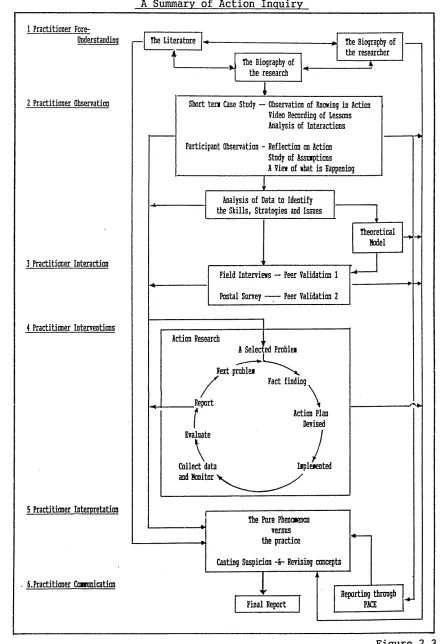
The following diagram summarises action inquiry as outlined. A Summary of Action Inquiry
1 Practitioner Fore-Onderstandinq
2 Practitioner Observation
3 Practitioner Interaction
4 Practitioner Interventions
5 Practitioner Interpretation
6.Practitioner Commicatian
The Literatnre The Biography of the researcher The Biography of
the research
Short ten Case Study — Observation of Knowing in Action Video Recording of Lessons Analysis of Interactions Participant Observation - Reflection an Action
Stndy of Assrarpticns A View of what is Happening
Analysis of Data to Identify the Skills, Strategies and Issnes
-*■
Theoretical Model
Field Interviews — Peer Validation 1 Postal Survey Peer Validation 2
Action Research
A Selected Problei Hext problei
Report
Action Plan Devised Evaluate
Collect data and Monitor '
The Pure Phenaienon versus the practice
Casting Suspicion -S- Revising concepts
[image:40.612.68.508.42.686.2]Final Report
In the diagram there is a hump on the right hand side in the arrow from the action research box to the reporting through PACE line, this attempts to show that no report was made through the PACE project about the action research phase. The reason for this is is described in Chapter 8.
Chapter 3
PRACTITIONER FORE-UNDERSTANDING
The Signpost to Chapter 3
The Literature
The Biography of the research
The Biography of the researcher
1
Fig 3.1
3.1 What Leads the Practitioner to Use the Practice to be Researched?
Research like any other human action and experience (as mentioned in
Chapter 2) is bound to be set within a framework of other activities
and all of these activities will have a biography, sediments, layers of
history, from which the birth of the present and the projection into
the future are spawned. The biography of the whole research situation
must affect what is there to research, who is there to research it, and
how it will be researched. Indeed had the National Curriculum, with its
emphasis upon a mandatory set of attainment targets, arrived in schools
in 1983 rather than the Lower Attaining Pupil's Programme the present
research would never have been carried out at all, for the practitioner
would no doubt have been working from a very different
fore-understanding. This chapter is then an attempt to place the raw
Practitioner fore-understanding is used here to encompass three areas. (1) The earlier biography of the researcher.
(2) The starting point and prehistory of the research project. (3) The review of literature relevant to the project.
Areas 1 and 2 make up the Part 1 of the chapter giving a sedimentation of the research situation. These are followed in Part 2 by area 3 the sedimentation of the situation surrounding the project through a review of the work of others as gleaned from the literature relevant to the project. The literature review and the background to the research are seen as essential to any research project - it is the area of the researcher biography which is not usually considered.
Being a participant, involved both as a subject of the research and as the researcher making the study, it is felt that personal biographical details relevant to the research must be included as a part of the study, for it is inevitable that our background ethical value system colours the choices that we make and that this will affect every decision made with regard to the research process and the classroom practice being researched. As Denzin states:
It is impossible not to take ethical and value stances in the
process of research. (Denzin 1978)
Indeed Denzin sees this ’making public1 the personal values systems as one of the rules governing sociologist's conduct. This chapter is the making public of the value stances with which the researcher approaches this research project. They are unique, never to be repeated, for once passed they become part of history.
the research, the biographical disclosure must also be seen as an essential way of uncovering further social contexts of the practice being researched. Having the role of teacher 'normally' in this classroom, but becoming researcher would seem to reverse what Denzin (1978) terms 'role pretence' (where the researcher becomes participant) for in the situation described it is the role of researcher which requires negotiation. Thus it would appear necessary to show the assumptions behind the practice and the assumptions behind the research.
The contention apparently being held by those proposing action inquiry as a research technique is that having a deep and fertile fore-understanding of the practice being researched puts the practitioner in the best possible position to perform relevant and astute work. Is this the case however? The practitioner may perform without reference to or consideration of the fore-understanding which he or she has. Is the insider perhaps blinkered and unable to see the framework in which they themselves reside and act? Is the researcher capable of seeing the alternative viewpoints available from the one adopted as his or her own? This disclosure of fore-understanding on the part of the researcher is the only means available to allow others a glimpse of the values and ethics of the researcher.
Patriarchy, Dialectical, Legitimacy and Relevance'. The Being, Thinking and Project classifications would appear to equate in some ways to what has been described here and also to the fore-understandings described by Ashworth, those of 'area of interest, interpretive concepts imposed on the research and personal involvement1 (Ashworth 1987). The present researcher found it very difficult to answer the self questions suggested by Rowan which perhaps itself shows something about the efficiency, authenticity and patriarchy which surround the work. It was preferred to lay things out in a biographical way.
Part 1. THE SEDIMENTATION OF THE RESEARCH SITUATION
3.2 The Biography of the Researcher
During this section of the discussion it has been felt necessary to move to the use of a more personal style, as an attempt is made to declare the layers of meaning that have contributed to the biography of the researcher, creating the stand point that has been taken as the project is reached. The laying bare of the values and being explicit in disclosing the fore-understanding will allow a critical appraisal by the reader that is not normally present in most research presentations. First there is the historical detail showing the development of the researcher. This is followed by a description of themes which appear to be emerging from the historical outline of the biography.
3.2.1 Historical Details about the Researcher
Prior to teaching
academic study and practical work following set recipes of some-what ritualised instructions for the preparation and analysis of chemical specimens.
■ Six years of work, as a laboratory technician in industry and in a school, with a parallel period leading a successful Scout Group during evenings and weekends helped me to make a conscious decision to become qualified as a teacher.
The critical adversaries
■ Also during this time a group of friends emerged with whom it was possible to discuss, debate and argue over wide ranging philosophical, moral and other issues - the critical adversaries. Their questioning, often severe, of methods used in the classroom and the philosophical underpinnings of these methods has continued throughout PACE and through the duration of the present research. The efforts of these critical adversaries has I am sure led to the self-questioning which has occurred throughout my teaching career and influenced to some extent the present research process.
Teacher training
thinking, planning and organising my own curriculum it was impossible to repeat science lectures which were no longer of interest to me. The Certificate in Education was completed in the original institution.
■ Some of the assignments for the education course were open ended enough to allow some practical work and observations e.g. during one study a set of Vigotsky's (1962) blocks were made and used to make small scale observations of language development
Teaching prior to PACE
■ I started teaching science and mathematics, and was also involved in a team teaching situation, planning, teaching and evaluating modules of social studies work.
■ I showed an early interest in non examination work through the Nuffield Secondary Science Project.
■ I became a member of the LEA social education working party and undertook much in-service training of a socio-psychological nature eg. pastoral care, counselling, behaviour modification etc.
■ I undertook further part time study with the Open University (OU) obtaining credits in a variety of courses which led to a Bachelor of Arts Degree:
'Technology for Teachers' involved practical assignments of a technical nature;
A 'Humanities Foundation' course with an introduction to politics where particular interest was shown in the Marxist view point.
the psychological aspects of learning, but also forced me to look more closely at the humanistic school of psychology and the work of Rogers 1969 and Maslow 1968 etc..
'Reading Development' where a practical assignment was again carried out involving a small scale investigation into mis-cue analysis with a small group of pupils.
■ I had for some years been involved in small scale trial and experimentation in my classroom with such techniques as individualisation of work and choice of projects, the contracting and personal progress charts of Weber (1978,1980) and I was using these as a means of improving the motivation, self image and performance of the least able secondary school pupils, with whom I now spent almost all of my teaching time.
Joining PACE
■ I was somewhat reluctant to become involved in the PACE project when it was first mooted by a Deputy Head Teacher. Was I stuck in a rut after twelve years of teaching? I was however chosen as a member of the team of teachers and two support teachers who were to initiate the changes to be introduced.
■ I felt that the IS course may well have developed in any case but the PACE project speeded up its development by forcing us to consider alternatives, but also by setting deadlines by which the courses should be ready. At this time the IS course was seen as the weakest link in Holgate PACE
inspectors, HMI and even the Secretary of State for Education.
■ The PACE project also gave me time to evaluate and reflect upon the practice that I had been developing.
■ As mentioned later PACE provided a large amount of in-service time for the teachers involved. I took advantage of much of this training to look at such areas as: 'Problem Solving', 'Games and Simulations in the Classroom', 'Instrumental Enrichment',
'Negotiated Learning', 'Computers in Education', 'Talking and Learning' and 'the Teacher as a Guide and Counsellor'.
■ The PACE project made me dip my toe in the literature of education once again, for I am the type of person who will not read for pleasure. The type of book which I want to read is not easily available in the local library and I need a stimulus to force me to read. PACE became such a stimulus. The areas of initial impact were those of 'individualised learning',
'contracting' and special education, for example (Davies 1978, Weber 1978,1980, Hinson and Hughes 1982, Pring 1984a).
■ The inservice programme of PACE introduced me to the ideas of others but it also forced me into centre stage - for more and more I was being asked to describe and explain my practice to other teachers.
■ The project evaluator of PACE also gave me the impetus to think about researching my own practice. Through discussion and joint planning a small scale evaluation exercise was undertaken and reported through PACE
three pages of prose only uses words based upon negotiation on twelve occasions. Throughout the PACE project I introduced and learnt with the pupils techniques which gradually became known as 'negotiation1 and 'negotiated learning'. These strategies became incorporated into my everyday practice.
■ The final year of PACE was to be a year of dissemination and staff working on the project were asked to consider submitting reports and evaluation papers based upon case data of some type. This gave me a chance to collect and record evidence of classroom negotiation.
3.2.2 Themes Emerging From the Historical Outline.
Disappointments
It was a shock and disappointment for me, involved as I was in the 'negotiation of learning', to hear and read the HMI findings (see page 1). Slowly I began to realise that HMI had isolated a need for greater knowledge and understanding about what was involved in negotiation. There was disappointment with myself for not having a clearer understanding of what I did seemingly automatically in my classroom. I claimed that I was negotiating with my pupils but nowhere was the process described clearly. There was a certain disappointment with the educational literature for there were no clear cut answers here either.
Personal development
terms, with the acceptance that they may be able to grasp ideas more quickly, but that given time I have enough intellectual toughness and capability to cope with tasks that I undertake. The PACE evaluator encouraged me to undertake further development by researching my own practice in an attempt to gain a higher degree.
Relationships in the classroom
There are obviously many assumptions which underpin 'negotiation' as a choice of teaching method. However it must be said that at the start of the project these assumptions were unclear and not closely examined Negotiation seemed to fit with the philosophy of what I was trying to do in my classroom. I was wanting to create positive rather than negative relationships with the pupils and to get them involved in work of an inquiring, practical and problem solving nature. Through the in-service training course and the Open University courses I had come to accept that learning was greatly influenced by not only the nature of the teaching materials but also by the motivation and self esteem of the pupils. I had come to value the pupils as people, not persons to receive what I had to teach them. A philosophy of teaching appears to be emerging which has drifted away from the academic transmission of knowledge towards the education of the whole person.
Political influences
local advisory and inspection service, but this appeared to be a formality as no attempt at re-direction was made. Thus the project was only affected politically by my own personal views and the politics already surrounding PACE. My own views I would declare as apolitical - not following a particular party and having no desire to vote for one at elections. If pushed, I would have to confess to some idealised form of democracy where everything was owned by the state, no-one made a profit at the expense of another etc. I had therefore not examined the politics of the PACE project, the politics of the Holgate school system nor the politics of my own classroom.
Identifications
I feel that I identify with change and development in education - the PACE programme at Holgate was seen by me as minor tinkering - I didn't feel that the changes had been sweeping enough. After many years of teaching the less able and least motivated pupils I felt that I understood their problems and I was wanting to help them become motivated towards learning new skills though not necessarily those of an academic nature. I identified with the needs and problems of other teachers who were willing to consider negotiation in their own classrooms and finding it difficult to come to terms with such a process. I had been through these experiences. I identified most closely with the research project which was planned because I had been forced into sitting down and planning what was going to happen - I felt that the project belonged to me - it was to be in the true spirit of self-directed learning.
The researcher role
describing and explaining the practice in my classroom and felt ready to accept with confidence the role of teacher/researcher. Initial presuppositions that I held, about the area of interest that the research itself lay, were fairly naive. I needed to search the literature of education and possibly those of politics and commerce/industry. In the educational field such areas as: autonomy, child centred education, contract learning, co-operative learning, experiential learning, goal setting, guidance and counselling, humanistic education, individualised learning, learner managed learning, open education and self directed learning appeared to be starting points but I feel that I kept an open mind. Initial interpretive concepts seemed to be that the practice could be analysed in a scientific way using some sort of analysis schedule which would tell us all we needed to know about the negotiation process. However there has been a movement in values from the pure sciences and the quantitative order towards work of a more qualitative nature.
A changing fore - understanding
3.3 The Pre - History and Starting Point of the Research
3.3.1 Background Prior to PACE
For well over a decade schools have been getting messages of reform from many quarters. HMI in the document "Curriculum 11— 16" pointed out that:
The education system is charged by society ___ with equipping young people to take their place as citizens and workers in adult life __ secondly there is the responsibility for educating the 'autonomous citizen', a person able to act for herself or himself, to resist exploitation, to innovate and to be vigilant
in the defence of liberty. (HMI 1977)
In most secondary classrooms the teacher accepts responsibility for what is learnt in the classroom. Subject areas follow exam syllabuses and these further dictate what knowledge the teacher needs to get across to the pupils. Pupils then are trained to follow the recipes planned out for them by the teacher. The teacher knows all that there is to know about a particular subject area and there has traditionally been little chance for pupils to practice choice, responsibility, or autonomy. As Skager points out
The ordinary school has been castigated by contemporary educational reformers for fostering dependency and passivity in learners rather than independence and motivation to learn.
(Skager 1984)
■ Allow pupils to develop responsible and co-operative relationships with a wide range of adults.
■ Allow pupils involvement in and responsibility for what they learn.
■ Allow adequate formal preparation for some of the adult roles that pupils will take. (Hinson and Hughes 1982).
The Institute of Personnel Management in its report 'What Employers Look for in School Leavers' takes things further and states that because of the rate at which change is occurring in society and the way
■ People who can cope with adapt to and manage change. ■ Confident and competent learners.
■ Those willing to continue to learn.
■ People able to find out for themselves what they need to know. ■ People capable of taking responsibility for themselves.
■ People who can work as a team.
■ Those who are capable of logical thought and creativity.
■ Those who know their strengths and skills and can build on them. (Institute of Personnel Management 1980)
They are obviously implying that schools do not provides these.
In 'Manifesto for Change' ( TES. 1981 ) a socially wider group of men and women distinguished in the fields of science, industry, politics, journalism, the arts, the church and education make similar criticisms and recommend that schools change to accommodate the skills and abilities required by the modern world.