A Novel Approach for Cluster Head Selection in Wireless
Sensor Network
Khushboo Gupta
Dept. of Computer Applications Krishna Institute of Engg. &
Technology, Ghaziabad
Amit Goyal
Dept. of Computer Applications Krishna Institute of Engg. &
Technology, Ghaziabad
Arun Kumar Tripathi
Dept. of Computer Applications Krishna Institute of Engg. &
Technology, Ghaziabad
ABSTRACT
Wireless Sensor Network (WSN) is one of the emerging technological fields due to recent advancements and area of research. The WSN is collection of small sensor nodes, which run on battery and have very less power. WSN requires various protocols to transmit information from one node to other. This paper focuses on dynamic Cluster Head (CH) selection process in Low Energy Adaptive Cluster Hierarchy (LEAH) protocol. This paper also discusses problems in LEACH protocol and giving a possible solution for it.
Keywords
WSN, Cluster Head, Sensor Nodes, Base Station.
1.
INTRODUCTION
WSN [1] comprises of small nodes to monitor physical or environmental conditions in the surroundings. These monitoring nodes are called as sensor nodes. Sensor nodes are very small in size and cheap in cost. They are placed in such terrains where it is difficult for human to reach and do observations. This peculiar property of sensor nodes make these an ideal candidate for doing monitoring for industrial, environmental, military and various other applications.
Fig.1 Wireless Sensor Network
In WSN, sensor nodes work together to information that is observed by individual sensor nodes. Sensor nodes observe various features in the surroundings and send them to the base station (BS). To send data to a BS requires a proper protocol. Protocol ensures the transfer of data in an optimized manner from sensor nodes to BS. The structure of WSN is shown in Fig 1.
There are various factors that affect the protocol and decide whether a protocol is good or bad. These factors are energy consumption, bandwidth requirement, packet loss, end to end delay, scalability etc. There are various types of protocols used in WSN. Mainly protocols in WSN are divided into three broad categories, Hierarchical protocols, Location Based protocols and Data Centric protocols [2].
Hierarchical protocols [3] support multi-tier architecture of the sensor network instead of single-tier architecture. This type of architecture reduce load over the network. Main
properties of these protocols are that they reduce flooding of packets in the network. These protocols also allow for data aggregation. It reduces the amount of data thus causing fewer loads on the network.
Location Based protocols [4] dealt with the specific location of sensor nodes in a network. Location of a sensor node is mainly taken from Global Positioning System (GPS) data. On the basis of these locations in these protocols sensor nodes are divided into clusters. Location Based protocols also reduce the flooding of packets in network to a great extent.
Data Centric protocols [5] are totally data oriented in nature. These protocols are designed to reduce the amount of data flow in a network. This will eventually reduce the energy consumption of the network. Main techniques which are followed in these protocols is data negotiation and data integration. These techniques reduce the data at each node thus overall reducing the data in the network by a lot. Section 2 deals with LEACH protocol and in section 3 some gaps of LEACH protocol are identified. Section 4 introduces some of the methodologies for removing those gaps while section 5 introduces results and analysis. Section 6 deals with conclusion of paper.
2.
LEACH PROTOCOL
Low Adaptive Energy Cluster Hierarchy (LEACH) [6] is one of the very first protocols to be introduced in the area of WSN. The main work of LEACH protocol is to reduce the energy consumption of the network. This is achieved by equally distributing the energy load on the sensor nodes through randomized rotation of local base stations. LEACH is one of the fundamental protocols for WSN based on the clustering technique. Various other modifications of LEACH are proposed over the years.
In LEACH, nodes organize themselves into clusters and one odd the nodes is chosen as cluster Head (CH) [6]. If CHs are chosen at random then one chosen will soon dies out so they are chosen using a randomized rotation of high energy CH position in order to not drain one of them out but to keep on going while utilizing less energy. At a point all sensor nodes choose themselves to be CH with a certain probability. All nodes then broadcast their status to every other node. The have CH must have minimum energy because only CH needs to keep their radio communication on. All the other nodes can keep their radio communication off and keep it on only at the time of communication with CH. In this way they are not drained out of their battery.
With few CHs there are few nodes actually transmitting to the BS. This also reduces the chance of packet loss and increases the throughput in the network thus increasing the efficiency of the network. The basic architecture of LEACH is shown in Fig 2.
Fig. 2: LEACH protocol working
In LEACH protocol, the CHs are not permanent and they keep on changing with time. As soon as one CH has less energy in it than other node with more energy take its place and all those decisions are taken place on the basis of the energy left in the nodes. In addition to low energy dissipation in case of LEACH all the nodes almost dies at the same rate instead of some nodes dying first and other dying at a later stage thus the network continue to perform with same efficiency as long as it lasts.
The whole algorithm can be broken into following stages: 1) Advertisement phase: Initially CHs is chosen from all the sensor nodes present. It is based on the number of CHs required by the network and the amount of time that node has been the CH so far in the network. This decision is made by the node. Every node say n chooses a random number on a scale from 0 to 1 and if the number is less than a threshold say T(n) then that node becomes CH. Once the CH is chosen it broadcast the message to all the nodes and they get to know about the CH at that time.
2) Cluster Set-Up phase: Nodes which are not CH will then decide about the CH to which they will transmit. This decision is entirely based on the energy required for transmission. Sensor node will go under that CH which requires minimum energy for transmission. After each node decides which cluster that node will belong to then they will transmit that information to the CH. During this phase all nodes will keep their receivers on.
3) Schedule Creation: After CH knows about all the nodes in the cluster it will then form a Time Division Multiple Access (TDMA) scheduling telling each node when to transmit.
4) Data Transmission: Once the cluster is formed and all the nodes are set then they start transmitting the data. Nodes can only transmit in the TDMA time frame allotted to them by the CH. The CH always keeps its receiver on while other nodes get it on only at the time of transmission. This allows all other nodes can save their power. While only one node uses its power
.
3.
GAPS OBSERVED
In LEACH protocol the selection of cluster heads is based on a random algorithm. This methodology of selection of cluster heads is efficient as comparison to the traditional protocols but it is not that efficient. The main problem observed is that
in a LEACH protocol due to the randomized selection of cluster heads, CHs are not distributed among the nodes in proper manner. It is seen a lot while simulating the LEACH protocol that two cluster heads are often selected close to each other. The required percentages of cluster heads are fixed prior to the algorithm. Thus when set of cluster heads are so close to each other it definitely show that there must be the case under which some cluster heads are far from each other. Thus there is no proper distribution of cluster heads in the whole topology.
This has adverse effect on the sensor nodes since at one place due to the absence of cluster heads near them they have to transmit there message to long distances. This will not be the case if there were efficient distribution of cluster heads. When cluster heads are too close to each other there is always the case that the area which can be covered by them efficiently is overlapped. On the other hand since there are nodes far away from each other so there is always the possibility of finding such areas which cannot be covered efficiently by cluster heads.
If by implementing any methodology the distribution of CHs can be optimized then it is highly possible that the sensor nodes will not have to spend too much energy just to reach the CHs. This will reduce high energy consumption is the sensor nodes. This will result in high lifetime of the sensor nodes which in turn increase the lifetime of WSN.
4.
SOLUTION PROPOSED
The main problem observed is associated with the randomized distribution of the CHs. If by any methodology the randomized distribution can be minimized then the problem can be solved. This will give a more uniform distribution of CHs in the WSN thus putting less pressure on sensor nodes. The solution to the given problem is in following algorithmic steps:-
1. Increase the number of CHs to be formed in WSN prior to distribution of CHs.
2. Using the same technique sensor nodes decides whether they want to be CH or not.
3. After selecting themselves as CHs those nodes send their positions and other data to the BS.
4. BS calculate the distance between CHs and on the basis of threshold decides which nodes are close to each other more than the acceptable limit or not.
5. Those nodes which are close to each other are of interest for BS. On the basis of other parameters received BS drops certain nodes from their position of CH. Thus a more optimal distribution of CH is achieved.
6. Then the nodes which are selected as CHs are broadcast in the entire network.
7. Sensor nodes receive the position of CHs and they communicate with the CH closest to them.
8. Sensor nodes then form clusters and start sending their observations to their CH.
On the basis of this algorithm only the CH selection process is altered. This will reduce the energy requirement in the CH selection phase. This will also introduce a more uniformly distributed architecture of the WSN.
consumption in sensor nodes while communicating with the CH. This results in considerable prolongation in the lifetime of the WSN.
5.
RESULTS AND ANALYSIS
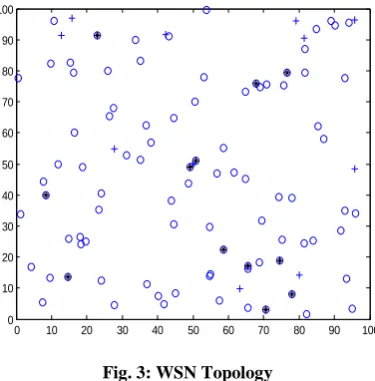
The simulation of LEACH protocol in this paper is perform on MATLAB software. A 400m x 400m area is chosen as the test bed for simulation. 100 nodes are taken and the BS is kept at the center at the coordinates of (200m, 200m). Initial energy 0.5J is taken in the sensor nodes. In Fig 3 the topology used is shown.
Fig. 3: WSN Topology
On this topology the whole protocol is simulated and on the basis of the simulation various results are obtained. These results are obtained by tweaking various parameters and looking at how the protocol is behaving.
As a result of simulation, graphs are plotted between number of rounds and dead nodes as well as between number of rounds and CHs. These graphs are mainly drawn by tweaking two main factors in WSN. First one is the probability (p) of the selection of a node as CH. Second is energy (E) of a common node.
[image:3.595.329.537.121.333.2]On the basis of changing value of 'p' graphs are presented in Figure 4 to Figure 7 and on the basis of changing value of E graphs are presented in Figure 8 to Figure 11.
Fig 4: Graph at p=0.1
As shown in Fig 4 when p=0.1 then the number of dead nodes reach its maximum value around 1200 rounds. Here p is the probability of any node to be selected as CH. This shows that the whole network seems to be dead after about 1200 rounds.
Fig 5: Graph at p=0.1
As shown in Fig 5 when the number of cluster head declines when value of p=0.1. This shows that as the number of nodes starts increasing the number of dead nodes starts to increase and the number of CH starts to reduce.
Fig 6: Graph at p=0.2
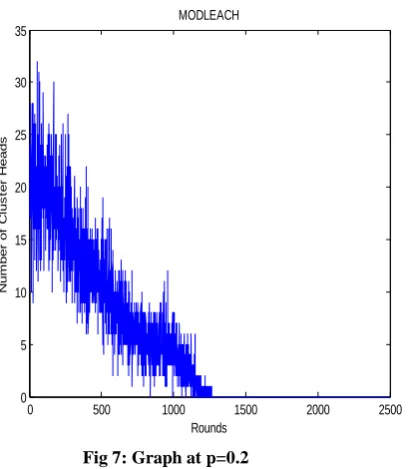
Fig 6 shows how the graph between dead nodes and number of rounds changes for p=0.2. As the probability of a node to become CH is increased, As a result the number of rounds up to which network can live increases. This shows that if the probability of a node to become CH is increased then the number of dead nodes increases slowly than the network with lower probability. This proves beneficial as the network lives longer thus supporting for long term.
0 10 20 30 40 50 60 70 80 90 100
0 10 20 30 40 50 60 70 80 90 100
0 500 1000 1500 2000 2500
0 10 20 30 40 50 60 70 80 90 100
Rounds
D
e
a
d
N
o
d
e
s
MODLEACH
0 500 1000 1500 2000 2500
0 2 4 6 8 10 12 14 16 18
Rounds
N
u
m
b
e
r
o
f
C
lu
s
te
r
H
e
a
d
s
MODLEACH
0 500 1000 1500 2000 2500
0 10 20 30 40 50 60 70 80 90 100
Rounds
D
e
a
d
N
o
d
e
s
[image:3.595.77.265.201.392.2]Fig 7: Graph at p=0.2
As shown in Fig 7 how the number of cluster heads behaves when the value of p=0.2. This shows that the number of CH tend to last for longer than the usual case for p=0.1. Thus the network tends to last for longer in service than usual.
Fig 8: Graph at E=0.5J
Fig 8 shows the same relation between dead nodes and the number of rounds. The parameter on which above graph is based is the energy of the sensor nodes. It is one of the most important parameters for the sensor nodes. Energy is what is needed by sensor nodes to continue working. If one can provide sensor nodes with more initial energy then they can perform better and the whole network can sustain itself for longer time.
Fig 8 shows that all nodes in the network become dead at around 1200 rounds.
Fig 9: Graph at E=0.5J
[image:4.595.71.277.74.309.2]Fig 9 shows a relation between the number of cluster heads and the round in sensor network. It shows that for E=0.5J the sensor network work for around 1200 rounds and all the CHs cease to exist at around 1200 rounds.
[image:4.595.329.536.76.282.2]Fig 10: Graph at E=1.0J
Fig 10 shows how the number of dead nodes change when the energy of the sensor nodes is increased from E=0.5J to E=1.0J. It shows a drastic change in the performance of the sensor nodes. Since energy is very important for sensor nodes and such small change in energy change their performance by so much. So if sensor nodes in real world can be supplied with good batteries then they can work for long time without going for damage.
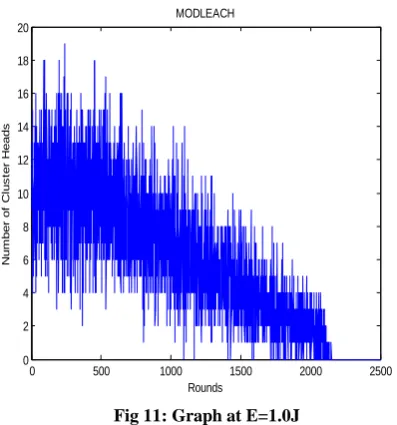
Fig 11 shows the relation between number of CH and the number of rounds in the sensor network for E=1.0J. This shows that the number of CH remain for a long time before they all vanishes. This shows if somehow sensor nodes are supplied with good batteries they can work for long amount of time without going down. Thus the network uses to work for long amount of time.
0 500 1000 1500 2000 2500
0 5 10 15 20 25 30 35
Rounds
N
u
m
b
e
r
o
f
C
lu
s
te
r
H
e
a
d
s
MODLEACH
0 500 1000 1500 2000 2500
0 10 20 30 40 50 60 70 80 90 100
Rounds
D
e
a
d
N
o
d
e
s
MODLEACH
0 500 1000 1500 2000 2500
0 2 4 6 8 10 12 14 16 18
Rounds
N
u
m
b
e
r
o
f
C
lu
s
te
r
H
e
a
d
s
MODLEACH
0 500 1000 1500 2000 2500
0 10 20 30 40 50 60 70 80 90 100
Rounds
D
e
a
d
N
o
d
e
s
[image:4.595.323.529.340.550.2] [image:4.595.66.281.365.600.2]Fig 11: Graph at E=1.0J
Above figures show that in case of LEACH protocol probability of a node to be CH and the energy of the nodes are two most important factors. In WSN by changing these factors by even a small quantity drastically change the outcome of the protocol. If the energy is more than the nodes use to run longer than usual. It we increase the probability to be CH by a small fraction then also the lifetime of the WSN is increasing drastically.
Although there are other factors too which use to effect the lifetime of the network. These factors are like what would be the optimum number of sensor nodes for a given area, what should be the fraction of sensor nodes which went on to be CH. These factors do effect the lifetime of WSN but they never do it so drastically as by these two factors.
6.
CONCLUSIONS AND FUTURE
WORK
WSN is a growing field and a lot of research is going on in this field. Increasing the lifetime of the WSN is the ultimate goal of every researcher. This can be achieved by various ways and all ultimately leads to saving energy. This paper discusses problem associated with CH selection in LEACH protocol. The problem is solved by involving the BS in the process of selection of CHs as it will reduce the energy required during the CH selection process. In this way the CH will not have to focus too much energy during its selection process and due to optimal distribution achieved it even gives a better cluster distribution thus producing better results. There are a lot of ideas which can be applied in the problem observed by this paper. One can look for some kind of inter-node communication approach so as to have optimal distribution of nodes. The above methodology proposed is only applicable in that case when the nodes are static in nature. If they are mobile in nature then the above solution might face problems. So, one can also propose a methodology for mobile networks.
7.
REFERENCES
[1] Sandeep Singh and Amandeep Kaur Virk ,“An Existential Review of Wireless Sensor Networks”, in the International Journal of Science and Research (IJSR ) (April 2013).
[2] Kemal Akkaya and Mohamed Younis,” A Survey on Routing Protocols for Wireless Sensor Networks”, in
Computer Science Bibliography (2005)[19]I.F. Akyildiz, W. Su, Y. Sankarasubramaniam, E. Cayirci:Wireless sensor networks: a survey Published by Elsevier Science B.V. (2002).
[3] Ankita Joshi, Lakshmi Priya.M “A Survey of Hierarchical Routing Protocols” in Wireless Sensor Network in MES Journal of Technology and Management.
[4] Ioanna Kulik, Wendi Heilzenman, Hari Balakrishnan ,”Negotiation-Based Protocols for Disseminating Information in Wireless Sensor Networks”, Wireless Networks, vol. 8,pp. 169–85 (2002)
[5] Y.Xu, J. Heidemann, and D. Estrin ,”Geography informed energy conservation for Ad-hoc routing”, in the Proceedings of the 7th Annual ACM/IEEE International Conference on Mobile Computing and Networking (MobiCom’01), Rome, Italy ( July 2001)
[6] W. Heinzelman, A. Chandrakasan, and H. Balakrishnan, “Energy-efficient communication protocol for wireless sensor networks” , in the Proceeding of the Hawaii International Conference System Sciences, Hawaii ( January 2000).
[7] Leach and Its Descendant Protocols: A Survey J.Gnanambigai, Dr.N.Rengarajan, K.Anbukkarasi International Journal of Communication and Computer Technologies Volume 01 – No.3, Issue: 02 September 2012
[8] ThiemoVoigt, Hartmutt Ritter, Jochen Schiller, Adam Dunkels, and Juan Alonso,”Solar-aware Clustering in Wireless Sensor Networks”,In Proceedings of the Ninth IEEE Symposium on Computers and Communications,June 2004.
[9] ]. An Energy-Aware Routing Protocol in Wireless Sensor Networks Ming Liu , Jiannong Cao, Guihai Chen and Xiaomin Wang Sensors 2009, 445-462; doi:10.3390/s90100445
[10]An Energy Efficient Multiple-hop Routing Protocol for Wireless Sensor Networks Yang Lei, FengJun Shang, Zhaohua Long, Yunsen Ren First International Conference on Intelligent Networks and Intelligent Systems 2009
[11]EZZATI ABDELLAH, SAID BENALLA, Abderrahim BENI HSSANE , Moulay Lahcen HASNAOUI, Ezzati Abdellah et al., “Advanced Low Energy Adaptive Clustering Hierarchy” (IJCSE) International Journal on Computer Science and Engineering Vol. 02, No. 07, 2010, 2491-2497
[12]Sanjeev Jain and
SudharshanTiwari,IEEEMember,”Energy Efficient Clustering Algorithms in Networks:ASurvey”,IJCSI International Journal of Computer Science Issues, Vol.8,Issue 4,No 2,September 2011,ISSN(Online): 1694-0814
[13]Energy Efficient Clustering Algorithms in Wireless Sensor Networks: A Survey Vinay Kumar1, Sanjeev
Jain2 and Sudarshan Tiwari, IEEE Member IJCSI International Journal of Computer Science Issues, Vol. 8, Issue 5, No 2, September 2011 ISSN (Online): 1694-0814
0 500 1000 1500 2000 2500
0 2 4 6 8 10 12 14 16 18 20
Rounds
N
u
m
b
e
r
o
f
C
lu
s
te
r
H
e
a
d
s
[image:5.595.69.268.74.287.2][14]RajashreeV.Biradar,Dr.S.R.Sawant,Dr.R. R.Mudholkar, Dr.V.C.Patil” Multihop Routing In Self-Organizing Wireless Sensor Networks” IJCSI InternationalJournal of Computer Science Issues,Vol.8,Issue 1,Januaray 2011 [15]An Improved LEACH Routing Protocol for
Energy-Efficiency of Wireless Sensor Networks Nguyen Duy Tan1, Longzhe Han2, Nguyen Dinh Viet3, and Minho Jo4 Smart Computing Review, vol. 2, no. 5, October 2012 DOI: 10.6029/smartcr.2012.05.006 360
[16]Meena Malik, Dr. Yudhvir Singh and Anshu Arora, “Analysis of LEACH Protocol in Wireless Sensor Networks” in the International Journal of Advanced Research in Computer Science and Software Engineering (Feb 2013).
[17]Estimated New Routing Scheme in MANETs International Journal of Computer Applications (0975 – 8887) Volume 17– No.5, March 2011
[18]Wendi Heinzelman, Joanna Kulik, and Hari Balakrishnan,” Adaptive Protocols for Information Dissemination in Wireless Sensor Networks”, Proc. 5th ACM/IEEE Mobicom, Seattle, WA, pp. 174–85 (Aug. 1999).