http://dx.doi.org/10.4236/jep.2014.51010
The Mexican Environmental Flow Standard: Scope,
Application and Implementation
María Antonieta Gómez-Balandra, María del Pilar Saldaña-Fabela, Maricela Martínez-Jiménez
Hydrobiology and Environmental Assessment Department, Mexican Institute of Water Technology, Jiutepec, México. Email: [email protected]
Received November 8th,2013; revised December 11th, 2013; accepted January 5th, 2014
Copyright © 2014 María Antonieta Gómez-Balandra et al. This is an open access article distributed under the Creative Commons Attribution License, which permits unrestricted use, distribution, and reproduction in any medium, provided the original work is properly cited. In accordance of the Creative Commons Attribution License all Copyrights © 2014 are reserved for SCIRP and the owner of the intellectual property María Antonieta Gómez-Balandra et al. All Copyright © 2014 are guarded by law and by SCIRP as a guardian.
ABSTRACT
With the implementation of the Official Mexican Standard NOM-011-CONAGUA-2000 [1], the water balance of 730 basins has been calculated and its water availability agreement is published. This rule points out to allocate water for the environment only as an annual volume since methods for estimating environmental flows were not standardized in the country. For this reason, The Water Agency (CONAGUA) issued the standard NMX-AA- 159-SCFI-2012 [2], to assess environmental flows needed both, at the strategic level in Integrated Water Re-sources Management (IWRM), or as part of the Environmental Impact Assessment (EIA) of large hydraulic projects. For over ten years, this standard was developed and finally published in September 2012 [3]. It explains different methods from hydrological to holistic approaches, with examples for the country. Its application will cover the urgent need to preserve water for ecosystems in watersheds with high ecological importance and low stress for water use. In this paper, an analysis of the environmental flow standard and examples of the suggested hydrological methods are presented. For its implementation, some steps are taking place, mainly establishing environmental water reserves and building capacities. In addition, environmental allocations are becoming a common practice for all water projects, as well as setting limits to hydrological alterations by hydroelectric dams. The standard promotes the use of technical integration tools to analyze the responses of ecosystems to changes in the flow regime and adaptive management under different scenarios of water use. Although the main steps have been taken, its implementation as mandatory rule will take time.
KEYWORDS
Environmental Flows; Hydrological Methods; Mexican Standard
1. Introduction
Environmental, ecological or in stream flow (EF) is the amount of water that is kept flowing down in order to maintain the river in a desired environmental condition in terms of its spatial and timing distribution required to maintain the components, functions and aquatic ecosys-tems processes from which people obtain benefits ([4-10]. The concept has evolved to recognize the natural varia-bility of flow regimes which consider: magnitude, dura-tion, timing, frequency and rate of change associated to environmental services and ecosystems resilience [11].
Environmental flow assessment (EFA) is based on a scientific process to deal with basin features, probabilis-
tic variability of natural flows and cross section hydro- morphology models. These issues determine habitat connectivity and availability to be used by species at several stages of their life cycle. EFA is also a social process since water regulators and users define the level of stress that can be supported by a river in terms of their quantity, quality and ecosystem services, although not many of these decisions have been properly taken. Then, generalized flow standards can be used to allocate water for the environment [12] but, every river can have an environmental flow regime according to what people want from a river in terms of conservation and use [13].
The Mexican Environmental Flow Standard: Scope, Application and Implementation 72
an important toolbox to assess sequentially from rivers’ natural flow regime to its ecological integrity (structure, function, processes and alterations). Methods have been classified as: hydrological, hydraulics, for habitat simula-tion and holistic [9,14-17]). Hydrological approaches are the basis to identify the natural flow regime and its alte-rations caused by water subtractions or hydraulic infra-structure [11,18]. Results are complemented with hy-draulic measurements and associated to habitat availabil-ity and connectivavailabil-ity among aquatic, riparian and coastal communities. In addition, holistic approaches consider environmental services for people and comparison of water allocation strategies or altered scenarios by infra-structure [19]. Due to the condition of many rivers which are over-allocated, fragmented, polluted and losing bio-diversity, it is recognized that EFA is needed as a part of approaches both at strategic level in the integrated water resource management IWRM and as a part of EIA for large hydraulic projects [20-22]
The EF implementation is on progress and overcoming several drags, since hydrological records are sometimes the only available data for many regions, whereas hy-draulic studies are really scarce and its development is time and cost consuming [9]. Besides, these methods need to broaden their scope towards habitat availability for species, not only as hydraulics research. This ap-proach is under development since several disciplines are involved and need to formulate flow alteration—habitat availability—ecological responses hypothesis to be tested through different indicators. The final goal is to deal with an adaptive approach both to operate hydraulic infra-structure and produce conditions for preserving species, maybe in the year by year basis. Thus the final output is to reduce the effects of anthropogenic activities on aqua-tic ecosystems. Changes can be followed by hydrological parameters, habitat availability, species presence—ab- sence, condition factor, weight—length relationship and food webs, among others [23]
2. EFA Mexican Approach
The “environmental water use or use for ecological con-servation” is defined by the National Water Law as “the minimum flow or volume required in receiving water bodies, including streams or reservoirs, or the minimum flow of natural discharge from one aquifer that must be maintained to protect environmental conditions and the ecological balance.
The specific definition of Ecological Flow in the Mexican Standard [2], which establishes the procedure to determine the environmental flow is: the quantity, quality, and flow variations or water levels required to preserve environmental services, components, functions, pro-cesses and the resilience of aquatic and terrestrial eco-systems. They depend on the hydrological, geomorpho-logical, ecological and social processes. This implies that
in addition to provide water for domestic, urban public, livestock and agriculture uses, it is possible to maintain flows from both runoff and aquifer outcropto preserve-rivers (perennial, intermittent and ephemeral), lenticwa-ter bodies (lakes, ponds, and wetlands), and riparian ecosystems.
The need for ecological flows was a pendant issue since the Water Act publication in 1992 and re -emerged with the application of an Official National Standard [1], to set basins’ water availability. This availability com-prises a committed natural discharge as a fraction of the hydrogeological unit of natural discharge, committed as superficial water to diverse uses or to be preserved to prevent negative impacts on ecosystems or the migration of bad quality water into the aquifer. The estimated water availability is then published in each hydrometric gauge of the basin and as a total volume.
The Mexican Standard to estimate the EF is a technical guideline rather than a compulsory limit [2]. Its main scientific principles are: the recognition of natural hy-drological regime and the gradient of the biological con-dition. Therefore, any methodology is valid for the stan-dard as long as it focuses on understanding the ecological significance of each component of the natural flow re-gime, and it generates proposals for its conservation or restoration in whole or partially, from the functional point of view.
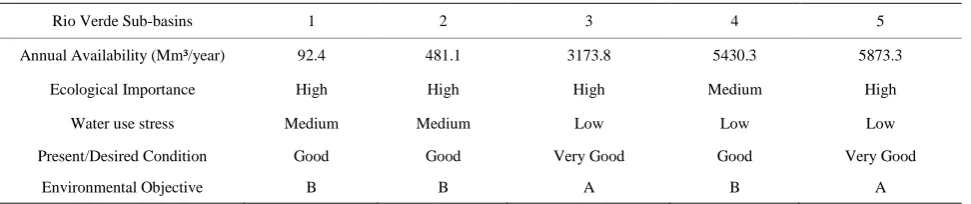
Following a top-down initiative and based on the gra-dients of ecological importance and water scarcity, an environmental objective (EO) was assigned such as water availability is issued for each basin or sub-basin in the country (Figure 1). The Rio Verde sub-basins were numbered for further analysis.
The EF Mexican standard calls for the application of hydrological methods as the basis to reserve or allocate water for the environment. Therefore, according to the EO’s, reference values (% of medium annual volume or flow) as well as the components of a seasonal flow re-gime are stated as follows:
1) Under a modified Tennant approach (García et al. [5]).
a) Percentage of mean annual flow (MAF) with dif-ferent seasonal percentages (Reference values).
b) Percentage of monthly mean flows MMF.
c) A base flow during dry season not less than the his-torical minimum monthly flow (MinF).
2) Under WWF Mexico approach.
a) A total volume associated to an ordinary regime (TVOR), considering wet, medium and dry years.
b) A total volume related to the frequency of floods’ regime (TVFR) with a return period of 1, 1.5 and 5 years to be reproduced within 10 years return period according to EO’s.
3) Under TNC approach [14].
Figure 1. Environmental objectives for the Mexican basins and the Rio Verde Basin (Modified from WWF, [24]).
b) Thresholds for hydrological alterations on hydro-logical parameters with ecohydro-logical importance (monthly flows, 1, 7, 30 and 90 days minimum and maximum flows).
These approaches can be applied at basins, sub-basins or river reaches as it is pointed out in Figure2. At least 20 years of hydrological data are recommended for all these analysis.
The Mexican flow standard also describes some initial experiences in using habitat simulation with BBM build-ing blocks methodology [24] as holistic approach and recommends the use of habitat simulation methods like PHabSim or others.
2.1. EFA Hydrological Methods Application
The Environmental objectives for the Rio Verde Basin and sub-basins located in the hydrological region 20 named Costa Chica de Guerrero were stated as is pointed out in Table1.
The hydrological gauge Paso de la Reina was chosen to show result from the standard application (Figure 3) in this site a proposed hydro project is under planning studies.
2.2. Modified Tennant Approach ([5])
General steps:
1) Selection of the site of study. 2) Analysis of the monthly dataset.
3) Determination of monthly and annual flow regime. 4) Formulation of proposals for monthly and annual environmental flow regime.
The Mexican Environmental Flow Standard: Scope, Application and Implementation 74
According to environmental objectives (EO), Table2
shows recommended seasonal flow percentages. Tennant modified by García et al. [5,26], and proposed by [25].
As Paso de la Reina site was classified as Environ-mental Objective “A” [2], then annual and monthly allo-cated percentages are shown in Figure5.
After setting percentages it must be reviewed that en-vironmental flow in dry season should never be greater than the monthly average flow (MMF) nor lesser than the base flow.
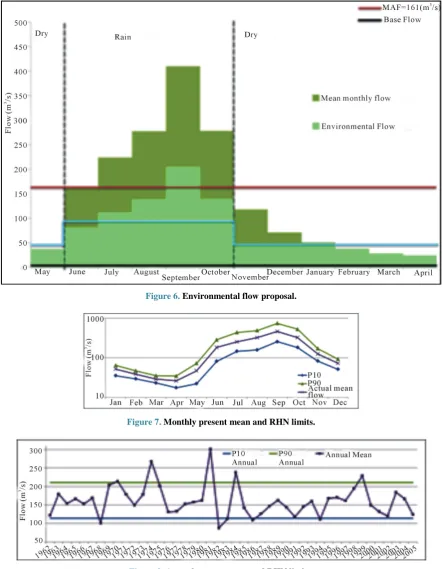
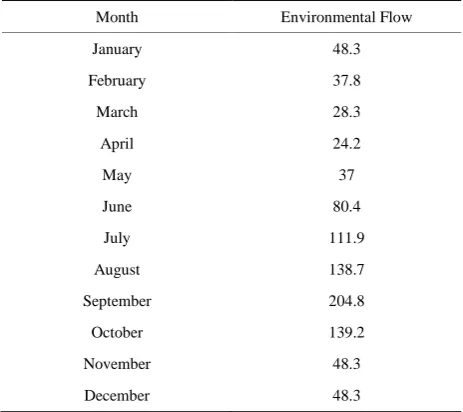
The environmental flow proposal is based on monthly percentages (light green area in Figure 6 and values of
Table3). For dry years the proposal can be adjusted up to seasonal thresholds (30% and 60% of MAF blueline). For rain season these limits can be set between percen-tages of mean annual flow MAF (blue line) and monthly mean flow (dark green area). For each stream, a base flow must be estimated (blackline).
2.3. WWF Approach
According to the World Wildlife Fund Mexico approach a reference volume as percentage of the medium annual flow should be equal or greater than 40% (Table4).
The next step is to identify alterations in the hydrolog-ical regime trough dividing time series data in two pe-riods. For the first set of 20 years (natural hydrological regimen RHN) obtain percentiles 10 and 90 and check if the number of the monthly means of the second period (present hydrological regime RHA) that are within these limits. If the fulfillment of the actual regime (RHA) is <50% in relation to percentiles (RHN) the river is consi-dered altered. The Figures 7 and 8 pointed out that the Rio Verde at Paso de la Reina hydrometric gauge is not altered.
For seasonal environmental flow estimation, the Total Ordinary Volume Regime (TOVR) and the Total Volume for Flood Regime (TVFR) were obtained using the pro-cedure proposed by World Wildlife Fund Mexico at the study basin level. TOVR was obtained multiplying the frequency by volume for each year condition to be re-produced with regards to the environmental objective (Table5).
The two steps to calculate TVFR that try to resemble
natural pattern, according to the conservation objectives, were:
[image:4.595.313.532.177.333.2]1) Classification and characterization of peaks: To separate flood types initially used the criterion of magni-tude, maximum flow and probability of occurrence over time (frequency). Analysis of statistical distributions are needed to determine magnitude of floods associated re-
Figure 2. EFA hydrological approaches in the Mexican
[image:4.595.315.533.377.577.2]standard.
[image:4.595.57.543.634.736.2]Figure 3. Water availability issued for the basin. CFR: 05/ 07/2013 [25].
Table 1. Environmental objectives by sub-basin.
Rio Verde Sub-basins 1 2 3 4 5
Annual Availability (Mm³/year) 92.4 481.1 3173.8 5430.3 5873.3
Ecological Importance High High High Medium High
Water use stress Medium Medium Low Low Low
Present/Desired Condition Good Good Very Good Good Very Good
Figure 4. Monthly flow regime and mean annual flow that determines the dry and rainy seasons.
Figure 5. Annual and monthly allocated percentages.
turn periods as follows:
a) Runoff with return period of 1 year (Category I).
[image:5.595.80.517.396.683.2]The Mexican Environmental Flow Standard: Scope, Application and Implementation 76
Figure 6. Environmental flow proposal.
Figure 7. Monthly present mean and RHN limits.
Figure 8. Annual present mean and RHN limits.
2) Duration in days of each runoff period is then ob-tained and the product of this duration, frequency and volume resulted in the Total Volume for Flood Regime for three different runoffs within 10 years. Table 6
shows the results for these calculations.
[image:6.595.77.520.86.366.2]Table 2. Reference values for each EO.
Environmental Objective
Period
Dry Rain
% MAF % MMF % MAF % MMF
A 30 100 60 50
B 20 80 40 40
C 15 60 30 30
[image:7.595.304.539.102.310.2]D 5 40 10 20
Table 3. Monthly environmental flow regime in cubic me-ters per second (m³/s).
Month Environmental Flow
January 48.3
February 37.8
March 28.3
April 24.2
May 37
June 80.4
July 111.9
August 138.7
September 204.8
October 139.2
November 48.3
December 48.3
Table 4. Reference values for specific environmental objec-tives.
Environmental Objective
Conservation Gradient
Environmental Flow (% MAF)
Perennial streams
A Very good >40
[image:7.595.56.288.251.457.2]> 64.6 m³/s or >2172 Mm3/year
Table 5. Total Ordinary Volume Regime.
Type of Year Very dry Dry Average Wet
Percentile P0 P10 P25 P75
Ordinary volume regime
(OVR Mm3/year) 2052 2862 3611 6066
% Mean Annual Runoff 40 56 71 119
Frequency 0.2 0.3 0.4 0.1
Total Ordinary
Volume Regime 3319 Mm
3/year
FRV = TOVR + TVFR
FRV = 3319 + 198 = 3517 Mm3/year
Table 6. Total Volume of Flood Regime.
Attribute of
hydrological regime Category I Category II Category III
Magnitude 1year return 1.5years return 5years return
m3/s 303 843 1874
Mm3/day 26 73 162
Frequency 10 6 2
Duration 3 2 1
Timing Jul-Oct
Rate of change
Rise 75
Fall 40
Total Volume for Flood Regime
in 10 Years
1980 Mm3
TVFR/Year 198 Mm3
MAR= 5430 Mm3/year
FRV = 3517 Mm3/Year = 64% of MAR
3. Conclusions
Although the Mexican Water Act states the environmen-tal use and the Availability Standard points out an annual volume to the environment in each basin, for more than fifteen years, the minimum flow as much as 10% of monthly flows have prevailed to deal with environmental allocation of water for projects with consumptive uses (water supply and irrigation). Availability agreements have been issued and are going to be reviewed every two years. Therefore, implementing EFA is the next challenge to be included in these agreements and then gives some priority of reserving water for the environment [27].
The Mexican environmental flow standard as a tech-nical procedure gives the support to move ahead from this 10% minimum approach and consider the natural flow variability. Through the recognition of this natural variability and applying at least hydrological methods, twofold protection goals can be achieved to: 1) Repro-duce seasonal and even monthly variability and 2) Con-sider thresholds for alteration either seasonal, monthly or inter-annually when ecological process can be vulnera-ble.
The hydrological methods are also the basis for the re-gional water resources management under frameworks like the integrated watershed resource management IWRM and the ecological limits of hydrological altera-tion (ELOHA) [28]
[image:7.595.56.290.585.695.2]The Mexican Environmental Flow Standard: Scope, Application and Implementation 78
ecological integrity of ecosystems. These approaches should be integrative and under an interdisciplinary ap-proach.
As a result of the application of habitat simulation or holistic methods, a set of ecological and social indicators can be obtained to follow during the EF implementation. For Mexico, the regional ecosystem changes and social responses will be valuable when the adaptive approach has to consider tradeoffs between ecological conserva-tion and water use tightening further hydraulic develop-ment.
REFERENCES
[1] NOM-011-CNA-2000, “Norma Oficial Mexicana, Con- servación del Recurso Agua. Que Establece las Especifi- caciones y el Método para Disponibilidad Media Anual de las Aguas Nacionales,” DOF 17-Abril-2002, México, p. 20.
[2] NMX-AA-159-SCFI-2012, “Norma Mexicana. Que Es- tablece el Procedimiento para la Determinación del Caudal Ecológico en Cuencas Hidrológicas,” DOF 20 de Sep- tiembre de 2012, México, p. 123.
[3] P. A. E. Lis, M. A. G. Balandra and P. S. Fabela, “Reque- rimientos para Implementar el Caudal Ambiental en México,” Instituto Mexicano de Tecnología del Agua, Alianza World Wildlife Fund/Fundación Gonzalo Río Arronte. Programa Hidrológico Internacional UNESCO, SEMARNAT, 2007, p. 176.
[4] T. Annear, I. Chisholm, H. Beecher and A. Locke, “In- stream flows for Riverine Resource Steweardship,” Re- vised Edition, Instream Flow Council, Cheyenne, 2004, p. 268.
[5] E. García, R. González, P. Martínez, J. Athala and G. Paz-Soldán, “Guía de Aplicación de los Métodos de cálculo de Caudales de Reserva Ecológicos en México, Colección,” CNA-IMTA-SEMARNAP, México D.F., 1999, p. 190.
[6] S. Postel and B. Richter, “Rivers for Life: Managing Wa- ter for People and Nature,” Island Press, Washington DC, 2003.
[7] N. L. Poff, “Managing for Variability to Sustain Fresh- water Ecosystems,” Journal of Water Resources Planning and Management, Vol. 135, No. 1, 2009, pp. 1-4. [8] A. H. Arthington, S. E. Bunn, N. L. Poff and R. J. Nai-
man, “The Challenge of Providing Environmental Flow Rules to Sustain River Ecosystems,” Ecological Applica- tions: A Publication of the Ecological Society of America, Vol. 16, No. 4, 2006, pp. 1311-1138.
[9] R. E. Tharme, “A Global Perspective on Environmental Flow Assessment: Emerging Trends in the Development and Application of Environmental Flow Methodologies for Rivers,” River Research and Applications, Vol. 19, No. 5-6, 2003, pp. 397-441.
http://dx.doi.org/10.1002/rra.736
[10] M. Acreman and M. J. Dunbar, “Defining Environmental River Flow Requirements a Review,” Hydrology and
Earth System Sciences, Vol. 8, No. 5, 2004, pp. 861-876. http://dx.doi.org/10.5194/hess-8-861-2004
[11] B. D. Richter, J. V. Baumgartner, R. Wigington and D. P. Braun, “How Much Water Does A River Need?” Fresh- water Biology, Vol. 37, No. 1, 1997, pp. 231-249. http://dx.doi.org/10.1046/j.1365-2427.1997.00153.x
[12] B. D. Richter, “Short Communication Re-Thinking Envi- ronmental Flows: From Allocations and Reserves to Sus- tainability Boundaries,” River Research and Applications, Vol. 26, No. 8, 2010, pp. 1052-1063.
[13] J. O’Keeffe and T. Le Quesne, “Keeping Rivers Alive— A Primer on Environmental Flows and Their Assessment,” World Wildlife Found—Water Security Series 2, Surrey, 2009.
[14] TNC (The Nature Conservancy), “Indicators of Hydro-logic Alteration,” Version 7.1 User’s Manual, 2009, p. 81.
[15] WWF and Fundación Gonzalo Río Arronte, “Guía Para la Determinación de Caudal Ecológico en México Sistemati- zación de Experiencias de la Alianza WWF,” Fundación Gonzalo Río Arronte I.A.P., Mexico D.F., 2011.
[16] M. J. DUNBAR and M. C. Acreman, “Applied Hy-dro-Ecological Science for the Twenty-First Century,” In: M. C. Acreman, Ed., Hydro-Ecology: Linking Hydrology and Aquatic Ecology (Proceedings of an International Workshop (HW2). Centre for Ecology and Hydrology (Formerly Institute of Hydrology), Wallingford, Oxford-shire, 2001, pp. 1-18.
[17] R. Hirji and R. Davis, “Environmental Flows in Water Resources Policies, Plans and Projects. Case Studies,” Water Resources, No. 117. Washington DC, 2009, p. 181. [18] N. L. Poff, J. D. Allan, M. A. Palmer, D. D. Hart, B. D.
Richter, A. H. Arthington, K. H. Rogers, J. L. Meyer and J. A. Stanford, “River Flows and Water Wars: Emerging Science for Environmental Decision Making,” Frontiers in Ecology and the Environment, Vol. 1, No. 6, 2003, pp. 298-306.
http://dx.doi.org/10.1890/1540-9295(2003)001[0298:RF AWWE]2.0.CO;2
[19] A. H. Arthington, R. J. Naiman, M. E. McClain and C. Nilsson, “Preserving the Biodiversity and Ecological Ser- vices of Rivers: New Challenges and Research Opportun- ities,” Freshwater Biology, Vol. 55, No. 1, 2009, pp. 1-16. http://dx.doi.org/10.1111/j.1365-2427.2009.02340.x
[20] C. Nilsson and B. M. Renöfält, “Linking Flow Regime and Water Quality in Rivers: A Challenge to Adaptive Catchment Management,” Ecology and Society, Vol. 13, No. 2, 2008, 20 p.
[21] C. J. Vörösmarty, P. B. McIntyre, M. O. Gessner, D. Dudgeon, A. Prusevich, P. Green, S. Glidden, S. E. Bunn, C. A. Sullivan, C. R. Liermann and P. M. Davies, “Global Threats to Human Water Security and River Biodiversity,” Nature, Vol. 467, 2010, pp. 555-561.
http://dx.doi.org/10.1038/nature09440
[22] The Brisbane Declaration, The Brisbane Declaration at 10th International Riversymposium & Environmental Flows Conference, Brisbane, 2007.
“Linking Water Quality and Quantity in Environmental Flow Assessment in Deteriorated Ecosystems: A Food Web View,” Plos One, Vol. 8, 2013, No. 7, p. 13. [24] WWF, Fundación Río Arronte, and CONAGUA, “Norma
Mexicana de Caudal Ecológico—Una PolíTica Pública Para la Gestión del Agua a Través de la Conservación del Régimen Hidrológico,” Mexico D.F., 2012.
[25] CONAGUA, “Identificación de Reservas Potenciales de agua Para el Medio Ambiente en México,” Comisión Na- cional del Agua, Alianza WWF-Fundación Gonzalo Río Arronte I.A.P, Primera Ed. Mexico, 2011, p. 87.
[26] D. L. Tennant, “Instream Flow Regimens for Fish, Wild- life, Recreation and Related Environmental Resources,” Fisheries, Vol. 1, No. 4, 1976, pp. 6-10.
http://dx.doi.org/10.1577/1548-8446(1976)001<0006:IFR FFW>2.0.CO;2
[27] J. King, R. Tharme and M. de Villier, “Environmental Flow Assessments for Rivers: Manual for the Building Block Methodology,” Water Research Commission, SAF, Cape Town, 2008.
[28] N. L. Poff, B. D. Richter, A. H. Arthington, S. E. Bunn, R. J. Naiman, E. Kendy, M. Acreman, C. Apse, B. P. Bled-soe, M. C. Freeman, J. Henriksen, R. B. Jacobson, J. G. Kennen, D. M. Merritt, J. H. O’Keeffe, J. D. Olden, K. Rogers, R. E. Tharme and A. Warner, “The Ecological Limits of Hydrologic Alteration (ELOHA): A New Framework for Developing Regional Environmental Flow Standards,” Freshwater Biology, Vol. 55, No. 1, 2010, pp. 147-170.
![Figure 1. Environmental objectives for the Mexican basins and the Rio Verde Basin (Modified from WWF, [24])](https://thumb-us.123doks.com/thumbv2/123dok_us/7985943.758039/3.595.83.509.84.471/figure-environmental-objectives-mexican-basins-verde-basin-modified.webp)