A corpus-based two-level model of
situation aspect
1Z H O N G H U A X I A O & A N T H O N Y MCE N E R Y
Lancaster University
(Received 8 August 2002 ; revised 28 August 2003)
In this paper we will extend Smith’s (1997) two-component aspect theory to develop a two-level model of situation aspect in which situation aspect is modelled as verb classes at the lexical level and as situation types at the sentential level. Situation types are the composite result of the rule-based interaction between verb classes and comple-ments, argucomple-ments, peripheral adjuncts and viewpoint aspect at the nucleus, core and clause levels. With a framework consisting of a lexicon, a layered clause structure and a set of rules mapping verb classes onto situation types, the model is developed and tested using an English corpus and a Chinese corpus.
1. IN T R O D U C T I O N
According to Smith (1997), the aspectual meaning of a sentence is the synthetic result ofSITUATION ASPECTandVIEWPOINT ASPECT. The former refers
to the intrinsic aspectual properties ofIDEALIZED SITUATIONS, while the latter
refers to the speaker’s choice of a perspective from which a situation is presented. The two are independent yet interacting components of two-component aspect theory. In this paper we will extend Smith’s (1997) two-component aspect theory to develop a two-level model of situation aspect in which situation aspect is modelled as VERB CLASSESat the lexical
level and asSITUATION TYPESat the sentential level.
At the lexical level, we use a five-way classification system, established in this paper (section 4), to classify situation aspect into six verb classes (section 5). These verb classes constitute the lexicon of our two-level model of situation aspect. At this level, verbs alone are considered. An essential concept that enables us to do this isNEUTRAL CONTEXT. For the moment, it
suffices to say that a neutral context is a simple clause in which everything
[1] We are obliged to the Economic and Social Research Council (ESRC) for funding some of the work presented in this paper (Grant reference No. RES-000-220128). We would also like to thank the anonymous referees of theJournal of Linguistics, as well as Jim Miller, for kindly commenting on an earlier version of this paper. An earlier, shorter version of this paper was presented at the 5th Chronos Colloquium on Tense and Aspect, held in Groningen in June 2002, and a rudimentary version of our two-level aspect model was published inJournal of Universal Language3.2, pp. 139–177.
that might change the aspectual value of a verb is excluded, though we will refine this definition in section 5.
Sentential-level situation aspect is the composite result of the interaction between verb classes and complements (e.g.push the doorOPEN), arguments (e.g. cooked THE TURKEY), and non-arguments such as peripheral adjuncts (e.g. read the book FOR 10 MINUTES) and viewpoint aspect (e.g. Mary WAS SINGING A SONG when she died; Comrie 1976 : 47). According to Van Valin (forthcoming), there are three levels of syntactic units of the layered structure of the clause (LSC), namely,NUCLEUS,COREandCLAUSE. These correspond to
the three levels of semantic units : predicate, predicate plus arguments, and predicate plus arguments as well as non-arguments. The three levels of the LSC that Van Valin proposes for his Role and Reference Grammar is a useful point of departure for us to explore the composition of situation aspect at the sentential level. In our model, the sentential level composition of situation aspect takes place at the three levels of syntactic units. The interaction between verbs and other sentential constituents (i.e. complements, arguments and non-arguments) is governed by a set of rules that map verb classes at the lexical level onto situation types at the sentential level.
It should be noted, however, that while situation aspect is modelled at the lexical and sentential levels in our analysis, the same classification system applies to both verb classes and situation types. With a framework consisting of a lexicon, a layered clause structure and a set of mapping rules, our model of situation aspect was developed and tested with data from an English corpus and a corpus of Mandarin Chinese. Before we present our new model, however, it is appropriate to review previous proposals and outline our methodology, which will be done in sections 2 and 3 respectively.
2. PR E V I O U S S T U D I E S O F S I T U A T I O N A S P E C T
While the earliest literature on aspectual classification dates as far back as Aristotle, modern approaches to aspect are normally considered to start with Vendler (1967), who proposed a four-way aspectual classification based on the verb classes STAte, ACTivity, ACComplishment and ACHievement, as well as linguistic criteria to differentiate between these verb classes. Vendler’s four verb classes can be differentiated using three binary features : [¡DYNamic], [¡DURative] and [¡TELIC] (cf. Shirai 2002 : 456), as shown in Table 1.
obscures the fact that we are talking about a single verb (cf. Lys & Mommer 1986 : 216), it is also inadequate as an account of aspectual meanings arising from arguments and non-arguments (e.g.readvs.read a book; cf. section 6). Yet Vendler’s (1967) quadripartite analysis, though having weaknesses, has been very influential and has been accepted as a useful starting point in the study of aspect by many authors (e.g. Carlson 1981 ; Mourelatos 1981 ; Moens 1987 ; Verkuyl 1989 ; Smith 1997).
To date, however, the reinterpretations of Vendler have led to models which, while they may deal with some issues effectively, simply generate others. Mourelatos (1981), for example, uses Kenny’s (1963) partial ordering tree to reconstruct Vendler’s verb classes. Mourelatos ’ main partition involves three verb classes :STATES,PROCESSESandEVENTS. Mourelatos draws
an analogy between the ‘ count feature ’ (Mourelatos 1981 : 204) of situations and the mass-count distinction in nouns. While states and OCCURRENCES
(i.e. processes and events) can be differentiated on the basis of [¡dynamic], the two types of occurrences are different in that events can be counted whereas processes cannot. Mourelatos (1981 : 200) proposes collapsing Vendler’s accomplishments and achievements into one category : events. In his analysis, therefore, the difference between the two is at best a secondary distinction. Thus, while events are further divided into developments and punctual occurrences according to their temporal lengths, processes are not. However, as we will see later in this section and in section 4.2, [¡durative] is indeed an important parameter for aspectual classification. A further problem with Mourelatos ’ classification is that he places ‘ split-second events ’ like blinkandhit together with Vendler’s achievements, under the label of punctual occurrences. This conflation cannot account systematically for the distinction between the two types of punctual events (see sections 5 and 7). Mourelatos (1981 : 199), however, does identify, unlike many other works, the effect of sentential constituents on situation aspect, namely, the inherent features of verbs, the nature of arguments (though he incorrectly includes external arguments ; see section 6.2), adverbials, viewpoint aspect and tense (see discussion of neutral context in section 5).
Vendler’s attempt to classify surface verbs once and for all is clearly infeasible (cf. Dowty 1979 : 62), as situation aspect is a sentence-level Class [¡dyn] [¡dur] [¡telic] Examples
STA x + x know, love, believe, possess
ACT + + x run, walk, swim, push a cart
ACC + + + run a mile, walk to school, paint a picture ACH + x + recognize, spot, find, lose, reach, win
Table 1
phenomenon (cf. Verkuyl 1993 ; Smith 1997). While Vendler was aware of the contributions of arguments to verb classes, it was Verkuyl (1993) who elaborated the compositional nature of situation aspect in a systematic way. However, Verkuyl’s (1989, 1993) approach to aspectual classification is also problematic. In his analysis, the feature [¡durative] (cf. section 4.2) is not linguistically significant. Verkuyl (1989 : 56f.) argues that as modern techno-logy has made it possible to produce a standard business letter by hitting a single key, the distinction betweentyping a(business)letter(accomplishment) andtyping the letter p(achievement) depends on something that has nothing to do with language itself.
While situations in the real world may be just as Verkuyl suggests, it should be noted that we are actually classifying theLINGUISTIC EXPRESSIONof these
real world situations instead of the real world situationsper se(cf. Siewierska 1991 : 232). The reason for this is that when we discuss aspectual classification, we are actually talking about linguistic conventions rather than real world situations (cf. Smith 1988 : 225 ; Siewierska 1991 : 232). As Bach (1981 : 15) suggests, our linguistic inquiry into ontological presuppositions should concern only those that can be found in our understanding of the world as it is reflected in linguistic categories (cf. also Shirai & Andersen 1995 : 744). Link (1983 : 303) also argues that ‘ our guide in ontological matters has to be language itself ’. The pragmatic approach taken by Verkuyl implies that the difference between [+durative] and [xdurative] situations is quantitative, that is, there are short accomplishments and long achievements. But in fact the qualitative difference between the two cannot be eliminated because achievements are conceived as filling or taking up no time at all. That explains the ill-formedness of *John reached the summit for a split second.2
Furthermore, some of Verkuyl’s (1989, 1993) rules mapping verbs onto situation types, e.g. the effect of external arguments, are incorrectly postu-lated. Verkuyl (1989 : 80), for example, uses the examples in (1) to argue that subject NPs also contribute to situation aspect.
(1) (a) Soldiers played that sonata. (Verkuyl 1989 : 80)3 (b) Adults hated that sonata. (ibid.)
(c) Nobody hated sonatas. (ibid.)
[2] In this paper, the asterisk * is used to indicate an unacceptable utterance. It should be noted, however, that while some Chinese examples cited in this paper are ill-formed, their English equivalents are perfectly felicitous.
[3] All numbered examples in this paper are cited from our corpora, either directly or in a modified form, unless indicated otherwise. It should be noted that modified examples may
NOTnecessarily be grammatical or acceptable. A citation from corpora or other sources is
According to Verkuyl (1989 : 81), the sentences in (1) are [xtelic] (or [xT] in his own terms) because they ‘ have subject-NPs with a minus value ’ of the feature B, i.e. bare plurals or mass nouns. When a sentence has a [xB] subject NP, the aspectual value of the sentence (S-aspect) is [xtelic] no matter whether the verb phrase (i.e. VP-aspect, including internal argu-ments) is [+telic] or [xtelic], thus
(2) (a) Subject-NP[xB]+VP[+T])Sentence[xT](e.g. (1a, b)) (ibid. : 81)
(b) Subject-NP[xB]+VP[xT])Sentence[xT](e.g. (1c)) (ibid. : 81)
Verkuyl is right to argue that (1b) and (1c) are [xtelic], but his explanation of why this is the case is not convincing at all. The two situations are atelic simply because hateis a [xtelic] verb. Atelic verbs typically produce atelic situations, disregarding the nominal feature of internal or external arguments (see section 6.2). Example (1a) is slightly more complicated because of the bare pluralsoldiers. As will be seen in section 6.2, bare plurals and mass nouns are not necessarily [xB] (or [xcount], as used in our model). When a speaker saysSoldiers played that sonata, he/she must have in mind a particular group of soldiers, for example, a group of soldiers at a party in a club. In this context, it is quite unlikely that the bare plural refers to soldiers in general. This means thatsoldiersin (1a) is [+B] and, therefore, in our analysis, (1a) should be [+telic] because (1a) will certainly pass the entailment test :Soldiers were playing that sonatadoes not entailSoldiers played that sonata. It is true that (1a) can take a durative adverbial like for 5 minutes(see section 4.3) felicitously (i.e.Soldiers played that sonata for 5 minutes). And in this case, the revised sentence is indeed [xtelic]. But the aspectual shift is attributable tofor 5 minutes because a for-adverbial can delimit a telic situation and coerce it into an atelic situation at the clause level (see section 6.3). In fact, while a
for-adverbial does not usually pair with a telic situation, it is not difficult to find instances of this co-occurrence. Consider the example in (3).
(3) For a second, a slightly wounded expression crossed Neil’s face [_]
The situation ‘ a wounded expression crossing Neil’s face ’ in (3) is [+telic] at the core level (see section 6.2). But when the sentence takesfor a second, it is coerced into aBOUNDED ACTIVITY(see sections 6.3 and 7) at the clause level.
Therefore in (3), the accomplishment ‘ cross Neil’s face ’ may not have achieved its final endpoint, i.e. the wounded expression was not expressed fully on Neil’s face within the specified time frame. For the moment, let us leave the issue of external arguments to one side and focus instead on another influential aspect model, that of Moens (1987). We will, however, return to the issue of external arguments in section 6.2.
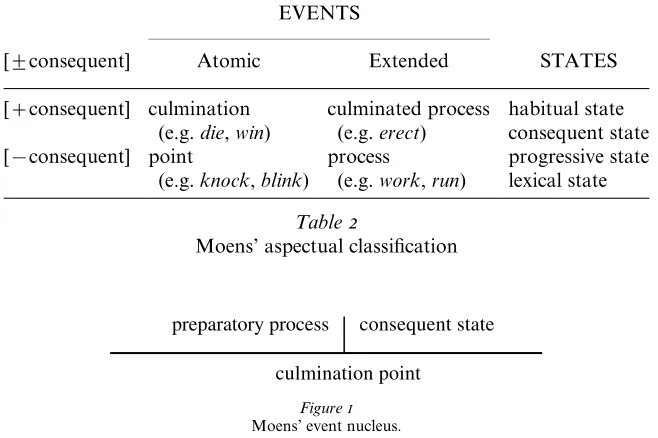
Moens (1987) presents an aspectual network in which a basic distinction is made between EVENTSandSTATES. Using two binary criteria, i.e. atomic vs.
It is clear that three of Moens’ event types, i.e.CULMINATION,CULMINATED PROCESSandPROCESS, correspond to Vendler’s achievement, accomplishment
and activity. In addition, Moens identifies a new event type POINT, which
is referred to as SEMELFACTIVE in our model (cf. sections 5 and 7). Moens
(1987 : 64f.) suggests that each of his aspectual classes is associated with a part of his tripartiteEVENT NUCLEUS, as shown in Figure 1.
Moens’ identification of point as a separate category is significant as it explains why some punctual events (i.e. points or semelfactives) can take the progressive whereas others (i.e. achievements) cannot. However, the problems with Moens’ system are self-evident. Firstly, it is not clear which part of the nucleus his new category of point should be associated with. It cannot be the CULMINATION POINT because the point category carries the value of
[xconsequent]. Secondly, if the process category pertains to thePREPARATORY PROCESS, there must be something to be prepared for. However, processes do
not have a culmination point to prepare for ; similarly, not all states are consequent. Thirdly, Moens has shoehorned ‘ habitual ’, ‘ consequent ’ and ‘ progressive ’ states, etc. into the category ofSTATEand yet barely discusses
this complicated category. These deficiencies in Moens ’ one-component aspect model encouraged us to follow Smith’s (1997) two-component aspect theory (cf. section 1).
In contrast to Vendler’s verb-based approach, Smith (1997) focuses her aspectual classification directly on idealized situations at the sentential level. Table 3 is a feature matrix system of Smith’s situation types with her own examples.
preparatory process consequent state
culmination point
Figure 1 Moens’ event nucleus. [¡consequent]
EVENTS
STATES
Atomic Extended
[+consequent] culmination (e.g.die,win)
culminated process (e.g.erect)
habitual state consequent state [xconsequent] point
(e.g.knock,blink)
process
(e.g.work,run)
[image:6.431.58.387.61.280.2]progressive state lexical state
Table 2
Smith’s classification does not appear to differ much from Vendler’s. The only noticeable difference is that semelfactives are separated from Vendler’s activities to reflect the distinction between achievements and accomplish-ments. Conceptually, however, Smith’s reconstruction is significant. As noted earlier, a striking feature of Vendler (1967) is that he confined his partition to the lexical level, as ‘ what he really did is to propose ontological categories ’ (Verkuyl 1993 : 33). In contrast, Smith (1997) is aware of the com-positional nature of situation aspect ; therefore her aspectual classification is not concerned with verbs. Rather it focuses directly on idealized situations at the sentential level. Smith (1997 : 54f.) also suggests some rules to govern the interaction between verbs and arguments in the composition process of situation aspect. However, her rules are only concerned with NP and PP-arguments. Furthermore, as she has not established an aspectual classi-fication of verbs at the lexical level, these rules cannot be applied easily, if at all. As Lys & Mommer (1986 : 218) argue, ‘ unless a system of verb classi-fication is also set forth, many generalizations will be missed ’.
As can be seen from the above discussion, none of the analyses discussed so far provides an adequate classification of situation aspect. Our two-level approach to modelling situation aspect is primarily motivated by the deficiencies inherent in these analyses. The Vendlerian approach works well at the lexical level, but not at the sentential level. Conversely the approach of Smith works well at the sentential level but not at the lexical level. Our two-level approach to situation aspect seeks to bridge this gap, operating at both the lexical and the sentential levels. Moens’ failure to give an adequate account of his complicated category of state has led us to treat viewpoint aspect as an independent yet interacting component of aspect theory. Verkuyl’s elaboration of the compositional nature of situation aspect has encouraged us to elaborate detailed rules mapping verb classes at the lexical level onto situation types at the sentential level.
Situation [¡dyn] [¡dur] [¡telic] Examples
STA x + *a know the answer, love Mary
ACT + + x laugh, stroll in the park
ACC + + + build a house, walk to school
SEM + x x tap, knock
ACH + x + win the race, reach the top
[a] Smith (1991 : 30, 1997 : 20) does not assign any telicity value to states because she thinks a final endpoint is irrelevant to this situation type. But as will become apparent in section 6.3, states may also have afinal temporal endpoint when they are delimited by devices like temporal adverbials at the clause level, as in (26a).
Table 3
3. OU R M E T H O D O L O G Y A N D C O R P O R A
While ‘ linguistic analysis will benefit if it is based on real language used in real contexts ’ (Meyer 2002 : 11), previous studies of aspect have largely been conducted without recourse to attested language data. They have, rather, been based on a handful of confected examples which, if not intuitively unacceptable, are atypical of attested language use (cf. Xiao 2002 : 4). Furthermore, those proposals have not, to date, been tested with corpus data. Yet corpora have a role to play both in developing and testing such theories, as demonstrated in the remaining sections of this paper.
With that said, we do not mean that the corpus-based approach and the intuition-based approach are completely exclusive, rather the two are complementary (cf. McEnery & Wilson 2001 : 19). With the intuition-based approach, researchers can invent purer examples instantly for analysis because intuitions are readily available and invented examples are free from language-external influences existing in naturally occurring language. How-ever, intuition should be applied with caution (cf. Seuren 1998 : 260–262 ; Hunston 2002 : 20–22, 43). Firstly, it is possible to be influenced by one’s dialect or sociolect. As such, what appears unacceptable to one speaker may be perfectly felicitous to another (cf. Xiao 2002 : 17). Secondly, when a researcher invents an example to support or disprove an argument, he/she is consciously monitoring his/her language production. Therefore, even if his/her intuition is correct, the utterance may not represent typical language use. Finally, results based on introspection alone are difficult to verify as introspection is not observable. In contrast, all of these disadvantages are circumvented by the corpus-based approach. Additional advantages of the corpus-based approach are that a corpus can reveal differences that intuition alone cannot perceive (cf. Francis, Hunston & Manning 1996 ; Chief, Hung, Chen, Tsai & Chang 2000 ; Hunston 2002 : 12f.) and a corpus can yield reliable quantitative data. Hence we decided to undertake a corpus-based approach to modelling situation aspect.
The use of corpus data as an input to the semantic analysis of aspect, a methodology to be elaborated in the following sections, represents some-thing new. Our study seeks to achieve a marriage between theory-driven and corpus-based approaches to linguistics, with the goal of providing an effective and fruitful avenue for the study of aspect. We believe that the discussion of external arguments in section 2 demonstrates quite clearly some of the value of corpus data in correcting biased intuitions.
(cf. McEnery & Wilson 2001 : 80) ; small corpora may contain sufficient examples of frequent linguistic features. As aspect is a frequent feature of the Chinese language, the Chinese corpus used in our study yielded more than enough examples for our purpose. The English corpus used in this paper, FLOB, a one-million-word balanced corpus of present-day British English (the Freiburg-LOB Corpus of British English ; cf. Hundt, Sand & Siemund 1998), also yielded enough examples of aspect marking for our purpose. Our aim in using the corpora was to establish the components of our model (sections 5 and 7) and provide a basis for the quantification of our aspectual classification system (section 4) and rules governing the composition of situation aspect (section 6).
4. TH E C L A S S I F I C A T I O N S Y S T E M F O R S I T U A T I O N A S P E C T
The first step in modelling situation aspect is to establish a classification system (cf. Vendler 1967 ; Verkuyl 1993 ; Smith 1997). The selection of parameters, however, needs to be undertaken with regard to a defensible rationale. This paper claims that the relevant distinguishing features should not only make a clear distinction between various types of verbs and situ-ations, they must also facilitate the explanation of the interaction between situation aspect and viewpoint aspect. In doing so, this paper will build upon the three established parameters, [¡DYNamic], [¡DURative] and [¡TELIC]
(e.g. Comrie 1976 ; Smith 1997), and add two new features, [¡RESULT] and
[¡BOUNDED], to complete our classification system.
4.1 [¡Dynamic]
akin to things that HAPPEN ’ (Carlson 1977 : 448). For example, the verb
xizao‘ to take a bath ’ can take the progressivezaiand is judged as a dynamic verb. However, becauseyongyou‘ to own ’ is a stative verb, it cannot take the progressivezai.
4.2 [¡Durative]
[¡Durative] as a feature relies on the contrast between a [+durative] situation, which ‘ lasts for a certain period of time ’, and a [xdurative] situation, which ‘ does not last in time ’ (Comrie 1976 : 41f.). Durativity is a mental concept, hence duration is relative and can be of any specified temporal length. For example,John sleptis durative whereasJohn coughed
is punctual. What matters of course is not how much time John’s sleep or cough actually takes but that a typical cough is so short that conventionally speakers do not focus on its internal structure (see section 2). With a punctual reference time, durative situations either have an inceptive reading (e.g.The phone rang at 10 a.m.) or are unacceptable (e.g.*John was tall at 10 a.m.). In Chinese, the most reliable test for durativity is the collocation test with the durative aspect marker-zhe. For example, of the 238 instances of the durative -zhe found in the Weekly Corpus, 236 are activities (e.g. xiao
‘ smile ’) while the other two involve semelfactives (e.g. pai ‘ pat ’), which actually behave like activities when denoting multiple events (cf. section 5.1).
4.3 [¡Telic]
While the consensus is that the [¡telic] distinction is essential to aspectual classification, there is no uniform definition of telicity. For Garey (1957 : 106), an action is telic if it tends ‘ towards a goal ’. Comrie (1976 : 45, 47) defines a telic situation as ‘ one that involves a process that leads up to a well-defined terminal point ’. Smith (1997 : 19) simply associates the [¡telic] distinction with the nature of the final endpoint : while telic events have a natural final endpoint, atelic events have an arbitrary final endpoint. Note that telicity is defined here differently from previous proposals. In our model, the feature [¡telic] is associated with the presence or absence of aFINAL SPATIAL ENDPOINT(see section 4.5 for the distinction between a final spatial endpoint
and aFINAL TEMPORAL ENDPOINT).
Several behavioural tests have been suggested in the literature to determine the telicity of a situation. The entailment test proposed by Garey (1957 : 195) is widely accepted (e.g. Vendler 1967 ; Comrie 1976 : 44f.). Garey (ibid.) asserts that the telicity value of a verb can be tested with the question ‘ if one is
‘ not ’ negates the REALIZATIONrather than theCOMPLETION of an event. For
example,ta mei kan na-ben shu ‘ He didn’t read that book ’ means that the reading event did not occur at all. To express the meaning intended in the entailment test, the RVC (resultative verb complement) form kan-wan
‘ to read-finish ’ must be used :ta mei kan-wan ne-ben shu ‘ He didn’t finish reading that book ’.
Ever since Vendler (1967 : 101), the compatibility test withfor/in-adverbials has been in operation as a diagnostic for determining the telicity value of a situation. A [xtelic] situation is compatible with afor-adverbial (e.g.John walked FOR AN HOUR) whereas a [+telic] situation is compatible with an
in-adverbial (e.g.John wrote a letterIN AN HOUR). The Chinese equivalents of
in an hourandfor an hour, (zai)yi-ge xiaoshi neiandyi-ge xiaoshirespectively, also work well (e.g.zai qi-fenzhong nei daoda‘ to arrive in seven minutes ’ and
shouhou yi-tian‘ to wait for one day ’). All of the thirteen instances ofin-PPs found in the Weekly Corpus indicate the [+telic] value of the situations concerned.
As noted in section 2, it is important to classify verbs and situations at two different levels. But if one uses only the three traditional parameters, the problem of the double lexicon entry encountered by Vendler cannot be avoided. To avoid this problem it is necessary to introduce two new binary features, namely, [¡result] and [¡bounded].
4.4 [¡Result]
In our model, a verb is assigned the value of [+result] if its meaning includes a reference to a changing point at which the final spatial endpoint denoted by the verb starts holding (cf. Moens 1987 : 140). Telic verbs do not necessarily encode a result. While an achievement verb and an accomplishment verb both have a final spatial endpoint, they differ in that the former indicates the success of achieving that endpoint (e.g. ying(qiu) ‘ to score (a goal) ’) but the latter does not (e.g.xie(xin) ‘ to write (a letter) ’). The examples in (4) and (5) below illustrate this point well. The verbatein (4a) involves a potential final spatial endpoint, which is made explicit by the internal argumentnine ham rolls. However, as the verb does not encode a result itself, once the internal argument is optionally absent, as in (4b), an accomplishment verb no longer has a final spatial endpoint and can only allow an atelic reading. [+Result] verbs are different. They always have a telic reading whether or not there is an additional argument indicating a final spatial endpoint, as shown in (5).
(4) (a) She [_] ate nine ham rolls (in/*for 10 minutes). (b) Bullseye [_] ate like a horse (*in/for an hour).
As [+result] verbs include a reference to the successful achievement of the encoded final spatial endpoint, situations denoted by these verbs cannot be contradicted by a conjoined second clause. For example, if you assert that
tamen quxiao-le na-chang bisai‘ They cancelled the game ’ in the first clause, you cannot possibly contradict this assertion by saying *keshi mei quxiao-cheng‘ *but did not succeed ’ in a conjoined clause. As such, the contradiction test can be used to determine the [¡result] value.
In this paper, we define the feature [¡result] in line with Moens (1987 : 140). It should be noted that while Smith (1997 : 27, 31) also associates some types of result with accomplishments and achievements, her interpretation of result is different from the [¡result] distinction in our model. For Smith, all [+telic] situations have a natural final endpoint that necessarily leads to a result, that is,RESULTis identified withTELICITY. In our analysis, a verb or
situation is [+result] only if it encodes a result itself. Only achievement verbs carry the value of [+result]. Our definition of result also differs from that of Shirai (1991) and Shirai & Andersen (1995 : 756), where [+result] refers to ‘ observable outcomes salient to the child ’. In our analysis, a result associated with an achievement verb may not necessarily be observable. Rather it can be abstract as long as it is encoded in the verb itself.
4.5 [¡Bounded]
Smith (1997) classifies instantaneous events like tap and knock as semel-factives and assigns the value of [xtelic] to this category (cf. section 2). As noted in section 4.3, Smith intends a [+telic] situation to have a natural final endpoint. It is obvious that Smith does not think instantaneous situations like semelfactives have a natural final endpoint. However, this is arguable, as if semelfactives have no natural final endpoint, how can they produce iterative readings ? A punctual situation, be it an achievement or a semel-factive, is conceived of as having no inherent duration, ‘ not even duration of a very short period ’ (Comrie 1976 : 42), hence its initial endpoint overlaps with its final endpoint (cf. Siewierska 1991 : 51). Because of its punctual nature, we argue that the final endpoint of a punctual situation is as natural, inherent and well-defined as its initial endpoint (the two are actually the same point ; cf. Jespersen 1924 : 272–274 ; Bauer 1970 : 192), though it should be kept in mind for the moment that the final endpoint of a semelfactive is different from that of an accomplishment or an achievement.
The controversy regarding the telicity value of semelfactives arises from different understandings of FINAL ENDPOINT. Traditionally, endpoints have
TERMINATION, i.e. an object that undergoes an identifiable change of state. John wrote a letteris telic becausea letterserves as the object of termination, whereas John walked is atelic because there is only an OBJECT OF ORIGIN
(i.e.John) but no object of termination. At this point, one might be tempted to jump to the conclusion that only structures with transitive verbs can be telic, but this temptation is dangerous. In fact, not all transitive structures are telic and not all intransitive structures are atelic. For example,John wrote letters is atelic because mass nouns and bare plurals are not delimited in space and cannot serve as the object of termination.4
However,The window broke is telic because it involves a termination object that underwent an identifiable change of state. Tenny (1994 : 26) also argues explicitly that telicity and boundedness are ‘ the same thing in two different domains : the spatial and the temporal ’. They are the same thing in that they both involve final endpoints ; and they are different in that they apply to different domains. A final temporal endpoint is basically different from a final spatial endpoint. As Lyons (1977 : 718) observes, ‘ spatial expressions are more basic, grammatically and semantically, than various kinds of non-spatial expres-sions ’. Therefore, spatial delimitedness always implies temporal bounded-ness, but the reverse is not true. For example, as the situationwalk to school
is delimited spatially (i.e. a specified distance), it must also be bounded temporally (e.g. it usually takes John ten minutes to cover the distance). However, if John walked for only three minutes today, the situation becomes bounded temporally. In this case, the temporally bounded situation does not have a final spatial endpoint.
In our model, the feature [¡bounded] refers to the presence or absence of a
FINAL TEMPORAL ENDPOINTwhile the feature [¡telic] is related to a final spatial
endpoint. It should be noted that just as [+result] always implies [+telic], [+telic] also implies [+bounded]. In other words, [xresult] may mean either [+telic] or [xtelic] ; and similarly, [xtelic] may mean either [+bounded] or [xbounded]. The three endpoint-related features are hierarchically structured, with [¡result] at the top and [¡bounded] at the bottom.5
[4] [xCount] NPs like mass nouns and bare plurals share the property of cumulative or div-isive reference (cf. Link 1983, Bach 1986). For example,milkplusmilkis stillmilk, part of runningis stillrunning. In contrast, [+count] NPs do not have such properties, e.g.a letter plusa lettermeanstwo letters, and part ofrunning a mileis no longerrunning a mile. [5] AJLreferee pointed out to us that the Jakobsonian/Prague School concept of markedness
5. TH E L E X I C A L L E V E L: V E R B C L A S S E S R E D E F I N E D
In this paper, verbs are classified in NEUTRAL CONTEXT, a concept similar
to Moens ’ (1987 : 131) ‘ basic proposition ’ or Lys & Mommer’s (1986 : 218) ‘ frame ’. The context is deemed neutral when everything has been excluded that might change the aspectual value of a verb. This means that of the six determinants of situation aspect identified by Mourelatos (1981 : 199), the inherent features of verbs alone are taken into account. In English, for example, a neutral context is typically a simple clause in which
(a) the verb is in the past tense ;
(b) the object is syntactically and semantically a singular countable noun and should only be present if it is obligatory, i.e. with a necessarily transitive verb ;
(c) viewpoint aspect must be simple (cf. Lys & Mommer 1986 : 218).
Thus, John walked is neutral whereas John walked me home is not, nor is
John was walking. In Chinese, a neutral context is similar except that there is no tense requirement and a perfective viewpoint aspect is preferable (e.g.
ta daying-le‘ He agreed ’). These restrictions are imposed to avoid the poss-ible influences of other sentential constituents (e.g. complements, arguments and non-arguments) on verbs (see section 6). Note, however, that a neutral context in our model is different from Moens’ or Lys & Mommer’s concept as our notion of neutrality has no requirements for the external arguments of verbs.
There are 32 combinations of the five binary features discussed in section 4. However, this does not mean that there are 32 verb classes because combi-nations of conflicting features must be ruled out. As noted in section 4.5, the three endpoint-related binary features are hierarchically structured. Therefore, feature combinations containing both [+result] and [xtelic], or both [+telic] and [xbounded], or [+result] and [xbounded], are not possible. As the achievement of an encoded result is always punctual, feature combinations containing both [+result] and [+durative] are not possible. If a situation is instantaneous or has a final spatial endpoint, it is obvious that the situation is [+dynamic] (cf. also Lindvall 1997); thus the combi-nations with both [xdynamic] and [xdurative], or with both [xdynamic] and [+telic], can also be excluded.
There are 23 combinations that group together conflicting features. Of the nine remaining combinations, three patterns are unattested in our data as basic verb classes in neutral contexts, though two of them are good as derived situation types at the clause level (cf. section 7).6
It is also interesting to note
that while on the one hand, the feature combination of [+dynamic], [+durative], [xbounded], [xtelic] and [xresult] can be instantiated either as activities or asSTAGE-LEVEL STATES(SLSs), on the other hand, the feature
com-bination of [xdynamic], [+durative], [xbounded], [xtelic] and [xresult] can be instantiated either asINDIVIDUAL-LEVEL STATES(ILSs) or as SLSs ; it is
no coincidence that SLSs have sometimes been considered as a transitional class between states and activities (e.g. Carlson 1981 : 39).
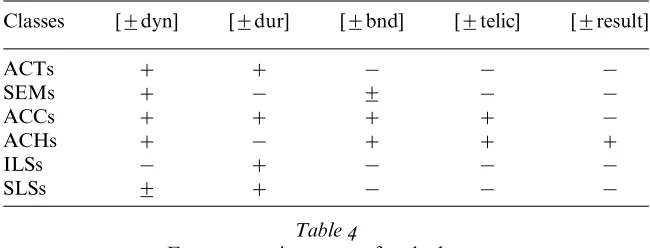
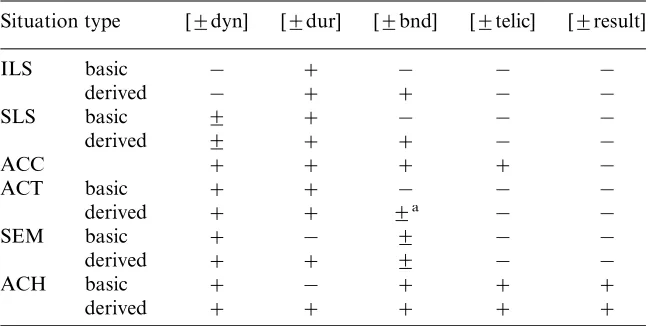
The six verb classes attested on the basis of our data are activities vs. semelfactives, accomplishments vs. achievements, and individual-level states (ILSs) vs. stage-level states (SLSs). The semantic features of these verb classes are summarized in Table 4.
5.1 Activity verbs vs. semelfactive verbs
Our class of activity verbs does not differ much from Smith’s (1997). They are dynamic and durative in nature, involve no final spatial or temporal endpoint and encode no result (e.g. deng ‘ wait ’, paobu ‘ run ’ andxunzhao
‘ look for ’). The [xbounded] feature determines that their co-occurrence with durative adverbials (e.g.wo zai budui gan-leHAOJI-NIAN‘ I worked in the army for many years ’) or the progressive (ta yizhiZAIku‘ He was crying all of the time ’) can only produce a durative single-event reading.
Although semelfactive verbs group with activities in that they are also dynamic verbs involving no final spatial endpoint and encoding no result, the two categories are different. Since semelfactives are prone to shift between single-event and multiple-event readings (cf. Comrie 1976 : 42), their final temporal endpoints can be overridden and thus they have the feature [¡bounded]. In contrast with activity verbs, semelfactive verbs intrinsically involve a final temporal endpoint. Therefore, semelfactives easily suggest iterative multiple-event readings (e.g. John coughed). When a semelfactive verb takes an adverbial denoting temporal length (e.g.da-le niJI-TIAN?‘ For how many days did they beat you ? ’), a temporal quantifier (e.g.ye chao ta
Classes [¡dyn] [¡dur] [¡bnd] [¡telic] [¡result]
ACTs + + x x x
SEMs + x ¡ x x
ACCs + + + + x
ACHs + x + + +
ILSs x + x x x
[image:15.431.46.371.57.181.2]SLSs ¡ + x x x
Table 4
toushang kan-leSHU-DAO‘ (Liu) also chopped at her head several times with his knife ’), or the progressive (e.g. ZAI guzhang ‘ be clapping one hands ’) or durative marker (e.g.YAO-ZHE tou tanxi‘ (she) sighed while shaking her head ’), it always produces an iterative reading. Yet even in these cases, semelfactives are different from activities : the former have iterative multi-event readings whereas the latter only allow durative single-multi-event readings. So semelfactives can indeed be counted and Mourelatos ’ processes should be fine-grained (see section 2).
5.2 Accomplishment verbs vs. achievement verbs
Traditionally, these two verb classes have been distinguished primarily by the [¡durative] feature (e.g. Smith 1997). But in our model, the difference between the two categories consists mainly of whether they do or do not encode a result (cf. section 4.4). By the [¡result] criterion, accomplishment verbs place emphasis on the process leading up to a result (i.e. the prepara-tory process in Moens ’ event nucleus). As the preparaprepara-tory process normally takes time, accomplishments are [+durative] in nature. On the other hand, the achievement of the result encoded in an achievement verb is normally punctual, thus achievement verbs are intrinsically [xdurative]. Accomplish-ments are verbs with the features [+dynamic], [+durative], [+bounded], [+telic], and [xresult] in that they focus on the process leading up to but not necessarily achieving the implied result (e.g.chi‘ eat ’ andxie‘ write ’), while achievements are verbs with the features [+dynamic], [xdurative], [+bounded], [+telic], and [+result] in that they focus on the successful achievement of the encoded result with or without profiling the process leading up to the result (e.g.ying ‘ win ’,daoda‘ arrive ’ andzhaodao ‘ find ’ ; cf. also Yang 1995 : 44).
5.3 ILS verbs vs. SLS verbs
One problem noted in section 4.1 is that sometimes states (or more precisely, some states) can take the progressive felicitously. Any theory of aspect should be able to account for this. In this section, we will present our account of how this occurs. An important part of our account rests upon distinguishing two types of states : individual-level and stage-level states.
The distinction between individual-level and stage-level predicates was first introduced by Carlson (1977 : 448). Carlson argues that stage-level predicates express transient or episodic stages of an individual (such as drunk and
supported by the different ways they interact with viewpoint aspect. That is, SLSs have to be marked aspectually to have a specific closed reading, whereas ILSs do not have such a requirement (cf. Xiao & McEnery forth-coming). ILS and SLS verbs can be defined respectively as follows : ILS verbs are stative durative verbs that do not have a final temporal or spatial endpoint and do not encode a result in the sense that they are normally predicated of permanent dispositions of an individual (e.g.xiang‘ resemble ’ and piaoliang ‘ beautiful ’). SLS verbs are durative and generally stative (Carlson 1977 : 448 ; Olsen 1994) verbs that do not have a final temporal or spatial endpoint and do not encode a result in the sense that they are normally predicated of less permanent stages of an individual (e.g.bing‘ be ill ’ andmang‘ be busy ’).
The dichotomous treatment of states we propose in this paper is not only well justified (cf. also Carlson 1981 : 39 ; Chierchia 1995 : 176–223), it is more explanatory of the behaviours of states. With the ILS/SLS distinction, the event-like properties of some states can be accounted for easily. As has been recognized in the literature, state verbs are not normally compatible with the progressive (cf. section 4.1) because they tend to describe the more perma-nent, or ‘ timeless ’ (Carlson 1977 : 446), characteristics of an individual ; but when they do occur in these contexts, they ‘ name the characteristics closely associated with various kinds of behaviours ’ (Brinton 1988 : 40). In other words, they describeSTAGESof an individual, which are considered as
tem-porary or contingent in nature (cf. Leech 1971 : 16 ; Comrie 1976 : 36 ; Lyons 1977 : 717 ; Smith 1983 : 483f.). Compare (6a) and (6b). The verb constellation in (6a) is predicated of the individual Max himself, and the state described is related to his inherent dispositions, without which the individual would not be Max. On the other hand, the verb constellation in (6b) is predicated of stages of the individual Max, that is, his current actions or behaviours, thus (6b) can be interpreted as ‘ Max made a fool of himself ’ on a particular occasion (cf. also Carlson 1981 : 36). The quality predicated by stage-level predicates can be removed without changing the essential quality of the in-dividual. As stages of an individual are more temporary than the individual’s dispositions, (6b) takes the progressive to refer to a particular stage of the individual Max.
(6) (a) Max is a fool.
(b) Max is being a fool. (Carlson 1977 : 448)
6. TH E R U L E S F O R T H E T H R E E-L E V E L I N T E R A C T I O N A T T H E S E N T E N T I A L L E V E L
In this section, we will propose twelve rules for the composition of situation aspect at the sentential level.7 As noted in section 1, the sentential level consists of three syntactic units : nucleus, core and clause. The nucleus deals with predicates. The core deals with predicates and arguments. The clause deals with predicates, arguments and non-arguments. Section 6.1 is con-cerned with the interaction at the nucleus level (Rules 1–2) and will examine the roles of RVCs (resultative verb complements) and verb reduplication in Chinese as well. Section 6.2 will discuss the effects of NP- and PP-arguments on situation types at the core level (Rules 3–6). In our model, NP-arguments have the nominal feature [+count] or [xcount],8 and PP-arguments are either PPs[Locative], PPs[Directional]or PP[Goal]. Section 6.3 will discuss non-arguments
that contribute to situation aspect at the clause level (Rules 7–12), including durative adverbials specifying time frames (for-PPs, from_to), temporal quantifiers (e.g.twice,five times), the progressive, as well as the Chinesede
resultative structure andba/beiconstructions.
6.1 Nucleus level composition
The following rules are hypothesized by us to apply to the interaction at the nucleus level :
Rule 1 : Verb[xtelic/¡bounded]+RVCs)Derived predicate[+result/+telic]
Rule 2 : Verb[xtelic/¡bounded]+reduplicant)Derived predicate[+bounded]
Rule 1 illustrates the effect of RVCs on situation aspect. As Brinton (1988 : 168) observes, these complements ‘ typically express a telic notion ’ and ‘ may add the concept of a goal or an endpoint to durative situations which other-wise have no necessary terminus ’ (e.g.hit the metal vs.hit the metalFLAT). RVCs refer to verb complements that indicate the resultant state or phase of the situation denoted by their preceding verbs in resultative compounds. There are three types of RVCs, namely, completive (RVCCs, e.g.xie-wan
‘ write-complete ’, zhunbei-hao ‘ prepare-complete ’), result-state (RVCSs, e.g.sha-si‘ kill-dead ’) and directional (RVCDs, e.g.xing-goulai‘ wake up ’). When these complements are added to [xtelic] or even [xbounded] verbs,
[7] An anonymousJLreferee suggested that instead of binary features such as [¡telic] and [¡bounded], we might rather use the verb classes, established in section 5, in our mapping rules. This, however, would make the formulations quite clumsy. For example, we would need to use ‘ ILS, SLS, activity and semelfactive ’ to replace ‘ verb[telic]’
the derived predicates become [+telic] and [+result] because the final spatial endpoint or result indicated by complements is attached to them. Compare
ta he-le jiu‘ He drank ’ andta he-ZUI-le jiu‘ He got drunk ’ ; while it is possible to sayta he-le jiu, keshi mei he-ZUI‘ He drank, but was not drunk ’, the version with the RVCzui(i.e.ta he-ZUI-le jiu, *keshi mei he-zui‘ *He got drunk, but was not drunk ’) is not acceptable. In the Weekly Corpus, 1,741 instances of RVCs were found – 45 RVCCs, 864 RVCSs and 832 RVCDs. For testing, thein-PP test and the contradiction test were used (cf. sections 4.3 and 4.4). Examination of the data shows that no matter what telicity and boundedness values basic level verbs have, their derived predicates are all [+telic] and [+result], i.e. they are achievement verbs.
In English there are no completive RVCs, and result-states RVCs can be either adjectives (e.g.pushed the doorOPEN) or resultative particles (e.g.pull the cartOVER). We used situations with adjectival result-state RVCs to test the reliability of Rule 1 in English. Eleven situations of this type were found in FLOB,9and Rule 1 passed thein-PP test and the contradiction test with all of them. Consider the following examples :
(7) (a) Marie pulled her handfree(in/*for 5 minutes). (b) Marie pulled her hand (for/*in 5 minutes).
(c) Marie pulled her handfree, *but she did not succeed. (8) (a) He snorted his nostrilsclear(in/*for 1 minute).
(b) He snorted his nostrils (for/*in 1 minute).
(c) He snorted his nostrilsclear, *but his nostrils were still not clear.
The verbpullin (7) is [xtelic] and [xbounded] (i.e. an activity) whilesnort
in (8) is [xtelic] and [¡bounded] (i.e. a semelfactive). But when the RVCs
freeandclearare added, both of them are turned into derived predicates that are [+telic] and [+result] in nature. That is, RVCs function to change ac-tivity or semelfactive verbs into achievement verbs. That is why (7a) and (8a) would be infelicitous if for-adverbials were used. Similarly, as the derived predicates encode a result, they cannot be contradicted by a conjoined clause, as shown in (7c) and (8c).
Let us now consider verb reduplication in Chinese. Because of intrinsic semantic constraints, only verbs with the features [+dynamic] and [xresult] can be reduplicated to denote a delimitative meaning in Chinese (cf. Xiao & McEnery forthcoming). As such,wang–wang‘ look–look, take a brief look ’ and mo–mo ‘ touch–touch, touch a bit ’ are natural whereas *pang–pang
‘ *fat–fat ’ and *ying–ying‘ *win–win ’ are not acceptable. Verb reduplication not only provides a perspective from which to view a situation perfectively, it also provides a temporal boundary to the situation denoted by a
reduplicated verb and changes its boundedness value from minus to plus. For a final temporal endpoint, the in/for-adverbial test for a final spatial endpoint is not relevant (cf. Yang 1995). Rather, the co-occurrence test with the perfective -lewill be used, as -le demonstrates a strong preference for [+bounded] situations (cf. Xiao 2002 : 151). There are 38 instances of verb reduplication in the Weekly Corpus (36 activities and two semelfactives). Only nine are perfective situations that can take -le, but the verbs in all of these sentences must be reduplicated, even though the aspect marker -lecan be optionally suppressed. Consider the following examples :10
(9) (a) wo huitou wang-le wang zhe-ge popolanlan de jia (ACT) I turn-head look-LE look this-CL run-down GEN home
‘ I turned around and took a brief look at this run-down home. ’ (b) *wo huitouwang-lezhe-ge popolanlan de jia
(10) (a) hanzi shayoujieshi mo[-le]-mo koudai you shuo [_] (ACT) man same-as feel[-LE]-feel pocket again say
‘ The man pretended to be serious about feeling in his pocket, and then said [_]. ’
(b) *hanzi shayoujieshimokoudai you shuo [_] (11) (a) laoren xiao-zhe dou-le dou shou (SEM)
old-man smile-zhe shake-LE shake hand
‘ Smiling, the old man shook his hand ’ (b) *laoren xiao-zhedou-leshou
Clearly, all of the (a) sentences with reduplicated verbs are felicitous whereas the (b) sentences are unacceptable. The situations of ‘ wang ’ (meaning ‘ to look at ’) in (9) and ‘ mo ’ (meaning ‘ to feel ’) in (10) are activities, which are neither [+telic] nor [+bounded]. Therefore they cannot occur with -le, as shown in (9b) and (10b). However, when the verbs are reduplicated, the derived pred-icates denote temporally bounded situations, and thus can occur with -le. The verbdou‘ to shake ’ in (11) is a semelfactive. Because verbs of this class shift easily between single-event and multiple-event readings, their temporal endpoints are often overridden. Therefore, these verbs normally group with activity verbs and usually need an extra delimiting device to provide a temporal boundary when they co-occur with -le. That explains why (11a) is felicitous whereas (11b) is ill-formed. Further, it is interesting to note that in (10) -leis left out but the verb reduplicant is not and cannot be omitted. This sentence conveys a complex event situation. The first event ‘ mo koudai ’ (meaning ‘ to feel in his pocket ’) must be realized before the second event ‘ shuo ’ (meaning ‘ to say ’) can be initiated. When -leis omitted in the original sentence, the first verb constellationHAS TObe reduplicated to perfectivize the
first event.
[10] In the glosses following Chinese examples,CLrepresents ‘ classifier’ andGENandPRTstand
6.2 Core level composition
While internal arguments such as direct objects and directional complements typically affect situation type, the question of whether or not external argu-ments also contribute to situation aspect is controversial. Dowty (1979), Brinton (1988), Verkuyl (1989, 1993) and Salaberry & Shirai (2002 : 2), for example, claim that external arguments have the same effect on situation type as internal arguments while Tenny (1994) and others argue that they do not. In our model, the rules governing the interaction between verbs and NP-arguments are expressed as follows :
Rule 3 : NP+Verb[+/xtelic])Core[+/xtelic]
Rule 4 : NP+Verb[xtelic]+NP)Core[xtelic]
Rule 5 : NP+Verb[+telic]+NP[+/xcount])Core[+/xtelic]11
These rules reflect the contribution of NP-arguments to the composition of situation aspect. The unspecified NPs can have the value of either [+count] or [xcount]. For the moment, let us set aside external arguments and examine internal arguments alone. Rule 3 shows that verbs are the sole determinant of situation types when internal arguments are optionally absent (e.g. (12a, b)). Rules 4 and 5 show that with [xtelic] verbs, NP-argu-ments do not affect situation types (e.g. (12c, d)) while with [+telic] verbs (including compound verbs derived at the nucleus level), the telicity values of situations at the core level are determined by the nominal feature of internal arguments (e.g. (12e, f )).
(12) (a) the flames go out (in/*for one hour) NP[+count]+Verb[+telic])Core[+telic]
(b) a buzz of excitement went around (for/*in hours) NP[+count]+Verb[xtelic])Core[xtelic]
(c) he buzzed the skyscraper hotel (for/*in 5 minutes) NP[+count]+Verb[xtelic]+NP[+count])Core[xtelic]
(d) which (=documentary) pours cold water on the daredevil exploits of the stars (for/*in three days)
NP[+count]+Verb[xtelic]+NP[xcount])Core[xtelic]
(e) (they) stapled on 80 shoulder-length dreadlocks (in/*for seven hours).
NP[+count]+Verb[+telic]+NP[+count])Core[+telic]
(f) I opened supermarkets (for/*in 5 years)
NP[+count]+Verb[+telic]+NP[xcount])Core[xtelic]
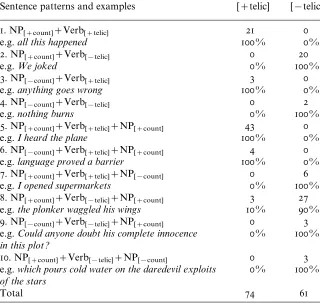
We tested these rules using the Weekly and FLOB corpora. However, as the corpora are only annotated with part-of-speech information, but not with
such semantic features as telicity and nominal values, a large-scale test proved impractical. Therefore, a segment of around 2,000 tokens was taken from FLOB (FLOB A19) and further processed by hand to allow us to undertake this analysis. As the first step in processing, all clauses without verbs (e.g.Just like that), with stative verbs (e.g.We’re no fools) and with reporting verbs (e.g.said Keith) were excluded from the sample ;12then all of the remaining clauses were annotated with semantic features such as telicity values for verbs and nominal values for NPs. If a complex sentence consisted of two clauses, it was counted as two simple clauses (e.g. (12d)).
After processing, a testbed of 135 semantically annotated simple clauses was obtained. As can be seen from the results in Table 5, the situation types Sentence patterns and examples [+telic] [xtelic]
1. NP[+count]+Verb[+telic] 21 0
e.g.all this happened 100 % 0 %
2. NP[+count]+Verb[xtelic] 0 20
e.g.We joked 0 % 100 %
3. NP[xcount]+Verb[+telic] 3 0
e.g.anything goes wrong 100 % 0 %
4. NP[xcount]+Verb[xtelic] 0 2
e.g.nothing burns 0 % 100 %
5. NP[+count]+Verb[+telic]+NP[+count] 43 0
e.g.I heard the plane 100 % 0 %
6. NP[xcount]+Verb[+telic]+NP[+count] 4 0
e.g.language proved a barrier 100 % 0 %
7. NP[+count]+Verb[+telic]+NP[xcount] 0 6
e.g.I opened supermarkets 0 % 100 %
8. NP[+count]+Verb[xtelic]+NP[+count] 3 27
e.g.the plonker waggled his wings 10 % 90 %
9. NP[xcount]+Verb[xtelic]+NP[+count] 0 3
e.g.Could anyone doubt his complete innocence in this plot ?
0 % 100 %
10. NP[+count]+Verb[xtelic]+NP[xcount] 0 3
e.g.which pours cold water on the daredevil exploits of the stars
0 % 100 %
[image:22.431.60.380.61.366.2]Total 74 61
Table 5
Situation types in the FLOB sample
denoted by clauses with the pattern of NP+Verb are solely determined by verbs ; 24 situations with [+telic] verbs (rows 1 and 3) are all telic whereas 22 situations with [xtelic] verbs (rows 2 and 4) are all atelic, irrespective of the nominal features of their external arguments. In clauses with the pattern of NP+Verb+NP, situation types are the composite result of verbs and their internal arguments. With [xtelic] verbs, atelic situations result irrespective of the nominal feature of internal arguments. 33 out of 36 clauses (91.7 %) with [xtelic] verbs (rows 8–10) denote atelic situations, the remaining three (8.3 %) denote telic situations simply because they take a PP[goal], which
provides a final spatial endpoint (see the discussion of Rule 6 below). With [+telic] verbs, internal arguments also play a role. All 47 clauses with [+count] object NPs (rows 5–6) denote telic situations whereas the six clauses with [xcount] object NPs (row 7) are atelic.
It is interesting to note that the nominal features of internal indirect arguments may also affect situation types (cf. Moens 1987 : 151) ; for example :
(13) (a) Henry went through torture (for/*in 7 hours) to conjure up some giggles.
(b) Henry went throughthe revolving door(in/*for 2 minutes).
Thein/for-PP tests show that (13a) is an atelic situation while (13b) is telic. The aspectual characterizations differ because the NP in the first instance is [xcount] whereas that in the second is [+count].
We must now return to the question of external arguments. Our data clearly show that external arguments do not contribute to situation aspect because ‘ external arguments cannot measure out the event ’ (Tenny 1994 : 62). But for this view to be tenable, one should be able to account for the following atypical, yet valid, examples :13
(14) (a) Brandyevaporated from these barrels for 50 years.
(b) A gallon of brandyevaporated from these barrels in 50 years.
The apparently confusing contrast between (14a) and (14b) is caused by different interpretations of the for-PP. English uses this device to express
DURATION(15a, b) ;SCOPE(15c, d) ; andINTENTION(15e). In French, duration is
expressed by pour ‘ for ’ whereas scope is expressed by pendant ‘ during ’ (cf. also Moens & Steedman 1988 : 21). In Chinese, expressions likeyi-nian
‘ one year ’ are used to indicate duration (e.g.chicheng yitan sanshiduo-nian
‘ (She) played an outstanding role in art circles for more than 30 years ’) or intention (pan-le san-nian xing ‘ (He) was jailed for 3 years ’). Scope is expressed by the preposition (zai)_zhong‘ during ’, or (yi)lai‘ from_on ’ if the situation lasts till the beginning of the stretch of speech in which it is discussed. Tenny (1994 : 6) notes that the relevant interpretation of for an hour, when used as a test for telicity values, is that the event continues for an
hour’s duration but does not necessarily stop after one hour. This means that only the duration meaning of afor-PP as used in (15a) is relevant. Thefor-PP in (15b) is irrelevant becausefor a few minutesrefers to the duration of the resultant state of an achievement, namely, his absence from the room. In (14a),for 50 yearsindicates a scope meaning rather than a duration meaning and hence is clearly not related to the test for telicity.
(15) (a) I criedfor days[_].
(b) He left the roomfor a few minutes.
(c) No doubt : Burgundy was having its hottest summerfor years. (d) For yearshe was considered a ‘ promising actor ’ [_].
(e) He was jailedfor 18 months[_].
Even if the nominal features of subject NPs do affect situation types, (14a) should be compatible with an in-PP because the subject NP, though a mass noun, is [+count] andevaporateis an achievement verb. Consider the following example :
(16) Opinion poll leads can evaporate overnight.
In this sentence, the subject NP is a bare plural. Nevertheless, the adverbial
overnightcan be replaced within an hourquite felicitously.
Mass nouns or bare plurals may not necessarily be [xcount]. Sometimes they can have a definite referent (i.e. an existential reading) rather than an indefinite referent (i.e. a generic reading ; cf. Carlson 1977 ; Dowty 1979 : 83f.). Consider the following examples from Dowty (ibid.) :
(17) (a) Tyrantsruled Wallachia for 250 years. (b) Elephantsare quite easily trained.
In (17a), some particular tyrants, not tyrants in general, are clearly referred to, even though the NP is a bare plural. This is in contrast with the bare pluralelephantsin (17b), which has to be taken as referring to elephants in general rather than a particular group of elephants (cf. Dowty 1979 : 84). By the same token, the mass nounbrandyin (14a) necessarily has an existential reading. It has specific reference, namely, the brandy that evaporated from those barrels and thus is [+count].14
[14] AJLreferee pointed out to us thatbrandyin (14a) did not have specific reference and, therefore, was not [+count], because the French version isdu cognacand notle cognac. We agree that in French, the partitivedubut not the definite articleleis appropriate in this context because the brandy that evaporated from the barrels represents only some of the brandy in the world. Obviously, it is not likely thatALLof the brandy in the world
We briefly discussed Verkuyl’s (1989) assertion concerning external argu-ments in section 2. Verkuyl (1993 : 23) further claims, with reference to the contrast between sentences like those in (18), that ‘ the subject-NP plays a decisive role in aspect construal ’. Dowty (1979 : 63) also argues that ‘ if an indefinite plural occurs even as the subject of an achievement, the sentence is acceptable with durative adverbials ’ (e.g. (19a)).
(18) (a) For monthspatientshere died of jaundice. (Verkuyl 1993 : 23) (b) *These two patientsdied of jaundice for months. (ibid.)
(19) (a) Tourists discovered the quaint little village for years. (Dowty 1979 : 63)
(b) *Johndiscovered the quaint little village for years. (ibid.) (20) (a) jiucheng ganran bingdu zhe shu-tian nei ji
90 % infect virus person a-few-day within right-after gao buzhi
end-up no-cure
‘ Ninety per cent of those infected with the Ebola virus die in a few days. ’
(b) huanzhe ji-ri zhinei jiu hui da chuxue er wang patient a-few-day within right-after likely big bleed then die ‘ Patients (of the disease) die of bleeding in a few days. ’
(c) Nikki Lauda won the Monaco Grand Prixfor several years. (Moens & Steedman 1988 : 21)
The for-PPs in (18a) and (19a) clearly carry a scope meaning because it is plausible to say For months[patients died of jaundiceIN A FEW DAYS] and [Tourists discovered the quaint little village IN A FEW HOURS] for years. Situ-ations with [xcount] external arguments can indeed take anin-PP, as shown in (20a, b). (18b) and (19b) are unacceptable simply because the situations described are not repeatable. Once someone dies, they are dead. Similarly, a person cannot discover the same thing twice. Repeatable achievements, in contrast, can take a for-PP felicitously, as shown in (20c), becausefor-PPs may coerce an aspectual shift at the clause level (see section 6.3). The resulting situation is a derivedITERATIVE ACHIEVEMENT(see section 7 below).
verbs are turned into derived achievements at the nucleus level (cf. section 6.1 above). The absence of an external argument in the pattern in row 8 provides further evidence for our argument that subject NPs do not affect situation types.
Here are some examples :
(21) (a) ta laihui zou-le (yi-ge xiaoshi) he back-and-forth walk-LE one-CL hour
‘ He walked back and forth (for an hour). ’ NP[+count]+Verb[xtelic])Core[xtelic]
(b) zuifan (wu-fenzhong nei) taopao-le criminal five-minute within escape-LE
‘ The criminal escaped (in 5 minutes). ’ NP[+count]+Verb[+telic])Core[+telic]
(c) zuo’anfenzi (zai shi-fenzhong nei) xiaochu-le jiaoyin criminal in ten-minute within remove-LE footprint
‘ The criminal removed his footprints (in 10 minutes). ’
NP[+count]+Verb[+telic]+NP[+count])Core[+telic]
As noted above, a situation with a [xtelic] verb in English is normally atelic, but the situation changes if there is a prepositional phrase specifying a final spatial endpoint. A PP-argument used in the spatial dimension can be
Sentence patterns [+telic] [xtelic]
1. NP[+count]+Verb[+telic] 7 0
100 % 0 %
2. NP[+count]+Verb[xtelic] 0 24
0 % 100 %
3. NP[xcount]+Verb[xtelic] 0 1
0 % 100 %
4. NP[+count]+Verb[+telic]+NP[+count] 72 0
100 % 0 %
5. NP[+count]+Verb[+telic]+NP[xcount] 0 1
0 % 100 %
6. NP[+count]+Verb[xtelic]+NP[+count] 0 6
0 % 100 %
7. NP[+count]+Verb[xtelic]+NP[xcount] 0 2
0 % 100 %
8. Verb[+telic]+NP[+count] 3 0
100 % 0 %
[image:26.431.64.381.58.302.2]Total 82 34
Table 6
a PP[Goal], as in (22a), a PP[Locative], as in (22b), or a PP[Directional], as in (22c)
(cf. Smith 1997). Only PPs[Goal] change the telicity value of situations with
[xtelic] verbs from minus to plus. PPs[Locative]and PPs[Directional]do not have
such an effect. The role of PPs[Goal]can be expressed as
Rule 6 : NP+Verb[xtelic]+PP[Goal])Core[+telic]
Compare the following examples.
(22) (a) He got up and walkedto the door(*for/in 10 minutes).
(b) Then we walked side by sidealong the wall(for/*in 10 minutes). (c) She walked brisklytowards Upper Street(for/*in 10 minutes).
The in/for-adverbial tests show that (22a) is telic while (22b, c) are atelic. These sentences all have the same [xtelic] verbwalk, and the only difference lies in the features of their PP-arguments. Evidently, it is the PP[goal]that has
contributed to the [+telic] value of (22a). A commonly recognized PP[goal]
isto-PP (cf. Vendler 1967, Smith 1997). To test the reliability of Rule 6, the co-occurrence of motion verbs withto-PPs in FLOB was examined.15There are 134 such instances in the corpus, and it was found that each of them can take anin-PP felicitously at the core level, whether the verb is [+telic] (as in (23a)) or [xtelic] (as in (23b)) at the nucleus level. This provides evidence that Rule 6 is valid in English. Interestingly, some directional adverbials have an effect similar to that of PPs[goal]in that they also change the telicity value
of a situation, as shown in (24) below.
(23) (a) Shedisappearedto the kitchen. (b) Hestrolledto the door.
(24) She walkedhome/downstairs(in/*for five minutes). (Brinton 1988 : 51)
In Chinese, however, there are only PPs[Locative](e.g. (25a)) and PPs[Directional]
(e.g. (25b)), since goals are normally indicated by RVCs (e.g. (25c)). Thus, Rule 6 does not apply to Chinese. Consider the following examples :
(25) (a) *Yang Bingming (yi-ge xiaoshi nei) zai jizhen shang Yang Bingming one-CL hour within on market-town on
guang-le stroll-LE
‘ *Yang Bingming strolled in the market town (in an hour). ’ (b) *(yi-ge xiaoshi nei) gan-wang-LE huochezhan
one-CL hour within rush-towards-le railway-station
‘ *(They) rushed towards the railway station (in an hour). ’
(c) liang ren (yi-ge xiaoshi nei) gan-dao-le shi duo two persons one-CL hour within rush-arrive-LE ten more
gongli yuan de yi-ge jizhen shang kilometer far GEN one-CL market-town on
‘ The two of them walked to the market town more than 10 km away (in an hour). ’
It is expected that the PP[Locative] zai jizhen shang‘ in the market town ’ and
the PP[Directional] wang huochezhan ‘ towards the railway station ’ do not
change the telicity value of (25a) and (25b) ; therefore, these two situations are incompatible within-PPs. (25c) is a telic situation, but the change in its telicity value is attributable to the RVCdao‘ to reach ’, that is,gan-daois a derived achievement verb (cf. section 6.1).
6.3 Clause level composition
The telicity and boundedness values of core-level situations may also be changed by non-arguments such as peripheral adjuncts and viewpoint aspect at the clause level. The roles of contributing elements can be expressed as follows :
Rule 7 : Core[xbounded]+for-PP/from_to)Clause[+bounded]
Rule 8 : Core[+telic]+for-PP/from_to)Clause[xtelic]
Rule 9 : Core[¡bounded]+temporal quantifier)Clause[+bounded]
Rule 10 : Core[+telic]+progressive)Clause[xtelic]
Rules 7 and 8 show that temporal adverbials likefor-PPs andfrom_to
play the dual roles of (i) specifying a temporal endpoint for a [xbounded] situation and (ii) stripping a telic situation of its final spatial endpoint if the endpoint falls beyond the specified time frame.
These two rules were tested against the two corpora used in this paper. The distribution offor-PPs/from_tois given in Table 7. As Rule 7 shows,
ILS SLS ACT SEM ACC ACH Total
for-PP FLOB 38 19 99 1 8 37 202
18.8 % 9.4 % 49 % 0.5 % 4 % 18.3 % 100 %
Weekly 3 2 61 4 5 17 92
3.3 % 2.2 % 66.3 % 4.3 % 5.4 % 18.5 % 100 %
from_ FLOB 7 3 10 0 0 0 20
to 35 % 15 % 50 % 100 %
Weekly 0 1 3 0 0 2 6
16.7 % 50 % 33.3 % 100 %
Table 7
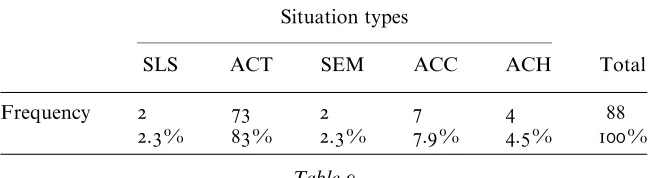
for-PPs/from_to function to provide a specific time frame. Therefore all core-level basic situation types with the feature values of [xbounded] and [xtelic] x73 states (including ILSs and SLSs), 173 activities and five semelfactives xare turned into temporally bounded situation types at the clause level. The following examples illustrate Rules 7 and 8 :
(26) (a) He was chairmanfrom ’81 to ’85. (b) They were silentfor a while.
(c) lian-le zhengzheng yi-nian, Yang Bingming kuai practise-LE whole one-year Yang Bingming nearly
chushi le
finish-apprenticeship PRT
‘ Having practiced for a whole year, Yang Bingming was soon to finish his apprenticeship. ’
(d) da-le ni ji-tian?
beat-LE you how-many-day
‘ For how many days did they beat you ? ’
(27) They wrotefrom eight-thirty in the morning till twelve, and againfrom four till six.
(28) I stood and read the menu for a while, discovering it served mainly hamburgers.
In (26a, b), for example,He was chairmanandThey were silentare an open-ended ILS and SLS, respectively, butfrom ’81 to ’85andfor a whilebound them temporally and turn them into a BOUNDED ILS and a BOUNDED SLS,
respectively. Similarly in (26c, d), the activity lian ‘ practice ’ and the semelfactiveda‘ beat ’ are temporally unbounded, but whenfor-PPs are used, they have a temporal boundary and become a BOUNDED ACTIVITY and a BOUNDED SEMELFACTIVE, respectively. On the other hand, as Rule 8 shows,
when an accomplishment takes afor-PP/from_to, its final spatial endpoint is stripped if the endpoint goes beyond the specified time frame. In (27), for example, the discourse suggests that the writing event is an accomplishment, but thefrom_toexpressions bound the telic situation before its final spatial endpoint is achieved. In other words, the writing event is not accomplished within the specified time frame and is thus turned into a bounded activity at the clause level. However, Rule 8 only applies toSOMEaccomplishments.
The hypothesis that a for-PP may function to trigger a situation type shift from accomplishment to activity at the clause level explains the felicitous co-occurrence of some core-level accomplishments with both in-PPs and
for-PPs, as observed by Dowty (1979 : 61) :
(29) (a) He read a book for/in an hour.
(b) She combed her hair for/in five minutes.
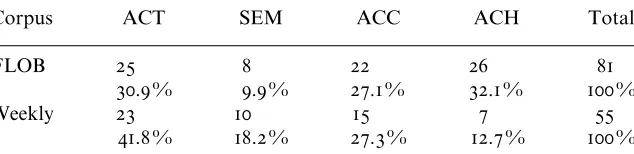
Rule 9 shows that temporal quantifiers (e.g.once,twiceandsix times) have the same delimiting effect asfor-PPs/from_to. The frequencies of temporal quantifiers found in the corpora are given in Table 8.16For accomplishments and achievements, their [¡bounded] value will not change when they are repeated for a specified number of times. For example, (30a) and (31a) have a temporal boundary as definite as, though not the same as, (30b) and (31b). Therefore, the 70 situations of these two types are irrelevant to Rule 9 and thus can be excluded from the analysis. On examination, it is found that all of the remaining situations, namely, 48 activities and eighteen semelfactives, have a temporal boundary at the clause level. As semelfactives shift between single event and multiple event readings (cf. section 5.1), they can be either [+bounded] or [xbounded]. The event of ‘ stabbing ’, for example, can occur just once or repeatedly. But when it is delimited by the quantifiersix times, as in (32a), it has a definite temporal boundary as expected. The activity ‘ xunshi ’ (meaning ‘ to look around ’), as in (32b), is intrinsically [xbounded]. But when it is delimited by the quantifieryi-fan‘ once ’, a temporal boundary is attached to it and the activity becomes temporally bounded. The effect of temporal quantifiers is more obvious in Chinese because the aspect marker -leis sensitive to a final endpoint, either temporal or spatial (cf. section 6.1). This contrasts strikingly with the simple (perfective) aspect in English. For example, if the quantifiersix timesin (32a) is removed, the English sentence is still felicitous ; but ifyi-fan‘ once ’ in the Chinese example in (32b) is removed, (32b) becomes unacceptable.
Corpus ACT SEM ACC ACH Total
FLOB 25 8 22 26 81
30.9 % 9.9 % 27.1 % 32.1 % 100 %
Weekly 23 10 15 7 55
[image:30.431.65.382.58.135.2]41.8 % 18.2 % 27.3 % 12.7 % 100 %
Table 8
Distribution of temporal quantifiers in the corpora