N A N O E X P R E S S
Open Access
Stability of nanofluids in quiescent and shear
flow fields
Sanjeeva Witharana
1*, Haisheng Chen
2*, Yulong Ding
1Abstract
An experimental study was conducted to investigate the structural stability of ethylene glycol-based titanium dioxide nanoparticle suspensions (nanofluids) prepared by two-step method. The effects of particle concentration, fluid temperature, shear rate and shear duration were examined. Particle size and thermal conductivity
measurements in quiescent state indicated the existence of aggregates and that they were stable in temperatures up to 60°C. Shear stability tests suggested that the structure of nanoparticle aggregates was stable in a shear interval of 500-3000 s-1measured over a temperature range of 20-60°C. These findings show directions to resolve controversies surrounding the underlying mechanisms of thermal conduction and convective heat transfer of nanofluids.
Introduction
Nanofluids are suspensions of nano-sized particles in liquids, where particle sizes are preferably below 100 nm. At modest particle concentrations, the thermal con-ductivity, forced convective heat transfer, and critical heat flux of nanofluids were reported to be superior to respective base liquids [1-8]. In the backdrop of conven-tional heat transfer technologies approaching their upper limits, nanofluids are seen as a potential conten-der for small- and large-scale thermal applications [9-12]. A number of attempts had been made in the past, and postulates were put forward to explain the underlying mechanisms. Although yet inconclusive, the nanoparticle aggregation in liquids is believed to be one of the principal mechanisms behind the enhanced ther-mal conductivity and convective heat transfer [13-16]. In either case, the importance of particle aggregation and their stability were underlined.
On the other hand, the aggregation of nanoparticles is found to be the key mechanism behind the increase of nanofluid viscosity and shear thinning behaviour [14,17,18]. Recently, it was shown that the high shear viscosity of nanofluids could accurately be predicted by
combining the conventional Krieger and Dougherty model and aggregation effects [18-20]. Those postulates were based on the assumption that, in the shear flow field, the aggregates will be stable because the hydrody-namic forces are insufficient to break the aggregates down to primary particles. However, the experimental evidences are insufficient to showcase the stability and particle structuring of nanofluids in flow conditions.
In the present study, the ethylene glycol (EG)-based Titania (TiO2) suspensions are selected to investigate the stability of nanofluids in quiescent and shear flow fields. Also their thermal conductivities are measured at various temperatures and compared with theoretical predictions. The experimental conditions were chosen resembling the possible industrial applications for nano-fluids. Considering the bounded yet deep focus of the stability of nanofluids under different conditions, this article is reported as a letter without comparing the data with the other literature.
Experimental
Nanofluids were formulated using TiO2nanopowder and
EG. The dry TiO2nanopowder purchased from Degussa
Corporation in Germany was claimed to be consisting of spherical particles of 25-nm diameter. Electron micro-scopy (EM) imaging such as in Figure 1 suggests that the particles were in the form of agglomerates. In order to manufacture a stable nanoparticle suspension, a sequence of processes were followed. Further details of formulation * Correspondence: [email protected]; [email protected]
1
Institute of Particle Science and Engineering, University of Leeds, Leeds LS2 9JT, UK
2
Institute of Engineering Thermophysics, Chinese Academy of Sciences, Beijing 100190, China
Full list of author information is available at the end of the article
can be found elsewhere [7,21]. The EM images of the nanofluid confirmed that the nanoparticles were well dis-persed. Moreover, the light-scattering data collected using the Malvern Zetasizer-nano device showed that the suspended particles were in the order of around 130 nm in size. This is an indication of the formulation technique substantially reducing the aggregate size but failing to break them down to primary particles. This observation agrees with the recently concluded International Nano-fluids Property Benchmarking Exercise (INPBE) [22]. These nanofluids were stable for 2 months without a visi-ble separation, indicating the stability of aggregates in the long run.
Measurements of thermal conductivity (k, W/mK) of TiO2-EG nanofluids were conducted using the state-of-the art Lambda meter device acquired from PSL Mea-surement Systems GMBH of Germany. This instrument works on transient hot wire principle. For calibration with EG, the instrument reproduced the data up to 99% precision.
Shear flow field was applied to the samples using a Bohlin rotational rheometer. The experimental condi-tions were as follows: shear rates 500, 1000, 2000 and 3000 s-1; time durations 5, 10, 20 and 40 min; and tem-peratures 20, 30, 40, 50 and 60°C. These temperature and flow parameters were so chosen to suit possible industrial applications [19]. The shearing was preceded and followed by particle size measurements using Mal-vern Zetasizer-nano. The size measurements were repeated six times, and the reproducibility of data fell within error of 4%. In all instruments, the thermal equi-librium was ensured by leaving the samples at measur-ing temperature for a sufficient period of time before taking the readings.
Results and discussion
Thermal conductivity (k, W/mK) data for the samples are presented in Figure 2. The trends ofkof the nano-fluid and base liquid appear alike. This follows that the presence of nanoparticles at these concentrations has not altered the dynamics of the base liquid. Interest-ingly, this was the case even at 60°C, indicating quies-cent flow fields. Also shown in Figure 2 are the percentage (%) enhancements of thermal conductivity. At any given temperature, the enhancement has system-atically increased with loading. However for a given con-centration, the enhancement appears to be fairly stable with temperature. This is a trend that agrees with the more recent literature on this area [23,24]. Also noted from Figure 2 are the low particle loadings unable to cause noticeable enhancement. This observation contra-dicts a section of the old literature, while agreeing with majority of recent study including INPBE [22] partici-pated by dozens of nanofluids research institutions.
[image:2.595.56.291.87.287.2]The average enhancement for each concentration in Figure 2b is plotted in Figure 3 together with the predic-tions of classical Hamilton-Crosser (H-C) model based on well-dispersed particles [25] and modified H-C model [20] based on aggregated particles. The classical H-C model can be written as
k/k0=
kp+ (n−1)k0−(n−1)ϕ(k0−kp)
kp+ (n−1)k0+ϕ(k0−kp) (1)
wherek, k0, kpare, respectively, the thermal conduc-tivities of the nanofluid, base liquid, and particle mate-rial, and nis the shape factor given by n= 3/ψ withψ the surface area-based sphericity (ψ= 1.0 for spheres).
Modified H-C model based on aggregated particles takes the form of [20]
k/k0=
ka+ (n−1)k0−(n−1)ϕa(k0−ka)
ka+ (n−1)k0+ϕa(k0−ka)
(2)
where ka is the thermal conductivity of aggregates which is estimated by the Bruggeman model for spheri-cal particles [26]:
ka k0 =1 4 ⎧ ⎪ ⎪ ⎪ ⎪ ⎪ ⎨ ⎪ ⎪ ⎪ ⎪ ⎪ ⎩
(3ϕin−1) kp k0
+ (3(1−ϕin)−1)+
(3ϕin−1) kp k0
+ (3(1−ϕin)−1)
2
+ 8kp
k0 1 2 ⎫ ⎪ ⎪ ⎪ ⎪ ⎪ ⎬ ⎪ ⎪ ⎪ ⎪ ⎪ ⎭ (3)
[image:2.595.317.537.595.651.2]Here, a is the effective particle volume fraction given by a = (aa/a)3-D according with the fractal theory, and in is the solid volume fraction of aggre-gates given by in = (aa/a)D-3. Also a andaa are the radii of primary nanoparticles and aggregates, respec-tively [27], and Dis the fractal index having a typical Figure 1Titania particles as received.
Witharanaet al.Nanoscale Research Letters2011,6:231 http://www.nanoscalereslett.com/content/6/1/231
value of 1.8 for nanofluids [20]. From Figure 3, the conventional H-C model underpredicts the measure-ments by a considerable margin can be seen. However, the modified H-C model that takes into account the aggregates of nanoparticles agreed well with the experimental data.
Overall view of Figures 2 and 3 suggests that (i) the aggregation of nanoparticles is a principal mechanism that drives the thermal conductivity enhancement and (ii) the aggregates are stable in quiescent flow fields even at temperature as high as 60°C. Independence of the experimental data on temperature further suggests (a)
[image:3.595.59.541.88.611.2]
(b)
the weak or negligible effect of particle Brownian motion on reported enhancement.
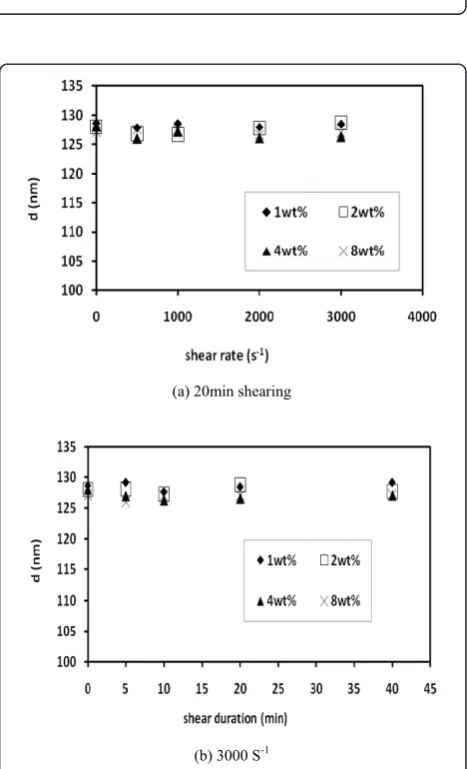
[image:4.595.204.532.79.699.2]Featured in Figures 4 and 5 are the studies on particle size in shear flow fields. All samples have the measured particle sizes considerably larger than the primary size (25 nm) reconfirming the existence of the aggregates. Yet, the average particle diameter (d) exhibits a narrow fluctuation between 126 and 132 nm, which falls within the boundaries of experimental error. Moreover, the shear rates and shear durations shown on Figure 4 had been unable to break the aggregates. The aggregates were therefore sufficiently stable under these conditions.
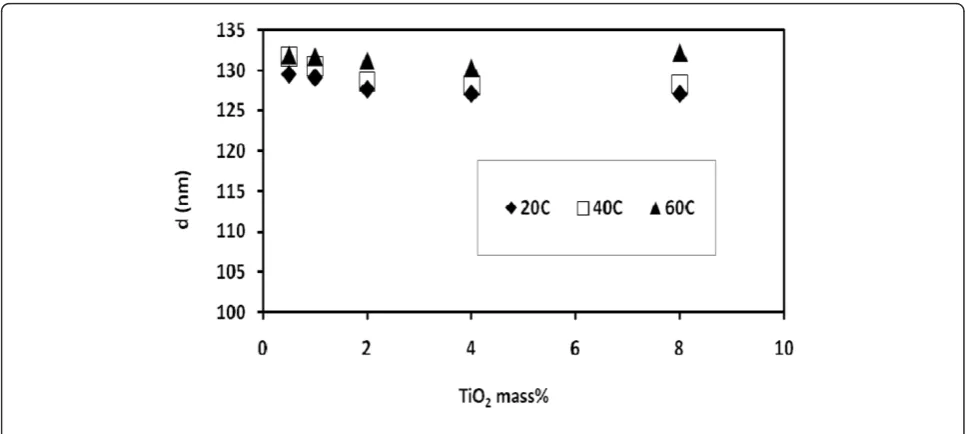
Figure 5 illustrates the dependence of the measured particle sizes on the measuring temperature and particle concentration. At any given concentration, a tempera-ture increase of threefold (from 20 to 60°C) has not registered a notable size change. Here, the indication is the temperature stability of aggregates. Furthermore, a concentration increase by 16 folds (from 0.5 to 8 wt%) has caused only a modest increase in size which again falls within the experimental error.
Conclusions
[image:4.595.57.534.87.315.2]Experiments were conducted to study the dependence of shear stability of nanofluids on temperature, particle loading and shear rate. Observed weak dependence of thermal conductivity enhancement on temperature sup-ports the claim of particle aggregation as a principal mechanism behind the enhancement. Moreover, the aggregates in quiescent flow fields were stable in tem-peratures up to 60°C. The data on shear stability show
Figure 3Measured and predicted thermal conductivity.
(a) 20min shearing
(b) 3000 S-1
Figure 4Average particle sizes measured at 20°C.
Witharanaet al.Nanoscale Research Letters2011,6:231 http://www.nanoscalereslett.com/content/6/1/231
[image:4.595.305.539.326.711.2]that the aggregates are sufficiently stable over a range of rigorous shear rates and temperatures. The observations of thermal conductivity and particle size complement each other in terms of predicting the former from the latter. A comparison of the present findings with the lit-erature data is currently underway and will be reported in future.
Abbreviations
EG: ethylene glycol; EM: electron microscopy; H-C: Hamilton-Crosser; INPBE: International Nanofluids Property Benchmarking Exercise.
Author details
1Institute of Particle Science and Engineering, University of Leeds, Leeds LS2
9JT, UK2Institute of Engineering Thermophysics, Chinese Academy of
Sciences, Beijing 100190, China
Authors’contributions
The work presented here was carried out in collaboration between all authors. SW defined the research theme, designed methods, carried out the laboratory experiments, analysed the data, interpreted the results and wrote the paper. HC prepared the samples, helped to carry out the laboratory experiments, analysed the data and helped on writing the paper. YD defined the research theme and analyzed the data, All authors read and approved the final manuscript.
Competing interests
The authors declare that they have no competing interests.
Received: 31 October 2010 Accepted: 16 March 2011 Published: 16 March 2011
References
1. Eastman JA, Choi SUS, Li S, Yu W, Thompson LJ:Anomalously increased effective thermal conductivities of ethylene glycol-based nanofluids containing copper nanoparticles.Applied Physics Letters2001,78:718-720. 2. Murshed SMS, Leong KC, Yang C:Enhanced thermal conductivity of TiO2
- water based nanofluids, International.Journal of Thermal Sciences2005,
44:367-373.
3. Wen DS, Ding YL:Effective thermal conductivity of aqueous suspensions of carbon nanotubes (carbon nanotubes nanofluids).Journal of Thermophysics and Heat Transfer2004,18:481-485.
4. Wensel J, Wright B, Thomas D, Douglas W, Mannhalter B, Cross W, Hong HP, Kellar J, Smith P, Roy W:Enhanced thermal conductivity by aggregation in heat transfer nanofluids containing metal oxide nanoparticles and carbon nanotubes.Applied Physics Letters2008,
92:023110.
5. Wen DS, Ding YL:Experimental investigation into convective heat transfer of nanofluids at the entrance region under laminar flow conditions.International Journal of Heat and Mass Transfer2004,
47:5181-5188.
6. Ding Y, Alias H, Wen D, Williams RA:Heat transfer of aqueous suspensions of carbon nanotubes (CNT nanofluids).International Journal of Heat and Mass Transfer2006,49:240-250.
7. He YR, Jin Y, Chen HS, Ding YL, Cang DQ, Lu HL:Heat transfer and flow behaviour of aqueous suspensions of TiO2 nanoparticles (nanofluids) flowing upward through a vertical pipe.International Journal of Heat and Mass Transfer2007,50:2272-2281.
8. Xuan Y, Li Q:Heat transfer enhancement of nanofluids.International Journal of Heat and Fluid flow2000,21:58-64.
9. Kim SJ, McKrell T, Buongiorno J, Hu LW:Enhancement of flow boiling Critical Heat Flux (CHF) in alumina/water nanofluids.Advanced Science Letters2009,2:100-102.
10. Kim SJ, Bang IC, Buongiorno J, Hu LW:Effects of nanoparticle deposition on surface wettability influencing boiling heat transfer in nanofluids.
Applied Physics Letters2006,89:153107.
11. Fan XL, Chen HS, Ding YL, Plucinski PK, Lapkin AA:Potential of‘nanofluids’ to further intensify microreactors.Green Chemistry2008,10:670-677. 12. Roberts NA, Walker DG:Convective Performance of Nanofluids in
Commercial Electronics Cooling Systems.Applied Thermal Engineering
2010,30:2499-2504.
13. Buongiorno J:Convective transport in nanofluids.Journal of Heat Transfer-Transactions of the Asme2006,128:240-250.
14. Keblinski P, Prasher R, Eapen J:Thermal conductance of nanofluids: is the controversy over?Journal of Nanoparticle research2008,10:1089-1097. 15. Prasher R, Song D, Wang JL, Phelan P:Measurements of nanofluid
viscosity and its implications for thermal applications.Applied Physics Letters2006,89:133108.
16. Ding Y, Chen H, Wang L, Yang CY, He Y, Yang W, Lee WP, Zhang L, Huo R:
Heat Transfer Intensification Using Nanofluids.KONA2007,25:23-38. 17. Keblinski P, Eastman JA, Cahill DG:Nanofluids for thermal transport.
[image:5.595.56.541.88.305.2]18. Chen H, Ding Y, Tan C:Rheological behaviour of nanofluids.New Journal of Physics2007,9:367.
19. Chen H, Yang W, Y He, Ding Y, Zhang L, C Tan, Lapkin AA, Bavykin DV:
Heat transfer and flow behaviour of aqueous suspensions of titanate nanotubes (nanofluids).Powder Technology2008,183:63-72. 20. Chen H, Witharana S, Y Jin, Ding Y, Kim C:Predicting the thermal
conductivity of nanofluids based on suspension rheology..
21. Wen DS, Ding YL:Formulation of nanofluids for natural convective heat transfer applications.International Journal of Heat and Fluid Flow2005,
26:855-864.
22. Buongiorno J,et al:A benchmark study on the thermal conductivity of nanofluids.Journal of Applied Physics2009,106:094312.
23. Ding YL, Chen HS, He YR, Lapkin AX, Yeganeh M, Siller L, Butenko YV:
Forced convective heat transfer of nanofluids.Advanced Powder Technology2007,18:813-824.
24. Ding Y, Chen H, Musina Z, Jin Y, Zhang T, Witharana S, Yang W:
Relationship between the thermal conductivity and shear viscosity of nanofluids.Physica Scripta2010,T139:014078.
25. Hamilton RL, Crosser OK:Thermal conductivity of hetrogeneous two-component systems.Industrial & Engineering chemistry fundamentals1962,
1:187-191.
26. Bruggeman DAG:Calculation of various physics constants in heterogenous substances I Dielectricity constants and conductivity of mixed bodies from isotropic substances.Annalen der Physik1935,
24:636-664.
27. Goodwin JW, Hughes RW:Rheology for Chemists-An introduction.The Royal Society of Chemistry, UK; 2000.
doi:10.1186/1556-276X-6-231
Cite this article as:Witharanaet al.:Stability of nanofluids in quiescent and shear flow fields.Nanoscale Research Letters20116:231.
Submit your manuscript to a
journal and benefi t from:
7Convenient online submission
7Rigorous peer review
7Immediate publication on acceptance
7Open access: articles freely available online
7High visibility within the fi eld
7Retaining the copyright to your article
Submit your next manuscript at 7 springeropen.com
Witharanaet al.Nanoscale Research Letters2011,6:231 http://www.nanoscalereslett.com/content/6/1/231
![Figure 2b is plotted in Figure 3 together with the predic-The average enhancement for each concentration intions of classical Hamilton-Crosser (H-C) model basedon well-dispersed particles [25] and modified H-Cmodel [20] based on aggregated particles](https://thumb-us.123doks.com/thumbv2/123dok_us/8848106.933880/2.595.56.291.87.287/enhancement-concentration-classical-hamilton-dispersed-particles-aggregated-particles.webp)