Munich Personal RePEc Archive
Wealth effect in the US: evidence from
brand new micro-data
Salotti, Simone
University of Siena
2009
Online at
https://mpra.ub.uni-muenchen.de/20966/
Wealth effect in the US: evidence from brand new micro-data
Simone Salotti
÷This draft: February 2010
Abstract
This article investigates how wealth and capital gains affected household consumption in the
USA in the period 1989-2007. The empirical evidence brought so far by the literature is
unclear, likely because of the low quality of the data more readily available. We combine
information from the Consumer Expenditure Survey and the Survey of Consumer Finances to
perform a detailed analysis on the effects of wealth on consumption. We divide between
durables and non durables consumption, and we also investigate the roles of the different
components of household wealth, both gross and net. Our estimates indicate that there is a
significant tangible wealth effect (between one and four cents per dollar), and its economic
importance lies in the low range of the estimates of the previous empirical literature. On the
contrary, financial wealth seems to have no significant effects on consumption, apart from a
low positive effect during the Nineties (around one cent per dollar of gross wealth). The
estimation of the model with a Pooled OLS on the repeated cross sections confirms the
findings of the cross-sections estimates. Interesting features arise from the estimation of the
model dividing the sample by income quartiles, such as a decreasing wealth effect as income
rises. Overall, our results suggest that the fears of sizable reverse direct wealth effects due to
sudden declines in housing values has been overstated in previous studies.
JEL: D12, E21
Keywords: Consumption, Household Wealth, Wealth Effect
÷
1. Introduction
During the Nineties and the beginning of the new Millennium, a period of growing stock and
housing prices, the US aggregate savings rate fell considerably, leading to a renewed interest in the
understanding of its determinants. In particular, the recent literature concentrated on the effects of
household wealth on household consumption and savings, through the so called 'wealth effect'
channel. This new wave of studies aimed at understanding the possible role of wealth in
exacerbating the effects of a slowdown of the economy in case of constant or declining share and
housing prices (Paiella, 2007a). With the subprime mortgages crisis of 2007 and the following
financial and economic crisis, this scenario, from mere hypothesis, has become reality. In light of
that, the aim of our article is to explore deeply the role of household wealth on consumption and,
consequently, on savings.
Greenspan (2003) credited housing wealth, realized capital gains, and home equity borrowing with
shoring up the economy in the aftermath of the stock market collapse of 2000 and the recession of
2001, primarily through their effects on consumer spending. However, the mechanism through
which wealth directly affects consumption is not yet clearly understood: while the arguments
supporting a direct wealth effect are clear (changes in wealth directly cause changes in consumption
through their effect on households' contemporaneous budget sets), the empirical evidence brought
so far by a large literature that investigates the role of wealth shocks on consumption is unclear.
Moreover, wealth can affect consumption through the indirect channel of providing a collateral for
obtaining access to credit (Cynamon and Fazzari, 2008). Some authors claim that the decline in the
personal saving rate (that, in most developed countries, started in the middle of the Eighties) is
largely due to the significant capital gains in corporate equities experienced over this period (Juster
et al., 2005). Others conclude that there is at best a weak evidence of a stock market wealth effect,
and underline the importance of housing wealth in determining the households decisions on
consumption and savings (Case et al., 2005).
In our article we investigate the role of wealth and capital gains on household consumption in the
period 1989-2007 using a household-level dataset specifically built for this purpose, since no single
existing survey contains detailed data both on consumption and wealth. Thus, we combine
information from two different surveys: the Consumer Expenditure Survey (CES) and the Survey of
Consumer Finances (SCF). Essentially, we impute the SCF wealth variables to the CES households
(that is, we use the SCF as a donor to enrich the variables set of the CES) in order to estimate a
consumption equation with wealth, in various decompositions, as one of the main explanatory
previously for similar purposes, by Bostic et al. (2009). However, we improve the matching
methodology implemented by Bostic et al. (2009) in order to obtain a much larger dataset than
theirs, following closely the guidelines on data matching suggested by Ridder and Moffitt (2007).
As a result, we do not limit ourselves to the analysis of home owners only, and we use a richer set
of variables. Finally, our analysis includes the years 2004 and 2007, while Bostic et al. (2009) have
data up to 2001 only.
In our analysis we differentiate between financial and tangible wealth, the latter further
disaggregated into the value of the house of residence and the other real estate properties; in
addition, we investigate the role of debt on consumption decisions by studying both gross and net
wealth. Furthermore, we use information on past capital gains to investigate their direct role on
consumption, as suggested by Juster et al. (2005). This direct investigation of the effects of capital
gains on consumption has been used in early studies (Bhatia, 1972, Peek, 1983), while more recent
work has focused on wealth-based models. We have chosen to perform both, even if the results of
the capital gains specification are more prone to suffer from measurement errors, since they are
reported (in the SCF) with a lower precision with respect to the wealth stock variables. We also
investigate the consumption determinants of the older households, thanks to various interaction
terms, and we finally look at the differences between households pertaining to different income
quartiles.
The main result of our study is that tangible wealth is the main type of household wealth to
significantly and positively affect consumption. In particular, the house of residence is the part of
tangible wealth which is responsible for the highest direct wealth effect. The estimated elasticity of
consumption spending with respect to tangible wealth is between two and four cents per dollar,
which is not far from previous estimates. However, this seems to suggest that the fears of sizable
reverse direct wealth effects due to a sudden declines in housing values could have been overstated
previously (one exception being Case and Quigley, 2008), since the values involved are not
impressive. Indeed, the dynamics of the recent economic and financial crises do not reveal any
direct linkage between the declining housing prices and household consumption, rather they shed
light on the perverse mechanisms of the real estate and credit (mortgages in particular) markets.
Among the additional results, older households experience a higher wealth effect (that is, extract
more liquidity from their assets, as predicted by theory), while they have lower elasticity of
consumption with respect to income. The estimation by income quartiles shows that richer
households have a higher current income elasticity; also, their consumption paths do not take into
high consideration the value of their assets, since the estimated wealth effect for these households
The rest of this paper is organized as follows. Section 2 provides a review of the previous literature.
Section 3 describes the data used and how they were combined. Also, the econometric models are
presented. Section 4 illustrates the results. Section 5 concludes briefly.
2. The ‘wealth effect’ in the literature
There is a large literature about the wealth effect, and most of it is based on the life-cycle model
originally proposed by Ando and Modigliani (1963). According to this theory, an increase in wealth
leads the individuals to gradually increase consumption, thus lowering their savings. Also, the
propensity to consume out of wealth, whatever its form, should be the same small number (Paiella,
2007b). In practice, this is likely to be violated, “if assets are not fungible and households develop
’mental accounts’ that dictate that certain assets are more appropriate to use for current expenditure
and others for long-term saving” (Paiella, 2007b, 191). Additionally, Lettau and Ludvigson (2004)
stress that wealth shocks must be perceived as permanent in order to affect consumption. As a
result, the appraisal of the wealth effect is something that must be quantified empirically, and it has
been done in a fair number of articles that make use of either household-level or aggregate data.
Consequently, a wide range of estimates have been produced. For the U.S economy, they usually lie
between 2 and 7 cents of additional consumption per year per 1 dollar increase in household wealth.
This is consistent with the magnitude of the effect estimated by the research staff of the Board of
Governors of the Federal Reserve System, that maintains the longest and most regularly updated
wealth effect estimates for the USA.
In the latest studies, different results have been found according to the type of household wealth
analyzed, mainly dividing between house equity and financial wealth. The reason lies in the fact
that households may perceive these two kinds of wealth differently under several perspectives, and
this may influence the way it affects consumption (see Case et al., 2005, for an excellent
discussion). The empirical evidence seems to confirm this intuition, and even go beyond that. For
example, Edison and Sløk (2002) further differentiate financial wealth between technology and
non-technology segments of the stock market, finding differences in the wealth effect channel for
the USA. Case et al. (2005) study both the financial and the housing wealth effect for the US,
finding a significant effect for the latter only. Bostic et al. (2009) disaggregate household wealth
into financial, house of residence and other real estate, finding different results accordingly. Other
(2004) and Carroll et al. (2006) study the housing wealth effect, while Davis and Palumbo (2001)
concentrate on the financial wealth effect.1
The empirical appraisal of the wealth effect poses some problems, such as endogeneity and the
issue of omitted variables. Endogeneity is present in this kind of analysis, since the value of
household wealth is the result of both past savings and movements of the asset prices. In this
respect, a common weakness of the articles that investigate the wealth effect is that they use either
aggregate data or non accurate household-level data. In both cases the analysis lack proper
instruments to deal with endogeneity. In the first case there are some well known problems, such as
aggregation issues and difficulties in decomposing age, cohort and time effects, as it is well
explained by Attanasio and Banks (2001). About the second case, even if there are many sources of
household-level data for the USA, each one of them, taken singularly, has some drawbacks for the
type of analysis that is considered here. The Panel Study of Income Dynamics, (PSID, used for
example by Lehnert, 2004, Juster et al, 2005), contains data on food consumption only, and data on
household wealth have been collected since 1984 every five year only. The CES (used by Dynan
and Maki, 2001, to name one) has very detailed consumption data, but the quality of its wealth data
is low. On the other hand, the SCF does not contain detailed consumption variables, while
information on wealth is collected very accurately.
In order to overcome these well-known problems of the literature, the strategy of this paper is to
build a new household-level dataset combining CES and SCF data. We use a sample combination
procedure (explained in the next section) as a way to impute missing values of a variable which we
judge to be important in our analysis: specifically, we use it to impute the SCF wealth values to the
CES individuals for which we already have detailed consumption data. Thus, we are able to use a
very large amount of information, dealing with the problem of omitted variables and therefore
moderating the issue of endogeneity. Methods of integrating different sources of information
similar to the one that we utilized here, have been recently used by some national institutes of
statistics as a convenient way to obtain detailed datasets without having to bear the costs of
producing brand new surveys (for instance, see Rosati, 1998, D'Orazio et al., 2006, Del Boca et al.,
2005).
3. Data and model
3.1 CES and SCF data
1
In our analysis we use the wealth data from the SCF to enrich the information contained on the
CES, that already contains detailed consumption data, for the period 1989-2007.2 Then, we exploit
this “augmented” CES to perform the econometric analysis on the wealth effect, since this new
dataset is perfectly appropriate to shed light on the effects of household wealth on consumption.
The CES is collected by the Bureau of Labor Statistics (BLS) to compute the Consumer Price
Index, and contains data on up to 95 percent of total household expenditures. It is a rotating panel in
which each household is interviewed four consecutive times over a one year period. Each quarter
25% of the sample are replaced by new households. The survey contains quarterly data, thus we had
to extrapolate data on yearly consumption. Moreover, the interviews are conducted monthly about
the expenditures of the previous three months: for example, a unit interviewed in January will
appear in the same quarter of a unit interviewed in February or March, even if the reported
information will cover a slightly different period of time. This overlapping structure of the sample
complicates the operation of estimating annual consumption in many dimensions. First, the year
over which we have information for each household is different depending on the month in which
the household completes its cycle of interviews. Second, and even more important, not all
households complete the cycle of four interviews, thus they don't report all the expenditures made
in one year.
In order not to waste a vast amount of information, we have chosen to use the data of the
households present for the whole year of reference, as well as the data of the households that were
interviewed three periods or less, using the following procedure. First, we harmonized the
expenditure variables using the Consumer Price Index, differentiated for food, energy and the other
goods, in order to have all expenditures expressed with the prices of June of the reference year.
Second, we deseasonalized the quarterly measures of consumption using the ratio to moving
average method. Finally, we used a simple technique to extend these corrected quarterly
expenditures to the whole year of interest: we multiplied by four the expenditure of the households
present for one quarter only, by two the expenditure of two quarters and by four thirds the
expenditure of the households interviewed for three quarters. For the households that were present
for four quarters in a row, we just had to compute the sum across quarters. Thanks to this procedure,
we were able to obtain a dataset with more than 14,000 households for the year 2007. We checked
whether this operation led to a dataset differing from the original (quarterly) one in terms of
distributions of the variables that we used in our analysis, finding no significant difference. For each
2
household, in addition to the expenditure variables, both for durable and for non-durable goods, we
kept socio-demographic variables and annual income.3
The household wealth data that we imputed to the CES households come from the SCF, which is
triennial and is produced by the Federal Reserve Board. This survey also includes
socio-demographic information that proved valuable for the statistical matching procedure, as well as for
the estimation of the consumption models. In particular, we used data on marital status, race, age,
education and occupation of the household head, home ownership status and family size. The period
covered by the analysis starts in 1989, mainly because the SCF question frame was different in
earlier periods, and ends in 2007, with 7 periods in total. Moreover, we used the information
contained in all the five implications of the SCF (implications that derive from the multiple
imputation procedure used to approximate the distribution of missing data, as explained in
Kennickell, 1998), by performing the sample combination with the CES separately for each
implication. To correctly take into account multiple imputation, the estimation of the consumption
models were then carried out using Repeated Imputation Inference (RII), as explained by Montalto
and Sung (1996). In a few words, this method exploits all the different versions of the dataset due to
the multiple imputation technique and combines the resulting estimates in order to produce more
correct estimates in case of imputed missing values (as, in the CES case, the ones on income).
3.2 The matching procedure
The aim of the procedure is to look for similar households across the two surveys and then to attach
the wealth variables observed for the SCF households to the most similar ones in the CES, so to get
an “augmented” CES that contains detailed information on wealth in addition to the consumption
and socio-demographic variables originally collected by the BLS. In constructing and applying the
matching procedure we followed several principles and suggestions given by Ridder and Moffitt
(2007) so to make sure to produce a high quality new dataset. The details of the procedure are the
following.
We first partitioned both samples into cells based on six categorical variables in order to avoid to
match individuals that differ in important characteristics. For the year 2007, and similarly for the
other years, more than 700 cells were created using:
* Race - white, black or other;
* Marital status - married or not;
3
* Education - twelfth grade or less, high school, some college or more;
* Tenure - home owner or not;
* Occupation - not working, managers and professionals, technicians, services, operators, other;
* Family size - one, two, three or four or more people in the household.
Thanks to this highly detailed partition that took into account many different variables, we were
able to avoid the risk of matching pairs of households differing in fundamental characteristics.
Almost every cell contained individuals from both surveys, and the imputation of the wealth
variables to the CES households has been done only using SCF households pertaining to the same
cell. Thus, within every cell, we looked for the most similar individuals across the two surveys
according to the values of income and age, building a unique distance function able to measure the
differences in this two variables.4 In this way, we were able to select the pairs of households coming
from the two different surveys in which the SCF household wealth values were assigned to the CES
household. We also refined the matching by dropping the individuals for which the distance
function displayed too high value, that is, the matched individuals had non-deniable differences in
age and/or income to be paired together.5 The matching process yielded a dataset with more than
14000 observations in 2007.6
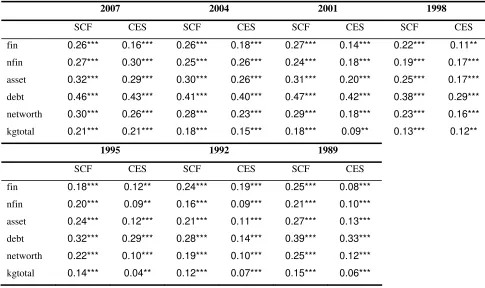
We checked the result of the matching procedure in two different ways. We verified the similarity
among the correlations between income (which is observed in both surveys) and the wealth
variables both in the SCF and in our augmented CES (after-matching). Table 1 shows that the
similarity is very high, suggesting the fact that the procedure did not change the distribution of the
imputed variables, a signal of good quality of the overall sample combination. Furthermore, we
produced the graphs of the probability density functions of the matched variables obtained with a
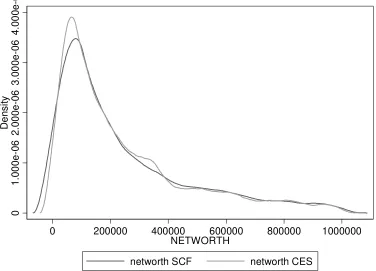
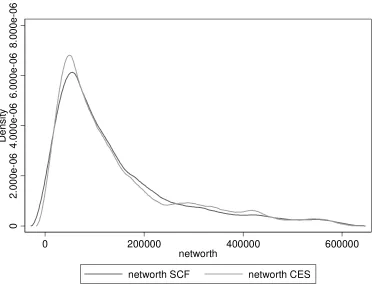
kernel density estimation, finding comfortingly similar curves. Figures 1-7 report the graphs for
household net wealth: we have chosen to report this variable because it comprehends both assets
and debt, therefore it summarizes more than other variables the results of the matching procedure.
Although the two distributions do not completely overlap because not all the SCF individuals are
4
We did it performing a bivariate (income and age) propensity score matching based on Mahalanobis distance. 5
In particular, we dropped the households that fell into the top 15% of the distribution of the distance variable. We also had to build a different distance function for the groups with one or two individuals only from either one or the other survey, using the normalized logarithmic income and age, and we dropped the top 20% of households matched according to this second, and rougher, algorithm (because with few households in a cell, there was a higher probability to match pairs of households that differ significantly in their values of income and age).
6
used as donors in the matching procedure, the curves do show very similar patterns, again making
sure that the matching procedure maintained the distributional properties of the variables of interest.
We used these precautions because sample combination methods must be applied with some care,
as there are some conditions that have to be met in order not to commit errors. First, the two
different surveys must be two samples drawn from the same population (Ridder and Moffitt, 2007).
Second, there must be a set of common variables on which to condition the matching procedure, as
it is clear from the above description of the procedure. In our case, the first condition seems easy to
be met, since CES and SCF should both represent the US population. However, their sample
designs are different, since the SCF oversamples households that are likely to be wealthier, while
the CES does not. This leads to differences in the distributions of the variables of interest (in primis,
income). Consequently we had to get rid of the wealthiest households present in the SCF in order to
get comparable income distributions between the two surveys (in particular, we dropped a
percentage between 20 and 30% of the sample households with the highest income depending on
the year of reference).7 About the second condition, there are many socio-demographic variables
that are collected in both surveys, and the only problem here is to recode the variables in order to
have them measured in the same scale. This has been carried out making a large use of the
documentation that accompanies the public releases of the two surveys. The majority of these
operations of recoding were elementary. The most interesting exception has been the recoding of
the occupational sector variable for the 1989 and 1992 waves of the CES, where there is an
additional category, "self-employed", that in the SCF is not taken into account. In this case we
performed a multinomial logit estimation to impute the occupational sector to the CES individuals
labeled as "self-employed" in order to proceed with the matching with the SCF. The estimation
results were in line with the distributions of the occupational variable both in the SCF and in the
subsequent editions of the CES.
3.3 The model
Following the literature on life cycle consumption, the basic specification of our model is the
following:
'
1 2 3
log( )C =β log( )Y +β log(fin)+β log(nfin)+α Z+ε
(1)
7
where C is total consumption, Y is current income, fin is gross financial assets, and nfin is tangible
assets. Z is a vector of additional socio-demographic controls: age, educational level, a dummy for
the marital status (married or with a partner/single), two dummies for the race (one for African
Americans, the other for non-Whites) and a dummy for the occupational status (working/not
working) of the household head; the number of persons in the household; a dummy for the
homeownership status; and three different dummies for the US geographical area (Northeast,
Midwest and South, with West being the reference region). While the regional dummies are
supposed to capture macroeconomic factors, the other variables capture life cycle effects that are
likely to affect consumption. In our analysis we used a number of different specifications, in order
to investigate the role of the different components of household wealth (equation (2)), the
importance of net compared to gross wealth (equation (3)), the effects on durables and non-durables
consumption only, the effects of capital gains instead of the stocks of wealth (equation (4)). The
specifications are the following:
'
1 2 3 4
log( )C =β log( )Y +β log(fin)+β log(house)+β log(ore)+α Z+ε (2)
where tangible assets are disaggregated into house, the value of the house of residence, if owned,
and ore, the value of other real estate properties.
'
1 2 3 4
log( )C =β log( )Y +β log(netfin)+β log(house)+β log(ore)+α Z+ε (3)
where netfin is financial assets diminished by household debt.
'
1 2 3 4 5
log( )C =β log( )Y +β log(kgbus)+β log(kgstmf)+β log(kghouse)+β log(kgore)+αZ+ε (4)
where kgbus is capital gains on business activities, kgstmf on stocks and mutual funds, kghouse on
the house of residence and kgore on other real estate properties.
These four equations were also estimated with two alternative dependent variables, the logarithm of
consumption of durable and non-durable goods, the latter being more relevant and, also, more
closely related to most of the previous literature. The use of expenditure on durable goods poses
some problems, since its timing does not match the flow of services coming from the goods. The
relationship between consumption, income and wealth applies to the flow of consumption, but
flow from the existing stock” (Paiella 2007b, 198). This is why we will mainly concentrate on the
results for total and, above all, non durable goods consumption.8
The models described by the above equations were estimated cross-sectionally using data on 1989,
1992, 1995, 1998, 2001, 2004 and 2007. In the second part of the analysis we also estimated a
model by pooling data over the six surveys, adding year dummies. In all the specifications we also
added a few interaction variables in order to better grasp the wealth and consumption dynamics of
the old people. In particular, a dummy that takes the value of 1 if the household head is over 65
years old is multiplied by income and all the wealth variables. Again, the regressions were run with
the three alternative dependent variables described above.
4. Results
The results from the cross-sectional estimation of equations (1-4) are reported in Tables 2-5. For
reasons of expositional clarity, only the coefficients of the main variables of interest are reported
(complete results are available on request). We therefore reported the coefficients associated with
income and the wealth variables, including the interaction terms used to better grasp the
consumption determinants of the older households (the discussion of the latters is postponed below,
when the results of the pooled cross sections are discussed). All the estimations take into account
the multiple imputation used in the SCF using the RII (see Montalto and Sung, 1996). Very briefly,
the SCF (and consequently, our augmented CES) consists of five complete data sets because
missing data are multiply imputed. Thanks to the RII, we use information from all five data sets in
order to make valid inferences, taking into account the extra variability in the data due to
imputation.
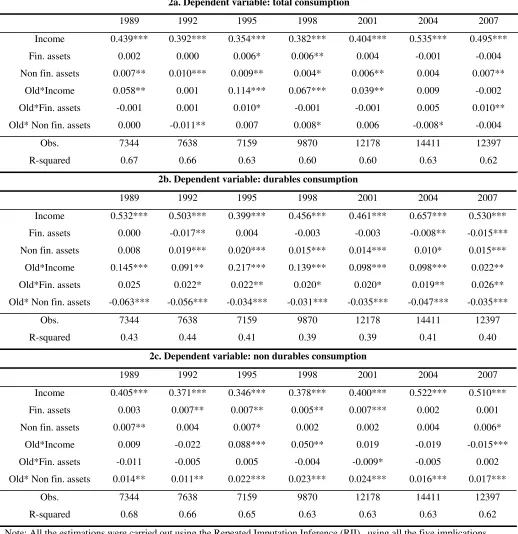
The results of the estimation of equation (1) are reported in tables 2a, 2b and 2c (as three different
dependent variables are used). Current income significantly affected consumption in the period
1989-2007, since its coefficient is always highly significant and the estimated elasticity ranges
between 0.35 and 0.53, indicating that current income plays a very important role in determining
current consumption. Turning to the household wealth coefficients, an interesting result is that the
different components do have different effects on consumption. In particular, financial wealth
positively affected consumption (both total and non-durable) during the Nineties only, while it
shows non-significant coefficients for the rest of the sample period. A possible explanation is that
8
the model captured the effects of the stock market boom that ended in 2001. However, when
significantly different from zero, the estimated elasticity of consumption to financial wealth is very
low, being it close to .01. This means that only a one cent increase in consumption is associated to a
one dollar increase in financial wealth, below most of the previous estimates that found significant
effects of this kind of wealth on consumption.
On the contrary, tangible wealth positively affects consumption throughout the whole period of
interest, even if the estimated elasticity is, again, very low (close to .01). However, we better
investigate the effects of tangible wealth in the following specifications, where we disaggregate it
into the value of the house of property and the value of the rest of real estate. We also take into
account debt considerations, when estimating equation (3). As a final consideration on the
estimation of equation (1), the surprising coefficients associated with the wealth variables in Table
2c (that is, with a negative sign) confirm the warning raised by Paiella (2007b): it is problematic to
use durable goods expenditure as the dependent variable in this kind of analysis. Therefore, we
disregard the results with this dependent variable in the rest of the discussion. However, due to the
importance of the durables part of household consumption (see Romer, 1990), throughout the whole
paper we use both total consumption and non-durables consumption as dependent variables, to
check if the results hold for the “most proper” measure of consumption (non-durables) as well as for
the most comprehensive measure (total consumption).
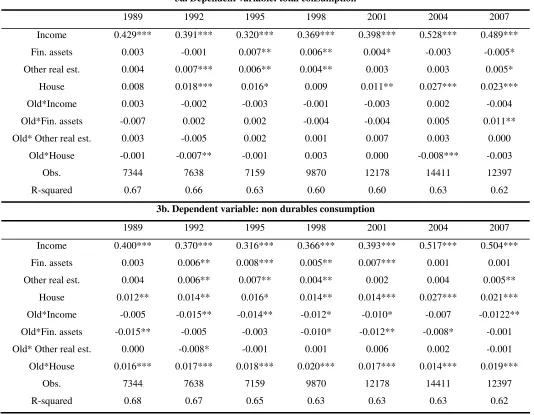
Tables 3a and 3b show the results of the estimation of equation (2), when tangible wealth is
disaggregated into the value of the house of residence and the value of other real estate. While the
results confirm the previous findings on financial wealth, they show that there are significant
differences in the way in which the value of the house of residence affects consumption, as opposed
to the rest of household’s tangible properties. The estimated elasticity for the value of the house of
residence is from three to five times larger than the one of the other real estate, reaching a wealth
effect of three cents per dollar in 2004. Moreover, while the other real estate has comparable values
across the whole sample period, the estimated elasticity for the house of residence is considerably
larger for the last two periods, 2004 and 2007. As in the case of the financial wealth coefficients of
the Nineties, this does not come as a complete surprise, because of the well known housing prices
bubble that started in 2000 and abruptly ended with the start of the recent financial crisis, in the
second half of 2007. This suggests that tangible wealth accounted for at least part of the continued
rise in consumption after the end of the financial wealth bubble in 2001, which in fact did not bring
a fall in consumption levels despite its important dimension.
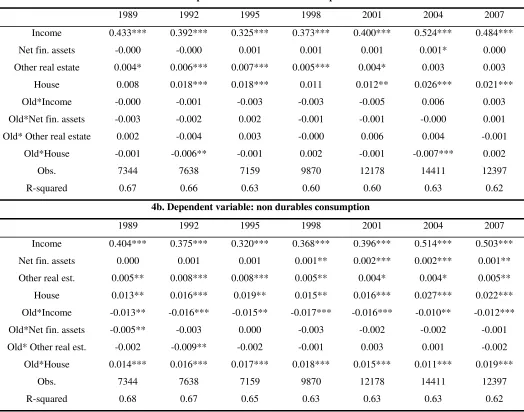
Tables 4a and 4b introduce debt considerations in the analysis, because net financial wealth is
findings for tangible wealth, while the results for the financial wealth effects are less clear-cut. The
estimated coefficients for this variable remain close to zero, but they are statistically significant in
different periods depending on the dependent variable used: there is a significant effect in the first
two periods when considering total consumption, but in the last two when considering non-durables
consumption. However, since the estimated elasticity is in all cases very low, we see this results as a
confirmation of the negligible role of financial wealth in determining consumption patterns. Also,
this suggests the possibility of some myopia on the part of households, since consumption seems
more sensitive to gross financial wealth than to net wealth.
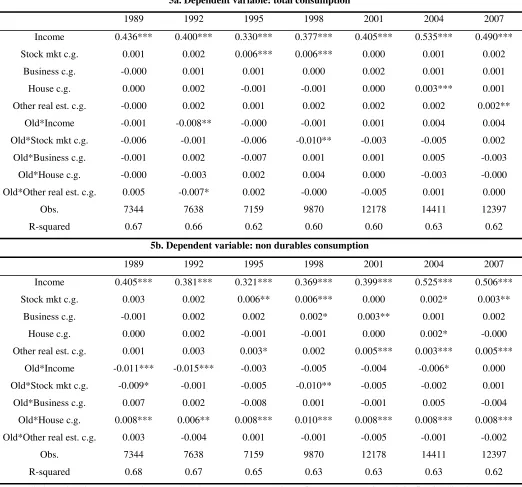
Tables 5a and 5b show the results of the estimation of equation (4), with capital gains as the wealth
variables of interest. As anticipated above, we did not expect to find important results from this
estimation, since capital gains variables are more prone than the wealth variables to severe
measurement errors that can compromise the estimation of the model. Indeed, this is confirmed by
the estimated coefficients. For all the four different types of capital gains, the associated coefficients
are always close to zero, and most of the time they are not statistically significant at standard levels.
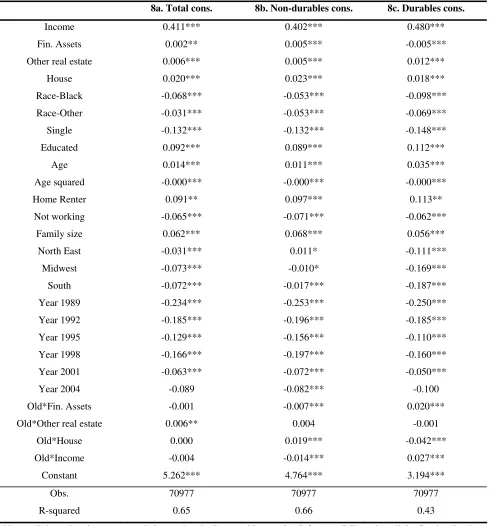
We now turn to the estimation of the pooled cross sections, shown in Tables 6 (equation (2)) and 7
(for the model described by equation (3)). The results confirm the findings of the cross-sectional
estimates, with the bigger importance of tangible wealth with respect to financial wealth, and the
higher elasticity coming from the value of the house of residence (with an estimated wealth effect
between two and three cents per dollar) with respect to the rest of the tangible assets (with an
estimated wealth effect not higher than one cent per dollar). The year dummies deserve some
considerations, keeping in mind that the reference year is 2007 (that is, the only missing dummy is
the one associated with 2007). All but one year dummies present highly significant negative
coefficients, confirming that consumption patterns are sensitive to macroeconomic conditions and
that consumption levels have risen through the sample period. The only dummy to present a
non-significant coefficient is the 2004 one, and we see this piece of evidence as a sign of the economic
crisis that hit the USA at the end of 2007, therefore causing the differences in consumption levels
between 2004 and 2007 less severe.
It is interesting to spend a few words on the results for the other explanatory variables of the model.
Most of them have significant coefficients throughout all the specifications. This is not surprising,
since a satisfactory R squared is reached in all estimations. Some results are particularly interesting
and confirm previous literature findings. For instance, the coefficients of the dummies that indicate
that the household head belongs to an ethnic minority (either Afro-American or a different one) are
always negative and economically important. A similar effect is also found for the dummy that
limiting the analysis to house-owners only, since the consumption dynamics between them and
renters are different. The results conform to the previous literature also when they show that higher
education is associated to higher consumption. The non trivial relationship between age and
consumption is confirmed by the high statistical significance of the coefficients of age and age
squared (the first positive, the second lower and negative). Finally, the regional dummies are often
associated to significant and negative coefficients, a fact that must be read bearing in mind the
region of reference (that is, whose dummy is not included) is West. Another interesting fact is the
coefficient associated to the dummy that indicates that the household head does not work, which
shows that such a condition is associated with a lower consumption, even controlling for income
and wealth. The behavior of the older households is investigated through the utilization of the
interaction terms between the “old” dummy and the income and wealth variables. The estimations
show that old people experience a higher wealth effect from the value of the house of residence
(reaching four cents per dollar of housing wealth, when non-durables consumption is the dependent
variable), while they have a lower income elasticity.
We deepen the pooled cross-sections analysis by performing an estimation dividing the sample by
income quartiles, to better understand the effects of distribution on the variables investigated. Table
8 presents the coefficients of the income and wealth variables for the estimation of equation (2),
dividing the pooled cross-sections sample by income quartiles. The results are interesting: the
consumption elasticity to income rises as we go from the lowest to the highest income quartile. At
the same time, the importance of wealth in affecting the consumption patterns decreases. This
suggests that variations of the value of the assets matter for consumption only when income is low,
while when it is high, its effects dominate the ones of wealth.
We investigated the robustness of our findings in a few ways. The results hold when we restrict our
sample to urban households only (they are almost 90% of the sample). The same is true when we
get rid of the 1% of household that are at the top and at the bottom both of the income and of the
consumption distributions. As said previously, the results are also robust to variations of the sample
combining procedure. This robustness is not surprising, since our sample is very large, and it is
unlikely that our results are driven by outliers or by small subsamples of households.
5. Conclusions
This paper analyses the strength of the wealth effect on consumption in the USA with a dataset
specifically built for this scope. We combine data from the CES and the SCF for the years
households in order to enrich the data collected in this latter survey and to perform an analysis
capable to link consumption and wealth using household-level data. This sample combination
produced a large dataset (more than 70,000 observations) capable to respect the properties of the
distributions of the variables of interest present in each of the two original survey. The resulting
dataset was then used to estimate four different specifications of a simple consumption model. The
effects of wealth were investigated using three different dependent variables: total, durables and non
durables consumption. However, the latter is the most correct measure of consumption to be used in
this kind of analysis, as widely discussed previously. Also, our dataset permits a high
disaggregation of tangible wealth, as well as a differentiation between net and gross financial
wealth. Two kinds of estimations are performed. First, the models were estimated for each
cross-section; then, a final estimation was carried out on the pooled cross-sections. In all the
specifications, a few interaction terms were used to better grasp the consumption dynamics of the
older households. The results show that tangible wealth positively affected consumption of US
households in the period 1989-2007. The estimated elasticity (between one and four cents per
dollar) lies in the low range of what constitutes the consensus on how asset market gains affect
consumer spending in the USA. It seems that households tend to consume both out of their house of
residence and out of their other real estate properties, even if the former is more important of the
latter. On the other hand, the results suggest that net financial wealth does not exert any direct effect
on household consumption, while gross financial wealth has some small effects (around one cent
per dollar), suggesting a sort of myopia on the part of households. This piece of evidence adds to
the mixed results of the previous literature, where the widest range of results has been found for this
kind of wealth. These results are confirmed both by the cross-sectional estimates and by the
estimation of the pooled cross-sections. Additional interesting results come from the estimation by
income quartiles, that shows that the consumption elasticity to income rises as we go from the
lowest to the highest income quartiles; at the same time, the importance of the wealth effect
decreases. About the older households, it seems that the wealth effect out of the house of residence
is higher for them (four cents per dollar), while their income elasticity is lower. Overall, our results
suggest that the fears of sizable reverse direct wealth effects due to a sudden decline in housing
values has been overstated in previous studies. In fact, the dynamics of the recent economic and
financial crises do not reveal any direct linkage between the declining housing prices and household
consumption, rather they shed light on the perverse mechanisms of the real estate and credit
(mortgages in particular) markets. Then, since wealth seems to play an important, though small role
in determining the consumption dynamics of the households, some other considerations must be at
countries as well, in the last twenty years. Policy makers should concentrate on these other
References
Ando, Albert , Modigliani, F., 1963. The “Life Cycle” Hypothesis of Saving: Aggregate
Implications and Tests. The American Economic Review, Vol. 53, No. 1, 55-84.
Attanasio, O., Banks, J., 2001. The Assessment: Household Saving - Issues in Theory and Policy.
Oxford Review of Economic Policy, Vol. 17, No. 1, 1-19.
Bhatia, K., 1972. Capital Gains and the Aggregate Consumption Function. American Economic
Review, 62, 866-79.
Belski, E., Prakken, J., 2004. Housing Wealth Effects: Housing’s Impact on Wealth Accumulation,
Wealth Distribution and Consumer Spending. Harvard University, Joint Center for Housing
Studies, W04-13, 2004.
Bostic, R., Gabriel, S., Painter, G., 2009. Housing Wealth, Financial Wealth, and Consumption:
New Evidence from Micro Data. Regional Science and Urban Economics, Vol. 39, 79-89.
Carroll, C., Otsuka, M., Slacalek, J., 2006. How Large is the Houseing Wealth Effect? A New
Approach. NBER Working Paper 12476.
Case, K., Quigley, J., 2008. How Housing Booms Unwind: Income Effects, Wealth Effects, and
Feedbacks through Financial Markets. Journal of Housing Policy, Vol. 8, Issue 2, 161-180.
Case, K., Quigley, J., Shiller, R., 2005. Comparing Wealth Effects: the Stock Market versus the
Housing Market. Advances in Macroeconomics, Vol. 5(1).
Cynamon, B., Fazzari, S., 2008. Household Debt in the Consumer Age: Source of Growth—Risk of
Collapse. Capitalism and Society, Vol. 3 : Iss. 2, Article 3.
Davis, M., Palumbo, M., 2001. A Primer on the Economics and Time Series Econometrics of
Wealth Effects. Board of Governors of the Federal Reserve System, Finance and Economics
D'Orazio, M., Di Zio, M., Scanu, M., 2006. Statistical Matching: Theory and Practice. Chichester,
England: Wiley.
Del Boca, D., Locatelli, M., Vuri, D., 2005. Child Care Choices of Italian Households. Review of
the Economics of the Household, No. 3, 453-477.
Dynan, K., Maki, D., 2001. Does Stock Market Wealth Matter for Consumption? Finance and
Economics Discussion Series, No. 2001.23, Washington: Board of Governors of the Federal
Reserve System.
Edison, H., Sløk, T., 2002. Stock Market Wealth Effects and the New Economy: a Cross-country
Study. International Finance 5:1, 1-22.
Greenspan, A., 2003. Remarks at the annual convention of the Independent Community Bankers of
America, Orlando, Florida,” March 4th.
Juster, T., Lupton, J., Smith, J., Stafford, F., 2005. The Decline in Household Saving and the
Wealth Effect. The Review of Economics and Statistics, 87(4), 20-27.
Kennickell, A., 1988. Multiple Imputation in the Survey of Consumer Finances.
http://www.federalreserve.gov/pubs/oss/oss2/method.html.
Lehnert, A., 2003. Housing, Consumption and Credit Constraints. Federal Reserve Board Working
Paper.
Lettau, M., Ludvigson, S., 2004. Understanding Trend and Cycle in Asset Values: Reevaluating the
Wealth Effect on Consumption. American Economic Review, 94(1), 279-299.
Montalto, C., Sung, J., 1996. Multiple Imputation in the 1992 Survey of Consumer Finances.
Financial Counseling and Planning, Vol. 7.
Paiella, M., 2007a. The Stock Market, Housing and Consumer Spending: a Survey of the Evidence
Paiella, M., 2007b. Does Wealth Affect Consumption? Evidence for Italy. Journal of
Macroeconomics, 29, pp. 189-205.
Peek, J., 1983. Capital Gains and Personal Saving Behavior. Journal of Money, Credit, and
Banking, 15, 1-23.
Rao, J., Wu, C., Yue, K., 1992. Some Recent Work on Resampling Methods for Complex Surveys.
Survey Methodology, 18(2), 209–217.
Ridder, G., Moffitt, R., 2007. The Econometrics of Data Combination. Handbook of Econometrics,
Vol. 6, 5469-5547.
Romer, C., 1990. The Great Crash and the Onset of the Great Depression. The Quarterly Journal of
Economics, Vol. 105 (3), 597-624.
Rosati, N., 1998. Matching statistico tra dati ISTAT sui consumi e dati Bankitalia sui redditi per il
Figures
Figure 1: Household net wealth kernel distribution, 2007
0 1. 00 0e -06 2. 00 0e -06 3. 0 0 0e -06 De ns it y
0 500000 1000000
NETWORTH
networth SCF networth CES
Figure 2: Household net wealth kernel distribution, 2004
0 1. 00 0e -06 2. 00 0e -06 3. 00 0 e -06 4. 00 0e -06 De ns it y
0 200000 400000 600000 800000 1000000
NETWORTH
[image:21.595.112.488.474.745.2]Figure 3: Household net wealth kernel distribution, 2001 0 1. 00 0e -06 2. 0 0 0e -06 3. 00 0e -06 4. 00 0e -06 De ns it y
0 200000 400000 600000 800000 1000000
networth
networth SCF networth CES
Figure 4: Household net wealth kernel distribution, 1998
0 1. 00 0e -06 2. 00 0e -06 3. 00 0e -06 4 .00 0e -06 5. 00 0e -06 De ns it y
0 200000 400000 600000 800000 1000000
networth
[image:22.595.113.487.468.736.2]Figure 5: Household net wealth kernel distribution, 1995
0
2.
00
0e
-06
4.
00
0e
-0
6
6.
00
0e
-06
De
ns
it
y
0 200000 400000 600000 800000 1000000
networth
networth SCF networth CES
Figure 6: Household net wealth kernel distribution, 1992
0
2.
00
0e
-0
6
4.
00
0e
-06
6.
00
0
e
-06
De
ns
it
y
0 200000 400000 600000 800000 1000000
networth
[image:23.595.113.498.466.737.2]Figure 7: Household net wealth kernel distribution, 1989
0
2.
00
0e
-06
4.
00
0e
-06
6.
00
0
e
-06
8.
00
0e
-06
De
ns
it
y
0 200000 400000 600000
networth
Tables
Table 1: correlations between logarithmic income and the wealth (SCF) variables
2007 2004 2001 1998
SCF CES SCF CES SCF CES SCF CES
fin 0.26*** 0.16*** 0.26*** 0.18*** 0.27*** 0.14*** 0.22*** 0.11**
nfin 0.27*** 0.30*** 0.25*** 0.26*** 0.24*** 0.18*** 0.19*** 0.17***
asset 0.32*** 0.29*** 0.30*** 0.26*** 0.31*** 0.20*** 0.25*** 0.17***
debt 0.46*** 0.43*** 0.41*** 0.40*** 0.47*** 0.42*** 0.38*** 0.29***
networth 0.30*** 0.26*** 0.28*** 0.23*** 0.29*** 0.18*** 0.23*** 0.16***
kgtotal 0.21*** 0.21*** 0.18*** 0.15*** 0.18*** 0.09** 0.13*** 0.12**
1995 1992 1989
SCF CES SCF CES SCF CES
fin 0.18*** 0.12** 0.24*** 0.19*** 0.25*** 0.08***
nfin 0.20*** 0.09** 0.16*** 0.09*** 0.21*** 0.10***
asset 0.24*** 0.12*** 0.21*** 0.11*** 0.27*** 0.13***
debt 0.32*** 0.29*** 0.28*** 0.14*** 0.39*** 0.33***
networth 0.22*** 0.10*** 0.19*** 0.10*** 0.25*** 0.12***
kgtotal 0.14*** 0.04** 0.12*** 0.07*** 0.15*** 0.06***
Table 2: equation (1), three different dependent variables
2a. Dependent variable: total consumption
1989 1992 1995 1998 2001 2004 2007
Income 0.439*** 0.392*** 0.354*** 0.382*** 0.404*** 0.535*** 0.495***
Fin. assets 0.002 0.000 0.006* 0.006** 0.004 -0.001 -0.004
Non fin. assets 0.007** 0.010*** 0.009** 0.004* 0.006** 0.004 0.007**
Old*Income 0.058** 0.001 0.114*** 0.067*** 0.039** 0.009 -0.002
Old*Fin. assets -0.001 0.001 0.010* -0.001 -0.001 0.005 0.010**
Old* Non fin. assets 0.000 -0.011** 0.007 0.008* 0.006 -0.008* -0.004
Obs. 7344 7638 7159 9870 12178 14411 12397
R-squared 0.67 0.66 0.63 0.60 0.60 0.63 0.62
2b. Dependent variable: durables consumption
1989 1992 1995 1998 2001 2004 2007
Income 0.532*** 0.503*** 0.399*** 0.456*** 0.461*** 0.657*** 0.530***
Fin. assets 0.000 -0.017** 0.004 -0.003 -0.003 -0.008** -0.015***
Non fin. assets 0.008 0.019*** 0.020*** 0.015*** 0.014*** 0.010* 0.015***
Old*Income 0.145*** 0.091** 0.217*** 0.139*** 0.098*** 0.098*** 0.022**
Old*Fin. assets 0.025 0.022* 0.022** 0.020* 0.020* 0.019** 0.026**
Old* Non fin. assets -0.063*** -0.056*** -0.034*** -0.031*** -0.035*** -0.047*** -0.035***
Obs. 7344 7638 7159 9870 12178 14411 12397
R-squared 0.43 0.44 0.41 0.39 0.39 0.41 0.40
2c. Dependent variable: non durables consumption
1989 1992 1995 1998 2001 2004 2007
Income 0.405*** 0.371*** 0.346*** 0.378*** 0.400*** 0.522*** 0.510***
Fin. assets 0.003 0.007** 0.007** 0.005** 0.007*** 0.002 0.001
Non fin. assets 0.007** 0.004 0.007* 0.002 0.002 0.004 0.006*
Old*Income 0.009 -0.022 0.088*** 0.050** 0.019 -0.019 -0.015***
Old*Fin. assets -0.011 -0.005 0.005 -0.004 -0.009* -0.005 0.002
Old* Non fin. assets 0.014** 0.011** 0.022*** 0.023*** 0.024*** 0.016*** 0.017***
Obs. 7344 7638 7159 9870 12178 14411 12397
R-squared 0.68 0.66 0.65 0.63 0.63 0.63 0.62
Note: All the estimations were carried out using the Repeated Imputation Inference (RII) , using all the five implications
resulting from the CES procedure of imputing missing income values. *, **, *** significant at 10, 5 and 1%
Table 3: equation (2), two different dependent variables
3a. Dependent variable: total consumption
1989 1992 1995 1998 2001 2004 2007
Income 0.429*** 0.391*** 0.320*** 0.369*** 0.398*** 0.528*** 0.489***
Fin. assets 0.003 -0.001 0.007** 0.006** 0.004* -0.003 -0.005*
Other real est. 0.004 0.007*** 0.006** 0.004** 0.003 0.003 0.005*
House 0.008 0.018*** 0.016* 0.009 0.011** 0.027*** 0.023***
Old*Income 0.003 -0.002 -0.003 -0.001 -0.003 0.002 -0.004
Old*Fin. assets -0.007 0.002 0.002 -0.004 -0.004 0.005 0.011**
Old* Other real est. 0.003 -0.005 0.002 0.001 0.007 0.003 0.000
Old*House -0.001 -0.007** -0.001 0.003 0.000 -0.008*** -0.003
Obs. 7344 7638 7159 9870 12178 14411 12397
R-squared 0.67 0.66 0.63 0.60 0.60 0.63 0.62
3b. Dependent variable: non durables consumption
1989 1992 1995 1998 2001 2004 2007
Income 0.400*** 0.370*** 0.316*** 0.366*** 0.393*** 0.517*** 0.504***
Fin. assets 0.003 0.006** 0.008*** 0.005** 0.007*** 0.001 0.001
Other real est. 0.004 0.006** 0.007** 0.004** 0.002 0.004 0.005**
House 0.012** 0.014** 0.016* 0.014** 0.014*** 0.027*** 0.021***
Old*Income -0.005 -0.015** -0.014** -0.012* -0.010* -0.007 -0.0122**
Old*Fin. assets -0.015** -0.005 -0.003 -0.010* -0.012** -0.008* -0.001
Old* Other real est. 0.000 -0.008* -0.001 0.001 0.006 0.002 -0.001
Old*House 0.016*** 0.017*** 0.018*** 0.020*** 0.017*** 0.014*** 0.019***
Obs. 7344 7638 7159 9870 12178 14411 12397
R-squared 0.68 0.67 0.65 0.63 0.63 0.63 0.62
Note: All the estimations were carried out using the Repeated Imputation Inference (RII) , using all the five implications
resulting from the CES procedure of imputing missing income values. *, **, *** significant at 10, 5 and 1%
Table 4: equation (3), two different dependent variables
4a. Dependent variable: total consumption
1989 1992 1995 1998 2001 2004 2007
Income 0.433*** 0.392*** 0.325*** 0.373*** 0.400*** 0.524*** 0.484***
Net fin. assets -0.000 -0.000 0.001 0.001 0.001 0.001* 0.000
Other real estate 0.004* 0.006*** 0.007*** 0.005*** 0.004* 0.003 0.003
House 0.008 0.018*** 0.018*** 0.011 0.012** 0.026*** 0.021***
Old*Income -0.000 -0.001 -0.003 -0.003 -0.005 0.006 0.003
Old*Net fin. assets -0.003 -0.002 0.002 -0.001 -0.001 -0.000 0.001
Old* Other real estate 0.002 -0.004 0.003 -0.000 0.006 0.004 -0.001
Old*House -0.001 -0.006** -0.001 0.002 -0.001 -0.007*** 0.002
Obs. 7344 7638 7159 9870 12178 14411 12397
R-squared 0.67 0.66 0.63 0.60 0.60 0.63 0.62
4b. Dependent variable: non durables consumption
1989 1992 1995 1998 2001 2004 2007
Income 0.404*** 0.375*** 0.320*** 0.368*** 0.396*** 0.514*** 0.503***
Net fin. assets 0.000 0.001 0.001 0.001** 0.002*** 0.002*** 0.001**
Other real est. 0.005** 0.008*** 0.008*** 0.005** 0.004* 0.004* 0.005**
House 0.013** 0.016*** 0.019** 0.015** 0.016*** 0.027*** 0.022***
Old*Income -0.013** -0.016*** -0.015** -0.017*** -0.016*** -0.010** -0.012***
Old*Net fin. assets -0.005** -0.003 0.000 -0.003 -0.002 -0.002 -0.001
Old* Other real est. -0.002 -0.009** -0.002 -0.001 0.003 0.001 -0.002
Old*House 0.014*** 0.016*** 0.017*** 0.018*** 0.015*** 0.011*** 0.019***
Obs. 7344 7638 7159 9870 12178 14411 12397
R-squared 0.68 0.67 0.65 0.63 0.63 0.63 0.62
Note: All the estimations were carried out using the Repeated Imputation Inference (RII) , using all the five implications
resulting from the CES procedure of imputing missing income values. *, **, *** significant at 10, 5 and 1%
Table 5: equation (4), two different dependent variables
5a. Dependent variable: total consumption
1989 1992 1995 1998 2001 2004 2007
Income 0.436*** 0.400*** 0.330*** 0.377*** 0.405*** 0.535*** 0.490***
Stock mkt c.g. 0.001 0.002 0.006*** 0.006*** 0.000 0.001 0.002
Business c.g. -0.000 0.001 0.001 0.000 0.002 0.001 0.001
House c.g. 0.000 0.002 -0.001 -0.001 0.000 0.003*** 0.001
Other real est. c.g. -0.000 0.002 0.001 0.002 0.002 0.002 0.002**
Old*Income -0.001 -0.008** -0.000 -0.001 0.001 0.004 0.004
Old*Stock mkt c.g. -0.006 -0.001 -0.006 -0.010** -0.003 -0.005 0.002
Old*Business c.g. -0.001 0.002 -0.007 0.001 0.001 0.005 -0.003
Old*House c.g. -0.000 -0.003 0.002 0.004 0.000 -0.003 -0.000
Old*Other real est. c.g. 0.005 -0.007* 0.002 -0.000 -0.005 0.001 0.000
Obs. 7344 7638 7159 9870 12178 14411 12397
R-squared 0.67 0.66 0.62 0.60 0.60 0.63 0.62
5b. Dependent variable: non durables consumption
1989 1992 1995 1998 2001 2004 2007
Income 0.405*** 0.381*** 0.321*** 0.369*** 0.399*** 0.525*** 0.506***
Stock mkt c.g. 0.003 0.002 0.006** 0.006*** 0.000 0.002* 0.003**
Business c.g. -0.001 0.002 0.002 0.002* 0.003** 0.001 0.002
House c.g. 0.000 0.002 -0.001 -0.001 0.000 0.002* -0.000
Other real est. c.g. 0.001 0.003 0.003* 0.002 0.005*** 0.003*** 0.005***
Old*Income -0.011*** -0.015*** -0.003 -0.005 -0.004 -0.006* 0.000
Old*Stock mkt c.g. -0.009* -0.001 -0.005 -0.010** -0.005 -0.002 0.001
Old*Business c.g. 0.007 0.002 -0.008 0.001 -0.001 0.005 -0.004
Old*House c.g. 0.008*** 0.006** 0.008*** 0.010*** 0.008*** 0.008*** 0.008***
Old*Other real est. c.g. 0.003 -0.004 0.001 -0.001 -0.005 -0.001 -0.002
Obs. 7344 7638 7159 9870 12178 14411 12397
R-squared 0.68 0.67 0.65 0.63 0.63 0.63 0.62
Note: All the estimations were carried out using the Repeated Imputation Inference (RII) , using all the five implications
resulting from the CES procedure of imputing missing income values. *, **, *** significant at 10, 5 and 1%
Table 6: equation (2), three different dependent variables – pooled cross sections
8a. Total cons. 8b. Non-durables cons. 8c. Durables cons.
Income 0.411*** 0.402*** 0.480***
Fin. Assets 0.002** 0.005*** -0.005***
Other real estate 0.006*** 0.005*** 0.012***
House 0.020*** 0.023*** 0.018***
Race-Black -0.068*** -0.053*** -0.098***
Race-Other -0.031*** -0.053*** -0.069***
Single -0.132*** -0.132*** -0.148***
Educated 0.092*** 0.089*** 0.112***
Age 0.014*** 0.011*** 0.035***
Age squared -0.000*** -0.000*** -0.000***
Home Renter 0.091** 0.097*** 0.113**
Not working -0.065*** -0.071*** -0.062***
Family size 0.062*** 0.068*** 0.056***
North East -0.031*** 0.011* -0.111***
Midwest -0.073*** -0.010* -0.169***
South -0.072*** -0.017*** -0.187***
Year 1989 -0.234*** -0.253*** -0.250***
Year 1992 -0.185*** -0.196*** -0.185***
Year 1995 -0.129*** -0.156*** -0.110***
Year 1998 -0.166*** -0.197*** -0.160***
Year 2001 -0.063*** -0.072*** -0.050***
Year 2004 -0.089 -0.082*** -0.100
Old*Fin. Assets -0.001 -0.007*** 0.020***
Old*Other real estate 0.006** 0.004 -0.001
Old*House 0.000 0.019*** -0.042***
Old*Income -0.004 -0.014*** 0.027***
Constant 5.262*** 4.764*** 3.194***
Obs. 70977 70977 70977
R-squared 0.65 0.66 0.43
Note: All the estimations were carried out using the Repeated Imputation Inference (RII) , using all the five implications
resulting from the CES procedure of imputing missing income values. *, **, *** significant at 10, 5 and 1%
Table 7: equation (3), three different dependent variables – pooled cross sections
8a. Total cons. 8b. Non-durables cons. 8c. Durables cons.
Income 0.413*** 0.406*** 0.478***
Net fin. assets 0.000 0.002*** -0.003**
Other real estate 0.006*** 0.006*** 0.010***
House 0.021*** 0.025*** 0.016***
Race-Black -0.071*** -0.055*** -0.102***
Race-Other -0.033*** -0.054*** -0.070***
Single -0.133*** -0.133*** -0.148***
Educated 0.094*** 0.091*** 0.113***
Age 0.014*** 0.011*** 0.036***
Age squared -0.000*** -0.000*** -0.000***
Home Renter 0.099*** 0.103*** 0.120**
Not working -0.066*** -0.075*** -0.057***
Family size 0.061*** 0.068*** 0.056***
North East -0.031*** 0.011* -0.112***
Midwest -0.072*** -0.010* -0.169***
South -0.072*** -0.017*** -0.187***
Year 1989 -0.232*** -0.253*** -0.246***
Year 1992 -0.184*** -0.196*** -0.184***
Year 1995 -0.129*** -0.155*** -0.109
Year 1998 -0.164*** -0.195*** -0.160***
Year 2001 -0.061*** -0.071*** -0.049***
Year 2004 -0.087 -0.081 -0.098
Old*Net fin. assets -0.000 -0.004*** 0.005**
Old*Other real estate 0.006** 0.003 0.005
Old*House 0.001 0.016*** -0.034***
Old*Income -0.002 -0.016*** 0.038***
Constant 5.235*** 4.742*** 3.169***
Obs. 70977 70977 70977
R-squared 0.65 0.66 0.43
Note: All the estimations were carried out using the Repeated Imputation Inference (RII) , using all the five implications
resulting from the CES procedure of imputing missing income values. *, **, *** significant at 10, 5 and 1%
Table 8: equation (2), pooled OLS by income quartiles
8a. Dependent variable: total consumption
q1 q2 q3 q4
Income 0.188*** 0.390*** 0.566*** 0.618***
Fin. assets -0.001 -0.001 -0.002 0.001
Other real est. 0.011*** 0.000 -0.001 -0.002
House 0.022** 0.014** 0.006 0.007
Old*Income 0.005 0.007 0.008 0.002
Old*Fin. assets 0.008** -0.002 0.001 0.002
Old* Other real est. -0.001 0.002 -0.005 0.011
Old*House -0.09*** -0.006* -0.008 -0.005
8b. Dependent variable: durables consumption
q1 q2 q3 q4
Income 0.332*** 0.422*** 0.590*** 0.574***
Fin. assets -0.011** -0.002 -0.005 0.001
Other real est. 0.021*** 0.000 -0.004 -0.006*
House 0.029* 0.021** 0.007 0.012
Old*Income 0.023*** 0.036*** 0.045*** 0.004
Old*Fin. assets 0.028*** 0.000 0.003 0.004
Old* Other real est. -0.009 0.004 -0.022 0.030*
Old*House -0.049*** -0.035*** -0.042*** -0.012
8c. Dependent variable: non durables consumption
q1 q2 q3 q4
Income 0.151*** 0.397*** 0.573*** 0.653***
Fin. assets 0.002 -0.001 -0.001 0.003*
Other real est. 0.009*** 0.001 0.001 -0.001
House 0.024*** 0.011** 0.006 0.003
Old*Income 0.004 -0.009 -0.10 -0.000
Old*Fin. assets 0.001 -0.006 -0.004 -0.004
Old* Other real est. -0.004 0.006 0.003 0.007
Old*House 0.004 0.016*** 0.014** 0.006
Note: All the estimations were carried out using the Repeated Imputation Inference (RII) , using all the five implications
resulting from the CES procedure of imputing missing income values. *, **, *** significant at 10, 5 and 1%