http://dx.doi.org/10.4236/cs.2016.76061
Certain Algebraic Test for Analyzing
Aperiodic Stability of Two-Dimensional
Linear Discrete Systems
P. Ramesh
Department of Electrical and Electronics Engineering, Anna University, University College of Engineering, Ramanathapuram, India
Received 21 March 2016; accepted 9 May 2016; published 12 May 2016
Copyright © 2016 by author and Scientific Research Publishing Inc.
This work is licensed under the Creative Commons Attribution International License (CC BY). http://creativecommons.org/licenses/by/4.0/
Abstract
This paper addresses the new algebraic test to check the aperiodic stability of two dimensional li-near time invariant discrete systems. Initially, the two dimensional characteristics equations are converted into equivalent one-dimensional equation. Further Fuller’s idea is applied on the equi- valent one-dimensional characteristics equation. Then using the co-efficient of the characteristics equation, the routh table is formed to ascertain the aperiodic stability of the given two-dimen- sional linear discrete system. The illustrations were presented to show the applicability of the proposed technique.
Keywords
Routh Table, Aperiodic Stability, Characteristics Equation, Two-Dimensional, Linear Discrete Systems
1. Introduction
au-tomatic controls. The existence of real and distinct roots in the negative real axis determines the aperiodic beha-vior of a linear system. The presence of any complex roots shows that the system is aperiodicallly stable. To analyze the aperiodic stability, a generalized method was investigated in the literature by szaraniec. A three-step transformation procedure is presented by fuller, which develops a polynomial whose number of right hand poles equals the number of complex roots present in the original polynomial.
In the Routh-Hurwitz stability criterion, the coefficient of the polynomial is arranged in two rows. When n is even, the Sn row is formed by coefficients of even order terms (i.e., coefficients of even power of S) and Sn−1 row is formed by coefficients of odd order terms (i.e., coefficients of odd power of S). When n is odd, the Sn row is formed by coefficients of odd terms (i.e., coefficients of odd power of S) and Sn−1 row is formed by coefficients of even order terms (i.e., coefficients of even powers of S). In our proposed scheme, the analysis of aperiodic stability of a given stable linear discrete system is presented with a help of fullers equation as follows it accounts all the coefficients of the equivalent one dimensional characteristics equations in the Sn row when n is either even or odd and Sn−1 row is formed using the coefficients by differentiating the equivalent one dimensional cha-racteristics equation. The other rows of routh array up to S0 row can be formed by normal Routh-Hurwitz stabil-ity criterion. Illustrative examples show the applicabilstabil-ity of the proposed scheme.
2. Literature Survey
The stability analysis is the most important test that should be considered in LTIDS analysis and design. There-fore stability determination is very important. Hence many researches had been conducted to ascertain, the sta-bility in last few years. A new formulation of the critical constrains for stasta-bility limits matrix and its bi-alterna- tive product was discussed by Jury in [1]. Bistritz had introduced in [2] the efficient stability test that involves real univariate polynomials and real arithmetic only. It also examines the doubling degree technique in the de-velopment of two dimensional stability test discussed by Bistritz in [3]. The possible root locations of two di-mensional polynomials were proposed by Khargonekerin [4] had proved the critical constrains of obtained from the polynomial and also obtained the stability within the unit circle. A new method to compute the stability mar-gin of two dimensional continuous system was provided by Mastorakis in [5] and illustrated and discussed. A discussion of stability test was obtained for two dimensional and sufficient conditions for asymptotic stability were easy to checked by Anderson etal. in [6] [7]. Results obtained in [8] proved that double bi-linear transfor-mation does not preserve the stability in either direction. i.e. Continuous to discrete domain and vice versa pro-posed by Jury et al. The algorithm was propro-posed by Bose etal. in [9] explains the positive definiteness of arbi-trary quadratic forms that is expressed in terms of inner wise number. The necessary and sufficient conditions are used to form the inner of square matrix discussed by Jury in [10]. A new algebraic procedure was solving the problem of stability in very low count of arithmetic operations was given by Bistritz and Ahmed in [11] [12]. A simplify algebraic equations were Presented by Jury in [13] it was analyzed for its consistency and stability. Goodman had focused in [14] the suitable difference between the one dimensional and two dimensional test cases were presented. Two dimensional recursive filtering were proposed by Huang in [15]. It derived and sim-plified version of stability theorem. The Hurwitz character of the system was determined by Bauer in [16] and Also proved a relationship between the Hurwitz character of the denominator polynomial of the two dimensional transfer function. Vimalsingh had proposed in [17] a new criterion for the general asymptotic stability of two dimensional discrete system discussed by the roesser model using saturation arithmetic was proposed. The im-plementation procedure for stability test for two dimensional digital filter was presented by katbab etal. in [18]
3. Proposed Method
The two dimensional discrete system is represented in transfer function [5] by Mastorakis (1998) as,
(
)
(
(
1 2)
)
1 21 2
, ,
,
A Z Z H Z Z
B Z Z
= (1)
where A and B are non-cancellable polynomials in Z1 and Z2. Method proposed in [5] is more complicated and requires more computations to check the aperiodic stability of the given system. In this paper to avoid more computations a simple algebraic procedure is presented
To convert two-dimensional characteristics equation in to one-dimensional characteristics equation: In general the following form of Two-dimensional (2D) [11] equation is chosen:
(
)
( )
( )
1( )
1
,
2 0 1 2 1 1 2 10
n n
n
B Z Z
=
T Z Z
+
T Z Z
−+ +
T Z
=
(2)The reciprocals of Z1 and Z2 are
1 1 Z
and 2 1 Z
respectively are utilized so that the Equation (2) is
re-written as:
1
0 1
1 2 1 2 1 2 1
1 1 1 1 1 1 1
, 0
n n
n
B T T T
Z Z Z Z Z Z Z
−
= + + + =
(3)
Again Equation (3) is represented as,
(
)
( )
1 2
1, 2 Z Z Z 0
M Z Z = = = f Z = (4)
This f Z
( )
=0 is one dimensional equation and for aperiodic stability Z <1.Then f Z
( )
can be analyzed by any algebraic method for checking aperiodic stability of the equivalent one- dimensional characteristics equation from two-dimensional characteristics equation.Aperiodic Stability Test
If the characteristics roots of f Z
( )
=0 lie in the sector region 0≤ <Z 1 and all are simple (distinct) and all the roots are positive then the system becomes aperiodically stable and the characteristic equation of the system can be written as,( ) (
1)(
2) (
n)
0f z = z−x z−x z−x = (5)
where, xi are distinct roots of F Z
( )
=0. In general, the Equation (5) can be arranged as( )
1 21 2 0 0
n n n
n n
f z =z −a z− − +a− z − − + a = (6)
The coefficients of f Z
( )
=0 should alternate in sign. It is observed in Equation (6).With Z = −Z, the coefficients of Equation (6) will become positive in the sector region, 1− < ≤Z 0.To test the aperiodic stability of a given linear time-invariant continuous system represented in the form of its characte-ristics equation.
( )
1 21 2 0 0
n n n
n n
f Z =Z +a Z− − +a− Z − + + a = (7)
Fuller (1955) formulated [20] a transformed equation of F s
( )
=0 as,( )
( )
2( )
2 d 0 d s s s s f s
F s f s s
s =
=
= + = (8)
aperiodically stable. Thus, extending Fuller’s idea, the following transformed equation is written for the Equation (9) as,
( )
( )
2( )
2 d
0 d
Z Z
z Z
f Z
F Z f Z Z
Z =
=
= + = (9)
The transformed Equation (9) can be handled by Routh’s test verify the sufficiency condition for aperiodic stability. Thus, above proposed procedure is applied for the following illustrative examples.
4. Illustrations
Example 1: [15]
Consider a two dimensional characteristic equation,
( )
1 0.751 0.5 2 0.31 2f z = − z − z + z z
Convert the two dimensional characteristic equation in to single dimensional characteristic equation,
1 2 1 2
1 0.75− z −0.5z +0.3z z =0
Taking the inverse of variables z1 and z2
1 2 1 2
0.75 0.5 0.3
1 0
z z z z
− − + =
1 2 z =z =x
2 0.75 0.5 0.3
1 0
x x x
− − + =
The required one dimensional equation is,
2
1.25 0.3 0
x − x+ =
( )
21.25
0.3
0
f x
=
x
−
x
+
=
The coefficient of f x
( )
has alternate in sign; then the necessary condition is satisfied.Then Substitute x= −x in f x
( )
( )
21.25
0.3
f
− =
x
x
+
x
+
( )
2 1.25f′ − =x x+
Applying Fuller’s Concept F x
( )
= f( )
− +x f′( )
−x( )
(
2)
(
)
1.25 0.3 2 1.25
F x = x + x+ + x+
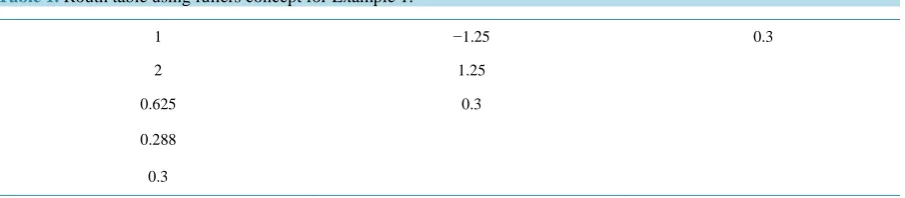
Routh Table:
[image:4.595.88.541.621.720.2]FromTable 1, all the elements in the first column are positive then the system is aperiodically stable.
Table 1. Routh table using fullers concept for Example 1.
1 −1.25 0.3
2 1.25
0.625 0.3
0.288
Output is verified using MATLAB
( )
;( )
;( )
p= f x q= f −x r= f′ −x
p = 1.0000 −1.2500 0.3000
q = 1.0000 1.2500 0.3000
r = 2.0000 1.2500
sol mat =
2.000 1.250 0 0 0.625 0.300 0 0
0.290 0 0 0
0.300 0 0 0
0.290 0 0 0
Example 2: [25]
Consider the following two dimensional characteristic equation
( )
2 2 2 2 2 22 2 1 1 2 1 2 1 1 2 1 2
1 1.2
0.3
1.5
1.8
0.75
0.6
0.72
0.29
0
f z
= −
z
+
z
−
z
+
z z
−
z z
+
z
−
z z
+
z z
=
Convert the two dimensional characteristic equation in to single dimensional characteristic equation,
2 2 2 2 2 2
2 2 1 1 2 1 2 1 1 2 1 2
1 1.2− z +0.3z −1.5z +1.8z z −0.75z z +0.6z −0.72z z +0.29z z =0
Taking inverse of variables z1 and z2,
2 2 2 2 2 2
2 2 1 1 2 1 2 1 1 2 1 2
1.2 0.3 1.5 1.8 0.75 0.6 0.72 0.29
1 0
z z z z z z z z z z z z
− + − + − + − + =
1 2 z =z =x
2 2 3 2 3 4
1.2 0.3 1.5 1.8 0.75 0.6 0.72 0.29
1 0
x x x x x x x x
− + − + − + − + =
The required one dimensional equation is,
4 3 2
2.7 2.7 1.47 0.29 0
x − x + x − x+ =
( )
42.7
32.7
21.47
0.29
f x
=
x
−
x
+
x
−
x
+
The coefficient of f x
( )
has alternate sign; then the necessary condition is satisfied. Then Substitute x= −x in f x( )
The transformed equation is formed as,
( )
4 3 22.7 2.7 1.47 0.29
f − =x x + x + x + x+
( )
3 24 8.1 5.4 1.47
f′ − =x x + x + x+
Using Fuller’s Concept, F x
( )
= f( )
− +x f′( )
−x( )
(
4 3 2) (
3 2)
2.7 2.7 1.47 0.29 4 8.1 5.4 1.47
F x = f x + x + x + x+ + f′ x + x + x+
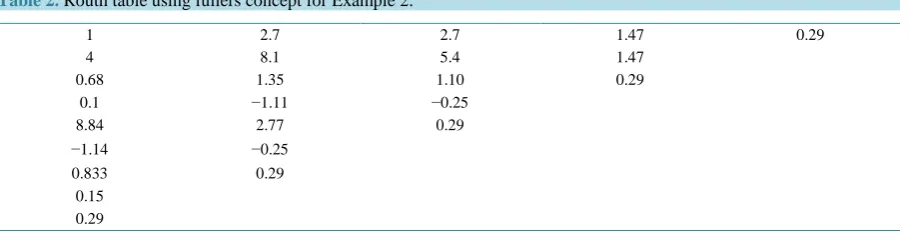
Routh Table:
[image:5.595.88.543.602.719.2]FromTable 2, there is two sign change in the first column therefore the given system is unstable.
Table 2. Routh table using fullers concept for Example 2.
1 2.7 2.7 1.47 0.29
4 8.1 5.4 1.47
0.68 1.35 1.10 0.29 0.1 −1.11 −0.25
8.84 2.77 0.29 −1.14 −0.25
0.833 0.29 0.15
Output is verified using MATLAB
( )
;( )
;( )
p= f x q= f −x r= f′ −x
p = 1.0000 −2.7000 2.7000 −1.4700 0.2900
q = 1.0000 2.7000 2.7000 1.4700 0.2900
r = 4.0000 8.1000 5.4000 1.4700
sol_mat =
1.000 2.700 2.700 1.470 0.290 0
4.000 8.100 5.400 1.470 0 0
0.675 1.350 1.102 0.290 0 0
0.100 1.133 0.248 0 0 0
0.900 2.780 0.290 0 0 0
1.164 0.252 0 0 0 0
0.833 0.290 0 0 0 0
− −
− −
Example 3: [15]
Consider a two dimensional characteristic equation,
(
1 0.95− z1) (
− 0.95−0.5z1)
z2 =0Convert the two dimensional characteristic equation in to single dimensional characteristic equation,
1 2 1 2
1 0.95− z −0.95z +0.5z z =0
Taking inverse of variables z1 and z2,
1 2 1 2
0.95 0.95 0.5
1 0
z z z z
− − + =
1 2 z =z =x
2
0.95 0.95 0.5
1 0
x x x
− − + =
The required one dimensional equation is,
2
1.90 0.5 0
x − x+ =
( )
21.90 0.5 f x =x − x+
The coefficient of f x
( )
has alternate sign; then the necessary condition is satisfied.Then Substitute x= −x in f x
( )
The transformed equation is formed as,
( )
21.90 0.5 f − =x x + x+
( )
2 1.90f′ − =x x+
Using Fuller’s concept F x
( )
= f( )
− +x f′( )
−x( )
(
2)
(
)
1.90 0.5 2 1.90
F x = x + x+ + x+
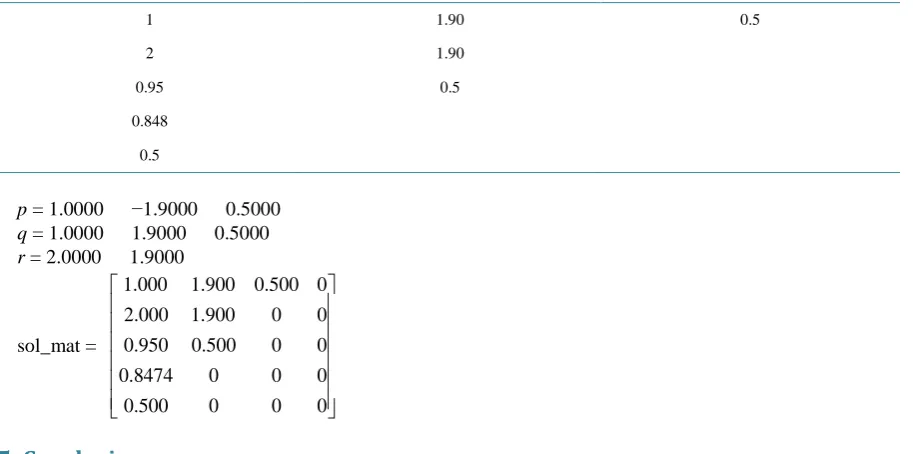
Routh Table:
From Table 3, all the elements in the first column of routh table are positive then the system is aperiodically stable.
Output is verified using MATLAB
( )
;( )
;( )
Table 3. Routh table using fullers concept for Example 3.
1 1.90 0.5
2 1.90
0.95 0.5
0.848
0.5
p = 1.0000 −1.9000 0.5000
q = 1.0000 1.9000 0.5000
r = 2.0000 1.9000
sol_mat =
1.000 1.900 0.500 0
2.000 1.900 0 0
0.950 0.500 0 0
0.8474 0 0 0
0.500 0 0 0
5. Conclusion
The main contribution of this paper is to ascertain the aperiodic stability of two dimensional linear time invariant discrete systems with the help of Routh table [24] by applying fuller’s concept [21] to form the Sn−1 row in the Routh table which reduces the order of the characteristics equation and hence reduces the number of computations. The result of the analysis is verified by using MATLAB. In the view of conceptual simplicity of these tests, it would appear that development of dedicated implementation procedures were simple and worthy subject of fur-ther investigation. The contribution made in this paper can be extended to characteristics polynomial containing complex coefficients.
References
[1] Jury, E.I. and Gutman, S. (1975) On the Stability of the A Matrix inside the Unit Circle. IEEETransactionon Auto-maticControl, 533-535. http://dx.doi.org/10.1109/TAC.1975.1100995
[2] Bistriz, Y. (2004) Immitance and Telepolation-Based Procedures to Test Stability of Continuous-Discrete Bivariate Polynomials. IEEETransactiononCircuitsandSystems, 3, 293-296.
[3] Bistritz, Y. (2004) Testing Stability of 2-D Discrete Systems by a Set of Real 1-D Stability Tests.IEEETransactions onCircuitsandSystemsI: RegularPapers, 51, 1312-1320. http://dx.doi.org/10.1109/TCSI.2004.830679
[4] Khargoneker, P.P. and Bruce Lee, E. (1986) Further Results on Possible Root Locations of 2-D Polynomials. IEEE TransactionsonCircuits&Systems, 33, 566-569. http://dx.doi.org/10.1109/TCS.1986.1085944
[5] Mastorakis, N.E. (1998) A Method for Computing the 2-DStability Margin. IEEE TransactionsonCircuits& Sys-tems-II, Analog&DigitalSignalProcessing, 45, 376-378. http://dx.doi.org/10.1109/82.664243
[6] Anderson, B.D.O. and Jury, E.I. (1973) A Simplified Schur-Cohn Test. IEEE TransactionsonAutomatic Control,
AU-31, 157-163. http://dx.doi.org/10.1109/TAC.1973.1100253
[7] Anderson, B.D.O. and Jury, E.I. (1973) Stability Test for Two-Dimensional Recursive Filter. IEEETransactionson AudioElectroacoustics, AU-21, 366-372. http://dx.doi.org/10.1109/TAU.1973.1162491
[8] Jury, E.I. and Bauer, P. (1988) On the Stability of Two-Dimensional Continuous Systems. IEEETransactionson Cir-cuitsandSystems, 35, 1487-1500. http://dx.doi.org/10.1109/31.9912
[9] Bose, N.K. and Jury, E.I. (1975) Inner Algorithm to Test for Positive Definiteness of Arbitrary Binary Forms. IEEE TransactiononAutomaticControl, 169-170. http://dx.doi.org/10.1109/TAC.1975.1100875
[10] Jury, E.I. (1971) Inners-Approach to Some Problems of System Theory. IEEE TransactionsonAutomaticControl,
AC-16, 233-240. http://dx.doi.org/10.1109/TAC.1971.1099725
http://dx.doi.org/10.1109/81.933325
[12] Ahmed, A. (1980) On the Stability of Two-Dimensional Discrete Systems. IEEETransactionsonAutomaticControl,
25, 551-552. http://dx.doi.org/10.1109/TAC.1980.1102352
[13] Jury, E.I. (1970) A Note on the Analytical Absolute Stability Test. ProceedingoftheIEEE, 58, 823-824.
http://dx.doi.org/10.1109/PROC.1970.7763
[14] Goodman, D. (1977) Some Stability Properties of Two-Dimensional Linear Shift-Invariant Digital Filters. IEEE TransactionsonCircuitsandSystems, 24, 201-208. http://dx.doi.org/10.1109/TCS.1977.1084322
[15] Huang, T.S. (1972) Stability of Two-Dimensional Recursive Filters. IEEETransactionsonAudioandElectroacoustics,
20, 158-163. http://dx.doi.org/10.1109/TAU.1972.1162364
[16] Bauer, P. and Jury, E.I. (1988) Stability Analysis of Multidimensional (m-D) Direct Realization Digital Filters under the Influence of Nonlinearities. IEEETransactionsonAcoustics, Speech&SignalProcessing, 36, 1770-1780.
http://dx.doi.org/10.1109/29.9014
[17] Singh, V. (2012) New Approach to Stability of 2-D Discrete Systems with State Saturation. Signal Processing, 92, 240-247. http://dx.doi.org/10.1016/j.sigpro.2011.07.012
[18] Katbab, A., Jury, E.I. and Mansour, M. (1992) On Robust Schur Property of Discrete-Time Polynomials. IEEE Trans-actionsonCircuitsSystems I: FundamentalTheoryandApplications, 39, 467-470.
http://dx.doi.org/10.1109/81.153641
[19] Kamat, P.S. and Zwass, M. (1985) On Zero Location with Respect to the Unit Circle of Discrete-Time Linear Systems Polynomials. ProceedingsoftheIEEE, 73, 1686-1687. http://dx.doi.org/10.1109/proc.1985.13351
[20] Szaraniec, E. (1973) Stability, Instability and Aperiodicity Test for Linear Discrete Systems. Automatica, 9, 513-516.
http://dx.doi.org/10.1016/0005-1098(73)90097-6
[21] Fuller, A.T. (1955) Conditions for Aperiodicity in Linear Systems. BritishJournalofAppliedPhysics, 5, 174-179.
http://dx.doi.org/10.1088/0508-3443/5/5/304
[22] Jury, E.I. (1985) A Note on Aperiodicity Condition for Linear Discrete Systems. IEEE Transactionson Automatic Control, 30, 1100-1101. http://dx.doi.org/10.1109/tac.1985.1103843
[23] Jury, E.I. and Blanchard, J. (1961) A Stability Test for Linear Discrete Systems in Table Form. ProceedingsoftheIRE,
21, 1947-1948.
[24] Bose, N.K. and Modarressi, A.K. (1976) General Procedure for Multivariable Positivity Test with Control Applications. IEEETransactionsonAutomaticControl, 21, 696-701. http://dx.doi.org/10.1109/TAC.1976.1101356