University of Huddersfield Repository
Walker, Reg, Bindless, Linda, Harrison, Fiona, Michael, Susan and Firth, Jan
Combining the best of nursing and medical care: evaluation of the West Yorkshire Nurse
Practitioner (Primary Care) Development Programme from 2001 to 2005
Original Citation
Walker, Reg, Bindless, Linda, Harrison, Fiona, Michael, Susan and Firth, Jan (2007) Combining the
best of nursing and medical care: evaluation of the West Yorkshire Nurse Practitioner (Primary
Care) Development Programme from 2001 to 2005. Project Report. Yorkshire and the Humber
Strategic Health Authority, the University of Huddersfield and Leeds Metropolitan University.
This version is available at http://eprints.hud.ac.uk/id/eprint/5297/
The University Repository is a digital collection of the research output of the
University, available on Open Access. Copyright and Moral Rights for the items
on this site are retained by the individual author and/or other copyright owners.
Users may access full items free of charge; copies of full text items generally
can be reproduced, displayed or performed and given to third parties in any
format or medium for personal research or study, educational or notforprofit
purposes without prior permission or charge, provided:
•
The authors, title and full bibliographic details is credited in any copy;
•
A hyperlink and/or URL is included for the original metadata page; and
•
The content is not changed in any way.
For more information, including our policy and submission procedure, please
contact the Repository Team at: [email protected].
COMBINING THE BEST OF NURSING AND
MEDICAL CARE
Evaluation of the West Yorkshire Nurse Practitioner
(Primary Care) Development Programme from 2001 to 2005
Report for Yorkshire and the Humber Strategic Health Authority, the University of
Huddersfield and Leeds Metropolitan University
By
Dr Reg Walker – Elliott Walker Consultancy
Linda Bindless – University of Huddersfield
Fiona Harrison – Leeds Metropolitan University
Susan Michael – Yorkshire and Humber NHS
Jan Firth – University of Huddersfield
COMBINING THE BEST OF NURSING AND MEDICAL CARE
Evaluation of the West Yorkshire Nurse Practitioner (Primary Care) Development Programme from 2001 to 2005
Report for Yorkshire and the Humber Strategic Health Authority, the University of Huddersfield and Leeds Metropolitan University
by
Dr Reg Walker - Elliott Walker Consultancy Linda Bindless – University of Huddersfield Fiona Harrison – Leeds Metropolitan University
Susan Michael – Yorkshire and Humber NHS Jan Firth – University of Huddersfield
ACKNOWLEDGEMENTS
I would like to acknowledge the guidance and support from the evaluation Steering Group consisting of:
Susan Michael (Chair), Yorkshire and Humber SHA Linda Bindless, University of Huddersfield
Janet Firth, University of Huddersfield
Fiona Harrison, Leeds Metropolitan University
Lynda Burt, Bradford and Airedale Primary Care Trust Joanne Crewe, Kirklees Primary Care Trust
Tracy Small, Kirklees Primary Care Trust
Professor Peter Bradshaw, University of Huddersfield Ann-Marie Bagnall, Leeds Metropolitan University.
We are all grateful to the survey respondents and to the NP and GP interviewees for giving us their views, and hopefully they have been well represented in the report. Thanks also to Dr Angie Ross for interviewing the doctors.
The work of the original Steering Group that produced the agreed framework for the West Yorkshire Nurse Practitioner programme is duly acknowledged in the main body of the report.
CONTENTS
page
1. INTRODUCTION 5
2. OBJECTIVES AND METHODS 2.1. Research objectives and purpose of this report 6
2.2. Research methods and numbers 6
2.3. Project oversight 8
2.4. The structure of the report 9
3. THE COMMISSIONING STRATEGY 3.1. Background to the West Yorkshire initiative 10
3.2. Development of the framework 10
3.3. Support infrastructure and funding arrangements 13 3.4. The commissioning process 13
3.5. Interim assessment of the strategy 14 3.6. The relative cost of the initiative 16
4. THE DEVELOPMENT PROGRAMME 4.1. The Huddersfield course 17
4.2. The Leeds Metropolitan course 18
4.3. Numbers of students and successful completions 18 4.4. University course evaluations 19
5. SURVEY FINDINGS 5.1. Context of experience gained as NP 21
5.2. How NPs rate the development programme 21
5.3. How the role has been more or less demanding than anticipated 22 5.4. Clinical responsibilities 22
5.5. Acceptance of the NPs’ role 23
5.6. Satisfaction with the role, and causes of dissatisfaction 24
5.7. Effects on career and future prospects 25
5.8. Having a Masters 27
5.9. How NPs intend to develop their role 27
5.10. Suggestions for changing the development programme 28 5.11 Other views 29
6. THE NURSE PRACTITIONER INTERVIEWS 6.1. Distinctive features of the Nurse Practitioner role 31 6.2. How the role compares with what they expected 32 6.3. What they are most confident about 32
6.4. What they don’t feel comfortable doing 33
6.6. Aspects of the role that others are reluctant for NPs to develop 34
6.7. Improving recognition of the role 35
6.8. Do they see their role changing significantly? 36
6.9. CPD priorities 36
6.10. Other views 37
7. INTERVIEWS WITH THE DOCTORS 7.1. Pros and cons of being a tutor/mentor 39
7.2. Post-qualifying relationships 39
7.3. The doctors’ views of the NP role 40 7.4. Quality of patient care, and acceptance of the NPs’ role 40 7.5. Development of the role 41
8. CONCLUSIONS AND RECOMMENDATIONS 8.1. Main conclusions 43
8.2. Comments on other issues 44
8.3. Recommendations 45
References 46
Appendix A: Survey Questionnaire 47
Appendix B: Schedule for Interviews with NPs 51
Appendix C: Schedule for Interviews with Doctors 54
1.INTRODUCTION
The West Yorkshire development programme for Nurse Practitioners (NPs) in primary care was designed to address an impending shortage of General Practitioners (GPs) at the turn of the decade and government policy to encourage the development of
advanced practitioner roles in nursing and other non-medical professions.
At the initiative of the West Yorkshire NHS Workforce Development Confederation (WYWDC), in 2001 a Steering Group representing the West Yorkshire Primary Care Reference Group, the WYWDC and the Universities of Huddersfield and Leeds
Metropolitan developed – in the absence of national guidelines on NP development – an agreed framework for developing the role of Nurse Practitioner in primary care and for commissioning courses and support infrastructures for aspiring NPs. This formed the basis for the commissioning of NP development courses at the two Universities – two-year courses at Masters level leading to a Postgraduate Diploma, with an optional third year leading to an MSc.
2.OBJECTIVES AND METHODS
2.1. Research objectives and purpose of this report
As set out initially, the evaluation had four objectives:
• To examine the commissioning process used to develop the programme and consider its transferability for commissioning future courses
• To evaluate the content of the programme in preparing Nurse Practitioners who are fit for purpose and practice
• To examine the impact of the programme on the students’ career opportunities
• To identify the extent to which Nurse Practitioners are able to utilise their new skills and knowledge.
Since the commissioning process took place six years ago, the first of these objectives really translates into evaluating the commissioning strategy. The purpose of this report, therefore, is to assess commissioning strategy and the effectiveness of the education programmes commissioned – specifically in relation to the first three cohorts: 2001-3, 2002-4 and 2003-5.
2.2. Research methods and numbers
The report is based on data drawn from six different perspectives, as follows. (1) The thinking that led to the framework produced in 2001.
(2) Reflections on the commissioning strategy obtained from interviews at WYWDC with Kath Hinchliff, who was responsible for the commissioning strategy, and Susan Michael, who later managed the contract; and interviews also with those who led the programme in the Universities: Fiona Harrison at Leeds Met; Janet Firth and Linda Bindless at Huddersfield.
(3) A review of the course evaluation reports for the first three cohorts. (4) Analysis of responses to a postal survey of NPs who had completed the
programme.
(5) Follow-up interviews with NPs.
(6) Interviews with some GPs who have acted as tutors and clinical assessors for student NPs.
Numbers
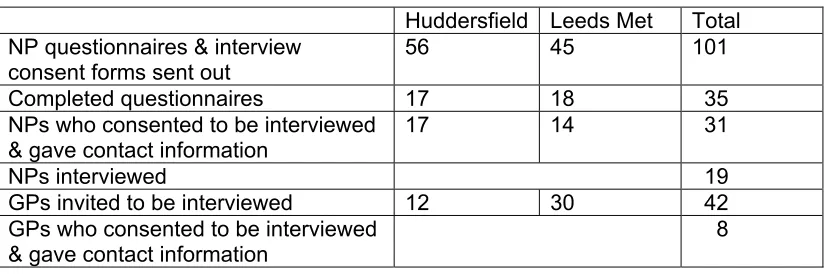
Table 1: Postal survey and interview numbers
Huddersfield Leeds Met Total
NP questionnaires & interview consent forms sent out
56 45 101 Completed questionnaires 17 18 35
NPs who consented to be interviewed & gave contact information
17 14 31 NPs interviewed 19 GPs invited to be interviewed 12 30 42 GPs who consented to be interviewed
& gave contact information
8
The postal survey
Because NPs’ and GPs’ time is at a premium, it was decided to keep both the survey questionnaire and interview schedules as brief as possible, focusing on general issues. The postal questionnaire, which is reproduced in Appendix A, covers the following issues:
• How NPs rate the main parts of the development programme
• In what ways the role is more or less demanding than anticipated
• The extent to which NPs play a lead role in various clinical situations
• Acceptance of the role by various other people
• Satisfaction with the role
• Effects on their career and future prospects
• The impact of having a Masters
• Foreseeable developments
• Suggested changes in the development programme.
The questionnaires were issued with a covering letter from the WYWDC which, among other things, assured anonymity and confidentiality. A letter inviting people to consent to be interviewed accompanied the questionnaire. To safeguard anonymity, separate envelopes were provided for returning the questionnaire and the interview consent form.
The NP interviews
These interviews took place a couple of months after the postal questionnaires had been returned and the initial analysis of the questionnaires helped to frame the interview schedule. Thirty-one NPs consented to be interviewed and supplied contact details, while three others omitted the contact details. Of the thirty-one, nineteen were interviewed: 15 face-to-face; three by phone and one by email.
It took 64 attempts to obtain the 19 interviews. Almost all of the NPs whom we were able to contact directly were in fact interviewed. In the few cases this wasn’t feasible because of the practicalities of location or of co-ordinating NP and researcher availability.
• What distinguishes the role of NP in primary care from other clinical roles?
• In practice, how well does the role fit it with how NPs think it should be?
• The parts of the role they feel most and least confident performing
• Aspects of the role that other people are keen, or reluctant, for them to develop
• Improving recognition of the role, and
• Whether they foresee the role changing significantly.
While time-consuming to arrange and get to, the interviews proved particularly useful in giving the researcher a flavour of the calibre of NPs and how they view their emerging role. The face-to-face interviews all took place on practice premises. For reasons of short duration, focus and practical convenience, these interviews were not tape-recorded; instead the researcher took notes which were transcribed soon after each interview took place.
The GP interviews
The interviews with GPs took place when most of the NP interviews had happened and, again, the earlier findings helped to frame the semi-structured schedule for interviewing the GPs. These interviews were all done by phone, with the researcher taking notes which were transcribed soon after each interview. Again, the interviews were short, only 10-15 minutes. The questions (see Appendix C) fell into two groups, as follows.
(A) The GP’s own role as in-house tutor and clinical assessor:
• The number of NPs tutored so far
• The benefits and disadvantages of the tutorial role
• Willingness to perform the role again
• How the relationship between GP and NP may have altered since the NP qualified.
(B) The NP’s role:
• The GP’s experience of working directly with a qualified NP, as distinct from in a tutorial role
• What particularly distinguishes the NP’s role from other clinical roles
• How the NP’s role affects patient care
• Acceptance and recognition of the NP role
• Hopes and concerns in regard to how the NP role may develop.
2.3. Project oversight
The Chair of the NHS Research Ethics Committee to which the proposal was submitted decided that nothing in it called for REC debate or opinion, and deemed it to be “a very appropriate (and well presented) argument for assessing a course funded by the WDC”. The Research Ethics Panel in the School of Human and Health Sciences at the
University of Huddersfield – which hosted the project – were also happy with the proposal and raised some practical issues which were addressed.
2.4. The structure of the report
3. THE COMMISSIONING STRATEGY
This section outlines the background to the West Yorkshire initiative and the framework that formed the basis for commissioning the Nurse Practitioner development
programme.
3.1. Background to the West Yorkshire initiative
Several factors have been contributing to the development of what are variously called Nurse Practitioner and Advanced Nurse Practitioner roles in both primary and secondary healthcare.
Mainly they reflect a mix of concerns about the supply of doctors, pressures to develop other clinical roles, and government reforms of the NHS. Broadly, the latter are designed to make the NHS more responsive to patients’ needs and public health agendas; to make healthcare provision more flexible while also achieving more integration within health services and between health and social services; to achieve more integrated workforce planning; and to make healthcare provision more innovative and more cost-effective – all matters for considerable debate, and beyond our remit.
More specifically, interest in the NP role was spurred by the partial reform of primary care general practice through the introduction of Personal Medical Services (PMS) practices – i.e. practices organised in ways that differed from what up to then had been the conventional model of independent GPs and GP partnerships – and pressures from various quarters to recognise untapped levels of ability among nurses and to build capacity for development of their clinical roles, as envisaged in the NHS Plan,
particularly in the Chief Nursing Officer’s framing of key roles for nurses. Development of advanced practitioner roles in the USA and elsewhere has also been influential.
However, progress towards a national framework for NPs has not kept pace with developments of the role on the ground, or development of educational provision for it around the country, although in 2006 there was progress to the extent that the Nursing and Midwifery Council (NMC) put formal proposals (NMC, 2005) seeking Privy Council approval to amend nursing registration in order to register advanced nurse practitioners – the term it uses, without capital letters – that approval being necessary to pave the way for legislation, though there is no way of knowing at present whether such legislation will be forthcoming.
However, even that was far from being the case at the turn of the decade when the West Yorkshire initiative was started. It was prompted by the mix of factors just described and particularly by the lack of anything approaching national guidelines for NP roles or for education for them.
3.2. Development of the framework
a Nurse Practitioner Steering Group with the aim of developing a framework to provide a basis of consistency across West Yorkshire for commissioning courses and
infrastructural support for developing Nurse Practitioners.
The group’s starting points included the national local drivers of change outlined above and particularly the NHS Plan goal to shatter old demarcations by requiring ‘NHS employers … to empower appropriately qualified nurses, midwives and therapists to undertake a wider range of clinical tasks including the right to make and receive referrals, admit and discharge patients, order investigations and diagnostic tests, run clinics and prescribe drugs’ (DoH, 2000: 83). The plan also refers to nurses managing patient caseloads, running clinics, performing minor surgery and outpatient procedures, and taking a lead in the way local health services are organised and run (DoH, 2000: 83-4).
The NP Steering Group was multi-professional. It consisted of eleven people representing five primary care interests, two health authorities and NHS Direct, and WYWDC and the Universities of Huddersfield and Leeds Metropolitan. Among the agreed objectives, the main ones can be paraphrased as follows:-
• To develop a shared understanding of the NP role in primary are
• To develop and agree a definition for the role of NP in West Yorkshire
• To advise on the competencies and educational requirements for NPs in primary care
• To advise on appropriate supervision and mentorship, and assess the associated financial implications and the capacity within primary care to provide the
necessary support
• To develop a framework to support commissioning for NP education.
The workings of this group need not concern us here. What is of interest are the group’s working definition of an NP and the associated principles and competencies, and the support infrastructure that the group proposed. These are summarised below, as set out in the group’s report to the Primary Care Reference Group in May 2001 (Coombs, May 2001); although a draft, it is in effect the final version.
Definition of NP and competencies
The following is the definition agreed by the Steering Group:-
“A Nurse Practitioner (primary care) is an independent practitioner who is able to demonstrate a high level of defined competencies, which enables the practitioner to manage a whole range of clinical situations. This incorporates diagnostics, therapeutics, decision making and clinical management, which is complementary to other members of the primary health care team” (Coombs, 2001).
In the Leeds Met course handbook (2003-5: 5) this definition is reproduced with the term ‘complementary’ replaced by the term ‘interdependent’.1
1In 2005 the Nursing & Midwifery Council produced a definition of the NP’s role, intended for the general
Underpinning the Steering Group’s definition was a long series of principles, namely that NPs should be:-
• First level qualified (Part 1) and registered nurses
• Experienced
• Generalists functioning at a higher level
• Knowledgeable/experienced in primary healthcare
• Independent – autonomous in decision making
• Able to demonstrate competencies in a whole range of areas [as described in the NHS Plan]
• Complementary to … other professions [in primary care]
• Professionally accountable
• Managerial accountable
• Able to demonstrate Continuing Professional Development (CPD)
• Able to lead developments and manage innovations in practice
‘Knowledgeable/experienced in primary care’ is clarified as including General Practice, community, accident and emergency services, and fast access primary care such as Walk In centres and NHS Direct.
The group also drew attention to several other aspects of working at a higher level of practice. In addition to providing effective health care and improving health outcomes, these refer to evaluation and research, leading practice development and innovation, developing oneself and others, and working across professional and organizational boundaries (UKCC, 1999).2 The group advocated that these be integrated into a
competency framework strongly featuring:
• Diagnostics
• Therapeutics
• Consultations and Clinical Decision Making
• Policy and protocol development, including evaluation.
The Steering Group’s framework for the role of NP consisted therefore of the agreed definition, the principles listed above, the list of ten key roles for nurses in the NHS Plan and the competencies the group wished to see incorporated in NP development.
The group’s principal recommendations were to ask the WYWDC to endorse this framework, and to consider how funding could be secured to reimburse facilitation and mentoring of NPs during development. The latter brings us to the nature of the support infrastructure they recommended and the funding arrangements envisaged.
appropriate specialist if needed” (NMC, 2005). The definition is followed by a clear and rounded statement of what patients, carers and other health professionals can expect an advanced nurse practitioner to be capable of doing.
3.3. Support infrastructure and funding arrangements
The Steering Group recognised that without the right level and type of support nurses are unlikely to feel properly prepared for the role, resulting in unnecessary stress or failure to meet required standards. This called for each NP to have a facilitator and a mentor, with specific roles and functions.
Facilitators and mentors
The facilitator would usually be a GP, but as experienced NPs became available they could undertake this. The facilitator’s role would be “to provide teaching and establish a conducive learning environment to ensure successful progress of the NP learner” (Coombs, 2001), and also to provide clinical supervision and feedback to course tutors on the developing NP’s progress. It was estimated that a commitment of one half day a week would be a minimum for this. The group also suggested that prospective
facilitators be assessed to help ensure the right level of competence and commitment. They recommended too that the quality of prospective learning placements be formally assessed by the Universities as part of the process of recruitment to the programme. The mentor’s role would be to encourage personal and professional development, and help with critical reflection on clinical practice. It was suggested that experienced NPs would be best placed to provide this, individually or on a group basis, and that
consideration also be given to alternatives such as action learning sets or peer supervision.
Funding arrangements
In regard to funding of the programme by the WYWDC, in addition to payment of course fees the arrangements proposed included ‘backfilling’ of the nurses’ salaries.
Furthermore, in it was argued that whereas PMS practices might be allocated funding by Health Authorities or PCTs specifically for facilitation and mentoring, as things stood GP practices would not receive such funding and it was “extremely unlikely” that GPs would be prepared to act as facilitators without payment or incentives – especially given the arrangements for funding GPs and their practices for taking medical trainees and
students. This would create inequities between nurses in different kinds of practice, so it was “imperative” that the WYWDC provided a consistent approach to funding this aspect of the programme across the board (Coombs, 2001).
3.4.The commissioning process
The proposed framework did indeed serve as the basis for the development programme that was commissioned in 2001. The thrust of the strategy was to provide the
educational and support infrastructure for a rolling development of Nurse Practitioners qualified to an advanced level – at least PostGraduate Diploma – and, crucially, to secure funding for the programme by establishing it as a priority for primary care organizations.
(subsequently increased to twenty).3 Furthermore, the support infrastructure for
in-practice learning was put in place – on the basis of one half day per week (term time) protected time for GP-facilitated learning plus the equivalent for self-directed learning – and there was provision for mentoring too. The Universities undertook the oversight of the quality of learning placements, liaison with the GP educators/facilitators, and so on. In addition to the Diploma, which constituted the qualification, there was also provision for optional completion in a third year of an MSc, with some protected time for that but not the facilitated learning built into the first two years.
The funding package covered course fees, the participant nurses’ salaries and payment to the support practices for the facilitated learning. The backfilling of nurses’ salaries for the two-year course period was generous, covering two days per week throughout the year, not just in term-time. However, this left some ambiguity regarding the ‘protected’ status of this provision outside of term time. Our survey findings indicate that some practices respected the protected time provision only during term time and tended to disregard it otherwise, while others continued to provide facilitated learning and time for self-directed learning outside of term time.
The programme commissioned
To sum up, the development process commissioned consisted of the following elements:-
• A two-year taught course based on one day per week for the academic year
• Practice-based learning one day per week for two years, split between a half day GP-facilitated clinical tuition and supervision and a half day self-directed learning
• Mentoring by experienced NPs (once enough were qualified)
• Tripartite reviews by the student, clinical educator/facilitator and the course tutor
• Assessment of the theoretical content of each module and of the student’s competencies by the University teaching team, coupled with assessment in the practice setting by the clinical educator/facilitator
• Completion of the PostGraduate Diploma
• Option at the end of Year 2 or in Year 3 to complete a MSc dissertation.
3.5. Interim assessment of the strategy
The extent to which the commissioning strategy has succeeded in developing a significant number of NPs who are fit for purpose and practice is the most important factor in evaluating it. That cannot be addressed properly until all the findings have been reviewed, so we will come back to this in the overall Conclusions.
However, it is appropriate at this point to take note of what made this commissioning process different, and to ask how the prime movers in the commissioning process now regard what was done. The cost of the initiative also has to be considered.
An unusually cohesive approach
It is worth noting that NHS educational programmes at postgraduate level usually are commissioned in three ways that notionally are different but tend to overlap. They come about: (i) through Trusts and/or Universities instigating a course to meet local or national needs or perceived demand; (ii) through professional bodies and networks responding to developments in clinical standards that generate the need for new or different training courses; (iii) through WDCs bringing people together to develop responses to particular needs.
Elements of all three played a part in the commissioning of this Nurse Practitioner
programme but the approach to it in West Yorkshire was underpinned by certain factors. First, the need was clear; some parts of the region were seriously un-doctored,
particularly in areas of high deprivation. Secondly, some ground-breaking efforts to address that problem by developing advanced nurse practitioners were going on, but with big discrepancies between local solutions. So the breakthrough was to seek and pave the way for a common approach. Thirdly, a group representing the main interests was brought together and they succeeded in agreeing a framework for addressing all the main issues – and support for that framework was gained from all fifteen PCTs in West Yorkshire, including ones which needed to change what they were doing in order to align themselves with the common approach. Fourth, the two Universities were committed to the agreed framework and had real grounds for confidence in developing their courses and their links with primary care providers. Fifth, the prime movers at the WYWDC managed to secure Board approval of sufficient funding for the initiative and to have it ring-fenced. All told, this was an unusually cohesive process of purposeful co-operation. To find out how they now regard it with all the benefit of hindsight, the key people in the WYWDC responsible for commissioning the programme were interviewed on two occasions, and the people who led the programme at the two Universities were also interviewed.
How the WYWDC and Universities regard the process
From the WYWDC’s perspective there were two outstandingly positive aspects of the process. One was the clear focus on the specific need to remedy the shortage of GPs by developing advanced nurse practitioners, and to underpin that development by
On their part, the University programme leaders highlight several factors that made the commissioning process particularly effective-
• the advantages of being given a ‘steer’ by the WYWDC and assurance of its support so long as the Universities made a good job of delivering the course;
• the quality of support from the GPs on the Steering Group;
• the opportunity to really think things through, coupled with the fact that the situation called for a united approach, without the usual vying between interests;
• the commitment to positive funding, covering not only course fees but relatively high ‘backfill’ and GP-facilitation costs;
• the quality of liaison with the WYWDC and the efficiency of its payment system. Of course there were the usual frustrations in getting complex things done, and some disappointments too. For instance, some of the GP facilitators chosen by students were
“just not committed to the role”, as one person put it – something that surfaces several times in survey responses and NP interviews, as will be seen. In contrast, some GPs were exceptionally committed to their role as facilitators.
Leaving aside for now the problem of variable quality, the nature of the support infra-structure for NP development brings us to the relative cost of the initiative.
3.6. The relative cost of the initiative
The financial arrangements underpinning the Nurse Practitioner programme were – and in mid 2007 still are – essentially no different to those for training Health Visitors or District Nurses. The WDC pays the course fees and reimburses practices for the
notional costs of replacing people while they are attending courses (full time or part time) or otherwise engaged in professional development, i.e. salary ‘backfill’ as is called. The backfill costs of programmes like these account for most of the expenditure – as much as 75% to 80%. In addition, for the NP programme payment for GP facilitation was part of the proposed framework, and for NPs going on to do the MSc a small amount was provided to ensure some protected time for their dissertation. Clearly, the amount and quality of practice support for NP development should be commensurate with the level of salary backfill and additional payment for facilitation, so it is regrettable that some of our respondents experienced shortcomings in that regard.
The backfill arrangements make it very costly to run programmes like these, but in terms of relative cost two points are worth making. First, the cost per student of the Nurse Practitioner programme is only 10 per cent higher than the full cost of training District Nurses or Health Visitors, i.e. when travel expenses for DNs/HVs are taken into account. Moreover, that 10% is mostly due to salary differentials. In real terms, therefore, the cost per student for the Nurse Practitioner programme is much the same as for other
programmes at a less advanced level.
Secondly, there is a big difference between funding a standard programme of
4. THE DEVELOPMENT PROGRAMME
This section outlines the structure of the two University courses and associated aspects of the development programme, gives the number of NPs who have been through the programme, and summarises the Universities’ own course evaluations. This refers to the first three cohorts, 2001-3, 2002-4 and 2003-5.
To re-cap, the Postgraduate Diploma course is a two-year part-time programme which combines university-based taught modules, practice and assessment; facilitated taught practice in primary care settings; self-directed learning, mentoring and portfolio
development. There is then an option to complete an MSc dissertation.
While both courses reflect the working definition of an NP, and the principles and
competencies in the agreed framework, the taught modules on the two courses are quite different. The WYWDC regards this difference as good because the complexity of
primary care calls for some diversity in advanced nursing expertise, and because it gives students and employers a choice between different approaches.
4.1. The Huddersfield course
Module Assessment
Clinical Sciences and Clinical Skills for NPs – 1
Practice component, case studies & reflective journal Health Professional
Accountability
Essay
Year 1, semester 1:
Clinical Practice and/or Mentor groups
Practice component, case studies & reflective journal Clinical Sciences and
Clinical Skills for NPs – 2
Practice component, case studies & reflective journal Public Health Policy and
Practice
Needs analysis & justification
Year 1, semester 2:
Clinical Practice and/or Mentor groups
Practice component, case studies & reflective journal Clinical Sciences and
Clinical Skills for NPs – 3
Practice component, case studies & reflective journal Mental Health and Mental
Illness
Case study
Year 2, semester 1:
Clinical Practice and/or Mentor groups
Practice component, case studies & reflective journal Consultation,
Communication and Change
Patient Simulated Surgery
Methods for Inquiry Project proposal & justification
Year 2, semester 2:
Directed study/Mentor groups
Practice component, case studies & reflective journal
Throughout 1 day per week in the practice setting split between GP-facilitated taught practice and self-directed learning, with summative assessments by the clinical educator.
4.2.The Leeds Metropolitan course
Module Assessment
Professional Development (1 module)
Professional Portfolio Human Health and Disease
(1.5 modules) OSCE* Competence Profile Critical Analysis assignment
Year 1, semesters 1 and 2:
Health Assessment (1.5 modules)
OSCE
Competence Profile Critical Analysis assignment Pharmacology (1 module) Case studies
Year 2, semester 1:
Skills for Evidence-based Practice (1 module)
Staged assessment
focusing on qualitative and quantitative approaches
Year 2, semester 2: Option to complete Masters (3 modules)
Throughout 1 day per week in the practice setting split between GP-facilitated taught practice and self-directed learning, with summative assessments by the clinical educator.
Year 3 individual tutorials, research and Masters dissertation * OSCE = Objective Structured Clinical Examination: a circuit of assessment stations where a range of practical skills are assessed against pre-determined criteria
Other elements
• In addition to the forms of assessment listed above, on both courses tri-partite meetings between student, course tutor and clinical educator take place three times during Years 1 and 2, or more often if necessary.
• From 2003 arrangements were made to ensure that all the NPs were qualified for Extended Nurse Prescribing (now Independent and Supplementary Nurse
Prescribing) when completing or within a short period of completing the course.
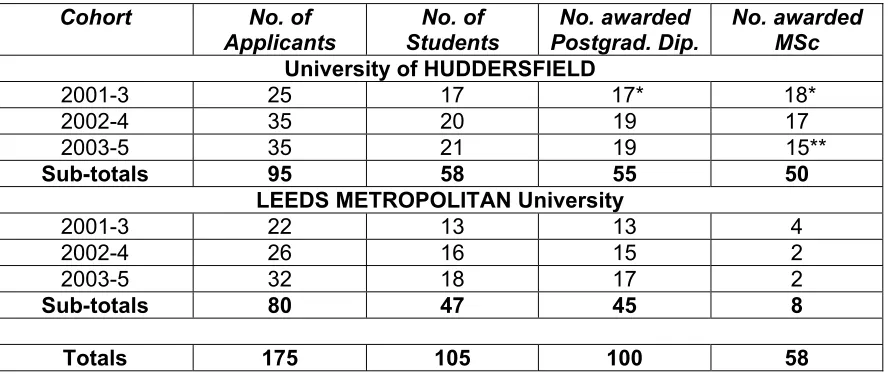
4.3. Numbers of students and successful completions
[image:21.612.86.530.159.346.2]
These levels of retention and successful completion point to high standards in the approach to selection and how the courses were run.
Table 2: Distribution of student numbers and successful completions by University and cohort
Cohort No. of
Applicants
No. of Students
No. awarded Postgrad. Dip.
No. awarded MSc
University of HUDDERSFIELD
2001-3 25 17 17* 18*
2002-4 35 20 19 17 2003-5 35 21 19 15**
Sub-totals 95 58 55 50
LEEDS METROPOLITAN University
2001-3 22 13 13 4 2002-4 26 16 15 2 2003-5 32 18 17 2
Sub-totals 80 47 45 8
Totals 175 105 100 58
* Another one was accredited through APEL and then completed the Masters. ** Two others already had Masters degrees and two more were due to complete subsequently.
4.4. University course evaluations
Both Universities evaluate their courses through a combination of student and staff evaluation of modules and annual reports by an external examiner, whose report covers the course as a whole. Fortunately, the external examiner reports for each course the years in question were all done by the same person, so there is continuity from year to year and the course leaders can see exactly what has been achieved and what needs to be done.
The Huddersfield external examiner’s reports are very thorough and go into a range of matters. From the reports for the years 2001-5 some salient points for the purposes of this report are:-
• that in general the modules were rated highly by students, and where problems were identified (such as a particular module falling below par or expectations not being made clear) they were usually resolved;
• that there were on-going issues about how to enable students to observe and practice clinical skills outside of actual practice settings, and related issues about assessing competence objectively;
• that while most students gained tremendously from the GP-facilitated learning sessions, some students regarded the quality of facilitation as being poor. These points are singled out as being worth highlighting because they are relevant for any programme of this kind. Similarly, salient points from the external examiner reports for the Leeds Met course in 2003-5 are:-
• that the approach to assessing students’ work was suitably rigorous but also helpful;
• that the combination of one day in University and the equivalent in practice with their GP facilitator provided the essential link for developing clinical skills and confidence;
5. SURVEY FINDINGS
[image:23.612.87.535.182.254.2]Thirty-five survey questionnaires were completed and returned, a response rate of one in three. The spread across the three cohorts that we are concerned with is shown below. This section summarizes a detailed analysis of the findings. The questionnaire is reproduced as Appendix A.
Table 3: No. of respondents by year awarded the NP Diploma (n=35)
2003 2004 2005 Response unclear
Huddersfield 5 8 4
Leeds Met 3 5 8 2
8 13 12 2
5.1. Context of experience gained as NP
In most cases – 29 out of 35 – these NPs have worked mostly or exclusively in GP practices (augmented in a couple of cases by Out of Hours work elsewhere), the other six having been employed directly or indirectly by PCTs.
5.2. How NPs rate the development programme
The NPs were asked to rate four main aspects of the programme on a scale of 1 (low) to 10 (high). Table 4 shows the mean average rating for each factor, and also the range. In round figures, the average ratings for the four aspects range from 7.5 to 8.5, within ranges from 10 down to 2. The factor rated mostly highly (8.5) is the weekly GP-supervised clinical practice.
The frequencies of the ratings are not particularly informative, except that far more NPs rated the GP-facilitated sessions at 9 or 10 than for any other factor. Despite complaints, only one person rated this factor at 2 and the next lowest rating is 5.
Table 4: How the NPs rated four main aspects of the programme
(with 1 low and 10 high)
Aspect of the programme Mean average rating
Range
The university-based taught modules
7.83 3 to 10 Weekly supervised clinical
practice with the GP
8.51 2 to 10 Project work, portfolio
development, and suchlike
7.46 3 to 10 Mentoring, individually or
in groups
[image:23.612.147.466.530.662.2]5.3. How has the role been more or less demanding than anticipated?
Respondents were asked to say in what ways (if any) the role as actually experienced is more demanding or less demanding than the course prepared them for.
For those who felt experienced enough to comment, the ways in which the role has been more demanding than anticipated are mostly to do with getting used to dealing with complex cases and conditions, the pressures of coping with the volume of work and decision making, and the need to keep learning. “Textbook cases rarely present”, as one person says. Other typical comments refer to “the constant variety of patient conditions”;
“learning to deal with prescribing issues”; “dealing with uncertainty”; “GP expectations”
and being “acutely conscious of my lack of experience”. Three more quotes sum up the demands of the role:
“Nothing can quite prepare you for a full-time clinical role where you are no longer a student.”
“Having overall responsibility for making diagnoses is sometimes daunting”
“The programme provides the fundamental skills/competencies, but the demands of the role require you to constantly develop them.”
Only seven people commented on the role being less demanding than anticipated. A couple refer to GPs being available for advice, and to the role becoming easier with experience. Less satisfactorily, two people say that they are having to do lots of things below their skill level; a third is actually working as a Community Matron, and a fourth is mentoring practice nurses.
5.4. Clinical responsibilities
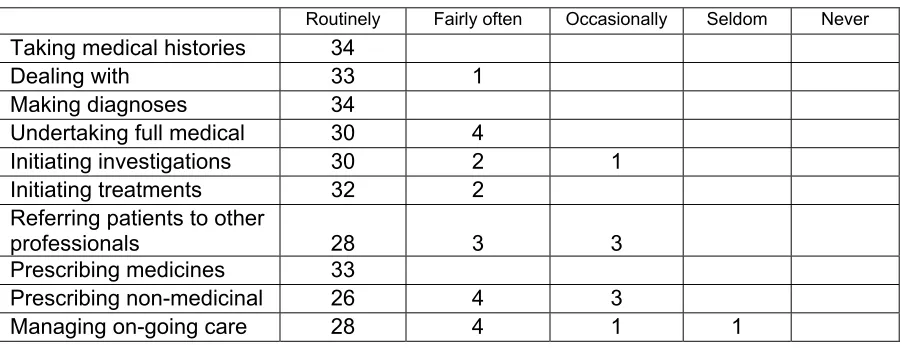
[image:24.612.85.537.549.723.2]To establish the extent to which NPs perform certain clinical responsibilities, question 4 asked: How often as a Nurse Practitioner do you play a lead role in the following clinical situations? – followed by a list of ten activities and frequency options ranging from ‘routinely’ to ‘never’. Table 5 shows the distribution of responses. One of the 35 respondents is in a mentoring role with no direct clinical responsibilities.
Table 5: Frequency that NPs perform certain clinical responsibilities (n=35)
Routinely Fairly often Occasionally Seldom Never Taking medical histories 34
Dealing with 33 1 Making diagnoses 34
Undertaking full medical 30 4
Initiating investigations 30 2 1 Initiating treatments 32 2
Referring patients to other
professionals 28 3 3 Prescribing medicines 33
Prescribing non-medicinal 26 4 3
Apart from the one who had no clinical responsibilities, most of the respondents routinely perform the ten listed activities, although it is less frequent in some cases. It is also important to know that in the pattern of responses on this there is very little difference between graduates of the two different courses.
Two conclusions can be drawn from these findings. First, that the ten activities listed constitute the core of the NPs clinical role. Secondly, that the content of development programme is closely aligned with what most NPs routinely do.
As implied, some NPs carry other responsibilities. The one with no direct clinical role is nonetheless involved in teaching clinical skills, clinical supervision and mentoring. The other routine activities mentioned by a few other respondents are: reviewing treatments, interpreting investigations, reviewing test results, home visits (all mentioned once) and chronic disease management (mentioned twice). Two other ‘fairly often’ activities were mentioned: teaching, and monitoring care for older people at an intermediate care hospital.
5.5. Acceptance of the NPs role
The next question probed the extent to which the Nurse Practitioner role is accepted by patients, carers, and other healthcare workers. Table 6 shows the distribution of
[image:25.612.84.537.451.705.2]responses, including a few additions (in italics) to the list we provided. The higher the numbers in the left-hand columns, the greater acceptance there is among those categories of people, and vice versa. The higher the numbers in the middle and right-hand columns, the more doubtful NPs are about acceptance of their role in some quarters, and vice versa.
Table 6: Others’ acceptance of the NPs’ role (n=35)
Fully Largely Somewha
t
Not much Don't know
Patients 15 18 3
Carers 11 20 4
PCT Managers 8 9 9 3 6
General Practitioners 16 16 3 Practice Managers 13 18 4 Practice Nurses 19 13 3 Reception staff 22 12 1
District Nurses 13 15 5 2 Health Visitors 10 12 9 3 Allied Health Professionals 5 13 15 1 1
Hospital Consultants 1 11 17 5 1 X-ray personnel 3 3 17 10 1 Laboratory personnel 7 17 6 4 1
Hospital nurses 1
Junior hospital doctors & registrars
1
Unsurprisingly, the overall pattern is that acceptance of the role is strongest among patients, carers, and others closely involved in general practice, with less acceptance among AHPs and colleagues in secondary care. The spread of responses in regard to PCT managers indicates variable acceptance of the role there too.
5.6. Satisfaction with the role, and causes of dissatisfaction
Twenty-five of the 35 respondents say they are very satisfied with their role, and six are fairly satisfied. Four are quite dissatisfied.
The following give the flavour of the main causes of satisfaction:-
“Love the job, especially the autonomy, seeing patients recover from my diagnoses & treatments”
“Support from other professionals”
“Able to make autonomous decisions & manage treatments”
“Autonomy. Pushing the boundaries”
“The ability to complete an episode of care”
“Constant challenge/variety”
“Holistic care. Able to offer different style of consultation”
“Being able to provide total management of my patient from diagnosis through to treatment”
“Mentally stimulating & rewarding”
In contrast, the following convey the main causes of dissatisfaction:-
“Expected to take on the role of being a doctor” “Lack of regulation to protect title”
“Not properly remunerated”
“Lack of recognition by [other] health professionals”
“Local hospital will not, on the whole, accept referrals from NPs” “Lack of understanding of the role outside general practice” “Lack of resources”
“Frustration having to get x-ray requests countersigned” “Sick notes” [i.e. NPs not being entitled to issue them] “Pay compared to GPs”
“Pressure to achieve QOF targets at all times”
“Having to constantly promote & market the role” “PCT not recognising NPs at all!”
“Barriers and red tape within PCT/hospital trusts” “Lack of recognition& barriers to autonomy”
To sum up, the causes of satisfaction are mainly to do with the challenges and rewards of having a degree of autonomy in developing a substantial clinical role and being able to provide [more] complete patient care. The causes of dissatisfaction arise mainly from lack of understanding and acceptance of the role, and unfair pay differentials. And the next set of findings underline the fact that the respondents have experienced mixed fortunes as NPs.
5.7. Effects on career and future prospects
In regard to concrete effects on their career so far as a result of being an NP, respondents cited various factors, mostly to do with improving personal and job satisfaction, gaining of confidence, opening of doors to further experience and skills development, job promotions, pay increases, or simply achieving a career ambition.
“Gained confidence, extended my skills, more autonomous”
“A confidence boost. I feel respected by the patients and practice nurses” “Have had some good pay rises. Feel a valued member of the team” “Appointed nurse consultant”
“Appointment as Nurse Director and to the GP partnership” “Has increased my options”
“It has fulfilled my professional career as I always wanted to be nurse practitioner” “Enhanced pay, more job satisfaction”
“Higher level of thinking – able to manage a lead role in non-med prescribing” “Large financial gain – more autonomy – more job satisfaction – better service for patients”
“Grade increase from G to H (whoopee!)”
“Respect from colleagues, GPs and practice nurses”
“Increased salary, status & satisfaction (in no particular order)” “Clinical skills vastly improved”
“Not sure, too early to tell”
that some NPs are brimming with confidence, while others are quite unsure about their prospects.
“Would like to be considered to be a partner and then practice where I work”
“Possible offer of partnership in GP practice”
“I think I will continue in this role to retirement”
“Likely to explore potential of nurse-led services”
“Unsure at the moment as my job may be replaced by salaried GP”
“Probably make me a more attractive option [for other employers] – depends on their opinion of advanced nurses”
“Enables me to work in a variety of roles & settings”
“Don’t know”
“Hopefully will enable me to find work elsewhere easily as my skills & experience are in demand”
“Unsure”
“Optimistically, will have increased my options when new service providers come into the NHS”
“Has opened doors, e.g. practice partnership”
“Unsure”
“Don’t know yet”
“Uncertain future – NMC have not agreed competencies for the title. DoH seem to favour Physician’s Assistants. NPs are finding it difficult to get jobs after qualifying”
“More of the same (increased salary, status, satisfaction)”
“Further training for specialist skills & services”
“Become a valued member of the team”
5.8. Having a Masters
We asked those who have a Masters degree to what extent does it affect them vis-à-vis their confidence in the role of NP, others’ acceptance of the role, and their actual
[image:29.612.93.519.198.253.2]competence. Table 7 shows the distribution of responses (omitting two who hadn’t yet completed at the time).
Table 7: Effects of having a Masters (n=22) (type of effect by extent)
A little A lot Hard to say Your confidence in your role as NP 4 15 3 Others' acceptance of the role 2 16 4
Your actual competence 9 9 4 Two-thirds of our 35 respondents had a Masters at the time of the survey. While that
appears to be a higher proportion than among the three cohorts overall, where the figure is 58%, one more person with a Masters in the overall numbers would make the
proportions the same, so our sample is not particularly biased in that direction.
In any case, among those who do have a Masters (this MSc or in one case an MBA), in most cases they say that it enhances their self-confidence a lot and also others’
acceptance of their role, but the perceived impact on actual competence is much less clear. These factors are reflected in the fact that opinion is divided on the importance of formally having the Masters qualification as distinct from the Postgraduate Diploma at a Masters level of study. For some, the issue is about NPs’ professional standing rather than additional competence.
5.9. How NPs intend to develop their role
In regard to how the NPs intend to develop their role in the foreseeable future, the responses tend to cluster around consolidating a general role or developing a specialism, simply keeping up to date, or aiming at partnership possibilities. The following quotes show the range of their intentions.
“Currently setting up and leading a nurse-led service and general practice”
“Become a partner in GP surgery hopefully”
“Spend time settling into role, improving, learning and then move on to develop a specialist role”
“Continually update my skills … Would love the opportunity to mentor a student NP”
“To become a clinical lead in current PCT practice”
“Would like to extend my clinical skills – minor surgery, joint injections, managing complex cases”
“Explore nurse-led services”
“Intend to consolidate for the next year. Would like to develop the mental health services offered by the practice”
“Develop the role by showing other GPs, practices & the PCT the value of NPs. I intend to do this by auditing my surgeries and presenting to the GPs and PCT, hopefully to prove what we actually do!”
“Complete MSc … Setting up multidisciplinary teamwork to reduce admissions and chronic disease management issues”
“Completing the Masters with a view to changing practice [in order to be better placed to] address patient needs & provide enhanced services”
“To consolidate knowledge & skills – To specialise in paediatrics”
“To keep up to date and ensure I do my job as well as possible.”
5.10. Suggestions for changing the development programme
Considering how the NP role is developing in general, respondents were asked what changes they would make to the development programme. The range of responses is quite broad and not readily summarized, so a representative cross-section of the comments and suggestions is given below, leaving aside topics which have already been covered.
Clinical skills development
“More of the basics of anatomy & physiology”
“More clinical [practice] and keep it at higher level”
“Somewhat less theoretical assignments, more examination-type assessment (not oral) and more time practice-based”
“Perhaps more emphasis on the psychological aspects of health and illness”
“X-ray training – more clinical lectures & treatments – sick notes – less writing useless essays and more clinical skills”
“Some chronic disease mgmt. Very difficult not be involved in this in general practice”
“More clinical teaching in hospital, [similar to what] we had before OSCEs”
“More hands-on experience. Time spent with hospital doctors. I spent time in A+E which has a good fast turnover of learning opportunities”
“Formal assessment of NP role, i.e. assessment in clinical practice”
“More joint training & development with doctors”
“Updates on enhanced services”
“Perhaps follow-up study days around clinical examination … as the [course] presents a very steep learning curve and a ‘drip feed’ of each system … after qualifying would be helpful”
NP involvement
“Involve qualified NPs more in mentoring and supervising students”
“More exposure to other NPs working in various fields”
Professional and career development
“Tutors to recognise that we have [already acquired] some of the theoretical professional development in previous roles”
“Encourage NP to look outside practice settings”
“More managerial/business skills & leadership skills”
One person called for “greater support for students who do not have experience in general practice before entry to the programme”. Some of the NPs interviewed believe that it is quite essential for someone wishing to practice as an NP in primary care to have prior experience in general practice, and not just in other spheres of primary care or in A+E.
5.11. Other views
The opportunity to add anything else at the end of the questionnaire yielded some views that sum up a lot – and in some cases are quite salutory. They lead naturally in to the interview findings which come next.
“Course excellent, support excellent”
“[We need] pay on equitable terms with GPs. The public image is still that NPs are a poor substitute as they are worth less. Also clarification on titles. NPs in 2ndary care do not have the same level of training in this country. And access to same services as new GPs - e.g. mentoring, 360 appraisal.”
“The role is fantastic. Having MSc has given me the clinical skills and confidence to practice as a safe, competent consultant.”
“Regulation needed so nurses cannot use term NP unless assessed to Postgrad or MSc level
“I would question the motives of GPs who agree to undertake a GP facilitator role. Is this financial? In my experience it definitely is the case, as they are reluctant to acknowledge the NP on qualification and award the appropriate remuneration etc. I feel strongly that GPs are only willing to offer
facilitation/supervision for their own financial rewards. This needs serious consideration as it affected my morale and status at the time I was employed by GPs. However, as a PCT employee … I am [now] thriving ….”
“I am convinced that having a MSc greatly enhanced my chances of securing well-paid employment when I relocated to […]. It is the best career decision I have made even though it was a lot of hard work.”
6. THE NURSE PRACTITIONER INTERVIEWS
This section presents the findings from the interviews – mostly face-to-face – with nineteen Nurse Practitioners. Because of the way the research was structured, all had already completed the postal questionnaire, and then consented to be interviewed as a distinct step. Mindful of the potential overlap, the interview schedule was designed to minimize any sense of repetition, and the fact that there was an interval between
questionnaire completion and interview helped in that regard too. In effect, therefore, the interviews give fresh perspectives on how NPs view their role.
The profile of the 19 interviewees in terms of basic data is as follows.
• All three cohorts were represented, with half of them being from the 2002-4 cohort.
Six were awarded the PgDiploma in 2003, nine in 2004, and 4 in 2005.
• Thirteen have gained their experience as NPs in GP practices, another three in a combination of GP practice and PCT or other setting, one in a PCT setting, and one is leading a PCT-financed nurse-led practice.
• Thirteen had a Masters (one prior to this programme), and another five had submitted or were about to.
• All but one of the interviewees is female.
What follows is meant to convey the range and weight of responses to the main
questions asked, drawing from different interviewees across the range of issues. Unless shown in quotation marks and italicised, these are not strictly quotations, but they do accurately reflect what the interviewees said, and the range of views expressed.
6.1. Distinctive features of the Nurse Practitioner role
The first substantive question asked what is it, based on their experience, that
particularly distinguishes the role of Nurse Practitioner in primary care from other clinical roles.
> “More autonomy to work as a health professional – more interesting work – expanded knowledge – working more independently”
> “The standout point is that we are seeing people with undifferentiated diagnoses.”
> The level at which you’re working. Taking on part of the GP’s role, as a nurse with enhanced diagnostic skills, and not limited to specific illness, more generic. > Little distinction from GP’s role. From other nursing roles: much more
> Very similar to a GP, however you use nursing skills, and additional skills to nursing skills, to provide a total package of care.
> “Approaching illness and health from a nursing model rather than disease/medical model”
6.2. How the role compares with what they expected
How well, in general, does the role as the NPs have experienced it fit in with how they think it should be? Most of the interviewees said that it is pretty much or exactly as they expected, in terms of what the course prepared them for. On the other hand, some had less satisfactory experiences.
> Exactly as expected. “The … course prepared us brilliantly.”
> “The course prepared us pretty well for how the role has developed.”
> “Yes. It’s the kind of role that develops as you get into it.”
> “I’ve made it my role – set it up for what I wanted it to be.”
> At first the role was very frustrating, because you couldn’t prescribe. Now have the confidence to see people from start to finish. It’s becoming a really fulfilling role. Also, patients are increasingly inclined to see the NP as a link person, someone familiar.
> [Having moved to a nurse-led practice] “Now doing what I hoped to be doing, and more.”
> Some of the theoretical content (e.g. on accountability) seemed beside the point when we wanted to be doing more clinical stuff, but in fact that professional stuff is critical and was well covered. The course is well aligned with the actual job.
One NP describes a situation where several people’s hopes have been dashed:- > In this PCT, a lot of nurses went on the course when there were no jobs for them [as NPs]. Out of 8 people, only one is working in the PCT full-time as an NP, while two are in GP practices; two went elsewhere, and the others had to revert to their previous roles. The PCT hasn’t the money to pay NPs – even though they’re paid only one-third of what GPs are - and managers have no clear idea what the role is about. So, some people have been very disappointed.
6.3. What they are most confident about
The question was: Which aspects of the role – as it is – do you feel most confident in performing? Three people found this hard to answer:-
> Hard to answer – “you never know what’s going to come through the door”.
> Hard to separate out – you become more familiar with certain physical systems, the ones that present most often.
The following represent the majority of responses:-
> History taking, doing physical examinations, prescribing, health promotion. Working to a nursing as well as medical model.
> The skills learned on the course, particularly patient assessment and diagnosis. > “Diagnostic skills – and I know my limitations. That’s really important.” (This NP has a lot of responsibility for chronic disease management, particularly diabetes.) > I feel more confident with physical things, or distinct diseases, compared with psychological problems.
> Respiratory medicine, women’s health, self limiting illness
6.4. What they don’t feel comfortable doing
This question – Are there any aspects of the role that you don’t yet feel comfortable doing? – prompted someparticularly candid responses.
> “Not really. The things I don’t like doing (e.g. men’s health), I just refer them to someone else.”
> “Eyes! – just can’t do it”
> “Examining men” – lets the GP do this! A matter of familiarity rather than technical ability.
> Most things I can deal with – and support is readily available. You develop the role according to your competencies anyway, but I see people with totally undifferentiated diagnoses.
> “I hate people who come in with headaches or dizziness!”
> Complicated medical cases with a history of chronic disease > “I’m fuzzy about a lot of mental healthy problems”
6.5. Aspects of the role that other people are keen for NPs to develop
This question drew some rather disparate responses, such as the following.
> Women’s health & mental health – though she is encouraged to develop in whatever way she feels comfortable with.
> “No, I don’t want to develop [the role] beyond what I feel comfortable doing – and I need to be careful not to do that.”
> Prescribing, particularly in her new role in palliative care. Advanced clinical skills and diagnosing.
> Doctors keen that she extends the role to full capacity and take on anything they need to do a lot of (e.g. blood pressure treatments). In effect, they try to off-load onto her … Also, she’s keen to keep dealing with common ailments, not get drawn into complex disease management.
> Colleagues: diabetes & chronic disease mgmt. Also kidney disease. And there’s a move afoot to get her involved in practice-based commissioning. Patients: the ones who come to her for chronic disease tend to also come for everything else too.
6.6. Aspects of the role other people are reluctant to let NPs develop
Thirteen of the nineteen interviewees say that they have not met any, or any significant resistance to what they are trying to do, and several talk of positive support. Which is not to say that there are no pockets of resistance (or worse) ….
> Some GPs don’t welcome it. Not in this practice, but elsewhere some GPs were all for it while she was in training – because of the financial benefits – but don’t want to know once she qualified.
> Has always felt well supported but never pressurised – although in another practice there was some consternation at first, but it settled down.
> Hasn’t come across any yet – apart from the hospital’s refusal to accept
referrals from NPs [though this doesn’t happen in another place where she works as an NP].
> “Because it’s a new role [in regard to palliative care], we’re advancing slowly.”
More generally, she reckons other NPs may experience problems, particularly if they’ve moved from Practice Nurse to NP. She hasn’t had any such issues, and had no problems with any of her medical colleagues – all supportive.
> “One or two GPs were disgruntled because of what we’ve done but most are encouraging, and the PCT is very encouraging. You have to build up trust with [medical] colleagues; e.g. by putting your hand up when you reach your limitations.”
> “No, not at all. If I wanted to do anything, they’d say ‘fine’.”
> She’s reluctant herself to develop chronic disease mgmt, since practice nurses do that. No point in duplicating others’ expertise. Can’t sign medical cert’s. Can’t sign death cert’s in care homes, GP has to, even though she has been treating the people. Can refer to 99% of consultants, but the consultants usually write back to the GP – because of insurance protocols, presumably - so sometimes she’s not always fully in the picture.
> “Anything I’ve wanted to do, if we can prove a case for it, it has been supported.”
> A bit of wariness from GPs, unsure how far the role should go. And nurses are a bit apprehensive about what she might be taking over from them.
> Don’t think so. GP very good, and the PCT too [where she has worked for about 14 years]. “I’ve been very lucky really.”
> No problems – apart from not being able to sign sick notes.
> “No. Very lucky being in a nurse-led, PCT-funded practice – not controlled by a group of partners with their own agendas.”
6.7. Improving recognition of the role
It hardly needs saying that a lot of hopes are pinned on the role of NP being accorded national recognition. Without labouring the point, the following gives the flavour of what interviewees think could be done at PCT or SHA level to improve recognition of the role – and the scepticism of some in regard to the likelihood of anything being done.
> “The NMC is dragging its heels. While … the role isn’t formally recognised, anyone can call themselves an advanced nurse practitioner – with all the knock-on effects that has in regard to pay-scales and so knock-on.”
> So long as there’s no national recognition, the PCT would happily have NPs with just minimal training … The role will be lost if the course is stopped and replaced by minor ailment courses.
> Protecting the title – PCTs and Trusts need to agree baselines.
>“NPs are no longer flavour of the year. GP leads can build recognition. But mainly it’s a matter of ploughing their own furrow”