http://dx.doi.org/10.4236/wjns.2016.63025
How to cite this paper: Nabavi, S.M., Tahbaz, S., Salahesh, A., Behjati, Z., Nourbala, F., Sadeghi, S., Saeedi, Z., Morsali, D. and Haghani, Sh. (2016) Correlation between Cognitive Functions, Fatigue, Depression and Disability Status in a Cohort of Multiple Sclerosis Patients. World Journal of Neuroscience, 6, 208-213. http://dx.doi.org/10.4236/wjns.2016.63025
Correlation between Cognitive Functions,
Fatigue, Depression and Disability Status
in a Cohort of Multiple Sclerosis Patients
Seyed Massood Nabavi
1,2, S. Tahbaz
3, A. Salahesh
4, Z. Behjati
5, F. Nourbala
6, S. Sadeghi
7,
Z. Saeedi
6, D. Morsali
8, Shima Haghani
9*1Center for Neuroscience and Cognition, Royan Institute, Tehran, Iran 2Iranian Journal of Neurology, Iranian Neurological Association, Tehran, Iran 3Psychology Department, Shahid Behehsty University, Tehran, Iran
4Multiple Sclerosis Research Unit, Mostafa Medical Center, Shahed University, Tehran, Iran 5Avicenna Research Institute, Shahid Beheshti University, Tehran, Iran
6Zendegi Psychology Services Center, Tehran, Iran
7Young Researchers and Elite Club, Azad University, Tehran, Iran
8Neurology Department, Medical Faculty, University of Texas Health, Huston, TX, USA 9Clinical Research Department, Tehran Heart Center, Tehran, Iran
Received 18 February 2016; accepted 17 July 2016; published 20 July 2016 Copyright © 2016 by authors and Scientific Research Publishing Inc.
This work is licensed under the Creative Commons Attribution International License (CC BY).
http://creativecommons.org/licenses/by/4.0/
Abstract
Objective: To investigate the relationship between depression, fatigue, disability and cognitive skills of patients with multiple sclerosis in a cohort of patients with multiple sclerosis in a single center in Tehran, Iran. Methods: One hundred and forty-seven patients with multiple sclerosis with mean age of 33 years, mean disease duration of 20.20 months, mean EDSS of 2.13, and F to M ratio of 76.5% over 23% were recruited for the purpose of this study. Cognitive function was compared with healthy control subjects (n = 100). Depression was measured by Beck Depression Inventory (BDI), fatigue was assessed using Fatigue Severity Scale (FSS) and Modified Fatigue Im-pact Scale (MFIS), disability was evaluated by Expanded Disability Status Scale (EDSS), and cogni-tive function was assessed by Brief Repeatable Battery of Neuropsychological tests (BRB-N). All data were analysed using Pearson correlation. Results: Age and disability level generally corre-lated negatively and significantly with task performance, whereas a higher level of education was associated with better task performance. While the correlation between BDI, FSS, and MIFS was significantly positive, BDI was negatively correlated with the two subscales of BRB, namely PASAT and WLG. Higher levels of depression in patients with MS are associated with lower cognitive per-formance in tasks requiring higher-order working memory (WM) processes. FSS showed the
strongest negative correlation score with BRB, however, the same parameter displayed significant positive correlation with MFIS. Moreover, the global EDSS scores were negatively correlated with BRB. Relative to controls, cognitive performance of MS patients was deficient in all BRB-N meas-ures except Symbol Digit Modalities Test which is a measure of attention and processing speed. Conclusions: Depression, fatigue, and disability (the most common problems observed in MS pa-tients) are clearly related with cognitive impairment in MS patients. Also, MS patients exhibit a pattern of cognitive impairment running across the studied cognitive domains in comparison to healthy subjects.
Keywords
Fatigue, Depression, Cognitive Dysfunction, Disability, Multiple Sclerosis
1. Introduction
Fatigue, depression, cognitive problem, and disability usually complicate the course of multiple sclerosis. gue has been identified in a broad range of neuroimmunological disorders like multiple sclerosis (MS) [1]. Fati-gue is considered an important symptom in MS patients because it affects patients’ social lives, occupation, overall quality of life, and mood. Between 60% and 90% of all MS patients occasionally complain of overpo-wering fatigue [2]. Several areas of the CNS (e.g. the premotor cortex, the limbic system, the basal ganglia, and the brainstem) are believed to be involved in the pathophysiology of MS fatigue [1]. According to fMRI fatigue may be related to impaired interactions between functionally related cortical and subcortical areas [3].
Moreover, a considerable incidence and prevalence of psychological and psychiatric symptoms in patients with multiple sclerosis, compared to individuals with similar degrees of disability, has been reported in the lite-rature [4]-[8]. Depression is by far the most common psychological disturbance in MS, though other mood dis-orders can occur. Several studies have reported high rates of depressi symptoms in MS patients compared to controls with other chronic neurological conditions, with an overall lifetime frequency of major depression reaching 50% [9]-[12] and an annual prevalence around 20% [13]. In spite of depression, neuropsychological deficits occur in about 40% - 65% of individuals with MS [14]. These symptoms often impair quality of life and social participation [15]. Neuropsychological impairment, known as “soft symptom”, is usually manifested in the following areas of cognition: memory, attention, information processing, abstract reasoning, and visuospatial skills, while primary language skills, immediate and implicit memory, and verbal intelligence appear to be un-affected [16].
Considering all the above facts, some of these symptoms can influence and even exacerbate each other. For example, fatigue or depression can influence cognitive performance of a patient in neurocognitive tests due to their psychomotor retardation and other cognitive outcomes. In this study we aim to investigate the relationship between fatigue, depression, cognitive functions, and disability status according to EDSS in MS patients.
2. Methods
2.1. Participants
One hundred and forty-seven consecutive MS patients (female = 112 [76.19%], male = 35 [23.81%]; mean age = 33 years) followed up at Mostafa MS research center in Tehran, Iran, were enrolled in this study. After ob-taining a written informed consent, patients were asked to take part in a number of assessments (see below) and then a neurpsycological test (BRB-N) was conducted by a psychologist.
2.2. Measurements
Expanded Disability Status Scale (EDSS). Physical disability of the patients was scored using EDSS.
in terms of how they have been feeling during the past two weeks, recording the date of completing the ques-tionnaire. The BDI-II is designed to provide a single overall score that can range from 0 to 63. The following cut-score guidelines are suggested for patients diagnosed with major depression: minimal (0 - 13), mild (14 - 19), moderate (20 - 28), and severe (29 - 63). Authors have reported convergent validity (e.g., r = 0.93 with the BDI-IA, r = 0.71 with the Hamilton Psychiatric Rating Scale for Depression), and excellent internal consistency (α = 0.91 among psychiatric outpatients, α = 0.93 among undergraduate students) [2].
Fatigue Severity Scale (FSS). The primary measurement of subjective fatigue in this study was done by FSS. This is one of the best known and most used fatigue scales. The FSS principally measures the impact of fatigue on specific types of functioning rather than the intensity of fatigue-related symptoms [3]. It has high internal consistency, has good test-retest reliability and is sensitive to change with time and after treatment. It also has good concurrent validity and is able to distinguish patients with different diagnoses (between systemic lupus erythematosus (SLE) and MS, and between CFS, MS, and primary depression) [3]. This scale shows high sensi-tivity, reliability and internal consistency in the assessment of fatigue. The internal consistency was found to be highly satisfactory (Cronbach’s alpha = 0.96 in patients and 0.88 in controls) [4]. The FFS is a nine-item self- report scale developed for use among patients with chronic illnesses. In this questionnaire, people have to rate their agreement (range 1 - 7) with nine statements concerning the severity, frequency and impact of fatigue on their daily life style. Scores can range between 9 (no fatigue) and 63 (maximum fatigue). This scale was chosen for this study because it is a short questionnaire, and hence a convenient method for the patients, which provides a simple unitary measure of global fatigue severity.
Modification of the Fatigue Impact Scale (MFIS). The MFIS is a component of the Multiple Sclerosis Quality of Life Inventory and, evaluates the impact of fatigue on physical, cognitive and psychosocial functioning [5]. It was developed to assess the perceived impact of fatigue on a variety of daily activities. These scores are de-signed to measure the disability associated with fatigue (the extent to which fatigue limits activities), not the se-verity of symptoms [6]. Patients are asked to rate on a Likert scale (range 0 - 4) how often they have expe-rienced 21 problems due to fatigue during the last month. MFIS total score ranges from 0 to 20, with the fol-lowing ranges reflecting how often the person is limited in activities by fatigue: 0 - 5 (never), 6 - 9 (rarely), 10 - 14 (sometimes), 15 - 19 (often) and 20 (almost always).
Brief Repeatable Battery of Neuropsychological Tests (BRB-N). BRB uses as a research tool for evaluating short-term changes in cognitive function in patients with MS and was designed to be brief [7]. This test consists of 5 subtests as follows:
Selective Reminding Test (SRT). The SRT is a measure of verbal learning and delayed recall of a 12-word list and uses six consecutive learning trials and a delayed trial [7]. The Long-Term Storage (LTS) score represents the sum of words recalled on two consecutive trials without reminding. The total sum of the words in LTS of all six trials is recorded (SRT-LTS). The Consistent Long-Term Retrieval (CLTR) score is the sum of words re-called on all the subsequent trials without reminding. The total sum of the words in CLTR of all six trials is tak-en (SRTCLTR). The Total Delay score is the number of words recalled after a delay of 10 minutes [8].
Spatial Recall Test. The 10/36 SPART measures visuospatial learning and memory [8]. It requires subjects to recall the placement of 10 checkers that are randomly placed on checkerboard. One score is the sum of correct responses in the three immediate recall trials (10/36 SRT). The other score is delayed recall after 15 minutes (10/36 SRT Delay).
Symbol Digit Modalities Test. The SDMT investigates sustained and complex attention, information processing speed and working memory [9]. It presents a series of nine symbols, each paired with a single digit, labeled 1 - 9, in a key at the top of a sheet. During 90 seconds, the subject substitutes as many symbols as possi-ble by the corresponding number and responds verbally. The score is the number of correct substitutions.
Paced Auditory Serial Addition Test. The PASAT requires cognitive abilities such as mental calculation, in-terference suppression, and information-processing speed. Subjects must be able to rapidly refresh WM content and resist interference from a previous response. The subject is instructed to add 60 pairs of digits such that each number is added to the one that immediately precedes it and report the outcome verbally. The digits are pre-sented by tape, first at a rate of every 3 seconds per digit, the second trial with every 2 seconds per digit. The score is the number of correct responses per trial (PASAT_3, PASAT_2) [8].
2.3. Statistical Analysis
All results were analyzed using the software package SPSS for Windows Standard Version 18. The relationships between depression, fatigues, expanded disability, and neurological performance in patients with MS were ana-lyzed by Pearson correlation.
3. Results
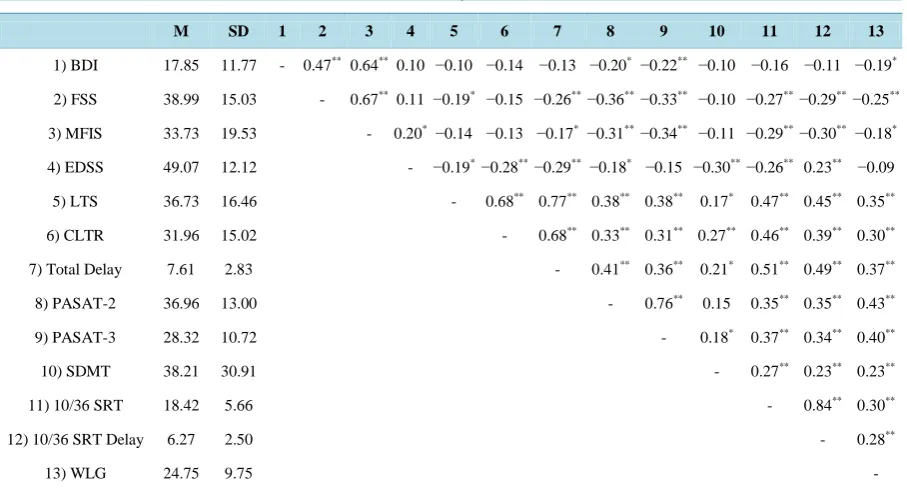
Descriptive statistics and correlations on each of the research variables are given in Table 1. As results show, BDI has statistically significant positive correlation with FSS and MFIS, but is negatively correlated with two subscales of BRB (PASAT & WLG). It means that higher levels of depression in patients with MS are asso-ciated with higher levels of fatigue and less functionality in consternation and semantic retrieval. FSS is nega-tively associated with all subscales of BRB (except CLTR), and conversely displayed significant positive corre-lation with MFIS. The recorre-lationship between FFS and subscales of BRB is more related with cognitive distur-bance (like verbal learning, delayed recall, visuospatial learning and delayed recall) in comparison of BDI.
In addition to the other scale that measures fatigue among patients, MFIS indicate the correlation between EDSS, PASAT, 10/36 SRT, WLG and total delay in selective reminding test subscale.
Most relationships among EDSS and subscales of BRB (except PASAT-3 and WLG) were again significant and negative. These results approve that the higher expanded disability is associated with less cognitive func-tion.
According to the results, the brief repeatable battery proved to be internally reliable in Iran (α = 0.70). As Ta-ble 1 reviews the correlations, the subscales of BRB have a desiraTa-ble pattern of correlations since they are asso-ciated with each other.
4. Discussion
[image:4.595.87.541.437.682.2]In this study, there was a significant correlation between depression, fatigue and cognitive dysfunction in MS patients using different assessment tools. The association found between the studied variables can imply that there is a causal factor responsible for these events.
Table 1. Mean, standard deviation, and correlation of main study variables.
M SD 1 2 3 4 5 6 7 8 9 10 11 12 13
1) BDI 17.85 11.77 - 0.47** 0.64** 0.10 −0.10 −0.14 −0.13 −0.20* −0.22** −0.10 −0.16 −0.11 −0.19*
2) FSS 38.99 15.03 - 0.67** 0.11 −0.19* −0.15 −0.26** −0.36** −0.33** −0.10 −0.27**−0.29**−0.25**
3) MFIS 33.73 19.53 - 0.20* −0.14 −0.13 −0.17* −0.31** −0.34** −0.11 −0.29**−0.30**−0.18*
4) EDSS 49.07 12.12 - −0.19*−0.28**−0.29** −0.18* −0.15 −0.30**−0.26** 0.23** −0.09
5) LTS 36.73 16.46 - 0.68** 0.77** 0.38** 0.38** 0.17* 0.47** 0.45** 0.35**
6) CLTR 31.96 15.02 - 0.68** 0.33** 0.31** 0.27** 0.46** 0.39** 0.30**
7) Total Delay 7.61 2.83 - 0.41** 0.36** 0.21* 0.51** 0.49** 0.37**
8) PASAT-2 36.96 13.00 - 0.76** 0.15 0.35** 0.35** 0.43**
9) PASAT-3 28.32 10.72 - 0.18* 0.37** 0.34** 0.40**
10) SDMT 38.21 30.91 - 0.27** 0.23** 0.23**
11) 10/36 SRT 18.42 5.66 - 0.84** 0.30**
12) 10/36 SRT Delay 6.27 2.50 - 0.28**
13) WLG 24.75 9.75 -
In line with previous research, the present study showed that EDSS and BDI are significantly disturbed in pa-tients with MS [11] [12]. However, the mean BDI score and therefore the rate of depression found in this study was higher than that observed in similar studies.
At baseline, the evolution of depression in MS patients has been shown to be independent from disability. Moreover, depression appeared to be endogenous and predictive of a poor EDSS score, suggesting that depres-sion could be an early predictive factor for the progresdepres-sion of disability. These concepts are supported in the present study. A higher BDI score was observed with more fatigue symptoms and poorer EDSS scores, although we did not follow up the patients to see if increased BDI score is accompanied by worse EDSS score [13].
Little is known about pathophysiology of fatigue and psychological dysfunction in MS. Many factors are said to influence fatigue in MS, such as medications, sleep disorders, body temperature, and depression. However, even after correction for common causes, the association between fatigue and depression persists [14]. Also, this phenomenon has been related to MS lesions and neurological involvements, albeit not supported with enough evidence [15]. Meanwhile, the current findings support the theory that inflammation and immune deregulation can influence neurotransmitter metabolism, neuroendocrine function, synaptic plasticity, and growth factor pro-duction, thus altering neural circuitry and contributing to depressive symptomatology [16]. On this basis, the presence of such significant correlation between different factors including fatigue, depression, and psychologi-cal status may support the universal nature of neurocognitive involvement in MS.
Moreover, the quality of life in MS patients has been found to be associated with physical disability, dis-ease-related fatigue, and depression. Furthermore, the impact of fatigue and depression on quality of life is in-dependent of physical disability and the other factors associated with MS [17]. Therefore, early recognition of fatigue and depression, and rapid intervention in order to correct these problems can certainly increase the qual-ity of life in MS patients.
This study has some limitations. First, it is a cross sectional study and does not evaluate each patient through time. Therefore, there is a probability that some patients might appear weaker or stronger in their measurements due to environmental situations. Secondly, it is a single center study and patients are not in the same stage of the disease as they were chosen consecutively. We are aware that recent exacerbation of the disease or occurrence of MS complications may influence our results reported here. The strength of this study is investigating different psychological variables in MS patients at the same time which can provide a good overview of this group of pa-tients within a short time.
5. Conclusion
In conclusion, we believe that fatigue, depression and cognitive dysfunction may be various features of a broad neurological dysfunction related to MS which needs to be fully identified. Further studies are needed to establish the pathophysiology of fatigue and cognitive dysfunction in MS in order to provide enough information for de-veloping treatment modalities.
References
[1] Greim, B., Engel, C., Apel, A. and Zettl, U.K. (2007) Fatigue in Neuroimmunological Diseases. Journal of Neurology,
254, 102-106. http://dx.doi.org/10.1007/s00415-007-2025-2
[2] Krupp, L.B., Alvarez, L.A., LaRocca, N.G. and Scheinberg, L.C. (1988) Fatigue in Multiple Sclerosis. Archives of Neurology, 45, 435-437. http://dx.doi.org/10.1001/archneur.1988.00520280085020
[3] Filippi, M., Rocca, M.A., Colombo, B., et al. (2002) Functional Magnetic Resonance Imaging Correlates of Fatigue in Multiple Sclerosis. Neuroimage, 15, 559-567. http://dx.doi.org/10.1006/nimg.2001.1011
[4] Minden, S.L. and Schiffer, R.B. (1991) Depression and Mood Disorders in Multiple Sclerosis. Neuropsychiatry, 4, 62-77.
[5] Pollock, S.E., Christian, B.J. and Sands, D. (1990) Responses to Chronic Illness: Analysis of Psychological and Physi-ological Adaptation. Nursing Research, 39, 300-304. http://dx.doi.org/10.1097/00006199-199009000-00014
[6] Rao, S.M., Huber, S.J. and Bornstein, R.A. (1992) Emotional Changes with Multiple Sclerosis and Parkinsosn’s Dis-ease. Journal of Consulting and Clinical Psychology, 60, 369-378. http://dx.doi.org/10.1037/0022-006X.60.3.369
[7] Schubert, D.S.P. and Foliart, R.H. (1993) Increased Depression in Multiple Sclerosis: A Meta-Analysis. Psychosomat-ics, 34, 124-130. http://dx.doi.org/10.1016/S0033-3182(93)71902-7
Learning from Research on Rheumatoid Arthritis. Neurorehabilitation and Neural Repair, 10, 81-89. http://dx.doi.org/10.1177/154596839601000201
[9] Joffe, R.T., Lippert, G.P., Gray, T.A., Sawa, G. and Horvath, Z. (1987) Mood Disorder and Multiple Sclerosis. Arc-hives of Neurology, 44, 376-378. http://dx.doi.org/10.1001/archneur.1987.00520160018007
[10] Sadovnick, A.D., Remick, R.A., Allen, J., Swartz, E., Yee, I.M., Eisen, K., et al. (1996) Depression and Multiple Scle-rosis. Neurology, 46, 628-632. http://dx.doi.org/10.1212/WNL.46.3.628
[11] Benito-León, J., Morales, J.M. and Rivera-Navarro, J. (2002) Health Related Quality of Life and Its Relationship to Cognitive and Emotional Functioning in Multiple Sclerosis Patients. European Journal of Neurology, 9, 497-502.
[12] Ziemssen, T. (2009) Multiple Sclerosis beyond EDSS: Depression and Fatigue. Journal of the Neurological Sciences,
277, S37-S41. http://dx.doi.org/10.1016/S0022-510X(09)70011-5
[13] Zephir, H., De Seze, J., Stojkovic, T., Delisse, B., Ferriby, D., Cabaret, M., et al. (2003) Multiple Sclerosis and De-pression: Influence of Interferon Beta Therapy. Multiple Sclerosis, 9, 284-288.
[14] Feinstein, A. (2011) Multiple Sclerosis and Depression. Multiple Sclerosis Journal, 17, 1276-1281. http://dx.doi.org/10.1177/1352458511417835
[15] Leocani, L., Colombo, B. and Comi, G. (2008) Physiopathology of Fatigue in Multiple Sclerosis. Neurological Sciences, 29, S241-S243. http://dx.doi.org/10.1007/s10072-008-0950-1
[16] Loftisa, J.M., Huckansa, M. and Morasco, B.J. (2010) Neuroimmune Mechanisms of Cytokine-Induced Depression: Current Theories and Novel Treatment Strategies. Neurobiology of Disease, 37, 519-533.
http://dx.doi.org/10.1016/j.nbd.2009.11.015
[17] Barwick, F.H. and Arnett, P.A. (2011) Relationship between Global Cognitive Decline and Depressive Symptoms in Multiple Sclerosis. The Clinical Neuropsychologist, 25, 193-209. http://dx.doi.org/10.1080/13854046.2010.538435
Submit or recommend next manuscript to SCIRP and we will provide best service for you:
Accepting pre-submission inquiries through Email, Facebook, LinkedIn, Twitter, etc. A wide selection of journals (inclusive of 9 subjects, more than 200 journals) Providing 24-hour high-quality service
User-friendly online submission system Fair and swift peer-review system
Efficient typesetting and proofreading procedure
Display of the result of downloads and visits, as well as the number of cited articles Maximum dissemination of your research work