http://dx.doi.org/10.4236/msce.2013.16006
Optimization of Microwave Assisted Alkaline Extraction
of Xylan from Birch Wood Using Response
Surface Methodology
Suhara Panthapulakkal1,2*, Mohini Sain1,2
1Department of Chemical Engineering and Applied Chemistry, University of Toronto, Toronto, Canada 2Centre for Biomaterials and Biocomposite Processing, Faculty of Forestry,
University of Toronto, Toronto, Canada
Email: *[email protected], [email protected]
Received August 2, 2013; revised September 2, 2013; accepted September 9, 2013
Copyright © 2013 Suhara Panthapulakkal, Mohini Sain. This is an open access article distributed under the Creative Commons At- tribution License, which permits unrestricted use, distribution, and reproduction in any medium, provided the original work is prop- erly cited.
ABSTRACT
The main purpose of this study was to optimize microwave assisted alkaline extraction of the hemicellulose, xylan, from birch wood. The simultaneous effects of process variables such as time (10 - 30 minutes), concentration of sodium hydroxide solution (4 - 8 wt%), solid to liquid ratio (1:8 to 1:20, g:mL), and sample size (5 - 10 g) on the temperature of the wood slurry, wood dissolution, and yield of extraction were evaluated. A central composite design (CCD) and re- sponse surface methodology (RSM) were used for the optimization of the extraction process. Based on the CCD, quad- ratic models were developed to correlate the extraction process variables with the responses such as temperature of wood slurry, wood dissolution, and yield of xylan and the models were analyzed using appropriate statistical methods (ANOVA). Statistical analysis showed that all the models developed were found to be adequate for the prediction of the respective responses. Optimization of the process was performed using a numerical optimization available in the soft- ware to maximize the yield of xylan and the optimum process variables for the maximum yield of xylan was found to be: 10 g of wood fibres, 8 wt% of NaOH solution, 1:10 solid to liquid ratio (g:mL) and 25 minutes of irradiation time. About 72.5% of the xylan present in the birch wood was extracted using the optimized extraction parameters.
Keywords: Biomass; Optimization; Microwave Extraction; Hemicelluloses; Xylan
1. Introduction
Hemicelluloses, the heterogeneous polysacharides, are the second most abundant polysacharides in plant bio- mass [1]. The versatility of these polymers and the nu- merous possibilities of their structural modification re- sult into their use for various industrial applications such as production of bulk or fine chemical, bio-polymers such as polyesters, hydro-gels and pharmacological products [2-6]. Structure of hemicelluloses varies with the source of the biomass. For example, woody biomass contains hemicelluloses with both pentoses and hexoses, whereas non-wood biomass contains hemicelluloses mainly with pentoses [7]. About 15 - 35 wt% of the over- all mass of most plant materials, including forest and agricultural residues, belongs to these polysaccharides
[7,8]. Xylan, β-(1→4)-linked D-xylopyranoside, is the common hemicelluloses found in hardwood. The appli- cation potential of these polymers has been reported elsewhere [3,4,6,9,10]. Different methods, including acid or alkaline extraction, auto hydrolysis, steam explosion, and pressurized extraction, have been used to separate these polymers from the plant biomass for further proc- essing [5,11-14].
Alkaline extraction is known to be the most suitable method for extraction of these polymers, as it causes less degradation of the polymer compared to the other meth- ods of extraction [14,15]. During alkaline extraction hy- drolysis of the ester linkages between hemicelluloses and lignin leads to the dissolution of the polysacharides, as oligomers, along with lignin. The efficiency of extraction depends on the strength of the alkaline solution used, temperature, and duration of extraction. Higher alkali
loading, and lower temperatures for extraction were re- ported as the preferred conditions for the extraction of high molecular weight oligomers [16]. However, low temperature needs prolonged duration for considerable extraction of hemicelluloses [17,18]. Microwave heating technology is known to be a cleaner and efficient alterna- tive to the conventional heating mode to accelerate che- mical reactions and has been widely used in various ap- plications such as synthesis of polymers, curing of rub- bers or polymers, liquefaction of wood etc. [19-22]. This technology has been gaining much attention in the biore- finery industry and has been used for pre-treatment of the lignocellulosics for their downstream processing [23-26].
Though there are many literatures available for the microwave assisted pre-treatment of the biomass and extraction of hemicelluloses from biomass using high temperature and/or pressure [13,23-29], only very few literatures are available on microwave assisted extraction of hemicelluloses under mild conditions [30,31]. The high temperature/pressure extractions hamper the eco- nomic feasibility of the process, as the process requires expensive equipments compared to the low temperature extractions. Further, under these conditions hemicellu- loses undergo degradation and results into lower mo- lecular mass hemicelluloses. On the other hand, short- term extraction under mild conditions can alleviate these disadvantages. Recently, Obermeir et al. reported that low temperature microwave assisted extraction can dis- solve up to 73% of hemicelluloses from wheat straw [31]. However, no available literature to-date reported the op- timization of a microwave assisted extraction of xylan from birch wood under mild conditions of temperature and pressure. Our research focused on the development of microwave assisted extraction of xylan using mild reaction conditions such as temperature and power input under atmospheric pressure and preliminary studies in- dicated that low power input microwave assisted extrac- tion can be used as an efficient alternative to the conven- tional extraction [32]. We found that a 10 minute micro- wave extraction of xylan from woody biomass at a low power input leads to a similar extraction yield that ob- tained at a 90 minutes of extraction at 90˚C using the conventional method. However, the process has to be optimized further with respect to sample size, alkali loading, time of irradiation, and concentration of alkali, as these are the parameters affecting the efficiency of the microwave extraction. In this study, our objective was the optimization of the microwave assisted alkaline ex- traction using statistical design of experiments.
Studies on the effect of one-factor at a time on the mi- crowave assisted extraction can hardly provide the rela- tionship between all the experimental input parameters (factors) and the output responses, as the results are valid
only for the fixed experimental conditions and the pre- diction of other conditions are vague. Design of experi- ments (DOE) using response surface methodology (RSM), where several factors can be varied simultane- ously, and each factor may be evaluated independently, can be a better alternative to study and establish the rela- tionship between all the factors studied on the output responses [33]. Advantage of this method is the mini- mum number of experiments required for predicting the relationship between variables and responses, and hence the optimization process, rather than studying all possible combinations of the experiment. Basically, RSM is a compilation of statistical techniques for designing experi- ments, building models, and estimating the effect of fac- tors on the responses and searching for the optimum con- ditions of factors for a particular experiment [34]. Fur- ther, this technique can quantify the relationships among one or more measured responses and the critical input factors. DOE has been widely used in the optimization applications in the bio-refinery industry [29,35-38]. In this study, we used DOE to investigate the effect four variables such as time of extraction, sample size, solid to liquid ratio, and concentration of alkali on the low power input microwave assisted extraction of xylan from birch wood. The responses studied were solubilization of wood (wood dissolution), temperature, and yield of xylan. Fi- nally, the extraction process was optimized to maximize the yield of xylan.
2. Experimental
2.1. Materials
The wood fibres used for extraction was prepared from birch wood logs obtained from premises near to Univer- sity of Toronto. The wood logs were cut into small pieces after removing the bark and dried in an air oven at 40˚C for 4 days. The small wood blocks were then powdered using a Wiley mill with a screen size of 2 mm. The fibres passed through the screen were collected and sieved us- ing a 0.42 mm screen to remove fines. The extractives from the wood fibres were removed following the pro- cedure reported earlier [32] and the extractive-free wood was used for all the experiments. The dried extractive- free wood consists of 42.95% ± 1.05% glucan, 29.35% ± 0.69% xylan, 0.96% ± 0.27% mannan, 21.26% ± 0.41% acid insoluble lignin, 1.43% ± 0.13% soluble lignin, and 0.52% ± 0.04% ash content. Sodium hydroxide solutions of different concentrations used for the extraction were of reagent grade.
2.2. Microwave Assisted Extraction
n
where, xi is the independent coded variable, Xi is the real
value of the independent variable, X0 is the real value of
the independent variable at the centre point and Xi is the
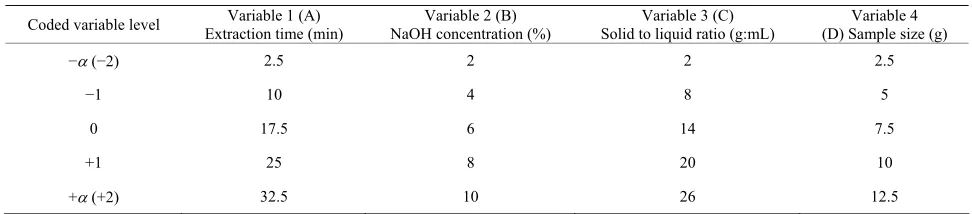
step value change. The range of variables and their levels studied are given in the Table 1.
The wood fibre slurry with different combinations of alkali was subjected to microwave extraction using a power input of 110 W, as it was found to the best power input for getting the xylan without much degradation. Immediately after extraction, temperature of the reaction media was noted. The wood residue was separated from the liquid phase by filtration and the residue was washed to remove the alkali. Xylan was precipitated from the liquid phase by neutralizing the solution to a pH of 4.6. The precipitate was re-dissolved in sodium hydroxide and precipitated by padding 3 volumes of ethanol under stirring, washed with 95% ethanol, and then freeze-dried. Wood dissolution and yield of xylan were expressed as follows (Equations (1) and (2)).
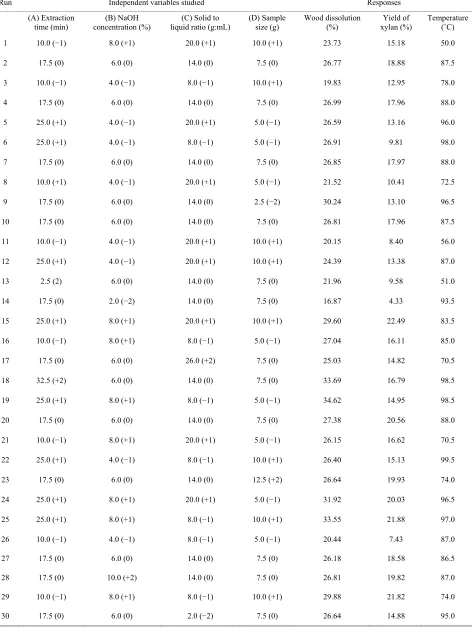
The variables coded as −1 and +1 represents the low and high levels of the variables studied, zero represents the centre point of the design and −, and + represents the axial or star points of the design. In the study, the value of was fixed at 2 to make the design a rotatable one. The complete CCD design was generated using the Design Expert 8.0.7.1 (trial version, Stat-Ease Inc., Min- neapolis, MN, USA) software. The complete design ma- trix obtained with the coded and uncoded independent variables and the corresponding responses obtained are given in the Table 2. As in any statistical designing of
experiment, the experiments performed were randomized to minimize the unpredictable variations in the observed responses due to uncontrolled extraneous factors. The responses studied include dissolution of wood, yield of xylan, and temperature of the slurry. A second degree polynomial quadratic equation was used to develop the empirical model to establish the correlation between the variables and each response Y, as shown in the following Equation (5).
2.3. Experimental Designing Using CCD
CCD is the standard RSM to optimize the response, es- timate the second order polynomial relationship between independent variables and the dependant variables, and the interaction between the independent variables with the dependant variables [34]. In order to optimize the microwave assisted extraction, a four-factor, five-level CCD with replicates at the centre point was used. The variables studied were extraction time (A), NaOH con- centration (B), solid to liquid ratio (C), and sample size (D). The variables ranges were selected based on our pliminary experiments. The number of experiments re-quired for 4 variables CCD was calculated using the Equation (3).
4 4 4
2 0
1 1 1, 1
i i i
i i ii i ij i j
i i i j i
Y b b x b x b x x
(5)where b0, bi, bii, and bij are the constant tem, regression
coefficients of the individual linear effects, quadratic effects, and interaction effects between the variables re- spectively. These polynomial equations were used to create the surface or contour plots to visualize the rela- tionship between the process variables and the responses studied.
2n 2 c
N n (3) where n is the number of independent variable, first term (2n) represents the number of factorial points, second
term (2n) represents the number of axial points (star points), and the third term (nc) represents the number of
replicates at the centre point. The whole CCD design of this study consists of a total of 30 experiments including 16 factorial points, 8 axial points ( = 2) with 6 repli- cates at the centre point. The replicates of the centre point were used to determine the reproducibility and re- liability of the experiments and the error occurred during the experiment. The variables were coded for statistical estimation as per Equation (4).
2.4. Statistical Analysis and the Model Evaluation
Statistical analysis of the experimental design was car- ried out using the Design Expert software. Multiple lin- ear regression analysis of the experimental data was used to evaluate the statistical significance of the model de- veloped. Analysis of variance (ANOVA) of the model for each response was also performed to study the sig- nificance of the regression coefficient of determinations
0 100 i i i X X x X
(4)
Solubilizatiom of wood (%)
Wt.of OD wood before extraction Wt.of OD wood after extraction) 100 Wt.of OD wood before extraction
(1)
Amount of xylan precipitatedYield of xylan % 100
Amount of OD wood used for extraction
Table 1. Independent variables studied in the CCD with their coded and uncoded levels.
Coded variable level Extraction time (min) Variable 1 (A) NaOH concentration (%) Variable 2 (B) Solid to liquid ratio (g:mL) Variable 3 (C) (D) Sample size (g) Variable 4
− (−2) 2.5 2 2 2.5
−1 10 4 8 5
0 17.5 6 14 7.5
+1 25 8 20 10
+ (+2) 32.5 10 26 12.5
for each effect (linear, quadratic, and interaction) in the model, and to assess response model fit to the data (the lack of fit parameters), and hence to evaluate the signifi- cance of the models for further rationalization. The competence of the model was also evaluated using ad- justed R2 and predicted R2, rather than R2 values, as the
value of R2 increase with the addition of variables de-
spite the significance of the added variables.
2.5. Optimization of the Processing Variables
The microwave extraction process was optimized using the numerical optimization approach available in the software with the objective of maximizing the yield of xylan. Four additional experiments were performed using the optimal conditions selected and the results (responses) were compared with the predicted responses to verify the validity of the surface response model developed.
3. Results and Discussion
The results of the optimization experimentation of the four variables (extraction time, concentration of alkali, solid to liquid ratio, and sample size) on the responses (wood dissolution, yield of xylan, and temperature gen- erated) are given in the Table 2. The surface response
quadratic models used to study the relationship between the independent variables and to that of the responses are shown in the Table 3. Model regression coefficients
were also reported in the table for checking the adequacy of the model. The positive values in the model show the synergistic effect of the variables on the response, where- as the negative values show the antagonistic effect of the respective effect of the variables. The correlation coeffi- cient values, standard deviation, and adequate precision (a term that measures signal to noise ratio) of the model indicate the quality of the model.
3.1. Effect of Extraction Variables on Temperature of the Wood Slurry
During microwave assisted extraction, the temperature of the wood slurry increases as a result of direct interaction with the electromagnetic radiation and the reaction media.
In this case most of the radiation absorption is caused by sodium hydroxide solution, as the microwave radiation couple with the components of high loss value in a sys- tem where the components have different dielectric pro- perties. Sodium hydroxide solution has a high loss factor (~1 - 5) [39] compared to wood (0.15 - 0.19) [40], and hence heating of the wood slurry occurs mainly through the interaction of microwave and the solution. The effect of independent variables (time of irradiation, concentra- tion of sodium hydroxide, solid to liquid ratio and sample size) on the temperature of the reaction media was stud- ied using the experimental design, and the results are given in the Table 2. The temperature reported here is
the temperature of the slurry after particular time of irra- diation. The lowest temperature reported was for the run #1 (50˚C), whereas the highest temperature was for the run #22 (99.5˚C). The lowest temperature obtained when all the variables studied except time were on the higher levels. On the other hand, the highest temperature was obtained when the variables time and sodium hydroxide concentration were on the higher levels indicating time of irradiation increases temperature of the slurry.
The surface response quadratic model using the CCD to establish the relationship between the variables and temperature of the system is given in the Table 3. The
regression coefficients, R2, adjusted R2 and predicted R2
for the model are 0.9987, 0.9974, and 0.9937 respec- tively. The high values of R2, close to unity, indicate that
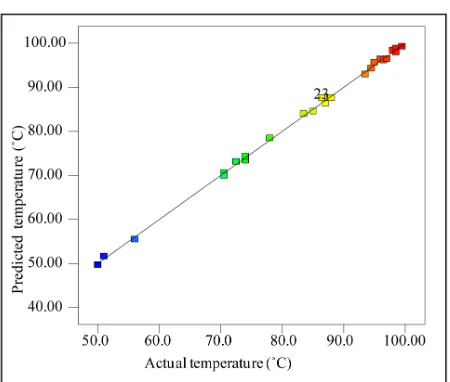
the final temperature of the system can be predicted with the model suggested. Further, close agreement within these values also indicates the accuracy of the predictive model. Figure 1 shows the predicted temperature versus
the actual temperature, and the strong correlation be- tween the predicted and actual temperature indicates the significance of the model within the experimental win- dow. Standard deviation of the model was 0.70 and the small standard deviation indicates the reproducibility of the model. Further, the adequate precision of the model reported was very high (100.489); better model will have a value greater than 4, which again indicates the suitabil- ity of the model for navigating the design space.
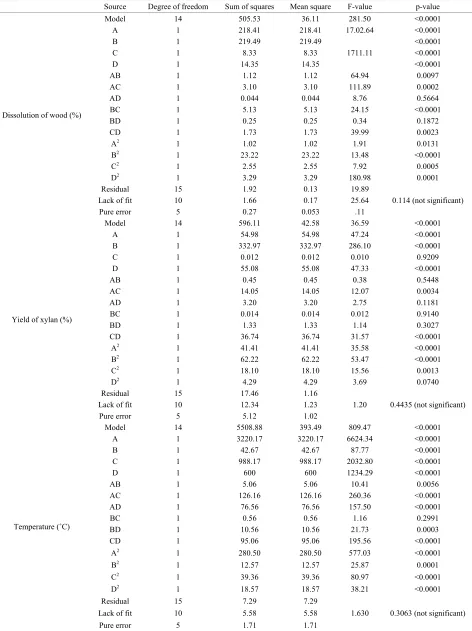
The ANOVA for the regression model for temperature s given in the Table 4. The coefficients with p-values
Table 2. DOE design matrix and the results.
Run Independent variables studied Responses
(A) Extraction time (min)
(B) NaOH concentration (%)
(C) Solid to liquid ratio (g:mL)
(D) Sample size (g)
Wood dissolution (%)
Yield of xylan (%)
Temperature (˚C)
1 10.0 (−1) 8.0 (+1) 20.0 (+1) 10.0 (+1) 23.73 15.18 50.0
2 17.5 (0) 6.0 (0) 14.0 (0) 7.5 (0) 26.77 18.88 87.5
3 10.0 (−1) 4.0 (−1) 8.0 (−1) 10.0 (+1) 19.83 12.95 78.0
4 17.5 (0) 6.0 (0) 14.0 (0) 7.5 (0) 26.99 17.96 88.0
5 25.0 (+1) 4.0 (−1) 20.0 (+1) 5.0 (−1) 26.59 13.16 96.0
6 25.0 (+1) 4.0 (−1) 8.0 (−1) 5.0 (−1) 26.91 9.81 98.0
7 17.5 (0) 6.0 (0) 14.0 (0) 7.5 (0) 26.85 17.97 88.0
8 10.0 (+1) 4.0 (−1) 20.0 (+1) 5.0 (−1) 21.52 10.41 72.5
9 17.5 (0) 6.0 (0) 14.0 (0) 2.5 (−2) 30.24 13.10 96.5
10 17.5 (0) 6.0 (0) 14.0 (0) 7.5 (0) 26.81 17.96 87.5
11 10.0 (−1) 4.0 (−1) 20.0 (+1) 10.0 (+1) 20.15 8.40 56.0
12 25.0 (+1) 4.0 (−1) 20.0 (+1) 10.0 (+1) 24.39 13.38 87.0
13 2.5 (2) 6.0 (0) 14.0 (0) 7.5 (0) 21.96 9.58 51.0
14 17.5 (0) 2.0 (−2) 14.0 (0) 7.5 (0) 16.87 4.33 93.5
15 25.0 (+1) 8.0 (+1) 20.0 (+1) 10.0 (+1) 29.60 22.49 83.5
16 10.0 (−1) 8.0 (+1) 8.0 (−1) 5.0 (−1) 27.04 16.11 85.0
17 17.5 (0) 6.0 (0) 26.0 (+2) 7.5 (0) 25.03 14.82 70.5
18 32.5 (+2) 6.0 (0) 14.0 (0) 7.5 (0) 33.69 16.79 98.5
19 25.0 (+1) 8.0 (+1) 8.0 (−1) 5.0 (−1) 34.62 14.95 98.5
20 17.5 (0) 6.0 (0) 14.0 (0) 7.5 (0) 27.38 20.56 88.0
21 10.0 (−1) 8.0 (+1) 20.0 (+1) 5.0 (−1) 26.15 16.62 70.5
22 25.0 (+1) 4.0 (−1) 8.0 (−1) 10.0 (+1) 26.40 15.13 99.5
23 17.5 (0) 6.0 (0) 14.0 (0) 12.5 (+2) 26.64 19.93 74.0
24 25.0 (+1) 8.0 (+1) 20.0 (+1) 5.0 (−1) 31.92 20.03 96.5
25 25.0 (+1) 8.0 (+1) 8.0 (−1) 10.0 (+1) 33.55 21.88 97.0
26 10.0 (−1) 4.0 (−1) 8.0 (−1) 5.0 (−1) 20.44 7.43 87.0
27 17.5 (0) 6.0 (0) 14.0 (0) 7.5 (0) 26.18 18.58 86.5
28 17.5 (0) 10.0 (+2) 14.0 (0) 7.5 (0) 26.81 19.82 87.0
29 10.0 (−1) 8.0 (+1) 8.0 (−1) 10.0 (+1) 29.88 21.82 74.0
Table 3. Polynomial equations for the quadratic model and the regression coefficients.
Quadratic model equations (A = extraction time, B = NaOH concentration,
C = solid to liquid ratio, and D = sample size) R2
Adjusted
R2 Predicted R2 deviationStandard Adequate precision
Temperature(˚C)= 87.58 +11.58A −1.33B − 6.42C −5D + 0.56AB + 2.81AC
+ 2.19AD − 0.19BC − 0.81 BD − 2.44 CD − 3.2 A2 + 0.68B2− 1.20C2 + 0.82D2 0.9987 0.9974 0.9937 0.70 100.489
Wood dissolution(%) = 26.94 + 3.02A + 3.02B − 0.59C − 0.77D + 0.27AB − 0.44AC
− 0.052AD − 0.57BC − 0.12BD − 0.33CD + 0.19A2− 0.92B2 − 0.30C2 + 0.35D2 0.9962 0.9927 0.9804 0.36 69.354
Yield of xylan (%) = 18.65 + 1.51A + 3.72B − 0.22C + 1.51D − 0.17AB + 0.94AC
[image:6.595.61.286.201.392.2]+ 0.45AD − 0.030BC + 0.29BD − 1.52CD − 1.23A2− 1.51B2− 0.81C2− 0.40D2 0.9715 0.9450 0.8722 1.08 22.918
Figure 1. Actual temperature vs predicted temperature.
less than 0.05 are considered as significant effect. The p value (<0.0001) and high Fischer variance value (F-value) (281.50) for the quadratic model implied this model was significant. From the regression coefficients of the vari- ables, it was found that the linear terms for all the vari- ables, and interaction term between all the variables, ex- cept the interaction between sodium hydroxide concen- tration and solid to liquid ratio, and all the quadratic terms in the model were significant.
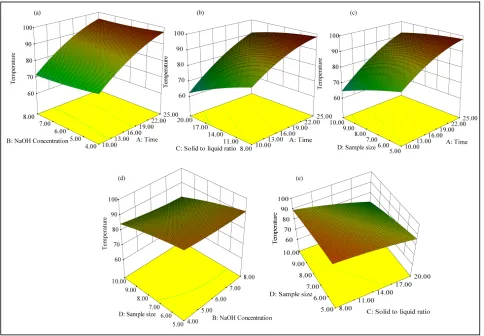
The effect of interaction terms between variables on the response, extent of interaction, and the nature of in- teraction can be obtained from the surface contour plots of the models. The response surfaces of the significant interaction effects are shown in the Figure 2. In all the
figures, in order to describe the interactive effects of the independent variables on temperature, the other two variables were kept constant at their mid levels. Figure 2(a) shows that, at 4% NaOH concentration the tem-
perature was increased from 70˚C to 98˚C when the time of irradiation increased from 10 minutes to 25 minutes, whereas at 8% NaOH concentration, the temperature was increased from 70˚C to 96˚C for the same duration of extraction. Effect of interaction between time and solid to liquid ratio on temperature shows a minimum tempera- ture for 10 minutes of extraction at a solid to liquid ratio of 1:20, and showed a maximum temperature for 25
minutes of extraction at a solid to liquid ratio of 1:8 (Figure 2(b)). Sample size and time also had a similar
effect on the temperature, and the maximum temperature was observed at longer duration of extraction and for a small sample size (Figure 2(c)). In Figure 2(e), maxi-
mum temperature was observed for a larger sample size and a lower solid to liquid ratio (10 g, 1:8 g/mL). These results indicate that irradiation time had a positive impact on the temperature, whereas sample size and the solid to liquid ratio had a negative impact under the experimental conditions studied. Figures 2(a) and (d) show the effect
of interaction terms between NaOH solution concentra- tion and time (at a constant level of sample size and solid to liquid ratio: 7.5 g, and 1:14 g/mL), and that of NaOH solution concentration and sample size (at a constant level of time and solid to liquid ratio; 17.5 minutes and 1:14 g/mL) on temperature. The NaOH concentration under these experimental conditions did not affect the temperature of the slurry. Increase in temperature leads to increased hydrolysis and leads to increased wood dis- solution, and so a high yield of xylan is expected at these conditions.
3.2. Effect of Extraction Variables on Wood Dissolution
Wood dissolution during alkaline extraction occurs due to the hydrolysis of the lignin-carbohydrate linkages. The amount of wood dissolved during the experimentation (Table 2) varied from about 17 wt% (run #14) to 35%
Table 4. Analysis of variance (ANOVA) for the RSM model.
Source Degree of freedom Sum of squares Mean square F-value p-value
Model 14 505.53 36.11 281.50 <0.0001
A 1 218.41 218.41 17.02.64 <0.0001
B 1 219.49 219.49 <0.0001
C 1 8.33 8.33 1711.11 <0.0001
D 1 14.35 14.35 <0.0001
AB 1 1.12 1.12 64.94 0.0097
AC 1 3.10 3.10 111.89 0.0002
AD 1 0.044 0.044 8.76 0.5664
BC 1 5.13 5.13 24.15 <0.0001
BD 1 0.25 0.25 0.34 0.1872
CD 1 1.73 1.73 39.99 0.0023
A2 1 1.02 1.02 1.91 0.0131
B2 1 23.22 23.22 13.48 <0.0001
C2 1 2.55 2.55 7.92 0.0005
D2 1 3.29 3.29 180.98 0.0001
Residual 15 1.92 0.13 19.89
Lack of fit 10 1.66 0.17 25.64 0.114 (not significant)
Dissolution of wood (%)
Pure error 5 0.27 0.053 .11
Model 14 596.11 42.58 36.59 <0.0001
A 1 54.98 54.98 47.24 <0.0001
B 1 332.97 332.97 286.10 <0.0001
C 1 0.012 0.012 0.010 0.9209
D 1 55.08 55.08 47.33 <0.0001
AB 1 0.45 0.45 0.38 0.5448
AC 1 14.05 14.05 12.07 0.0034
AD 1 3.20 3.20 2.75 0.1181
BC 1 0.014 0.014 0.012 0.9140
BD 1 1.33 1.33 1.14 0.3027
CD 1 36.74 36.74 31.57 <0.0001
A2 1 41.41 41.41 35.58 <0.0001
B2 1 62.22 62.22 53.47 <0.0001
C2 1 18.10 18.10 15.56 0.0013
D2 1 4.29 4.29 3.69 0.0740
Residual 15 17.46 1.16
Lack of fit 10 12.34 1.23 1.20 0.4435 (not significant)
Yield of xylan (%)
Pure error 5 5.12 1.02
Model 14 5508.88 393.49 809.47 <0.0001
A 1 3220.17 3220.17 6624.34 <0.0001
B 1 42.67 42.67 87.77 <0.0001
C 1 988.17 988.17 2032.80 <0.0001
D 1 600 600 1234.29 <0.0001
AB 1 5.06 5.06 10.41 0.0056
AC 1 126.16 126.16 260.36 <0.0001
AD 1 76.56 76.56 157.50 <0.0001
BC 1 0.56 0.56 1.16 0.2991
BD 1 10.56 10.56 21.73 0.0003
CD 1 95.06 95.06 195.56 <0.0001
A2 1 280.50 280.50 577.03 <0.0001
B2 1 12.57 12.57 25.87 0.0001
C2 1 39.36 39.36 80.97 <0.0001
D2 1 18.57 18.57 38.21 <0.0001
Residual 15 7.29 7.29
Lack of fit 10 5.58 5.58 1.630 0.3063 (not significant)
Temperature (˚C)
Figure 2. Response surface plots showing the interaction between the variables affecting the temperature of wood slurry: (a) Interaction between time and NaOH solution concentration; (b) Interaction between time and solid to liquid ratio; (c) Interaction between time and sample size; (d) Interaction between sample size and NaOH concentration; and (e) Interaction between sample size and solid to liquid ratio.
98.5˚C) as described in the previous section and this en- hances the wood dissolution.
The simultaneous effect of the independent variables on the dissolution of wood is established by the surface response quadratic model using the CCD (Table 3). The
relatively high values of R2 (0.9962) and adjusted R2
(0.9927) of the response surface model indicate that the model considers only the significant terms and so a good agreement between the experimental and the predicted responses. The predicted R2 (0.9804) was also found to
be closer to the adjusted R2 values indicating the ade-
quacy of the model. Relatively smaller standard devia- tions of the model (0.36) used for the prediction of wood dissolution indicated the better reproducibility of the re- sults. Further, adequate precision for the wood dissolu- tion model was reported to be 69.30, which is well above the required value of 4. The higher values of R2, smaller
standard deviation and high value of adequate precision of the model demonstrated the suitability of the model for the prediction of the real relationship among the variables studied to the wood dissolution. Figure 3
Figure 3. Actual wood dissolution vs predicted wood disso- lution.
[image:8.595.310.537.480.657.2]The ANOVA for the response surface quadratic mod- els for wood dissolution are given in the Table 4. The
p-value for the quadratic model for the wood dissolution (<0.0001) and high F-value (281.50) implied that this model is significant. From the regression coefficients of the variables, it is clear that the linear terms of all the variables studied, interaction terms between variables except the two interaction terms (time and sample size; and NaOH solution concentration and sample size) and the quadratic terms were significant. Significance of the interaction terms between time and NaOH solution con- centration (F value, 8.76, p-value 0.0097), and that of solid to liquid ratio and sample size (F-value 13.48, p-value 0.0023) are less significant than the interaction terms between time and solid to liquid ratio (F-value 24.15, p-value 0.0002), and NaOH concentration and solid to liquid ratio (F-value 39.99, p-value < 0.0001).
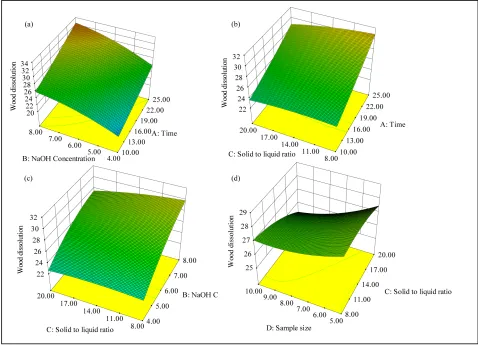
The response surfaces of the significant interaction ef- fects on the wood dissolution are shown in Figure 4. The
percentage of wood dissolution affected by different NaOH concentration and extraction time was shown in
Figure 4(a), where solid to liquid ratio and sample size
were kept constant at 1:14 (g/mL) and 7.5 (g) respec- tively. Extraction time and NaOH concentration time exhibited a positive impact on the wood dissolution and the wood dissolution increased with the increase of time of extraction and sodium hydroxide concentration. Maximum the wood dissolution at a constant level of NaOH solution (6 wt%) and sample size (7.5 g). The figure indicated that maximum wood dissolution ocurred for 25 minutes of extraction at a solid to liquid ratio of 1:8 g/mL. Effect of interaction terms of NaOH solution concentration and solid to liquid ratio on the wood dis- solution is shown in Figure 4(c). The extractions were
performed using 7.5 g of wood sample for 17.5 minutes. The wood dissolution increased as the level of NaOH concentration increased and a maximum of about 30 wt% was observed when the NaOH concentration was at 8 wt%, and the solid to liquid ratio was 1:8 g/mL. Increase in the sample size and solid to liquid ratio has a negative impact on the wood dissolution (Figure 4(d)), when the
extraction was performed for 17.5 minutes using 6 wt%
Figure 4. Response surface plots showing the interaction between the variables affecting the wood dissolution: (a) Interaction between time and NaOH solution concentration; (b) Interaction between time and solid to liquid ratio; (c) Interaction
etween solid to liquid ratio and NaOH concentration; (d) Interaction between solid to liquid ratio and sample size. b
[image:9.595.58.536.350.695.2]NaOH. Hence, 25 minutes of microwave irradiation of the slurry using 8 wt% of NaOH solution at a solid to liquid ratio of 1:8 (g/mL) is expected to provide a maxi- mum amount of wood dissolution.
3.3. Effect of Extraction Variables on Yield of Xylan
The yield of xylan (based on oven dry wood) obtained in the CCD design are given in the Table 2. The lowest and
highest yields of xylan obtained in the design space were 4.33% and 22.49% respectively (run #14 and #15). Low- est yield of xylan observed for the experiment corre- sponds to the lowest amount of wood dissolution where the levels of independent variables were: sodium hy- droxide (−2, 2 wt%), time (0, 14 minutes), solid to liquid ratio (0, 1:14 g/mL) and sample size (0, 7.5 g). Contrary to the maximum wood dissolution (run #19), the highest yield of xylan (run #15) was obtained when all the inde- pendent variables are at the higher levels; extraction time (+1, 25 minutes), concentration of sodium hydroxide (+1, 8 wt%), solid to liquid ratio (+1, 1:20 g/mL), and sample size (+1, 10 g). The yield of xylan obtained for run #19, where maximum wood dissolution was observed, was 14.9%. The variation in yield can be attributed to the rise in temperature of the wood slurry. The temperature of the slurry after run #19 was 98.5˚C, whereas that of run #15 was 83.5˚C. High wood dissolution is expected at higher temperature, as the hydrolysis rate and dissolution of the hydrolyzed components (hemicelluloses and lignin) in- crease with the temperature. The high temperature gen- erated might lead to the degradation of the hemicellu- loses resulting in a low yield of xylan.
The effect of independent variables on the yield of xy- lan was studied using the surface response quadratic model given in the Table 3. The model was found to be
significant from the values of regression coefficients (R2
= 0.9715 and adjusted R2 = 0.9450). The predicted R2
(0.8722) was closer to the adjusted R2 and would give a
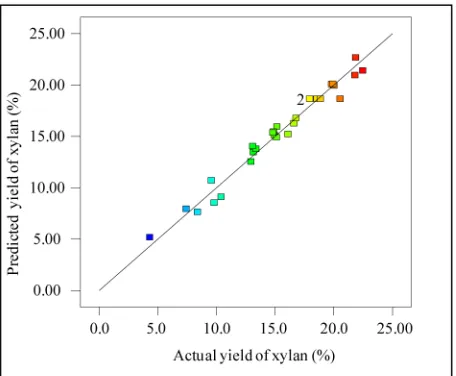
good fit to the statistical model used. The observed small standard deviation of the model (1.08) and the high ade- quate precision value (22.91) also indicates the repro- ducibility and applicability of the quadratic model for the prediction of yield of xylan. Figure 5 shows the pre-
dicted and actual yield of xylan obtained during the ex- perimental design studied and the strong correlation ob- served (R2 = 0.9856) indicates the accuracy of the model.
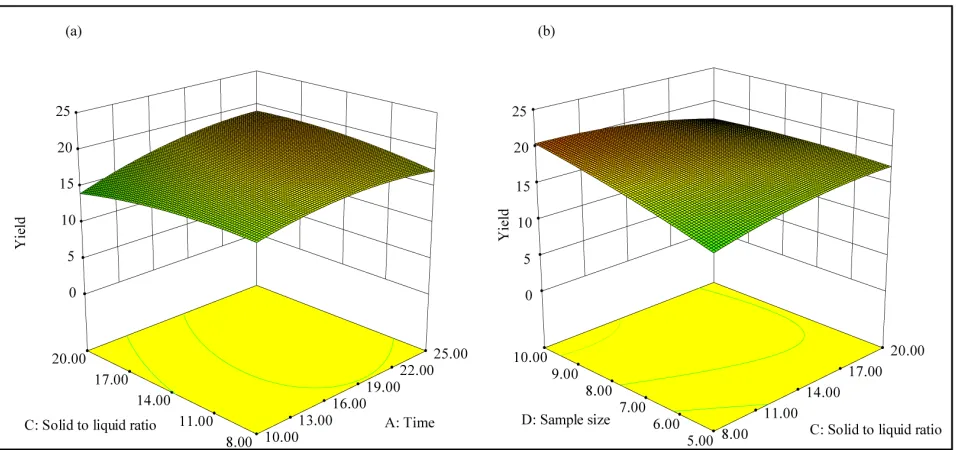
The response surface contour plots of the significant interaction terms are shown in Figure 6. Figure 6(a)
depicts effect of the interaction between time and solid to liquid ratio on the yield of xylan (NaOH concentration and sample size was kept at 6 wt% and 7.5 g respec- tively), whereas Figure 6(b) shows the effect of interac-
[image:10.595.310.538.85.273.2]tion between solid to liquid ratio and sample size (NaOH
Figure 5. Actual yield of xylan vs predicted yield of xylan.
concentration and time of extraction was kept at a con- stant level of 6 wt% and 17.5 minutes respectively) on the yield of xylan. Larger sample size and smaller solid to liquid ratio resulted in a higher yield of xylan (Figure 6(b)), where as longer extraction time and larger solid to
liquid ratio resulted comparatively higher yield. It is clear from all these results that larger sample size, higher con- centration of NaOH, longer irradiation time, and smaller solid to liquid ratio would lead to a higher yield of xylan.
3.4. Optimization of Microwave Assisted Extraction of Xylan and Validation of the Model
The objective of the study was to find the microwave assisted extraction conditions that result in the highest yield of xylan from birch wood. The optimal extraction conditions for obtaining the highest yield of xylan were extracted by the Design Expert software using a numeri- cal optimization. Several potential solutions were pro- vided by the software, and based on the experimental feasibility, the following optimum operating settings were selected for obtaining a higher yield of xylan: time (A) = 25 minutes, NaOH concentration (B) = 8 wt%, solid to liquid ratio (C) = 1:8 g/mL, and sample size (D = 10 g. Four replicates of the extraction were performed at this optimal extraction conditions. The results of the ex- traction with the respective predicted values are given in the Table 5.
Figure 6. Response surface plots showing the interaction between the variables affecting the yield of xylan: (a) Interaction between time and solid to liquid ratio; (b) Interaction between solid to liquid ratio and sample size.
Table 5. Experimental and predicted values of wood dissolution, yield of xylan, and temperature at the optimum extraction conditions used for the alkaline extraction of xylan.
Wood dissolution (%) Yield of xylan (%) Temperature (˚C)
Optimized extraction conditions
Experimental Predicted Experimental Predicted Experimental Predicted
Time: 25 minutes
NaOH concentration: 8 wt%
Solid to liquid ratio: 1:8 (g:mL) 33.78 33.53 21.27 22.66 97.63 96.46
Sample size: 10 g ±0.21 ±0.36 ±2.6 ±1.08 ±0.5 ±0.69
were 21.27% ± 2.65%, 33.78% ± 0.21%, and 97.67% ± 0.47% respectively. The experimental values obtained were found to be in good agreement with the values cal- culated from the models suggesting that the quadratic surface models were adequate for the optimization of microwave assisted extraction under study. Wood used for this study contained 29.35% of xylan. Conversion of the yield of xylan obtained based on oven dry basis of wood to that of original xylan present in wood indicated that about 72.5% of the xylan present in birch wood can be extracted by 25 minutes of low temperature micro- wave assisted extraction. Though there is no available literature for direct comparison, Sun et al. [17] reported that a low temperature alkaline extraction of wheat pro- vided 76.4% of xylan, when wheat straw was treated with 1.5% NaOH at solid loading of 2.5% dry matter for 144 hours at room temperature. It is clear that great re- duction in the extraction time can be obtained using mi- crowave assisted extraction for a similar yield of xylan. In a recent study [31] using microwave assisted alkaline
[image:11.595.55.539.377.481.2]4. Conclusion
Central composite design and surface response method- ology were employed to optimize the low-temperature microwave assisted alkaline extraction of xylan from birch wood. The effect of four extraction parameters (time, alkali concentration, solid to liquid ratio and sam- ple size) on the temperature of the wood slurry, wood dissolution, and yield of xylan were studied. Three qua- dratic polynomial models were developed to correlate the extraction variables with the three responses. Analysis of variance (ANOVA) of the models developed indicated the statistical significance of the models for the predic- tion of each response studied. Temperature of the slurry, and wood dissolution were significantly influenced by all the four extraction parameters, whereas the yield of ex- traction was not affected by the linear effect of solid to liquid ratio. Process optimization was conducted to maxi- mize the yield of xylan and the experimental values ob- tained for the respective yield of xylan, wood dissolution and temperatures were found to agree satisfactorily with the quadratic model used for xylan extraction. Optimum conditions used for the maximum extraction of xylan from birch wood under microwave irradiation were: 10 g of wood fibres, 8 wt% of NaOH solution, 1:10 solid to liquid ratio (g:mL) and 25 minutes of irradiation time. 22 wt% of xylan (OD) was obtained from about 34% of the dissolved wood at the optimal extraction conditions.
5. Acknowledgements
The authors acknowledge the financial assistance pro- vided by the Ontario Research Fund-Research Excel- lence (ORE-RE) for conducting this research.
REFERENCES
[1] G. O. Aspinall, “Structural Chemistry of the Hemicellu- loses,” In: M. L. Wolfrom and R. S. Tipson, Eds., Ad-vances in Carbohydrate Chemistry, Academic Press, London, 1959, pp. 429-468.
[2] F. Carvalheiro, L. C. Duarte and F. M. Girio, “Hemicel- luloses Biorefineries: A Review on Bio-Mass Pre-Treat- ments,” Journal of Scientific and Industrial Research, Vol. 67, No. 11, 2008, pp. 849-864.
[3] A. Ebringerova, “Structural Diversity and Application Potential of Hemicelluloses,” Macromolecuar Symposia, Vol. 232, No. 1, 2006, pp. 1-12.
http://dx.doi.org/10.1002/masy.200551401
[4] N. M. L. Hansen and D. Plackett, “Sustainable Films and Coatings from Hemicelluloses: A Review,” Biomacro- molecules, Vol. 9, No. 6, 2008, pp. 1493-1505.
http://dx.doi.org/10.1021/bm800053z
[5] I. Gabrielii, P. Gatenholm, W. G. Glasser and R. K. Jain, “Separation, Characterization and Hydrogel Formation of Hemicelluloses from Aspen Wood,” Carbohydrate Poly-
mers, Vol. 43, No. 4, 2000, pp. 367-374. http://dx.doi.org/10.1016/S0144-8617(00)00181-8 [6] S. Daus and T. Heinze, “Xylan Based Nanoparticles:
Pro-Drug for Ibuprofen Release,” Macromolecular Bio- science, Vol. 10, No. 2, 2010, pp. 211-220.
http://dx.doi.org/10.1002/mabi.200900201
[7] D. Fengel and G. Wegener, “Wood: Chemistry, Ultra- structures, Reactions,” W. De Gruyter, Berlin, New York, 1984.
[8] E. Sjostrom, “Wood Chemistry Fundamentals and Appli- cations,” 2nd Edition, Academy Press Inc., San Diego, 1993.
[9] A. Ebringerova and T. Heinze, “Xylan and Xylan Deriva-tives—Biopolymers with Valuable Properties, 1. Natu-rally Occurring Xylans Structures, Isolation Procedures and Properties—A Review,” Macromolecular. Rapid Communications, Vol. 21, No. 9, 2000, pp. 542-556. http://dx.doi.org/10.1002/1521-3927(20000601)21:9<542 ::AID-MARC542>3.0.CO;2-7
[10] F. B. Sedlmeyer, “Xylan as By-Product of Biorefineries: Characteristics and Potential Use for Food Applications,”
Food Hydrocolloids, Vol. 25, No. 8, 2011, pp. 1891- 1898. http://dx.doi.org/10.1016/j.foodhyd.2011.04.005 [11] L. Ramos, “Chemistry Involved in the Steam Treatment
of Lignocellulosic Materials,” The Química Nova, Vol. 26, No. 6, 2003, pp. 863-871.
http://dx.doi.org/10.1590/S0100-40422003000600015 [12] G. Garrote, M. A. Kabel, H. A. Schols, E. Falque, H.
Dominguez and J. C. Parajo, “Effects of Eucalyptus Glo- bulus Wood Autohydrolysis Conditions on the Reaction Products,” Journal of Agriculture and Food Chemistry, Vol. 55, No. 22, 2007, pp. 9006-9013.
http://dx.doi.org/10.1021/jf0719510
[13] A. U. Buranov and G. Mazza, “Extraction and Charac- terization of Hemicelluloses from Flax Shives by Differ- ent Methods,” Carbohydrate Polymers, Vol. 79, No. 1, 2010, 17-25.
http://dx.doi.org/10.1016/j.carbpol.2009.06.014
[14] W. G. Glasser, W. E. Kaar, R. K. Jain and J. E. Sealey, “Isolation Options for Non-Cellulosic Heteropolysaccha- rides,” Cellulose, Vol. 7, No. 3, 2000, pp. 299-317. http://dx.doi.org/10.1023/A:1009277009836
[15] P. Kumar, D. M. Barret, M. J. Delwiche and P. Stroeve, “Methods for Pretreatment of Lignocellulosic Biomass for Efficient Hydrolysis and Biofuel Production,” Indus- trial Engineering and Chemistry Research, Vol. 48, No. 8, 2009, pp. 3713-3729.
http://dx.doi.org/10.1021/ie801542g
[16] T. Persson, J. L. Ren, E. Joelsson and A. S. Jonsson, “Fractionation of Wheat and Barley Straw to Access High-Molecular-Mass Hemicelluloses Prior to Ethanol Production,” Bioresource Technology, Vol. 100, No. 17, 2009, pp. 3906-3913.
http://dx.doi.org/10.1016/j.biortech.2009.02.063
http://dx.doi.org/10.1016/0926-6690(95)00025-8
[18] P. Binod, R. Sindhu, R. R. Singhania, S. Vikram, L. Devi, S. Nagalakshmi, N. Kurien, R. K. Sukumaran and A. Pandey, “Bioethanol Production from Rice Straw: An Overview,” Bioresource Technology, Vol. 101, No. 13, 2010, pp. 4767-4774.
http://dx.doi.org/10.1016/j.biortech.2009.10.079
[19] C. O. Kappe, “Microwave Dielectric Heating in Synthetic Organic Chemistry,” Chemical Society Reviews, Vol. 37, No. 6, 2008, pp. 1127-1139.
http://dx.doi.org/10.1039/b803001b
[20] N. Sombatsompop and C. Kumnuantip, “Comparison of Physical and Mechanical Properties of Nr/Carbon Black/ Reclaimed Rubber Blends Vulcanized by Conventional Thermal and Microwave Irradiation Methods,” Journal of Applied Polymer Science, Vol. 100 No. 6, 2006, 5039- 5048. http://dx.doi.org/10.1002/app.23472
[21] V. Singh, A. Tiwari, P. Kumari and A. K. Sharma, “Mi- crowave Accelerated Synthesis and Characterization of Poly(Acrylamide),” Journal of Applied Polymer Science, Vol. 104, No. 6, 2007, pp. 3702-3707.
http://dx.doi.org/10.1002/app.25682
[22] A. Kržan and M. Kunaver, “Microwave Heating in Wood Liquefaction,” Journal of Applied Polymer Science, Vol. 101, No. 2, 2006, pp. 1051-1056.
http://dx.doi.org/10.1002/app.23488
[23] H. Ooshima, K. Aso and Y. Harano, “Microwave Treat- ment of Cellulosic Materials for Their Enzymatic Hy- drolysis,” Biotechonology Letters, Vol. 6, No. 5, 1984, pp. 289-294.
[24] P. Kitchaiya, P. Intankul and M. Krairish, “Enhancement of Enzymatic Hydrolysis of Lignocellulosic Wastes by Microwave Pre Treatment under Atmospheric Pressure,”
Journal of Wood Chemistry and Technology, Vol. 23, No. 2, 2003, pp. 217-225.
http://dx.doi.org/10.1081/WCT-120021926
[25] S. D. Zhu, Y. X. Wu, Z. N. Yu, J. T. Liao and Y. Zhang, “Pretreatment by Microwave/Alkali of Rice Straw and Its Enzymatic Hydrolysis,” Process Biochemistry, Vol. 40, No. 9, 2005, pp. 3082-3086.
http://dx.doi.org/10.1016/j.procbio.2005.03.016
[26] Z. H. Hu and Z. Y. Wen, “Enhancing Enzymatic Digesti- bility of Switch Grass by Microwave Assisted Alkali Pre Treatment,” Biochemical Engineering Journal, Vol. 38, No. 3, 2008, pp. 369-378.
http://dx.doi.org/10.1016/j.bej.2007.08.001
[27] M. Palm and G. Zacchi, “Extraction of Hemicellulosic Oligosaccharides from Spruce Using Microwave Oven or Steam Treatment,” Biomacromolecules, Vol. 4, No. 3, 2003, pp. 617-623. http://dx.doi.org/10.1021/bm020112d [28] A. Roos, T. Persson, H. Krawczyk, G. Zacchi and H.
Stalbrand, “Extraction of Water-Soluble Hemicelluloses from Barley Husks,” Bioresource Technology, Vol. 100, No. 2, 2009, pp. 763-769.
http://dx.doi.org/10.1016/j.biortech.2008.07.022
[29] T. Yoshida, S. Tsubaki, Y. Teramoto and J. Azuma, “Op-
timization of Microwave Assisted Extraction of Carbo- hydrates from Industrial Wastes of Corn Starch Produc- tion Using Response Surface Methodology,” Bioresource Technology, Vol. 101, No. 20, 2010, pp. 7820-7826. http://dx.doi.org/10.1016/j.biortech.2010.05.011
[30] P. Binod, R. Satyanagalakshmi, R. Sindhu, K. U. Janu, R. K. Sukumaran and A. Pandey, “Short Duration Micro- wave Assisted Pretreatment Enhances the Enzymatic Saccharification and Fermentable Sugar Yield from Sug- arcane Bagasse,” Renewable Energy, Vol. 37, No. 1, 2012, pp. 109-116.
http://dx.doi.org/10.1016/j.renene.2011.06.007
[31] I. J. Obermeir, V. Seiber, M. Faulstich and D. Scheider, “Solubilization of Hemicellulose and Lignin from Wheat Straw through Microwave-Assisted Alkali Treatment,”
Industrial Crops and Products, Vol. 39, 2012, pp. 98- 203.
[32] S. Panthapulakkal, V. Pakhrenko and M. Sain, “Micro- wave Assisted Short-Time Alklaine Extraction of Birch Wood,” Journal of Polymers and Environment, 2013. [33] D.C. Montgomery, “Design and Analysis of Experi-
ments,” 5th Edition, Wiley, New York, 2001.
[34] State-Ease, “User’s Guide,” Version 8.0.7.1, Design Ex- pert Software, Inc., Minneapolis.
[35] J. Lü and P. Zhou, “Optimization of Microwave-Assisted FeCl3 Pretreatment Conditions of Rice Straw and Utiliza-
tion of Trichoderma Viride and Bacillus Pumilus for Production of Reducing Sugars,” Bioresource Technol- ogy, Vol. 102, No. 13, 2011, pp. 6966-6971.
http://dx.doi.org/10.1016/j.biortech.2011.04.044
[36] C. S. Goh, H. T. Tan, K.T. Lee and N. Brosse, “Evalua- tion and Optimization of Organosolv Pretreatment Using Combined Severity Factors and Response Surface Meth- odology,” Biomass and Bioenergy, Vol. 35, No. 9, 2011, pp. 4025-4033.
http://dx.doi.org/10.1016/j.biombioe.2011.06.034 [37] N. Ender Us and A. Perendeci, “Improvement of Methane
Production from Greenhouse Residues: Optimization of Thermal and H2SO4 Pretreatment Process by Experimen-
tal Design,” Chemical Engineering Journal, Vol. 181- 182, 2012, pp. 120-131.
http://dx.doi.org/10.1016/j.cej.2011.11.038
[38] G. Brudecki, I. Cybulska and K. Rosentrater, “Optimiza- tion of Clean Fractionation Process Applied to Switch Grass to Produce Pulp for Enzymatic Hydrolysis,” Bio- resource Technology, Vol. 131, 2013, pp. 101-112. http://dx.doi.org/10.1016/j.biortech.2012.12.118
[39] D. R. Keshwani, “Microwave Pretreatment of Switch Grass for Bio-Ethanol Production,” Ph.D. Thesis, North Carolina State University, Raleigh, 2009
[40] A. Koubaa, P. Perre, R. M. Hutcheon and J. Lessard, “Complex Dielectric Properties of Sapwood of Aspen, White Birch, Yello Birch and Sugar Maple,” Drying Technology, Vol. 26, No. 5, 2008, pp. 568-578.