Research article Available online www.ijsrr.org
ISSN: 2279–0543
International Journal of Scientific Research and Reviews
Pathways to make “Khadi” sustainable
Jayashree Venkatesh* and G. Deekshitha
Department of Apparel Technology and Management, Bangalore University, Bangalore- 560001, India.
Email: [email protected]
ABSTRACT
Multi-cultural composition like that of India reveals a strong link of physical and climatic lean on the culture of dressing and the socio-psycho aspects of its region. India has rich tradition of textiles and the crafted textiles and costumes are the assets of India. The aim of this paper is to explore the possibilities of incorporating the Indian Fabric Khadi and adapting them in dresses and accessories. Further, the pointed and favorable policies instituted by the government backed by design inputs will give the Khadi industry a fillip. Khadi product diversification has tremendous potential since it can be effectively backing the “Make in India” and “Skill India” initiatives for the textile and garment industry. The paper contributes to the sustainable design area for social, economic and environmental wellbeing. The aim of the paper is to repositioning Khadi as sustainable fashion textile product that fits into the modern lifestyle of the Indian as well as international consumer. The world economy is growing and consumers have realized their responsibility towards nature and are willing to make sincere efforts to preserve the nature and the tradition. To provide further impetus it is important that the stake holders spread awareness, build a brand image and reposition Khadi in the Indian as well as international markets.
KEY WORDS:
Brand, Khadi, product diversification, Fashion, sustainability.*
Corresponding author:
Dr. Jayashree Venkatesh
Department of Apparel Technology and Management,
Bangalore University,
Bangalore- 560001, India
1. INTRODUCTION
“In the future, there won’t be a sustainable sector,
ALL fashion will be sustainable by design or it won’t exist”
Dave Cobban, Consumer Mobilization Director at Nike
In the current fashion scenario and aggressive marketing, the innovation in product
development and business strategies need to adapt to modern practices to preserve the art, technique
and brand identity. This research highlights the design process that enables Khadi in repositioning as
a sustainable fashion fabric. The attempt is to design and develop Haute Couture styles that fits into
the modern life style of the global market. The traditional art forms are greatly appreciated all over
the world because of information dissipation provided by the digital age. Furthermore, consumers
have realized their responsibility towards nature and traditional crafts and are willing to take efforts
to preserve them. Systematic and concentrated effort from designers backed by aggressive marketing
will re-position Khadi as a brand in India as well as abroad. Westernization, Liberalization and
Globalization is changing the fashion and market status prompting the designers to be innovators.
Khadi constitutes an important segment of the textile sector. Khadi has been defined as any cloth
woven on handlooms in India from cotton, silk or woolen yarn handspun in India or from a mixture
of any two or all of such yarns. Due to the artistic nature of khadi products and with sustained
efforts, good demand of khadi products can be created in the international market. KVIC (Khadi and
Village Industries Commission) has been creating employment opportunities for spinners, weavers,
and other allied artisans. A large number of women artisans are covered under these schemes.(1). The
aim of this paper is to explore the possibilities of incorporating the Indian Fabric Khadi and adapting
them in dresses and accessories.
The concept of implementing the traditional forms of art is in a rapid stage of development
that can be implemented on garments through the contemporizing of the concept and everything
within it. Pattachithra is a traditional form of art of our country that has its roots of origin in Orissa
and is representative form of hand artwork that implements motifs of religious significance onto
paper which is now being implemented on fabric as well. Their form of painting is mainly
characteristic of the art work done by hand with natural ingredients and naturally developed tools. In
form of color and a limited but beautiful exaggeration of the features of devotional characters of gods
and goddesses. The Durga motif has been chosen as a representation of the current day woman who
is a characteristic representation of today’s modern woman.(2) Pattachitra is an art form, a means of
livelihood for people that is characteristic of bright colors, elegant features and is representative of
the traditional gods and goddesses of the mythological importance. Pattachitra is generally done on a
prepared canvas and generally contains of traditional design. wear.
Figure:1: Durga Motif from Patachitra
The Father of the Nation, Mahatma Gandhi, urged the people of India to wear khadi
garments. It was not only a call to create self-reliance but also a call to wear something that could
demonstrate the unity of India. Khadi was given an important status by Gandhiji after his return from
South Africa. While in search of the Charkha, Gandhiji felt that for a nation to turn to mass
production, it had to return to indigenously produced goods. Most of the khadi cloth is of pure white
(bleached or unbleached), and most of the people wear them based on their “ideology”. Khadi has an
extremely important connection with Indian freedom movement, and has become virtually symbolic
of the struggle for freedom.3
Alexander the Great, when he invaded the country in 327 BC, was dazzled by the art of fabric
making and printing, as also was Marco polo, the Venetian traveler. It was in 1921 that Gandhiji
launched the movement of 'spin your own cloth and buy hand spun cloth', which gained momentum
making khadi, the fabric of the freedom struggle. In 1953 when the Khadi and Village Industries
Board was established, it had only 156 registered institutions. Today every village, either remote or
small, has its own khadi institution. Initially weaving of khadi was rather difficult, as it was
impossible to weave a full length of cotton with the uneven khadi thread. Today the range of khadi
products is unlimited from garments to household linen to furnishing, etc.
The Khadi and Village Industries Commission (KVIC) have contributed significantly to the
rural development of the Indian economy through its presence - prior to independence in an
manner. Khadi and Village Industries Commission (KVIC), is a statutory organization engaged in
promoting and developing Khadi and Village industries created by the Act of Parliament (No.61 of
1956 and as amended by Act No.12 of 1987), Khadi and Village Industries Commission was
established in April 1957, taking over the former All India Khadi and Village Industries Board. The
Khadi and Village Industries Commission is charged with the planning, promotion, organization and
implementation of programmes for the development of Khadi and Village Industries in rural areas
Khadi has the unique property of keeping the wearer warm in winter as well as cool in
summer season. This fabric on washing is more enhanced, thus, the more you wash it, better the
look. Khadi easily lasts years together, at least for 4-5 years. Very attractive. and designer apparel
can also be made from doing handwork on the khadi garments. The weaving of khadi is preceded by
the spinning of the thread on the charkha after which it goes on to the bobbin winder, warper, sizer,
and finally the weaver. The khadi board organizes spinning while weaving is done by the weavers at
their home in an individual capacity. Spinning is mostly done by the women in villages. During
spinning of khadi, the threads are interwoven in such a manner that it provides passage of air
circulation in the fabric.
Figure 2: Genesis of Khadi and Village Industries Commission (KVIC).
Today the Khadi and Village Industries have a strong foothold. The low capital investment,
the easy availability of raw materials and the need for simple skills favor the villages industries.
These provide a livelihood to the villager serve to supplement the income of the peasant. Since a
majority of these vocations involve anterior and posterior industries, these lead to the overall growth
Figure 3: Factors for revival of Khadi.
In this paper an attempt has been made to contemporize the design of Pattachitra and apply
the same on westernized khadi wear. The aim of the study was to apply Pattachitra motifs on the
khadi red carpet wear. The methodology included a style analysis with the basis of bringing out new
trends by analyzing the old. It included the novel idea generation to bring out a new concept from to
formulate new ones that revolutionize red carpet fashion. This study can be extended and the product
range and diversification could be explored contributing to the design research and new trends.
2. MATERIALS AND METHODS
2.1 Materials used
2.1.1 Fabrics Used
Khadi : khaddar or khadi is handspun, hand-woven natural fiber cloth that has originated from India, Bangladesh and Pakistan mainly made out of cotton. The cloth is usually woven
from cotton and may also include silk, or wool, which are all spun into yarn on a spinning
wheel called a charkha. It is a versatile fabric, cool in summer and warm in winter.
Organza: Organza is a thin, plain weave, sheer fabric traditionally made from silk. Many modern organza are woven with synthetic filament fibers such as polyester or nylon. Silk organza is woven
by a number of mills along the Yangtze River and in the province of Zhejiang in China. A coarser
silk organza is woven in the Bangalore area of India. Deluxe silk organza are woven
Cotton-Poplin: A fabric that is made of the cotton fiber. It is a plain-woven fabric that is light weight and has been used for lining in these products. It is lightweight, compatible, flexible and
comfortable.
Trims used: Thread, metallic anklet baubles, needles
Figure 4: Khadi and Organza Fabrics.
2.2 Geometric properties of Materials
Table 1: Parameters of fabrics
PARAMETERS FABRIC CONTENT
Sl.no Type of fabric Khadi fabric Organza White cotton fabric
1 Yarns Cotton, cotton synthetic Cotton, cotton
2 Type of weave plain plain plain
3 Weight of fabric (GSM) 85 33 56
4 Thickness(mm) 0.16 0.12 0.16
5 Ends per inch (EPI) 82 92 97
6 Picks per inch (PPI) 74 84 87
The fabrics were also tested for: colorfastness to washing, colorfastness to perspiration, colorfastness
to crocking (wet and dry).
Materials used for embroidery:
Fig 5 Silver beads Fig 6 Anklet Baubles Fig 7 Embroidery Threads
Silver beads: Tiny circumference ball of hardened plastic that is coated with silver paint that serves as an enamel.
Anklet Baubles: Generally used for anklets. It is made out of a flexible metal with a tiny ball on the inside that serves for establishing sound within the bauble and thus emitted outside. It is available in
Embroidery threads: Generally, two ply, used exclusively for embroidery. Available in a large range of colors.
2.3 The motif
Designing the motif
The motif was designed based off of the inspiration of Goddess Durga from the traditional art of
Pattachithra of Orissa. The features and design characteristics were contemporized to achieve a novel
print design to be applied with help of screen printing later on.
2.4 Embroidery on marked fabric
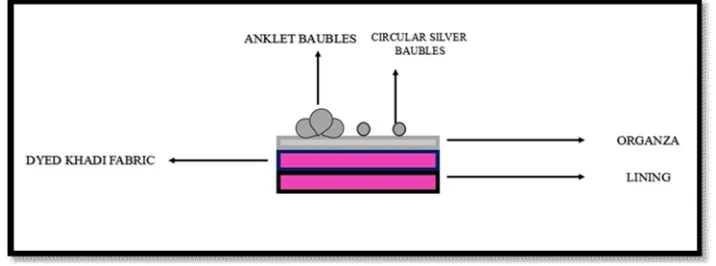
The pieces to be cut out from the fabric were marked in such a way that a stay stitch was done
around a given area. The three layers of the fabric were layered one on top of the other. They were
layered in the order as follows: Dyed Khadi fabric – over which the organza was laid – above which
the anklet baubles and the silver balls were embroidered.
Figure. 8: Texture development and value addition
3. RESULT AND DISCUSSION
The salient features of Khadi fabrics are that it is It is light and soft, It is comfortable, can be
subjected to dyeing and printing and has inherent strength. Organza fabrics are also light weight,
Figure 9: Correlation of the traditional and contemporized motifs
Figure 10: Value addition on organza fabric
Figure 11: Value addition on tie & dyed Khadi fabric
The design is a knee length ensemble that is a one-piece garment that is made of
cream-colored khadi for the bottom that is pleated and dual color dyed khadi and organza for the top blouse
that contains anklet bauble embroidery and characterized by flared sleeves with patches and a sweet
Figure 12: Design -1: Invigorating Agility
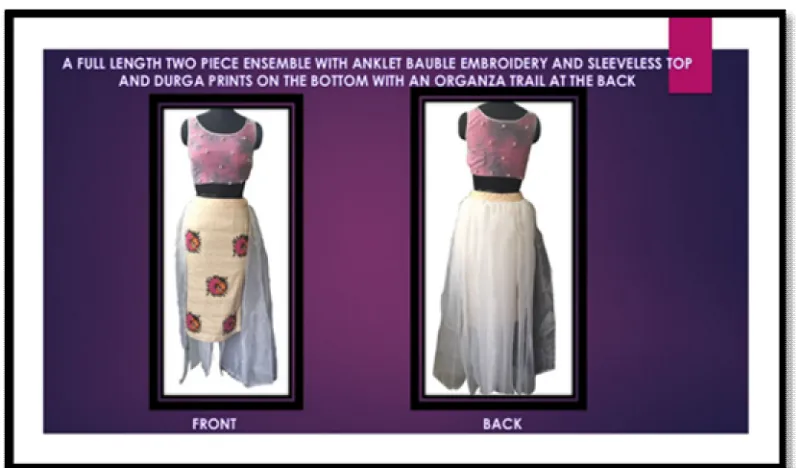
The design is a knee length ensemble that is a two piece that is made of cream-colored khadi
for the bottom and dual color dyed khadi and organza for the top blouse that contains anklet bauble
embroidery and characterized by being sleeveless and a U neckline. The bottom has Durga motifs.
And the bottom contains a trail of embroidered organza.
Figure 13: Design – 2: Beneficial Lightness
4. SUMMARY AND CONCLUSION
Kantha.G.in his thesis states that problems faced by sarvodaya products and their
the centers from various states. Research and product development will ensure wider market.
Effective promotional methods through documentation, publications and advertisements,
e-commerce will enhance sales and revenue. Frances Sinha and Sanjay Sinha (2012) have pointed out
that promotion of industries based on local resources and skill is a vital component of planning for
employment and income distribution.
The fashion industry runs based upon the consumers acceptance and the consumers tend to
buy clothes and other fashion goods based upon their knowledge of the product and the influence it
has on the consumer. The consumer is now exposed to various forms of media and tend to know all
the latest trends especially through red carpet events. Red carpet events tend to represent the latest
trends that tend to occur and all type of red-carpet events be it international or within a particular
region tends to utilize the spotlight to bring into knowledge of the buyer the different fabrics, prints,
colors and silhouettes etc. And thus, slowly leading to their spread within the market to reach the
consumer eventually in the right price ranges that may be affordable. Red carpet wear has
tremendous influence on fashion and is the part of media and fashion culture. It attracts attention
from people and is followed by the people all over the world, especially women’s red-carpet wear
enjoys greater focus.
Figure 14: “Khadi spins employment and weave prosperity in rural India”
Designing using Khadi fabrics and value addition using traditional art forms of Pathachitra
marketing the Khadi products, marketing strategies adopted by Khadi units, customer satisfaction
and attitudes towards these products.
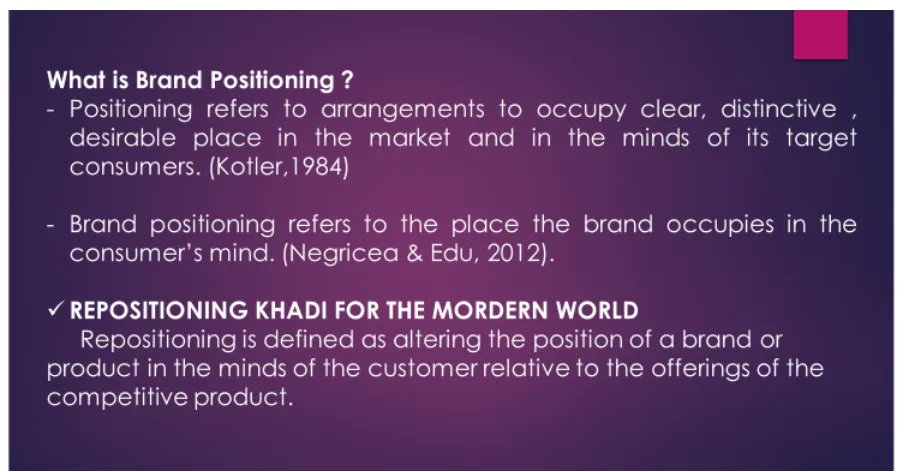
Figure 15: Brand Positioning.
This paper is an attempt to contribute to the products development and sustainability aspect
for the global market not compromising on the cultural ethos. This is essential since we are living in
an age of digital marketing and global market that still remains untapped and harbors a lot of
potential, if implemented successfully.
REFERENCES
1. Pradnya P. Ambre and Sugandha La . ‘Khadi – Awareness and Promotion among Youth”,
International Research Journal of Engineering and Technology (IRJE). 2017; 04 (07):2149.
2. Das, N. “Patachitra of Orissa: A Case Study of Raghurajpur Village”. Pratidhwani the Echo,
an online journal of Humanities and social science. 2013;1 (IV).
3. Balasubramanya K. “A Study on Khadi and Village Industries Sector”. International Journal
of Academic Research, 2015;.2 (5).