Testing of a Novel
Distributed Shared Memory
Framework
Laurence Markey
A dissertation submitted to the University of Dublin,
in partial fulfillment of the requirements for the degree of
Master of Science in Computer Science
Declaration
I declare that the work described in this dissertation is, except where otherwise stated, entirely my own work and has not been submitted as an exercise for a degree at this or any other university.
Signed: _________________________ Laurence Markey
Permission to lend and/or copy
I agree that Trinity College Library may lend or copy this dissertation upon request
Signed: _________________________ Laurence Markey
Acknowledgments
I would like to thank my supervisor, Brendan Tangney, for his
guidance, encouragement and advice throughout the work on this
dissertation.
Also Stefan Weber who developed the DSD framework that was
the focus of this dissertation, and never lost his patience or good
humour during many many consultations.
And finally Brian Coghlan for allowing me to use the CAG Cluster
Summary
A novel object oriented framework for software Distributed Shared Memory (DSM) has been developed by the Distributed Systems Group in Trinity College, Dublin for programming parallel applications on a group of loosely coupled workstations. It offers the developer the ability to apply different rules for how accesses to shared data are seen by each process (consistency models) which can be implemented by different means of managing shared data (coherence protocols). Different combinations of models and protocols can be applied to individual objects within an application, in addition the protocols that the framework uses can be customized by the developer.
By providing this range of facilities it is hoped that developers will be able to exploit application specific semantics to achieve improvements in performance and speed-up characteristics while maintaining relative ease of programming.
The objective of this project is to test to what extent this DSM framework delivers the flexibility, customizability and programmability in design of parallel applications that it promises and whether it can offer appropriate speedup characteristics for different classes of problem.
Two applications with significantly different data sharing characteristics were designed and implemented as sample cases to test the framework: the Travelling Sales Person (TSP) problem which has a low communication-to-computation ratio and for which workers can work independently of each other; and the LU Decomposition problem which has a very a high communication-to-computation ratio and an algorithm where workers are highly interdependent
Table of Contents
1 INTRODUCTION... I
2 BACKGROUND TO DISTRIBUTED SHARED MEMORY... 4
2.1 INTRODUCTION... 4
2.2 WHAT IS DSM... 4
2.3 PARALLEL PROGRAMMING... 4
2.3.1 MultiProcessing... 5
2.3.2 Message Passing... 6
2.3.3 DSM... 7
2.4 DIFFERENT DSM SYSTEMS... 9
2.4.1 Consistency models... 15
2.4.2 Coherence Protocols... 18
2.5 SUMMARY... 20
3 FRAMEWORKS... 21
3.1 INTRODUCTION... 21
3.2 WHAT FRAMEWORKS ARE... 21
3.2.1 Other types of reuse... 22
3.2.2 Features of frameworks... 24
3.2.3 Problems with using Frameworks... 26
3.3 FRAMEWORKS APPLIED TO DSM... 27
3.3.1 An existing framework... 27
3.3.2 The Distributed Shared Data (DSD) Framework Developed in Trinity College... 28
3.3.3 Structure of the Framework... 29
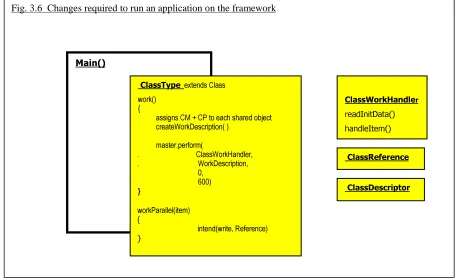
3.4 HOW TO PARALLELISE A PROGRAM ON THE FRAMEWORK... 34
3.5 SUMMARY... 37
4 TESTING THE FRAMEWORK... 38
4.1 INTRODUCTION... 38
4.2 RELATIVE SPEED-UP... 38
4.4 THE TRAVELLING SALES-PERSON PROBLEM... 42
4.4.1 The Algorithm... 43
4.4.2 Parallelisation of the TSP... 48
4.4.3 Predicted effect of the protocols... 50
4.4.4 Results of speed-up tests... 53
4.4.5 Analysis of Results... 54
4.4.6 Explanation of Super Linear Speedup... 60
4.4.7 Analysis of the use of the framework... 61
4.4.8 Conclusions for TSP... 63
4.5 LU DECOMPOSITION... 65
4.5.1 The Algorithm... 65
4.5.2 Parallelisation of LU Decomposition... 71
4.5.3 Predicted Effect of the Protocols... 72
4.5.4 Results of speed-up tests... 73
4.5.5 Analysis of Results... 75
4.5.6 Analysis of the use of the framework... 76
4.5.7 Conclusions for LU Decomposition... 77
4.6 SUMMARY... 78
5 REVIEW OF THE DSD FRAMEWORK... 79
5.1 INTRODUCTION... 79
5.2 IS DSD A GENUINE FRAMEWORK?... 79
5.3 WHAT KIND OF A FRAMEWORK IS IT?... 80
5.4 HOW EFFECTIVE IS IT AT SUPPORTING DSM?... 80
5.5 PROBLEMS... 82
5.6 CONCLUSION... 82
6 APPENDICES... 83
6.1 TRAVELLING SALES PERSON 17 CITIES... 83
6.2 TRAVELLING SALES PERSON 17 CITIES - ADDITIONAL DATA... 85
6.3 TRAVELLING SALES PERSON 16 CITIES... 86
6.4 LU DECOMPOSITION... 87
List of Tables and Illustrations
ILLUSTRATIONS
Fig. 3.1 Structure of the Framework Fig. 3.2 Release Consistency Fig. 3.3 Lazy Release Consistency
Fig. 3.4 Issuing of Work Items to Workers
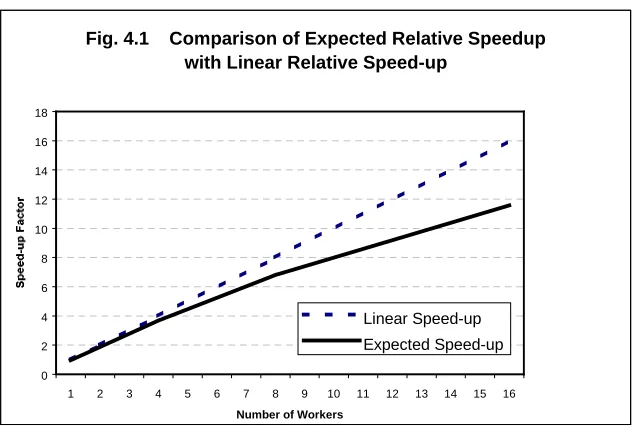
Fig. 3.5 Structure of Applications that Can be Run in Parallel Fig. 3.6 Changes Required to Run an Application on the Framework Fig. 4.1 Comparison of Expected Relative Speed-up with Linear
Relative Speed-up
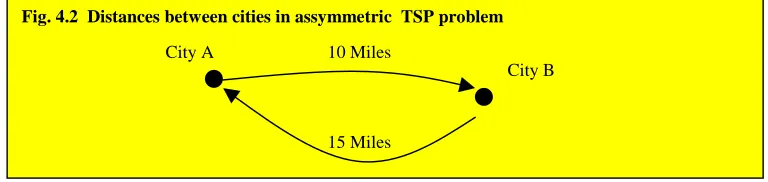
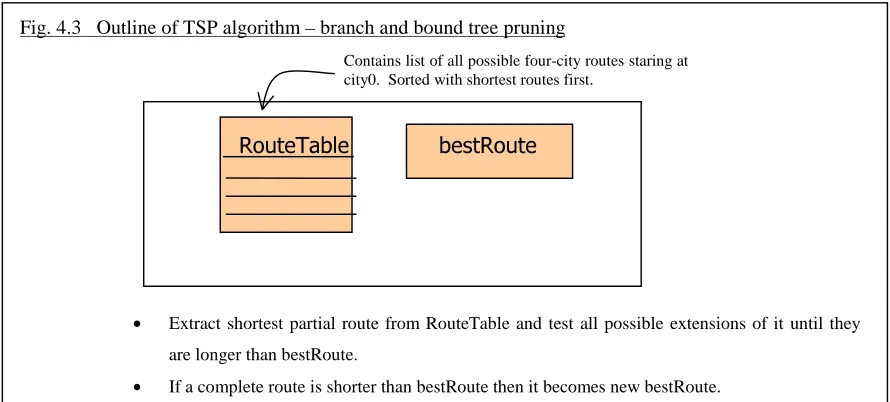
Fig. 4.2 Distances Between Cities in Asymmetric TSP Problem Fig. 4.3 Outline of TSP Algorithm – Branch and Bound Tree Pruning Fig. 4.4 Illustration of Branch and Bound Algorithm
Fig. 4.5 Calculation of Route Length
Fig. 4.6 Classes Changed in Order to Parallelise TSP Fig. 4.7 Replication Protocols
Fig. 4.8 HomeBased Protocols
Fig. 4.9 Relative Speed-up Graph for 17 City TSP Fig. 4.10 % Standard Deviation for 17 City TSP
Fig. 4.11 Relative Speedup Graph for 17 City TSP Additional Data Fig. 4.12 Speedup Graph for 16 City TSP
Fig. 4.13 Simple Algorithm for LU Decomposition Fig. 4.14 Better Algorithm for LU Decomposition Fig. 4.15 Relative Speedup Graph for LU Decomposition
TABLES:
Table 1 17 City TSP Summary Table
1 Introduction
Parallel programming has been developed in the attempt to improve the speed at which
programs can be executed, particularly those that demand a great deal of processing power.
It describes the attempt to improve the speed at which a given problem is processed by
having a number of processors or workstations working in co-operation on the problem. It
is contrasted with sequential programming where only one processor is used and all
operations take place in a linear sequence. One of the measures of the performance of a
parallel programming system is its speed-up characteristic i.e. how much faster a program
is processed as more processors are recruited to work on it.
Distributed Shared Memory (DSM) is a technique that allows parallel programming of
applications on a network of computers. It relies on the “shared memory” abstraction
which enables computers that do not share memory to have shared access to data by a
means which appears similar to how they access data in their own memory. The shared
memory consists of items of shared data which are replicated at each workstation that needs
to use them, thereby eliminating the need to read these data across a relatively slow (in
terms of processor speeds) network.
However having multiple copies of items of data introduces the issue of how to maintain all
of these copies in a consistent state. This can be separated into two elements the Coherence
Protocol which determines what mechanisms are used to maintain the copies in a consistent
state, and the Consistency Model which defines what constitutes a consistent state by
constraining the event-orderings are allowable.
Different coherence protocols will use difference means of passing updates between
workstations. The optimal coherence protocol will be different for different applications,
being determined by the different communications requirements of the applications.
Maintaining strict consistency where all reads at all nodes return the most recently written
value introduces extra delays because no processor can read a data item when any other
processor is updating a copy of that data item. These delays can be reduced by allowing a
1989; Dubois et al., 1988; Gharacharloo et al., 1990; Keleher et al., 1996a), the more
relaxed they are the better performance they offer. However application semantics often
demand that some of these are not acceptable for any data item in the application, or are not
acceptable for certain key data items.
In order to optimise the performance of parallel programmes it would be desirable to be
able to separate the means of applying coherence protocols and consistency models so that
an appropriate combination could be selected for each application from a range of differing
consistency models and coherence protocols. In addition further optimisation would be
promised by a system that could apply consistency on a per-object basis.
This is what has been attempted in a framework that has been developed in Trinity College
Dublin. The framework (Weber et al., 1998) consists of a set of Java classes that can be
selected and extended to provide combinations of consistency models and coherence
protocols on a per-object basis for parallel programming. It allows the flexibility of easily
choosing and changing the combination of coherence protocol and consistency model that
have been chosen for any data item. In addition it allows existing protocols to be
customised, or new ones defined in order to achieve optimal performance for specific
applications. It does this in an environment that is relatively easy to program.
Objective
The objective of this dissertation was to test how well the framework delivers on the
benefits that it promises. This was done by using the framework to implement two parallel
applications with different sharing semantics and then testing the performance of these
applications over the network in order to determine what type of speed-up was offered. In
the process of developing and testing these applications it was possible to analyse how well
the framework delivered on the flexibility, programmability and customisability that it
claims to offer.
Results
It was found that developing parallel applications for the framework was relatively easy,
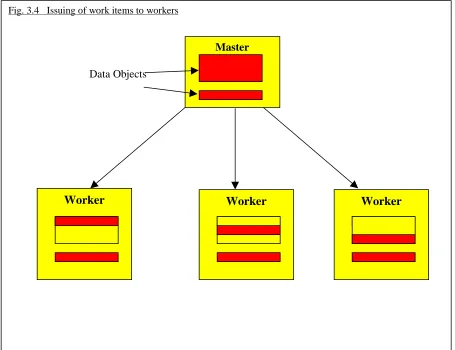
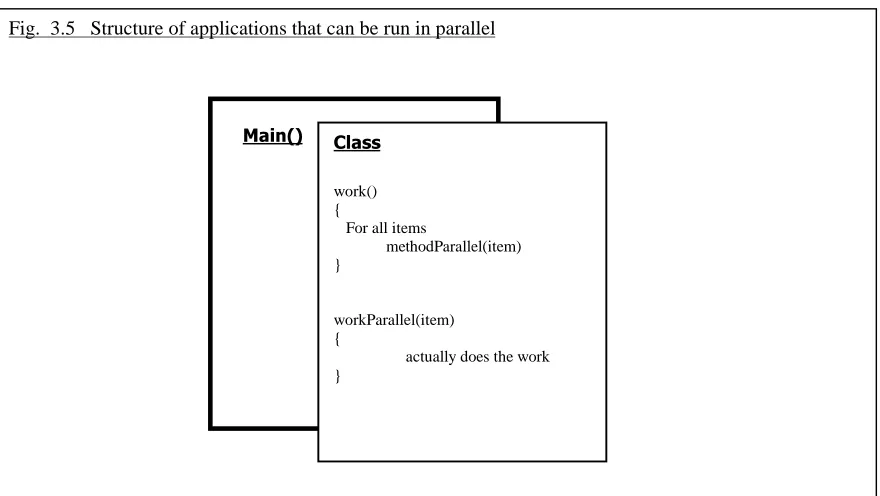
particularly if the problem space could be partitioned into a list of work items before the
consistency models provided in advance. It was possible to customise these, or develop
new ones by creating new classes that extend the base CoherenceProtocol or
ConsistencyModel classes. The steps required to assign and change consistency models
and coherence protocols for individual variables were clear and easily programmable. The
speed-up characteristics obtained were very different for the two applications reflecting the
different sharing semantics and communication/computation ratios of the applications.
Selection of appropriate ConsistencyModels and CoherenceProtocols had a significant
affect on the levels of speed-up obtained.
Therefore we have concluded that the framework has delivered the capabilities that it has
2 Background to Distributed Shared Memory
2.1 Introduction
The purpose of this chapter is to introduce some of the concepts and approaches that form
the background against which this investigation was carried out. It introduces Distributed
Shared Memory (DSM), explains parallel programming and surveys some of the
approaches other than DSM that have been used for parallel programming. It then looks at
some of the different approaches that have been proposed based on DSM, the problems that
they encountered and how some of these can be overcome. It lays out a conceptual
framework that can be used for classifying and understanding DSM systems and for
optimising the performance of parallel programs run over DSM.
2.2 What is DSM
Distributed Shared Memory (DSM) is a technique that allows parallel programming of
applications on a network of computers. It relies on the “shared memory” abstraction
which enables computers that do not share memory to have shared access to data by a
means which appears similar to how they access data in their own memory.
The objective of this dissertation is to evaluate a novel framework that has been developed
for developing programs to run over DSM. In order to clarify exactly what benefits are
promised by this new framework-based approach to DSM it is worthwhile to survey the
different approaches that have been applied to parallel programming in the past.
2.3 Parallel Programming
Parallel programming is the name for the attempt to improve the speed at which a given
problem is processed by having a number of processors working in co-operation on the
problem. It is contrasted with sequential programming where only one processor is used
and all operations take place in a linear sequence.
Developing parallel programs involves many concerns that are not encountered while
synchronisation. Since a parallel program uses multiple sequential processes executing and
interacting in parallel to solve a problem, developers have to ensure that a consistent view
of the problem data is maintained across all these processes, this is called synchronisation.
However in the interests of efficiency this must be achieved without requiring excessive
communication between processes.
2.3.1 MultiProcessing
The initial approach used to implement parallel programming was multi-processing. It
required the construction of a computer with a number of CPUs that share the same bus and
that use that bus to access a shared memory. By having a single bus and a single shared
memory that contains only one copy of each data item and the semaphore that controls
access to that data, it provides a system whose structure implements data consistency and
synchronisation. Consistency is the requirement that all of the processors see a consistent
view of the data. This is ensured by the fact that there is only one set of data which all
processes have access to, thus no two processes can have a different view of the data.
Synchronisation is achieved because the system implements semaphores, it ensures that
when any one process is updating a data item all other processes have no access.
However these bus-based multiprocessors suffer from a lack of scalability, they cannot be
used with more than a few dozen processors because the bus (which only one CPU can use
at a time) tends to become a bottleneck. This is because when any one processor accesses a
data item in the shared memory they prevent all other processors from accessing any data
item because only one processor can access the bus at any time. In addition, in its simplest
form, this architecture makes no distinctions between non-shared data and shared data and
between read-only data and read-write data. In each of these cases non-shared data and
local copies of read-only data could be stored in local memory if that were available
without compromising the consistency of the overall data set. This would allow
performance improvement because shared-bus access would not be required for access to
these data types and so frequency of demand for the shared-bus bottleneck would be
reduced.
Switched multiprocessors, such as DASH (Lenoski et al., 1992) can be made to scale, but
processor tries to overcome the limitation on the number of processors that can efficiently
share use of a single bus by having several clusters of processors, each cluster with its own
bus and the clusters connected by slower (relative to buses) intercluster links. When a
processor wants to access a data item located on the local memory it accesses just as it
would in the multiprocessor situation described above. If however the item’s address
indicates that it is located on the memory of one of the other clusters then the data item is
fetched across the intercluster link. This topology assumes that most accesses by
processors will be to their local memory and so the slow intercluster links will be relatively
infrequently used thus having little affect on performance and allowing greater scale.
However, as mentioned already, these systems are expensive and complex to build and
maintain. Given that many locations had networks of workstations it became more
attractive to see if the existing processing power on these networks could be used to
perform parallel processing, rather than purchasing expensive hardware that performed a
specialised function. This approach of attempting to use a network of standalone computers
for parallel processing is called multicomputing.
A multicomputer consists of a number of separate standalone computers, each with their
own CPU and their own memory, which communicate via a network. This makes larger
scale feasible: because each machine accesses its own memory there is no bottleneck for
access to memory, they only use the network to propagate updates to data shared with other
machines. Large multi-computers are easier to build and cheaper because they use standard
workstation and network hardware. However they create a more difficult programming
environment, because the programmer now has to deal with issues of consistency and
synchronisation. In addition they have to cope with extra time required to communicate
across a network. There have been two main approaches to multi-computing: Message
passing and Distributed shared memory.
2.3.2 Message Passing
Parallel programming requires that the processes running the application must share data.
Message passing achieves this by passing between processes messages containing the data
to be shared (Coulouris, et al., 1994). By using this approach where, provided messages are
performed on any type of computer message passing can implement parallel programming
over a heterogeneous network.
Message passing requires extra work on the part of the programmer as compared to
multiprocessing. Variables to be passed between processes must be marshalled into
messages, messages transmitted and variables unmarshalled at the receiving side. If a
heterogeneous system is to be used then different marshalling will be required for each
different kind of computer being used on the system. In addition there is a requirement to
monitor that messages have been received by their intended recipient, and to manage issues
such as flow control, buffering and blocking.
Because each process maintains its own copy of the data, message passing must implement
synchronisation to ensure that all processes are using a consistent set of data. However it
cannot do this using normal synchronisation constructs such as locks, instead
synchronisation must be implemented using special primitives. Message passing does not
offer the same flexibility in the selection and changing of policies as will be offered by
some of the other systems we will discuss.
2.3.3 DSM
Distributed Shared Memory (DSM) is a technique which allows parallel programming of
applications on a network of computers. It relies on the “shared memory” abstraction
which enables computers that do not share memory to have shared access to data by a
means which appears similar to how they access data in their own memory.
Each of the computers is a standalone computer, but using DSM they can all work in
parallel on a single application. Each computer works on the problem as it would work on
a standalone application, because each has accesses shared data in a way similar to how it
accesses its own local data. It is up to the DSM system to ensure that that each workstation
sees a view of the shared data that is consistent with that seen by all the other workstations.
Shared Memory
Unlike message passing DSM does not require the programmer to manage communication
address space. A distributed application consisting of processes running on several nodes
can access the data in the shared address space using operations like "read" and "write"
which, combined with synchronisation primitives, are applied to a specific address. Thus
each process uses the shared address space in a similar way to how they use their local
memory space with the addition of synchronisation management.
The shared address space consists of local memory on each machine in the system. When a
process accesses data in the shared address space, a mapping manager maps the shared
memory address to the physical memory of one of the nodes on the system. The process
can then read that data and make a local copy. Each computer can maintain local copies of
recently accessed data items. Changes made by one process to items in the shared address
space are propagated by the DSM system to the local memory of all other machines with
copies of that data. The DSM system ensures a consistent overall set of data, the
programmer need not worry about this.
Thus it appears to distinct processes on different nodes that they have concurrent access to a
shared set of data. And this is achieved while allowing most accesses to data to be to local
memory. This enables DSM to improve performance by using local memory accesses
whenever it wishes to access a shared variable. The DSM system only needs to propagate
data when a change is made to a shared variable. In addition communication between
processes and across node boundaries is transparent, it is handled by the DSM and no
marshalling is required.
However enforcement of consistency does not come without cost. If we are to ensure that
all processes sharing some data see changes to that shared data in the same order then we
will have to implement distributed locks. This will require several stages of communication
to establish locks on all copies of data, and update all copies of data; only when this has
been committed can any processes have access to this data. This introduces significant
delays, particularly when communicating across a network. However, as we shall see it is
possible to significantly increase performance if we relax the level of consistency being
2.4 Different DSM Systems
Having outlined the concept of a virtual shared memory upon which DSM relies, we shall
now look at different DSM systems that have been developed and the different approaches
they have used to implementing the virtual shared memory. They can be broadly grouped
into two categories: page-based DSM and object-based DSM.
Page-Based DSM
The initial attempts at DSM were attempts to simulate the operation of multi-processors
using a distributed system. This was partly because one of the goals of these original DSM
systems was to be able to run existing multi-processor programs on larger DSM systems
with the minimum of modification. Multi-processors use a memory shared by all
processors in a cluster located on one bus, with one copy of each data item stored in the
memory (Tanenbaum, 1995). Each processor can access each address in the memory
directly. As we have seen one way of coping with the limitations on access to the shared
bus was by passing data along inter-cluster links.
The network hardware that was available for these early DSM systems was optimised for
passing pages across the network. So the early attempts at DSM married these two
approaches, they divided the address space into pages, each page being located in the local
memory of one machine in the system. When a processor tries to access an address in a
page that is not local the DSM software identifies the page, locates it and fetches it from the
machine it is currently stored on.
Thus the virtual memory consists of pages, stored in local memory of a machine on the
network, that migrate across the network as different processors need to access their
contents. This migration is required for read accesses as well as write accesses, because the
only way data can migrate across the network is if the page it is located on is transferred to
another machine.
Because it takes longer to access a page that is located on another machine, performance
can be improved by locating particular pages on the machines that use them most
frequently. However this approach is not adequate if there is more than one processor that
needs frequent access to a given page, because it can lead to a problem called thrashing or
Thrashing occurs when there are several processes that have frequent needs for access to
the same page, this will mean that ownership will be difficult to determine and the page will
be transferred back and forth across the network at a very high frequency. These processes
will spend much of their time waiting for the page to be returned to them and so their
performance will suffer.
The solution to thrashing it is to allow several copies of the page to exist simultaneously on
a number of machines and to institute some means of ensuring that they all display a
consistent view of the data that they contain. This is the approach that was adopted in the
IVY system.
IVY (Integrated Shared Virtual Memory at Yale) was implemented on a network of Apollo
workstations connected by a network (Li and Hudak, 1989). The memory was divided into
pages, 1 Kbyte in size, which were transferred across the network. There could be more
that one process on each workstation. Each process saw the address space as divided into
two areas:
1. A shared virtual memory address space which can be accessed by any process
2. A private space which can only be accessed by processes on the same workstation
Each workstation has a mapping manager that controls the mapping between the shared
virtual memory space and the local memory of the workstation. When a process raises a
page fault a check is made to see if the page is located locally at the workstation. If the
page is not local a remote memory request is made and the page is acquired from another
workstation.
IVY follows a multiple readers-single writer semantics. There can be multiple copies of a
page, each of which can be read separately, thus eliminating thrashing when several
processes want to read from the same page. All readers always see the latest value written,
which means that IVY enforces “strict” consistency (see below). This consistency model is
implemented using the “write-invalidation” protocol. This means that when a writer wants
to write to a page which is copied elsewhere, then all other copies of that page are
invalidated before the update is made. If a reader attempts to read from an invalidated page
consistency where all readers see the latest update, it is necessary to complete the
invalidation of copies of an updated page before another update can commence. Therefore
there can only be one writer to a page at any time.
Write invalidation saves communication because copies of pages are only updated when a
process attempts to read from them. So communication is reduced by only updating those
copies that are used subsequently; and by only updating them when they are to be read
which may be after several writes have been made.
Ivy resolved the thrashing problem for reads, but not for writes. Each time a write is
performed all other copies of the page are invalidated, so subsequent readers or writers will
have to receive a copy of that page over the network.
Mirage uses a different approach to reducing thrashing (Fleisch & Popek, 1989). It adds a
parameter to the sharing protocol that sets the minimum time for which a page will be
available at a node. By ensuring that a page remains at that location for at least a certain
time it allows one process complete a sequence of updates to a page before the page is
passed across the network. This parameter can be tuned dynamically to ensure that the
page does not stay at a node longer than is needed. It also provides a “yield” primitive
which a process calls when it has completed a sequence of updates. Thus ensuring that the
page does not stay fixed for the duration of the period if there are no further accesses to be
made.
However even if these measures do allow page-based systems to reduce thrashing, there is
another problem which they have more difficulty in coping with: false sharing.
Granularity and false sharing
Granularity describes the size of the minimum unit of shared memory. In page-based
systems it is the page size. The underlying protocols and hardware that are used to
propagate updates will have an influence on the choice of granularity. From their point of
view efficiency is maximized by making the granularity into a multiple of the size used by
these. Page-based systems are designed to optimise the passing of pages around the
network so the page size will be determined by the underlying hardware. This ensures that
A larger page-size will take advantage of the locality of reference exhibited by processes.
A process that accesses one variable is very likely to access other variables located near to
it in memory. However this consideration is often overridden by the fact that a large
page-size increases the likelihood of false sharing. This occurs when a number of processes seek
to access unrelated data items that happen to be located on the same page. Thus there will
be delays caused by this contention even though the variables themselves are unrelated.
False sharing particularly occurs if a page contains a key variable that is accessed very
often, this will mean that processes will experience considerable delays in accessing any
other variables located on the same page.
This problem has been moderated somewhat for page-based systems by adopting a mode of
operation where key variables are stored alone on one page, so that accessing them will not
cause any difficulties in accessing other unrelated data items. However this is only a
work-around and an attempt to replicate what is achieved more effectively in shared-variable
DSM systems. In particular it wastes valuable memory space, and bus time; a whole page
has to be maintained and passed around in order to manage the state of only one variable.
Shared Variable DSM
Shared variable systems were proposed as a means of overcoming some of the problems
with page-sharing. By focussing the system on the management of variables rather than
pages they eliminate the problem of false sharing. Processes seize individual variables,
thus there is no possibility that accessing one variable will prevent others accessing an
unrelated variable that happens to be located beside it in memory.
In addition they ensure that only those variables that need to be shared are passed across the
network. Rather than having the same mechanism for all of memory, variables that need to
be shared are treated differently from the rest of memory.
Shared variable systems allow several processes to maintain replicates of individual
variables in their memory. This solves the problem of thrashing, and ensures that
individual processes have faster access to shared variables. However, it calls for a
This can be optimised by allowing different levels of consistency for different variables
which can be achieved by performing specific annotations on the variables that declare
what policy applies to them.
Munin is a system that uses this approach (Bennett et al., 1990, Carter et al. 1991). It has a
fixed range of types that can be applied to shared data: write-once, write-many, private,
migratory etc. Different protocols are used for updating shared data that have been
assigned different types. Thrashing caused by competing writers can be avoided by
specifying the type as write-many.
A shared variable system puts the responsibility on the programmer to annotate each data
item to indicate which variables are shared together and what type of policies apply. This
was not necessary in page-based systems where the system treated all data similarly. This
flexibility does offer improved performance, however because of the need to annotate each
data item it is difficult to avoid costly mistakes. What was needed was some means of
simplifying the application of different sharing policies to data items. This is what
object-based DSM aims to do.
Object-based DSM
An object is a programmer-defined encapsulated data structure (Booch, 1994). It consists of
internal data and associated methods. The methods are procedures that operate on the
object state, they can be called by any program that has a reference to the object. Thus an
object is a data abstraction that comes supplied with methods to operate on it. One of the
key properties of an object is that it implements information hiding which means that direct
access to the internal state is not allowed. The only means by which the internal state can
be accessed or operated on is via the defined methods. Forcing all accesses to an object’s
data to go through the methods helps structure the program in a modular way and allows the
programmer to control the means by which the object can be changed. Objects offer
possibilities for optimisations that are not available with a shared memory composed only
Another key property of objects is inheritance. This allows an object to inherit the data and
methods of another object. This can be used to simplify the management of how different
policies are applied to different classes of data items.
In an object-based distributed shared memory processes on several machines share an
abstract space filled with shared objects. The management of these objects is handled by
the DSM system. Any process can invoke any object’s methods once it has obtained a
reference to that object. The process and object need not be located on the same machine,
once the method is called it will be run at the location where the object resides.
The issues of replication and managing updates and/or invalidations in order to maintain
consistency still have to be addressed in this system. However it does offer number of
advantages. In particular the fact that the access methods can be used to restrict how
accesses can be made may ensures that synchronisation can be built into the access
mechanism. This reduces the possibility of error and makes programming different sharing
policies for different data items much easier. Because of the fact that synchronisation and
access are controlled at the level of the object the underlying implementation can be more
flexible. This has led to the separation of what we have so far called sharing policies into
two separate elements which can be defined separately for an object-based DSM system
(Weber et al., 1998). The Consistency Model describes the type of consistency that is being
enforced for a given variable and the Coherence Protocol describes the mechanisms that are
being used to implement that model.
And of course an object-oriented approach, by using inheritance, allows the development of
frameworks, which are sets of co-operating classes embodying abstract designs that can be
reused to provide a structure for developing applications within a certain domain
(frameworks are discussed fully in the next chapter). Using a successful framework should
simplify the development of individual applications within the framework’s domain.
These three concepts: consistency model, coherence protocol and framework and the
benefits that using them together can offer are the key ideas driving the design of the DSM
system that has been developed in Trinity College. The remainder of this chapter will be
devoted to explaining consistency models and coherence protocols; frameworks are
2.4.1 Consistency models
A consistency model is a system of rules that puts constraints on what orderings of events
are allowed in a DSM system (Weber et al., 1998). It is used to ensure that at all times
every process with access to a shared data set has a view of that data set that is coherent
with the view of all other processes. However for the views of all processes to be coherent
it is not necessary that they be the same. A shared memory is coherent if the value returned
by a read operation is always the value that the programmer expected. This means that a
shared memory can be coherent when different processes see different values of a given
variable at the same time provided that this is what the programmer had expected. By
“what the programmer expected” we mean in accordance with the consistency model that
the programmer has specified. As long as the programmer has allowed that different users
may see different values of a variable, then different values of the same variable coexisting
in the same system are coherent.
Intuitively we tend to think that there can be only one consistency model that can be
adequate, all processes must have the same view at any one time (which can be
implemented by saying that all reads from data must return the most recently written value).
This is based on the premise that if I read a value that does not incorporate an update that
has been made by another user, then my view of that value is inconsistent with the view of
the writer of that value. However this need not be the case, if for example the values being
entered are only estimates of something that is unknown, then the fact that two processes
have different estimates may not constitute a major problem.
The classic example that illustrates this point is that of newsgroups. There are many users
of a newsgroup and there are many messages posted. However it is not essential that new
messages go out to all users at exactly the same time and so are seen by all users in exactly
the same order.
Strict consistency may be abandoned because it often confers limited benefits in terms of
correctness, i.e. it does not produce a better result for many applications, while it always
exacts a heavy penalty on performance. DSM systems achieve gains in performance by
enforcing more “relaxed” consistency models that require less communication overhead.
order of accesses. Some of the consistency models that have been proposed are outlined
below.
Strict Consistency
The most stringent consistency model is called strict consistency or alternatively sequential
consistency. It is defined as:
“Any read from a variable must return the value stored by the most recent write to that variable.” (Lamport, 1979)
This model requires the total ordering of requests, so that all requests are seen in the same
order throughout the system. So the distributed system of copies of the variable appears as
if there was only one copy of the variable which all processes were accessing. This leads to
great reduction in efficiency because any update to a variable can only be completed not
merely when that update has been propagated to all processes, but only when their
confirmation that they have received the update has been received. Thus this works against
the key advantage of DSM i.e. maintaining local copies of shared data, thus allowing local
memory accesses to that data. Now every update is not complete until several sequences of
messages have been passed back and forth across the network between the initiator and
every other copy of that variable on the system. Once one process starts an update then no
other process can access the variable until this process is complete.
Note also that because of the delays that this necessarily imposes processes are not
guaranteed to be able to update or even read from a variable at will, thus this intuitive
consistency model may not even be an unattainable ideal, but could actively interfere with
applications that rely on real-time data access.
Processor Consistency
Processor consistency is a relaxation from strict consistency, which was defined by its
author as:
All processes see the writes of any one process in the order in which they were sent.
However there is no guarantee as to what order a sequence of writes by different processors
will be seen in at different processors. This means that writes by different processors that
had a causal effect on each other may be seen by some processors in an order that breaks
this causal relation. This means that writes by a single process can be queued, and so long
as they are performed in the right order then other processes need not break off processing
in order to perform these writes. This allows considerable freedom to nodes on a system as
to when they need to perform updates, however even more relaxed consistency models have
been proposed.
All the models we have seen so far have been uniform models, i.e. they treat all memory
accesses as being equally important and apply the same restrictions to them all. However
once we understand the semantics of particular applications we will see that very often only
a small proportion of accesses to memory are critical. Hybrid models define classes of
accesses that are treated differently in an attempt to utilise this knowledge.
Release Consistency
Release consistency exploits the fact that programmers use synchronisation constructs in
many applications, these are used to manage critical sections of the program execution or
access to critical variables. Release consistency assumes that as long as these are
synchronised then synchronisation will not be an issue for the rest of the program. This
system relies on the programmer’s ability to use these constructs correctly because
synchronisation is only applied where the programmer has asked for it. Synchronised
accesses can be declared using acquire and release accesses, which indicate the start and
end of critical sections of code. The guarantee that is offered is:
“All ordinary memory accesses issued prior to a release will take effect at all other processes before the release completes – including those accesses issued prior to the preceding acquire” (Gharachorloo et al., 1990)
Updates need not be forced until a critical section is being left, hence the title release
consistency. For this reason release consistency can be used to share several updates in one
Gharachorloo has shown that release consistency gives results equivalent to strict or
sequential consistency, provided the synchronisation accesses are used correctly. Thus
increased performance can be achieved without compromising application semantics
through optimising the use of synchronisation by only applying it where needed and
allowing processes to proceed without delay where it is not applied in the program.
Lazy Release Consistency
There have been a number of proposals for a relaxation of Release Consistency. These are
all responses to the observation that release consistency might be too “eager” in some
situations. It is eager in that it sends updates as soon as the updating process releases its
lock on a critical section. The “lazier” versions propose different rules which ensure that
updates can be delayed or reduced in scope. For instance Keleher describes a lazy release
consistency that propagates an update, not when a lock is released, but only when it is next
acquired; it only needs to send the update to the process acquiring the lock, and can include
the update in the response to the lock request (Keleher et al., 1996a).
The lazy release consistency that has been implemented in the DSM system to be studied
here only propagates an update when a subsequent read is attempted on the same portion of
data. This is particularly useful for applications where different processes are performing
independent operations which do not need to read the results obtained by other processes.
In this case updates need not be processed at all until the end of the application when only
the master needs to be updated with the results obtained by each process.
2.4.2 Coherence Protocols
The coherence protocol describes the mechanisms that are used to ensure that the virtual
shared memory in DSM is maintained in a coherent state. The consistency model defines
what orders of events (i.e. accesses to memory) are allowed. The coherence protocol is
responsible for ensuring that these accesses are performed correctly so that the consistency
model that has been specified is implemented.
Li and Hudak (1989) is the classic article that identifies the key issues that have to be
analysis focuses on the requirements of a page-based system, and does not separate
consistency model issues from coherence protocol issues. However we can identify in their
article issues that are not addressed by consistency models, as outlined above, these are the
issues that the coherence protocol must manage. If coherence is to be achieved the
following must be implemented: managing the local copies of data items in the virtual
shared memory in a way that ensures the whole data set remains consistent; keeping track
of the ownership and location of copies of the data; and achieving the distribution of
updates to all nodes with copies of the updated data. We will look at each of these in turn.
Memory Management
Managing the local copy of the virtual shared memory space involves handling local
accesses (writes/reads to/from the local copy) and handling updates. Updates can be
achieved either by overwriting all copies of the data to be updated (write update protocol),
or by updating one copy and invalidating all others (write invalidate protocol). Invalidation
of a local copy will prevent the protocol from returning the value of that local copy as the
result of a read.
For a read operation memory management must return a value when supplied with the
location of the local copy. However this does not mean that the value of the local copy is
what will be returned. If the local copy has been invalidated because another copy of that
data has been updated then the value of the updated copy will be returned.
Tracking Ownership
Ownership refers to tracking where the most up-to-date copy of a data item is located. This
is a service that must be visible to all nodes in the system. In order to assist in the
management of the complete set of copies of a data item it must also keep track of all local
copies of each data item so that they can be located should they need to be either updated or
invalidated.
This can be achieved by using a broadcast message which instructs nodes to invalidate their
copy of a given item if they have one. However this depends on being confident that all
nodes will always receive such broadcast messages. A more robust alternative is to have an
with each node where a copy resides, it can receive confirmation that every copy has been
invalidated.
Distribution Management
Distribution management involves the interface with the communication mechanism. It
must ensure that updates are sent out to whatever nodes are deemed to require the update.
In addition it must handle incoming updates from other nodes. As well as handling updates
it must also deal with requests for updates, i.e. it must be able to send them out to particular
nodes and be able to handle them when they come in from another node.
Once these three issues have been dealt with in an interlocking manner then the protocol
should be able to correctly perform updates to the virtual shared memory in the order
specified by the consistency model.
2.5 Summary
The purpose of this chapter was to introduce some of the concepts and approaches that form
the background against which this investigation was carried out. It explained parallel
programming and surveyed some of the approaches have been used including DSM. It
looked at some of the different approaches to DSM that have been proposed, the problems
that they encountered and how some can be overcome. It identified a conceptual
framework of consistency model and coherence protocol that can be used for understanding
the functionality provided by DSM systems and for optimising the performance of parallel
programs by managing these issues separately. In the next chapter frameworks are
3 Frameworks
3.1 Introduction
The purpose of this chapter is to introduce the concept of a framework, the characteristics
of frameworks, their uses and to indicate how they might be relevant to programming DSM
applications.
Then the DSO framework that has been developed in Trinity College is introduced. Its
links to the major DSM concepts identified in the last chapter are explained in terms of its
major elements, and the relationships between them. Finally the steps required to prepare
an application so that it can be run as a parallel application over the DSO framework are
explained.
3.2 What Frameworks Are
Frameworks are structures of classes that are used to assist in code reuse. However this
does not meant that they just another name for class libraries. The components in a class
library can serve as a standalone tools each of which can be recruited as a solution to a
particular problem, without needing to call on any other element of its class library. They
are designed to provide their functionality in more or less any context. A class library is
effectively a toolbox.
A framework on the other hand is a high-level plan that can be applied to create a family of
solutions to a range of problems posed by a particular application domain. It can do this
because it addresses key issues in the domain in a systematic and interrelated way. This is
explained as:
“ A framework is a set of classes that embodies an abstract design for solutions to a family of related problems … frameworks provide for reuse at the largest granularity.” (Johnson & Foote, 1988)
This means that a framework is a set of cooperating classes that must be reused together in
order to provide a reusable outline design for solutions to a specific class of problems. It
collaborations in terms of key methods that they implement and interface methods through
which they interact. In order to apply the framework to a particular problem a programmer
must customise it to provide the particular functionality required for the application. This is
done by creating subclasses that extend the abstract classes of the framework, adding
particular functionality without compromising the inter-relating structure that has been laid
down in the framework. The programmer has the option of creating a suite of such
subclasses for each class in the framework, thus providing a modular system where
different policies and designs can be applied within the structure of the framework.
The objective in developing a framework is to capture a range of domain specific
knowledge in a structure that ensures that all of the key issues of this domain have been
addressed. In effect it is to achieve design reuse. By applying a framework developers
should be able to proceed more quickly to the details of the application they wish to create,
rather than first having to identify what general concepts apply in this domain and then
develop a structure which is capable of integrating them into a workable whole. Through
using workable structure that has been laid out code reuse is also achieved.
The framework allows the programmer to work within a structure that has been tested for
many different applications and that has been constructed with the benefit of the
accumulated expertise of the framework’s developers.
3.2.1 Other types of reuse
In order to clarify exactly what kind of reuse is offered by frameworks, we will consider in
this section the similarities and differences between frameworks and some other types of
reuse, namely class libraries, design patterns and components.
Class libraries
As mentioned above class libraries are a common approach to software reuse that is less
domain-specific than frameworks (Johnson and Foote, 1988). Class libraries provide a
range of standalone tools to be applied to wherever a particular functionality is required. In
general they can be applied in any context. Class libraries provide code reuse. Frameworks
provide reuse at a much higher level of abstraction. A framework is an outline for the
development of a certain class of applications, whereas a class library could be used in
Design patterns
Design patterns are another approach to software re-use that is more general than class
libraries (Gamma et al., 1995). However patterns are not domain specific in the way that
frameworks are. Patterns are designs that can be reused in any number of domains. They
do not offer code reuse, it is up to the developer to create code that implements the pattern.
Patterns are generally much smaller in scope than frameworks, a pattern will define a type
of interaction between a small number of elements. For instance the barrier that was added
to the consistency model for one of the test applications for the framework is an example of
a design pattern. It is a technique used to co-ordinate a number of processes. In contrast a
framework is an outline for a complete system.
Components
Components are self-contained instances of abstract data-types (Fayad & Schmidt, 1997).
They provide a defined interface that allows any application, or indeed another component,
that has a reference to them to be able to interact with them via this interface. Reuse of a
component is achieved by leveraging knowledge of its external interface, no understanding
of the implementation of this interface is required. In contrast reuse in a framework is a
matter of extending the super-classes that have been provided. This requires a detailed
understanding of the internal structure of these classes and of their interaction. In extending
the classes the programmer will often need to override methods of the super-classes without
compromising the functionality that they were intended to provide. Reuse of components
requires a much lower level of expertise.
Many computer environments that are designed for use by non-experts consist of a
collection of components that can be plugged together to provide more complicated
functionality. However each component in itself is only an instance of an abstract type,
whereas a framework is an overarching design encompassing a set of classes. However, as
we shall see, mature frameworks can often look like systems of interchangeable
3.2.2 Features of frameworks
To summarise what has gone before we can see that frameworks have the following
features:
Reusability
The developer is able to save time and improve the quality of applications by reusing the
structure that has been defined using the domain-specific knowledge of the builders of the
framework. Frameworks provide reuse of both design and code.
Modularity
By allowing extensions of the classes in the framework, while still ensuring that they
implement the key interfaces and methods a developer can create a suite of modules from
which combinations can be selected to provide alternative policies and designs within the
application domain.
Extensibility
The framework is extensible in that the developer is free to extend the abstract classes to
achieve extra functionality that is not included in the framework. However this can only be
done if the developer understands the role of the classes that are to be extended and retains
this in the new subclasses.
Inversion of Control
The framework provides an overarching system. The extensions and additions by the
developer will be to methods that are called by the framework. Therefore the framework
tends to control the order of execution. Thus unlike class libraries a framework is a system
which executes the modifications the user supplies, not a set of modifications which the
user may apply to an application.
Types of Framework
Johnson and Foote (1988) identified two kinds of framework: whitebox and blackbox
frameworks. The key difference between the two is that in whitebox frameworks
application specific behaviour is added by subclassing from the classes of the framework.
This is very much the classic framework scenario as outlined above. These methods must
designer of the superclasses. This requires the application developer to have an
understanding of the framework’s implementation.
In blackbox frameworks, on the other hand, various components which extend each of the
main classes of the framework are already available. They have been supplied by the
creators of the framework, or perhaps by previous users who have extended the framework.
An application developer may then be able to create a particular application by selecting
from the components that have been made available. In order to create an application the
developer need only know the public interfaces of the components and the functionality that
they provide, there is no need to understand the details of their implementations or of the
detailed workings of the framework.
For this reason blackbox frameworks are more easy to use and require much less of a
learning curve, because the user only need only learn about the particular functionality
provided by different components, not about the mechanisms by which the different kinds
of classes are inter-related to form a working framework.
Johnson and Foote point out that this demarcation is not strict, there is a continuum
stretching from whitebox to blackbox frameworks. Indeed the tendency is that a framework
will move from being a whitebox to being a blackbox framework as more subclasses are
developed to provide particular functionality. If someone has already developed a given
functionality for a whitebox framework then there is no obligation on a user to go and
define their own subclass with similar functionality. Instead they can simply reuse the
functionality that has already been defined. As time goes on and more such classes with
different kinds of functionality are defined using the framework will tend to become more a
matter of selecting appropriate combinations rather than subclassing to create new
functionality.
Conversely for a blackbox framework. If the developer finds that the components available
do not provide the functionality needed then, provided the developer has access to the
super-classes and understands their rationale, it is possible to develop subclasses that
It might be better to say that whitebox and blackbox refer to different ways in which a
framework can be used. Depending on a developer’s programming expertise and
understanding of the framework, it may be open to that developer to extend the framework
in a whitebox manner. If that expertise is lacking then the developer is restricted to using
the framework in a blackbox manner.
3.2.3 Problems with using Frameworks
Using frameworks for application development offers many advantages such as code and
design reuse, and achieving quality applications. Very often frameworks are defined
precisely because it has been found very difficult to design a robust application for a
particular type of domain. However frameworks also carry their own disadvantages (Fayad
and Schmidt, 1997), only some of which come from the fact that they will most likely be
dealing with a difficult application domain.
Development effort
The effort and domain knowledge required to successfully develop a framework for a given
application domain is greater than that required to develop an application in that domain.
This of course is no surprise. A framework is intended to be general and to cope with
variations that may not apply in a given application. Also the time invested in developing a
framework is intended to be an investment that will yield reduced development time and
better quality for a whole range of applications to be developed in the domain.
Learning curve
The learning curve involved in learning to use a particular framework will be quite high.
This is certainly the case if the framework is to be used as a whitebox framework.
Difficult to debug
Debugging applications created with a framework is often difficult. The framework
controls the flow of control, so it may be difficult to identify what is the cause of a given
3.3 Frameworks applied to DSM
Having looked that the characteristics and features of frameworks, and before explaining
the DSD framework it will be worthwhile to consider another framework that has been
proposed to aid in the development of DSM parallel applications – DISOM.
3.3.1 An existing framework
DISOM (Castro et al., 1996) is an example of an object-oriented framework developed for
building DSM applications based on shared objects. Classes become shareable by
extending super-classes that have methods to pass updates to relevant nodes. The
framework provides one consistency model (entry consistency). Others can be added by
defining new classes with functionality that differs from the entry consistency class.
However DISOM does not offer a similar interface to the coherence protocol therefore
there is no capacity for the user to modify the coherence protocol.
DISOM allows consistency models to be applied to classes. Thus all instances of a class
will have the same consistency rules applied to them. However in many applications
although there will be many instances of a given type of data item, there may be
performance benefits to be gained by relaxing the consistency applied to many of them and
only applying more strict consistency to those that perform key roles in the algorithm.
This framework is offering flexibility in only one (consistency models) of the two major
areas where it can be applied in DSM, in addition it only allows consistency to be applied
on a per-class basis, not on a per-object basis. DISOM only provides one pre-defined
consistency model and leaves it up to the user to define any others that they might wish to
use, therefore it makes no concessions towards black-box use and demands that the user
develop a full understanding of the structure of the DISOM framework before they can
attempt to apply alternative consistency models.
Possible improvements
One would expect that a framework that could overcome all these limitations would offer
considerable benefits in terms of improved performance of applications, through
selecting and customising both consistency models and coherence protocols that are
selection of predefined consistency models and coherence protocols and the mechanism for
choosing and changing them is flexible then the system would be much more usable for
non-expert users. Such a system should make parallel applications as programmable as the
semantics of shared memory will allow.
This is precisely what has been attempted in the design of the DSM framework that has
been developed in Trinity College. It’s structure and use are outlined in the rest of this
chapter.
3.3.2 The Distributed Shared Data (DSD) Framework Developed in
Trinity College
As we have seen a framework is a set of cooperating classes that must be reused together in
order to provide a reusable outline design for solutions to a specific class of problems. The
design which this framework attempts to provide in outline is based on the concepts that
have been extracted from our consideration of object-based DSM. It aims to allow the user
design DSM applications by assigning combinations of consistency models and coherence
protocols to individual objects.
The rationale for the DSD framework is to provide a flexible structure for building DSO
systems from the most appropriate elements (Weber et al., 1998). In particular it should be
able to deliver the following benefits:
Provide a selection of predefined consistency models and coherence protocols
So allowing non-expert users a range of policies without requiring them to extend the
framework.
Allow Consistency Models and Coherence Protocols to be combined on a per-object basis
This will enable programmers to take advantage of application-specific semantics on
particular applications in a way which is not allowed by other DSM systems. Other
systems do not allow individual instantiations of classes to have different protocols
through treating each instance of a class type in the manner most appropriate to its role in
the program.
Allow customisation of coherence protocols and consistency models
The framework allows expert users who understand the workings of the classes of the
framework to extend the base classes to create their own protocols and models in order to
achieve optimum performance for particular applications.
Flexibility
It allows easy choosing and changing of the protocols and models that are applied to
different variables.
Programmability
It is intended that the framework should make it relatively easy to modify an existing
application in order to get it to run over the DSM framework. It should minimise the
amount of further difficulty in programming parallel applications other than those that are
inherent in parallel programming.
Relative speed-up
The objective of parallelising an application is to reduce the time taken to execute the
application by enabling more processing power to be applied to the problem. The relative
speed-up is the rate at which the time taken is reduced as more workers are added.
3.3.3 Structure of the Framework
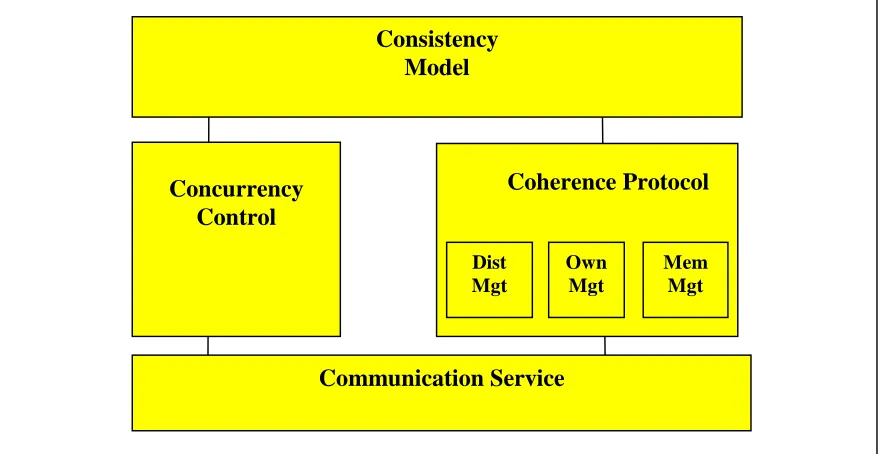
The structure of the framework is as follows (Weber et al., 1998). There are three elements
in the DSM: Consistency Models, Coherence Protocols and Concurrency Control. The
consistency models and coherence protocols perform the roles that were identified in the
last chapter, defining acceptable event-orderings and implementing those event-orderings.
The concurrency control implements locks and barriers that are used by the consistency
Consistency Model
All consistency models are derived from a base class that defines the common interface for
consistency models: the operations read, write, lock and unlock. This ensures that they all
can perform the function of a consistency model in the framework. Lock and unlock have
corresponding methods in concurrency control. Read and write have corresponding
methods in the coherence protocol base class that perform the actual accesses. There are
subclasses of the base class for strict and relaxed consistencies. The classes for actual
implementations of particular consistency models can then be derived from either the strict
or the relaxed consistency model. As we will use Release Consistency and Lazy Release
Consistency, these two are explained in more detail below.
Release Consistency
Release consistency defines two primitives that stand at either end of a critical piece of
code: acquire and release. Updates are not forced until the release is encountered, the hope
is that several updates will have taken place, and only one message will be required to
deliver them.
This is implemented as shown in Fig. 2. A worker wishing to update shared data makes a
lock request. The master replies when the lock has been established. The worker updates
the master with the new value of the shared data and requests an unlock, (i.e. release is Consistency
Model
Coherence Protocol
Dist Mgt
Own Mgt
Mem Mgt
Communication Service Concurrency
[image:38.595.89.529.71.298.2]called) this causes the master to issue an update to all relevant workers and then remove the
lock.
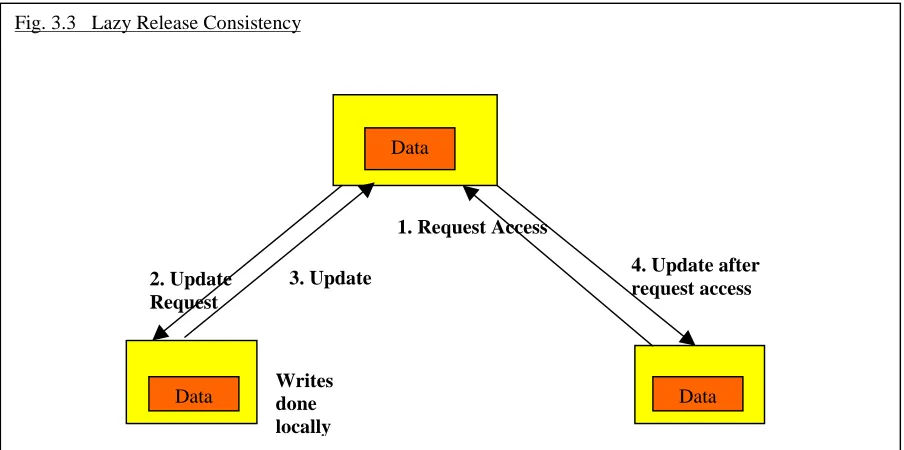
Lazy Release Consistency
Lazy Release Consistency is similar except that updates are not propagated to other workers
until they attempt to access the variable. The hope is that many updates will have been
made before an access and only the last update will be sent to the worker in question.
This is implemented by having each worker make its updates locally. Then when another
worker requests access the master gets the update from the updating worker and it is passed
to the worker requesting access.
1. Lock Request
2. Data Locked
4. Unlock Request
5. Update
6. Unlock
3. Update
Data
[image:39.595.85.536.110.333.2]Data Data
Fig. 3.2 Release Consistency
2. Update Request
Data
Data Writesdone Data
locally
1. Request Access
4. Update after request access 3. Update
[image:39.595.76.528.527.752.2]