5550
A STUDY OF THE DIGITIZATION PROCESS TO PRESERVE
THE CULTURE AND HERITAGE OF A CIVILIZATION
USING NATURAL LANGUAGE PROCESSING AND IT’S
IMPACT ON THE SOCIAL, ECONOMIC AND SCIENTIFIC
ASPECTS
1MUKESH MADANAN, 2NORLAILA HUSSAIN, 3ADEEL AHMAD KHALIQ
1Lecturer, Dhofar University, Department of Computer Science, Salalah, Oman
2Assistant Professor. Dhofar University, Department of Computer Science, Salalah, Oman
3Lecturer, Jazan University, Department of Computer and Network Engineering, Saudi Arabia
E-mail: 1[email protected], 2[email protected], 3[email protected]
ABSTRACT
Venturing into the arena of digitization, technology has been innovative in establishing digitized manuscripts and e-books. Digitizing and archiving manuscripts and documents blanketing texts and images using digital cameras and scanners are being viewed as a stepping stone to the use of technology. To be a part of Generation Next, focus has to be on up to the minute technology of digitization. This entangles to preserve not only manuscripts but also the culture and heritage depicting it. Preserving the artefacts, manuscripts and paintings through primitive techniques physically in historical societies and libraries has limitations. Highlighted restraints are access to general public and lack of facilities to safeguard valuables and keep in place their vulnerability. Manuscripts and documents when archived through chemical methods do not most of the time depict actual bearings. Digitization of rich culture and heritage documents and manuscripts would recalibrate these constraints and iron out most of these limitations. The paper focuses on the digitization process to preserve the artifacts using natural language processing techniques and indexing and also highlights the future of digitization to enhance the cultural heritage of a nation.
Keywords: Digitization, Cultural Heritage, Metadata, Indexing, Database Management
1. INTRODUCTION
Information technologies today are rapidly evolving and have a compelling impact on the day to day routine. Globalization has brought the world within a box of communication where everyone leads a uniform life. This has recently influenced the eradication of culture and heritage from the minds of youth causing loss of their unique identities. The young generation also seems to be very gradually erasing their traditions and incorporating minimum values from their ancestors.
Preservation of culture and heritage has been recognized as the leader in advocating conservation. The legacies and evasive values of physical artifacts have to be passed on to the
Generation Next. Manuscripts, documents,
archeological sites and monuments at the moment symbolize the cultural heritage of a civilization. Magazines, paintings and artworks also heap up the
civilization history. As a matter, even today’s living testimony has to be recorded and passed on to the next progeny.
5551 Data capture or acquisition is done normally using a digital camera or scanners.
With the advent of technology, the preservation techniques also have to be leading-edge. Digital technology has been the magic wand in the techniques recently used to do preservation and conservation. From mainframe computers of the 1940s, which were costly, labour intensive and maintained centrally by large organizations, via the introduction of micro and mini computers in the 1970s and 1980s, to the development of improved, inexpensive processors and memory which influenced the personal computing revolution in 1990s, these changes have dramatically affected the way we live and work [5]. But with the importance of culture and heritage preservation grooming, we have to look forward to the new swing in digitization strategies and techniques. The digitization of the text and literature has to be seen
with remarkable vitality. Alongside the
preservation of literature and manuscripts, prior importance has to be given to safeguard the manuscripts and art forms. As Cassar M. states “Efforts to preserve and enhance cultural assets not only reduce the risk of permanent loss of diversity among the immoveable and moveable heritage, but they can provide important benefits and
opportunities for greater social cohesion,
reinforcing a common identity and strengthening socio-economic aspirations” [15].
The conventional environment and craftsman’s experience of a civilization is transferred by the cultural heritage. The progress of a civilization is also depicted by the culture. The preservation of the historical monuments and architectures has not been efficiently executed due to the time constraints and technology hindrances. To an extent, natural disasters and wear and tear have also caused the destruction of such valuable piece of history. To render the culture and heritage of the a civilization, the digitization techniques have to be integrated to the preservation methods which in turn would lead to building a repository of preserved civilization. The ancestors have recorded most of the details of history in terms of writings which are preserved using traditional methods such as chemical treatment and preservation techniques in cultural heritage institutions and museums. But such preservation has limitations where access to public and researchers are limited.
The digitization of cultural heritage which has been recorded in the books and manuscripts is a
multidimensional process. Digitization will involve selection, assessment, ranking, project management and tracking during the first phase. The secondary phase will follow with preparation of originals for digitization, metadata collection and creation and digitising. Succeeding the digitising activity, the process of quality management, data acquisition and management, submission of scanned images to systems for storage, and assessment and evaluation of the digitization effort will follow. The methodology or phases will involve planning the entire process followed by digitising the manuscripts and documents and leads to the process of maintenance and error prevention. The phases throughout the digitization project are overlapping to ensure quality and standard. In the research paper by George P. and team it has been mentioned that “The whole process involves digitization, data processing and storage, archival and management, representation and reproduction”[10].The vitality that distinguishes the digital preservation context from the analog one is the sheer scale of it [17].
The selection of the artifacts and manuscripts for digitization will be based on certain criteria such as demand, copy right, funding etc. The digitization will also focus on a framework which spotlights on data capture and creation, access and delivery along with managing the collection. The digitization process can be seen as primary step in preservation which will also involve the data retrieval methods. Sporleder explains” The main reason for most of the large-scale digitization projects, however, is the fact that governments worldwide have come to view cultural heritage as a valuable asset, both ideationally and economically” [2].
1.1 Culture and Cultural Heritage
5552 are recorded in books and ancient manuscripts. Hadžić,O states that “culture can be justified for tourism, for industry and for employment, but it must also be seen as an essential element in preserving and enhancing national pride and spirit” [4].All the sites and locations represent the vast history of a civilization which has to be preserved and conserved for the future generations. Heritage preservation and interpretation are indispensible elements in the conservation natural and cultural resources[4].Though modernization and technology has caught hold, the culture and heritage and living tradition have to be upheld. The landscape and architecture is a niche of old world wonders which are very unique and preservation of such heritage should be of prior importance.
Literature and architecture are one of the prehistoric forms of arts and crafts. Though urbanization has taken effect, the rural inhabits are of vital importance. The complexity of literature and architecture has certainly increased with time and become more contemporary. The manuscripts and architecture of the past reveal a lot about the human history. Architectural heritage is the most important facet of cultural heritage. One of the most important parameters in describing cultural heritage is historical space and historical time [16].
The culture of a civilization is very much dependent of the geography and location. The cultural divergence is clearly pictured in most of the writings and paintings. The historic architectural sites and buildings reflect a simpler cultural expression but the private residences reveal the gendered architectural space. Passing a civilization’s exceedingly rich culture and heritage and lifestyle to the generation next is done primarily through manuscripts and literature. The art, culture, folklore, artistry and architecture of a civilization are tremendously viewed as exotic by the tourists. Preservation of the cultural heritage has been of prior importance with focus on retrieval of cultural information which can be achieved through the digitization of the books and documents. A well preserved heritage enables communities to learn
about their cultural history truly and
chronologically [25].
1.2 Digitization
Due to the introduction of various technical strategies, the preservation of the existing collections and creation of new assortment has been the focus of cultural institutions and governments
all over the world. Latest trends have opened a new doorway to preserve the cultural heritage of nations using the improved techniques and methods of digitization through which digital archives are created and managed. Digitization can be used as a promotional tool as it reduces the distance between the public and the objects which are of historical importance. Moreover the digitised content could be displayed and exhibited through various forms of technology. Digitization breathes new life into materials from the past, and turns it into a formidable asset for the individual user and an important building block of the digital economy [22].Digitization allows cultural heritage institutes to provide continuous, simultaneous and world-wide access to their collections, including those objects which are usually not on public display due to lack of exhibition space or due to their fragility [2].The digitization process is non-linear and decisions made about technical standards will affect all future uses of digitised images, whether they are suitable as archival images available for a digital preservation strategy [13].
Digitization refers to art of converting physical analogue originals to digital objects. The digitization strategy has proved to be very much efficient in preservation of the originals in digital format. The digital format organizes the objects into bits of data which are easily addressable and accessible. The process is very loosely explained or defined but it encapsulates a lot of management and technical processes and activities. The selection of artifacts and materials for digitization, processing of the files created, storing and preserving and distribution and retrieval are some of the activities involved in digitization process.
The process is very tedious and requires a well described collection of parameters and instructions on establishing and implementing. Depending on the nature of the collection of digitised objects to be created, the sophisticated
technical processes involved varies. The
digitization will comprise of document handling, creating and managing metadata, scanning, image processing and indexing. This will also render the disaster recovery features. In cultural heritage
documentation, choosing the appropriate
5553 systems, data collection and management, making digital copies and associated metadata available, assessment and evaluation [11].
1.3 Natural Language Processing
The digitization is only a step towards preserving the cultural heritage. After scanning, the data has to be saved and given unique title or reference numbers which can be termed as metadata. The metadata created gives only information to humans and to facilitate their searching. For machines to understand, the human metadata created will pose a problem because of its language ambiguity and specification. Moreover, it may sometimes lead to substandard results during data retrieval. In certain situations, data retrieval may lead to incorrect results based on the search query. This may be due to the lexical ambiguity in the entered query. In order to access the information saved and stored in the database, the data about the digital content has to be enriched and polished. A way to reduce the lexical ambiguity is to set up a set of metadata and naming conventions .This opens up research topics in natural language processing. Always the language used for the process varies and may not be standardized. The ancient languages may be multi-lingual which requires a lot of understanding and knowledge. In addition to this, there may be issues of the manuscripts being in variety of modes which may possess hindrance.
One way to restrict this language ambiguity is to regulate metadata to certain vocabulary. Controlled vocabularies are often organized hierarchically into a thesaurus or knowledge base which can aid automatic query expansion [2]. This can lead to enforcing a one to one mapping between meaning and form of the object created. The use of metadata from this vocabulary will reduce the errors in data retrieval and provide accurate results. Data cleaning can reduce the errors in the recording of metadata. Normalization can also lend in hand to minimize the errors by segmenting the data.
Natural Language Processing will provide a platform to move from simple text to knowledge base data storage. For accurate data retrieval we need to save and store data in an organized structured form in a knowledge base. As the artifacts are marked and catalogued before the digitization process, each label in the catalogue can
be made a database field in a sequence labeling task. In certain situations, the metadata creation has to be very precise to enable data retrieval of certain artifacts when available in digital format. This can be achieved by automatic metadata creation which is facilitated by most of the scanning softwares during digitization. As the focus is on ancient manuscripts a detail study of the typical spelling and vocabulary may be needed. Data retrieval being querying the databases, we need to be accurate when using modern language to search as the ambiguity of spoken languages may be a hindrance in the process. Therefore, the queries have to be converted to ancient spellings or an alternative may be to convert these ancient manuscripts’ index or metadata to new age equivalents.
The digitization project will provide a better understanding of the language processing process including tokenization and parsing. During tokenization, the metadata will be broken down to suitable tokens. Through the process of digitization and saving the digital contents we can also aim at designing a language component which co-relates digital image and textual analysis. The language analysis component can be used to provide accurate data extraction during the information retrieval process. The process will focus on a service-oriented platform keeping in demand the necessity of cultural heritage preservation. Another focal point of the digitization project will be to design and develop tokens, taggers and recognizers along with extractors which can be handy while information searching is carried out. Future enhancements of the digitization project which could be considered would be computational statistics and cognitive science
2. FRACTIONALE AND IMPORTANCE
Literature and cultural heritage provides a connection to the social values and beliefs of the society. The cultural heritage draws people to the ancient traditions and practices which were followed by their ancestors. The study of ancient literature might prove to be beneficial in providing the nationals a sense of unity. Moreover it provides a better understanding of the ancestors’ life and their earlier generations. By preserving the literature we indirectly conserve the cultural heritage.
5554 benefits which are quite evident from the preservation of cultural is communal support. The cultural heritage comprises a vast amount of large and minute things which the ancestors of the community have written in the manuscripts. The ancestors have recorded their life styles, architectural designs and ancient history in the writings. The agriculture and landscape are also a part of the cultural heritage. A lot of these have been mentioned and recorded in the books, journals and manuscripts.
The purpose of digitization project is to preserve the documents and manuscripts so as to facilitate knowledge to younger generations. The main aspect of the preservation of culture is to archive the history in such a manner which will reduce the physical and chemical deterioration and minimize damage of the original artifact. Primary goal of such a process is to prolong the existence of these manuscripts and ancient documents. The culture of a prior civilization shapes values and aspirations of the existing generations. Digitization is also a means of creating resources that can be re-purposed for unforeseen uses in the future [5].
Cultural integrity is very important which distinguishes people from one another. In addition, the preservation of cultural heritage digitally will enhance the need of assimilation and competence of education. Moreover the preserved cultural heritage in terms of manuscripts and books could be refurbished in case of timely deterioration. Such preserved heritage will attract tourists thereby increasing the economic stability. The temperament of such artifacts by nature is unavoidable but referencing the digital preservation content, they could be restored at any time. The importance of preserving culture, gains importance with time as people relocate from one place to another and become busy to reflect their pedigree. In order to keep the history intact for the days of future and reduce the risk of endangerment it is very essential to preserve the cultural heritage.
Preserving the cultural heritage can be achieved in a number of ways. The latest trend has been to use various ways of technology to speed up and digitise to the maximum the available resources. When thinking of a long term strategy, digitization method ranks at the top of the list. A number of advantages have resulted in this top ranking. One of them is easy accessibility to the general public. Any digitised content can be stored in the digital format and shared through various
means of technology. In addition, when the content is available in digitised form, the number of people accessing the media or object at the same time can be numerous compared to the physical visit. Preserving the cultural heritage digitally will enhance the integration with technology and applications and improve the knowhow. Digital storage will allow information sharing and enhance the popularity of the content in a short span. Going green has been the motto of the Sultanate and preserving contents digitally will certainly reduce paper and save botany. The secondary aim of preservation is reuse. When digitised, the content can be reused and accessed a number of times without causing any damage to the original artifact. The contents are indexed and such a process will enhance data retrieval much easier when compared to the manual process of preservation. In the case of books and manuscripts when preserved digitally can serve as a measure of republishing if the originals are subjected to natural wear and tear. This can in fact serve as a source of disaster recovery and backup. Advantages of the digitization technique does not sum up to the above. It provides a copy right for the content where the accessibility rights are to the original author. The reduction of storage space is another achievement of the digitization technique. The digitization technology will certainly prevent the loss of data caused due to deterioration and mishandling in cultural institutions. The process will also reduce destruction or obsolescence use of the original
artifacts. Digitization contributes to the
conservation and preservation of heritage and scientific resources; it creates new educational opportunities; it can be used to encourage tourism; and it provides ways of improving access by the citizen to their patrimony [4].
5555 involve polishing, enriching the information which can be attained by data processing and image processing.
3. STATE OF THE ART
With the emergence of technology and globalization, a need to preserve the history has been observed as an important task. A number of methods have been used recently to capture the history and retain it for the future. A lot of effort has been put into the process of preservation and the momentum is tremendously increasing due to both human and natural factors. The museums, libraries and cultural institutions in the country hold a number of collections which were accumulated over years. The aim of these cultural institutions is to bring the users close to the culture and heritage of the country. Traditional preservation technique still deters the archiving of such cultural heritage manuscripts.
Digitising the document preserved in cultural heritage institutions and museums only marks the beginning of the process. The digitised content created will be stored in a database management system which should be easily accessible and maintainable by the use of sophisticated devices. Activities such as cleaning, connecting and data refining succeed digitization
process. The main advantage of digitization technique is that it allows flexibility depending on the type of material to be digitised. The process is time consuming as well as the expenditure inclusive of manpower and equipment for it is quite high. The process of digitization is very complicated which requires a lot of knowledge in data acquisition and analysis, leading to rendering a modeling of the data or monuments. The process will be inclusive of surveying, drawing and designing, and a lot of post digitization activities such as data management and data storage and retrieval. A lot of policies have to be created and developed by a dedicated team of professionals to start the process of digitization to preserve the culture and heritage. A draft with specified deadlines has to be drawn in order to facilitate easy structure of the project. The process policies will revolve around the cost, time, labor, selection, equipment for digitization and subsequent digitization activities such as data management and data retrieval.
The process will also mark an end to the pen and paper based collection management which caused a lot of burdensome to the staff to search for a particular document in chunks of volumes of catalogues. Safe guarding the data loss is main objective of digitization project. The backup process has to organized and well – maintained in order to facilitate future accessibility for various
5556 groups concerned with education, research and innovation.
3.1 Manpower
The main area of digitization is the skill sets of manpower employed to achieve the success and aims and objectives of the project. The initial step of the digitization team will be to collect the ancient manuscripts and documents from the site and bring it to the digitization center which will involve a lot of care and training to handle these artifacts. Prioritizing the artifacts will be a major consideration factor for the people involved. Other responsibilities of the manpower will be cataloging and recording and sorting of the original artifacts to be digitised. In addition to this, the condition and importance of the artifact to be digitised has to be assured keeping in mind the value it will bring to the cultural society. In some special cases to achieve digitization to the maximum, the artifacts and manuscripts might require cleaning which should be only handled by experienced and well qualified staff. The members will be solely responsible for the equipments involved in digitization activity and any faults which may occur should be reverted by proper training before the process starts.
3.2 Selection and Identification of the artifacts
Creation and management of a digital collection will involve data capture, data access and delivery along with the management of the collection. Digitization project is very unique keeping in mind the aim is to preserve the culture and heritage embedded in the documents and manuscripts. The initial step in digitization procedure is the selection or identification of the artifacts and materials. Artifacts are critically assessed to determine their potential values depending on the need and priority. This in turn will also result in the feasibility of the digitization project. A number of factors such as demand, rationale and relevance also guide to the selection criteria. High consideration and concern should be given to the availability of the original artifact for the purpose of digitization. In addition to this, copy rights of the originals have to be attained. Moreover, selection of the available technology needs to be precise so as to accommodate image capturing of such ancient manuscripts. The process of digitization will also focus on the creation of
metadata which has to be feasible to the technical standards.
The digitization project is undertaken to fulfill accessibility need of the clients and users. The type of users who will be accessing the collection is a primary factor along with the delivery of the content to them. The condition and feasibility of the originals have to be carefully examined. Any sort of manuscripts, books, letters, architectural drawings, photographs and prints could be considered and given prior importance. Special care has to be taken when handling such a piece of history as they are always subjected to wear and tear. The manpower involved in handling such historical important artifact should be provided ample training to do so. The physical state and quality of the original artifacts to be digitised has to be considered as this may affect the quality of digital image. One of the central questions for building the digital assets is whether the digital resources will be having sufficient impact in the world [22].
3.3 Equipment and Training
The digitization process will involve the use of lot of softwares and hardwares. Softwares will be required to do the scanning and data capture image of the artifacts. Softwares are also required for formatting the data and tagging of the metadata created. Hardwares such as high precision scanners, hand held laser scanners and high precision digital cameras will be used to scan and capture the digital image of the artifacts. Laser scanners and digital cameras will ensure that the scanning process will be non-contact one and will comply with the damage restriction policies of certain artifacts. Other materials which will come handy are gloves for handling original artifacts and containers for storing the original artifacts before and after digitization.
5557
Preservation of the original artifact is very important as per the culture and heritage norms. Always the physical artifact is a separate entity when compared to the digital artifact created. In our project, we aim to create two digital copies of the artifact, one of which will serve as the master copy and the other will be used for client access.
3.4 Software and Hardware
The digitization process will involve the use four categories of softwares. The first category will be a set of softwares to scan the artifacts and manuscripts and the second category will be used to edit and skew the scanned digital images of the artifacts. The process will also require accurate color reproductions which need monitor calibrating softwares. The photo editing software should facilitate the tagging of images via extended metadata platform. The quality control will be dependent on the color parameters of the digital image created. The scanning process will involve use of scanners equipped with high quality cameras which enables high precision data capture. The scanners selected should be able to produce both grayscale and color images at a wide range of image resolutions. The monitor calibrating software will be used to regenerate the color of the digitised image by quantifying the output of the monitor. In order for the human eye to render these colors, precision between original artifact and digitised content the calibration software is very much essential. The photo editing software will be used for reproducing the color temperature and saturation and hue of the original artifact. The documents and manuscripts will be scanned with or without the use of any auto-correction methods depending on the nature of the artifact. This is done so that the professional working on the calibrating software can modify the color combination accordingly to suite the original document scanned. The format of the digital object should be decided to facilitate the storage and retrieval. We will be crating two versions of the digital artifact-master copy and access copy. The master copy will be saved in the TIFF (Tagged Image File Format) and the access copy will be in JPEG (Joint Photographic Experts Group).The size of the image will be a criteria as this has to be in accordance with the storage and retrieval efficiency. The digitised content will be stored and moved to an integrated data management system (IDMS) which will be the fourth category.
To maintain the quality of the digital content a number of processes might be required. Some of the digital content after scanning will have to be re-oriented to be saved in the digital repository. The digitization professional when scanning and saving the file in the IDMS should not crop the image so as to ensure the entire painting or art or page of book or manuscript has been captured completely. The file naming conventions has to be unique so it can be easy to identify and retrieve information from the database. The digital content after scanning will become a unique identity. Hence a lot of care has to be taken to avoid duplication of
the work or the metadata.
Hardware Specifications recommended:
PC Configuration
Processor: Intel i7
RAM:8GB
Hard Disk:2TB
Network Adapters:2 gigabit Ethernet
Graphic adapter with Digital
output(DVI-D or Display Port),Minimum
Resolution:1920 x 1080
Monitor:24” or larger, Resolution 1929 x
1080 or higher
Hardware calibrate able Monitor
recommended
Operating system: Windows-[ 7(64 bit) or
above] or Mac OS X [v10.6 or above]
Scanner Specification:
CCD(Charge Coupled Device) : Trilinear
CCD 14.400 pixel
Lenses: 80mm and 120mm
Variable Scan Resolution Magnification
Range: with 80mm lens: 240-900ppi,with 120mm lens: 400-1800ppi
Variable Texture Effect: for left mode only
Variable Reproduction Angle: 0°,10° and
15°
Original holder: 150 x 250cm
Maximum size scan: 240ppi: 250 x
150cm,900ppi: 250 x 40cm, 1800ppi: 250x 20cm
Maximum Scan Height with Light Angle
Device: 60cm
LED lights: with automatic light
positioning
3.5 Metadata and Indexing
5558 to store and save data and images in a way which identifies each and every object individually. This information regarding the objects and artefacts which are digitised is termed as metadata. Metadata can be in turn considered to be data about data stored in a database or any other storage sources. Metadata can serve many purposes depending on the person interacting with it. They can be used for technical, administrative, descriptive, preservation,
transport and usage purposes
.
The registration of the metadata for the digital objects is an important task and has to be done very accurately. A descriptive metadata for each of the digital object created will definitely provide uniqueness. Additional information can be provided in terms of date and time for each metadata. The management of the digital objects is governed by factors such as uncovering of the complete details regarding the digital content, acceptance of the format in which the digital object is saved and stored, extent to which the users can use the digital objects etc. In addition to this, the change of technology which may be used in future should also be considered along with the technical aspects. For longevity and scalability, the best practices used in this project will be documented, covering items such as file naming conventions, metadata entries and structure, and other archival
concerns, starting with the digitization
documentation [6].
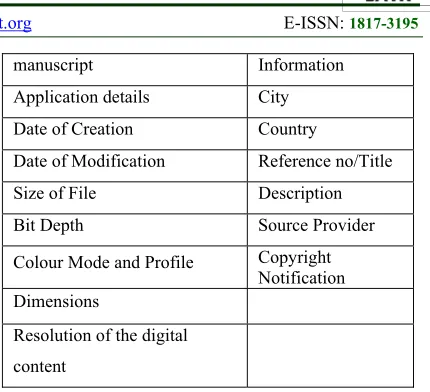
[image:9.612.312.527.67.263.2]As the goal to create a metadata collection of digital repository is for long term, ensuring the metadata created will facilitate data migration to which ever platform will be used in future is vital. The solution to this is to keep in touch with similar digitization projects which will further motivate knowledge transfer via conferences on digital technology and culture preservation. Re-use and contextualising is crucial for cultural content and if the metadata standards and interoperability rules are followed, the user can create his own virtual collections in minutes, can learn the stories behind the object of his interest, can organise and re-use his personal collections, share with others, print, etc [23]. The metadata will be technically created and will comprise of the following:
Table 1: Metadata Set for Digitization
Technical Metadata Additional Metadata
Name of File File Creator
Type of Document or Contact
manuscript Information
Application details City
Date of Creation Country
Date of Modification Reference no/Title
Size of File Description
Bit Depth Source Provider
Colour Mode and Profile Copyright Notification Dimensions
Resolution of the digital content
In addition to this, it is recommended to develop and create bibliographic metadata to provide details of the manuscripts
3.6 Quality Assurance and Control
The digitization process is undertaken to preserve the cultural heritage of a civilization. So all measures has to be taken to ensure the quality of the deliverable is above par. The primary step is the quality of equipments used for the process. The scanner used should render the colour quality of the object to be scanned to the maximum. Colour imbalances can be rectified by the use of monitor calibrating softwares and colour processing softwares. These all factors regarding colour aspects need precise training of the staff which is provided in the pre-process. In a digitization process, one of the most important areas is colour management of the digitised content. Monitor calibration is the first and most important step in colour management [1].
5559 and Quality Assurance (QA) metrics will be designed to keep track of the quality aspects of the artifacts being digitised along with a quality maintenance record for the equipments used. The quality and integrity of born-digital material will have an influence on how rapidly it can move through the production and descriptive process [12].
3.7 Digital Back up and Disaster Recovery
As the aim of the project is preservation, we have to take into account long term preservation and disaster recovery aspects. In order to achieve this, back up of the digital repository of artifacts should be created and stored at on-site location and should be updated on a daily basis depending on the digitization carried out. In addition to this, it is also suggested to keep an additional back up of the digital contents to safeguard the preservation of culture and heritage. This secondary back up should be kept at an off-site location. This back up should also be updated on a regular basis to save the digital collection so as to serve as an emergency option in case of disaster recovery. In addition to this, we can focus on Network Attached Storage (NAS) and Storage Area Network (SAN) to achieve long term for the master copy of the digital content. Similar to the value and security of the original artifact, the security of the digitised content is also important which can be restricted to only authorized person involved in the project [18].
4. DESCRIPTION OF THE PROPOSED
DIGITIZATION PROCESS
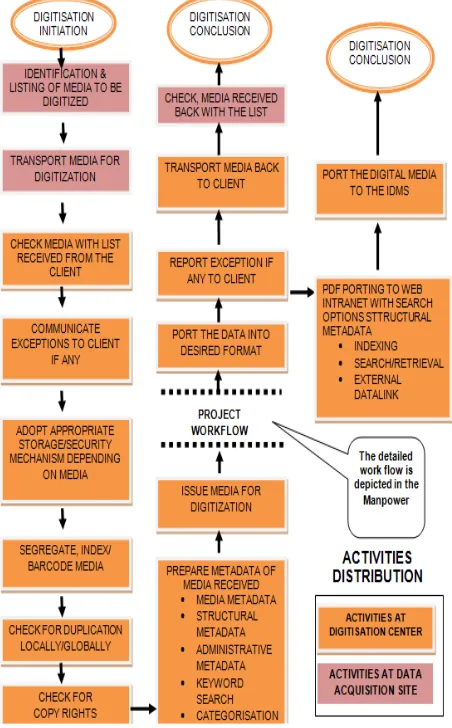
A draft plan has to be created to facilitate all the stages which will lead to success procedure of digitization project and will ensure proper preservation and data retrieval. A well defined set of policies and benchmarks to maintain quality is also be outlined. A high level DFD is proposed in Figure 2(Digitization Data Flow) that depicts the proposed methodology of the project. The generic digitization process that will encompass and implement all the key functionality and features for proper execution of this project is defined here.
4.1 Methodology
The entire digitization will comprise of a variety of stages such as consulting the collaborators and planning and defining a digital infrastructure. The digital infrastructure comprise of two key components: the digital preservation network of partners (creators, owners, collectors, users) collaborating to preserve and provide
long-term access to digital content; and the digital preservation architecture (structures, logical components and logical relationships), the technical components that enable digital preservation [17].Digitization in the modern era has been so far the go to solution for preservation of culture and heritage. The DFD below divides the activities involved in digitization process to mainly two places namely: activities performed at Digitization center and activities performed at the acquisition site.
Figure 2: Digitization Data Flow
[image:10.612.316.542.233.597.2]5560 integrated database management system for storage after scanning and calibration. For long term archiving, implementation of SAN and NAS is required. This is in addition to the storage of digital content in the hard drives and system storage. The digitization process will add value to the cultural and heritage exhibits and make them more exposed to the scientific world. This will enhance the research and interest of researchers and upcoming generations.
4.2 NAS and SAN Implementation
As the main goal and objective of the digitization process is long term storage and preservation we need to have a database where there is option for advanced storage and information management. Two storage techniques can be considered for this purpose-Storage Area Networks (SAN) and Network Attached Storage (NAS). In addition to this, we will be using traditional data storage model which consists of disk drives attached physically to the database server. The database is connected to the server using SCSI or SSA. But adoption of this strategy is restricted as compliance with scalability, restriction of distances between server and database, multiple
[image:11.612.316.521.237.275.2]storage sharing and performance and speed
.
Figure 3: Data Storage Model
Network Attached Storage may be considered a modification of the traditional model where the network sharing of the information is added. In NAS, a number of storage drives are connected to database server which facilitates storage across the network through protocols such as NFS and TCP/IP. Considering the traditional model aspects such as distance between server and database could be eliminated in addition to improvement in the speed and data management. As the model includes a number of networks, the load over the network will be high as the number of requests to be processed will increase.
Figure 4: Network Attached Storage
[image:11.612.91.298.437.478.2]Storage Area Networks reduce the load on the server by providing fiber channel base.SAN uses RAID hardware which provides mirrored caching and dynamic storage allocation. In addition to this, data protection and backups can be easily obtained.SAN also provides support for databases on various platforms. By implementing SAN we could also consider implementing a clustered database. The basic difference between NAS and SAN is that in the SAN the disks in RAID array are not shared at the file system but at the block level.
Figure 5: Storage Area Network
In traditional database storage access model, servers accessing storage involves three basic steps-client requests data from the database server over the network, database server does disk I/O and the result is sent to the user or client over the network [24].Compared to the traditional model, the NAS model has five basic steps to access the data[24].
The additional step which is included in the NAS model is that the database server should request the NAS server for the I/O disk check which in turn provides a response to the database server following the reply from the database. In SAN, the client makes data request over the network to the database server, database server performs the I/O over the fiber channel I/O bus to hardware RAID and then database server sends results back to the client over the network [24].
4.3 Tasks and Phases
Following would be the schematic of the various tasks involved in the proposed project.
1. Requirement gathering Phase: While the
macro level requirements of the project have been understood to get a more granular insight into the requirement of the project, the requirements in the following areas are gathered.
a. IDMS customisation
b. Document preparation and preservation
and handling
c. Digitization standards
d. QA, QC and metrics
[image:11.612.90.299.662.700.2]5561
f. Storage and backup
g. Site inspection for digitization facility
2. Design Phase: Based on the inputs from the
Requirements gathered the following strategies are designed.
a. Document handling strategy
b. Identification of scanners and
equipment for image processing
c. Customisation of the automated
workflow
d. QC strategy and deliverable structure
e. IDMS customisation and deployment
f. People requirement.
g. Hardware architecture design
h. Storage and backup policy
i. Metadata schema
j. Additional software requirements
k. Site layout and work areas definition
3. Site, document and equipment preparation
a. Preparation of the site
i.Segmenting the site and layout creation ii.Painting
iii.Lighting and backup power iv.Networking
v.Tables chairs and furniture
b. Equipment preparation
i.Power and backup ii.Installation
iii.Calibration of scanners
c. Servers, PCs and storage installation
d. Installation of customised IDMS software
e. Installation of workflow-customised with
all elements
f. Installation of all accessory software
g. Procurement of document preparation
consumables
4. Implementation phase
a. Kick-off with recap on procedures for
various teams
b. Setting Standard operating procedures
for
i.Document preparation ii.Scanning
iii.QC Protocol iv.Communication
c. Creation of roles, users and tasks and
assigning to respective persons.
d. IDMS links establishment
5. Operations and production phase
a.Document preparation
b.Metadata Preparation
c.Scanning
d.Segmenting and Structural Metadata
preparation
e.Quality control – at various stages of
workflow
f.Export of data to the IDMS – Metadata
and Images
g.IDMS rendering of data
h.Process Adherence Monitoring
i.Document Accounting
j.Maintenance, preventive and breakdown
of the following : i.Scanners ii.Servers
iii.PCs- Peripherals iv.Storage
v.IDMS vi.Infrastructure
Based on the tasks and phases explained above, the following deliverables are expected:
i. Assessment Matrix with Document control
sheet
ii. Digitised object
iii. Data Migration
iv. Final Technical report of the project
5. MANAGEMENT PLAN AND PROJECT
ACTIVITIES
The project should be managed by a management committee consisting of the lead researcher and other members. Project technical progress, financial updates, commercialization, dissemination, and technology transfer, as well as project reporting should be discussed on a regular basis. Regular interaction with the industry group will also ensure that the project is meeting the objectives of the interested industry partners.
Management Plan will be as follows to cart the deliverables:
1st Deliverable: The Technical report
summarizing the state of the art, requirement specifications and test best deployment experiences.
2nd Deliverables: Digitised Object
3rd Deliverable: Data Migration
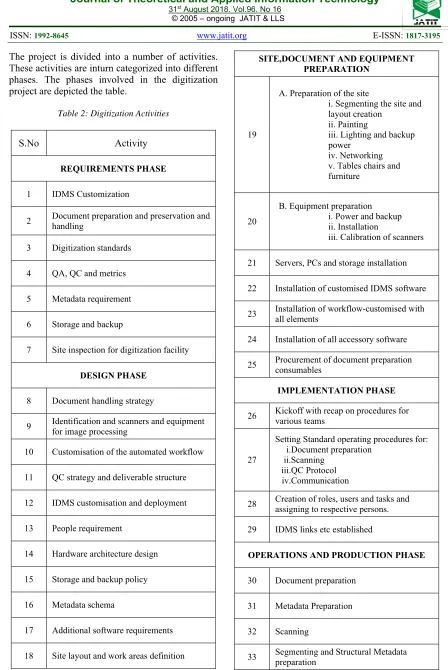
5562 The project is divided into a number of activities. These activities are inturn categorized into different phases. The phases involved in the digitization project are depicted the table.
Table 2: Digitization Activities
S.No Activity
REQUIREMENTS PHASE
1 IDMS Customization
2 Document preparation and preservation and handling
3 Digitization standards
4 QA, QC and metrics
5 Metadata requirement
6 Storage and backup
7 Site inspection for digitization facility
DESIGN PHASE
8 Document handling strategy
9 Identification and scanners and equipment for image processing
10 Customisation of the automated workflow
11 QC strategy and deliverable structure
12 IDMS customisation and deployment
13 People requirement
14 Hardware architecture design
15 Storage and backup policy
16 Metadata schema
17 Additional software requirements
18 Site layout and work areas definition
SITE,DOCUMENT AND EQUIPMENT PREPARATION
19
A. Preparation of the site
i. Segmenting the site and layout creation
ii. Painting
iii. Lighting and backup power
iv. Networking v. Tables chairs and furniture
20
B. Equipment preparation i. Power and backup ii. Installation
iii. Calibration of scanners
21 Servers, PCs and storage installation
22 Installation of customised IDMS software
23 Installation of workflow-customised with all elements
24 Installation of all accessory software
25 Procurement of document preparation consumables
IMPLEMENTATION PHASE
26 Kickoff with recap on procedures for various teams
27
Setting Standard operating procedures for: i.Document preparation
ii.Scanning
iii.QC Protocol iv.Communication
28 Creation of roles, users and tasks and assigning to respective persons.
29 IDMS links etc established
OPERATIONS AND PRODUCTION PHASE
30 Document preparation
31 Metadata Preparation
32 Scanning
5563 34 Quality control – at various stages of workflow
35 Export of data to the IDMS – Metadata and Images
36 IDMS rendering of data
37 Process Adherence Monitoring
38 Document Accounting
MAINTENANCE
39
i. Scanners ii. Servers
iii. PCs- Peripherals iv. Storage v. IDMS vi. Infrastructure
RESEARCH AND DEVELOPMENT
40 Data Set Preparation
41 Experiments Implementation
42 Results Publication
6. BENEFITS OF DIGITIZATION
Manuscripts and transcripts represented in analogue and images represented in canvas, negatives or glass plates reflect the cultural heritage of a nation. Drawbacks of these representations include bondage to the physical aspect, temperamental of these artefacts and loss of the original quality when duplicated. Digitization eradicates these drawbacks and puts the originality back into the artefacts if duplicated. The digital version procured after the digitization process provides linking to multimedia techniques and independency over the physical barriers is achieved. Storage options are also enhanced with the digitization aspect as it reduces physical space. With the latest trends in computing the digital content can be distributed to wide network of clients. The preservation of cultural heritage has an impact on the economic prosperity of country inclusive of the tourism and business. It also has an effect on the development of environment and education. The advantages of the digitization can be summarized as access, support of preservation
activities, collections development, institutional and strategic benefits, and research and education [5].
Global Accessible:
The digital content could be accessible to
authorized personnel from anywhere in the world.
The people all over the world can access
these digital contents at any time from any part of the world.
The contents will be available all time
24*7.
Minimize the cost and time of storage:
The digital objects would reduce the
physical storage space compared with storing lot of information as paper documents
In the commercial area, the space and time
required for storage and retrieval of paper based documents cost high. By digitising the objects and artefacts this will be considerably reduced.
In our digitization process, scanning
documents and interpreting them into digital system can reduce the amount of prime storage space and cost required by paper.
Quick Information Retrieval:
If the documents are scanned it could be
accessible from any computer by any
authorized people compared with
traditional paper based documentation which has to be housed in a file cabinet and request through another person for delivery.
The digitised content can be retrieved
easily and it can be shared and routed to any person who needs it.
Internet access:
In recent days at most all countries are
well equipped and connected through broadband networks; actually people need only internet and gadgets to access these digital documents.
Moreover these digital documents are
available with required format that the person expects.
Lost documents and disaster recovery:
This digital documentation process would
5564
We can recover the data and information
immediately after any calamities
Flexible Indexing and Data Retrieval:
Indexing the images of digital documents
can be done several ways, these can help to retrieve files by any word or phrase in the document, this capability is not possible with paper or microfilm based documents which are done manually.
The digital documentation system can
have single or multiple taxonomies and categorization.
The digital documents distribution is
multi-threading and folding, one image can be distributed to multiple terminals simultaneously.
Cultural & Heritage Preservation:
In this phase of project we would digitise
the cultural and heritage related documents and images.
Essential and significant credentials from
important eras in the history will be accessible online.
The cultural heritage of a civilization will
be known to the entire part of the world.
The project will also make accessible
recordings of traditional music, dance, paintings and other fine arts.
Internal relationship:
The document deliberates on relations
with other countries and region over political matters, trades and relationships.
The comprehensive selection of resources
gives detailed reports of the geography and mineral wealth.
Student’s benefits:
These digital documents would be helpful
to those studying about culture and civilizations.
The unique records could be easily
accessible by students and researchers.
The digital documents and photographs
could show the region’s older days after tremendous infrastructure development like road, flyovers and massive building structures.
The cultural heritage artefacts when available in digital format can tremendously enhance education sector. The educational institutions can directly approach and refer these
historical manuscripts and deliver an educational module based on these collections available. Dynamic learning of history and culture of the country would definitely grasp the interest of students when technology changes the faces of
books and manuscripts
.
Moreover, the benefits will also be institutional and national and strategic. The project will certainly mark an upgradation digital profile while converting the physical national treasures such as documents, arts and manuscripts to digital format which can be considered very prestigious. The project will in turn lead to the development of collection which is rich in diversity representing the culture and heritage. The rich corpus of data obtained through the project will open gateway for the research community to advance more in the direction of Natural language processing, image processing etc. It will also help the Government to preserve the historical records for life time. The digitised content would help the citizens and international research society to pursue research in this area.
7. ECONOMIC IMPACT OF DIGITIZATION
5565
8. SOCIAL IMPACT OF DIGITIZATION
Digitization would bring the world within a box where exchange of the cultural values could be facilitated. The ancient and antique manuscripts and documents would engage wider publicity and connections. In short it would be a
means to improve the information and
communication and strengthen the international links. Such a project will increase the awareness of the culture and heritage of the country among the citizens and foreigners. Throughout the phase of digitization, we will have to collaborate with multiple industries and organizations. The participation of the civil structures is highly crucial for the success of cultural heritage research, documentation, preservation and promotion [14]. The growing interest in the links between cultural heritage preservation and mainstream societal concerns such as development, environment,
health, education, access to information,
construction and the economy is self-evident [15].
9. ACADEMIC, SCIENTIFIC AND
INNOVATION SIGNIFICANCE
Digital technologies and applications contribute to the economic strength, societal well-being, and effective governance of a nation [20]. Modernity is the essence of the digital world and digitization can gradually change the face of academia and education. In a way, the technology is modifying the meaning of words and letters. The leap from print to digital format caused to an extent by technology boom will certainly mark an innovation in the publishing and educational institutions. Digitising the collections can be considered to be a technological development stage in the country. Technological development lead to multichannel, multimedia destination management system, serving purposes not only of travel information distribution, planning and fulfillment, but also of travel-related education and entertainment, which is important for sustainable development of tourism [4]. This will also enhance information sharing and knowledge distribution throughout. In long term, digitization can be considered to be building blocks of a digital economy. The project will also spice up accessibility of cultural heritage and knowledge and
will inject fuel in areas of advertising and tourism..
Teaching and learning excellence are also important cornerstones of effective digital resources [22]. Moreover, digitization helps researchers and
curators at cultural heritage institute themselves, as information can be found more quickly and curation process can be partly automated [2].
The advantages to academic research and advanced scholarship are equally impressive, and the potential of networked technologies to create a dynamic reading and scholarly environment is driving digitization initiatives at many institutions [5].The ancient manuscripts, maps, books and documents which were accessible only to a limit, through digitization will re-live and restore its grandeur. The data discovery of the digitised content will also be enhanced. The artefacts which are of historical importance will open up a cross cut relationship between different streams of research such as archaeology and typography. In addition to this, the creation of a digital collection will allow to develop relationships with cultural institutions. The information shared will be on the basis of workflows and knowledge databases and digitization standards. Digitised materials are perfect for training students en masse and preparing them for scholarly research [8]. Besides all these significances, the digitization will ensure perpetuation of the cultural heritage of the nation
10. CHALLENGES IN DIGITIZATION
5566 concern will be the human resource engaged with the project. The staff training has to be done from the initial stage of selection of the artefacts along with the conversion of the manuscripts to digital image and to the storage of this content in an
integrated database management system.
Digitization projects are rife with copyright problems, and their restrictive legal conditions can often complaint and consternation [7]. Digitization projects face great uncertainty with regard to the level of the copyright license fees due [9].
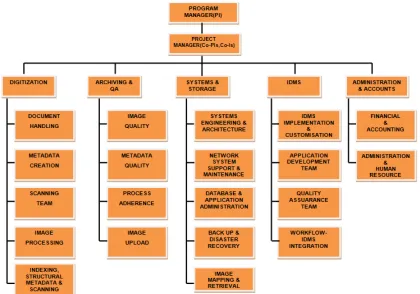
11. PROJECT EXECUTION BREAKDOWN
The staff involved is to manage and execute the scientific tasks of the project, design the theoretical solutions and supervise and support the other human resources to achieve the outcomes of the projects. They are also responsible for writing
technical reports
.
The work breakdown is show inFigure 6.
12. CONCLUSION
Digitization would literally accomplish archiving heritage and would provide resources to uphold the affluent and prosperous cultural heritage of even the smallest society. This will not only
prompt research aspects but as well be an aspiration to explore more aspects of technology when archives and surrogates created are made available at one’s disposal. Through the course of digitization, we not only conserve our past but ensure abduction of years to come as it remodels to our past.
The process of digitization will preserve artefacts and documents and provide access to authorised professional at any location on any time basis.
Data retrieval time will be considerably reduced as well. Data retrieval will open doors to new strategies in natural language processing in terms of creating metadata and indexing the artefacts including lexical analysis and data extraction. Digitization also enables the physical documents to be handled less and hence not detrimental to the documents that are in a fragile
condition without compromising on the access.
[image:17.612.103.523.234.528.2]As the value of the artefacts to be digitised is extremely high and the consequences to damage may be far fetching, scanning will need to
5567 be done on non-contact type overhead scanners which are both gentle on the documents and in most cases may not require the binding of the documents to be removed. This reduces the damage to artefacts some of which are extremely old and precious. Digitization will focus on facilitation of data access and prevention of data loss due to deterioration and obsolescence. Researchers could also approach such collections provided in the repository for analysis and review.
With more sophisticated process and techniques the process of digitization could be more simplified and brought down to a hands-on task. This could provide the way for preserving the culture and heritage through the digital printing techniques which is now available. The museums and cultural preservation centers could employ the process and print digital images of monuments and artifacts and make it available within the vicinity of public.The paper just aims to provide insight to the entire process of digitization through NLP and indexing. The process explained and explored are on the basis of methods followed in the digitization industry. Through the evolution of time, many of the process will be updated depending on the facilities available.
REFERENCES
[1]Zayed, A. A. (2009). Digitization Workflow and
Guidelines - University of Exeter.
[2]Sporleder, C. (2010). Natural Language
Processing for Cultural Heritage Domains.
Language and Linguistics Compass
[3]Grussenmeyer, P., Landes, T., Voegtle, T.,
Ringle, K., (2012), Comparison Methods of Terrestrial Laser Scanning, Photogrammetry and Tacheometry Data for Recording of
Cultural Heritage Buildings, International
Society for Photogrammetry and Remote Sensing
[4] Hadžić ,O.,(2004), Tourism and Digitization of
Cultural Heritage, Mathematical Institute SASA
[5]Why digitise? The costs and benefits of
digitization, Facet publishing, Retrieved from
http://www.facetpublishing.co.uk/downloads/fil e/sample_chapters/digitising%20collections%20 chapter%201.pdf
[6]Okerson,A.,Beaudin,E.,(2005), Iraq
ReCollection: A Proposal for Preserving Iraq’s
Cultural Heritage, Yale University Library
[7]Rikowski,R., (2010), Digitization
Perspectives,Sense Publishers
[8]Proffitt,M.,Schaffner,J.,(2009), The Impact of
Digitising Special Collections on Teaching and
Scholarship ,Reflections on a Symposium about
Digitization and the Humanities, OCLC
Programs and Research
[9]Korteweg,D.A,Hugenholtz,P.B, (2011),
Digitization of Audiovisual Materials by Heritage Institutions: Models for Licenses and
Compensations,SSRN
[10] George Pavlidis , Anestis Koutsoudis, Fotis
Arnaoutoglou, Vassilios Tsioukas,
Christodoulos Chamzas, (2006), Methods for
3D digitization of Cultural Heritage, Science
Direct Journal of Cultural Heritage Volume 8 Issue 1
[11] Federal Agencies Digitization Guidelines
Initiative, (2009), Digitization Activities,
Project Planning and Management Outline, Version 1.0
[12] Poole,N.,(2010), The Cost of Digitising
Europe’s Cultural Heritage : A Report for the Comité des Sages of the European Commission,
Collections Trust
[13] Youngs,K., (2010), Managing the Digitization
of Library, Archive and Museum Materials,
Collections Trust
[14] Borrissova,V.,(2010), Digitising Cultural
Heritage in Bulgaria A Survey of Intellectual
Property-related Experiences and Practices
[15] Cassar,M., (2006), Evaluating the Benefits of
Cultural Heritage Preservation: An Overview of
International Initiatives, Centre for Sustainable
Heritage
[16] Laužikas , R. ,(2005) Digitization of Cultural
Heritage: Model of an Integral,
Three-Dimensional Spatio-Temporal Thesaurus,
Online Publication System of the University of Tübingen
[17] Preserving our Digital Heritage, Plan for the
National Digital Information Infrastructure and
Preservation Program, (2002), Digital
Preservation-Library of Congress,Retrieved
fromwww.digitalpreservation.gov/documents/n diipp_plan.pdf
[18] Reddy, E.R, (2001)A Proposal for Action Plan
for Digitization of University Libraries,
Documentation Research and Training Centre Indian Statistical Institute, Bangalore Centre, India
[19] Status of Technology and Digitization in the
Nation’s Museums and Libraries,
(2006),Institute of Museum and Library
Services
[20]
5568
Maximizing the Impact of
Digitization,Strategy& Reports,India
[21] Prospects for a scientific software innovation
institute in biological collections:
Digitization,2011,The Society for the
Preservation of Natural History Collections
[22] Meyer,E.T, (2011), Splashes and Ripples,
Synthesizing the evidence on the impacts of
digital resources, Oxford Internet Institute at the
University of Oxford
[23] Sotirova,K.,Peneva,J.,Ivanov,S.,Doneva,R.,Do
breva,M.,(2012), Digitization of Cultural Heritage-Standards, Institutions, Initiatives,
Access to Digital Cultural Heritage: Innovative Applications of Automated Metadata Generation
[24] Schulz,G.,(2000),Database Configuration:
SAN or NAS,http://www.bytepile.com
[25] Günlü.E, Yağcı.K, Pırnar.I,(2009),Preserving
Cultural Heritage and Possible Impacts on Regional Development: Case of İZMİR,