Linearity 2009
EPTCS ??, 20??, pp. 1–12, doi:10.4204/EPTCS.??.?? c E. de Vries, A. Francalanza and M. Hennessy
Message-Passing Concurrency
Edsko de Vries∗ Trinity College Dublin, Ireland [email protected]
Adrian Francalanza University of Malta [email protected]
Matthew Hennessy∗ Trinity College Dublin, Ireland [email protected]
We view channels as the main form of resources in a message-passing programming paradigm. These channels need to be carefully managed in settings where resources are scarce. To study this problem, we extend the pi-calculus with primitives for channel allocation and deallocation and allow channels to be reused to communicate values of different types. Inevitably, the added expressiveness increases the possibilities for runtime errors. We define a substructural type system which combines uniqueness typing and affine typing to reject these ill-behaved programs.
1
Introduction
Message-passing concurrency is a programming paradigm whereby shared memory is prohibited and process interaction is limited to explicit message communication. This concurrency paradigm forms the basis for a number of process calculi such as the pi-calculus [15] and has been adopted by programming languages such as the actor based language Erlang [3].
Message-passing concurrency often abstracts away from resource management and programs written at this abstraction level exhibit poor resource awareness. In this paper we study ways of improving this shortcoming. Specifically, we develop a statically typed extension of the pi-calculus in which resources, i.e. channels, can be reused at varying types and unwanted resources can be safely deallocated.
Idiomatic pi-calculus processes are often characterized by wasteful use-once-throw-away channels [15, 14]. Consider the following two pi-calculus process definitions
TIMESRV,recX.getTime?x.x!hhr,mini.X DATESRV,recX.getDate?x.x!hyear,mon,dayi.X
TIMESRV defines a server that repeatedly waits on a channel namedgetTimeto dynamically receive a channel name, represented by the bound variablex, and then replies with the current time onx. DATESRV is a similar service which returns the current date. An idiomatic pi-calculus client definition is
CLIENT0,(νret1)getTime!hret1i.ret1?(yhr,ymin).(νret2)getDate!hret2i.ret2?(zyear,zmon,zday).P
CLIENT0 uses two distinct channelsret1andret2 as return channels to query the time and date servers, and then continues as processPwith the values obtained. These return channels are scoped (private), to preclude interference from other clients concurrently querying the servers.
From a resource management perspective it makes pragmatic sense to try and reduce the number of channels used and useonechannel to communicate with both the time server and the date server.
CLIENT1,(νret)getTime!hreti.ret?(yhr,ymin).getDate!hreti.ret?(zyear,zmon,zday).P
From a typing perspective, this reuse of the same channel entailsstrong updateon the channel: that is, reuse of a channel to communicate values of different types. Strong update must be carefully controlled; for instance, an attempt to use one channel to communicate with both servers in parallel is unsafe:
CLIENTerr,(νret) getTime!hreti.ret?(yhr,ymin).P1k getDate!hreti.ret?(zyear,zmon,zday).P2
Standard pi-calculus type systems accept onlyCLIENT0and rule out bothCLIENT1andCLIENTerr. How-ever,CLIENT1is safe because the communication with the date server happensstrictly afterthe commu-nication with the time server, and also because the time server will only use the return channelonce.
Adequate resource management also requires precise descriptions of when resources are allocated and existing ones are disposed. The characteristic scoping construct (νc)P is unfit for this purpose and should be used only as a bookkeeping construct delineating name scoping (which evolves during computation through scope extrusion) . One reason against such an interpretation is the structural rule
(SSCP) P≡(νc)P whenever c6∈fn(P)
whose symmetric nature would entail implicit garbage collection of channels, but also the possibility of unfettered spurious channel allocations. Another reason against this interpretation is the fact that the pi-calculus semantics does not specify whether, in a process such asCLIENT0, channelret2 is allocated before or after the input onret1. This problem becomes more acute when scoping occurs inside recursive definitions. We address this shortcoming by introducing an explicit allocation constructalloc(x).P. When the allocation is executed, a new channelcis created at runtime and thealloc(x).Pchanges to(νc)P{c/x}. Dually, we also extend the calculus with an explicitdeallocationoperatorfreec.P. We can then rewrite the client as:
CLIENT2,alloc(x).getTime!hxi.x?(yhr,ymin).getDate!hxi.x?(zyear,zmon,zday).freex.P
Inevitably, the added expressiveness of this extended pi-calculus increases the possibilities for runtime errors like value mismatch during communication and usage of channels which have been deallocated.
We define a type system which rejects processes that are unsafe; the type system combines unique-ness typing [4] and affine typing [14], while permitting value coercion across these modes through sub-typing. Uniqueness typing gives us global guarantees, simplifying local reasoning when typing both strong updates and safe deallocations. Uniqueness typing can be seen as dual to affine typing [10], and we make essential use of this duality to allow uniqueness to be temporarily violated.
2
The Resource Pi-Calculus
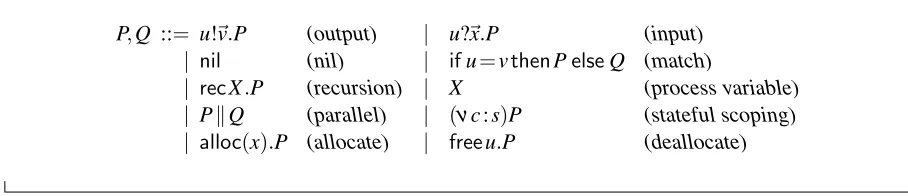
Fig. 1 shows the syntax for the resource pi-calculus. The language is the standard pi-calculus extended with primitives for explicit channel allocation and deallocation; moreover, channel scoping records whether a channel is allocated (>) or deallocated (⊥). The syntax assumes two separate denumerable sets of channel namesc,d∈NAMESand variablesx,y∈VARS, and lets identifiersu,v∈NAMES∪VARS range over both. The input and channel allocation constructs are binders for variables~x andx resp., whereas scoping is a binder for names (i.e., c). The syntax also assumes a denumerable set of process variablesX,Y∈PVARSwhich are bound by the recursion construct.
P,Q ::= u!~v.P (output) | u?~x.P (input)
| nil (nil) | ifu=vthenPelseQ (match)
| recX.P (recursion) | X (process variable)
| PkQ (parallel) | (νc:s)P (stateful scoping)
[image:3.612.77.531.78.176.2]| alloc(x).P (allocate) | freeu.P (deallocate)
Figure 1: Polyadic resource pi-calculus syntax
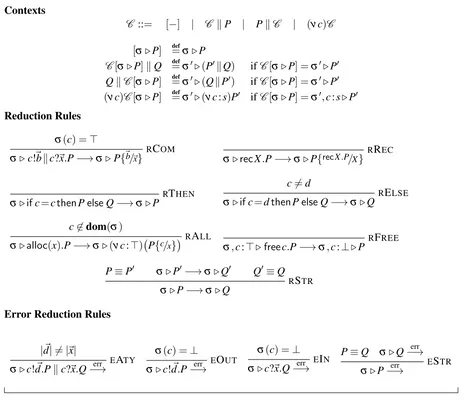
stateful scoping(νc:s)Pdescribes the state of scoped channels. A tuplehσ,Piis a configuration when-everfn(P)⊆dom(σ)and is denoted asσ.P. We say that a configurationσ.Pis closed wheneverP does not have any free variables. Fig. 2 defines contexts over configuration whereC[σ.P]denotes the application of a contextC to a configuration σ.P. In the case where a context scopes a namec the definition extracts the state relating tocfromσand associates it withc. For example,
(νc)[c:>,d:>.c!d] =d:>.(νc:>)c!d
The reduction relation is defined as the least contextual relation over closed configurations satisfy-ing the rules in Fig. 2, ussatisfy-ing a standard pi-calculus structural equivalence relation(≡). Communication (RCOM) requires the communicating channel to be allocated. Allocation (RALL) creates a private al-located channel and substitutes it for the bound variable of the allocation construct in the continuation; the conditionc6∈dom(σ)ensures thatcis fresh inP. Deallocation (RFREE) is the only construct that changes the visible state of a configuration,σ.
Fig. 2 also defines error reductions as the least contextual relation satisfying the rules for−→err . These rules capture errors resulting from arity mismatch and attempts to communicate on deallocated channels. In particular arity mismatch can come from unconstrained use of strong updates such as in the case of CLIENTerrin the Introduction.
3
Type System
3.1 The typing relation
The type language is defined in Figure 3 and the typing rules are given in Figure 4. The typing relation over processes takes the usual shape: Γ`Pread as “Pis well-typed under the typing assumptions in Γ”. Typing environments are multisets of pairs of identifiers and types; we do not a priorimake the
assumption that they are partial functions (Section 3.5). This relation is extended to configurations as
Γσ.P
by requiring that the process is well-typed inΓ, all channels inΓare allocated inσ, andΓis a partial
function (i.e.,for every identifier inPthere is exactly one typing assumption inΓ).
3.2 The type language
Contexts
C ::= [−] | C kP | PkC | (νc)C
[σ.P] def=σ.P
C[σ.P]kQ def=σ0.(P0kQ) ifC[σ.P] =σ0.P0 QkC[σ.P] def=σ0.(QkP0) ifC[σ.P] =σ0.P0
(νc)C[σ.P] def=σ0.(νc:s)P0 ifC[σ.P] =σ0,c:s.P0
Reduction Rules
σ(c) =>
RCOM
σ.c!~bkc?~x.P−→σ.P{~b/~x} σ.recX.P−→σ.P{recX.P/X} RREC
RTHEN σ.ifc=cthenPelseQ−→σ.P
c6=d
RELSE σ.ifc=dthenPelseQ−→σ.Q
c6∈dom(σ)
RALL
σ.alloc(x).P−→σ.(νc:>) P{c/x} σ,c:>.freec.P−→σ,c:⊥.P RFREE P≡P0 σ.P0−→σ.Q0 Q0≡Q
RSTR σ.P−→σ.Q
Error Reduction Rules
|d~| 6=|~x|
EATY σ.c!d~.Pkc?~x.Q−→err
σ(c) =⊥
EOUT σ.c!d~.P−→err
σ(c) =⊥ EIN σ.c?~x.Q−→err
P≡Q σ.Q−→err
[image:4.612.75.541.98.505.2]ESTR σ.P−→err
Figure 2: Contexts, Reduction Rules and Error Predicates
T ::= [−→T]a (channel type)
| proc (process)
a ::= 1 (affine)
| ω (unrestricted)
| (•,i) (unique afteristeps,i∈N)
(a channel isusedwhen communication takes place across the channel). This attribute can take one of three forms:
• A channel of type [−→T]ω is an unrestricted channel; such type assumptions correspond to type assumptions of the form[−→T]in non-substructural type systems.
• A channel of type[−→T]1isaffine, and comes with an obligation: it can be used at most once.
• A channel of type[−→T](•,i)comes with a guarantee that it isuniqueafteriactions; we abbreviate the type[−→T](•,0)of channels that are uniquenowto[−→T]•. Unique channels can be used to describe instances where only one process has access to (owns) a channel. Accordingly, strong update and deallocation is safe for unique channels.
3.3 Structural rules
Since the type system is substructural, usage of type assumptions must be carefully controlled, and the logical rules do not allow to use an assumption more than once. Operations on the typing environment are described separately by the structural rules of Fig. 4. Although the subtyping relation is novel because it combines uniqueness subtyping (SUNQ) with affine subtyping (SAFF) making themdualwith respect to unrestricted types, the subtyping and weakening structural rules are standard.
Rule TCON contracts an assumption of the form u:T, as long as T can be split as T1 and T2. Unrestricted assumptions can be split arbitrarily (PUNRandPPROC); affine assumptions cannot be split at all. An assumptionu:[~T]• about a unique channel can be split as an affine assumptionu:[~T]1 and an assumption about a channel that is unique after one action u:[~T](•,1)—an action using the latter assumption must be coupled with a co-action on the affine channel, and since the affine assumption can only be used once it is sound to assume that the channel is unique again after the action has happened. More generally, a channel which is unique afteriactions can be split into an affine assumption and a channel which is unique after(i+1)actions, and splitting is defined in such a way that the number of affine assumptions for a channel never exceeds the indexiof the corresponding unique assumption.
In particular when the index is 0 no other assumptions about that channel can exist in the typing environment. This means that if a process can be typed using a unique assumption for a channel, no other process has access to that channel. The last structural rule,TREV, makes use of this fact to allow strong updates (“revision”) to channels as long as they are unique.
3.4 Logical rules
The rules for input and output (TOUT andTIN) decrement the attribute of the channel,i.e., theycount usage. This operation is denoted byΓ,c:[~T]a−1 in Fig. 4 and states that affine assumptions can only be used once, unrestricted assumptions can be used an arbitrary number of types, and if a channel is unique afteri+1 actions, then it will be unique afteriactions once the action has been performed.
Moreover, TOUT requires separate typing assumptions for each of the channels that are sent. The attributes on these channels are not decremented, because no action has been performed on them; instead, the corresponding assumptions are handed over to the parallel process receiving the message. If the sending process wants to use any of these channels in its continuation (P) it must split the corresponding assumptions first.
Logical rules
Γ,u:[−→T]a−1,−−→x:T`P TIN
Γ,u:[−→T]a`u?~x.P
Γ,u:[−→T]a−1`P
TOUT
Γ,u:[−→T]a,v−−:→T`u!~v.P
Γ1`P Γ2`Q TPAR
Γ1,Γ2 `PkQ
u,v∈Γ Γ`P Γ`Q
TIF
Γ`ifu=vthenPelseQ
Γω,X:proc`P
TREC
Γω`recX.P
TVAR X:proc`X
Γ,x:[−→T]•`P TALL
Γ`alloc(x).P
Γ`P
TFREE
Γ,u:[−→T]•`freeu.P /0`nil TNIL
Γ,c:T`P
TRST1
Γ`(νc:>)P
Γ`P
TRST2
Γ`(νc:⊥)P
whereΓω is an environment containing only unrestricted assumptions and all bound variables are fresh.
Structural rules
T=T1◦T2 Γ,u:T1,u:T2`P TCON
Γ,u:T`P
Γ`P
TWEAK
Γ,u:T`P
Γ,u:T2`P T1<:T2 TSUB
Γ,u:T1`P
Γ,u:[−T2→]•`P TREV
Γ,u:[−T1→]•`P Typing configurations
∀c∈dom(Γ).σ(c) => Γ`P Γis a partial map
TCONF
Γσ.P Channel usage
Γ,c:[−→T]a−1=def
Γ if a=1
Γ,c:[~T]ω if a= ω
Γ,c:[~T](•,i) if a= (•,i+1)
Type splitting
PUNR
[−→T]ω= [−→T]ω◦[−→T]ω proc=proc◦procPPROC [−→T](•,i)= [→−T]1◦[−→T](•,i+1) PUNQ Subtyping
SINDX
(•,i)<:(•,i+1) (•,i+1)<:ω SUNQ
SAFF ω<: 1
a1<:a2
STYP
[image:6.612.92.518.94.271.2][−→T]a1<:[−→T]a2
uses of some channel. Nevertheless, it is not as serious a restriction as it may seem ,as recursive pro-cesses can still send, receive and allocate unique channels. For instance, the following process models an “infinite heap” that keeps allocating new channels and sends them across a channelheap:[[T]•]ω:
INFHEAP,recX.alloc(x).heap!x.X
As expected, allocation introduces unique channels (TALLOC) and only unique channels can be deallo-cated (TFREE). Finally, a typing assumption is introduced in the typing environment for locally scoped names only if the corresponding channel is allocated (TRST1 andRRST2).
3.5 Consistency
When we take a bird’s eye-view of a system, every channel has exactly one type. In the definition of
Γσ.P, we therefore restrict the environment to have at most one assumption about every channel: we require thatΓis a partial function. Consequently, we state type safety and subject reduction lemmas
with respect to environments that are partial functions.
Nevertheless, when two processes both need a typing assumption relating to the same channel c, there need to be two separate assumptions in the typing environment (cf. TPAR in Fig. 4). These two assumptions need not be identical; for example, an assumptionc:[]•can be split as two assumptions
c:[](•,1),c:[]1
Aconsistentenvironment is defined to be an environment that can be obtained by applying any of the structural rules (contraction, weakening, subtyping or revision) from an environment which is a partial function. It follows that any process that can be typed in a consistent environment can also be typed in a environment that is a partial function. The reader may therefore wonder why we do not restrict the typing relation to partial functions. It turns out that even if a process can be typed in a consistent environment, some of its subprocesses might have to be typed in an inconsistent environment. As an example, consider the typing derivation
TOUT a:[[]1]ω,u:[]1`a!u
a:[[]1]ω,u:[]•,x:[]1`freeuka!x
TIN a:[[]1]ω,u:[](•,1),x:[]1`u?().(freeuka!x)
TIN a:[[]1]ω,u:[](•,1)`a?x.u?().(freeuka!x)
TPAR a:[[]1]ω,a:[[]1]ω,u:[]1,u:[](•,1)`a!uka?x.u?().(freeuka!x)
TCON(twice) a:[[]1]ω,u:[]•`a!uka?x.u?().(freeuka!x)
This is a valid typing derivation, and moreover the typing environment used at every step is consistent. But now consider what happens after this process takes a reduction step:
u:[]•,u:[]1`freeuka!u
TIN u:[](•,1),u:[]1`u?().(freeuka!u)
TCON u:[]•`u?().(freeuka!u)
Thus, when an environment
Γ,c:[~T]a,c:[~T]a0
(e.g.,u:[](•,1),u:[]1) is consistent, it may be the case that
Γ,c:[~T]a−1,c:[~T]a0
(e.g.,u:[]•,u:[]1) isinconsistent: this means that the tails of input or output processes may have to be typed under inconsistent environments, even when the larger process is typed in a consistent environment. However, communication in the pi-calculus provides synchronization points: when a communication happens, two processes willbothstart executing their tail processes. The following lemma says that if this happens, the resulting overall system (of both processes) is still typeable in a consistent environment; in fact, both must be derivable from thesamepartial function. This lemma is crucial in the subject reduction proof.
Lemma 1. LetΓ,u:[~T]a1,u:[~T]a2 be a consistent environment, i.e., derivable from a partial functionΓ0
by applying structural rules. ThenΓ,u:[~T]a1−1,u:[~T]a2−1 is derivable from the same environmentΓ0,
and is therefore consistent.
3.6 Soundness
We prove soundness of the type system in the usual way. Theorem 2(Type safety). IfΓσ.P then P9err.
Theorem 3(Subject reduction). IfΓσ.P andσ.P→σ0.P0then there exists a environmentΓ0such thatΓ0σ0.P0.
Taken together these two theorems imply that a well-typed process will not have any runtime errors. The proofs of these theorems can be found in the accompanying technical appendix [21].
3.7 Examples
The systemsCLIENTikTIMESRVkDATESRVfori∈ {0,1,2}can all be typed in our type system, whereas
CLIENTerris rejected because type splitting enforces a common object type (cf.PUNR,PUNQin Fig. 4.) For convenience, we here recallCLIENT2and consider how it is typed, assumingxis not free inP:
CLIENT2,alloc(x).getTime!hxi.x?(yhr,ymin).getDate!hxi.x?(zyear,zmon,zday).freex.P
Assuming an environment with getTime:[[T1,T2]1]ω and getDate:[[T3,T4,T5]1]ω, CLIENT2 types as follows. RuleTALL assigns the unique type[T1,T2]• to variable xand the structural rule TCONthen splits this unique assumption in two using PUNQ. Rule TOUT uses the affine assumption forxfor the output argument and the unique-after-one assumption to type the continuation. Rule TIN restores the uniqueness ofxfor the continuation of the input after decrementing the uniqueness index, at which point TREVis applied to change the object type ofxfrom pairs of integers (for time) to triples of integers (for dates). The pattern of applyingTCON,TOUT andTINrepeats, at which pointxis unique again and can be safely deallocated byTFREE.
Uniqueness allows us to typecheck a third client variation manifesting (explicit) ownership transfer. Rather than allocating a new channel,CLIENT3requests a channel from a heap of channels and returns the channel to the heap when it no longer needs it, thereby reusing channelsacrossclients.
With the assumptionheap:[[T]•]ω typing the system below is analogous to the previous client typings.
CLIENT3kCLIENT3kCLIENT3kTIMESRVkDATESRVk(νc)heap!hci (1) In CLIENT2 and CLIENT3, substituting x!().Q for P makes the clients unsafe (they perform resp.
deallocated-channel usage and mismatching communication). Both clients would be rejected by the type system because the use ofx inx!().Qrequires a split for the assumption of x, and it is not possible to split any assumption into a unique assumption and any other assumption.
Finally, system (1) above can be safely extended with processes such asCLIENT4which uses unique channels obtained from the heap in unrestricted fashion. Our type system acceptsCLIENT4by applying subtypingfrom unique to unrestricted on the channelxobtained fromheap.
CLIENT4,heap?x.recX.(getTime!hxi.x?(yhr,ymin).PkX)
4
Related Work
The literature on using substructural logics to support destructive or strong updates is huge and we can give but a brief overview here. More in-depth discussions can be found in [20, 17].
Resources and pi-calculus Resource usage in a pi-calculus extension is studied in [19] but it differs from our work in many respects. For a start, their scoping construct assumes an allocation seman-tics while we tease scoping and allocation apart as separate constructs. The resource reclamation construct in [19] is at a higher level of abstraction thanfreec.P, and acts more like a “resource finaliser” leading to garbage collection. Resource reclamation is implicit in [19], permitting differ-ent garbage collection policies for the same program whereas in the resource pi-calculus resource reclamation is explicit and fixed for every program. The main difference however concerns the aim of the type systems: our type system ensures safe channel deallocation and reuse; the type system in [19] statically determines an upper bound for the number of resources used by a process and does not use substructural typing.
Linearity versus Uniqueness In the absence of subtyping, affine typing and uniqueness typing coincide but when subtyping is introduced they can be considered dual [10]. For linear typing, the subtyping relation allows coercing non-linear assumptions into a linear assumptions,i.e., !U→U, but for uniqueness typing, the subtyping relation permits coercing unique assumptions into non-unique assumptions. Correspondingly, the interpretation is different: linearity (resp. affinity) is alocal obligationthat a channel must be used exactly (resp. at most) once, while uniqueness is aglobal guaranteethat no other processes have access to the channel. Combining both subtyping relations as we have done in this paper appears to be novel. The usefulness of the subtyping relation for affine or linear typing is well-known (e.g., see [12]); subtyping for unique assumptions allows to “forget” the uniqueness guarantee;CLIENT4above shows one scenario where this might be useful. Linearity in functional programming In pure functional programming languages, data structures are always persistent and destructive updates are not supported: mapping a function f across a list
[x1, . . . ,xn]yields anewlist[f x1, . . . ,f xn], leaving the old list intact. However, destructive updates
are not shared. Both uniqueness typing [4] and linear typing have been used for this purpose, although even some proponents of linear typing agree that the match is not perfect [23, Section 3]. In functional languages with side effects, substructural type systems have been used to support strong (type changing) updates. For instance, Ahmedet al. have applied a linear type system to support “strong” (type changing) updates to ML-style references [2] in a setting with no subtyping. It has been recognized early on that it is useful to allow the uniqueness of an object to be tem-porarily violated. In functional languages, this typically takes the form of a sequential construct that allows a unique object (such as an array) to be regarded as non-unique to allow multiple non-destructive accesses (such as multiple reads) after which the uniqueness is recovered again. Wadler’slet! construct [22] (or the equivalent Clean construct#!) and observer types [16] both fall into this category, and this approach has also been adopted by some non-functional languages where it is sometimes calledborrowing[7]. It is however non-trivial to extend this approach to a concurrent setting with a partial order over execution steps; our approach can be regarded as one preliminary attempt to do so.
Strong update in the presence of sharing There is substantial research on type systems that allow strong update even in the presence of sharing; the work on alias types and Vault [18, 24, 8] and on CQual [9] are notable examples of this. These type systems do explicit alias analysis by reflecting mem-ory locations at the type level through singleton types. This makes it possible to track within the type system that a strong (type changing) update to one variable changes the type of all its aliases. The interpretation of unique (or linear) in these systems is different: a unique reference (typically called acapabilityin this context) does not mean that there is only a single reference to the object, but rather that all its aliases are known. For non-unique reference not all aliases are known and so strong update is disallowed.
These systems are developed for imperative languages. They are less useful for functional lan-guages because they cannot guarantee referential transparency, and they appear to be even less useful for concurrent languages: even if we track the effect of a strong update on a shared ob-ject on all its aliases, this is only useful if we knowwhenthe update happens. In an inherently non-deterministic language such as the pi-calculus this is usually hard to know before execution.
Linearity in the pi-calculus Linear types for the pi-calculus were introduced by Kobayashiet al.[14] but do not employ any subtyping. Moreover, their system cannot be used as a basis for strong update or channel deallocation; although they split a bidirectional linear (“unique”) channel into a linear input channel and a linear output channel (cf. Definition 2.3.1 for the type combination operator(+)) these parts are never “collected” or “counted”. The more refined type splitting op-eration we use in this paper, combined with the type decrement opop-eration (which has no equivalent in their system) is key to make uniqueness useful for strong updates and deallocation. Our system can easily be extended to incorporate modalities but it does not rely on them; in our case, channel modalities are an orthogonal issue.
Fractional permissions and permission accounting Boyland [6] was one of the first to consider split-ting permissions intofractionalpermissions which allow linearity or uniqueness to be temporarily violated. Thus, strong update is possible only with a full permission, whereas only passive access is permitted with a “fraction” of a permission. When all the fractions have been reassembled into one whole permission, strong update is once again possible.
of concurrency is shared-memory, their mechanism of permission splitting and counting is sur-prisingly similar to our treatment of unique assumptions. However, while their resource reading of semaphores targetsimplicitownership-transfer, uniqueness typing allow us to reason about explicit ownership-transfer. Moreover, subtyping from unique to unrestricted types provides the flexibility of not counting assumptions whenever this is not required, simplifying reasoning for resources that are not deallocated or strongly updated.
Session types Session types [11] and types with CCS-like usage annotations [12] are used to describe channels which send objects of different types. However, these types give detailed information on how channels are used, which makes modular typing difficult. For example, theheapchannel used byCLIENT3cannot be given a type without knowing all the processes that use the heap.
5
Conclusions and Future Work
We have extended ideas from process calculi, substructural logics and permission counting to define a type system for a the pi-calculus extended with primitives for channel allocation and deallocation, where strong update and channel deallocation is deemed safe for unique channels.
The purpose of our type system is not to ensure that every resource that is allocated will also be deallocated (i.e.,the absence of memory leaks). This is difficult to track in a type system. For instance, consider
alloc(x). c!d1.d1!hi.nil k c!d2.nil k c?y.y?().freex
Statically, it is hard to determine whether the third parallel process will eventually execute the freex operation. This is due to the fact that it can non-deterministically react with either the first or second parallel process and, should it react with the second process, it will block atd2?().freex. In order to reject this process as ill-typed, the type-system needs to detect potential deadlocks. This can be done [13], but requires a type system that is considerably more complicated than ours. We leave the responsibility to deallocate to the user, but guarantee that resources once deallocated will no longer be used.
The simplicity of our type-system makes it easily extensible. For instance, one useful extension would be that of input/output modalities, which blend easily with the affine/unique duality. Presently, when a server process splits a channel c:[T]• into one channel of type [T](•,2) and two channels of type[T]1to be given to two clients, the clients can potentially use this channel to communicate amongst themselves instead of the server. Modalities are a natural mechanism to preclude this from happening.
We are currently investigating ways how uniqueness types can be used to refine existing equational theories, so as to be able to equate processes such asCLIENT1andCLIENT0. This will probably require us to establish a correspondence between uniqueness at the type level and restriction at the term level.
References
[1] P. M. Achten & M. J. Plasmeijer (1995):The ins and outs of Clean I/O.Journal of Functional Programming
5(1), pp. 81–110.
[2] Amal Ahmed, Matthew Fluet & Greg Morrisett (2005):A Step-Indexed Model of Substructural State. In: Pro-ceedings of the 10th ACM SIGPLAN International Conference on Functional Programming (ICFP), ACM, pp. 78–91.
[4] Erik Barendsen & Sjaak Smetsers (1996):Uniqueness Typing for Functional Languages with Graph Rewrit-ing Semantics.Mathematical Structures in Computer Science6, pp. 579–612.
[5] Richard Bornat, Cristiano Calcagno, Peter O’Hearn & Matthew Parkinson (2005):Permission accounting in separation logic.SIGPLAN Not.40(1), pp. 259–270.
[6] John Boyland (2003): Checking Interference with Fractional Permissions. In: R. Cousot, editor: Static Analysis: 10th International Symposium,Lecture Notes in Computer Science2694, Springer, pp. 55–72.
[7] Dave Clarke & Tobias Wrigstad (2003):External Uniqueness Is Unique Enough. In:ECOOP 2003 – Object-Oriented Programming,Lecture Notes in Computer Science2743, Springer Berlin / Heidelberg, pp. 59–67.
[8] Manuel F¨ahndrich & Robert DeLine (2002): Adoption and focus: practical linear types for imperative pro-gramming. In:PLDI ’02: Proceedings of the ACM SIGPLAN 2002 Conference on Programming language design and implementation, ACM, pp. 13–24.
[9] Jeffrey S. Foster, Tachio Terauchi & Alex Aiken (2002): Flow-sensitive type qualifiers. In: PLDI ’02: Proceedings of the ACM SIGPLAN 2002 Conference on Programming language design and implementation, ACM, pp. 1–12.
[10] Dana Harrington (2006):Uniqueness logic.Theoretical Computer Science354(1), pp. 24–41.
[11] Kohei Honda, Vasco Thudichum Vasconcelos & Makoto Kubo (1998): Language Primitives and Type Dis-cipline for Structured Communication-Based Programming. In:ESOP ’98: Proceedings of the 7th European Symposium on Programming, Springer-Verlag, pp. 122–138.
[12] Naoki Kobayashi (2003): Type Systems for Concurrent Programs. In: Formal Methods at the Crossroads: From Panacea to Foundational Support,LNCS2757, Springer Berlin / Heidelberg, pp. 439–453.
[13] Naoki Kobayashi (2006):A New Type System for Deadlock-Free Processes. In:CONCUR 2006 Concurrency Theory,Lecture Notes in Computer Science4137, Springer Berlin / Heidelberg, pp. 233–247.
[14] Naoki Kobayashi, Benjamin C. Pierce & David N. Turner (1999):Linearity and the pi-calculus.ACM Trans. Program. Lang. Syst.21(5), pp. 914–947.
[15] Robin Milner, Joachim Parrow & David Walker (1992): A calculus of mobile processes, parts I and II. Inf. Comput.100(1), pp. 1–40.
[16] Martin Odersky (1992): Observers for Linear Types. In: Bernd Krieg-Br¨uckner, editor: Proceedings of the 4th European Symposium on Programming (ESOP),Lecture Notes in Computer Science582, Springer-Verlag, pp. 390–407.
[17] Franc¸ois Pottier (2007). Wandering through linear types, capabilities, and regions. Survey talk given at INRIA, Rocquencourt, France.
[18] Frederick Smith, David Walker & J. Gregory Morrisett (2000):Alias Types. In: ESOP ’00: Proceedings of the 9th European Symposium on Programming Languages and Systems, Springer-Verlag, pp. 366–381.
[19] David Teller (2004):Recollecting resources in the pi-calculus. In: Proceedings of IFIP TCS 2004, Kluwer Academic Publishing, pp. 605–618.
[20] Edsko de Vries (2008): Making Uniqueness Typing Less Unique. Ph.D. thesis, Trinity College Dublin, Ireland.
[21] Edsko de Vries, Adrian Francalanza & Matthew Hennessy (2009): Uniqueness Typing for Resource Man-agement in Message-Passing Concurrency—Technical Appendix. Technical Report, Trinity College Dublin, Ireland. Available fromhttp://www.cs.tcd.ie/Edsko.de.Vries/pub.
[22] Philip Wadler (1990):Linear types can change the world! In: M. Broy & C. B. Jones, editors:Proceedings of the IFIP TC2 WG 2.2/2.3 Working Conference on Programming Concepts and Methods, North-Holland, pp. 561–581.
[23] Philip Wadler (1991):Is there a use for linear logic? In:Proceedings of the 2nd ACM SIGPLAN symposium on Partial Evaluation and semantics-based program manipulation (PEPM), ACM, pp. 255–273.