Perturbing Potential and Orbit Dynamics
Javier Bootello Engineer I.C., Malaga, Spain Email: [email protected]
Received June 9, 2013; revised July 15, 2013; accepted August 6,2013
Copyright © 2013 Javier Bootello. This is an open access article distributed under the Creative Commons Attribution License, which permits unrestricted use, distribution, and reproduction in any medium, provided the original work is properly cited.
ABSTRACT
This article checks a perturbing gravitational potential, with some orbit dynamics parameters: the angular precession at each single point of any elliptic orbit, the increase of the eccentricity of the Moon and the secular increase of the Astro-nomical Unit. This potential is consistent with the solution of the precession of Mercury, event which was the first suc-cess of General Relativity, and now is near to reach its first centenary. We suggest in this paper to update the classic test of G.R., studying the gradual progression of precession, not only in its perihelion but testing a complete trajectory around the Sun.
Keywords: Gravitational Potential; Orbit Precession; Eccentricity; Astronomical Unit
1. Perturbing Gravitational Potential
P
(
)
We will set an inertial frame with the origin in the bary- centre of the Sun-Mercury system, and not in the bary- centre of the solar system; this is because we are going to examine Mercury’s orbit as a geodesic free-fall path, isolated from other planets gravitational interference.
Potential P
is defined as a slight perturbation to the Newtonian gravitational potential, linked with the radial velocity of the target. We also assume potential’s transmission velocity, equal to that of light (c).Consider a target with a radial speed Vr related to the inertial frame, moving in the same forward direction as the potential. The transit time of the potential crossing through the target, will be larger related with the transit time when the object is in a rest position and will de- crease, if they are moving in opposite directions. The larger or reduced transit time between target and poten- tial, is proportional to (Vr/c).
Be t1 the transit time of a potential crossing through an
object. If the target moves in the same forward direction as the potential, the transit time t2 will be larger than t1
and will have the following expression, only acceptable if (leaving aside second order terms in mag- nitude, as radial acceleration):
Vrc
1 Vr t c
2 2
t c t (1)
2 1
1
t t Vr c Vr
t c c Vr c
(2)
This coefficient t2t1 t1
, is the dimensionless ra-
tio of the new real disturbing time (t2 – t1) related to the
unperturbed transit time (t1).
The new gravitational potential is equal to the Newto- nian, added with a perturbing action proportional to
2
t t t 2 1 1
. Since the potential is an energy field with
work characteristics, the perturbance is proportional to the square of time as it is the product of the acceleration by distance. The disturbance is not linear with time nor with the radial distance. It is also necessary to accept that as quantum electrodynamic iteration, the intensity is pro- portional to
t2t1
t12The motion of particles in an external gravitational
field with a Maxwell framework, is in first order equiva- lent to a dynamic system linked with (v/c)2. [1]
.
Perturbing potential is then defined as:
2 2
2 1
1
t t
GM GM Vr
S
r t r c
(3)
where = true anomaly. (same sign as gra-
vity) for
0
S
0π and S
0 for π 2π
S
. As the Newtonian field, potential has a clear physical basis, consistent with the laws of impulse and momentum transfer, energy conservation and the action/ reaction effect of the usual mechanics. There is not there- fore a new potential but the same classic gravitational field, perturbed by an action that increases/decreases slight- ly the force of gravity: the target has a radial speed.
P
GM
P S c r 2 1 GM Vrr
S (4)
Point out that, if we apply potential to any per- fect sphere or any compact three-dimension target (in- stead of a single particle), the resultant ratio is three times (Vr/c)2 as we will conclude in Paragraph 5.
2. Equations of Motion of Mercury Induced
by Potential
S
Any small perturbing potential applied to a target in a keplerian ellipse, produces slight changes to the orbital parameters, first of all a precession, besides other minor actions such as the increase/decrease of the orbital axis and eccentricity.
Consider as the instantaneous angular preces- sion at each single point of the Newtonian ellipse. Pre- cession will reach a final value (Δ) at the end of one orbit as result of its gradual accumulation. We will use Landau & Lifshitz formulation [2], which defines the precession produced by a perturbing potential. This formula is valid as a theorem, suitable for any small perturbation what- ever could be its physical origin and returning the exact value. Integration is performed over an unperturbed orbit [3] (Using Langrange Planetary Equations, we reach a very similar result).
r U2 d rad.
mS 0 2 2 m M M
(5)where M = m h = angular momentum,
δU = perturbing potential Energy = .
Then, the instantaneous precession referred to is:
1r S2
radh h
./
radians
(6)where h = angular momentum per unit of mass.
Applied to any elliptic orbit and a planet like Mercury:
3 23 ; 1 cos GM Vr S V r c p r e sin ; eh r r p (7)
where e = eccentricity ; p = semi-latus
1 ehsin 2pc
23GM
r
h h r
sin2 21 cos
e h
h e p
3 2
GM c
(8)
derivates referred to h are:
2
1 1
e e
h h e
[4]; (9)
and then:
0 d 2 ; p p h h
(10-a)
2 2 2 2 2 2 0 3sin sin cos
2 1 d
1 cos 1 cos
GM c p e e e e e
2 2 2 2 03 sin 2 cos d
1 cos
GM e e
c p e
(1 b)
0-
2 3 1 1 coscos sin sin cos
GM e c p
e e e
Final orbital precession Δ(2π), has the same
ever could be the eccentricity (e > 0), and is exactly the final one
(11)
value what
orbit precession of:
26
2 GM rad./orbit 43 sec.arc./cent.
c p
(12)
The resultant one orbit precession produced turbing potential
by per-
S applied to Mercury and liptic orbit, is
any el- just exactly the same precession obtained by General Relativity in 1.915, which explained the ano- maly discovered by LeVerrier in 1.859.
The question now, is how such action is achieved throughout the 88-days orbital period and what are the theoretical assumptions about the sequential and gradual progression of precession along the orbit. Potential
S , and GR produce exactly the same final one orbit precession, however the equations of motion are not the same therefore, the instantaneous precession at each sin- gle point of the elliptic orbitis different. The instantane- ous precession produced by S
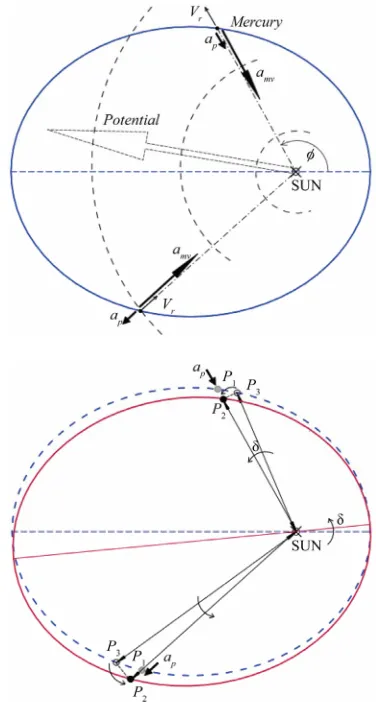
, is not constant nor linear, causing an angular lead/lag (Ω) related to the fixed and linear GR precession.Along the upward branch of the orbit, as Mercury moves away from the Sun, the radial velocity has the same forward direction as the gravitational potential, so perturbing acceleration increases gravity. Perturbing ac- celeration is directed inward the orbit, so Mercury will move inward in relation with the position it should oc- cupy in the keplerian ellipse.
tions (10) and (11)).
Along the descending branch of t orbit, Mercury comes closer to the Sun with a radial speed opposite to the gravitational pote
he
ntial, therefore perturbing accelera- tion, decreases gravity. The perturbing acceleration is directed outside the orbit, so Mercury will move outward in relation with the position it should occupy in the ke- plerian ellipse; the equilibrium position is located in a farther point to the Sun: a “previous” point of the cano- nical ellipse. The orbit must rotate also a forward angle: a positive instantaneous precession.
As seen in Figure 1, (graphic expression of Equations 10 and 11), the instantaneous precession
produced by potential S
, is always positive, producing a for-stabl ys lo
y and a space-time with spherical sy
ward advance in both branches of the orbit. This is be- cause perturbing potential produces a e position which is alwa cated in a “previous” point in the ke- plerian trajectory (Figure 2), and therefore precession is always positive and also with symmetrical magnitude about the major axis.
[image:3.595.310.537.84.267.2]In nearly all General Relativity textbooks and articles, the trajectory is defined starting from the Schwarzschild solution, in a geometr
Figure 1. Instantaneous (δ) and orbital (Δ) precession pro- duced by GR and S
.mmetry. On that basis, the equation of the trajectory of Mercury, and any other elliptic orbit is:
1 cosp r
e
(13)
where
is a small function that pro orbit differences, from the Newtonianorbit precession. The classic relativity textbook “Gravi- by W.
duces the GR kepler-ellipse: an
tation” Misner [5], concludes in a linear progress- sion:
0
1 cos 1 2
p r
e
(14)
with 0 = 2πK
As result of it, GR instantaneous pre with a fixe related to
cession is steady, d ratio , so that the advance along rbit inear accumulation till its final value (F
ir
elliptical integral: one o , has a l
igure 1). This particular solution with a constant an- gular precession was, the f st result obtained by Ein- stein in 1915 [6]:
“...That contribution from the radius vector and de- scribed angle between the perihelion and the aphelion is obtained from the
2
1 2
d 2
x
A 3
2 2x x
[image:3.595.327.515.313.664.2]
(15)Figure 2. Instantaneous precession dynamics. Keplerian and perturbed orbit. Vr = radial velocity. anw = Newtonian
acceleration. ap = perturbing acceleration. P1 = Position in x
B B
where α1 and α2(…reciprocal values of
minimal distance from the Sun…)
GR admits also small periodic oscillations that are
the maximal and the Keplerian ellipse. P2 = Position induced by perturbing
acceleration. P3 = Equivalent position of P2 in the Keplerian
insignificant contributions and their only effect is to change slightly the position of the perihelion and the in- terpretation of rmin and e [7].
The most extended and accepted formulation of GR orbit fluctuations is: [8]
3 2 1 12 2 6
c p 1 cos 2 e sin
GM e
(16)
also produces very small oscillations but in mag- nitude, are 1/30 related with those produced by S
n a par- potential. There are also other prop sed i
ticular so
osals ba
lution of the Schwarzschild’s methodo-logical approaches [9].
The peak instantaneous precession produced by S
is at = 1.73 rad, = 4.56 rad, very close to the peak values of Vr (Figure 2). The maximum angular lead/lag is at = 5.42 rad and = 0.85 rad, with Ω = ± 0.54 rad related to the fixed and linear GR precession.
The peak positional lead/lag of Mercury, would hap- pen in A [
K
= 2.46 rad] and B [ = 3.82 rad]. This is because in these points, the radius is larger.
In case A, Mercury would be in a forward position regarding a GR precession. This relative position would be i = 2.4 103 m (transversal vector) and j = –0.36
103 m (radial vector), magnitudes which would be
equal but with opposite sign in B. Also point out that in about 21 days, Mercury would move from the peak forward position (A) to the most delayed (B), always referred to the relative location with a constant GR precession.
Spacecraft Messenger has begun to orbit Mercury past March 18 (2011), and during two years, both will make 8.4 revolutions around the Sun. That event should after- wards allow to measure and draw accurately the geome- try of the whole orbit of Mercury, as an open geodesic free-fall path, isolated from other planets gravitational interference. Another alternative is to wait till the Bepi- Colombo be launched in 2015, an European mission to Mercury where, testing relativistic gravity is recognized as a crucial scientific objective.
3. The Increase of Eccentricity of the Orbit
of the Moon
This increase has recently been presented [10], collecting 9 lo
w
the data extracted by the Lunar Laser Ranging along 3 years since its deployment in the Moon by the Apol missions.
The increase is: (9 ± 3) 10−12/year [11,12].
We will analyse the effects of a small perturbing ac- celeration over the eccentricity of any elliptic orbit. Ac- cording to Gauss Planetary Equations, (only acceptable
hen e1 and low orbit inclination), the eccentricity variation, is linked with the perturbing acceleration, what- ever could be its physical origin:
2
d 1 sin
d r
e e A
t na
(17)
where Ar is the radial perturbing acceleration.
The perturbing acceleration is the derivative of the per- turbing potential S
related to r, thto obtain the Newtonian acceleration from
et have the e same as we do the classic gravitational field. All the particles of the targ
same perturbing acceleration whatever they are located in the body:
22
S GM Vr
Ar
r c r r
(18)
2 2
2 4
3 sin 1 3
1 cos
GM eh GM Vr
Ar
e c
c r
(19)
where Ar > 0 (same sign as gravity) for 0 π 2
r
and
Ar < 0 for π2π.
If we develop Equation (17) and change deriv related to time (t) with that related to
atives
2
dt d dt d d r
de d de de de h (20)
For a Keplerian ellipse, we have also:
21
;
sin d
e p
na h
h
r r c p
2 2 2
2 2 2 2
sin
de h 3GM e h p
(21)
and then,
2 3
2
d 3
sin d
e GM
e
c
tegration will give the eccentricity increase orbit of the Moon around the Earth. Potential
(22)
The in along one
S always produces a positive an
about the axis of the ellipse. If we consider the sign of Ar
in
d symmetrical effect
each branch of the orbit, we can integrate between 0 and π with a double factor.
2 3
orbit 2
0
6GM sin d
e e
c p
(23)the definite integral is:
2 2
orbit 6GM2 43 8GM2
e e e
c p c p
eters are: GM = 3.986 1014
108 m
The increase of eccentricity in one orb
12
0.279 10
e
(24)
The Earth/Moon param m3s–2; e = 0.0549; a = 3.84
it is:
orbit (25)
and referred to a year:
12
year 27.3365 0.279 10 3.73 10
Then, we can conclude tha
produ tential
t the increase of eccentricity of the orbit of the Moon ced by po S
, is obtaine onomical detec- tion through the Lunar Laser Ranging.4.
consistent with the data d by astr
The Increase of the Astronomical Unit
The increase of the Astronomical Unit was analysed by Krasinsky [13] however, there is not a clear explanation of its origin.
The increase is: 15 ± 4 cm/year.
Perturbing potential S
produces an increase in the semi-major axis of the ellipse that, according to Gauss Planetary Equations, will have the following expres- sion:
2d 2
d 1 r
a e A sen
t n e (27)
Using similar formulations as in paragraph before,
3 3
2 2 sin
a e e
d 6
d 1
a GM
c p
(28)
For one orbit of the Earth around the Sun,
orbit 2 1 2 0sin d
a e
c p e
3 3
12GM a
(29)
3
orbit 2 2 2 2
1
16 16
1
a
GM GM
a e
c p e c
3 2
1 e e (30)
The Earth-Sun parameters are:
GM = 13.27 1019 m3s–2; e = 0.0167
and then:
. .year 1
U A
1.06 cm year (31) ncrease of the Astro- nomical U
Then, we can conclude that the i
nit produced by potential S
applied to the , is con t with the data obtained by astronomical detection through the aric measurements of distances betwee m
4], are not appropri ied to orbit of the Earth sisten
nalysis of radiomet- n the Earth and the ajor planets including observations from Martian orbit- ers from 1.971.
If we apply Gauss equations to the orbit of other plan- ets, these would be only acceptable for those with a very low eccentricity. In other cases with higher eccentricity orbits, (as Mercury), the Gauss planetary equations and others related [1 ate, appl S
perturbing potential. The results are:
2 Venus/orbit 0.74 10 m
a
; aJupiter/orbit2.7 m;
Saturn/orbit 3.8 m a
5. Potential
S
Application to a Three
Dimension Solid Sphere
S is a perturbation of the classic gravitational poten-
tial due to the higher/lower pulse of time that implies a radial velocity of the target. The coefficient (Vr/c)2, is a
a radial velocity
dimensionless ratio which defines the relation between the applied potential to one particle that moves with
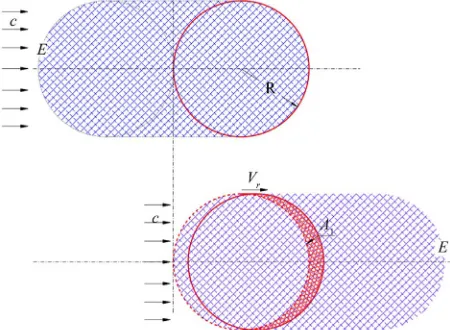
related with another with a perfect circular orbit. Instead of a particle, we will consider a solid sphere and the perturbing potential S
transit action (Figure 3). The trasmission coefficient is different.Be t1 the transit time of the potential through the equa-
torial diameter of the sphere, when the target is moving in a perfect circular orbit. When the target has a radial velocity Vr (elliptic orbit), the force of gravity associated with the potential, should produce and transmit during t1,
a larger quantity of energy-work than before; the distance travelled has been enlarge with a new length of Vr t1
producing a very small increase of the sphere’s active volume, linked with the perturbing action: A1 Vr t1
(Figure 3)
In order to distribute this new energy, balanced be- tween all the particles of the target, we must consider:
a) Energy (E) transmitted is in direct proportion to the spherical surface (A1).
b) Not all the diameters have the maximum length as in the equator.
c) The coefficient only compares the perturbing action regarding the initial situation.
d) Distribution of the “perturbing action” volume, be- tween the total volume of the sphere.
Therefore, the coefficient k will be:
2
1 1 1
3 3
2 3 3
4 3 4 3
AVrt R Vrt Vr Vr
R R
1 (32)
and then: k 3
2R t c
6.
Potential
Conclusions
P
[image:5.595.310.535.543.708.2] is defined as a slight perturbation to the
Newtonian gravitational potential, linked with the radial velocity of the target. The larger or reduced transit time between target and potential, is proportional to ±(Vr/c), coefficient that gives the relative increase or reduction ratio related with a particle-target in a rest position or a perfect circular movement. There is not therefore a new potential but the same classic field, perturbed by an ac- tion that increases/decreases slightly the force of gravity: the target has a radial speed.
Applied to the orbit of Mercury, produces exactly the same one orbit secular precession deduced by General Relativity; however, the equations of motion are not the same, and that means differences in the instantaneous angular precession. The instantaneous precession, could
Does these theoretic proposals suit with the complete geodesic trajectory of Mercury?
REFERENCES
[1] W. Flanders and G. Japaridze, International Journal Theo- retical Physics, Vol. 41, 2002, pp. 541-550.
doi:10.1023/A:1014257523781 [2]
[3] V. Melnikov and N. Kolosnitsyn, Gravitation & Cosmol- ogy, Vol. 10, 20
[4] G. Adkins and Review D, Vol. 75, L. Landau and M. Lifshitz, “Mekhanika,” 3rd Edition, But- terwoth-Heinemann, Oxford, 1976.
04, pp. 137-140. J. McDonnell, Physical
2007, Article ID: 082001. doi:10.1103/PhysRevD.75.082001 [5] C. Misner, K. Thorne and J. Whe
be detected by Messenger spacecraft which is now orbit-
ing Mercury and the Sun. Another alternative is to wait eler, Physics Today, Vol.
27, 1973, p. 47. doi:10.1063/1.3128805 [6] A. Einstein, “The Collected Papers of
till the BepiColombo be launched in 2015. These data should be reduced with the perturbations produced by other planets. It is certainly a difficult and complex duty but clearly available with the current development of our technology and also not expensive.
Close to reach the centenary of the formulation and first success of General Relativity, there are still some open issues.
We suggest in this paper, to update the classic test of G
A. Einstein,” Prince-
logy and Gravitation,”
, “Classical Dynamics of Par- ks, Belmont, 2004. ton University Press, Princeton, 1996.
[7] M. Berry, “Principles of Cosmo
Cambridge University Press, Cambridge, 1990. [8] B. Marion and S. Thornton
ticles and Systems,” Thomson-Broo
[9] J. Bootello, International Journal Astronomy & Astro- physics, Vol. 2, pp. 249-255.
doi:10.4236/ijaa.2012.24032
[10] J. Anderson and M. Nieto, “Astrometric
eneral Relativity, studying the gradual progression of precession, not only in its perihelion, but also along a complete trajectory around the Sun.
S potential applied to the orbit of the Moon around the Earth, produces an increase of the eccentricity that is consistent with the real observed data.
S potential applied to the orbit of the Earth, pro- duces an increase of the Astronomical Unit which is con- sistent with the real observed data.
Point out that it is really significant that the same gravitational potential with clear physical boundary con- ditions, consistent with the laws of impulse and momen- tu
Solar-System Ano- malies,” Proceedings of the International Astronomical Union, Vol. 5, 2010, pp. 189-197.
doi:10.1017/S1743921309990378
[11] J. Williams and D. Boggs, “Lunar Core and Mantle. What Does LLR See?” Proceedings of the 16th International Workshop on Laser Ranging, Poznan, 13-17 October 2008, pp. 101-120.
[12] L. Iorio, Royal Astronomical Society, Vol. 415, 2011, pp. 1266-1275. doi:10.1111/j.1365-2966.2011.18777.x [13] G. Krasinsky and V. Brumberg, Celestial Mechanics and
Dynamical Astronomy, Vol. 90, 2004, pp. 267-288.
m transfer, energy conservation and the action/reaction effect of the classical mechanics, could explain directly this three singularities, without any “ad hoc” parameters ar
doi:10.1007/s10569-004-0633-z
[14] J. Burns, American Journal of Physics, Vol. 44, 1976, p. 944. doi:10.1119/1.10237
rangement.
7. Appendix
S potential produces a similar effect as the observe flat rota
d with spiral galaxies, d but
priate to complete the studies relate