Munich Personal RePEc Archive
Testing Independence for a Large
Number of High–Dimensional Random
Vectors
Gao, Jiti and Pan, Guangming and Yang, Yanrong
Monash University, Australia, Nanyang Technological University,
Nanyang Technological University
15 March 2012
Online at
https://mpra.ub.uni-muenchen.de/45073/
Testing Independence for a Large Number of
High–Dimensional Random Vectors
Guangming Pan, Jiti Gao and Yanrong Yang
March 15, 2013
Abstract
Capturing dependence among a large number of high dimensional random vectors
is a very important and challenging problem. By arrangingnrandom vectors of length
p in the form of a matrix, we develop a linear spectral statistic of the constructed
matrix to test whether thenrandom vectors are independent or not. Specifically, the
proposed statistic can also be applied tonrandom vectors, each of whose elements can
be written as either a linear stationary process or a linear combination of a random
vector with independent elements. The asymptotic distribution of the proposed test
statistic is established in the case of 0<limn→∞ pn <∞ asn→ ∞. In order to avoid
estimating the spectrum of each random vector, a modified test statistic, which is based
on splitting the original nvectors into two equal parts and eliminating the term that
contains the inner structure of each random vector or time series, is constructed. The
facts that the limiting distribution is a normal distribution and there is no need to know
the inner structure of each investigated random vector result in simple implementation
of the constructed test statistic. Simulation results demonstrate that the proposed
test is powerful against many common dependent cases. An empirical application to
detecting dependence of the closed prices from several stocks in S&P500 also illustrates
the applicability and effectiveness of our provided test.
Keywords: Central limit theorem, Covariance stationary time series, Empirical spectral
distribution, Independence test, Large dimensional sample covariance matrix; Linear spectral
statistics.
1
Introduction
Testing cross-sectional dependence between a large number of high–dimensional random
vec-tors attracts great interest in high dimensional statistical analysis, especially in longitudinal
data and panel data analysis (Frees (1995); Mundlak (1978); Hsiao, Pesaran and Pick (2009);
Sarafidis, Yamagata and Robertson (2009); Chen, Gao and Li (2012)). In longitudinal data
or panel data analysis, one of the key reasons of pooling the data together is to overcome
the aggregation problems that arise with dependent data in modelling the behaviour of
het-erogenous agents on the basis of the representative assumption. In multivariate time series
analysis, elucidation of various causalities between time series is vital to forecasting and
prediction. Compared with the literature focusing on detecting serial dependence within a
univariate time series, relatively few studies have been done to capture dependence between
time series (Haugh (1976); Geweke (1981); Hong (1996)). Moreover, the goal of these papers
is restricted to investigating dependence between two covariance stationary time series.
Mutual independence is difficult to test while nonlinear dependence is also not easy to
detect. Mutual independence is more demanded than pairwise independence. One
conven-tional measure of linear dependence is the correlation function, which may overlook nonlinear
dependent structures that have zero correlations, e.g. Hong (1996). Another useful tool is
to utilize the equivalence of the joint distribution and the product of the corresponding
marginal distributions under independent case (see Hong (2000); Hong (2005)). Of course,
this method can capture all kinds of dependence types since it is a sufficient and
neces-sary condition of independence. However, it is just applicable to pairwise independence
test rather than mutual independence test for a large number of high–dimensional random
vectors. Hong (1999) developed a generalized spectral density approach via the empirical
characteristic function for serial independence test of one time series. This method is also
applicable to some types of linear and nonlinear dependencies but only works for detecting
pairwise dependence.
In this paper, we propose a novel test statistic to test mutual independence for nrandom
vectors of lengthpwhen n and pare comparable. Since there aren×pobserved data
avail-able, we pool them together to form a data matrix so that some features of the data matrix
to investigate independence among the initial n random vectors can be utilized. Large
di-mensional random matrix theory then serves as a powerful tool to investigate such a matrix.
then consider the empirical spectral distribution (ESD) of the eigenvalues of the
correspond-ing sample covariance matrix S = n1XXT, where xi, i = 1,2. . . , n are the observed n time
series, each being of lengthp, i.e. xi = (X1i, X2i, . . . , Xpi)
′
. Here we would like to point out
that there have been a substantial set of research works dealing with high dimensional data
by random matrix theory (see, for example, Ledoit and Wolf (2002), Johnstone (2001), Birke
and Dette (2005) and Yao (2012)). Our approach essentially uses the ESD of the sample
covariance matrix S for n random vectors to distinguish dependence from independence.
Our discussion covers both the case where the random vectors are n covariance stationary
time series and the case where the random vectors are vectors of linear combinations of
independent random variables.
To study the size of the proposed test we first establish the limiting spectral
distribu-tion(LSD), i.e. the limit of the ESD of the sample covariance matrixSunder the finite second
moment condition on the components. This generalizes the result of Yao (2012), which
ob-tained the LSD under the finite fourth moment condition. Moreover, for the first time we
establish a central limit theorem (CLT) for linear spectral statistics of the sample covariance
matrices whose columns are covariance stationary time series under the finite fourth moment
condition on the time series components. This CLT complements the classical result of
lin-ear spectral statistics of the sample covariance matrices of the independent random vectors
with i.i.d. components or linear independent structure (see Bai and Silverstein (2009) and
Lytova and Pastur (2009)).
As stated above, correlation functions are useful enough for describing linear dependence
but can not detect all sorts of nonlinear dependecies. To some extent, our proposed test
statistic is also based on a correlation structure, i.e. the sample covariance matrix. A
natural question is how our test performs under all sorts of dependent structures. For the
Gaussian case, the sample covariance matrix of a linear covariance stationary time series can
be written in the form of S1 = n1T11/2YY ′
T11/2, where T1 is a p×p nonnegative positive
Hermitian deterministic matrix and Y is a p×n random matrix with i.i.d. components.
If the cross–sectional dependence can be described as n1T11/2YT2Y′T11/2 with T2 being an
n×n Hermitian deterministic matrix, the limit of its ESD is then given in Theorem 1.2.1
of Zhang (2006), which is different from the limit of the ESD of S1 corresponding to the
independent case. In view of this, our test is able to capture this type of dependent structure.
great attention among researchers. Spatial models and factor models are two commonly used
dependent structures. The simulation given in Section 4 below shows that the proposed test
can be applied to these two types of dependence. Finite sample simulations illustrate that
the proposed test can also detect some kinds of nonlinear dependence with zero correlations
except the “ARCH” dependence. To detect the ARCH dependence we use high power of
entries Xji instead ofXji so that the test statistic still works.
The paper is organized as follows. In Section 2, we briefly review some basic concepts
and results from large dimensional random matrix theory. Section 3 states the proposed
test statistic and the asymptotic theorems for the developed statistic, including the LSD of
the sample covariance matrix for n covariance stationary time series and the CLT of the
linear spectral statistic. Section 4 analyzes the finite sample performance of the test and
investigate some kinds of commonly used cross–sectional dependent structures, including
non-zero correlation dependences(e.g. spatial models and factor models, etc.) and some
zero-correlation dependent structures. Section 5 provides an empirical application to stock
prices in S&P 500. Section 6 presents a conclusion. All the proofs are given in an appendix.
Throughout the paper, the limit is taken as n → ∞.
2
Preliminary
The observed n random vectors xi = (X1i, X2i, . . . , Xpi)
′
with i = 1,2, . . . , n are grouped
into a matrix X = (x1,x2, . . . ,xn). Denote the sample covariance matrix by
S= 1
nXX
T. (2.1)
The goal is to do the following independence hypothesis test
H0 :x1,x2, . . . ,xn are independent; against H1 :x1,x2, . . . ,xn are dependent.
Throughout the paper, we consider two types of high dimensional random vectors xi.
The first type xi is stationary time series specified as follows.
Assumption 1. The n time series can be expressed as
Xjt =
∞ X
k=0
where for any t = 1,2, . . . , n, {ξi,t}∞i=−∞ is an independent and identically distributed (i.i.d)
sequence with mean zero and variance one; {bk}∞k=0 is a sequence of real numbers satisfying
P∞
k=0|bk|<∞.
This assumption covers many classical covariance stationary time series, for example, the
autoregressive (AR), moving average (MA), and autoregressive and moving average(ARMA)
time series of finite orders, etc.. In addition to ensuring stationary, the conditionP∞k=0|bk|<
∞ is imposed to also guarantee that the spectral norm of the population covariance matrix
T1 of each time series under investigation is bounded, as will be seen from the proof.
The second type xi is linearly generated by yi whose components are independent, as
defined below.
Assumption 2. Letxi =T11/2yiwithyi = (Y1i,· · · , Ypi)T andT11/2 being a Hermitian square
root of the nonrandom nonnegative definite Hermitian matrix T1. For each i = 1, . . . , n,
Y1i,· · · , Ypi are i.i.d with mean zero and variance one.
Assumption 3. Let p be some function of n. Assume that n and p tend to infinity in the
same order, i.e.
c:= lim n→∞
p
n ∈(0,+∞).
When {ξi,t} are normally distributed, Assumption 1 is a special case of Assumption 2.
Indeed, it is clear that each Xjt is Gaussian distributed and eachxi is multivariate Gaussian
distribution, whose covariance matrix is a Toeplitz matrix, if{ξi,t}are normally distributed.
Thenxi in Assumption 1 can be written as a form ofT11/2yi as well. Here, to save notation,
we still useT1 as a covariance matrix ofxi although it is a Toeplitz matrix. Therefore in this
case the sample covariance matrices S associated with Assumptions 1 and 2 have a unified
expression
1
nT
1/2
1 YYTT
1/2
1 , (2.3)
where Y= (y1,· · ·,yn).
Denote the sample covariance matrix in the form of (2.3) by S1. We are now interested
in its limiting spectral distribution (LSD) which is the limit of the empirical spectral
distri-bution(ESD) FS1
(x). Here for any A of sizep×p with real eigenvalues, its ESD is defined
by
FA
(x) = 1
p
p
X
j=1
where µ1 ≤ µ2 ≤ · · · ≤ µp are eigenvalues of the matrix A. A common way to find the
LSD is to first establish an equation of its Stieltjes transform, which is defined as, for any
cumulative distribution function (CDF) G(x),
mG(z) =
Z 1
λ−zdG(λ), Im(z)6= 0.
It can be then recovered by the Frobenius-Perron formula inversion formula
G{[a, b]}= 1
πηlim→0+
Z b
a
ImmG(ζ+iη)
dζ, (2.4)
where a, bare points of continuity of G(x).
Silverstein’s result (1995) shows that the LSD of S1 in (2.3) is Fc,H(x) whose Stieltjes
transform is the unique solution to
m(z) =
Z 1
τ1−c−czm(z)−zdH(τ), (2.5)
in the set {m ∈ C : −1−c
z +cm ∈ C
+} if FT1
→ H(τ). This also yields the LSD of the sample covariance matrixSfor linear stationary processes with the Gaussian entries because
the condition that FT1
→ H(τ) holds automatically in the case of linear stationary time series. An alternative expression of (2.5) for stationary time series will be given in the next
section by using its spectral density.
To propose a statistic to test the hypothesis H0 based on the feature of Fc,H(x), we
consider an alternative that the sample covariance matrixS takes the form of
1
nT
1/2
1 YT2YTT11/2, (2.6)
where T2 is an n×n deterministic Hermitian matrix. Hence the dependence of the n time
series is described by the matrix T2.
Denote the sample covariance matrix in the form of (2.6) by S2. Zhang (2006) provides
the LSD of the matrix S2 different from (2.5). For easy reference, we state this result in the
following lemma.
Lemma 1. In addition to Assumptions 2 and 3, we assume that as n → ∞, the ESDs
of T1 and T2, denoted by FT1 and FT2 respectively, converge weakly to two probability
non-random CDF Fc,H1,H2 with probability one, for which if H1 ≡ 1[0,+∞) or H2 ≡ 1[0,+∞),
then Fc,H1,H2 ≡1[0,+∞); otherwise if for each z ∈C
+,
s(z) = −z−1(1−c)−z−1cR 1
1+q(z)xdH2(x)
s(z) = −z−1R 1+p1(z)ydH1(y)
s(z) = −z−1 −p(z)q(z)
(2.7)
is viewed as a system of equations for the complex vector (s(z), p(z), q(z)), then the Stieltjes
transform of Fc,H1,H2, denoted by mFc,H1,H2(z), together with two other functions, denoted by
g1(z)and g2(z), both of which are analytic onC+, will satisfy that mFc,H1,H2(z), g1(z), g2(z)
is the unique solution to (2.7) in the set n
s(z), p(z), q(z) :Im s(z)>0, Im zp(z)>0, Im q(z)>0o.
From (2.5) and (2.7), we see that the LSD of the matrix S1 is different from that of
S2 since the latter one depends on the spectral distribution of the matrix T2 which is an
identity matrix under the null hypothesis H0. Based on the observation, a natural idea is to
utilize the difference between the LSDs of S under H0 and H1 to distinguish independence
from dependence.
To this end let
Gn(λ) = p
FS
(λ)−Fcn,Hn(λ)
(2.8)
and consider the linear spectral statistic of S:
Mn =
Z
f(λ)dGn(λ), (2.9)
where Fcn,Hn(λ) is obtained from the LSD Fc,H(λ) of S under H0 and Assumptions 1 or 2 with c and H replaced by cn = p/n and Hn respectively; Hn =FT1 and f(λ) is a smooth
function. Roughly speaking, the difference between the LSDs of S under H0 and H1 is
reflected in behaviour of Mn. Indeed, if we rewrite the statisticMn as
ph Z f(λ)dFS
(λ)−Fcn,Hn,H1(λ)
i
+ph Z f(λ)dFcn,Hn,H1(λ)−Fcn,Hn(λ)
i
, (2.10)
where Fcn,Hn,H1(λ) denotes the LSD of S under the alternative hypothesis H1, then we see
that the last term of (2.10) captures the difference between the LSDs ofS underH0 and H1,
not to mention the first term of (2.10). One typical example ofFcn,Hn,H1(λ) could beFc,H1,H2
in Lemma 1.
Central limit theorems (CLT) ofMn corresponding to Assumptions 1 and 2 will be given
3
Main theorems and the test statistic
3.1
Covariance stationary time series
The aim of this subsection is to establish the LSD ofSand CLT of the linear spectral statistic
Mn under the null hypothesis H0 and Assumption 1. Below we first present the LSD of S.
Theorem 1. Under Assumptions 1 and 3 and the null hypothesis H0, with probability one,
the ESDFS
(x)converges to a nonrandom distribution functionFc,φ(x) whose Stieltjes
trans-form mφ(z) satisfies
z =− 1
mφ(z) + 1
2π
Z 2π
0
1
cmφ(z) + φ(λ)
−1dλ, (3.1)
where φ(λ) denotes the spectral density of xt
φ(λ) =
∞ X
k=−∞
φkeikλ, λ ∈[0,2π),
with φk =Cov(Xjt, Xj+k,t).
Remark 1. This weakens the finite fourth moment condition imposed in Yao (2012). In
addition we would point out that (3.1) is just an alternative expression of (2.5) in terms of
the spectral density ofxi. Therefore we useFc,φ(x)to denoteFc,H(x)in the case of stationary
time series.
From (3.1), we see that the Stieltjes transformmφ(z) does not have an explicit expression.
In practice, we can adopt a numerical method to calculate it which is provided in Yao (2012).
For easy reference, we state it below:
Algorithm of calculatingmφ(z): Choose an initial valuem(0)φ (z) = u+iε, wherez =x+iε
with xa given value and ε a small enough number. Iterate the following mapping below for
k ≥0:
1
mφ(z)
=−z+A(mφ(z)), (3.2)
where
A(mφ(z)) = 1 2π
Z 2π
0
1
cmφ(z) +φ−1(λ)
dλ,
until convergence. Let m(φK)(z) be the final value.
We next develop CLT of Mn, which, we believe, is new in the literature. Recall the
Theorem 2. In addition to Assumptions 1 and 3, we suppose that Eξ4
j−k,t = 3. Let
f1, f2, . . . , fh be functions analytic on an open region containing the support of Fcn,Hn. Then
the random vector Z
f1(λ)dGn(λ),
Z
f2(λ)dGn(λ), . . . ,
Z
fh(λ)dGn(λ)
(3.3)
converges in distribution to a Gaussian random vector Xf1, Xf2, . . . , Xfh
with mean
func-tion for ℓ = 1,2,· · · , h,
EXfℓ =− 1 2πi
I
C
fℓ(z)
1 2π
R2π
0 cm
3
φ(z)φ2(λ) 1 +φ(λ)mφ(z)
−3
dλ
1−c1 2π
R2π
0 m2φ(z)φ2(λ) 1 +φ(λ)mφ(z)
−2
dλ2dz
and covariance element for ℓ, r = 1,2,· · · , h,
Cov(Xfℓ, Xfr) =− 1 2π2
I
C1
I
C2
fℓ(z1)fr(z2)
mφ(z1)−mφ(z2)
2dmdzφ(z1) 1
dmφ(z2)
dz2
dz1dz2. (3.4)
The contours C above are closed and are taken in the positive direction in the complex plane,
each enclosing the support of Fc,φ(λ) and mφ(z) is the Stieltjes transform of the LSD of the
matrix S= n1XTX.
Here mφ(z) can be obtained from mφ(z) of (3.1) because the spectra of S differs from
that of S by|n−p| zeros.
3.2
Linear independent structures
This subsection is to consider xi satisfying Assumption 2.
The CLT of the linear spectral statisticMndefined in (2.9) has been reported in Theorem
9.10 of Bai and Silverstein (2009). For easy reference, we list it below.
Proposition 1. In addition to Assumptions 2 and 3 suppose that EY4
11 = 3 and kT1k, the spectral norm of T1, is bounded and FT1
converges weakly to H(x). Then the random vector
(3.3) converges in distribution to a Gaussian vector with mean
EXf =− 1 2πi
I
C
f(z) c
R m3(z)t2dH(t)
(1+tm(z))3
1−cR m(1+2(ztm)t2(dHz))(2t)
2dz (3.5)
and covariance function being the same as (3.4) with mφ(z) replaced by m(z). Here m(z),
which can be obtained fromm(z) in (2.5), is the Stieltjes transform of the LSD of the matrix
When T1 becomes the identity matrix, H(t) becomes a degenerate distribution at point
1 and we do not need to assume that EY4
11 = 3 in this case. Theorem 1.4 of Pan and Zhou
(2008) gives CLT for the random vector (3.3). We list it below.
Proposition 2. In addition to Assumptions 2 and 3 suppose that EY4
11 < ∞. Then the random vector (3.3) converges in distribution to a Gaussian vector with mean
EXf =− 1 2πi
I
C
f(z) c m3(z)
(1+m(z))3
1−c(1+mtm2((zz)))2
2dz− c(EX
4
11−3)
2π2 I
C
f(z)
m3(z)
(1+m(z))3
1−c(1+mtm2(z()z))dz (3.6)
and covariance
Cov(Xfl, Xfr) = − 1 π2 I C1 I C2
fl(z1)fr(z2)
(m(z1)−m(z2))2
d dz2
m(z2)
d dz1
m(z1)dz1dz2
−c(EX
4
11−3)
2π2 I
C1
I
C2
fl(z1)fr(z2)
d dz1
[ 1 1 +m(z1)
] d
dz2
[ 1 1 +m(z2)
]dz1dz2. (3.7)
3.3
Test statistic
There are two questions to be addressed before proposing a test statistic based on Theorem
2, Propositions 1 and 2. The first one is the choice of the test function f(λ) associated
with Mn in (2.9). The second one is that the mean of the asymptotic distribution of Mn,
which includes the spectral density φ(λ) of time series xi or H(x) associated with linear
independence structures, is often unknown in practice no matter what f(λ) is.
For the first question, we choose two simple test functions f1(λ) = λ and f2(λ) = λ2
for simplicity and consider their linear combination. To overcome the second difficulty, we
divide n time series into two groups, each of which contains [n/2] time series, where [n/2] is
the largest integer smaller than n/2. By Theorem 2 or Proposition 1 we have
Z
xdG(ni)(x),
Z
x2dG(ni)(x)−→d Xx(i), Xx(i2)
, as n→ ∞, i= 1,2, (3.8)
where G(ni)(x) = p
FS(i)
(x)−Fc
n(i),Hn(i)(x)
with cn(i) = p/[n/2], Hn(i) = Hn, Fc
n(i),Hn(i)(x) is the analogue of Fcn,Hn but corresponding to S
(i) = 1
[n/2]X (i)X(i)′
and X(i) consisting of
the i-th group of the divided time series, i = 1,2 (X = (X(1),X(2)) when n is even). Here
Xx(i), Xx(i2)
is the limiting distribution corresponding to the i-th group time series. Since
the statistics on the left hand side of (3.8) for the two groups of time series are independent
under H0, we calculate the difference of the two statistics and obtain Z
xdGen(x),
Z
x2dGen(x)
d
−→Xex,Xex2
where
e
Gn(x) = G(1)n (x)−G(2)n (x) =p
FS(1)(x)−FS(2)(x), (3.10)
and Xex =Xx(1)−Xx(2), Xex2 =X(1)
x2 −X
(2)
x2 .
It follows from Theorem 2 that (Xex,Xex2) is bivariate normal with mean 0 and
covari-ance matrix Ωe, where Ωe = 2Ω and Ω = (ωgh)2×2 is the asymptotic covariance matrix of
(R xdG(ni)(x),R x2dG(ni)(x)) given by
ωgh =− 1
π2 I
C1
I
C2
fg(z1)fh(z2)
(mφ(z1)−mφ(z2))2
d dz2
mφ(z2)
d dz1
mφ(z1)dz1dz2. (3.11)
Note that (3.10) does not involve any unknown parameters. Therefore, we propose the
following testing statistic for H0:
Ln=
Z
xdGen(x),
Z
x2dGen(x)
e
Ω−1
R
xdGen(x)
R
x2dGe
n(x)
. (3.12)
As for the linear independence structures, the statistic Ln is the same except thatmφ(z)
in (3.11) should be replaced by the Stieltjes transform m(z) given in Proposition 1.
The following theorem is a direct application of Theorem 2 or Proposition 1.
Theorem 3. Under the assumptions in Theorem 2 or in Proposition 1, the test statistic Ln
converges in distribution to χ2(2), which denotes the chi–squared random variable with the
degree of freedom being 2.
Remark 2. The proposed statistic Ln contains the inverse covariance matrix Ωe−1 and this
matrix contains the unknown parameter mφ(z). This parameter can be estimated either by
the algorithm provided above, or the sample Stieltjes transform mn(z) = 1
ptr(X
′
X−zIn)−1.
Furthermore, the asymptotic distribution is still χ2 after plugging in the estimator ofm
φ(z)
by the Slutsky theorem. In view of this the proposed statistic Ln is easy to implement.
Remark 3. Traditionally, the method of dividing total samples into two parts is to use one
part to do test and the other part to estimate unknown parameters. However, the strategy
of dividing total samples into two parts here serves as a different purpose, eliminating the
unknown term involved in the linear spectral statistic Mn. Indeed, we make use of the full
strength of all observations, because if the first group and the second group are not
We also considered a Bootstrap method as follows. By a parametric bootstrap we may
redraw a sample x∗ = {x∗1, ...,x∗n} from the p-variate normal distribution with mean zero
and the population covariance matrix S defined in (2.1). Then consider the bootstrap linear
spectral statistic Z
f(x)dG∗n(x), (3.13)
where G∗
n(x) = p
h
FS3
(x)−Fcn,FS(x)
i
and S3 = 1
n n
P
i=1
x∗i(x∗i)T. We can further construct a
statistic like (3.12) by replacing Gen(x)with G∗n(x). Moreover its asymptotic distribution can
be directly obtained from Theorem 2 or Proposition 1.
However simulations show that the bootstrap statistic is not as powerful as the one
pro-posed based on the strategy of dividing observations. The key reason is that the
indepen-dence assumption under H0 is reflected in FS
and its limit only such that the difference
p(FS
−Fcn,Hn) is not used. As a consequence it can not identify the alternatives whose
limit is the same as the one determined by (2.6) such as 1nXT3XT with T3 = I+eeT (all
components of e are one).
3.4
The power under local alternatives
This section is to investigate the power for some local alternatives. The first interesting
example (local alternative) is that x1,· · · ,xn satisfy Assumption 2 butT1 there is assumed
to be random, independent of {Yij}. Evidently,x1,· · · ,xn are not independent in this case.
Yet, Silverstein’s result (1995) indicates that (2.5) still holds if {Yij} are independent and
independent of T1. This indicates that there may be the cases where the LSD of sample
covariance matrix is also determined by (2.5) even when x1,· · · ,xn are not independent.
A nature concern is whether the statistic Ln works in this case. We now consider the case
when the random T1 is the inverse of another sample covariance matrix (S becomes the F
matrix in this case). It is then proved in Theorem 3.1 of Zheng (2012) thatLn has a central
limit theorem different from that for independent x1,· · · ,xp. The difference is caused by
randomness of T1 and one may refer to (6.32) in Step 2 of Zheng’s proof.
Although it is difficult to provide a central limi theorem for the statistic Ln for the
general alternative hypothesis H1, we can still evaluate the power of Ln for a class of local
covariance matrix in the form of XT2XT, as in (2.6). Set
R(ji) =p
Z
xidFS(j)
H1 (x)−F
S(j)
H0 (x)
, i= 1,2; j = 1,2; (3.14)
where FS(j)
H0 stands for the ESD of S(j) under H0 while F
S(j)
H1 is the ESD of S(j) under H1.
Theorem 4. In addition to assumptions in Theorem 2 or Theorem 1, suppose that in
prob-ability
lim n→∞
R(ji)→ ∞, for any i, j. (3.15)
Then
lim
n→∞P(Ln> γ1−α|
H1) = 1,
where γ1−α is the critical value of χ2 under H0 corresponding to the significance level α.
Remark 4. Suppose that each column of X satisfies either Assumption 1 or Assumption 2
and all columns are independent. Condition (3.15) is equivalent to requiring
trX(j)T(j)(X(j))Ti−trX(j)(X(j))Ti → ∞, for any i, j (3.16)
in probability, where X(j)T(j)(X(j))T denotes the sample covariance matrix of the jth group
of the observations under the alternative H1 with T(j) characterizing the dependence among
observations, while X(j)(X(j))T stands for the sample covariance matrix of the jth group of
the observations under the null hypothesis H0.
If
T(j) =I+eeT,
where the elements of the vector e are all equal to one, then it is straightforward to verify
that (3.16) is true. Moreover, most of the examples given in the subsequent section satisfy
(3.16).
4
Simulation results
This section provides some simulated examples to show the finite sample performance of
the proposed test statistic Ln. To show the efficiency of our test, some classical time
se-ries models, such as MA(1), AR(1) and ARMA(1,1) processes, are considered. As for the
dependent structures, we consider some dependent structures described by MA(1) model,
AR(1) model, ARMA(1,1) model and factor model. The factor model is commonly used to
4.1
Empirical sizes and empirical powers
First we introduce the method of calculating empirical sizes and empirical powers. Since the
asymptotic distribution of the proposed test statistic Ln is a classical distribution, i.e. χ2
distribution of degree 2, the empirical sizes and powers are easy to calculate. Let z1−1 2α be
the 100(1−1
2α)% quantile of the asymptotic null distributionχ
2(2) of the test statisticL
n.
With K replications of the data set simulated under the null hypothesis, we calculate the
empirical size as
ˆ
α= {♯ of L H
n ≥z1−1 2α}
K , (4.1)
whereLH
n represents the value of the test statisticLn based on the data simulated under the null hypothesis.
In our simulation, we choose K = 1000 as the number of repeated simulations. The
significance level is α= 0.05. Since the asymptotic null distribution of the test statistic is a
classical distribution, the quantile z1−1
2α is easy to know. Similarly, the empirical power is
calculated as
ˆ
β = {♯ of L A
n ≥z1−1 2α}
K , (4.2)
whereLA
n represents the value of the test statisticLn based on the data simulated under the alternative hypothesis.
4.2
Testing independence
In order to derive independent stationary time series {xi = (X1i, X2i, . . . , Xpi)
′
: i =
1, . . . , n}, we generate data from the following three data generating processes (DGPs):
DGP1 : Xji =Zji+θ1Zj−1,i, j = 1,2, . . . , p; i= 1,2, . . . , n; (4.3)
DGP2 : Xji =φ1Xj−1,i+Zji, j = 1,2, . . . , p; i= 1,2, . . . , n; (4.4)
DGP3 : Xji−φ1Xj−1,i =Zji+θ1Zj−1,i, j = 1,2, . . . , p; i= 1,2, . . . , n, (4.5)
where {X0i, Zji :j = 1,2, . . . , p;i = 1,2, . . . , n} ∼ i.i.d N(0,1). For each DGP, we generate
p+ 100 observations and then discard the first 100 data in order to mitigate the impact of
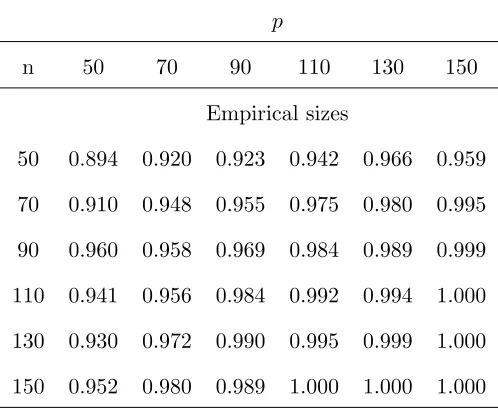
With these simulated data, we apply the proposed statisticLnand calculate the empirical
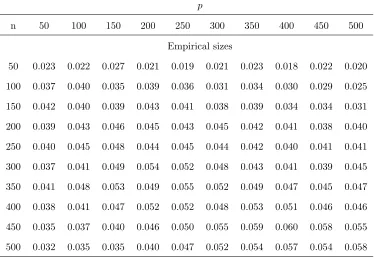
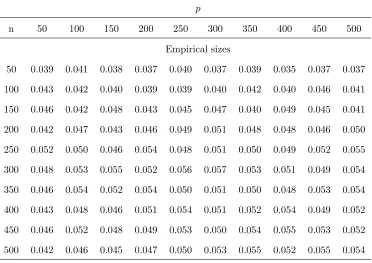
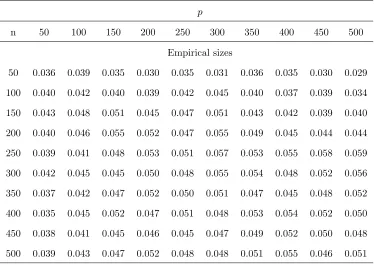
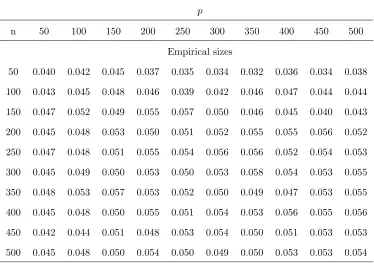
sizes. Table 1, Table 3 and Table 5 establish the empirical sizes for the three DGPs under
different pairs of (p, n). The results show that our statistic Ln works well under the null
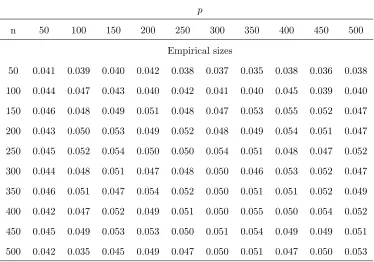
hypothesis H0. Additionally, their empirical sizes from the bootstrap method proposed in
Remark 3 are illustrated in Table 2, Table 4 and Table 6 respectively.
4.3
Testing dependence
4.3.1 Three types of correlated structures
In this section, we test four dependent structures with the proposed test and provide the
powers under each case. As in the last part of this section, we first generate data X =
(x1,x2, . . . ,xn) under DGP 1. To describe the cross-sectional dependence between xi1 and
xi2, ∀i1 6=i2, we generate new data Xe =XT, where Tis a p×p Hermitian matrix which is
the square root of a covariance matrix. T is constructed by the following three methods.
1. MA(1) type covariance matrix ΣM A = (σM A kh )
p k,h=1:
σkh(M A)=
(1 +θ2), k =h;
θ, |k−h|= 1;
0, |k−h|>1.
(4.6)
Under this case,T=Σ1M A/2.
2. AR(1) type covariance matrix ΣAR = (σ(khAR)) p k,h=1:
σkh(AR) = φ
|k−h|
1−φ2. (4.7)
Under this case,T=Σ1AR/2.
3. ARMA(1,1) type covariance matrix ΣARM A = (σ(khARM A))pk,h=1:
σ(khARM A) =
1 + (φ1−+φθ)22, k =h;
φ+θ+(φ1+−θφ)22φ, |k−h|= 1;
φ|k−h|−1(φ+θ+ (φ+θ)2φ
1−φ2 ), |k−h| ≥2.
(4.8)
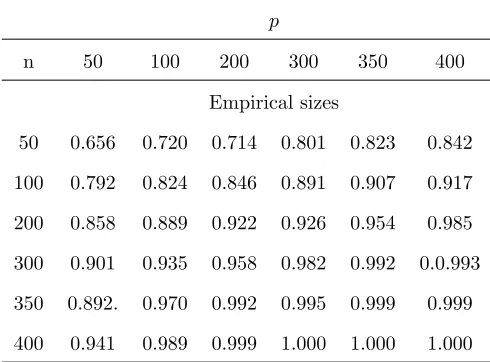
The powers under the three cases are illustrated in Table 7, Table 8 and Table 9. The true
parameters are taken as φ = 0.8 and θ = 0.2. It can be seen that the powers are near 1 as
n and p tend to infinity in the same order.
4.3.2 Factor model dependence
We consider a data generating process which comes from a dynamic factor model, which is
always used to describe cross-sectional dependence.
Xji =λ
′
fj+εji, i= 1,2, . . . , n, j = 1,2, . . . , p, (4.9)
with
fj =zj+θzj−1, i= 1,2, . . . , n, j = 1,2, . . . , p, (4.10)
where λ is an r× 1 deterministic vector whose elements are called factor loadings; fj is an r×1 random vector generated from (4.10), whose elements are called factors and the
cross-section dependence betweenxi1 andxi2 are caused by the common factorsfj. {zj :j =
1,2, . . . , p} ∼i.i.d N(0r,Ir) where 0r is an r×1 vector with elements 0 and Ir is an r×r
identity matrix. {εji :j = 1,2, . . . , p;i= 1,2, . . . , n} ∼i.i.d N(0,1) are idiosyncratic errors.
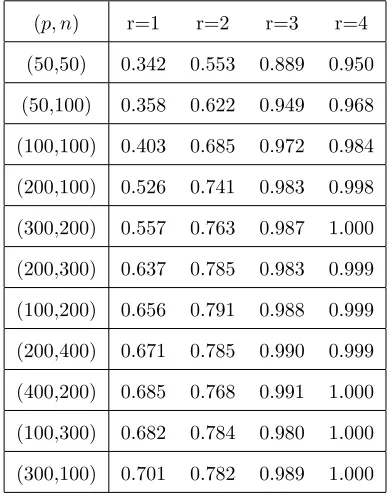
First, we generate the factor loadings in the vector λfromN(4,1) before generating data from (4.9) and (4.10). After generating the data, we can apply the proposed test statistic
Ln to the data and the empirical powers are shown in Table 10. From this table, we can
see that the powers increase as the number of factors r increases. This is reasonable in the
sense that more factors should bring in stronger dependence.
4.3.3 Common random dependence
We consider a special dependent structure which is caused by a common random part. The
data generating process is as follows.
xi =Ayi, i= 1,2, . . . , n, (4.11)
where A is a p ×p random matrix whose components are i.i.d standard normal random
variables; and yi, i = 1,2, . . . , n are independent p×1 random vectors, whose components
are assumed to be i.i.d standard normal random variables.
Therefore the random vectors x1,x2, . . . ,xn are dependent due to the common random
part A. The empirical powers are listed in Table 11. From the table, we can see that the
4.3.4 ARCH type dependence
It is known that dependent relations may be linear dependence or nonlinear dependence.
The examples above are all linear dependent structures. In this section, we will present a
nonlinear dependent structure.
Let us consider an autoregressive conditional heteroskedasticity (ARCH) model of the
form:
Xji =Zji
q
α0+α1Xj,i2 −1, i= 1,2, . . . , n; j = 1,2, . . . , p; (4.12)
where {Zji : j = 1,2, . . . , p;i = 1,2, . . . , n} are white noise error terms with zero mean and
unit variance. Here we take α0, α1 ∈ (0,1) and 3α21 < 1, since the fourth moment of the
elements of Xji exists.
From this model, the sequences {x1,x2, . . . ,xn} are dependent but uncorrelated.
More-over, this sequence is a multiple martingale difference sequence. The components of each
vector xi are independent here. This simplified assumption is imposed because the
asymp-totic theory is established for covariance time series under the assumption that the fourth
moment equals 3 while the asymptotic theorem is provided for random vectors with i.i.d.
components without this restriction.
Simulation results indicate that the proposed test statistic Ln can not detect this type
of dependence between x1,x2, . . . ,xn. Nevertheless, if we replace the elements Xjt by Xjt2,
then our statistic Ln can capture the dependence of this type. This efficiency is due to the
correlation between the high powers of {Xjt :t= 1,2, . . . , n}.
Table 12 lists the powers of the proposed statistics Ln testing model (4.12) in several
cases, i.e. α0 andα1 take different values. From the table, we can find the phenomenon that
asα1 increases, the powers also increase. This is consistent with our intuition that largerα1
brings about larger correlation between x1,x2, . . . ,xn.
5
An empirical application
We now apply the proposed method to the daily returns of the 96 stocks from S&P500,
one of the most popular stock markets. The original data are the daily closed stock prices
of the companies belonging to S&P500 from January 2011 to December 2011, with total
derived from Wharton Research Data Services (WRDS). We use the logarithmic difference
Xji = ln(Sji/Sj−1,i). Then N = 251 logarithmic differences are available for each stock.
Note that although we have N = 251 observations available for each stock here, we only use
the firstp(p≤N) data to do the test. The value of p is comparable ton.
The interest here is to test whether the daily returns for the investigated n stocks are
dependent. Here we study three groups of companies, i.e. n = 60,70,90 stocks respectively
from S&P500. Since the distribution of Xjτ possesses high peak and heavy tails compared
with the normal distribution, which is a typical property of the financial data (Rama (2001)),
for simplicity we suppose that a transformation of the data follows a standard normal
dis-tribution,
ˆ
Xji :=
Xji−ai
bi
βj
∼N(0,1), (5.1)
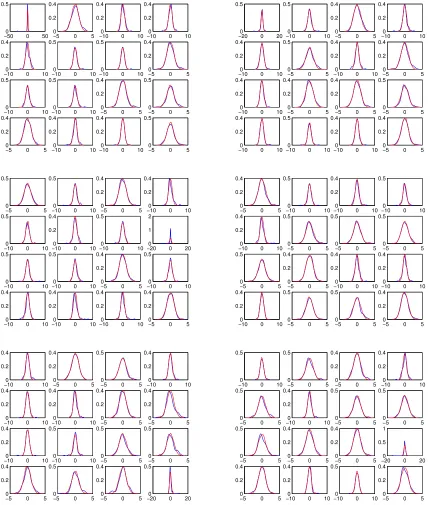
whereai, bi, βiare unknown parameters. Figure 1 illustrates the smoothed empirical densities
of the transformed data ˆXji for all the selected 96 stocks under investigation. From these
graphs, we can see that the model (5.1) is fitted well.
It is time to calculate Ln. We randomly choose n companies from the total available
96 companies and calculate the proposed statistic Ln. Repeat this experiment k = 5 times
and obtain 5 values for Ln. They are listed in Table 13. From this table, we can see that
more companies involved in the test lead to larger statistic values. For each case, all the
five statistic values are outside the interval with critical values as the end points. We should
reject the null hypothesis that the randomly chosen n= 60,70,90 stocks are independent at
the significance level 5%. This coincides with the popular financial theory that states that
cross-sectional dependence exists in modern stock markets.
6
Conclusion
This paper provides a novel approach for independence test among a large number random
vectors including covariance stationary time series of lengthpby using the empirical spectral
distribution of the sample covariance matrix of the grouped time series under investigation.
This test can capture various kinds of dependent structures, e.g. MA(1) model, AR(1)
model, ARCH(1) model and the dynamic factor model established in the simulation
sec-tion. The conventional method(LRT proposed by Anderson (1984)) utilized the correlated
instead of covariance stationary time series. Hong (1996) proposed a test statistic based
on correlation functions to investigate independence between two covariance stationary time
series. On the one hand, this idea is only efficient for normal distributed data. It may
be an inappropriate tool for non-Gaussian distributed data, such as martingale difference
sequences (e.g.ARCH(1) model), nonlinear MA(1) model etc., which possess dependent but
uncorrelated structures. On the other hand, his method is only applicable to independence
test for finite number of covariance stationary time series. Then the proposed test is more
advantageous in these two points. The simulation results and an empirical application to
cross-sectional independence test for stock prices in S&P500 highlight this approach.
7
Appendix
In this appendix, we present some lemmas and technical facts used in the proofs of the main
theorems.
7.1
Useful lemmas
Lemma 2 (Stein’s equation). Let η={ηℓ}pℓ=1 be independent Gaussian random variables of zero
mean, and Φ : Rp → C be a differentiable function with polynomially bounded partial derivatives
Φ′ℓ, ℓ= 1, . . . , p. Then we have
E{ηℓΦ(η)}=E{ηℓ2}E{Φ
′
ℓ(η)}, ℓ= 1, . . . , p; (7.1)
and
V ar{Φ(η)} ≤ p
X
ℓ=1
E{η2ℓ}E{|Φ′ℓ(η)|2}. (7.2)
Lemma 3 (Generalized Stein’s equation of Lytova and Pastur (2009)). Let ηbe a random variable such thatE{|η|q+2}<∞ for a certain nonnegative integerq. Then for any function Φ :R→Cof
the classCq+1 with bounded derivatives Φ(ℓ), ℓ= 1, . . . , q+ 1, we have
E{ηΦ(η)}= q
X
ℓ=0
κℓ+1
ℓ! E{Φ
(ℓ)(η)}+ε
q, (7.3)
where the remainder term εq admits the bound
|εq| ≤CqE(|η|q+2) sup t∈R|
or
|εq| ≤Cq
Z 1
0
Eηq+2Φ(q+1)(ηv)(1−v)qdv, (7.5)
with Cq ≤ 1+(3+2q) q+2
(q+1)! .
We would point out that (7.5) can be obtained from the proof of Lytova and Pastur (2009).
Our proof utilizes the generalized Fourier transform as follows:
Lemma 4 (Proposition 2.1 of Lytova and Pastur (2009)). Let g :R+ → C be locally Lipshitzian and such that for someδ >0
sup t≥0
e−δt|g(t)|<∞
and let eg:{z∈C:Im(z)<−δ} →Cbe its generalized Fourier transform
e
g(z) =i−1
Z ∞
0
e−iztg(t)dt.
The inversion formula is given by
g(t) = i 2π
Z
L
eizteg(z)dz, t≥0,
where L= (−∞ −iε,∞ −iε), ε > δ, and the principal value of the integral at infinity is used.
Denote the correspondence between functions and their generalized Fourier transforms asg↔eg. Then we have
g′(t)↔i g(+0) +zeg(z);
Z t
0
g(τ)dτ ↔(iz)−1eg(z);
Z t
0
g1(t−τ)g2(τ)dτ := (g1∗g2)(t)↔ieg1(z)eg2(z). (7.6)
Furthermore, we introduce a simple fact about exponential matrices below.
Lemma 5 (Duhamel formula). Let W1,W2 be n×nmatrices and t∈R. Then we have
e(W1+W2)t=eW1t+ Z t
0
eW1(t−s)W
2e(W1+W2)sds. (7.7)
Moreover, if Wij(t)1≤i,j≤n is a matrix-valued function oft∈Rthat is C∞ in the sense that each
matrix element Wij(t) is C∞. Then
d dte
W(t)=Z 1 0
esW(t)W′(t)e(1−s)W(t)ds, (7.8)
Proof of Theorem 1: Since
E Z λdFS(λ)=E1 ptr(
1 nXX
′
)=
∞
X
k=0
b2k,
the sequence E{FS
(λ)} is tight. By Theorem B.9 of Bai and Silverstein (2009), the proof of
Theorem 1 is complete if we can verify the following two steps:
1. For any fixed z∈ C+,mn(z)−Emn(z)→0, a.s. asn→ ∞, wheremn(z) = 1ptrG−1(z) with G−1(z) = (S−zI
p)−1 and Ip being a p×p identity matrix. 2. For any fixed z∈ C+,Em
n(z)→mφ(z), asn→ ∞, wheremφ(z) =R λ−1zdFc,φ(λ).
The first step is omitted here, since it is similar to the proof on page 54 of Bai and Silverstein
(2009).
We will finish the second step by comparing Emn(z) for the Gaussian case and nonGaussian
case: asn→ ∞
Emn(z)−Emˆn(z)→0, (7.9)
Emˆn(z)→mφ(z), (7.10)
where ˆmn(z) is obtained from mn(z) with the elements Xjt = P∞k=0bkξj−k,t replaced by ˆXjt =
P∞
k=0bkξˆj−k,t. Here {ξˆj−k,t}are i.i.d Gaussian random variables with mean zero and variance one
and {ξˆj−k,t}are independent of {ξj−k,t}. (7.10) obviously holds by Yao (2012).
Let Im(z) = v > 0 and below we will frequently use the fact that |mˆn(z)| and |mn(z)| are
both bounded by 1/v without mention. We now consider (7.9) and start with the truncation of
underlying random variables. Define
Sτ = 1 nX
τ(Xτ)T, Xτ = (Xτ
jt)p×n, Xjtτ =
∞
X
k=0
bkξjτ−k,t, ξjτ−k,t =ξj−k,tI(|ξj−k,t| ≤τ√n), (7.11)
whereτ =τn is a positive sequence satisfying
τ →0, 1
τE(|ξ11|
2I(|ξ
11|> τ√n))→0. (7.12)
We claim that for every τ >0,
lim n→∞
Emn(z)−Emτn(z)
wheremτ
n(z) = 1ptrG−1τ (z) withGτ−1(z) = 1ptr(Sτ −zIp)−1. In fact, we have
Emn(z)−Emτn(z)
≤ p√1 n
p,n
X
j,t=1
E G−τ1(z)G−1(z)√1 nX
jt Xjt−X τ jt
+ 1 p√n
p,n
X
j,t=1
E Xjt−Xjtτ
G−1(z)G−τ1(z)√1 nX
jt
≤ Cnp p√n
∞
X
k=0
|bk|E|ξ11|I(|ξ11| ≥τ√n)≤
CE|ξ11|2I(|ξ11| ≥τ√n)
τ
∞
X
k=0
|bk| →0,
where the first inequality uses the resolvent identity
(A−zIp)−1−(B−zIp)−1 =−(A−zIp)−1(A−B)(B−zIp)−1,
holding for any Hermitian matricesA and B and the second inequality uses
G−1τ (z)G−1(z)√1 nX
jt
≤ 1v||G−1(z)√1 nX||=
1 v||G
−1(z)1
nXX
TG−1(z)||1/2
≤ 1 v||G
−1(z)||1/2+1
v|z|
1/2||G−1(z)|| ≤C. (7.14)
Here k · k denotes the spectral norm of a matrix. Also throughout the paper we use C to denote
constants which may change from line to line.
In view of (7.13) it is sufficient to prove that|Emτ
n(z)−Emˆn(z)| →0, as n→ ∞.However for simplicity below we still use notation mn(z),X, Xjt, ξj−k,t instead of using mτn(z),Xτ, Xjtτ, ξjτ−k,t and prove (7.9). But one should keep in mind that|ξj−k,t| ≤τ√n.
We next prove (7.9) by an interpolation technique first introduced in Lytova and Pastur (2009).
To this end define the interpolation matrix
S(s) = 1
nX(s)X
T(s),X(s) =X θ,t(s)
=s1/2X+ (1−s)1/2Xˆ, s∈[0,1] (7.15)
and
G−k(s, z) =S(s)−zIp
−k
, mn(s, z) = 1 ptrG
−1(s, z), k= 1,2.
Write Φjt(s) =
G−2(s, z)√1
nX(s)
jt. We then have
Emn(z)−Emˆn(z) =
Z 1
0
∂
∂sEmn(s, z)ds=
−1 p Z 1 0 p,n X j,t=1
Ehs−1/2√1
nXjtΦjt(s)
i
ds+1 p Z 1 0 p,n X j,t=1
Eh(1−s)−1/2√1
nXˆjtΦjt(s)
i
where we have used the formula below
∂G−1(s, z)
∂s =−G
−1(s, z)∂S(s)
∂s G
−1(s, z).
Consider the second term in (7.16) first. Since ˆXjt=P∞k=0bkξˆj−k,t we have
E√1
nXˆjtΦjt(s)
=
∞
X
k=0
bkE
1
√
nξˆj−k,tΦjt(s)
. (7.17)
Applying Lemma 2 to each summand in (7.17) we have
(1−s)−1/2
∞
X
k=0
bkE( 1 √
nξˆj−k,tΦjt(s)) = 1 n ∞ X k=0 bk p X
θ=j−k
bθ−j+kE
Dθ,t(Φjt(s))
, (7.18)
where the partial derivativeDθ,t =∂/∂(√1nXθt(s)) and we used the fact that
∂Xˆθt ∂ξˆj−k,t
=bθ−j+k,
∂Xθt(s) ∂Xˆθt
= (1−s)1/2.
Consider the first term in (7.16) now. As before, applying the fact that Xjt =P∞k=0bkξj−k,t and Lemma 3 to each summand of the first term in (7.16), we obtain
Es−1/2√1
nXjtΦjt(s)
=s−1/2
∞
X
k=0
bkE
1
√
nξj−k,tΦjt(s)
(7.19)
= s−1/2√1 n
∞
X
k=0
bkκ1,τEΦjt(s) +s−1/2 1 n
∞
X
k=0
bkκ2,τ p
X
ζ=j−k
bζ−j+kE
Dζ,t(Φjt(s))
+ε1,
whereκi,τ denotes theith cumulant of the variable ξj−k,t withi= 1,2,
|ε1| ≤
C1s−1/2
n3/2 ∞
X
k=0
|bk|E|ξj−k,t|3 sup |ξj−k,t|≤τ√n
|Dej2−k,t(Φjt(s))|
,
with
e
D2j−k,t(Φjt(s)) =Dej−k,t
Xp
ζ=j−k
∂Φjt(s) ∂√1
nXζ,t(s) ∂√1
nXζ,t(s) ∂√1
nXζ,t ∂√1
nXζ,t ∂√1
nξj−k,t
= s p
X
ζ=j−k p
X
γ=j−k
bζ−j+kbγ−j+kDζ,t
Dγ,t(Φjt(s))
,
whereDej−k,t =∂/∂√1nξj−k,t. Here we would point out that checking the argument of Lemma 3 in Lytova and Pastur (2009) shows that sup
t∈R
in (7.5) can be replaced by sup
|ξj−k,t|≤τ√n
in the remainder
ε1 due to the truncation step.
We conclude from (7.16)-(7.19) that
Emn(z)−Emˆn(z) =−
Z 1
0
hs−1/2
pn1/2 ∞ X k=0 bk p,n X j,t=1
+s−1 /2 np ∞ X k=0 bk p,n X j,t=1
(κ2,τ −1) p
X
ζ=j−k
bζ−j+kE
Dζ,t(Φjt(s))
i
ds. (7.20)
The next aim is to prove that each of the three integrands goes to zero as n tends to infinity.
To this end, first let µℓ,τ(µℓ) and κℓ,τ(κℓ) be the ℓth moment and cumulant of the truncated ξjt
and the untruncated (ξjt) respectively. Then
|µℓ,τ −µℓ| ≤CE
|ξ11|ℓI(|ξ11|> τ√n)
.
As a result we have
|κℓ,τ −κℓ| ≤CE
|ξ11|ℓI(|ξ11|> τ√n)
≤ C
(τ√n)2−ℓE(|ξ11|
2I(|ξ
11|> τ√n). (7.21)
This result uses the fact that cumulants can be expressed by moments as follows
κj =
X
λ cλµλ,
where the sum is over all additive partitions λ of the set {1, . . . , j}, {cℓ : ℓ ∈ λ} are known
coefficients and µλ =Qℓ∈λµℓ.
Second we provide the upper bound of Φjt(s), Dγ,t(Φjt(s)) and Dζ,t
Dγ,t(Φjt(s))
. For
sim-plicity, we introduce more new notation.
I(ζ, γ) =eγeTζ +eζeTγ, W(γ, t) =eγeTt 1 √
nX
T(s) +√1
nX(s)ete T γ,
J1(ζ) =G−1(s, z)W(ζ, t)G−2(s, z), J2(γ, ζ) =G−1(s, z)I(γ, ζ)G−2(s, z)
J3(γ, ζ) =G−1(s, z)W(γ, t)G−2(s, z)W(ζ, t)G−1(s, z),
J4(ζ, γ) =G−1(s, z)W(ζ, t)G−1(s, z)W(γ, t)G−2(s, z),
where eγ and ej are p×1 unit vectors with the γ-th and j-th elements being 1 respectively and others being zeros; and et is n×1 a unit vector with the t-th element being 1 and others being zeros. With these notation by a simple but tedious calculation we obtain
Dγ,t(Φjt(s)) = −eTjG−2(s, z)eγ+eTjJ1(γ)
1 √
nX(s)et+e T jJT1(γ)
1 √
nX(s)et and
Dζ,t
Dγ,t(Φjt(s))
=eTjJ1(ζ)eγ+eTjJT1(ζ)eγ−eTjJ4(ζ, γ)
1 √
nX(s)et −eTjJ4(γ, ζ)
1 √
nX(s)et−e T
jJ3(γ, ζ)
1 √
nX(s)et+e T
jJ1(γ)eζ−eTjJT1(γ)eζ −eTjJ3(ζ, γ)
1 √
nX(s)et−e T
jJT4(γ, ζ)
1 √
nX(s)et−e T
jJT4(ζ, γ)
1 √
nX(s)et +eTjJ2(γ, ζ)
1 √
nX(s)et+e T
jJT2(γ, ζ)
1 √
From the expansions of Φjt(s), Dγ,t(Φjt(s)) andDζ,t
Dγ,t(Φjt(s))
we see that all the terms in
such expansions include only three factors below:
D1 =
1
√ nX
T(s)G−ℓ(s, z)√1 nX(s)
tt, D2=
G−ℓ(s, z)√1 nX(s)
kt,
D3 =G−ℓ(s, z)kk′, ℓ= 1,2, k, k ′
=j, ζ, or γ.
These three factors turn out to be bounded, as seen below.
Obviously |D3| ≤v−ℓ. Similar to (7.14) using
G−1(z)1
nX(s)X
T(s) =I+zG−1(s, z). (7.22)
one may verify that
|D2| ≤
1
vℓ−1kG−1(s, z)
1 √
nX(s)k ≤C, j = 1,2 and
|D1| ≤ k√1
nX
T(s)G−ℓ(s, z)√1
nX(s)k=kG
−ℓ(s, z)1
nX(s)X
T(s)k≤C.
Therefore Φjt(s) and the two derivatives Dγ,t(Φjt(s)), Dζ,t
Dγ,t(Φjt(s))
are bounded. This,
together with (7.21) and (7.12), yields
s−
1/2
pn1/2 ∞ X k=0 bk p,n X j,t=1
κ1,τEΦjt
≤ C
τE(|ξ11|
2I(|ξ
11|> τ√n))→0
and np1 ∞ X k=0 bk p,n X j,t=1
(κ2,τ −1) p
X
ζ=j−k
bζ−j+kE
Dζ,t(s)Φjt(s)≤CE(|ξ11|2I(|ξ11|> τ√n))→0.
Moreover sinceE|ξjt|3 ≤τ√nand (7.12) we have
1p p,n X j,t=1 ε1
≤Cτ →0, as n→ ∞.
These, together with (7.20), yield (7.9). The proof of this theorem is complete.
Proof of Theorem 2: The strategy of the proof is the same as that in Lytova and Pastur (2009).
That is, we first establish CLT for the case when{ξj−k,t}are i.i.dN(0,1) and then generalize it to
the general distributions.
When{ξj−k,t}are i.i.dN(0,1), as stated in Section 2, underH0, the matrixScan be written in
the form thatS= n1T11/2XXTT1/2
1 so that Theorem 9.10 of Bai and Silverstein (2009) is applicable.
asymptotic mean is obtained from that in Bai and Silverstein (2009) and the facts that (See Yao
(2012) and Gray (2009))
lim p→∞
1 p
p
X
k=1
f(σk) =
Z ∞
0
f(x)dH(x) = 1 2π
Z 2π
0
f(φ(λ))dλ.
However to apply Bai and Silverstein (2009), we have to make sure that the spectral norm of the
population covariance matrix T1 of each time series is bounded. We claim that this is ensured by
the condition P|bj|<∞. In fact, letσk=Cov(Xjt, Xj+k,t). By the expression (2.2) of the time series and a change of variables we have
∞
X
k=0
|σk|=
∞
X
k=0
|Cov(
∞
X
k1=0
bk1ξj−k1,t,
∞
X
k2=0
bk2ξj+k−k2,t)|
=
∞
X
k=0
|
∞
X
k1=0
bk1bk1+k|<(
∞
X
k=0
|bk|)2 <∞. (7.23)
By Lemma 4.1 of Gray (2009) and (7.23) we conclude that
||T1|| ≤4 ∞
X
k=0
|σk|<∞. (7.24)
We next adopt an interpolation trick and compare the CLT of the general case with that of the
Gaussian case. Recall the definition ofGn(λ) in (2.8). Let
Nn◦[f] =
Z
f(λ)dGn(λ), Nn[f] =
Z
f(λ)dpFS(λ).
Define Nb◦
n[f] and Nnb [f] to be obtained fromNn◦[f] and Nn[f] respectively, with the entries Xjt =
P∞
k=0bkξj−k,t replaced by ˆXjt =P∞k=0bkξˆj−k,t where{ξˆj−k,t}are i.i.d. N(0,1) and independent of
{ξj−k,t}. By the continuous theorem of characteristic functions, it suffices to show that
Rn(x) :=E
eixNn◦[f]
−EeixNbn◦[f]
→0, as n→ ∞. (7.25)
Since the integrand function f admits the Fourier transform
ˆ
f(θ) = 1 2π
Z
e−iθλf(λ)dλ,
the Fourier inversion formula is
f(λ) =
Z
eiθλfˆ(θ)dθ. (7.26)
Then the statistic Nn[f] can be written as
Nn[f] =
Z
ˆ
where
un(θ) =T rU(θ), U(θ) =eiθS. (7.27)
By (7.26) we obtain
f′(S) =i
Z
ˆ
f(θ)θU(θ)dθ. (7.28)
We still use the same truncation as that in (7.11) (and use the same notation) but this time τ
satisfies (see formula (9.7.7) of Bai and Silverstein (2009))
τ →0, τ−4E|ξj−k,t|4I(ξj−k,t|> τ√n)→0. (7.29)
Note that
P{X6=Xτ} ≤ p,n
X
j,t=1
P{Xjt 6=Xjt} ≤τ 1 τ4n2
p,n X j,t=1 ∞ X k=0
bkE|ξj−k,t|4I(ξj−k,t|> τ√n)→0.
In view of this it is enough to prove that
EeixNnτ◦ [f]
−EeixNbn◦[f]
→0, as n→ ∞, (7.30)
whereN◦
nτ[f] is obtained fromNn◦[f] withX replaced byXτ.
As in the proof of Theorem 1 we still use notationξj−k,t,X,Nn[f] rather thanξjτ−k,t,Xτ,Nnτ◦ [f] and below prove (7.25). Recall the interpolation matrix defined in (7.15) and furthermore define
en(s, x) = exp
ixT rf S(s), U(s, θ) = (Ujk) =eiθS(s).
By (7.28) we have
Rn(x) =an
Z 1
0
∂ ∂sE
en(s, x)
ds
= ixan
Z 1
0
Ehen(s, x)T r
f′(S(s)) s−1/2√1
nX−(1−s)
−1/2√1
nXˆ
1 √
nX τ′
(s)ids
= −xan
Z 1
0
ds
Z
θfˆ(θ)(Dn−Bn)dθ, (7.31)
wherean= exp(−ixR f dpFcn,φn) and
Dn= 1 √ ns p,n X j,t=1
EXjtΨjt(s)
, Bn= 1
p
n(1−s) p,n
X
j,t=1
EXˆjtΨjt(s)
,
with
Ψjt(s) =en(s, x)
U(s, θ)√1 nX(s)
By Lemma 2 and a calculation similar to (7.17), (7.18) and (7.19) we obtain
Bn= 1 n p,n X j,t=1 ∞ X k=0 bk p X
k(1)=j−k
bk(1)−j+kE
Dk(1)t(Ψjt(s))
, (7.32)
whereDk(1)t=∂/∂√1nXk(1)t.
Also, by Lemma 3 with q= 3 we have
Dn=
3
X
ℓ=0
Tℓτ+ε3, (7.33)
where
T0τ = s−1/2
√ n
p,n
X
j,t=1
κ1,τ
∞
X
k=0
EΨjt(s),
Tℓτ =
s(ℓ−1)/2 ℓ!n(ℓ+1)/2
p,n
X
j,t=1
κℓ+1,τ
∞ X k=0 bk p X
k(ℓ),k(ℓ−1),...,k(1)
bk(ℓ)−j+kbk(ℓ−1)−j+k· · ·bk(1)−j+k
·EDk(ℓ)tDk(ℓ−1)t· · ·Dk(1)tΨjt(s)
, ℓ= 1,2,3;
and
|ε3| ≤
Cs2 n5/2
p,n X j,t=1 ∞ X k=0
|bk|
p
X
k(4),...,k(1)=j−k
|bk(4)−j+k| · · · |bk(1)−j+k|
·
Z 1
0
Eh|ξj−k,t|5Dk(4)t· · ·Dk(1)tΨjt(s)
ξj−k,t=vξj−k,t
i
(1−v)3dv, (7.34)
where Ψjt(s)
ξj−k,t=vξj−k,t means thatξj−k,t involved in Ψjt(s) is replaced byvξj−k,t andκℓ,τ is the ℓth cumulant ofξj−k,t.
Next, we provide the upper bounds of derivatives:
Dk(ℓ)tDk(ℓ−1)t· · ·Dk(1)tΨjt(s), ℓ= 0,1,2,3,4.
LetY(s) = (Yrt(s)) = √1nX(s). Applying the Duhamel formula of Lemma 4 to the entries, Ujk(ℓ),
of U(s, θ) we have
Dβα(Ujk(ℓ)) =i h
(UY(s))jα∗Uβ,k(ℓ)
(θ) +(UY(s))k(ℓ)α∗Ujβ
(θ)i, (7.35)
where the convolution∗is defined in (7.6). Here and below we useUto denoteU(s, θ) when there is no confusion. In view of (7.35) and the fact that Ip =Ppr=1ere
′
r we have
Dk(ℓ)t(UY(s))jt =Dk(ℓ)t Xp
r=1
Yrt(s)Urj
= Uk(ℓ)j+i h
(YT(s)UY(s))tt∗Uk(ℓ)j
(θ) +(UY(s))jt∗(UY(s))k(ℓ)t
(θ)i,
Dk(d)t(YT(s)UY(s))tt=Dk(d)t Xp
r=1
(UY(s))rtYrt(s)
= 2(UY(s))k(d)t+ 2i
(Yτ′(s)UY(s))tt∗(UY(s))k(d)t
(θ), (7.37)
and by (7.28)
Dk(ℓ)t(en(s, x)) =−2xen(s, x)
Z
θfˆ(θ)(UY(s))k(ℓ)tdθ, (7.38)
whereℓ, d= 1,2,3,4.
Since Pnt=1|Uαt|2 = 1 and ||U||= 1, from H¨older’s inequality, we obtain
|(UY(s))jt| ≤ p
X
r=1
(Yrt(s))2
1/2
, |(YT(s)UY(s))tt| ≤ p
X
r=1
(Yrt(s))2. (7.39)
Recalling the definition of Ψjt(s) and repeatedly using (7.35)-(7.39) one can verify that
Dk(ℓ)tDk(ℓ−1)t· · ·Dk(1)tΨjt(s)
≤C+C p
X
r=1
(Yrt(s))2(ℓ+1)/2, ℓ= 0,1,2,3,4. (7.40)
For example see (7.49) below for the expansion of Dk(1)tΨjt(s). Moreover it is straightforward
to check that ℓ = 0,1,2,3, E Ppr=1(Yrt(s))2(ℓ+1)/2 is bounded by the fact that n2E|Yrt(s)|4 = E|Xrt(s)|4 <∞. We then conclude that
EDk(ℓ)tDk(ℓ−1)t· · ·Dk(1)tΨjt(s)
≤Cℓ, ℓ= 0,1,2,3. (7.41)
However, to prove ε3→0, (7.40) for the caseℓ= 4 is not enough for our purpose since
E|Xrt(s)|5 ≤Cτ√n, (7.42)
not bounded. To offset this √n, one key observation is that from (7.35)-(7.38) we see that each
term in the expansion ofDk(ℓ)tDk(ℓ−1)t· · ·Dk(1)tΨjt(s) is a product or a convolution of some of the following factors
(UY(s))h1t, (U)h2h3, (Y
T(s)UY(s))
tt, en(s, x),
where hi can be j or any k(ℓ), ℓ = 1,· · · ,4. Let m1 and m2 be the total number of factors of
types of (UY(s))h1t and (YT(s)UY(s))tt appearing in each term of the expansion, respectively.
Then from (7.35)-(7.38) and (7.49) below we see that (m1+ 2m2)≤5 (this explains (7.40) to some
extent). Consider the case when (m1+ 2m2) = 5 first. In this case from (7.35)-(7.38) and (7.49)
below we see that at least one (UY(s))h1tmust be contained in the expansion. We below show how
to handle such terms by demonstrating one example and all other cases can be similarly proved.
Consider the term