Munich Personal RePEc Archive
Some Notes on Inconsistence and
Indecisiveness in the Analytic Hierarchy
Process
Jiri, Mazurek
Silesian University - School of Business Administration
9 November 2012
Online at
https://mpra.ub.uni-muenchen.de/42543/
Some Notes on Inconsistence and Indecisiveness in the Analytic Hierarchy
Process
Jiří Mazurek
Abstract: The aim of the article is to introduce a mathematical concept of indecisiveness into the analytic hierarchy process (AHP) framework. Indecisiveness can be useful in two ways: first, decision makers with high indecisiveness (higher than a given threshold value) can be excluded from a decision making process in its early stages as low-competent and replaced by other, more competent DMs; second, indecisiveness along with consistency index C.I. can be used for the calculation of (aposteriori) DMs’ weights without any additional information about DMs’ age, formal knowledge, social status, etc. The proposed approach is demonstrated on examples.
Keywords: AHP, inconsistence, decision making, indecisiveness.
JEL classification: D79.
1. Introduction
Decision making processes are omnipresent in human life as well as in many areas of economics such as marketing, management, human resources, logistics, etc. Decision making methods range from the simple majority rule to more sophisticated approaches such as the analytic hierarchy/network process (AHP/ANP) by T. L. Saaty, see e.g. [3], [4], [5] or [6], computing with words ([7] or [8]) or decision making in the fuzzy environment ([1] or [2]).
In general, a multi-criteria decision making process consists of the following steps: 1. Identification of the problem.
2. Analysis of the problem.
3. Establishing sets of alternatives, criteria and experts who will evaluate alternatives. 4. Evaluation of alternatives by experts with respect to given criteria.
5. Selection of the best alternative (which includes aggregation of experts’ preferences and ordering of alternatives from the best to the worst).
In the literature the step 5 is of the most interest, as there is vast number of methods proposed for various kinds of decision making processes. This article focuses on the step 4, and more specifically on the problem of ‘quality’ of decision makers’ (DMs’) preferences in the group decision making. So far, DMs’ preferences were thoroughly examined in terms of their (in)consistence (that is existence of a contradiction) because human judgment is imperfect due to many reasons such as time pressure, imprecise information, lack of knowledge, prejudices, etc.
DMs’ preferences are crucial part of each decision making, as they represent problem’s input, hence they determine problem’s solution. Apart from (in)consistence, which is of great importance without no doubt, DMs’ preferences are not studied in a more detail, though there are at least two other often neglected features important for problem’s solution associated with DMs’ preferences:
- differences among DMs’ preferences (degree of a conflict among DMs), - decisiveness of each DM.
opposition). Group decision making is always associated with less or more conflict among DMs, which must be resolved finally if a consensus is going to be achieved.
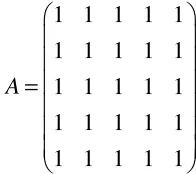
As for the latter, decision makers can express their preferences on a set of alternatives with a different degree of intensity (or confidence). In AHP, the intensity of preference is expressed on Saaty’s scale from 1 to 9 (see Table 1). In real decision situations, some decision makers can express stronger preferences than others. It seems natural to assign higher weights to a DM who has strong opinion on a topic (a DM is strongly decisive possibly due to better knowledge or experience), and lower weight to a DM with weak opinion. As shown in Section 2, in extreme cases a DM can express preferences that are absolutely consistent (see Table 2), but completely indecisive, thus useless. Clearly, inconsistence is not sufficient measure of quality DMs’ preferences.
Therefore, the aim of the article is to propose the measure of indecisiveness in the group AHP framework. This new measure can be useful in two ways:
- DMs with high indecisiveness can be excluded from a decision making process as low-competent immediately in its early stages and replaced by other, more low-competent DMs.
- Indecisiveness along with Saaty’s consistency index C.I. can be used for the calculation of (aposteriori) DMs’ weights. Decision makers with larger consistency and decisiveness are assigned larger weights and vice versa. The advantage of this approach rests in the fact that only information given by DMs is used, and no additional knowledge ‘from outside‘ about DMs’ age, formal knowledge, social status, etc., is required.
The article is organized as follows: in Section 2 AHP and consistency index C.I. are briefly described, in Section 3 the measure of indecisiveness is introduced along with derivation of weights of DMs, and in Section 4 numerical examples are provided. Conclusions close the article.
2. Analytic hierarchy process
Analytic hierarchy process (AHP) was proposed by T. L. Saaty in 1980 [4]. Its fundamental part consists of pair-wise comparisons of objects on the kth level of hierarchy with regard to objects on the immediately higher (k – 1)th level. Typically, the highest level is a goal, the second level form criteria and the lowest level consists of alternatives. The aim of AHP lies in the selection of the best alternative. As the article focuses on indecisiveness of decision makers in evaluating alternatives, only comparisons of alternatives with regard to a given set of criteria by one or more DMs will be considered.
Alternatives are compared on the scale from 1 to 9, where 1 denotes equal importance and 9 extreme importance of one alternative over another (see Table 1); sij denotes preference of an
alternative i over an alternative j. Preferences sij are reciprocal: if an alternative A is
moderately preferred over an alternative B, then sAB =3, and by definition sBA =1/3.
All pair-wise preferences sij form a reciprocal matrix P with elements
1
ij ji
s s
= ;∀i,j.
Pair-wise preferences are consistent, if sij⋅sjk =sik, ∀i,j,k; that is the transitive property of DM’s preferences is preserved.
max
. .
1
n C I
n
λ − =
− , (1)
where
λ
max is the largest (positive) eigenvalue of the matrix P, n is the order of P, and 0. .I ≥
C . The value . .C I =0 indicates absolute consistency of preferences; the larger is C.I., the more inconsistent preferences are. According to Saaty [6], human judgment is inconsistent by nature, so . .C I <0.1 is tolerated.
[image:4.595.76.518.296.640.2]Consistency index is the only measure of ‘quality’ of decision makers’ preferences in AHP. However, consider a preference matrix A shown in Table 2. It is easy to verify that
λ
max( )A =5, so C I. .=0. Preferences expressed by A are absolutely consistent, but they are also absolutely useless, as no alternative is preferred over any other alternative (because a decision maker is absolutely indecisive). This example shows that consistency index alone is not a sufficient tool for preferences assessment.1 1 1 1 1
1 1 1 1 1
1 1 1 1 1
1 1 1 1 1
1 1 1 1 1
A
=
[image:5.595.248.346.72.159.2]
Table 2. An example of preferences of an absolutely indecisive DM.
3. The measure of indecisiveness
As shown in Table 2, a DM is absolutely indecisive, if all sij =1. Let 1 denote the matrix with
such elements. Then decisiveness of a DM with preferences given by the matrix A(aij) can be
evaluated from an absolute difference matrixD(dij): dij = aij−1 .
The larger are elements dij, that is differences aij −1, the higher is DM’s decisiveness. For a
decisiveness evaluation, the entrywise p-norm applied on D can be used:
1/
1 1
p n n
p ij p
i j
D d
= =
=
∑∑
(2)where p∈N. The special case p = 2 is called Frobenius norm (it is an equivalent of the Euclidean norm for vectors), and will be used henceforward.
The larger is D p the greater is the decisiveness of a decision maker. It is possible to state
some minimal value of D p (the threshold of decisiveness – τ) dependent on n, so that DMs
with decisiveness D p smaller than τ would be excluded from a decision making process.
Weights wi of decision makers can be derived with the use of formulas (1) and (2) combined
into one overall index. Weights of DMs are functions of indecisiveness and consistency index:w=w D( p, . .)C I , and should satisfy the following properties:
- The function w is non-negative.
- The function w is strictly increasing in D .p
- The function w is strictly decreasing in C.I.
In addition, because C.I. acts as a penalization factor in w, it is reasonable to require no penalization for absolute consistency (C.I. = 0). This condition is satisfied e.g. for the exponential function (e0 =1). One simple function w satisfying all three conditions, and additional condition mentioned above, can be given as:
10 . . 2
C I
w= D ⋅e− (3)
most cases. Also, it follows from (3) that for the limit value of acceptable consistency C.I. =
0.1, the weight w takes especially simple form: D 2
w e
= .
Usually, DMs compare alternatives with regard to more than one criterion. In such a case, indecisiveness and consistency index C.I. is estimated for each criterion separately, and then the average indecisiveness along with average C.I. is used to calculate (average) DMs’ weights by relation (3).
Numerical examples illustrating weight evaluation with the use of (3) are provided in the following section. Nowdays, there are many software tools which facilitate computation of
C.I. or
λ
max:- ExpertChoice (www.expertchoice.com),
- Mathematica (www.wolfram.com/mathematica/),
- Meta-numerics (www.meta-numerics.net),
- WolframAlpha (www.wolframalpha.com), etc.
ExpertChoice is a commercial product for AHP solutions; it computes C.I. directly. Other mathematical tools are capable of computing an eigenvalue system of the matrix P. The last two products are free of charge.
4. Numerical examples
In this Section two numerical examples are provided. In Example 1 alternatives are compared by one criterion and in Example 2 by two criteria. In both cases consistency index C.I., indecisiveness D pand weights w of all DMs are evaluated.
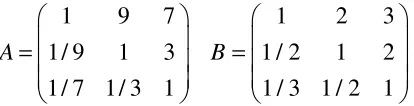
Example 1. Let A and B be preference matrices of decision makers DM1 and DM2
respectively on three alternatives (see Table 3) by a given criterion. We will evaluate weights of both decision makers using the formula (3) and the Frobenius norm (p = 2).
1 9 7 1/ 9 1 3 1 / 7 1/ 3 1
A
=
1 2 3 1 / 2 1 2 1 / 3 1 / 2 1
B
=
[image:6.595.180.387.539.592.2]
Table 3. Preferences of DM1 (matrix A) and DM2 (matrix B).
Consistency index C.I. (1) for both DMs:
max( )A 3.206
λ
= , n = 3 ⇒ . .( 1) 3.206 3 0.103 2C I DM = − = .
max( )B 3.008
λ
= , n = 3 ⇒ . .( 1) 3.008 3 0.004 2C I DM = − = .
Hence, DM2 is more consistent in his evaluation of alternatives. On the other hand, DM1 is
(
)
1/2
2 2 2
2 2 2 1
2
8 6 2
8 6 2 10.29
9 7 3
D DM = + + + + + =
(
2)
2
D DM = 2.64
Finally, we compute weights w1 and w2, and normalized weights w1´ and w2´ of DM1 and
DM2 respectively using (3):
10 0.103 1 10.29 3.67
w = ⋅e− ⋅ = .
10 0.004
2 2.64 2.63
w = ⋅e− ⋅ = .
1´ 0.583
w = , w2´ 0.417= .
The first decision maker is assigned slightly larger weight due to his greater decisiveness.
Example 2. Let A and B be the same preference matrices of decision makers DM1 and DM2
respectively on three alternatives (see Table 3) by a criterion C1 as in Example 1. Let C and D
be preference matrices of decision makers DM1 and DM2 respectively on three alternatives by
a criterion C2 (see Table 4).
1 2 3 1/ 3 1 4 1/ 2 1/ 4 1
C =
1 4 1/ 2 1/ 4 1 1 / 5 2 5 1
[image:7.595.179.383.363.416.2]D =
Table 4. Preferences of DM1 (matrix C) and DM2 (matrix D) with regard to the criterion C2.
Consistency index C.I. (1) of preferences with regard to the criterion C2:
max( )A 3.107
λ
= , n = 3 ⇒ . .( 1) 3.107 3 0.054 2C I DM = − = .
max( )B 3.025
λ
= , n = 3 ⇒ . .( 1) 3.025 3 0.013 2C I DM = − = .
Again, DM2 is more consistent in his evaluation. As for decisiveness, DM2 is more decisive:
(
)
1/2
2 2 2
2 2 2 1
2
2 1 3
1 2 3 3.906
3 2 4
D DM = + + + + + = ,
(
2)
2
D DM = 5.239.
Weights w1(2) and w2(2), and normalized weights w1(2)´ and w2(2)´ of DM1 and DM2
respectively, are:
(2) 10 0.054
1 3.906 2.276
w = ⋅e− ⋅ = .
10 0.013
2 5.239 4.600
w = ⋅e− ⋅ = .
(2)
1 ´ 0.331
From Example 1 we know, that weights of DMs with regard to the criterion C1 are:
(1)
1 ´ 0.583
w = , w2(1)´ 0.417=
By averaging we can assign final weights to both DMs: w1´ 0.457= , w2´ 0.543= .
With computed weights the decision making can proceed into the aggregation phase and then to the selection of the best alternative.
5. Conclusions
The aim of the article was to introduce a concept of indecisiveness into the group analytic hierarchy process (AHP) framework and to show how weights of decision makers can be derived only from their preferences with the use of indecisiveness and Saaty’s consistency index C.I. The advantage of this approach is that no additional information about decision makers’ experience or knowledge ‘from outside’ is required. Further work may focus on differences (conflicts) among decision makers’ preferences in the group AHP and the influence of the differences on a possibility of an existence of a group consensus.
References:
[1] Carlsson, C. Fullér, R. Fuzzy multiple criteria decision making: Recent developments.
Fuzzy Sets and Systems 78(2), 1996, p. 139-153.
[2] Fodor, J., Roubens, M. Fuzzy preference modelling and multicriteria decision support, Dordrecht: Kluwer 1994.
[3] Ramík, J. Perzina, R. Moderní metody hodnocení a rozhodování, SU OPF: 2008. ISBN 978-80-7248-497-3.
[4] Saaty T. L. The Analytic Hierarchy Process: Planning, Priority Setting, Resource
Allocation, ISBN 0-07-054371-2, McGraw-Hill, 1980.
[5] Saaty T. L. The Analytic hierarchy and Analytic Network Measurement Processes: Aplications to the Decisions under Risk. European Journal of Pure and Applied
Mathematics, (1)1, 2008, p. 122-196.
[6] Saaty T. L. Relative Measurement and its Generalization in Decision Making – Why Pairwise Comparisons are Central in Mathematics for the Measurement of Intanglible Factors, The Analytic Hierarchy/Network Process. Rev. R. Acad. Cien. Serie A, Mat., Vol. 102(2), 2008, p. 251-318.
[7] Wang, P. P. Computing with words. John Wiley, NewYork, 2001.
[8] Zadeh, L. A. Fuzzy logic-computing with words. IEEE Transactions on Fuzzy Systems, 4, 1996, p. 103-111.
Mgr. Jiří Mazurek, Ph.D. Assistant Professor
Department of Mathematical Methods in Economics School of Business Administration in Karviná, Silesian University in Opava
![Table 1. Saaty’s scale in AHP. Source: [6].](https://thumb-us.123doks.com/thumbv2/123dok_us/7787022.724082/4.595.76.518.296.640/table-saaty-scale-in-ahp-source.webp)