Johan Korhonen
Learning difficulties, academic well-being
and educational pathways among
adolescent students
Johan K or honen | L ear ning difficulties , academic well-being and educational path
wa
ys among adolescent students | 2016
Learning difficulties,
academic well-being and
educational pathways among
adolescent students
Johan Korhonen
Special Education
Faculty of Education and Welfare Studies Åbo Akademi University
Vasa, Finland, 2016
Custos
Docent Karin Linnanmäki, Åbo Akademi University
Supervisors
Docent Karin Linnanmäki, Åbo Akademi University Professor Pirjo Aunio, University of Helsinki
Pre-examiners
Professor Markku Niemivirta, University of Helsinki Professor Ulf Träff, Linköping University, Sweden
Opponent
Professor Rauno Parrila, University of Alberta, Canada
ISBN 978-952-12-3463-7 (Print) ISBN 978-952-12-3464-4 (PDF)
Abstract
The purpose of this thesis was to investigate the interplay between learning difficulties in mathematics and reading, academic well-being and educational pathways. Particular emphasis was placed on mathematical learning difficulties, that was the main interest of research in all four studies. In Study I, the relations between mathematics performance and different language skills (word-, reading comprehension, and spelling) were investigated in ninth-grade students (N = 810). Study II focused on the relative importance of mathematics and reading achievement on students’ (N = 1152) educational aspirations together with interest and well-being measures. Study III investigated change and stability of mathematical learning difficulties and academic well-being across the transition to upper secondary education in adolescent students (N = 980). Finally, educational dropout was predicted with learning difficulties and academic well-being in Study IV.
Structural equation modelling techniques were used in all the studies and resulted in the following findings. Students’ reading skills were strongly related to their mathematics performance while spelling was not (Study I). Latent profile analysis identified a group of students with combined difficulties in mathematics and reading but no “single difficulty” groups (Study IV). Mathematics was more important compared to reading for boys’ educational aspirations, while for girls reading was more important (Study II). School burnout predicted educational aspirations indirectly through interest while academic self-concept had a positive direct effect on students’ educational aspirations (Study II). Students with mathematical learning difficulties and low-achieving students did not differ from their peers in academic self-concept development from grade nine to upper secondary education although they experienced lower levels of academic self-concept in grade nine (Study III). However, students with mathematical learning difficulties in general upper secondary education displayed opposite change patterns in school burnout compared to typically achieving students. Both learning difficulties and academic well-being predicted educational dropout (Study IV). In general, learning difficulties and academic well-being were related (Study II, III, & IV) but a group of students with average performance in reading and mathematics, but negative academic well-being was identified (Study IV).
To conclude, learning difficulties and academic well-being are related and both shape students’ educational pathways. Moreover, mathematical learning difficulties co-occur frequently with difficulties in reading in this age group. These findings emphasize the importance to identify individual differences not only in students’ academic achievement, but also concerning their well-being, and support both areas in school.
Abstrakt
Syftet med denna avhandling var att undersöka sambandet mellan inlärningssvårigheter i matematik och läsning, akademiskt välbefinnande och utbildningsvägar. Inlärningssvårigheter i matematik var i fokus i alla fyra delstudier. I studie I undersöktes samband mellan matematikprestationer och olika färdigheter inom läsning (ord-, läsförståelse och stavning) i ett sampel av elever i årskurs nio (N = 810). Studie II fokuserade på den relativa betydelsen av matematik- och läsfärdigheter för studerandes (N = 1152)) utbildningsmålsättningar tillsammans med mått på deras intresse och välbefinnande. I studie III undersöktes förändring och stabilitet av inlärningssvårigheter i matematik och akademiskt välbefinnande hos studerande (N = 980) under övergången till andra stadiets utbildning. Slutligen predicerades skolavbrott i andra stadiet med hjälp av inlärningssvårigheter och akademiskt välbefinnande i studie IV.
Strukturekvationsmodeller användes i alla delstudier och resulterade i följande fynd. Studerandes läsfärdigheter hade ett starkt samband med deras matematikfärdigheter medan deras stavningsfärdigheter inte var relaterade till deras matematikfärdigheter (Studie I). Latenta profilanalyser identifierade en grupp studerande med svårigheter i både läsning och matematik medan ”en-svårighetsgrupper” inte identifierades (Studie IV). Matematikfärdigheter var viktigare för pojkarnas utbildningsmålsättningar medan läsfärdigheter var viktigare för flickornas utbildningsmålsättningar (Studie II). Skoltrötthet hade en negativ indirekt effekt på studerandes utbildningsmålsättningar via intresse medan akademisk självuppfattning hade en positiv direkt effekt (Studie II). Studerande med inlärningssvårigheter i matematik och studerande med svaga prestationer i matematik skiljde sig inte från sina klasskamrater med avseende på utvecklingen av deras akademisk självuppfattning från årskurs nio till andra stadiet även om de uppvisade lägre akademisk självuppfattning i årskurs nio (Studie III). Däremot uppvisade studerande med inlärningssvårigheter i matematik i gymnasiet ett motsatt mönster beträffande utvecklingen av skoltrötthet jämfört med normalpresterande studerande. Både inlärningssvårigheter och akademiskt välbefinnande predicerade skolavbrott (Studie IV). Överlag fanns det ett negativt samband mellan inlärningssvårigheter och akademiskt välbefinnande (Studie II, III, & IV), men också en grupp studerande med medelprestationer och negativt akademiskt välbefinnande kunde identifieras (Studie IV).
Sammanfattningsvis kan man konstatera att det finns ett samband mellan inlärningssvårigheter och akademiskt välbefinnande och att båda formar studerandes utbildningsvägar. Vidare kan man konstatera att inlärningssvårigheter i matematik sammanfaller ofta med inlärningssvårigheter i läsning i denna åldersgrupp. Dessa fynd understryker vikten av att inte endast identifiera individuella skillnader i skolprestationer utan också i akademiskt välbefinnande och stöda båda områden i skolan.
Acknowledgements
This long adventure, finally culminating in this thesis, would not have been possible to finish without the support of many people. Contrary to some beliefs, research is not something you do alone but in cooperation with others. You need a lot of support and guidance, from your colleagues but also from your family and friends. I have been lucky in both departments.
I wish to thank my supervisor Docent Karin Linnanmäki for igniting my interest in mathematical learning difficulties and encouraging me to start this adventure. During our time as colleagues, both in different research projects and at the department, she has always guided me in the right direction but at the same time also given me the freedom to shape my own path. I am also very grateful that she introduced me to my second supervisor Professor Pirjo Aunio. I would not be the researcher I am today without Pirjo. From the very beginning she has challenged me to work harder, aspire higher, and of course, do better research. I am extremely lucky that I have had two great supervisors that complement each other and who both also have become good friends to me.
I would sincerely like to thank my pre-examiners, Professor Markku Niemivirta and Professor Ulf Träff for their constructive feedback on my thesis. I also feel honored to have Professor Rauno Parrila as my opponent.
During this time, I have also had the pleasure to share the ups and downs of doing research with the other members of Pirjos research group; Riikka Mononen, Heidi Hellstrand, Ulrika Ekstam, Eija Väisänen, Henrik Husberg and Anna Tapola. Thank you for taking the time to read and comment all manuscript drafts during the years and for all the fun times during seminars and conferences. I also want to express my gratitude for having Anna as a coauthor in one of the studies. Your critical thinking and knowledge in motivational theories made all the difference. My thanks also go to my colleagues at Åbo Akademi University (Kristina Ström, Christel Sundqvist, Kajsa Lindström, Anki Risberg, and Tanja Östman) for all the peer-support and encouraging words during the years. I would also like to thank my fellow PhD student in the project, Camilla Svens-Liavåg for all the nice discussions about research and other topics. Pekka Räsänen
(Niilo Mäki Institute), thank you for all the inspiring discussions concerning mathematical learning difficulties and for good company during conferences.
I want to express my gratitude to Svenska Kulturfonden, Harry Schaumans stiftelse and Högskolestiftelsen for supporting our project financially.
My well-being during this project has been greatly enhanced by my dear friends. Franken, thank you for being such a great friend since preschool. I also want to express my joy of having the support and company of Ale and Hencki throughout my later educational career, first as classmates in general upper secondary, and then as roommates during our University studies.
Finally, I want to express my gratitude to my family. I grew up in a big and loving family where my parents Solveig and Hannu always put us children first. Thank you for all the love and support. My dear brothers, Mikael, Patrik and Tomi have always been entertaining company and good friends. I also feel very lucky to have a loving person beside me who has supported me during this adventure. Thank you Maria for being there. Our three children have all come to us during this project and have made all things so much more fun. Thank you Alma, Ella and Isak for being you.
Vasa, October, 2016
Table of Contents
Abstract ... 3
Abstrakt ... 4
Acknowledgements ... 5
List of Original Publications ... 10
1. Introduction ... 11
1.1. Learning Difficulties ... 11
1.1.1. Learning difficulties in mathematics ... 11
1.1.2. Learning difficulties in reading ... 13
1.1.3. Learning difficulties in both mathematics and reading ... 14
1.2. Academic Well-Being ... 17
1.2.1. Academic self-concept ... 18
1.2.2. School burnout ... 18
1.2.3. Perceived learning difficulties ... 19
1.3. Educational Pathways ... 19
1.3.1. Educational aspirations ... 20
1.3.1.1. Expectancy-value theory ... 21
1.3.1.2. Internal/external frame of reference model ... 23
1.3.1.3. Gendered pathways to educational aspirations ... 23
1.3.2. Transition to upper secondary education ... 24
1.3.2.1. Academic self-concept and the ‘big fish in a little pond’ effect ... 25
1.3.3. School dropout ... 26
1.4. The Present Study ... 27
1.4.1. Context: The Finnish education system ... 30
2. Methods ... 32
2.2. Measures ... 33
2.2.1. Mathematics skills ... 33
2.2.2. Reading skills ... 34
2.2.3. Academic self-concept ... 34
2.2.4. Perceived learning difficulties ... 35
2.2.5. School burnout ... 35
2.2.6. Individual interest ... 35
2.2.7. Educational aspirations ... 36
2.2.8. Upper secondary education track ... 36
2.2.9. School dropout ... 36
2.2.10. Parental educational background ... 36
2.3. Data Analysis ... 37
2.3.1. Missing data analysis ... 37
2.3.2. Confirmatory factor analysis and latent factor path analysis ... 37
2.3.3. Multiple group confirmatory factor analysis ... 38
2.3.4. Longitudinal confirmatory factor analysis ... 39
2.3.5. Latent change score analysis ... 39
2.3.6. Latent profile analysis ... 40
2.3.7. Analyses of variance and covariance ... 40
2.3.8. Chi-square tests and adjusted residuals ... 41
2.3.9. Configural frequency analysis ... 41
3. Overview of the Original Studies ... 42
3.1. Study I ... 42
3.1.1. Aims ... 42
3.1.2. Participants and procedure ... 42
3.1.3. Measures ... 42 3.1.4 Data analysis ... 42 3.1.5. Results ... 43 3.1.6. Discussion ... 43 3.2. Study II ... 44 3.2.1. Aims ... 44
3.2.2. Participants and procedure ... 44
3.2.4. Data analysis ... 45
3.2.5. Results ... 45
3.2.6. Discussion ... 46
3.3. Study III ... 47
3.3.1. Aims ... 47
3.3.2. Participants and procedure ... 47
3.3.3. Measures ... 48 3.3.4. Data analysis ... 48 3.3.5. Results ... 49 3.3.6. Discussion ... 50 3.4. Study IV ... 51 3.4.1. Aims ... 51
3.4.2. Participants and procedure ... 52
3.4.3. Measures ... 52
3.4.4. Data analysis ... 53
3.4.5. Results ... 53
3.4.6. Discussion ... 54
4. General Discussion ... 55
4.1. Learning Difficulties in Mathematics and Reading ... 56
4.2. Learning Difficulties and Academic Well-Being ... 57
4.3. Changes in Academic Well-Being Related to Mathematical Learning Difficulties Across the Transition to Upper Secondary Education ... 58
4.4. Learning Difficulties and Academic Well-Being Predicting Educational Aspirations and Potential for Dropping Out ... 60
4.5. Strengths and Limitations ... 62
4.7. Pedagogical Implications ... 65
References ... 67
Original Publications ... 79
List of Original Publications
Study I: Korhonen, J., Linnanmäki, K., & Aunio, P. (2012). Language and mathematical performance: A comparison of lower secondary school students with different level of mathematical skills.
Scandinavian Journal of Educational Research, 56(3), 333-344.
Study II: Korhonen, J., Tapola, A., Linnanmäki, K., & Aunio, P. (2016).
Gendered pathways to educational aspirations: The role of achievement, academic self-concept, interest, and school burnout.
Learning and Instruction, 46, 21-33.
Study III: Korhonen, J., Linnanmäki, K., & Aunio, P. (submitted). Change and
stability in mathematical learning difficulties and academic well-being in adolescent students.
Study IV: Korhonen, J., Linnanmäki, K., & Aunio, P. (2014). Learning
difficulties, academic well-being and educational dropout: A person-centered approach. Learning and Individual Differences, 31, 1-10.
Author contribution
Johan Korhonen is the first author for all four manuscripts that are included in this doctoral thesis. Korhonen is responsible for all the analyses used in this dissertation study and has written all manuscripts under the supervision of Docent Karin Linnanmäki and Professor Pirjo Aunio.
1. Introduction
The effectiveness of a given educational system can be determined based on its capability to equip its students with the relevant academic competencies as well as its support of their general well-being and motivation to learn. In addition, the quality—and especially equality—of an educational system can be measured in terms of its effectiveness in promoting the progress of each individual student irrespective of factors that might serve as disadvantages along the student’s educational journey (e.g., the student’s social or ethnic background or learning difficulties [LDs]).
This work investigates the impact and interrelationships of LDs and academic well-being on students’ educational pathways, as assessed at the end of their compulsory education. This work advances the current knowledge on the relationship between reading difficulties (RDs) and mathematical learning difficulties (MLDs), their impact on educational aspirations and likelihood of dropout along with academic well-being and any changes and/or stability of MLDs and academic well-being in adolescent students across the transition to upper secondary school.
1.1. Learning Difficulties
In this study the focus is on learning difficulties in mathematics and reading. These difficulties are first described separately and then together to provide an overview of what we know of the co-occurrence of LDs in these two content areas.
1.1.1. Learning difficulties in mathematics
Learning difficulties in mathematics can take various forms (e.g., difficulties in basic arithmetic and word problem solving) and have different underlying causes (Toll, Kroesbergen, & Van Luit, 2016; Träff, 2013). Furthermore, the literature uses different terminology—such as mathematical disability (MD), developmental dyscalculia (DD), mathematical learning difficulties (MLD) and low achievement (LA) in mathematics—to describe the mathematics-related LDs
found in an average student population (for a more detailed discussion, see Mazzocco, 2007). Mathematical disability, developmental dyscalculia and mathematical learning difficulties (which are terms that are often used interchangeably) in children have a prevalence of 3% to 6% in the school-aged population, which is comparable to the rate of dyslexia (Shalev, 2007; Rubinstein & Henrik, 2009). This deficit can be tracked to the neural level, where it is manifested in weaker brain activation in the intraparietal sulcus and the middle and inferior frontal gyrus of both hemispheres (Kaufmann, Wood, Rubinstein, & Henrik, 2011; Price et al., 2007; Rotzer et al., 2009). Thus, these conditions have a biological cause.
According the latest knowledge, a defining feature of MLD is difficulty processing numerical information (De Smedt & Gilmore, 2011; Skagerlund & Träff, 2014). More specifically, two possible and potentially related causes— deficits in the approximate number system (ANS) (Mazzocco et al., 2011; Olsson, Östergren, & Träff, 2016) and with symbolic numerical magnitude processing (De Smedt & Gilmore, 2011; Skagerlund & Träff, 2014)—have been reported to characterize MLD. ANS refers to an innate preverbal ability to represent and manipulate quantities and is believed to form the basis for the acquisition of the symbolic number system used to learn formal arithmetic (Dehaene, 2011; Piazza, 2010). Symbolic numerical magnitude processing is usually assessed with a symbolic numerical magnitude comparison task (De Smedt, Noël, Gilmore, & Ansari 2013), where one is instructed to indicate the numerically larger of two presented magnitudes in a symbolic format (i.e., Arabic digits).
A recent meta-analysis incorporating 284 effect sizes from 17,201 participants showed that symbolic numerical magnitude processing is more strongly related to mathematical achievement than nonsymbolic comparisons (Schneider et al., 2016). Moreover, symbolic magnitude processing has been found to be the strongest predictor of arithmetic skills at the beginning of primary school (Lyons, Price, Vaessen, Blomert, & Ansari, 2014), to mediate the relationship between informal and formal mathematics skills (Merkley & Ansari, 2016) and to predict mathematical skills more strongly than phonological awareness predicts reading skills (Vanbinst, Ansari, Ghesquiere, & De Smedt, 2016). Symbolic numerical magnitude processing has also been shown to be related to developmental
dyscalculia (Meijas, Grégoire, & Noël, 2012) and mathematics achievement in adults (Linsen, Torbeyns, Verschaffel, Reynvoet, & De Smedt, 2016).
On a behavioural level, this manifests in difficulties with basic arithmetic tasks. Specifically, children with MLD rely on counting-based strategies when solving arithmetic problems and do not easily shift to more effective strategies like fact retrieval from their long-term memory. To identify students with MLD in both research settings and in practice, some researchers have advocated for the use of the persistence criterion (Fletcher et al., 2005; Stock, Desoete, & Roeyers, 2010; Mazzocco & Räsänen, 2013). For example, to determine the persistence of MLD in a student, he or she has to score under a given cut-off score on a mathematics test for 2 or more consecutive years. Research findings have emphasised the validity of this approach, as there are students who only meet the criteria for MLD at one time point instead of two or more; this is also in line with the response to intervention practices for defining MLDs (e.g., Fuchs et al., 2007).
However, not all children struggling with mathematics meet the criteria for having an MLD. In research settings, it is common practice to identify students with mathematics-related LDs by using a cut-off criteria of up to 35%. Low-achievement (LA) in mathematics has a wider definition than MLD and includes all students who struggle in mathematics for various reasons, including sociocultural and educational factors (Mazzocco, 2007). In addition, working memory (WM) (Friso-van den Bos, Van der Ven, Kroesbergen, & Van Luit, 2013), language skills (Lefevre et al., 2010), motivation (Murayama, Pekrun, Lichtenfeld, & vom Hofe, 2012), self-concept (Seaton et al., 2014) and socioeconomic background (Sirin, 2005) have all been shown to influence students’ mathematics skills. Therefore, it is important to distinguish between students with MLD and LA students to accurately advance the knowledge base on why students struggle with mathematics and to determine the best indicators of these difficulties (Mazzocco & Räsänen, 2013.
1.1.2. Learning difficulties in reading
Similar to mathematics, reading difficulties (RDs) can take various forms (e.g., fluency and/or comprehension) and have multiple underlying causes. It has become conventional to distinguish children who have specific RDs (e.g.,
developmental dyslexia) from children who have RDs in the context of more general learning problems (Snowling, 2005). Specifically, an RD or developmental dyslexia is a mild hereditary neurological disorder that manifests as a persistent difficulty in learning to read in children with otherwise normal intellectual functioning and educational opportunities (Ramus, 2004). More specifically, students with RD tend to have pervasive deficiencies in word identification, fluency, phonological (letter sound) decoding, and spelling (Vellutino & Fletcher, 2007). The prevalence of specific reading difficulties depends on the specific cut-off point taken as indicative of RD, but studies have shown that 3% to 10 % of the population has RD (Snowling, 2000).
On a neural level, when comparing people with RD and normal readers, studies have shown that there is difference between brain structure and function, particularly in the left hemisphere temporal regions (Shaywitz et al., 2002).Well-established markers for RD at the cognitive level are phonological processing deficits (Vellutino, Fletcher, Snowling, & Scanlon, 2004) and deficits in rapid automatized naming (RAN) (Kirby, Georgiou, Martinussen, & Parrila, 2010; Landerl et al., 2013). Furthermore, the associations among phonological processing, RAN and reading skills are moderated by the orthographic complexity of the language under study (e.g., Finnish versus English) (Georgiou, Torppa, Manolitsis, Lyytinen, & Parrila, 2013). As stated earlier, not all students who are struggling in reading show these domain-specific cognitive deficits and should not be categorized as having an RD. This broader group, which encompasses all students with difficulties in reading regardless of the underlying cause, is usually defined as low-achieving students in reading. In this group, problems in reading may arise from factors like WM (Daneman & Carpenter, 1980), motivation (Guthrie et al., 2007), self-concept (Retelsdorf, Köller, & Möller, 2014) and socioeconomic background (Sirin, 2005).
1.1.3. Learning difficulties in both mathematics and reading
Many students have problems in attaining average achievement in both reading and mathematics (Dirks, Spyer, van Lieshoult, & de Sonneville, 2008; Light & DeFries, 1995). This rate of co-occurrence is substantially greater than would be predicted from the individual prevalence rates of MLDs and RDs (Dirks et al.,
2008). Students with comorbid difficulties display more severe and global functional difficulties than students with only MLDs (Andersson & Lyxell, 2007; Fuchs & Fuchs, 2002; Mazzocco & Myers, 2003). These students also seem to have broader problems with language learning, especially with spelling and reading comprehension, than children with only one of these difficulties (Dirks et al., 2008). For example, both Ostad (1998) and Shafrir and Siegel (1994) have reported an overlap between spelling problems and MLDs.
Based on the literature, there is no shared understanding for the origins of the comorbidity of RD and MLDs. One possible cause of this co-occurrence on the cognitive level is working memory capacity (Hanich, Jordan, Kaplan, & Dick, 2001; Siegel & Ryan, 1989). Research findings suggest that students with low-achievement in mathematics have a general working memory processing deficit; thus, this could partially explain the shared variance in mathematical skills and language skills (Kyttälä, 2008; Pickering & Gathercole, 2004). However, Landerl, Fussenegger, Moll and Willburger (2009) found two different cognitive profiles for children with dyscalculia and dyslexia, namely a phonological deficit in dyslexia and a number-processing deficit in the case of dyscalculia. Their conclusion concerning children with comorbid difficulties is that they have additive cognitive deficits that indicate no evidence for shared cognitive risk factors. There are other findings that suggest that the presence of both RDs and MLDs seems to be caused by a fundamental deficit in phonological processing, which affects, for instance, arithmetic fact retrieval (Geary, 1993; Geary & Hoard, 2001; Rourke & Conway, 1997).
However, dysfunction in phonological processing does not seem to be a plausible explanation, as approximately half of the children with MLDs do not have RDs (Badin, 1983; Ostad, 1998), nor is it clear why these students also show fact retrieval deficits while their phonetic abilities are intact (Jordan, Hanich, & Kaplan, 2003). Augustyniak, Murphy and Phillips (2005) have concluded that mathematical ability seems to be based on a more complex set of abilities than reading ability. Furthermore, findings show that some areas in mathematics are more dependent on reading abilities than others (Jordan et al., 2003; Vukovic & Lesaux, 2013a).
The measures used to operationalize reading skills also vary among studies. Measures such as word decoding, rapid naming, spelling and reading comprehension are often used to operationalize reading skills, and in many studies, composite scores consisting of two or more of these measures are used to examine the relationship between mathematics and reading (Dirks et al., 2008; Swanson & Beebe-Frankenberger, 2004; Wise et al., 2008). Only a few studies have examined the unique contribution of different language skills to mathematics performance (Vukovic & Lesaux, 2013b). Dirks and colleagues (2008) have demonstrated that using different measures of reading skills results in different children being identified as having RDs and, thus, different children being treated as having both RDs and MLDs. So far, it seems that there is no consensus of the underlying causes for RDs and MLDs and why these difficulties sometimes overlap each other.
The terminology and definitions for RD and MLD vary across studies, although a common factor visible in school practice is that students struggling with reading and mathematics learning can most often be found in the lowest performing group on standardized mathematics and reading tests. A traditional and widely used approach to define subtypes of learning difficulties is to divide students into groups according to RD only, MLD only and combined difficulties (MLDRD) (Anderson & Lyxell, 2007; Andersson, 2010; Jordan et al., 2003; Vukovic, Lesaux, & Siegel, 2010). Interestingly, the MLD-only and RD-only groups have been found to perform at the same level on word problem tasks and significantly better than the MLDRD group (Jordan et al., 2003).
Consistent with these results, Vukovic and colleagues (2010) have demonstrated that both children with dyslexia and children with specific reading comprehension difficulties performed equally on word problems and significantly poorer than normal readers. However, the children with reading comprehension difficulties did not differ from normal readers in arithmetic fact fluency and operations, whereas the dyslexia group performed on a lower level. They concluded that children with decoding problems (dyslexia) had a higher risk of also experiencing MLD. Concerning MLD, there is evidence that both the MLD-only and MLDRD groups showed fundamental deficits in factual
knowledge and that this is a primary characteristic for MLDs (Andersson, 2010; Jordan et al., 2003).
A recent meta-analysis by Swanson, Jerman and Zheng (2009) investigated differences in cognitive features in students with MLDs, typically achieving students, RD students and MLDRD students. The clearest differences were found between the typically achieving students and those with MLD, namely in working memory and literacy skills, whereas the MLD and RD groups differed in variation in working memory and mathematical problem-solving skills. The only thing that differentiated the MLD students from MLDRD students was IQ and long-term memory, with the MLDRD group displaying lower levels for both.
These results lend support to the hypothesis that grouping that aims to create qualitatively (type) different subtypes only creates quantitatively (level) different subtypes of learning difficulties. To summarize, we can conclude that in the younger children (aged 7-13), the MLD-only and MLDRD groups performed worse than the RD-only and typically achieving students on the more technical aspects of mathematics (factual knowledge, place value, etc.) and that the children with dyslexia performed poorer compared to the children with reading comprehension and typically achieving children in the more technical aspects of reading (e.g., word reading) (Andersson, 2010; Jordan, et al., 2003; Vukovic et al., 2010). However, the MLDRD group seemed to perform on a lower level on almost all measures compared to the other groups, and the RD-only and MLD-only groups performed at the same level on mathematical word problem tasks. It is therefore tempting to look at both mathematical and reading skills as continuums where the order of the traditional subtypes of learning difficulties is similar; i.e., the MLDRD group is at the lower end and the typically achieving children are at the higher end of the continuum. The MLD-only and RD-only groups fall between and their order are defined by which skill is currently assessed.
1.2. Academic Well-Being
School is a central factor in the lives of adolescents (Eccles & Roeser, 2009), and therefore it is important to define well-being in relation to the school context.
How students perceive themselves as learners in school and how they experience their schooling have been shown to influence their well-being (Goetz, Cronjaeger, Frenzel, Ludtke, & Hall, 2010; Tuominen-Soini, Salmela-Aro, & Niemivirta, 2008, 2012). Furthermore, students’ academic well-being is viewed as an important indicator of the educational process (van Petegem, Aelterman, Rossel, & Creemers, 2007) and has received growing attention in recent years (Holopainen, Lappalainen, Junttila, & Savolainen, 2012; Rueger, Malecki, & Demaray, 2010; Tuominen-Soini et al., 2008, 2012). However, there is no consensus around the definition or measurements of academic well-being, so positive and negative indicators of well-being, such as self-esteem, school value and stress, are commonly used as indicators of adolescent academic well-being (Pollard & Lee, 2003). In the present study, academic well-being is operationalized with academic self-concept, school burnout, and perceived learning difficulties.
1.2.1. Academic self-concept
Self-concept is theorised as a hierarchical multidimensional construct (Shavelson, Hubner, & Stanton, 1976; Marsh & Shavelson, 1985). The most relevant dimension of self-concept in the educational settings is arguably academic self-concept. Academic self-concept can be defined as mental representations of one’s competencies in academic domains (Marsh & Craven, 1997). These ability beliefs are influenced by prior achievement and social comparison processes (Marsh, 1986). Academic self-concept is positively related to achievement (Marsh, Hau, & Kong, 2002; Valentine, DuBois, & Cooper, 2004), approaches to learning (Burnett, Pillay, & Dart, 2003), social interaction (Gurney, 1986) and general happiness (Harter, 1990). According to the OECD, self-concept and related constructs are “closely tied to students’ economic success and long-term health and wellbeing” (2003, p. 9).
1.2.2. School burnout
School burnout can be defined as exhaustion due to school demands, a cynical and detached attitude toward one’s school and feelings of inadequacy as a student; it can develop as a result of a high imbalance between perceived
demands and personal resources (Salmela-Aro, Kiuru, Leskinen, & Nurmi, 2009; Salmela-Aro & Upadyaya, 2014a). These subdimensions have been shown to be associated with adolescent students’ motivational strivings, whereby a tendency to minimize schoolwork and effort (i.e., work avoidance orientation) increases the likelihood of cynicism and sense of inadequacy. It is noteworthy that even high-achieving and motivated students, especially girls, have been found to be vulnerable to exhaustion (Tuominen-Soini et al., 2012; Tuominen-Soini & Salmela-Aro, 2014). Furthermore, previous studies have found that girls experience higher levels of school burnout than boys (Salmela-Aro, Kiuru, & Nurmi, 2008; Salmela-Aro & Tynkkynen, 2012). School burnout is also related to low academic achievement (Kiuru, Aunola, Nurmi, Leskinen, & Savolainen, 2008) and depression (Bakker et al., 2000; Salmela-Aro, Savolainen, & Holopainen, 2009).
1.2.3. Perceived learning difficulties
Perceived learning difficulties have not received much attention in the literature. Theoretically, perceived learning difficulties are different from academic concept and more related to efficacy (Bong & Skaalvik, 2002). While self-concept refers to an individual’s’ general perceptions of the self in a given domain, self-efficacy refers to the expectations and convictions of what the individual can accomplish in a given situation. Perceived learning difficulties refer to difficulties with learning in a particular situation or setting (e.g., difficulty taking notes when the teacher explains specific content in class). In the few studies incorporating perceived learning difficulties, it has been shown to be related to academic well-being, academic achievement and secondary education placement (DeGarmo & Martinez, 2006; Hakkarainen, Savolainen, & Holopainen, 2012).
1.3. Educational Pathways
To better understand the relationship between learning difficulties and academic well-being, it is useful to take into the consideration the context that this relationship is formed in. Adolescent students are generally in the middle of their
educational journey, making it a natural point to start investigating the relationship between learning difficulties and academic well-being in conjunction with their educational aspirations, transition to upper secondary school and possibly dropping out of school. The various processes leading to these important educational outcomes have been described and explained using several prominent theories incorporating achievement and motivational beliefs (Eccles et al., 1983; Marsh, 1986, 1987). In the following sections, the adolescent educational pathway and the processes influencing it are described, and the variables under study (i.e., learning difficulties and academic well-being) are situated within the theories used to explain these processes.
1.3.1. Educational aspirations
Educational aspirations in adolescence have been used to explain educational disparities in general and individuals’ occupational choices and attainment later in life (Domina et al., 2011; Rojewski, 2005). There is no commonly shared definition for the term ‘educational aspirations’, but it is often used to refer to a person’s goals and plans within an academic setting (Trebbels, 2015). Researchers have defined and measured educational aspirations via the number of career plans per adolescent (Mendez & Crawford, 2002), the prestige of their educational aspirations (Leung, Conoley, & Scheel, 1994; Viljaranta, Nurmi, Aunola, & Salmela-Aro, 2009) and the level of self-set educational goals (Vasalampi, Salmela-Aro, & Nurmi, 2009; Watt et al., 2012).
Educational aspirations can also be defined as being either idealistic or realistic. While idealistic aspirations refer to the attainment level that a student hopes to achieve, realistic aspirations reflect the actual perceived likelihood of success and more pragmatic expectations of completing a certain level of education (Rojewski, 2005). However, in several studies focusing on educational choices, the operationalisation of educational aspirations has covered both idealistic and realistic alternatives, with no clear distinction being made between the two terms Chow, Eccles, & Salmela-Aro, 2012; Durik, Vida, & Eccles, 2006; Guo, Marsh, Parker, Morin, & Yeung, 2015). In some studies, girls have reported higher educational aspirations (Mahaffy & Ward, 2002; Mau & Bikos, 2000), whereas in other studies, boys’ aspirations have been higher (Inoue, 1999;
Mendez & Crawford, 2002). There have also been studies that found no gender differences in educational aspirations (e.g., Ireson & Hallam, 2009; Watt et al., 2012). Besides the possible gender differences in the level of educational aspiration, it also seems that the processes or paths that lead to these aspirations may differ by gender (Domene, Shapka, & Keating, 2006; Watt et al., 2012).
1.3.1.1. Expectancy-value theory
Students’ abilities and academic success (both in reading and mathematics) shape their educational aspirations (Durik et al., 2006; Shapka, Domene, & Keating, 2006). However, academic achievement is not, by itself, a sufficient factor to explain students’ educational aspirations. For example, irrespective of girls’ high mathematics and sciences grades, they are underrepresented in advance STEM courses and occupational fields. Further, it has been documented that along with the possible direct effects, the influence of academic achievement may be indirect and mediated by different motivational constructs (Parker, Nagy, Trautwein, & Lüdtke, 2014).
According to the expectancy-value model (Eccles et al., 1983; Wigfield & Eccles, 1992), students’ expectancies of success at school and subjective task values are key predictors of academic decision making that are related but distinct. Expectancies of educational success are defined as an individual’s competence perceptions about how well they will perform on future academic tasks and subjective ability beliefs (Eccles et al., 1983).
In many of the studies, students’ competence perceptions have been conceptualized through academic self-concept. Subjective task value is usually operationalized in terms of intrinsic value (i.e., interest) and importance value (i.e., utility and attainment value combined) (Jacobs et al., 2002; Watt et al., 2012). Individual interest refers to the tendency to reengage and enjoy a particular content domain (Frentzel, Goetz, Pekrun, & Watt, 2010; Renninger & Hidi, 2011). Individual interest towards an academic domain is likely to develop when engagement with it is experienced as inherently rewarding (Renninger & Su, 2012). Once interest deepens, it becomes intertwined with a student’s personal values and may even form a part of their identity (Renninger, 2009: Renninger & Hidi, 2011). Both academic self-concept and individual interest
have been shown to positively predict educational aspirations in a number of studies (Guo, Marsh, Morin, Parker, & Kaur, 2015; Guo, Marsh, Parker, Morin, & Yeung, 2015; Watt et al., 2012).
Within the expectancy-value framework, some studies have also examined how self-perceived drawbacks predict educational choices (Perez, Comley, & Kaplan., 2014). The concept of cost has been utilized to describe the perceived negative consequences of engaging in learning, such as required effort or psychological well-being (for a more detailed discussion, see Eccles et al., 1983). In addition, these studies have identified that cost measures both predict and correlate negatively with student interests (Flake, Barron, Hulleman, McCoach, & Welsh, 2015; Gaspard et al., 2014) and educational aspirations (Battle & Wigfield, 2003; Luttrell et al., 2010; Perez et al., 2014). In fact, the conceptualisations of cost and school burnout share some common features. For example, the exhaustion component of school burnout is related to both dimensions of cost, namely, the amount of effort and emotional and psychological demands, whereas inadequacy and cynicism are more similar to the latter dimension (Flake et al., 2015; Gaspard et al., 2014; Salmela-Aro, Kiuru et al., 2009).
However, there are also some important differences between school burnout and cost. First, school burnout is a more general negative emotion toward school (Salmela-Aro, Savolainen, & Holopainen, 2009), whereas cost is more domain or situation specific (Wigfield & Eccles, 2000). Second, school burnout develops over a longer period of time, whereas cost is more situational and anticipatory. In fact, arguably, school burnout can be regarded as a consequence of experiencing prolonged cost (Shaufeli & Bakker, 2004; Tuominen-Soini et al., 2008). To summarize, despite the differences between cost and burnout, both have been theorized and shown to hinder student motivation and engagement by using up their psychological resources and decreasing their positive affect (Barron & Hulleman, 2015; Salmela-Aro & Upadyaya, 2014a; Tuominen-Soini & Salmela-Aro, 2014). As a consequence, students’ capability and desire to set and achieve ambitious educational goals may also be diminished (Nurmi & Salmela-Aro, 2002).
1.3.1.2. Internal/external frame of reference model
The internal/external (I/E) frame of reference model (Marsh, 1986; Marsh et al., 2015) postulates that students’ self-perceptions are dependent not only on social (external) comparisons, but also on dimensional (internal) comparisons, in which achievement in one school subject is evaluated in reference to another school subject (Möller et al., 2009). Traditionally, this model has been used to explain the relationship among mathematics, verbal achievement and self-concept. In the external comparison process, high mathematics achievement is supposed to lead to higher mathematics self-concept and high verbal achievement is supposed to lead to higher verbal self-concept. However, according to the internal comparison process, higher mathematics achievement will result in lower verbal self-concept after the effect of verbal achievement is taken into account. Consequently, while students achieving well in mathematics also often perform well in reading, they consider themselves ‘as being good at’ mainly one or the other of the domains. There are robust findings across age groups, gender and countries concerning the presence of this mechanism (Möller, Pohlmann, Köller, & Marsh, 2009).
The I/E frame of reference model has been extended to the expectancy-value model (Eccles, 2009). According to Eccles (2009), the external and internal comparisons of one’s abilities and values are a natural part of adolescents’ identity development process, whereby they start to identify themselves more strongly with some academic domains than with others. This identification process, in turn, is likely to be influenced by gender stereotypes: out of two academic domains that an adolescent achieves well in, he or she will be more prone to emphasize and prefer the one that corresponds to gender-typical expectations and norms. As a consequence, adolescents’ academic choice behaviour and expectations concerning their educational and occupational goals may also be influenced (e.g., Nagy, Trautwein, Baumert, Köller, & Garrett, 2006; Parker et al., 2012).
1.3.1.3. Gendered pathways to educational aspirations
In this study, one focus have been on the relative importance of reading and mathematics achievement (and well-being measures) for students’ educational
aspirations, which can be investigated in the context of the expectancy-value model and the I/E model. Studies focusing solely on one academic domain have found mixed results concerning gender differences in the relationship (i.e., moderator effects) among academic self-concept, individual interest and educational aspirations (e.g., Durik et al., 2006; Watt et al., 2012).
Interestingly, in studies contrasting two or more academic domains, gender has been found to moderate the effects of these variables on educational aspirations and choices. For example, Nagy and colleagues (2006) demonstrated that during secondary school, boys’ self-concept and interest in mathematics affected their decision making concerning advanced biology course choices, whereas for girls, the choices in mathematics and biology were independent of the contrasted domain’s motivational beliefs.
In line with this, a few studies utilising a person-centred methodological approach have investigated how different interest profiles measured by interest in different domains predict educational aspirations (Chow & Salmela-Aro, 2011; Chow et al., 2012; Viljaranta et al., 2009; Watt, 2005). In these studies, boys were observed to be more likely to have a profile of high interest or task values in mathematics and science compared to girls, who were more likely to display a profile with high reading interest (Chow et al., 2012; Viljaranta et al., 2009).
While in Chow and colleagues’ study (2012) the interest profiles fully mediated the relationship between gender and educational aspirations in the physical and information technology–related sciences, Viljaranta and colleagues (2009) found that their task-value profiles predicted educational aspirations for girls but not for boys. They hypothesized that boys´ educational aspirations might originate from an objective criterion (e.g., academic achievement), whereas girls seemed to base their expectations on broader considerations, including their values and motivation.
1.3.2. Transition to upper secondary education
Educational transitions have been found to be related to a decrease in students’ motivation and well-being (e.g., Eccles & Midgley, 1989; Otiz, Grouzet, & Pelletier, 2005). So far, most studies have focused on middle school transitions (i.e., junior high school to senior high school) in early adolescence and have been
conducted in the United States. In Finland, the transition from compulsory education to upper secondary education (high school to college) is an important step in adolescent students’ educational pathways (Nyyssölä, 2004). More specifically, the general upper secondary schools prepare students for university studies (i.e., the academic track), whereas the vocational upper secondary schools (i.e., the vocational track) are more practically oriented, preparing students for working life. Admittance to the academic track usually requires higher academic skills compared to the vocational track, and it is generally recommended that adolescents move to a school form that is in accordance with their academic skills (Eccles, 1993; Hakkarainen, Holopainen, Savolainen, 2012; Savolainen et al., 2008). It is expected that these students will show higher motivation and well-being when they are in a more congruent educational setting (Vasalampi, Salmela-Aro, & Nurmi, 2010) compared to a compulsory education setting that is the same for all students. However, there is a lack of studies that have specifically looked at changes in well-being among students with learning difficultiess. Studies that have examined the development of school burnout have not specifically looked at students with MLDs; rather, the focus has been on differences in educational tracks and gender (Salmela-Aro, Kiuru, & Nurmi, 2008; Salmela-Aro, Savolainen, & Holopainen, 2009; Salmela-Aro & Tynkkynen, 2012; Salmela-Aro & Upadyaya, 2014b; Tuominen-Soini & Salmela-Aro, 2014). However, in a study by Salmela-Aro and colleagues (2008), low-achieving students (operationalized by a low grade point average) were identified as having higher levels of school burnout compared to their peers. In addition, girls in both tracks and all students in the academic track reported an increase in school burnout (Salmela-Aro et al., 2008; Salmela-Aro & Tynkkynen, 2012; Salmela-Aro & Upadyaya, 2014b).
1.3.2.1. Academic self-concept and the ‘big fish in a little pond’ effect
In this study, academic self-concept is also considered to reflect students’ academic well-being. In general, academic self-concept development has been found to be related to academic achievement in a reciprocal manner (e.g., Marsh, Hau, & Kong, 2002). However, the educational setting that students are situated in also has an impact on their academic self-concept. The ‘big fish in a little pond’
effect(BFLPE) (Marsh, 1987; Marsh & Craven, 2002; Nagengast & Marsh, 2011) can be used to describe the effects of one’s frame of reference in educational settings. The BFLPE is based upon a social comparison process (for a detailed account of the theoretical background of the BFLPE, see Marsh et al., 2008), where individual student achievement has a positive effect on academic concept while school-average achievement has a negative effect on academic self-concept. Students compare themselves with their peers, and, therefore, individual academic self-concept is shaped not only by a student’s own achievement, but also by the achievement of other students in the same class or school. Thus, students have lower academic self-concept when they are in high-ability classes or schools compared to students of the same high-ability that are educated in mixed or low-ability classes or schools. Interestingly, these kind of effects have also been observed when comparing the academic and vocational track in a sample of Finnish students concerning their education-related goal appraisals (Vasalampi et al., 2010).
Students with MLDs have lower academic self-concept in general compared to their peers (Bear, Minke, & Manning, 2002; Zeleke, 2004). The literature on learning difficulties and the BFLPE is scarce. In the only study conducted with this focus, Marsh, Tracey and Craven (2006) demonstrated that students with learning difficulties in inclusive settings had lower academic self-concept compared to students with learning difficulties in segregated settings and offered the BFLPE as a potential explanation for this result.
1.3.3. School dropout
Dropping out of school can have far-reaching negative consequences on an individual level. Students who drop out are more likely to be unemployed (Sum, Khatiwada, McLaughlin, & Palma, 2009), have a lower income level (Levin, Belfield, Muenning, & Rouse, 2007; Rumberger & Lamb, 2003) and experience lower levels of general well-being (Bynner & Parsons, 2002; Lamb, 2011). In addition to these individual costs, there are also social costs associated with increased welfare needs and reduced taxation revenue (Owens, 2004).
As graduation from secondary school is currently viewed as the minimum level of educational attainment for the successful inclusion of young people into
society, it is important to identify at-risk groups already present in comprehensive education. Converging evidence suggests that the single most important dropout predictor is low academic achievement (Battin-Pearson et al., 2000; Janosz, LeBlanc, Boulerice, & Tremblay, 1997, 2000), which is often related to a lower socioeconomic background of a student’s family (Duncan & Brooks-Gunn, 2001; Fall & Roberts, 2012). However, learning difficulties in mathematics and reading have not been analysed separately in these studies on dropout rates. A large body of research has also determined that students classified as having low academic well-being face a higher risk of dropping out of school (Archambault, Janosz, Morizot, & Pagani, 2009; Fall & Roberts, 2012; Fortin, Marcotte, Potvin, Royer, & Joly, 2006; Janosz et al., 1997, 2000).
1.4. The Present Study
Although considerable efforts have been made to understand the dynamics between learning difficulties in reading and mathematics and their relationship to other educational outcomes and well-being measures, there are still gaps in our shared understanding of these processes. Different conceptualizations of the constructs under study, the inclusion of different variables in research designs and different theoretical starting points have made it challenging to integrate findings from different studies. This dissertation study makes an attempt to provide a more holistic picture of adolescent students’ educational pathways with focus on learning difficulties in reading and mathematics and academic well-being.
In this study, MLDs are defined as problems in the domain of mathematics that are attributed to either environmental or individual factors. This is a broader definition of MLD than, for example, mathematical disability (Geary, 1994) or developmental dyscalculia (Butterworth, 2005). Similarly, RDs are defined as problems with reading that are attributed to either environmental or individual factors. However, an attempt is made in this study to separate low-achieving students and students with MLDs using the persistence criterion (Fletcher et al., 2005) and to investigate possible differences in the development of academic well-being measures in adolescent students in the low-achieving and MLD
groups. In the present work, academic well-being is operationalized through academic self-concept, perceived learning difficulties and school burnout. Academic well-being is highly relevant for the educational process (Tuominen-Soini et al., 2008, 2012) and is closely related to academic achievement (Hakkarainen et al., 2012; Valentine et al., 2004).
Even though there is extensive evidence on the link between learning difficulties and educational outcomes (e.g., school dropout and educational aspirations), there are research gaps that the present study aims to fill. Firstly, previous studies have more or less treated students with learning difficulties as a homogenous group, which means that there is a lack of knowledge of whether some types of learning difficulties impose a higher risk of dropping out of school or predict an individual’s educational aspirations differently.
Secondly, there are varying research results regarding the relationship between reading difficulties and mathematical learning difficulties. Even though much research has been conducted within the framework of the RD, MLD, and MLDRD typologies, results from these same studies support the hypothesis that the differences between the groups are more quantitative than qualitative. Moreover, these studies have not utilized person-centred methods in creating classifications and have not focused on adolescent students. The assessment methods used to measure reading skills also vary between studies. In many studies, composite scores consisting of two or more scales of reading skills (e.g., word reading and reading comprehension) have been used to examine the relationship between mathematics and reading (see, for example, Dirks et al., 2008; Swanson & Beebe-Frankenberger, 2004; Wise et al., 2008). There seems to be a gap in the research literature concerning studies that examine the unique contribution of different reading skills to mathematics performance.
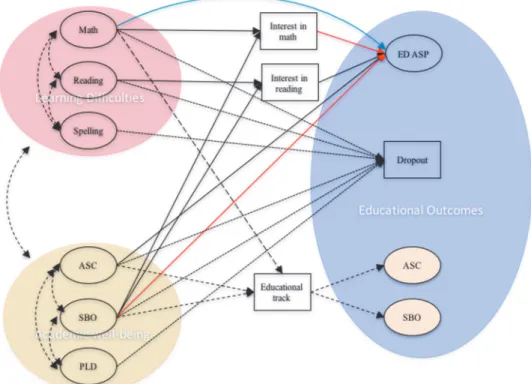
Based on the literature on educational aspirations, which has mostly been situated either within the expectancy-value model or I/E frame of reference model, the variables included in our study play pivotal roles in the processes that shape these aspirations. Furthermore, the literature clearly demonstrates that these processes are somewhat different for boys and girls and that incorporating achievement and motivational beliefs measures from the two domains (mathematics and reading) are warranted. Hence, we have incorporated
individual interest in mathematics and reading into our empirical model as mediators of the effects of mathematics and reading achievement according to the expectancy-value model. Finally, there is some evidence that students’ academic well-being should also be included when trying to understand educational aspirations (e.g., Perez et al., 2014).
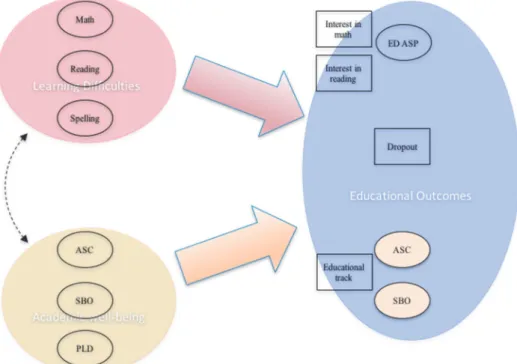
This dissertation is based on four original publications, which are referred to in the text by Roman numerals (studies I to IV). The overall aim of the present dissertation study was to investigate the interplay among LDs in mathematics and reading, academic well-being and educational pathways (Figure 1) in adolescent students. The general aim was pursued based on the following research questions:
1) How are mathematical learning difficulties (MLD) and reading difficulties (RD) related in adolescent students (studies I and IV)?
2) How are learning difficulties and academic well-being related (studies II, III and IV) in adolescent students?
3) How are changes in academic well-being related to mathematical learning difficulties (MLD) during the transition from comprehensive school to upper secondary school (study III)?
4) How can learning difficulties and academic well-being explain educational aspirations and school dropout in adolescent students (studies II and IV)?
Figure 1. Theoretical model of adolescent students’ educational pathways where LDs and academic well-being predict educational outcomes; ASC = academic self-concept, SBO = school burnout, PLD = perceived learning difficulties, ED ASP = educational aspirations, educational track = general or vocational upper secondary education.
1.4.1. Context: The Finnish education system
Finland is officially bilingual, with Finnish and Swedish being the national languages. The Swedish-speaking minority constitutes approximately 5% (n = 291,219) of the population (Official Statistics of Finland, 2012a). The education systems are identical for both language groups but, unusual for a minority, the Swedish-speaking population has lower unemployment rates (Saarela & Finnäs, 2003) and higher general well-being (Nyqvist, Finnäs, Jakobsson, & Koskinen, 2008).
In Finland, comprehensive school is a 9-year compulsory general schooling for all children aged 7 to 16 years. It is comprised of primary school (Grades 1 to 6) and lower secondary school (Grades 7 to 9). At the end of comprehensive school (Grade 9), students choose between upper secondary general education (i.e., the academic track) and vocational education (i.e., the vocational track). A majority of students (50%) who finish compulsory education in Finland choose
upper secondary education, whereas 41% of the students choose vocational education. Upper secondary education prepares students for university studies, whereas vocational education is more practically oriented (for a detailed description, see Rinne & Järvinen, 2011). This choice is one of the most important decisions that they will make regarding the ultimate level of education that they will attain (Nyyssölä, 2004).
When students apply for a secondary education programme, there is a risk that they will not be admitted to an educational program or that they drop out at an early stage if their academic performance is low. Studies have shown that LDs increase the risk of not being admitted to an educational program and that these students tend to choose the vocational education track (Järvinen & Vanttaja, 2006; Savolainen, 2001; Vanttaja & Järvinen, 2004). Students with LDs that get admitted are at a high risk of dropping out and leaving school without finishing their studies, particularly post-compulsory schooling (Jahnukainen, 2001).
The dropout rate at Finnish comprehensive schools is minimal (0.04%; Official Statistics of Finland, 2012b), but in the secondary education programmes, the school dropout rate is far larger (5.5%; Official Statistics of Finland, 2012b). One reason for the high completion of comprehensive education is the extensive special educational support system in Finnish schools (Simola, Rinne, & Kivirauma, 1999). In Finland, on average, children from homes with low socioeconomic status have a higher probability of being excluded from education and beginning their working life between the ages of 16 to 18 than the rest of the population (Järvinen & Vanttaja, 2001). The relationship between parental background and achievement in Finland is also well documented, although this effect is weaker than in many other countries (OECD, 2010).
2. Methods
2.1. Participants and Procedure
In all of the four original studies used in this dissertation, the data were drawn from the Vem Väljer Vad (VVV, ‘Who Chooses What’) study, which is a project led by Karin Linnanmäki (Åbo Akademi University). The project has been mainly funded by the Swedish Cultural Foundation in Finland and Högskolestiftelsen i Österbotten. VVV is an ongoing follow-up study whose overall aim is to investigate adolescent students’ educational pathways from compulsory to tertiary education with a focus on learning difficulties and academic well-being. The project started in 2007, and I have been involved in the planning and implementation of the data collection from the beginning of this study. Data have been collected from 14 different Swedish-speaking secondary schools located all over the geographic area inhabited by the Swedish-speaking minority group in Finland.
The data used in the present work were from two measurement occasions. The first data collection was executed when the students were in Grade 9 in 2008, and the second data collection was conducted 2 years later when the same students were in secondary education. Information on the measures, number of participants and the time points included in the original studies are summarized in Table 1.
Table 1
Measures, number of participants and time points included in the studies
Measure N Study I Study II Study III Study IV Time point 1 Mathematics 980 X X X X Reading comprehension 1028 X X X Word comprehension 1000 X X X Spelling 1019 X X Academic self-concept 866 X X X School burnout 921 X X X Perceived learning difficulties 921 X Interest in math 870 X
Interest in reading 1034 X Educational aspirations 859 X
Parental educational background 734 X
Time point 2
Mathematics 712 X
Academic self-concept 650 X School burnout 693 X Upper secondary education track 1066 X
School dropout 1152 X
2.2. Measures
For this dissertation study, data were collected with assessment tools to measure students’ skills in reading and mathematics. Academic well-being was measured with questionnaires, and students were also asked to report gender, parental educational level and educational aspirations. Teachers reported students’ interest in mathematics and reading. Information concerning dropout and educational track was gathered from schools.
2.2.1. Mathematics skills
The mathematics skills of students were assessed with the standardized KTLT test (Räsänen & Leino, 2005). We used the Swedish version of the scale, which has been standardized for the Finnish Swedish population. This scale assesses students’ performance in basic arithmetic (addition, subtraction, multiplication
and division), word problem solving, algebra, geometry and unit conversion skills. It is also used for screening purposes for identifying at-risk students. This scale is intended for Grades 7 to 9 (13 to 16 years of age), and it consists of four parallel versions (A, B, C and D). The KTLT test contains 40 items, with a correct answer worth 1 point and an incorrect answer worth no points. Thus, the results range from 0 to 40. Students have 40 minutes to complete the scale, which is in the form of a paper-and-pencil test.
2.2.2. Reading skills
The LS reading ability test (Johansson, 2005) is a standardized test for Grades 7 to 9 (13 to 16 years of age) and Grade 1 in upper secondary school (16 to 17 years of age). The test identifies students with RDs. The subtests we used were word comprehension, reading comprehension and a spelling test. The word comprehension and reading comprehension scales had multiple-choice tasks, and in the spelling test, the words that needed to be written were presented verbally for the students.
Word comprehension (40 items). These items measured students’ word comprehension skills in Swedish. There were 40 sentences that were missing the last word. Five words were listed after each sentence, and the students had to choose the right word that fit the sentence.
Reading comprehension (5 texts). These items measured students’ reading comprehension skills in Swedish. There were five short texts that the students read. After that, they chose the correct title from four suggestions for each text and then chose the correct statements from six statements about the content of the text.
Spelling (50 items). These items measured students’ spelling skills in Swedish. The test administrator read a sentence and then repeated words that the students must write down correctly.
2.2.3. Academic self-concept
Academic self-concept was measured using items from the Perceived Competence Scale for Children (Harter, 1982). The original scale consists of 28 items and is a paper-and-pencil test. We used a modified version that had two
additional items, one of which measured academic self-concept. For each item, students were given two statements. First, they were asked to decide if they are more like the young people described on the left side of the statement or more like those depicted on the right side. Secondly, they were asked to mark whether each statement was completely true or just partly true for them. The responses were then scored on a 4-point scale ranging from least competent (1) to most competent(4). Because the original scale was created in English and available in Finnish and Norwegian, we utilised a multilingual team to ensure the validity of the instrument by translating the questionnaire from Norwegian to Swedish and from Finnish to Swedish and comparing the similarity of both translations.
2.2.4. Perceived learning difficulties
Perceived learning difficulties were assessed using nine items measuring how much difficulty the students experienced in their schoolwork (e.g., take notes in class, understand instructions on the whiteboard, etc.). Each item was assessed using a 7-point Likert scale ranging from 1 (not at all) to 7 (very much). The items originally came from the School Health Promotion study (Rimpelä, 2003) and were translated to Swedish for this purpose.
2.2.5. School burnout
School burnout was assessed using the School Burnout Inventory (SBI), which is a nine item scale developed by Salmela-Aro and Näätänen (2005). The inventory consisted of three subscales: exhaustion at school (EXH), cynicism towards the meaning of school (CYN) and sense of inadequacy as a student (INAD). Each subscale comprised three items which were assessed using a 6-point Likert scale ranging from 1 (completely disagree) to 6 (completely agree). A multilingual team translated the scale from Finnish to Swedish.
2.2.6. Individual interest
We used teacher ratings to measure students’ interest in mathematics and Swedish (i.e., their mother tongue). The students’ mathematics and Swedish teachers were asked to evaluate the students’ motivation and activity in class and rate the students’ interest in these subjects on a 5-point Likert scale. They
received a name list of their students by class (e.g., class 9b) and were requested to fill in the ratings for every student.
2.2.7. Educational aspirations
We measured the students’ idealistic and realistic educational aspirations according to two statements on a 3-point Likert scale (vocational upper secondary education, polytechnic education and university education): ‘Highest academic degree I want to achieve’ and ‘Highest academic degree I will probably achieve’.
2.2.8. Upper secondary education track
Information on students’ educational track (vocational or academic) was collected from schools. First, information from all 14 comprehensive schools where the students had applied was collected. Second, the upper secondary schools were contacted to get confirmation that the students were studying there. If this was not the case, the students themselves were contacted to get the information.
2.2.9. School dropout
School dropout in this study refers to students not enrolled in education 2 years after Grade 9. Of the original sample of 1,152 students, 55.4% (n = 639) were studying at general upper secondary schools, 36.9% (n = 426) were studying at vocational upper secondary school and 3% (n = 35) of the students were not on any educational path at the time of the second data collection. Of these latter students, 37.1% had never started secondary school, 51.4% dropped out from a vocational upper secondary school and only 11.4% dropped out from a general upper secondary school. Furthermore, there was a heterogeneous group of students (n= 52) that included those who were studying abroad, combining general and vocational upper secondary studies or studying at folk high schools that do not give qualifications for specific professions.
2.2.10. Parental educational background
Students were asked to report their mother’s and father’s highest educational degrees on a 6-point scale (1 = no education, 2 = short course-based vocational