27 March 1974
European Communities
EUROPEAN PARLIAMENT
Working Documents
1974-1975
DOCUMENT 15 /74
Report
drawn up on behalf of the Committee on Budgets
on the proposal from the Commission of the European Communities to the
Council (Doc. 4/72 - II) for a directive on the,liarmonization of excise duties on
alcohol
Rapporteur: Mr H.K. ARTZINGER
.!
,,
/By letter of 22 March 1972 the President of the Council of the
European Comni.unities requested the European Parliament to deliver an
opinion on the proposals for Council directives in the field of special
excise duties and taxes having equivalent effect: Part II, proposal from
the Commission of the European Communities for a directive on the harmonization of excise duties on alcohol.
On 29 March 1972 the President of the European Parliament referred
these proposals for directives to the Committee on Budgets as the
committee responsible and the Committee on Agriculture and the Committee
on Economic and Monetary Affairs for their opinion.
On 16 May 1972 the Committee on Budgets appointed Mr Artzinger rapporteur.
The draft report was considered by the Sub-Committee on Tax
Harmonization at its meetings of 21 June 1972, 30 November 1972,
8 October 1973 and 11 February 1974.
The Committee on Budgets adopted the following motion for a
resolution at its meeting of 18 March 1974 by 11 votes for and 1 against,
with 1 abstention.
The following were present: Mr Aigner, acting chairman: Mr Rossi,
vice-chairman: Mr Artzinger, rapporteur: Mr Bangemann (deputizing
for Miss Flesch), Lord Bess·borough, Mr Beano, Mr Concas.1 Mr Fabbrini,
Mr Gerlach, Mr Maigaard, Mr de la Malene, Mr P~tre, Mr Pounder,
Mr Radoux, Mr •rerrenoire, Mr Wieldraaijer and Mr Wohl fart.
The opinions of the Committee on Agriculture and the Committee on
Economic and Monetary Affairs are being distributed separately.
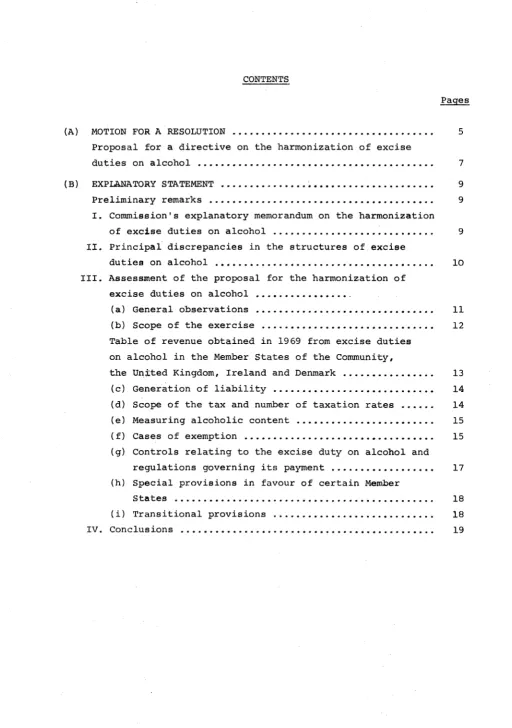
-CONTENTS
(A) MOTION FOR A RESOLUTION . • . • • . . • • • • • • • • • • • • . • . . . • • • • • • • • • • • 5
Proposal for a directive on the harmonization of excise
duties on
alcohol...
7(B) EXPIANATORY STATEMENT . . . • • . • ~ . . . 9
Preliminary remarks... 9
I. Commission's explanatory memorandum on the harmonization
of excise duties on alcohol... 9
II. Principal discrepancies in the structures of excise
duties on alcohol .•••.•••..•.• , • • • • • . • • • • • . • • • • • • • . • • . • 10
III. Assessment of the proposal for the harmonization of excise duties on alcohol
(a) General observations
(b) Scope of the exercise
...
.;...
•... .
Table of revenue obtained in 1969 from excise duties
on alcohol in the Member States of the Community,
11
12
the Untted Kingdom, Ireland and Denmark... 13
(c) Generation of liability • • • • • • • • • • • . • • • . • • • . • • . • • . .. 14
(d) Scope of the tax and number of taxation rates... 14
(e) Measuring alcoholic content... 15
(f)
Cases
ofexemption...
15(g) Controls relating to the
excise
duty on alcohol andregulations governing its payment... 17
(h) Special provisions in favour of certain Member
States . . . . . . . 18
( i) Transitional provisions . • . • • • • • • . • . . • . . . • . . • • • • • . 18
IV. Conclusions . . . . . . . . . . . . 19
[image:4.613.33.545.26.754.2]A
The Committee on Budgets here·by submits to the European Barliament
the foLlowing motion for a resolution, together with explanatory
statement:
MOTION FOR A RESOLUTION
embodying the opinion of the European Parliament on the proposal from the commission of the European communities to the Council for a directive on
the harmonization of excise duties on alcohol
The European Parliament,
- having regard to the proposal from the Commission of the European Communities to the ·council1 ,
- having been consulted by the Council in an instance where such
consultation was not mandatory (Doc. 4/72),
- having regard to the report of the Committee on Budgets (Doc. 15/74),
- having regard to the opinions of the Committee on Economic and Monetary
Affairs and the Committee on Agriculture,
1. Considers that the Commission's proposal will lead to a progressive
harmonization of excise duties on alcohol in the Member States1
2. Emphasizes the considerable fiscal importance of excise duties on
alcohol in all the Member States;
3. Consequently proposes the retention of this duty which is also
desirable for reasons of public health1
4. Invites the Commission to formulate without delay, after the Excise
Committee has been set up, proposals designed to ·eliminate certain
elements affecting in various ways the cost price of alcoholic
beverages in Member States and so having an unfavourable impact upon competition, such as the various regulations relating to the
lodging of deposits in cases of deferred payment of the excise, time-limits for payment, control regulations, etc;
l OJ No C43 29 April 1972, p.25
5. Welcomes the fact that the tax is to be applied to alcoholic beverages
only and that other products or means of production in particular medicaments, are to be exempt - a fact which brings out clearly the
reasons of pu'blic health motivating this tax;
6. Regrets, however, that the articles of the directive do not give
clear expression to the notion of tax exemption for industries using alcohol as a primary or auxiliary ingredient and suggests that the
proposal be amended accordingly;
7. Is of the opinion that the harmonization of excise duties on alcohol
is necessary only to the extent that present regulations distort
competition in trade 'between the Member States, and accordingly declares its support for special arrangements without any special
time-limit for the taxation of products of small-scale distilleries of purely local importance:
8. Regrets that harmonization limited for the time being to fiscal
structures, which will have few economic repercussions, will not
eliminate inequalities of competition;
9. Asks the Commission to concentrate in particular upon the harmonization
at an early date of taxation rates;
10. Requests the Commission to incorporate the following amendments in
its proposal, pursuant to Article 149, paragraph 2, of the EEC
Treaty:
11. Instructs its President to forward this resolution and the report
of its committee to the Council and Commission of the European Communities.
-1
Text Proposed by the Commission of
the European Communities 1
Amended Text
PROPOSAL FOR A DIRECTIVE
on
the harmonization of excise duties on alcohol
Preamble and recitals unchanged
Articles 1 - 6 unchanged
Article 7 Article 7
Official English version of this ~he following shall be exempt from
text:not available excise duty:
1. unchanged
(a) unchanged
(b) unchanged
(c) unchanged
( d) unchanged
( e) ~<J.E._ the __ manufacture of products
-other than beverages - of, the
food-stuffs and confectionery industry
having an alcohol content of less than 6%
2 • unchanged
3. unchanged
4. unchanged
Articles 8 - 28 unchanged
Text proposed by the Commission of
the European Communities
Article 29
Articles 33-37 unchanged
Amended Text
Article 29
Member States may retain special
provisions departing from the
present directive which are already :Ln force at the .time of its publi-cation, provided that they concern
matters of minor importance, that no trans-frontier trade is involved,
and that they have no unfavourable impact.on conditions of competition.
Article 30
deleted
Article 31
deleted
Article 32
Preliminary remarks
B
EXPLANATORY STATEMENT
1. It has already been stated, in the report on the outline directive
concerning the harmonization of excise duties at Community level, that the
Commission proposes the retention and harmonization of excise duties on alcohol 1.
In its explanatory memorandum, the Commission points out that several
of the discrepancies in taxation which led to discrimination with regard
to imports have already been eliminated on the basis of Articles 12
(elimination of customs duties between Member States) and 95 (fiscal
provisions) of the EEC treaty.
The abolition of such discrimination is, however, not sufficient in itself to achieve, in the alcohol sector, fiscal conditions that are neutral
from the point of view of competition.
I. The Commission's explanatory memorandum on the harmonization of excise
duties on alcohol
2. The harmonization of excise duties on alcohol should contribute to the
achievement of Economic and Monetary Union, one aim of which is the
establishment of neutral conditions of competition in trade between Member States.
In the final stage, this harmonization will also contribute towards suppressing countervailing charges in international trade and controls at in teraal frontiers.
3. While the Commission, in its Explanatory memorandum, does not refer to
the actual principle of retaining excise duties on alcohol it does
enumerate some of the main elements of a fiscal nature which create·unequal
conditions of competition and necessitate a harmonization of this tax.
1
See Doc. 4
/72.
-II. Principal discrepancies in the structures of excise duties on alcohol
4. These discrepancies are mainly to be observed:
- in the scope of the tax,
- in the granting of reduced rates,
- in the manner of collecting the tax,
- in the point in time at which the tax falls due,
- in the manner in wh i eh liability to excise is controlled by the fiscal
authorities.
5. The Commission cites the following examples:
- differentiation of the excise according to the manner of consumption of
alcoholic beverages: in France, the tax is higher on aperitifs than on
digestifs;
- in Italy, denatured alcohols intended for industrial use are not exempt
(reduced tax);
- in several Member States, the homologues of ethyl alcohol (propyl,
isopropyl, methyl and amyl alcohols) are subject to excise;
- i11 Italy, Lhe excise is divided inlo a manufacturing tax and a State tax,
the two having different functions;
- in France, warehouses for the storage of alcohol are supervised through
the accounting records whereas in the other Member States the permanent
presence of officials of the administration is required;
- in Germany, trade in alcohol is exempt from all control as soon as the
excise has been paid;
in Belgium, the excise is paid when the alcohol leaves the distillery,
whereas in the other Member States i t is paid when the product is
delivered to the consumer;
the tjme-lim.its allowed for pay.ing the duty range from 15 days, on average,
in Italy lo five months in Germany.
6. The Commission's statement that the cost price of alcoholic products may
show considerable discrepancies as a result of these differences, which are
sufficient to distort the conditions of competition between Member States,
is therefore obviously accurate.
-III. Assessment of the proposal for the harmonization of excise duties on alcohol
a) General observations
7. The consideration on which the entire Commission proposal seems to be
based is the need to harmonize excise duties on alcohol in order to
establish equal conditions of competition in this s~ctor and so do away
finally with countervailing charges on exports and imports and with the
frontier controls which they entail.
8. It is regrettable that the Commission proposal merely refers in
pas-sing to considerations of public health and their implications as an
argument in favour of excise duties on alcohol, for quite apart from the
question of revenues, this is the principal argument in favour of re-taining this duty and it cannot fail to influence, among other things, the
structures and level of taxation.
9. It is a well-known fact that levels - and consequently rates - of
taxation are the principal means of controlling or limiting the consumption of strong alcoholic beverages through the increase in cost resulting from the tax on their consumption.
That is why your .committee has included the criteria of public
health and the general structures of taxation on alcohol in his assessment
of the proposal, including the provisions aiming for total or partial exemption of certain beverages from the tax on alcohol.
10. Even though the Commission in its explanatory statement primarily
regards the tax on alcohol consumption as a source of revenue, the fact
must not be overlooked that it also serves other purposes and was indeed
originally justified on the grounds of public health. Everyone is aware
that it is a source of considerable fiscal revenue constituting a by no
means negligible item on the revenue side of national budgets; but its purely fiscal aspect should not lead us to forget its original purpose.
A comparison of levels of taxation in the Member States demonstrates that
the amount of this tax increases in proportion to the importance attached
to considerations of public health. This applies particularly to the new
Member States of the Community, which attach especial importance to this aspect of the matter.
11. The fact that the evolution of incomes is not the same in all Member
States and the need for maintaining, by means of taxation, certain limits on the consumption of alcoholic beverages indicate the scale of the
di fficultiea which will later be enco1mtered when harmonizing the rates of the excise. These rates must not only be approximated to one anolher
{after the structures have been harmonized) but also - even if it be
at fairly long intervals - adapted to the evolution of incomes, if the effect of limiting consumption is not gradually to disappear.
12. Equal conditions of competition cannot in fact be achieved if Member
States disagree on the amount of excise to be charged on alcoholic
beverages in order to keep their manufacture and consumption down to a level consonant with the demands of public health. We shall confine
ourselves to recalling, by way of example, that in France a higher duty is imposed on ape:cil:.ifs than on digestifs.
The table on page 13 gives a summary of the revenue collected from
excise duties on alcohol in the Member States.
b) Scope of the excise
13. Article 1 of the proposal provides for a harmonized excise only on
ethyl alcohol, whether unprocessed or contained in other products.
14. Information supplied by the Commission indicates that in Italy,
but not in other countries, a special State duty is levied on methyl,
propyl and isopr01¥l alcohol (1000 lire per hectolitre of pure alcohol),
since these alcohols are, or may be, used instead of denatured ethyl
alcohol, which is itself subject to a duty of 6000 lire per hectolitre
of pure alcohol. The other homologues of ethyl alcohol (amyl .alcohol,
butyl alcohol etc.) are not subject ot excise in any Member State.
15. Article 7 of the proposed directive exempts from excise duty
denatured ethyl alcohol intended for uses other than the manufacture
of beverages. The implication of tre proposed directive is that the
homologues of ethyl alcohol should also be exempt, since they can be only
utilized as replacements for denatured ethyl alcohol, itaelf exempt.
Their use i.n the manufacture of beverages, the sole case in which they
should be subject to taxation is scarcely conceivable.
Germany
France Italy
Netherlands Belgium
Luxembourg
The Community
United Kingdom
Ireland
Denmark
Revenue obtained in 1969 from excise duties
on alcohol in the Member States of the
Community, the United Kingdom, Ireland and
Denmark
In the national In u.a. As% of
currency (millions) revenue
(millions) from
indirect taxation
DM 2,142 544.0 3 .16
FF 2,145 374.7 2.5
Lit. 62,562 101.0 0.97
hfl. 414 114.4 4.2
FB 2,437 48.7 1. 70
FL 102 2.4 2.4
( 1969) 1,094.3
£ 324.0 795. 2
£ 14.8 352.3
dkr 504.2 67.2
As% of total fiscal revenue
1. 7
1. 5 0.7 1. 7
1. 0
1. 1
2.6
4.0
2.1
16. In addition, the application of the d:icective to these other alcohols
would lead to difficulties of supervision etc.
17. Article 2 of the proposed directive lists the beverages to which the
directive does not apply, the general criterion being that the total
alcoholic content of these beverages should be less than 15° G.L.
c) Generation
of
liability18. According to Article 3 of the proposed directive, liability to the
excise is constituted by:
- the manufacture of ethyl alcohol,
- the processing of products to which ethyl alcohol is added,
- the despatch of products from the manufacturer's premises,
- their importation.
d) Scope of the tax and number of taxation rates
19. According to Articles 5 and 6 of the proposed directive, each
Member State is to establish a si~gle excise rate, known as the full rate.
In order to avoid discrimination and distortion of competition, there is to
be no differentiation of the excise according to the materials used, the
size of the manufacturing undertaking or any other criteria.
Such differentiations exist at present only in France (according
to the manner of consumption) and in Italy (according to the primary
materials used).
20. According to Article 6, a reduced rate corresponding to not less than
20% and not more than 50% of the full rate is envisaged for certain
beverages such as dessert wines and vermouths with an alcoholic content
not exceeding 22°, the limit otherwise being fixed at 15°.
21. The proposal of reduced rates for dessert and flavoured wines is
designed to take account of the peculiar nature of these beverages, which
are prepared by the addition - incidentally, in widely varying proportions
- of alcohol to wine. The natural alcohol contained in the wine is
considerably more expensive than the alcohol obtained by distillation.
nppllcation of the full rate to these products would mean that the wine,
i.e. the basic product, was being taxed as alcohol, whereas non-processed
wine is liable only to a very small duty (see the directive on wine).
-22. The rates levied in the different Member States on flavoured wines
0
with an alcoholic content of 16 represent the following percentages of
the full rate:
- Italy: 7"/o
- German Federal Republic: 34"/o
- Netherlands: 34"/o
- Belgium: 36"/o
- Luxembourg: 47%
- France: 80%.
23. It follows from these figures that a reduction of the discrepancies
to a rate constituting at least 20"~ and at most 50% of the full rate is a
first approximation. At a later stage, this reduced rate should, for
reasons of public health, be grought nearer to the upper limit (50"/o of the fu 11 rate) than to the lower limit ( 20"/o of the fu 11 rate) •
e) Measuring alcoholic content
24. In most Member States, alcoholic content is at present measured by
the Gay-Lussac method, use being made either of the original (1822) or of
tre revised (1882) tables at a temperature of 15° centigrade. Some other
Member States, including Ireland and the United Kingdom, employ other
methods at a temperature of 15.56° centigrade (60° fahrenheit).
The present tendency is to prefer a temperature of 20° (Tralles
table) .
Article 4 of the proposed directive will, therefore, have to be
revised in due course. At present, no particular difficulties are raised
by the provision according to which a temperature of 15° centigrade should
be used.
f) cases of exemption
25. According to Article 7, alcoholic products
- intended for uses other than human and animal consumption,
- intended for tremanufacture of cosmetic products,
- used for the manufacture of medicaments or intended for external
medical application,
- containing ethyl alcohol and exported from a bonded warehouse, are, in general, exempt from excise.
26. With regard to the exemption proposed for cosmetic articles, to
which most Member States at present apply a reduced rate of taxation, the
more popular ones.
Your ~ommittee also considers that cosmetic products should be
exempt from excise duties on alcohol, but only because there are no reasons
of public health requiring that they should not be.
27. As for the second reason given for this exemption - namely, the
tendency in the cosmetics sector to replace ethyl alcohol by non-taxed
products - this, in your committee's view, is an aspect alien to the
fiscal system. There is, however, no need to examine this aspect in
any more detail here.
28. For reasons that need not be explained, your committee
emphatically supports the proposed exemption of medicaments and of
products intended for external medical application.
29. Article 7 of the proposed directive stipulates that alcohol used
for the manufacture of medicaments, even when i t is one of the ingredients
shall be exempt from excise. The term 'medicament' should be understood
according to the following definition given in Council Directive
No 65/65 (EEC) of 26 January 1965 1 'Any substance or composition
described as possessing curative or preventive properties with regard
to human or animal diseases.'
30. In the case of products with a high alcoholic content such as
spirits of melissa, i t is for Member States to decide whether these
are proper means of curing or preventing diseases. In any case, the
future Excise Committee should prevent any differences of interpretation.
31. Exempted from excise is alcohol used for the manufacture of any
medicament, whether for the purposes of human or veterinary medicine
and regardless of whether i t be produced by the pharmaceutical industry
or by pharmacists.
32. Exemption from excise applies not only to medical alcohol contained
in medicaments intended for internal use or utilized in their manufacture
but also to alcohol intended for external medical application, whether for
disinfecting the skin or wounds or for sterilizing instnuments. The
exemption applies to both denatured and non-denatured alcohol (denaturing
is only one of many means of preventing frauds) and also to alcohol
employed in hospitals or sold by pharmaceutical chemists.
1
It is for the Member States to take the necessary measures to prevent
the use of this alcohol for the manufacture of beverages.
33. In the preamble the Commission expresses support for tax exemption
on ethylalcohol used in industry as a raw material. This view can only
be endorsed, particularly in respect of the foodstuffs and confectionery
industry, which uses ethylalcohol in a large number of products as a preservative, as a means of preserving flavour, or even as a flavouring
agent. To make this objective clearer in the directive your committee
suggests that an addition be made to the relevant article.
g) Controls relatina to the excise duty on alcohol and regulations
governing its payment
34. In all Member States, alcohol, from the stage of production to that
of consumption, is subject to an official control designed to ensure the
levy of excise. Nevertheless, the stringency of these controls varies
from one Member State to another, and their mode of application may well
vary in its effect upon the competitive capacity of undertakings. Thus,
not all Member States impose an obligation, when putting alcohol onto the
market, to lodge a deposit as a guarantee of payment of the subsequent
fJrtcal l lal>i lil:.y. Manufacl:.ur.i.ng prem.ises are also supervised in a great
variety of ways - for example, through the agency of officials permanenLly
seconded for the purpose or simply on the basis of book-keeping accounts. It is to be regretted that in its proposed directive the Commission has
not proceeded to harmonize provisions concerning the payment of deposits; as a result, undertakings in Member States where this deposit is not the
normal practice will retain their present advantages with regard to the
receipt of interest.
35. As soon as it has been set up, the Excise Committee will have to
look into the question of., harmonizing control regulations and modes of
payment. Discrepancies in the time-limits allowed for payment of the
excise should also be eliminated at a very early stage of harmonization.
Admittedly, this suspension of duty is necessitated by the fact that its
amount. .iR relatively hi9h and manufacturers would 'feel very keenly the
efrecl. of' hnvlnq to co11Linue over any lenqlh of:' t:lme paying this duty
in advance: but as the interval between manufacture and consumpt.J.on J s
the same in Member States, so the time-limits allowed for payment of the
excise should also be the same. Another argument in favour of a uniform
system is the need to prevent any advantage from accruing to imported
36. As soon as i t has been set up, the Excise Committee should also
begin work on drawing up proposals for preventing the emergence of any
further complications with regard to the documents required for putting
alcohol on the market. These documents, necessary for control purposes as
long as the excise has not been paid under the system of storage in
bonded or unbonded warehouses, should not be governed by provisions which
differ from one Member State to another.
h) Special provisions in favour of certain Member States
37. The commission proposes a temporary regime of limited duration
in favour of small distilleries and home distillers, to whom Member States
have hitherto granted tax relief.
38. Article 19 accordingly lays down that the excise due is to be
assessed according to the actual quantity of pure alcohol, while
Article 29 recognizes the possibility of departing from this principle
in favour of German and Luxembourg small-scale distillers, the tax in
such cases being calculated on a flat-rate basis as a function of the
quantities distilled.
39. According to Article 10 (1), Member States are obliged to produce
all alcohol in bond. Article 30 permits an exception in favour of
small-scale German and Luxembourg distilleries and French home distillers: the
present system of control may continue to be applied until a Community
solution has been found.
40. Your committee takes the view that excise duties on alcohol should
be harmonized only to the extent that such harmonization prevents
distortions of competition and makes the remission of export charges and
introduction of import charges unnecessary.
41. Existing special arrangements which are to remain in force for a
limited time do not conflict with the criteria set-out in Section 31.
They apply, in fact, to situations of purely local significance which
concern only a restricted .number of persons and do not seriously affect
the conditions of competition.
42. Your .committee therefore, proposes that Articles 29, 30, 31 and 32
of the proposed directive be replaced by a new Article ~9 with the
following wording:
'Member States may retain special provisions departing from the
present directive .which are already in force at the time of its
pu·bli-cation, provided that they concern matters of minor. importance, that no
!:rans-frontier trade is, involved and that they have no unfavourable impact
i)
43.
Transitional provisions
The provisions of Article 33 on the reduction of discrepancies in
the rates of excise duty will remain practically meaningless so long as
Member States continue to enjoy a considerable freedom of decision in
regard to excise duties and Value Added Tax.
44. As regards Value Added Tax, there is little doubt that a very small
difference (as between, for example, 15% in one Member State and 17%
in another) is unlikely to impede the functioning of the Common Market
when frontier controls have been abolished and trans-frontier traffic
no longer occasions the imposition or remission of duties.
45. No taxes other than the harmonized excise duty and value added tax
can be levied on the import of alcoholic products. This is made clear
in Article 35 of the proposed directive. Private individuals must be
able to cover their needs in another Member State without having to pay
this additional tax.
46. Finally, it may be pointed out that the general provisions of the
Treaty retain their validity, in particular those of Article 95, which
forbid Member States to impose any taxes that favour one product in
relation to another.
IV. Conclusions
47. Your corrunittee congratulates the Commission on its balanced
proposal for a directive for harmonizing excise duties on alcohol.
4a
In all Member States, including those which have just joinedthe Community, the considerable fiscal importance of this tax, whose
contribution to the total national revenue ranges from 0.7% (Italy),.
to 4.0% (Ireland), is sufficient justification for maintaining and
harmonizing excise duties on alcohol.
49. It should, however, not be forgotten that the tax on alcohol is
also designed to serve the interests of public health.
Since the new Member States attach great importance to this aspect
of the matter, the means it offers of limiting consumption should be
50. Your conunittee regrets that certain provisions have not been formulated
with greater precision, and asks the Conunission, as Roon as the Excise
Conunittee begins its work, to submit proposals for standardi~ing in
particular:
- the system of deposits payable where payment of excise is deferred
and of·u~me~li~its for payment of the excise duty;
- provisions relating to controls;
- the manner of interpreting in the various Member States the exemption
of alcoholic products.
51. Generally speaking, fiscal harmonization is legitimate only in so
far as i t serves the Conununity's interests. Consequently, special
arrangements valid for a specific length of time and governing the
manu-facture of alcoholic products by small-scale distilleries which are of
purely local importance, as provided for in Articles 29-32 of the proposed
directive, do not meet with the approval of your committee, since i t is
opposed to carrying fiscal harmonization to these lengths on the grounds
that distilleries of this type constitute no real threat to competition
between Member States.
52. These reservations form the basis for the two amendments proposed
to the text of the directive. For the rest, while regretting that this
first proposal for harmonizing fiscal structures will have no apprecia'ble
impact and consequently cannot be expected to lead to an elimination
of distortions of competition, your conunittee reconunends that the