Proceedings of the Third Conference on Machine Translation (WMT), Volume 1: Research Papers, pages 61–72
A Large-Scale Test Set for the Evaluation of Context-Aware Pronoun
Translation in Neural Machine Translation
Mathias Müller1,2 Annette Rios1 Elena Voita3,4 Rico Sennrich1,5
1Institute of Computational Linguistics, University of Zurich
2Amazon Research, Berlin∗
3Yandex Research, Russia 4University of Amsterdam, Netherlands
5School of Informatics, University of Edinburgh
Abstract
The translation of pronouns presents a special challenge to machine translation to this day, since it often requires con-text outside the current sentence. Re-cent work on models that have access to information across sentence boundaries has seen only moderate improvements in terms of automatic evaluation metrics such as BLEU. However, metrics that quan-tify the overall translation quality are ill-equipped to measure gains from additional context. We argue that a different kind of evaluation is needed to assess how well models translate inter-sentential phenom-ena such as pronouns. This paper therefore presents a test suite of contrastive tions focused specifically on the transla-tion of pronouns. Furthermore, we per-form experiments with several context-aware models. We show that, while gains in BLEU are moderate for those systems, they outperform baselines by a large mar-gin in terms of accuracy on our contrastive test set. Our experiments also show the ef-fectiveness of parameter tying for multi-encoder architectures.
1 Introduction
Even though machine translation has improved considerably with the advent of neural machine translation (NMT) (Sutskever et al., 2014; Bah-danau et al.,2015), the translation of pronouns re-mains a major issue. They are notoriously hard to translate since they often require context outside the current sentence.
As an example, consider the sentences in Fig-ure1. In both languages, there is a pronoun in the
∗Work performed prior to joining Amazon.
EN However, the European Central Bank (ECB) took an interest in it. It describes bitcoin as “the most successful virtual currency”.
DE Dennoch hat die Europäische Zentralbank (EZB) Interesse hierfür gezeigt. Sie beschreibt Bitcoin als “die virtuelle Währung mit dem grössten Erfolg”.
Figure 1: Example sentence illustrating how the translation of pronouns is ambiguous on a sen-tence level. Pronouns of interest are in italics, and the antecedents they refer to are underlined. Taken from WMTnewstest2013.
second sentence that refers to the European Cen-tral Bank. When the second sentence is translated from English to German, the translation of the pro-noun it is ambiguous. This ambiguity can only be resolved with context awareness: if a transla-tion system has access to the previous English sen-tence, the previous German translation, or both, it can determine the antecedent the pronoun refers to. In this German sentence, the antecedent Eu-ropäische Zentralbankdictates the feminine gen-der of the pronounsie.
It is unfortunate, then, that current NMT sys-tems generally operate on the sentence level (Vaswani et al.,2017;Gehring et al.,2017;Hieber et al.,2017). Documents are translated sentence-by-sentence for practical reasons, such as line-based processing in a pipeline and reduced compu-tational complexity. Furthermore, improvements of larger-context models over baselines in terms of document-level metrics such as BLEU or RIBES have been moderate, so that their computational overhead does not seem justified, and so that it is hard to develop more effective context-aware ar-chitectures and empirically validate them.
To address this issue, we present an alternative way of evaluating larger-context models on a test set that allows to specifically measure a model’s capability to correctly translate pronouns. The test suite consists of pairs of source and target sen-tences, in combination with contrastive translation variants (for evaluation by model scoring) and ad-ditional linguistic and contextual information (for further analysis). The resource is freely available.1 Additionally, we evaluate several context-aware models that have recently been proposed in the lit-erature on this test set, and extend existing models with parameter tying.
The main contributions of our paper are:
• We present a large-scale test set to evaluate
the accuracy with which NMT models trans-late the English pronoun it to its German counterpartses,sieander.
• We evaluate several context-aware systems and show how targeted, contrastive evalua-tion is an effective tool to measure improve-ment in pronoun translation.
• We empirically demonstrate the effectiveness of parameter tying in multi-encoder context-aware models.
Section2explains how our paper relates to ex-isting work on context-aware models and the eval-uation of pronoun translation. Section3describes our test suite. The context-aware models we use in our experiments are detailed in Section4. We dis-cuss our experiments in Section5 and the results in Section6.
2 Related Work
Two lines of work are related to our paper: re-search on context-aware translation (described in Section2.1) and research on focused evaluation of pronoun translation (described in Section2.2).
2.1 Context-Aware NMT Models
If the translation of a pronoun requires context be-yond the current sentence (see the example in Fig-ure1), a natural extension of sentence-level NMT models is to condition the model prediction on this necessary context. In the following, we describe a number of existing approaches to making models “aware” of additional context.
1https://github.com/ZurichNLP/ ContraPro
The simplest possible extension is to trans-late units larger than sentences. Tiedemann and Scherrer (2017) concatenate each sentence with the sentence that precedes it, for the source side of the corpus or both sides. All of their models are standard sequence-to-sequence models built with recurrent neural networks (RNNs), since the method does not require any architectural change.
Agrawal et al. (2018) use the same concatena-tion technique with a Transformer architecture (Vaswani et al.,2017), and experiment with wider context.
A number of works do propose changes to the NMT architecture. A common technique is to ex-tend a standard encoder-decoder model by addi-tional encoders for the context sentence(s), with a modified attention mechanism (Jean et al., 2017;
Bawden et al., 2018;Voita et al.,2018). One as-pect that differs between these works is the ar-chitecture of the encoder and attention. While
Jean et al.(2017);Bawden et al.(2018) extend an RNN encoder-decoder with a second encoder that the decoder attends to, Voita et al.(2018) extend the Transformer architecture with an encoder that is attended to by the main encoder. Voita et al.
(2018) also introduce parameter sharing between the main encoder and the context encoder, but do not empirically demonstrate its importance.
While the number of encoded sentences in the previous work is fixed, Wang et al. (2017);
Maruf and Haffari (2018) explore the integration of variable-size context through a hierarchical ar-chitecture, where a first-level RNN reads in words to produce sentence vectors, which are then fed into a second-level RNN to produce a document summary.
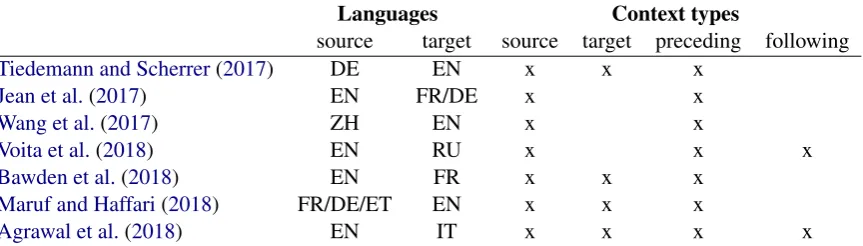
Apart from differences in the architectures, re-lated work varies in whether it considers source context, target context, or both (see Table 1 for an overview of language arcs and context types). Some work considers only source context, but for pronoun translation, target-side context is intu-itively important for disambiguation, especially if the antecedent itself is ambiguous. In our evalua-tion, we therefore emphasize models that take into account both source and target context.
Our experiments are based on models from
Bawden et al. (2018), who have released their source code.2 We extend their models with pa-rameter sharing, which was shown to be beneficial
Languages Context types
source target source target preceding following
Tiedemann and Scherrer(2017) DE EN x x x
Jean et al.(2017) EN FR/DE x x
Wang et al.(2017) ZH EN x x
Voita et al.(2018) EN RU x x x
Bawden et al.(2018) EN FR x x x
Maruf and Haffari(2018) FR/DE/ET EN x x x
[image:3.595.87.519.62.185.2]Agrawal et al.(2018) EN IT x x x x
Table 1: Overview of context-aware translation models in related work.
byVoita et al.(2018). Additionally, we consider a concatenative baseline, similar toTiedemann and Scherrer (2017), and Transformer-based models (Voita et al.,2018).
2.2 Evaluation of Pronoun Translation Pronouns can serve a variety of functions with complex cross-lingual variation (Guillou, 2016), and hand-picked, manually annotated test suites have been presented for the evaluation of pronoun translation (Guillou and Hardmeier,2016;Isabelle et al.,2017;Bawden et al.,2018). While suitable for analysis, the small size of the test suites makes it hard to make statistically confident comparisons between systems, and the hand-picked nature of the test suites introduces biases.3 To overcome these problems, we opted for a fully automatic ap-proach to constructing a large-scale test suite.
Conceptually, our test set is most similar to the “cross-lingual pronoun prediction” task held at DiscoMT and WMT in recent years (Hardmeier et al., 2015;Guillou et al.,2016;Loáiciga et al.,
2017): participants are asked to fill a gap in a tar-get sentence, where gaps correspond to pronouns.
The first edition of the task focused on English→French, and it was found that local con-text (such as the verb group) was a strong sig-nal for pronoun prediction. Hence, future editions only provided target-side lemmas instead of fully inflected forms, which makes the task less suitable to evaluate end-to-end neural machine translation systems, although such systems have been trained on the task (Jean et al.,2017).
Loáiciga et al. (2017) do not report on the proportion of intra-sentential and inter-sentential anaphora in their test set, but the two
top-3For example, all pronoun examples in the test suite by
Bawden et al.(2018) require the previous target sentence for disambiguation, and thus do not reward models that condition on more than one sentence of context.
performing systems only made use of intra-sentential information. Our test suite focuses on allowing the comparison of end-to-end context-aware NMT systems, and we thus extract a large number of inter-sentential anaphora, with meta-data allowing for a focus on inter-sentential anaphora with a long distance between the pro-noun and its antecedent. Our focus on evaluat-ing end-to-end NMT systems also relieves us from having to provide annotated training sets, and re-duces pressure to achieve balance and full cover-age of phenomena.4
An alternative approach to automatically evalu-ate pronoun translation are reference-based meth-ods that produce a score based on word alignment between source, translation output, and reference translation, and identification of pronouns in them, such as AutoPRF (Hardmeier and Federico,2010) and APT (Miculicich Werlen and Popescu-Belis,
2017). Guillou and Hardmeier(2018) perform a human meta-evaluation and show substantial dis-agreement between reference-based metrics and human judges, especially because there often ex-ist valid alternative translations that use different pronouns than the reference. Our test set, and our protocol of generating contrastive examples, is fo-cused on selected pronouns to minimize the risk of producing contrastive examples that are actu-ally valid translations.
3 Test set with contrastive examples Contrastive evaluation requires a large set of suit-able examples that involve the translation of pro-nouns. As additional goals, our test set is designed
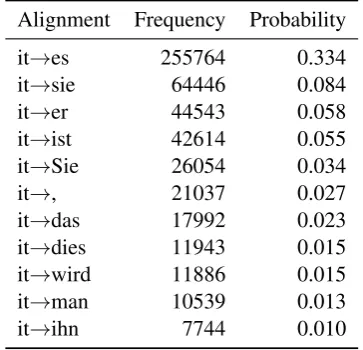
Alignment Frequency Probability it→es 255764 0.334 it→sie 64446 0.084
it→er 44543 0.058
it→ist 42614 0.055 it→Sie 26054 0.034
it→, 21037 0.027
it→das 17992 0.023 it→dies 11943 0.015 it→wird 11886 0.015
it→man 10539 0.013
[image:4.595.90.272.63.238.2]it→ihn 7744 0.010
Table 2: Frequency and probability of alignments of it in the training data of our systems (all data from the WMT 2017 news translation task). Alignments are produced by a fast_align model.
to 1) focus on hard cases, so that it can be used as a benchmark to track progress in context-aware translation and 2) allow for fine-grained analysis.
Section 3.1 describes how we extract our data set. Section3.2explains how, given a set of con-trastive examples, concon-trastive evaluation works.
3.1 Automatic extraction of contrastive examples from corpora
We automatically create a test set from the Open-Subtitles corpus (Lison and Tiedemann, 2016).5 The goal is to provide a large number of diffi-cult test cases where an English pronoun has to be translated to a German pronoun.
The most challenging cases are translatingitto eitherer, sieores, depending on the grammatical gender of the antecedent.6 Not only is the transla-tion ofitambiguous, there is also class imbalance in the training data (see Table2). There is roughly a 30% probability thatitis aligned toes,7 which makes it difficult to learn to translateer andsie. We use parsing and automatic co-reference reso-lution to find translation pairs that satisfy our con-straints.
5http://opus.nlpl.eu/ OpenSubtitles2016.php
6The pronounsheandsheusually refer to a person in En-glish, and since persons do not change gender in the trans-lation, we assume that learning the correspondenceshe→ erandshe→siedoes not present a challenge for a model. Cases whereheorsherefer to a noun that is not a person are possible, but extremely rare.
7Note that these statistics include non-referential uses of it, that we exclude from our testset.
To provide a basis for filtering with constraints, we tokenize the whole data set with the Moses tokenizer, generate symmetric word alignments with fast_align (Dyer et al.,2013), parse the En-glish text with CoreNLP (Manning et al., 2014), parse the German text with ParZu (Sennrich et al.,
2013) and perform coreference resolution on both sides. The coreference chains are obtained with the neural model of CoreNLP for English, and with CorZu for German (Tuggener,2016), respec-tively.
Then we opt for high-precision, aggressive fil-tering, according to the following protocol: for each pair of sentences(e, f)in English and
Ger-man, extract iff
• econtains the English pronounit, andf con-tains a German pronoun that is third person singular (er, sie ores), as indicated by their part-of-speech tags;
• those pronouns are aligned to each other;
• both pronouns are in a coreference chain;
• their nominal antecedents in the coreference chain are aligned on word level.
This removes most candidate pairs, but is neces-sary to overcome the noise introduced by our pre-processing pipeline, most notably coreference res-olution. From the filtered set, we create a balanced test set by randomly sampling 4000 instances of each of the three translations ofitunder consider-ation (er, sie, es). We do not balance antecedent distance. See Table4 for the distribution of pro-noun pairs and antecedent distance in the test set.
For each sentence pair in the resulting test set, we introduce contrastive translations. A con-trastive translation is a translation variant where the correct pronoun is swapped with an incor-rect one. For an example, see Table 3, where the pronoun it in the original translation corre-sponds tosiebecause the antecedentbatis a fem-inine noun in German (Fledermaus). We produce wrong translations by replacingsiewith one of the other pronouns (er,es).
source: It could get tangled in your hair.
reference: Siekönnte sich in deinem Haar verfangen. contrastive: Erkönnte sich in deinem Haar verfangen. contrastive: Eskönnte sich in deinem Haar verfangen. antecedent en: a bat
[image:5.595.150.453.63.174.2]antecedent de: eine Fledermaus (f.) antecedent distance : 1
Table 3: Example sentence pair with contrastive translations. An antecedent distance of 1 means that the antecedent is in the immediately preceding sentence.
for disambiguation and we therefore expect the sentence-level baseline to perform well on them.
We take extra care to ensure that the resulting contrastive translations are grammatically correct, because ungrammatical sentences are easily dis-missed by an NMT system. For instance, if there are any possessive pronouns (such asseine) in the sentence, we also change their gender to match the personal pronoun replacement.
The German coreference resolution system does not resolveesbecause most instances ofesin Ger-man are either non-referential forms, or they refer to a clause instead of a nominal antecedent. We limit the test set to nominal antecedents, as these are the only ambiguous cases with respect to trans-lation. For this reason, we have to rely entirely on the English coreference links for the extraction of sentence pairs withit→es, as opposed to pairs withit→erandit→siewhere we have coreference chains in both languages.8
Our extraction process respects document boundaries, to ensure we always search for the right context. We extract additional information from the annotated documents, such as the dis-tance (in sentences) between pronouns and their antecedents, the document of origin, lemma, mor-phology and dependency information if available.
3.2 Evaluation by scoring
Contrastive evaluation is different from conven-tional evaluation of machine translation in that it does not require any translation. Rather than test-ing a model’s ability to translate, it is a method to test a model’s ability to discriminate between given good and bad translations.
8There are some cases where the antecedent is listed asit in the test set. This is our fallback behaviour if the corefer-ence chain does not contain any noun. In that case, we do not know the true antecedent.
distance it→es it→er it→sie total
0 872 736 792 2400
1 1892 2577 2606 7075
2 631 459 420 1510
3 274 167 132 573
>3 331 61 50 442
total 4000 4000 4000 12000
Table 4: Test set frequencies of pronoun pairs and antecedent distance (measured in sentences).
We exploit the fact that NMT systems are in fact language models of the target language, con-ditioned on source text. Like language models, NMT systems can be used to compute a model score (the negative log probability) for an existing translation. Contrastive evaluation, then, means to compare the model score of two pairs of in-puts: (actual source, ref erence translation)
and(actual source, contrastive translation).
If the model score of the actual reference transla-tion is higher, we assume that this model can de-tect wrong pronoun translations.
However, this doesnotmean that systems actu-ally produce the reference translation when given the source sentence for translation. An entirely different target sequence might rank higher in the system’s beam during decoding. The only conclu-sion permitted by contrastive evaluation is whether or not the reference translation is more probable than a contrastive variant.
[image:5.595.312.522.235.347.2]the whole test set and report the overall percent-age of correct decisions as accuracy.
During scoring, the model is provided with ref-erence translations as target context, while during translation, the model needs to predict the full se-quence. It is an open question to what extent per-formance deteriorates when context is itself pre-dicted, and thus noisy. We highlight that the same problem arises for sentence-level NMT, and has been addressed with alternative training strategies (Ranzato et al.,2015).
4 Context-Aware NMT Models
This section describes several context-aware NMT models that we use in our experiments. They fall into two major categories: models based on RNNs and models based on the Transformer architecture (Vaswani et al.,2017). We experiment with addi-tional context on the source side and target side.
4.1 Recurrent Models
We consider the following recurrent baselines: baselineOur baseline model is a standard bidi-rectional RNN model with attention, trained with Nematus. It operates on the sentence level and does not see any additional context. The input and output embeddings of the decoder are tied, en-coder embeddings are not.
concat22 We concatenate each sentence with one preceding sentence, for both the source and target side of the corpus. Then we train on this new data set without any changes to the model ar-chitecture. This very simple method is inspired by
Tiedemann and Scherrer(2017).
The following models are taken, or slightly adapted, fromBawden et al.(2018). For this rea-son, we give only a very short description of them here and the reader is referred to their work for details.
s-hier A multi-encoder architecture with hier-archical attention. This model has access to one additional context: the previous source sentence. It is read by a separate encoder, and attended to by an additional attention network. The output of the resulting two attention vectors is combined with yet another attention network.
s-t-hierIdentical tos-hier, except that it consid-ers two additional contexts: the previous source sentence and previous target sentence. Both are read by separate encoders, and sequences from all encoders are combined with hierarchical attention.
s-hier-to-2 The model has an additional en-coder for source context, whereas the target side of the corpus is concatenated, in the same way as forconcat22. This model achieved the best results inBawden et al.(2018).
For each variant, we also introduce and test weight tying: we share the parameters of embed-ding matrices between encoders that read the same kind of text (source or target side).
4.2 Transformer Models
All remaining models are based on the Trans-former architecture (Vaswani et al., 2017). A Transformer avoids recurrence completely: it follows an encoder-decoder architecture using stacked self-attention and fully connected layers for both the encoder and decoder.
baseline A standard context-agnostic Trans-former. All model parameters are identical to a Transformer-baseinVaswani et al.(2017).
concat22A simple concatentation model where only the training data is modified, in the same way as for the recurrentconcat22model.
concat21Trained on data where the preceding sentence is concatenated to the current one only on the source side. This model is also taken from
Tiedemann and Scherrer(2017).
Voita et al. (2018) A more sophisticated
context-aware Transformer that uses source text only. It has a separate encoder for source con-text, but all layers except the last one are shared between encoders. A source and context sentence are first encoded independently, and then a sin-gle attention layer and a gating function are used to produce a context-aware representation of the source sentence. Such restricted interaction with context is shown to be beneficial for analysis of contextual phenomena captured by the model. For details the reader is referred to their work.
5 Experiments
We train all models on the data from the WMT 2017 English→German news translation shared task (∼ 5.8 million sentence pairs). These cor-pora do not have document boundaries, therefore a small fraction of sentences will be paired with wrong context, but we expect the model to be ro-bust against occasional random context (see also
All RNN-based models are trained with Ne-matus (Sennrich et al., 2017). We learn a joint BPE model with 89.5k merge operations ( Sen-nrich et al.,2016). We train shallow models with an embedding size of 512, a hidden layer size of 1024 and layer normalization. Models are trained with Adam (Kingma and Ba,2015), with an initial learning rate of 0.0001. We apply early stopping based on validation perplexity. The batch size for training is 80, and the maximum length of training sequences is 100 (if input sentences are concate-nated) or 50 (if input lines are single sentences).
For our Transformer-based experiments, we use a custom implementation and follow the hyperpa-rameters from Vaswani et al.(2017); Voita et al.
(2018). Systems are trained on lowercased text that was encoded using BPE (32k merge opera-tions). Models consist of 6 encoder and decoder layers with 8 attention heads. The hidden state size is 512, the size of feedforward layers is 2048.
Model performance is evaluated in terms of BLEU, on newstest2017, newstest2018 and all sentence pairs from our pronoun test set. We compute scores with SacreBLEU (Post,
2018).9 Evaluation with BLEU is done mainly to control for overall translation quality.
To evaluate pronoun translation, we perform contrastive evaluation and report the accuracy of models on our contrastive test set.
6 Evaluation
The BLEU scores in Table 5 show a moder-ate improvement for most context-aware systems. This suggests that the architectural changes for the context-aware models do not degrade overall translation quality. The contrastive evaluation on our test set on the other hand shows a clear in-crease in the accuracy of pronoun translation: The best models-hier-to-2.tiedachieves a total of +16 percentage points accuracy on the test set over the baseline, see Table6.
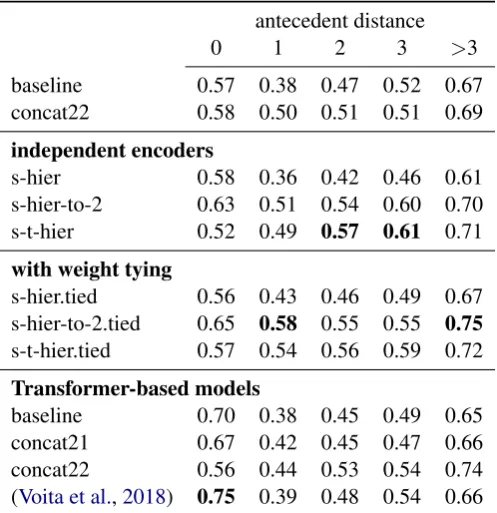
Table 7 shows that context-aware models per-form better than the baseline when the antecedent is outside the current sentence. In our exper-iments, all context-aware models consider one preceding sentence as context. The evaluation according to the distance of the antecedent in Table 8 confirms that the subset of sentences
9Our (cased) SacreBLEU signature isBLEU+c.mixed+ l.en-de+#.1+s.exp+t.wmt{17,18}+tok.13a+ v.1.2.10.
with antecedent distance 1 benefits most from the tested context-aware models (up to +20 percentage points accuracy). However, we note two surprising patterns:
• For inter-sentential anaphora, the
perfor-mance of all systems, including the base-line, improves with increasing antecedent distance.
• Context-aware systems that consider one
preceding sentence also improve on intra-sentential anaphora, and on pronouns whose antecedent is outside the context window.
The first observation can be explained by the distribution of German pronouns in the test set. The further away the antecedent, the higher the percentage of it→escases, which are the
major-ity class, and thus the class that will be predicted most often if evidence for other classes is lacking. We speculate that this is due to our more permis-sive extraction heuristics forit→es.
We attribute the second observation to the ex-istence of coreference chains where the preced-ing sentence contains a pronoun that refers to the same nominal antecedent as the pronoun in the current sentence. Consider the example in Table
9: The nominal antecedent ofitin the current sen-tence isdoor,Türin German with feminine gen-der. The nominal antecedent occurs two sentences before the current sentence, but the German sen-tence in between contains the pronounsie, which is a useful signal for the context-aware models, even though they cannot know the nominal an-tecedent.
Note that only models aware of target-side con-text can benefit from such circumstances: The s-hiermodels as well as the Transformer model by (Voita et al., 2018) only see source side context, which results in lower accuracy if the distance to the antecedent is>1, see Table8.
While such coreference chains complicate the interpretation of the results, we note that im-provements on inter-sentential anaphora with an-tecedent distance > 1 are relatively small
(com-pared to distance 1), and that performance is still relatively poor (especially for the minority classes er and sie). We encourage evaluation of wider-context models on this subset, which is still large thanks to the size of the full test set.
newstest2017 newstest2018 pronoun set cased uncased cased uncased cased uncased
baseline 23.0 23.7 33.7 34.2 19.4 19.9
concat22 23.8 24.4 34.5 35.0 20.2 20.8
independent encoders
s-hier 23.5 24.0 33.5 34.0 18.9 19.5
s-hier-to-2 23.8 24.3 34.2 34.8 19.2 19.7
s-t-hier 23.1 23.6 33.1 33.6 19.3 20.0
with weight tying
s-hier.tied 23.6 24.1 33.7 34.2 19.7 20.3 s-hier-to-2.tied 24.2 24.8 34.1 34.7 20.1 20.7 s-t-hier.tied 23.5 24.0 33.9 34.5 19.4 20.0 Transformer-based models
baseline - 24.6 - 35.4 - 21.1
concat21 - 24.8 - 35.3 - 21.8
concat22 - 24.4 - 36.0 - 21.3
[image:8.595.129.471.61.322.2](Voita et al.,2018) - 25.3 - 36.5 - 21.7
Table 5: English→German BLEU scores on newstest2017, newstest2018 and all sentence pairs from our pronoun test set. Case-sensitive and case-insensitive (uncased) scores are reported. Higher is better, and the best scores are marked in bold.
reference pronoun total es er sie baseline 0.44 0.85 0.17 0.31 concat22 0.53 0.84 0.32 0.42 independent encoders
s-hier 0.43 0.80 0.20 0.29 s-hier-to-2 0.55 0.84 0.41 0.40 s-t-hier 0.52 0.88 0.32 0.36 with weight tying
s-hier.tied 0.47 0.85 0.30 0.26 s-hier-to-2.tied 0.60 0.87 0.45 0.48 s-t-hier.tied 0.56 0.86 0.39 0.42 Transformer-based models
baseline 0.47 0.81 0.22 0.38 concat21 0.48 0.88 0.26 0.31 concat22 0.49 0.91 0.20 0.36 (Voita et al.,2018) 0.49 0.84 0.23 0.39
Table 6: Accuracy on contrastive test set (N=4000 per pronoun) with regard to reference pronoun.
antecedent location intrasegmental external
baseline 0.57 0.41
concat22 0.58 0.51
independent encoders
s-hier 0.58 0.39
s-hier-to-2 0.63 0.53
s-t-hier 0.52 0.52
with weight tying
s-hier.tied 0.56 0.45
s-hier-to-2.tied 0.65 0.58
s-t-hier.tied 0.57 0.55
Transformer-based models
baseline 0.70 0.41
concat21 0.67 0.44
concat22 0.56 0.47
[image:8.595.308.526.419.678.2](Voita et al.,2018) 0.75 0.43
[image:8.595.71.288.426.686.2]antecedent distance
0 1 2 3 >3
baseline 0.57 0.38 0.47 0.52 0.67 concat22 0.58 0.50 0.51 0.51 0.69 independent encoders
s-hier 0.58 0.36 0.42 0.46 0.61 s-hier-to-2 0.63 0.51 0.54 0.60 0.70 s-t-hier 0.52 0.49 0.57 0.61 0.71 with weight tying
s-hier.tied 0.56 0.43 0.46 0.49 0.67 s-hier-to-2.tied 0.65 0.58 0.55 0.55 0.75 s-t-hier.tied 0.57 0.54 0.56 0.59 0.72 Transformer-based models
baseline 0.70 0.38 0.45 0.49 0.65 concat21 0.67 0.42 0.45 0.47 0.66 concat22 0.56 0.44 0.53 0.54 0.74 (Voita et al.,2018) 0.75 0.39 0.48 0.54 0.66
Table 8: Accuracy on contrastive test set with regard to antecedent distance of antecedent (in sentences).
source sentence with antecedent What’s with the door? target sentence with antecedent Was ist mit der Tür? source context Itwon’t open. reference context Siegeht nicht auf. source sentence - Isitlocked?
[image:9.595.175.424.125.382.2]reference sentence - Istsieabgeschlossen? contrastive 1 - Isterabgeschlossen? contrastive 2 - Istesabgeschlossen?
effectiveness of parameter sharing between the main encoder (or decoder) and the contextual en-coder. We observe an improvement of 5 percent-age points froms-hier-to-2tos-hier-to-2.tied, and 4 percentage points from s-t-hier to s-t-hier.tied. Context encoders introduce a large number of ex-tra parameters, while inter-sentential context is only relevant for a relatively small number of pre-dictions. We hypothesize that the training signal is thus too weak to train a strong contextual en-coder in an end-to-end fashion without parame-ter sharing. Our results also confirm the finding byBawden et al.(2018) that multi-encoder archi-tectures, specificallys-hier-to-2(.tied), can outper-form a simple concatenation system in the transla-tion of coreferential pronouns.
The Transformer-based models perform strongest on pronouns with intra-segmental antecedent, outperforming the recurrent baseline by 9–18 percentage points. This is likely an effect of increased model depth and the self-attentional architecture in this set of experiments. The model by (Voita et al., 2018) only uses source context, and outperforms the most comparable RNN system, s-hier.tied. However, the Transformer-based concat22 slightly underperforms the RNN-based concat22, and we consider it future research how to better exploit target context with Transformer-based models.
7 Conclusions
We present a large-scale test suite to specifically test the capacity of NMT models to translate pro-nouns correctly. The test set contains 12,000 dif-ficult cases of pronoun translations from English it to its German counterparts er, sie and es, ex-tracted automatically from OpenSubtitles (Lison and Tiedemann,2016).
We evaluate recently proposed context-aware models on our test set. Even though the increase in BLEU score is moderate for all context-aware models, the improvement in the translation of pro-nouns is considerable: The best model (s-hier-to-2.tied) achieves a +16 percentage points gain in accuracy over the baseline.
Our experiments confirm the importance of careful architecture design, with multi-encoder architectures outperforming a model that simply concatenates context sentences. We also demon-strate the effectiveness of parameter sharing be-tween encoders of a context-aware model.
We hope the test set will prove useful for em-pirically validating novel architectures for context-aware NMT. So far, we have only evaluated mod-els that consider one sentence of context, but the nominal antecedent is more distant for a siz-able proportion of the test set, and the evalua-tion of variable-size context models (Wang et al.,
2017;Maruf and Haffari, 2018) is interesting fu-ture work.
Acknowledgements
We are grateful to the Swiss National Science Foundation (SNF) for supporting the project CoNTra (grant number 105212_169888).
References
Ruchit Agrawal, Turchi Marco, and Negri Matteo.
2018. Contextual Handling in Neural Machine
Translation: Look Behind, Ahead and on Both Sides.
Dzmitry Bahdanau, Kyunghyun Cho, and Yoshua Ben-gio. 2015. Neural machine translation by jointly
learning to align and translate. In Proceedings of
the International Conference on Learning Represen-tations.
Rachel Bawden, Rico Sennrich, Alexandra Birch, and Barry Haddow. 2018. Evaluating Discourse
Phe-nomena in Neural Machine Translation. InNAACL
2018, New Orleans, USA.
Chris Dyer, Victor Chahuneau, and Noah A. Smith. 2013. A simple, fast, and effective reparameteriza-tion of ibm model 2. InProceedings of the 2013 Conference of the North American Chapter of the Association for Computational Linguistics: Human Language Technologies, pages 644–648. Associa-tion for ComputaAssocia-tional Linguistics.
Jonas Gehring, Michael Auli, David Grangier, Denis Yarats, and Yann N. Dauphin. 2017. Convolutional
sequence to sequence learning. In Proceedings
of the 34th International Conference on Machine Learning, volume 70 of Proceedings of Machine Learning Research, pages 1243–1252, International Convention Centre, Sydney, Australia. PMLR.
Liane Guillou. 2016.Incorporating Pronoun Function
into Statistical Machine Translation. Ph.D. thesis, University of Edinburgh.
Liane Guillou and Christian Hardmeier. 2016. Protest: A test suite for evaluating pronouns in machine
translation. In Proceedings of the Tenth
Liane Guillou and Christian Hardmeier. 2018. Au-tomatic Reference-Based Evaluation of Pronoun Translation Misses the Point.
Liane Guillou, Christian Hardmeier, Preslav Nakov, Sara Stymne, Jörg Tiedemann, Yannick Vers-ley, Mauro Cettolo, Bonnie Webber, and Andrei
Popescu-Belis. 2016. Findings of the 2016 wmt
shared task on cross-lingual pronoun prediction. In Proceedings of the First Conference on Machine Translation, pages 525–542, Berlin, Germany. As-sociation for Computational Linguistics.
Christian Hardmeier and Marcello Federico. 2010. Modelling Pronominal Anaphora in Statistical Ma-chine Translation. InProceedings of the seventh In-ternational Workshop on Spoken Language Transla-tion (IWSLT), pages 283–289.
Christian Hardmeier, Preslav Nakov, Sara Stymne, Jörg Tiedemann, Yannick Versley, and Mauro
Cet-tolo. 2015. Pronoun-focused mt and cross-lingual
pronoun prediction: Findings of the 2015 discomt shared task on pronoun translation. InProceedings of the Second Workshop on Discourse in Machine Translation, pages 1–16, Lisbon, Portugal. Associa-tion for ComputaAssocia-tional Linguistics.
Felix Hieber, Tobias Domhan, Michael Denkowski, David Vilar, Artem Sokolov, Ann Clifton, and Matt
Post. 2017. Sockeye: A Toolkit for Neural Machine
Translation.arXiv preprint arXiv:1712.05690.
Pierre Isabelle, Colin Cherry, and George Foster. 2017.
A challenge set approach to evaluating machine translation. InProceedings of the 2017 Conference on Empirical Methods in Natural Language Pro-cessing, pages 2486–2496, Copenhagen, Denmark. Association for Computational Linguistics.
Sebastien Jean, Stanislas Lauly, Orhan Firat, and
Kyunghyun Cho. 2017. Does Neural Machine
Translation Benefit from Larger Context? ArXiv e-prints.
Sébastien Jean, Stanislas Lauly, Orhan Firat, and
Kyunghyun Cho. 2017. Neural machine translation
for cross-lingual pronoun prediction. In Proceed-ings of the Third Workshop on Discourse in Machine Translation, pages 54–57, Copenhagen, Denmark. Association for Computational Linguistics.
Diederik Kingma and Jimmy Ba. 2015. Adam: A
Method for Stochastic Optimization. In
Proceed-ings of the International Conference on Learning Representations (ICLR) 2015, San Diego, USA. Ithaca, NY.
Pierre Lison and Jörg Tiedemann. 2016. Opensub-titles2016: Extracting large parallel corpora from movie and tv subtitles. InProceedings of the Tenth International Conference on Language Resources and Evaluation (LREC 2016), Paris, France. Euro-pean Language Resources Association (ELRA).
Sharid Loáiciga, Sara Stymne, Preslav Nakov, Chris-tian Hardmeier, Jörg Tiedemann, Mauro Cettolo,
and Yannick Versley. 2017. Findings of the 2017
discomt shared task on cross-lingual pronoun pre-diction. In Proceedings of the Third Workshop on Discourse in Machine Translation, pages 1–16, Copenhagen, Denmark. Association for Computa-tional Linguistics.
Christopher D. Manning, Mihai Surdeanu, John Bauer, Jenny Finkel, Steven J. Bethard, and David
Mc-Closky. 2014. The Stanford CoreNLP natural
lan-guage processing toolkit. InAssociation for Compu-tational Linguistics (ACL) System Demonstrations, pages 55–60.
Sameen Maruf and Gholamreza Haffari. 2018. Docu-ment context neural machine translation with
mem-ory networks. In Proceedings of the 56th Annual
Meeting of the Association for Computational Lin-guistics, ACL, pages 1275–1284, Melbourne, Aus-tralia.
Lesly Miculicich Werlen and Andrei Popescu-Belis. 2017. Validation of an automatic metric for the
ac-curacy of pronoun translation (apt). In
Proceed-ings of the Third Workshop on Discourse in Machine Translation (DiscoMT), EPFL-CONF-229974. As-sociation for Computational Linguistics (ACL).
Matt Post. 2018. A call for clarity in reporting bleu scores. arXiv preprint arXiv:1804.08771.
Marc’Aurelio Ranzato, Sumit Chopra, Michael Auli,
and Wojciech Zaremba. 2015. Sequence level
training with recurrent neural networks. CoRR,
abs/1511.06732.
Rico Sennrich, Orhan Firat, Kyunghyun Cho, Alexan-dra Birch, Barry Haddow, Julian Hitschler, Marcin Junczys-Dowmunt, Samuel Läubli, Antonio Vale-rio Miceli Barone, Jozef Mokry, and Maria
Nade-jde. 2017. Nematus: a Toolkit for Neural Machine
Translation. InProceedings of the Software Demon-strations of the 15th Conference of the European Chapter of the Association for Computational Lin-guistics, pages 65–68, Valencia, Spain. Association for Computational Linguistics.
Rico Sennrich, Barry Haddow, and Alexandra Birch.
2016. Neural machine translation of rare words
with subword units. InProceedings of the 54th An-nual Meeting of the Association for Computational Linguistics (Volume 1: Long Papers), pages 1715– 1725, Berlin, Germany. Association for Computa-tional Linguistics.
Rico Sennrich, Martin Volk, and Gerold Schneider.
2013. Exploiting synergies between open resources
Ilya Sutskever, Oriol Vinyals, and Quoc V Le. 2014. Sequence to sequence learning with neural
net-works. InAdvances in neural information
process-ing systems (NIPS), pages 3104–3112.
Jörg Tiedemann and Yves Scherrer. 2017. Neural
Ma-chine Translation with Extended Context. In
Pro-ceedings of the Third Workshop on Discourse in Ma-chine Translation, pages 82–92, Copenhagen, Den-mark. Association for Computational Linguistics.
Don Tuggener. 2016. Incremental Coreference
Resolu-tion for German. Ph.D. thesis, University of Zurich.
Ashish Vaswani, Noam Shazeer, Niki Parmar, Jakob Uszkoreit, Llion Jones, Aidan N Gomez, Łukasz Kaiser, and Illia Polosukhin. 2017. Attention is All you Need. In I. Guyon, U. V. Luxburg, S. Bengio, H. Wallach, R. Fergus, S. Vishwanathan, and R.
Gar-nett, editors, Advances in Neural Information
Pro-cessing Systems 30, page 5998–6008. Curran Asso-ciates, Inc.
Elena Voita, Pavel Serdyukov, Rico Sennrich, and Ivan Titov. 2018. Context-Aware Neural Machine
Trans-lation Learns Anaphora Resolution. In ACL 2018,
Melbourne, Australia.
Longyue Wang, Zhaopeng Tu, Andy Way, and Qun Liu. 2017. Exploiting Cross-Sentence Context for
Neural Machine Translation. InProceedings of the