Munich Personal RePEc Archive
Corruption in India: A Quantitative
Analysis
Borooah, Vani
University of Ulster
2011
Online at
https://mpra.ub.uni-muenchen.de/75671/
Corruption in India: A Quantitative Analysis
Vani K Borooah
*University of Ulster
July 2012
Abstract
This paper represents one of the first attempts at quantifying the level of
corruption in India. This was made possible by the unique website
ipaidabribe.com
which invites people who paid a bribe to record their
experience. By choosing a specific issue - identity verification by a police
officer prior to issuing a passport - it was able to focus on a "harassment" bribe:
a bribe paid for something a person was legally entitled to. Nearly half the
persons using this website to report "passport verification" bribes were from the
eight major Indian cities of New Delhi, Mumbai, Kolkata, Chennai, Bangalore,
Hyderabad, Pune, and Ahmedabad. This fact is, perhaps, less an indication of
the concentration of corruption in these cities and more of the greater propensity
of metropolitan residents to record their grievances. Of these cities, residents of
New Delhi had to pay the largest amounts, and residents of Ahmedabad the
smallest, in passport verification bribes.
* School of Economics, University of Ulster, Newtownabbey, Co. Antrim, Northern Ireland, United Kingdom.
1
1. Introduction
The fact that the level of corruption in India has become a matter of grave concern
needs little justification. Public anger over the "scams" associated with the 2010
Commonwealth Games and the auction of the 2G spectrum licences - which resulted in the
jailing (pending trial) of respectively, the chief of the Games' organising committee
(Kalmadi) and the Minister of Telecommunications (Raja) - has led the government to
establish a committee to draft an anti-corruption bill.1 Needless to say, underlying such cases
of spectacular corruption, are a myriad instances where bribes, of various sizes, are paid to
obtain a variety of favours.
In analysing such bribes it is useful to draw a distinction between "harassment" bribes
- where one pays a bribe to receive what one is legally entitled to - and "non-harassment
bribes" where one pays a bribe for a favour to which one is not entitled.2 So, for example,
paying a tax inspector a bribe to receive an income tax refund to which one was entitled
would constitute a harassment bribe while paying a policeman to ignore a traffic offence
would constitute a non-harassment bribe. A particularly egregious example of harassment
bribes are those paid for establishing one's identity in order to obtain a passport (hereafter,
"passport verification" bribes). Egregious because the demand for such payment violates our
most intimate possession - our identity - and over which we have, or should have, absolute
control.
The process of obtaining a passport in India can be long and, sometimes, fraught.
First, there is the "help" offered by touts as soon as one arrives at the passport office - Rs. 15
for a form, Rs. 4,500 for additional pages, Rs. 6,000 for a new passport. The alternative to
refusing such offers of help is to wait endlessly in long queues and the sheer volume of
1 Though even the composition of this committee is not without controversy with a prominent cabinet minister
(Pawar) being forced to resign from it because his anti-corruption credentials were viewed as suspect.
business - about 1,500 applications daily at New Delhi's regional passport office - provides
fertile ground for touts to flourish.3 After the application has been lodged the police pay a
visit to the applicant's place to verify his/her identity both directly and through neighbours. A
"passport verification" bribe is paid to the police officer concerned in order to ensure that the
verification is completed without "difficulty".
The website www.ipaidabribe.com (created by the non-profit organisation,
Janaagraha) provides a forum to those who have paid bribes to record their experience, and
the bribe paid, while preserving their (and the beneficiaries) anonymity. While bribes were
paid to a variety of agencies (Police, Income Tax, Excise, and Customs) for a variety of
reasons, the most well-defined purpose was that of passport verification and, indeed, of the
8,544 cases of bribery reported till the beginning of May 2011, 1,356 cases (16%) related to
passport verification cases. A typical story from the website runs as follows: "[The] police
visited me and asked for my verification documents. On producing all the documents the
policeman asked me to produce documents for my kid. When everything was verified he
questioned 'what is the proof that my kid is mine'? This was so ridiculous that my wife came
to tears". The matter was satisfactorily resolved after he paid a Rs. 2,000 bribe.
2. Data and Results
Based on the information provided in the Janagraha website on the 1,011 cases in
which bribes were paid for passport verification (up to April 2011) we created a dataset
consisting of: the amount of the passport verification bribe; the town or city, and the year, in
which the bribe was paid.4 There were a total of 999 cases. The lowest passport verification
3 See "At the passport office, touts have 'tatkal' scheme", Times of India, 17 April 2011, p. 8.
4 A case in which a bribe of Rs. 12,000 was paid was dropped because it related to an immigration issue at New
bribe paid was Rs. 20 (in Bangalore and in Raigargh) and the highest was Rs. 6,000 in New
Delhi. The median bribe was Rs. 400 and the mean bribe was Rs. 544.
One can examine the difference in bribes paid between "cities"5 and non-cities: of the
999 passport verification bribes, 546 bribes (55% of the total) were paid in "cities" and 453
bribes (45% of the total) were paid in non-cities. Compared to the lowest and highest bribes
of Rs. 20 and Rs. 5,000 paid in non-cities, the lowest and highest bribes paid in cities were
Rs. 20 and Rs. 6,000. However, the median and mean bribes in cities (respectively, Rs. 300
and Rs. 495) were lower than the median and mean bribes in non-cities (respectively, Rs. 500
and Rs. 603) and, furthermore, the difference between cities and non-cities in the mean
passport verification bribe was statistically significant at the 5% level with t(997)=2.6 (Pr
|T|>2.6=0.01). This suggests either or both of two possibilities: first, police officers in
non-cities were bolder and more grasping in their demands compared to their counterparts in
cities; second, compared to bribe-givers in non-cities, bribe-givers in cities were more
prepared, at low levels of bribery, to record their experiences on the website.
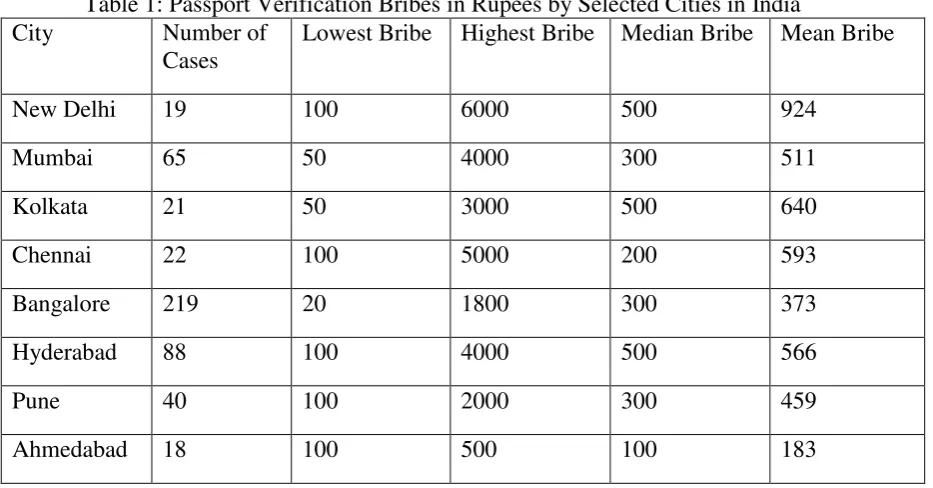
Table 1 shows the lowest, highest, median, and mean passport verification bribes paid
in the four metropolitan centres (New Delhi, Mumbai, Kolkata, Chennai) and in four major
industrial centres (Bangalore, Hyderabad, Pune, and Ahmedabad). Nearly 50% (492 of the
999) reported cases of passport verification bribes were drawn from these eight cities and just
two cities, Bangalore and Hyderabad, with, respectively, 219 and 88 cases, accounted for
31% of the total number of cases. The highest and lowest mean bribes were in New Delhi
(Rs. 924) and in Ahmedabad (Rs. 183) and the highest and lowest median bribes were in New
Delhi, Kolkata, and Hyderabad (Rs. 500) and in Ahmedabad (Rs. 100).
5 New Delhi (including Gurgaon and Noida), Kolkata, Chennai, Mumbai (including Navi Mumbai and Thane),
Table 1: Passport Verification Bribes in Rupees by Selected Cities in India City Number of
Cases
Lowest Bribe Highest Bribe Median Bribe Mean Bribe
New Delhi 19 100 6000 500 924
Mumbai 65 50 4000 300 511
Kolkata 21 50 3000 500 640
Chennai 22 100 5000 200 593
Bangalore 219 20 1800 300 373
Hyderabad 88 100 4000 500 566
Pune 40 100 2000 300 459
Ahmedabad 18 100 500 100 183
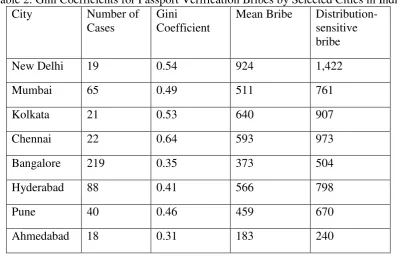
Table 2 shows the degree of inequality, as measured by the Gini coefficient, in the
amounts paid by different persons in the eight cities enumerated above. If Bi and Bj are the
bribes paid by persons i and j, i,j=1...N, the Gini coefficient associated with the distribution
of bribes is defined as:
2
1 1
1
| |
2
N N
i j
i j
G B B
N
In other words, the Gini coefficient is computed as half the mean of the difference in bribes
between pairs of bribe givers, divided by the average bribe (). So, G=0.45 implies that the
difference in bribes between two givers chosen at random will be 90 percent of the average
bribe: if =500, this difference will be Rs. 450. The highest and lowest degrees of inequality
in the distribution of passport verification bribes were in Chennai (Gini=0.64) and
Ahmedabad (Gini=0.31).
Following Sen (1998), we argue that if is the mean bribe, and G the degree of
asL(1G)*. This has the intuitive interpretation that greater the inequality in the
distribution of bribes, the higher the social loss from a given mean bribe (). We define *
as the "distribution sensitive" bribe which reflects the inequality in the distribution of bribery
experiences underlying the mean bribe, where *≥. The social loss from every bribe giver
paying * would be equal that from a mean bribe of , with some paying more than and
[image:7.595.99.497.266.523.2]others paying less.
Table 2: Gini Coefficients for Passport Verification Bribes by Selected Cities in India City Number of
Cases
Gini Coefficient
Mean Bribe Distribution-sensitive bribe
New Delhi 19 0.54 924 1,422
Mumbai 65 0.49 511 761
Kolkata 21 0.53 640 907
Chennai 22 0.64 593 973
Bangalore 219 0.35 373 504
Hyderabad 88 0.41 566 798
Pune 40 0.46 459 670
Ahmedabad 18 0.31 183 240