Munich Personal RePEc Archive
Educational(work)performance in african
countries: problems, policies and
prospects
Nwaobi, Godwin
QUANTITATIVE ECONOMIC RESEARCH BUREAU
30 January 2007
Online at
https://mpra.ub.uni-muenchen.de/1622/
EDUCATIONAL [WORK] PERFORMANCE IN AFRICAN
COUNTRIES: PROBLEMS, POLICIES AND PROSPECTS
GODWIN CHUKWUDUM NWAOBI
PROFESSOR OF ECONOMICS AND RESEARCH DIRECTOR
[email protected]
[email protected]
234-08035925021
QUANTITATIVE ECONOMIC RESEARCH BUREAU
(
http://www.quanterb.org
)
P.O.BOX 7173, ABA
ABIA STATE, NIGERIA
WEST AFRICA
AND
ABSTRACT
Without education, development will not occur, only an educated people
can command the skills necessary for sustainable economic growth and for a
better quality of life. Recognizing this fact, African governments have placed
heavy emphasis on expanding educational opportunities from primary school
through university to the past four decades. More over, international organization
has put so much emphasis on supporting educational expansion and
improvement in Africa. However, education in Africa is in crisis today (and most
especially for African universities). Enrollments rise as capacities for government
support decline; talented staff are abandoning the campuses; libraries are out
dated; research output are dropping, students are protesting overcrowded and
inhospitable conditions; staffs are equally protesting poor working conditions
(with continues strikes); university graduates are seriously underemployed or
unemployed; and general educational quality is deteriorating. The need for
action is urgent and thus effective educational policy making is imperative for the
I NTRODUCTI ON
“The formal institutions of education that exist today and even many of
those in the planning stages in developing countries, are becoming less relevant
to the requirements of emergent knowledge societies” (Rotarian. 1996; UNCTD,
1998).
I ndeed, learning begins at birth and continues through life. Over the years,
societies have developed systems of education to provide their youth and adults
with opportunities and settings to learn in a purposeful and organized manner.
An older informal system (trades and crafts learning) is mostly in swift decline
and it is steadily giving way to a more formal system, which is the system of
schools, colleges, universities and similar established institutions, organized and
paid for (Haddad, 1994).
Thus, I ndigenous Africa education among all groups remains an important
transmitter of cultural identity from one generation to the next. I n the colonial
era, missionaries and metropolitan governments opened up a network of western
type schools in Africa. However, the administration of education systems was
dominated by expatriates, as was teaching beyond the primary level. Thus, the
educational systems inherited by the African nations at the time of independence
were quite inadequate to meet the needs of the new countries for
self-governance and rapid economic growth. From this low starting point, the
progress achieved in African education has been spectacular and quantitative
expansion has been particularly impressive (World Bank, 1988)
However, these advances are now seriously threatened. Africa’s explosive
population growth greatly increases the number of children seeking access to
schools and increases the number of potential illiterates. And as long as
enrolments stagnate, current inequalities in access to education are not likely to
be eliminated. Male-female differentials remain a particularly serious problem.
Complicating this problem are low levels and recent erosions of educational
standards, and there is some suggestion of further decline supplies of key inputs are
critically low and the use of these inputs has declined in relation to the use of
teachers time and of physical facilities. However, the direct evidence remains the
poor performance of students. I n particular, the African universities are seriously in
crisis period. Thus, the mandated given to them at independence requires
re-assessment as a result of changes in the world, in Africa, and in the university
structures.
I nternationally, the emergence of global markets has created a competitive
world economics system characterized by rapid knowledge of generation and
technological innovation. These changes affect local labor markets and the types of
skills they require (saint, 1992). Again, high population have growth rated and
increased access to education have boosted the social demand for higher education,
leading to rising university enrolments and proliferation of tertiary institutions.
Moreover, these universities are man-based and diversified institutions operating
under severe financial constraints. Against, these observations, these is therefore a
cluster of critical concerns, concerning the future form and substance of higher
education in Africa. These include apparent declines in education quality; questions
of curriculum relevance and appropriate distribution of students among the principal
disciplines; the high and often unsustainable costs of university training; a need for
improved university management; an ineffective working relationship between
government and university; and equity issues surrounding access to higher
education.
I n fact, the relevance of universities to national needs is a growing concern for
both government and citizens. Here, relevance include education al choices within
the university that are germane to the national economy and in tune with the
prevailing labor market; some capacity for critical and innovative thinking on issues
of national importance; the transmission of essential professional and cultural
values; institutional process and behavior that equip graduates for leadership in
society; and regional, gender, ethnic representation in the composition of
staff/ students; and in the content of the curricula. Rising graduate unemployment,
the relevance of universities under growing scrutiny. Attracting and retaining
talented staff remains a problem for many of these universities. Declining salaries,
deteriorating working conditions and increasing numbers of students (exacerbated
by un- supporting political conditions) have prompted many staff to seek a better
situation elsewhere. Statistically, the African academy of science suggests that
African counties spend as little as o.1 percent of GNP on research while developed
attires
Spend twenty times as mush (saint, 1992). I n supporting this fact, appendix
A| B (African educational indicators) reveals the extent of educational devastation in
Africa. This therefore suggests that a more challenging phase of reform and renewal
awaits the continent.
I n fact, the current crisis in African educational system is now wide spread and
require urgent policy response from governments, universities and international
organizations. However, educational development is extraordinarily complicated
because it involves and affects a large number of beneficiaries and providers, as well
as political figures, all of whom have a stake in the process and the outcome. Added
to this, is the long gestation period for any policy to realize its objectives. For these
reasons, policy change should not be introduced lightly nor should it be abandoned
without careful examination. Thus, the basic thrust of this paper is to propose
reform measures for revitalizing and reactivating African education system in the 21st
century of knowledge societies. This objective therefore requires us to fully and
thoroughly formulate and evaluate policy options, taking account of different
rationalities and to devise plans of a broad enough nature that can adapted overtime
(and that complement policy at the national levels).
The rest of the paper is divided into nine sections. Section two examines the
early development in Africa while section three looks at basic formal education.
Section four is concern with tertiary formal education while African informal and
lifelong education is the theme of section five. African female education is the
discussion of section six. Again, section seven explores the African labor market
2.0
AFRI CAN EARLY CHI LD DEVELOPMENT
Early child Development (ECD) remains one of the most powerful levers for
accelerating education for all and the international Development Goals on
poverty reduction. Children who are well nurtured during their first years of life
tend to do better in school and stand a better chance of developing the skills
required to contribute productively to social and economic growth. However, as
child ages environmental effects appear to accumulate. Poor cognitive and social
abilities are associated with weaker future academic performance and lower
adult economic and social outcomes, including poor health, antisocial behaviour,
and violence. These under achieving adults influence the cognitive abilities of the
next generation of children, creating an intergenerational cycle of poverty and
unequal opportunities. Thus, early interventions can substantially enhance a
child’s life chances and loosen intergenerational grip of poverty and inequality.
Early childhood development programs comprise a range of interventions that
include providing nutritional supplements to children, regularly monitoring their
growth, stimulating the development of their cognitive and social skills through
more frequent and structured interactions with a caring adult, and improving the
parenting skills of caretakers. The evidence suggests that these programmes can
be highly effective in addressing problems experienced later in schooling and
adulthood. Evidence is also mounting that interventions in early childhood
particularly benefits poor and disadvantaged children and families.
I ndeed, interventions to improve your children’s capacity to develop and learn
an focus on improving parents teaching and child care skills, delivering services
in a community. Programmes may be established in homes, day-care centres or
communities. Evidence have suggested that three design features are important
for the full realisation of benefits from ECD programmes starting early; having
strong parental involvement; and focusing on child health (especially nutrition)
and cognitive and social stimulation. Here, the focus on health leads to a virtuous
Some formal programmes can be too expensive for poor families, culturally
irrelevant and insensitive to families needs. They thus run the risk of being
abandoned even when they demonstrate high returns. For the implementation of
ECD programmes, political economy constraints arise from the difficulty of
making a case for spending resources on programmes with the promise of
(uncertain) benefits to come only year in the future. Such a case is often made
by the immediate beneficiaries (parents of school-age children) or intermediate
beneficiaries (teachers) who organise themselves into powerful political forces.
But the institutional set up for ECD programme delivery (with funds in many
instances channelled to myriad small NGOs, community centres or home based
caregivers) and the absence of strong central responsibilities inhibit organised
political pressure. The same institutional set-up generates problems of
integration with other government programmes and of co ordinates across
several government departments. Getting information to parents, community
leaders and policy makers about the objectives and efficiency of ECD services
can build public awareness and strengthen demand. Monitoring systems build
support by providing timely feedback on a range of intermediate output to policy
makers and programme managers, while proper evaluations provide more
convincing evidence of impact and broader lessons from interventions.
I ntegrating ECD programmes into the broader development frameworks and
involving parents, families and community members enhance the sustain ability
of programmes.
There are several possible approaches to scaling up ECD interventions. I n the
first place, expand publicly funded preschool programmes to all children by
making it a statutory right. Definitely, this would have significant funding
implications but the benefit is potentially widespread support from middle-class
and poor families with children. The second approach targets disadvantaged
families and this may be more cost effective. To bolster participation, the
conditioned on various desirable behaviours, including changes in the home care
environment, as well as regular health centre visits for growth monitoring,
immunizations and nutrition interventions. While targeted programmes have a
smaller constituency (and thus would not benefit from a broad coalition of
support); a national programmes with transparent criteria for eligibility and good
monitoring of conditionality (could mobilize support not only from the direct
beneficiaries but also from other stakeholders in society). I t is also possible to
combine a universal pre-school approach with a conditional cash transfer
programme. This would yield the highest benefits in the participation of the poor
and the productivity gains for all, but it would also be more costly. However, the
final approach adopted would have emerged from considerations of cost,
3.0 FORMAL EDUCATI ON; BASI C
Essentially, education is a great equalizer of opportunities between rich and
poor and between men and women. But this equalizing promise of education can
be realized only if children form different backgrounds have equal opportunities
to benefit form quality education. African societies have a long rich history of
education traditions. I ndigenous education was offered by all ethnic and
linguistic groups and remains an important transmitter of cultural identity form
one generation to the next. I t aims to instill in children the attitudes and skills
appropriate for male and female social roles, emphasizing the duties and
privileges derived form cultural values. I mparted through language, as well as in
formal lessons and rituals outside the home, the indigenous education responds
to the concrete problem of local committees. However, African early Christian
heritage represents a second important element of education in the region, with
roots extending back long before the colonial period. A third major antecedent to
the colonial period is the influence of I slam on African education (with Arab
culture and language being adopted in much of North Africa). The western
colonial period in sub-Saharan Africa began with the animal of the Portuguese in
the fifteenth century. This colonial precedent is still much in evidence in most of
Africa, and sometimes they constrain the degree to which governments are free
to initiate new policies.
I ndeed, the principal suppliers of western style education (pre-independence)
were the colonial governments and the Africa missions of the Roman Catholic
and various protestant churches here, the division of administrant and financial
responsibilities between government and church differs form one colonial region
to the next. I n their guest for converts and literate governments opened up a
network of schools in the region. Many were based for the most part on overseas
models and deflated little in the economic changes that the colonial powers set
in motion helped create a demand for western style education. Thus, education
language being adopted in much of North Africa). The western colonial period in
sub-Saharan Africa began with the arrival of the Portuguese in the fifteenth
century. These colonial precedents are still much in evidence in most of Africa,
and sometimes they constrain the degree to which governments are free to
initiate new policies.
I ndeed, the principal suppliers of western-style education were the colonial
governments and the Africa missions of the Roman Catholic and various
protestant Churches. Here, the division of administrative and financial
responsibilities between government and Church differed from one colonial
regime to the next. I n their quest for converts and literate African subjects, the
missionaries and colonial governments opened up a network of schools in the
region. Many were of a high standard and yet the curriculum were based for the
most part on overseas models and reflected little in the way of Africa content.
Nevertheless, the economic charges that the colonial powers set in motion
helped create a demand for western-style education. Thus, education became
the vehicle for moving within one generation, from peasantry and poverty to the
topmost ranks of society. Yet, access to education was quite limited and
especially in he thinly populated areas of French West Africa. I n 1960, the gross
primary enrollment ratio in all of sub-Saharan Africa was only thirty-six percent.
The enrollment ratio was thirty-eight percent in the francophone territories and
forty percent in the Anglophone territories. Unfortunately, many countries in
West Africa and East Africa had over ninety percent illiteracy at the time of
independence. Again, different Africa peoples were regarded and treated
differently by colonial administrators; the cost of providing education differed,
certainly between urban and rural area; some population groups were more
responsive than others to educational opportunities; and most Africans
(responding to the incentives imposed by matrilineal customs) preferred
education for their sons to education for their daughters. Consequently,
patterns in Northern Nigeria had less in common with those in the same British
territory then with those in the north or neighboring French Cameroon. Such
within country difference and between-country similarities remain evident today.
However, transition rates from one educational level to the next were how in
1960, and educational dropout rates were high. Here, the systems of education
inherited by the Africa nations at the time of independence were altogether
inadequate to meet the needs of the countries for self governance and rapid
economic growth. And yet quantitative expansion has been particularly
impressive.
Basically, primary school enrollments increased the most in absolute terms,
growing from approximately 11.9 million pupils in 1960 to 51.3 million pupils in
1983 (as shown in table 3.1). The gross primary enrollment ratio rose from 36
percent to 75 percent over the period. Again, the building of schools and training
of teachers to accommodate the additional students throughout the region were
mammoth achievements. Between 1960 and 1983, the number of primary
schools in sub-Saharan Africa increased from about 73,00 to 162,000 and the
number of primary school teachers, from 310,000 to more than 1.3 million
(world bank, 1988). Although the average pupil teacher ratio remained roughly
the same during this period, the average primary school size increased from 162
[image:12.612.100.543.592.706.2]pupils to 317 in 1983.
Table 3.1 sub-Saharan Africa: school enrollments and enrollments ratios (1960 –
1983)
LEVEL 1940
1983
Primary Education Enrollment (thousands 11,900 51,300
Gross Enrollment ratio (percent) 36 75
Secondary education enrollment (thousands) 800 11,100
The number of teachers employed at the secondary level also increased
tremendously between 1960 and 1983. This massive educational expansion,
which began in some countries in the 1950s and intensified after independence,
built up the stock of human capital considerably. Unfortunately, this trend was
not sustainable in the later years (as statistically shown in appendix A and B).
Again, the amount of resources allocated to education before 1990s reveals the
high degree of commitment of African nations to educational development and
explained the significant advance that occurred in the sector during this period.
However, the impressive gains won in African education are now seriously
threatened by circumstance outside the sector, including Africans explosive
population growth, which swells the number of potential illiterates on the
continents, an Africa’s recent economic decline, which has necessitated
significant cutbacks in public spending. I n other words, current economic and
demographic realities undermine both the quantitative and qualitative
educational advances achieved since independence (Nwaobi, 2000).
Retrogression in education will, in turn, make the solution of these problems
more difficult and so the pattern is repeated as it is destined to continue (As
4.0 FORMAL EDUCATI ON: TERTI ARY
After independence, African higher education developed relevant curricula
and revised its content to reflect African priorities, legitimized research and
established specialized university research units, largely replaced expatriate
faculty with indigenous staff, and fostered fledgling intellectual communities.
Here, a major achievement has been to produce the skilled human resources
required to staff and manage public and private institutions in the newly
independent states. Specifically, African universities have registered remarkable
progress in their efforts to become legitimate national institutions of higher
learning. The proportion of indigenous teaching staff has risen from sixty – four
percent in 1978/ 79 to eighty – four percent in 1986/ 8777 (Saint, 1992.
Curricular were also revised to incorporate national content and interests, and
graduate training programs were launched. Here, graduate output in the region
rose impressively from 17,000 in 1970 to 83,000 in 1987. Despite of severe
economic constraints in many countries, university enrolments expanded steadily
during the 1980s. However, this expansion did not occur at the same pace in all
countries. Overall, the university student population in the region increased by
61 percent between 1980 and 1990; and rose from 337,000 to an estimated
542,700. I n the process, higher education systems began to differentiate and in
many cases the new universities were given specific mandates to focus on
agriculture, education, science and technology. I n spite of this impressive
growth, access to higher education remains more limited in Africa than in other
regions of the world (as shown in appendix A and B). I n other words, the output
mix of Africa universities has come under increasing scrutiny y as their initial task
of producing professionals to lead and manage the institutions of government
has been largely accomplished, and spreading policies of economic liberalism
seek to promote more diversified local economies. Here, a majority of countries
sciences, mathematics and engineering while in other African countries, the
proportion of students in the sciences actually declined.
I ndeed, attracting and retaining talented staff has now become the
biggest current problem for many African tertiary institutions. Declining salaries,
deteriorating working conditions and increasing numbers of students,
exacerbated by un-supportive political conditions, have prompted many staff to
seek a better situation elsewhere. As a result, many universities are left with
young, inexperienced and insufficiently trained staff that lacks the necessary
mentors and role models to guide them. While others have recently been forced
to curtail enrollments and postpone graduations due to staff shortages. Again,
research output has lagged behind the training accomplishments of African
universities and lack of national investment in research is one reason for this
weak performance. Unlike developed countries, African counties spend as little
as 0.1 percent of GNP on research. Government allocations for university
research are largely non-existent, and foreign donors have endeavored to offset
this short fall.
I n contrary, community service has not become an institutionalized
activity in most universities. Again, it is not apparent that universities possess
any comparative advantage in assuming service responsibilities over the rapidly
expanding number of African non-governmental organizations that appear better
equipped for this purpose.
I t is unfortunate that the universities and the governments that support
them exist in an uneasy and sometimes adversarial relationship across much of
sub-Sahara Africa. The source of this tension have been the governments’
perception of the university community as a frequent locus of criticism and
political opposition; the increased involvement of governments in university
affairs, and the inability of governments to provide for the financial needs of
universities on sustainable basis. As portions of the African university community
their development partnership with universities had been betrayed. They
therefore reacted by seeking to monitor and control university activities. I ndeed,
private universities offer one way of diversifying the financial base of national
higher education systems without adding significantly to government costs. At
present, private universities are insignificant in Africa and as long as public
higher education is provided by governments at little or no cost to the individual
(and private higher education remains entirely self-supporting) private
universities may continue to play a very minor role.
I n several cases, existing governance structures constrain university
responsiveness to internal constituencies, to local labor markets and to society’s
needs in general. They are often dominated by the chief executive, controlled by
government, and constrained by cumbersome decision making processes. Here,
mechanisms of internal communication with staff and students are weak, and
external articulation with civil and business communities is frequently
non-existent. Again, maintenance of university buildings and equipment is a little
recognized problem which has a direct bearing on educational quality, where
classrooms are poorly lit, bathrooms do not function, and laboratory equipment
is broken, student learning becomes more difficult. These problems are
compounded where institutionalized maintenance programs (and budgets for
them) do not exist. Against this backdrop, a cluster of critical concerns now
frames discussion concerning the future form and substance of higher education
in Africa. Principal among them are apparent declines in educational quality;
questions of curriculum relevance and appropriate distribution of students among
the principal disciplines; the high and often unsustainable costs of university
training; a need for improved university management; an ineffective working
relationship between government and university; and equity issues surrounding
access to higher education. I n order to address these concerns, African nations
must answer certain basic questions; what kind of tertiary institutions can they
5.0
AFRI CAN I NFORMAL AND LI FE LONG EDUCATI ON
After independence, over fifty parents of all adults in sub-Saharan Africa
had never attended school and over ninety percent and never completed the
primary cycle. Today, because of higher enrolment ratios, these figures should
decline more rapidly in the future than they have in the past. But in many other
countries, it is still not fast enough (given population growth) to reduce the
absolute number of persons with little or no formal schooling obviously, this is a
continuing waste of human potential. Consequently, is there anything that can
be done to provide these persons with at least some minimal education or
training (Ridker, 1994)? I n the late 1960s, a variety of informal education (NFE)
programs were proposed to answer this question, and governments, donors, and
NGOs initiated a number. Other concern include adult literacy and numeracy;
practical agricultural subjects; home economics; health and hygiene; local history
and civics. The Bank reacted favorably and proceeded to support a variety of
programs. Most of these programs were small and often experimental or pilot
efforts embedded in larger education projects. Typically, the largest portion of
funding in these components was for foreign exports to help with curriculum
development and the design and production of new teaching materials, though a
few included building, furniture and equipment that significantly raised costs,
unfortunately, few of these efforts accomplished much and none achieved a
significant degree of sustainability (independent of outside support). Yet, they
rendered the centers more attractive by facilitating the education of participants
beyond the basic level. I n addition, dropout, mastery, and retention rates
appeared to be low. At least, this was the conclusion one can draw from a global
review of adult literacy programs. This review found that each of these rates
averages around fifty percent, so that the overall effectiveness rate for some
projects may be only twelve to fifteen percent (Ridker, 1994).
However, given the largely negative experience, the bank lost its
resources used in non formal education would be better used to expand primary
education more rapidly so that there would be fewer persons in future
generations who did not have at least a basic education. Specially, there were
two main reasons for the disappointing results first, too much was expected of
these projects and in the enthusiasm of that time; they were promoted by some
as alternatives to formal primary education. Thereafter, as they accomplished
much less, disappointment and disinterest set in. again, proposals for such
programs tended to be accepted indiscriminately, without much investigation of
their merits, potential audience, costs, or implementation capacity. Borrower
inputs into these projects were minimal, resulting in the absence of any sense of
commitment or ownership; and the bank staff was largely inexperienced in this
sub sector. For instance, most of these projects paid insufficient attention to the
immediate usefulness to the participant of the materials being taught, despite
evidence of the importance of this factor in explaining dropout, mastery
appropriate reading materials for new literates, so as to maintain their interest
and reduce the likelihood of their losing their skills after the program ends (that
is, all issues not adequately pursued in previous African prices).
For the Nigeria case, the main anchor for the education for all programs
was the national commission for mass literacy: Adult and non-formal education
(NMEC). I ts basic responsibility was to develop the necessary strategies and
coordinate literacy and post-literacy programs nationwide. The crucial link
between women’s education and child survival and development makes early
intervention (formal of non-formal) imperative for young girls of primary school
age and for adolescent girls. Particularly distressing was that many children were
leaving school unable to read and write, and unprepared for future education or
productive participation in society. Added to these are many other children who
for one reason or the other never attended school and have therefore remained
illiterate. I na survey of the out-of-school children (UNESCO, 2000) 152
owned by Government (Local, state and Federal); the rest were distributed
among communities, religious organizations, NGOs and Corporate bodies. The
institutions provided mainly vocational skills training and literacy classes. Their
facilities were well equipped and their clients were mostly within the 19 – 19 age
group while some were obviously older. Again, the curriculum seemed to focus
more on home economics, secretarial studies, heaving, etc, than the more “Male
wrested” skills like welding motor mechanics, carpentry, etc. however, some of
these out of school programs have not succeeded in forgoing links and creating
mechanisms/ safety nets for establishing equivalence and linkage with the
6.0
AFRI CAN FEMALE EDUCATI ON
I ndeed, female education is recognized as one of the critical pathways to
promote social and economic development. Evidence from sub-Sahara
Africa indicate that although there have been improvements in female
participation, girls and women’s access to education remains limited in
several countries across the region. I t is evident that, once enrolled, girls
are more likely to drop out of school than boys; and that few girls opt for
math and science related fields of study (Odaga and Heneveld, 1995).
Thus, increasing girl’s participation in education has been identified as one
of the most significant developmental challenges facing sub-Sahara Africa.
Generally, the enrollment rate of girls remains lower than that of boys;
their drop-out and absenteeism rates are higher; and their achievements
and performance poorer (particularly in mathematics and science). Here,
we highlight the state of knowledge about the factors that influence
female education in sub- Sahara Africa. These factors may be categorized
in several ways. Some of these factors are related to institutional policy
and practices; other are associated with society’s customs, beliefs and
attitudes about women’s roles, responsibilities and capabilities. I n other
words, these, factors can be summarized into three categories:
socioeconomic (socio-cultural) factors; school environment factors; and
political (institutional) factors. Socioeconomic and socio-cultural factors
(which influence the demand for female education) are significant in
parental and familial decisions on whether to invest in female education.
Pervasive gender ideologies are the household and community levels often
favor males over female and promote differential educational
opportunities and outcomes. Schools have been implicated in promoting
the non-participation of girls in education. Again, school related factors
affect both the supply of and the demand for female education. Political
institutions that overtly or covertly promote gender biases and affect
women’s participation in educational systems.
Essentially, non-indigenous education was introduced to sub-
Sahara Africa through I slam and Christianity. Here, female education was
considered relevant only if it promoted the introduction of I slam of
Christianity and the consolidation of religious communities. When the
colonial state became central in education, the education of women was
also not an important concern. Thus, these were much resistance to
western schools in the early days and the idea of sending children,
particularly girls to formal schools was considered preposterous by local
communities. However, when the women’s’ education was considered part
of the educational development program for indigenous communities, the
type of education provide was as a vehicle for promoting domesticity.
Here, a limited number of African women were trained to be good
housewives and mother, primarily for the emergent male clerks and
church officials. I n the process, the notion of the African woman as a
dependent housekeeper wife and mother confined to the home and
economically dependent on a husband, the breadwinner, was introduced
into African cultures. Thus, the cost of this externally imposed tradition in
conjunction with the local tradition was heavy for African women; and
they continued to take responsibility for providing for their families but did
this without the benefits that accrued from access to education. I ndeed,
the following explanations given not educating girls when the colonial
powers introduced schooling include the threat to female chastity; control
over women’s productive and reproductive labor; women’s economic value
in bride wealth and productive and reproductive activities; apprehension
that educated girls will not make ‘controllable’, obedient and subservient
wives; widely held belief that it is a waste money to educate a girl who
natal home; limited relevance of formal education for girls; limited labor
market opportunities available to education girls; and the prohibitive costs
of formal education.
I ndeed, the quality of students chosen affects the quality of a
country’s future leadership, its capacity to complete in regional and world
economics, its long-run chances for developmental progress, and even its
political stability. Considerations of quality and representative ness interact
to produce the specific selection policies in each country. Achieving the
right balance is not easy and a nation’s best potential minds (regardless of
gender or ethnic background) should be given the opportunity for full
development. Thus, women-specific institutional initiatives appear to have
produced a positive impact on women’s participation at all levels of the
education system in several countries specifically, in Nigeria (1986), a
women education branch was created within the ministry of education. I ts
objectives are to promote public awareness of the benefits of educating
women and to provide women with improved opportunities for formal and
non-formal education a partial result of the branch’s considerable effort
was that female enrollments in the primary schools increased over a five
year period from twenty-nine percent to forty five percent in Kano state
and thirty-five percent in Kaduna state (saint, 1992). Also (in Nigeria) a
National Association of women in science, technology and mathematics
was established. This expanded female participation in science based
coursed by means of a national awards scheme and a motivational “road
show”. Similarly, in Ghana, universities have accepted the need for
increased female participation and have decided to allocate residence hall
space in accordance with the number of women admitted. This
consequently removes limited space available in women’s residence hall as
Appendix A and B show the extent of gender educational disparity
in African countries.
7.0
AFRI CAN LABOUR MARKET
Human capacities (problem solving abilities, command of relevant
factual information, and technical, managerial and entrepreneurial skills)
are acquired through education and experience (learning by doing). On
both units, African nations achieved independences with severe deficits.
Few persons had ever been to school and had also attended school
beyond the primary levels; and few had skills beyond those needed for
subsistence agriculture and petty trading activities (Ridker, 1994). During
the past decades, considerable progress has been made but this was not
sufficient to significantly reduce Africa’s dependence on expatriates for the
operation of many vital functions. Particularly worrisome is the reduction
in the capacity of much education system to produce the numbers and
qualities of educated persona needed by these societies to take leadership
roles in science, technology, management, and business. A data review on
the stock of trained persons, use of expatriates, and capacity of the
education systems makes these points clear. Appendix A and B provides a
picture of the educational attainment of Africa’s adult population as well
as evidence for females and for individuals countries. Other measures of
the stock of human capital are more difficult to find, but the few that
exists point in the same direction. The skill shortages suggested by these
numbers, especially at more senior levels, are reflected in the numbers of
expatriates working in Africa and in the types of tasks they are
performing. These expatriates often provide invaluable services. Without
them, there would be no medical schools, agricultural research institutes,
physics departments, or modern telecommunication systems in many
provide the wrong advice, sometimes crow out locally available skills; may
have high opportunity cost; and in a number of different ways, may be
increasing dependence on the continuation of their services.
Essentially, the principal causes of this situation (persistence of
shortages of trained Africans for higher level positions) can be grouped
under three headings: the character of development strategies in SSA,
financial and other problems playing the education system, and the
character of the labor markets for third factor with operational relevance
that helps explain the continued shortage of skilled Africans has to do with
the operation of the labor markets for these skills, which causes
expatriates to be hired in place of Africans and Africans to seek
employment outside their local market. Thus, increasing the skills and
capabilities of workers is the key to economic success in an increasingly
integrated and competitive global economy. I nvestment in people can
boost the living standards of households by expanding opportunities,
raising productivity, attracting capital investment, and better increasing
earning power. Also, better health, nutrition and education have value in
their own right, enabling people to lead more fulfilling lives.
Unfortunately, capital, land and labor markets in Africa countries
are imperative. I nformational asymmetries and contract enforcement
problems imply that some people with good project ideas end up
constrained in their access to capital. This, even as other people earn a
lower return on their capital. I n agriculture, land market failures mean
that some farmers exert too little effort on some plots and too much effort
on other plots. I nvestment in human capital can also be allocated in
efficiently, because of intra-household disputes, because credit
constrained households lack the resources to keep their children healthy
and in school or because indiscrimination in the labor market reduces the
diverse market failures cause difference in initial environments (such as
family wealth, race, or gender) to make investment less efficient.
Specifically, in Nigeria, the future out look tertiary education seems
grim and the problems are coming from the staff death of “experienced
and highly qualified staff” needed to impart knowledge to students. The
pressure to recruit staff has forced universities to recruit people who have
no business being in universities in the first instance. I n effect, academic
standards are suffering a decline and future development of manpower
for the industries may be threatened. I n other words, the quality of
tertiary education in the future will be far worse than what it is at the
present. I n the oil and gas industry, there is also a sever dearth of
manpower. Here, mostly affected, is the upstream sub-sector where
specialized training is required because of the application of cutting edge
technology. The dearth of trained manpower in the oil and gas industry
has also led to the in flax of expatriate workers into the country through
the abuse of expatriate quota.
This acts indeed a source of worry for the two in-house unions in
the oil and gas industry (petroleum and Natural Gas senior staff
Association, PENGASSAN) and its junior staff counterpart (National union
of petroleum and Natural Gas workers of Nigeria, NUPENG). Even, in the
information technology (I T) industry, manpower shortage is biting harder.
As a result of the shortage, scores of expatriates now go in and out of the
country on regular basis to take up jobs that should ordinary be handled
by local nationals.
The GSM operators such as MTN, V Mobile, M-tel and Globacom
rely heavily in expatriates to man vital positions. The fixed wireless
operators such as multilinks, Reltel, starcomms, MTN first wireless and
intercellular rely on external skills to ensure that their systems do not
the engineering departments of these networks; about 90% are
foreigners. For operators in a technology sensitive sector like variations,
the depletion in the ranks of aircrafts, pilots, engineers, flight dispatchers,
cabin crew, aeronautical radio engineers, traffic controllers and flight
inspectors is becoming a matter of serious threat to the industry.
Similarly, in key aviation agencies the Nigeria civil aviation Authority
(NCAA) federal Airports Authority of Nigeria (FAAN); Nigeria Airspace
management Agency (NAMA), vacancies are being advertised in national
newspapers and magazines for sensitive positions like flight controllers,
pilots, engineers and technicians, with little success. The major reasons
being the dearth of qualified professionals to take up the positions.
Consequently, the nation is affected by shortages in all its critical sectors
with the resultant growth implications.
I ndeed, the challenge for governments is to design interventions
that balance equity and efficiency goals in ways that are within a country’s
institutional capacity. History suggests that this is a complex task, and
there are real tradeoffs that need to be assessed. Here, different societies
are likely to make different choice. However, there are many ways of
getting labor market institutions “wrong”. And when countries get it
wrong, one segment of the labor market benefits from others. Protection
at the expense of other outcomes is highly unequal and the costs to
efficiency and growth are usually severe. Governments also get it wrong if
they intervene extensively in the labor market when production markets
are not competitive. Things can also go greatly wrong when governments
mandate protection with no attention to incentives. The duration of
unemployment, with its destructive impact on human capital, loss of
employability, weakened ties to economic and social life, and for many,
high degrees of poverty and social exclusion. Thus, reforming labor
difficult because reforms need to be coordinated across a variety of labor
market institutions and often also with reforms outside the labor market.
I t is politically difficult because there usually are vested interests in
maintaining the status- quo. Moreover, the short-term costs of reform can
be large and unevenly distributed. Take reforms to reduce employment
protection: those currently protected see themselves as having much
more to lose from reform than to gain from such a reduction. And if they
are also politically influential (represented by unions and with political
voice) their power to block reforms may be insurmountable barriers.
8.0
POLI CY REFORMS
The notion of educational development (educational sector and
how can be made to grow and function more effectively) I mplicitly
suggests a well –structured field of unambiguous issues, clearly defined
objectives, mutually exclusive choices, undisputed causal relationships,
predictable rationalities, and rational decision makers. I n other words,
educational development is actually a series of untidy and overlapping
episodes in which a variety of people and organizations with diversified
perspectives are actively involved (technically and politically) in the
process through which issues are analyzed and policies are generated,
implemented, assessed and redesigned (Haddord, 1994).
Accordingly, as analysis of the education sector implies as
understanding of the education policy process itself the “how” and “when”
of educational development. Here, we define policy functionally to mean:
An explicit or implicit decision or group of decisions, which may set out
directives for guiding future decisions or initiate, sustain or retard action
or guide the implementation of previous decisions. Policies, however,
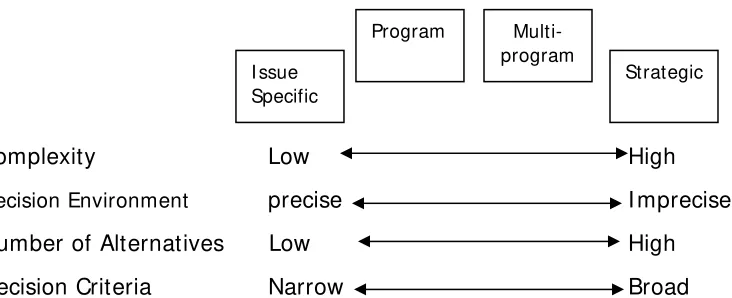
choices and decision criteria. This range is schematically depicted below:
Figure 8.1
Program Multi-program I ssue
Specific
Strategic
Complexity Low High
Decision Environment precise I mprecise
Number of Alternatives Low High
[image:28.612.109.475.241.390.2]Decision Criteria Narrow Broad
Figure 8.1 Policy Ranges
I ssue – Specific policies are short-term decision involving
day-to-day management or as the term implies, a particularly issue. A program
policy is concerned with the design of a program in particular area, while
multi-program areas. However, strategic decisions deal with large-scale
policies and broad resources allocations.
Although, decision-making is a crucial element in the policy
process, clearly, it is preceded by analytical and / or political activities
(analysis, generation of options, bargaining, and so forth) and followed by
equally important policy – related activities (implementation, assessment
and possible redesign). This study therefore introduces a framework for
education policy analysis that covers the pre-policy decision activities, the
of reality but rather a conceptual model to catch from reality those
elements that can be detected and analyzed. I t is therefore broad enough
to capture and integrate the intricate process of any policy making model.
Yet, at the same time it should disintegrate the process into components
to determine how they work and interact.
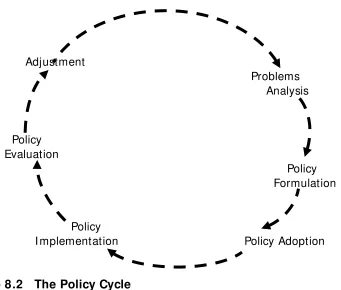
Adjustment Problems Analysis
Policy Evaluation
Policy Formulation
Policy
[image:29.612.136.477.261.551.2]I mplementation Policy Adoption
Figure 8.2 The Policy Cycle
But given the state of the art of decision theory and the nature of
educational development and education policy making, the education
policy cycle may be describe in terms of the main activities schematically
summarized in figure 8.2. However, since the purpose of this framework is
to provide a basis for policy analysis, the policy cycle is broken down
further in order to highlight the dynamics flow procedure, interaction) of
analysis of the existing situation, generation of policy options; planning for
policy options; evaluation of policy options; making the policy decision;
planning for policy implementation; policy impact assessment; and
subsequent policy cycles. This framework looks complicated because
inevitably, it is multifaceted and covers a wide range of process. However,
any attempt to restrict policy analysis to certain elements or to disregard
one element results in an incomplete approach to policy analysis.
I ndeed a policy change is normally a response to a problem or a
set of problems in the sector, and must therefore; start with an
appreciation of the educational sector (universities) and its context. I n
addition to the analysis of the sector itself, policy analysis should consider
a number of aspects of the total context including political, economic,
demographic, cultural, and social issues which are likely to impinge in
various ways on the education sector and its decision making and even
implementation processes. New policies are usually generated when the
present situation of the sector and its contexts is perturbed by a problem,
a political decision or a re organization scheme (overall national planning).
Policy options can be generated in several different ways to accommodate
the disequilibria. For analytical purposes we can group these processes
under four categories: the systematic mode, the incremental mode, the ad
hoc mode, and the importation mode. I n the third policy processes, policy
options can be evaluated only if estimations if their likely implications are
made. The “I maginary” situation that could be created, if a policy option
were implemented, is compared with the present situation, and the
transition from the existing to the imaginary case is evaluated in terms of
feasibility, desirability and affordability.
I deally, the final policy decision would be the result of evaluating
the different policy options in terms of the criteria outlined above, and
indications of research findings and analyses of data, on the one hand,
and on the other, the realities of finance, personnel and time, and the
demands of a variety of stake holders. I n real situations, optimal options
will not be always selected and balances will probably not be perfect, so
that the analyst would be wise to identify their weakness and prepare
adjustments for them. And once a policy has been chosen, planning for
policy implementation should begin immediately. Although much of the
work that must be carried out during this stage can be based in
evaluations performed to make the policy decision, planning for
implementation involves concreteness absent in earlier stages of the
policy process.
Similarly, the stages of implementation are included in the
discussion of policy analysis because much policy formation, de facts,
takes place during this stage.
Once the policy has been in placing long enough to produce
results, a policy assessment check should be implemented. “Long enough”
requires some sense of how long it should take for the policy to take hold.
I n this respect, a policy should not be junked until the adequacy of its
implementation is evaluation. However, if assessment reveals lacks in
outcomes and if implementation can be shown to have been well done,
then it is necessary to re examine the policy decision and determine what
adjustments or new policies should be substituted for the original choice.
One this is accomplished, the planning for implementation and
implementation stages of the cycle can be revisited. And if a policy
initiative is carried out systematically, the process of policy design,
planning, implementation, impact assessment, and redesign will become
iterative and in theory, infinitely so, as the framework suggests policy
from one cycle to the next in the way an educational system can evolve
with both respect for it part and in response to needed changes.
Critically, efforts at any educational reform stand little chance of
sustainable success unless they are grounded in broad public consensus.
I n Africa, a wide cross section of society has a personal stake in the
university and feels competent to advance opinion on university related
matters. Thus, consensus building should constitute the first order of
business on any agenda for educational reform. This is important because
it allows for testing of the political feasibility of proposed changes before
actual decision are made. The challenge is not just to identify potential
solutions, but also to determine those that are politically viable under
specific circumstances and to discover the pace and conditions under
which they can best be implemented.
I nternational development assistance will again play a prominent
role in efforts to stabilized and revitalize African educational system. This
is because of the fact that severe financial constraints at the national level
have (in many cases) reduced government funding for higher education to
salary support and essentially operating costs. Funding for new initiatives,
pilot projects, and special investments is most likely to come from outside
sources. But donor policies must be modified if their assistance is to be
effectively applied in support of African educational renewal. Specifically,
Donors are urged to support institutional strategic planning exercises in
response to the university initiatives. These exercises should seek to
develop mission statement for the university, which responds to present
and future national circumstances, and to support this with appropriate
cost projections. Flexible funding requires that donors allow universities
greater management initiatives in the use of such funds. But it
necessitates agreement on appropriates mechanisms of accountability
stewardship obligations in the disbursement of public funds. Here, one of
the most promising uses of targeted flexible funding may be for
institutional linkages. However, in the long run, African universities must
strive to reduce their dependence on international development assistance
and to cultivate local donors within their own countries. These local
donors include alumni, business, and professional association’s policy
makers with ties to the university.
Each African country should embrace the task of formulating and
implement ting as internally coherent set of policies that will reflects the
country’s unique history and aspirations and effectively addresses its own
exacerbated problems in the education and training sector. Although the
particularly of the policy packages that emerge would vary from would
vary from one country to the next, it is none the less clear that every
country – specific package will need to contain, in varying proportions,
elements of policy along three distinct dimensions; adjustment,
revitalization and selective expansion.
Adjustment to current demographic and fiscal realities is essential if the
disrupted effects of these external factors are to be minimized in the years
ahead. Here, the diversification of educational finance will be a necessary part of
country specific policy packages. This diversification can be achieved through
increased cost-sharing public education and through increased official tolerance
and encouragement of non-governmental suppliers of educational services. The
region containment of unit cost is equally important. Revitalization of the
education infrastructure will give renewal emphasis to the fundamentals of
providing education services so that maximum advantage is extracted from the
current capacity of education and training systems. For the restoration of quality,
some measures are necessary. Textbooks and learning materials must become
generally available in the classrooms. There must be a renewed commitment to
investment must be made in maintenance of physical past and equipment and in
operational expenditures.
For the selective expansion dimension, renewal of progress toward
universal primary education is the new investment that will bring the highest
economic and social returns in many countries. All the secondary level,
expansion of enrolments in selected subjects and streams will be necessary in
most countries in the year’s head. And to accommodate these increases, there is
the need to consider alternative delivery moves that shift more of the burden for
learning onto the students themselves. The amount of training that occurs once
individuals have entered the labor force must be increased. This training should
serve both school leavers and those who have no exposure to formal schooling,
so that individuals can acquire the necessary job related skills and renew these
skills during their working lifetime in response to changing market conditions.
Again, the expansion of African capacity to produce postgraduate intellectual
talent to fill the highest scientific and technical jobs in education establishments,
(in government, and in the private sector) is an important matter to be
addressed in building for Africa’s future.
Government is the central actor in Africa educational system. I t finances
the lion’s shape of university subjects, set access policies, appoints key officials,
and ensures that standards are maintained through accreditation or other
mechanisms. Consequently, the way in which government relates to the higher
education sector in caring out these responsibilities will very much condition the
possibilities and pace for higher education reform. Thus, greater understanding
of Africa education issues is needed to formulate appropriate institutional plans
and policy guidance without an adequate information based and the capacity to
document educational performance regularly, the state supervision approach will
have difficult in operationally defining and tracking critical policy variables for the
sector. While these capacities can be established within government ministries or
advantages to housing them within educational institutes. Specifically, these
include greater ease of access to information by all interested parties and the
opportunity training programs.
Currently, relatively little analysis of education issuers is carried and
institutional planning would certainty be enriched if Africa higher education
specialists were able to stimulate a true dialogue by contributing their own
9.0
CONCLUSI ON
I ndeed, African nation have a long history of education and
training. I ndigenous education among all groups remains an important
transmitter of cultural identity from one generation to the next. I n the
colonial era, missionaries and metropolitan governments opened up a
network of western-type schools in Africa. However, the administration of
education system was dominated by expatriates, as was the teaching
beyond the primary level. Again, access to education was quite limited,
especially in the thirty population areas of French West Africa, Thus, the
education systems inherited by the African nations at the time of
independence were thus quite inadequate to meet the needs of the new
countries for self governance and rapid economic growth.
From this low starting point, the progress achieved in African
education has been spectacular and the quantitative expansion has been
particularly impressive. I t has substantially improved the human capital
stock. Unfortunately, these advances were seriously threatened (in part)
by circumstances outside education. Africa’s explosive population growth
greatly increases the number of children seeking access to schools and
increases the number of potential illiterates complicating the problems of
stagnating enrollment are the low levels and erosions of educational
quality. Cognitive achievement among African students is low by world
standards and there is some suggestion of further decline. Here, the
supplies of key inputs are critically low and the use of these inputs has
declined in relation to the use of teacher’s time and of physical facilities.
Similarly, the academic achievement in Africa has been sufficiently poor to
be a cause for serious concern.
Consequently, hard decisions on education policy should not be
postponed. Each African nation should embraced the task of formulating
nations unique history and aspirations and that effectively addresses its
own recently exacerbated problems in the education and training sector.
Although the particulars of the policy packages can be expected to vary
from one country to the next, every country-specific packages needs to
contain, in varying proportions three distinct dimensions: adjustment,
revitalization and selective expansion.
Basically, educational development is made up of a series of untidy
and overlapping episodes in which a variety of people and organizations
with diversified perspectives are actively involved in the processes through
which issues are generated, implemented, assessed and redesigned. I n
order to capture the intricacies of policies and processes, we offered a
consolidated model of policy making that places analytical rationality (the
process), within the political and administrative aspects of policy making
(the actors). The processes fall between two extremes; incremental and
synoptic. The incremental process is interactive and approaches problems
solving in a step-by-step manner. The synoptic policy making confronts
problems as a whole, combining economic, political and social analysis
into one integrated planning process that makes interruption unnecessary.
The actors are positioned between two modes of policy making: the
organizational/ bureaucratic (where decisions enervate from an
organizational entity such as the government and the military) and the
societal/ personality mode (where decisions are the result of negotiation
among interest groups, which often have conflicting agendas such as
government ministries, teachers unions and parents pressure groups).
This static model captures very well the instance of decision making but
does not explicitly consider the activities preceding (analysis, generation
of options bargaining) and following it (implementation, assessment and
possible redesign. A dynamic framework was therefore suggested to cover
post-decision activities. Finally, the education policymaking is on iterative and
not a linear process. I n analyzing it, both the process and the actors must
be investigated; as well as the steps preceding and following the decision
itself: Policy change should not be introduced lightly, nor should it is
A1
POPULATI ON
A B C S/ no COUNTRY STATUS
Millions AVERAGE ANNUAL % GROWTH
2000 -4
DENSI TY PEOPLE PER SQ KM 2004
2004
Primary completion rate (% )
Gender parity ratio in Primary and
secondary school (% )
Gross domestic Products $ Avg. millions annual % growth Adult Literacy
rate % ages 15 and older 1998 -2004 1988/ 89 1993/ 94 2000/ 01 2003/ 04
1990/ 91 2002/ 03 2004
Net Migration thousands
2000 - 4
1995-2000
70 80 96 83 99 84,649 4.8 -185
67 33 - - - 20,108 8.1 -120
34 22 51 48 66 4,075 4.5 -29
- 19 29 61 72 4,824 5.2 -129
59 47 31 82 79 657 2.7 -400
68 56 70 83 85 14,733 4.6 0
49 27 - 60 - 1,331 1.4 11
26 19 25 41 59 4,285 14.3 99
65 32 - - - 6,571 3.5 -1410
83 54 59 85 87 4,384 3.4 42
48 46 51 66 69 15,285 1.5 150
- - 91 81 94 75,148 3.5 -500
- 19 40 - 76 925 3.3 -9
42 22 39 68 69 8077 3.7 -77
54 61 62 77 91 8,620 4.8 -51
- 17 41 44 69 3,508 2.9 -227
74 86 73 92 94 15,600 1.5 -21
71 35 47 98 - 4,364 0.9 -3
64 36 71 81 92 1,813 1.8 -50
19 12 40 58 71 4,863 6.3 -284
51 33 43 67 94 1,357 5.3 -10
51 47 75 70 88 50,055 4.5 -300
46 28 52 73 79 5,548 8.5 75
85 77 92 111 104 5,456 3.2 20
14 18 26 56 69 3,081 4.1 -6
67 63 82 78 81 72,106 4.9 -95
64 44 37 96 95 1,845 5.1 -1977
39 45 48 68 87 7,665 4.6 -100
30 - 56 67 70 1,075 15.8 -110
- 81 99 103 100 212,777 3.2 364
A2
69 46 58 96 - 10851 6.8 -206 53 40 78 59 - 2,061 2.6 128 74 75 101 86 102 28,185 4.3 135 35 - 63 77 96 6,833 5.8 -66 68 - 69 - 91 5,389 4.4 86 90 96 81 96 95 17,750 7.0 -125
- - - - - - - -
56 - - - -
76 - - - -
81 - - - -
56 - - - -
- - - - - - - -
- - - - - - - -
84 - - - -
- - - - - - - -
84 - - - -
- - - - - - - -
92 - - - -
79 - - - -
82 - - - -
- - - - - - - -
79 - - - -
- - - - - - - -
82 - - 87 95 40,887,8 37