Munich Personal RePEc Archive
The logic of technical standardisation: a
politico-economic model
Nedergaard, Peter
2007
Online at
https://mpra.ub.uni-muenchen.de/33107/
International Center For Business and Politics Steen Blichers Vej 22 DK-2000 Frederiksberg Tel. +45 3815 3585 Fax. +45 3815 3555 e-mail [email protected]
The logic of Technical Standardisation:
A Politico-Economic Model
Peter Nedergaard
Internatio
nal
Center
for
B
u
s
in
e
s
s
a
n
d
P
o
li
tics
Paper
No.
39
The logic of Technical Standardisation: A Politico-Economic Model1
© Peter Nedergaard
Working paper no. 39, 2007 Editor: Lars Bo Kaspersen
International Center for Business and Politics Copenhagen Business School
Steen Blichers Vej 22 DK-2000 Frederiksberg
Phone: +45 3815 3583 E-mail: [email protected]
www.cbs.dk/cbp
Abstract
In this paper technical standardisation is understood and explained in a model where economic
analysis is coupled with an analysis of the political system as proposed in rational choice theory.
The aim is to answer both the question why various countries (e.g. the United States versus
European countries) let either the market or public intervention determine the mode of technical
standardisation and the possible implications of these two ways of organizing technical
standardisation from an economic and a political point of view. Based upon the analysis of the
paper a couple of general policy recommendations are made concerning the mode of technical
standardisation.
Keywords: Rational choice, market failures, technical standards, standardisation, government
failures.
1. Introduction
The aim of this paper is to propose a deductive theoretical model for analysing technical
standardisation2. Generally, the study of technical standardisation from a political economy angle is
often neglected (e.g. Tirole, 1992: 409; Schmidt & Werle, 1993: 2-11). There are at least two
reasons for this. First, hereby one needs contributions from economic theory as well as from
political theory, and these interdisciplinary demands are often difficult to fulfil. Second, there is also
a need to integrate both macro and micro theoretical dimensions of these two lines of theories in
order to construct a coherent theory that captures the activities of firms and consumers as well as
their impact on the society as a whole.
In general, the analysis of technical standardisation from a political economy point of view has
almost exclusively taken place at the level of society, leaving aside the micro level.3 However, in
this paper both the macro and the micro level are integrated as well as both economic and political
theory. The aim is to put a spotlight on the basic problems of technical standardisation: How can we
analytically capture the fact that various countries let either the market or public intervention
In response, this paper will produce a model and concepts that put us in a position to answer these
two questions better than has hitherto been the case. The paper will not, however, give an empirical
answer of the two basic problems of technical standardisation, but some general policy
recommendation will be made concerning technical standardisation.
2. What is technical standardisation?
Technical standardisation is an area full of varying definitions and concepts. Hence, a few
introductory remarks are needed in order to clarify the issue. First, technical standards can be
categorized in accordance with their offspring. Technical standards, like technical artefacts, are
socially constructed. They result from social efforts to construct and implement technical efforts in
order to make more comprehensive systems work (Schmidt & Werle, 1993: 6).
However, in principle, standards can be the result of either a market-driven private initiative or a
public intervention involving private firms and other non-governmental actors. In this respect, a
variety of national traditions can be identified due to various mixtures of involvement of
non-governmental and non-governmental actors. In the huge internal market of the United States, technical
standards are, normally, based upon public intervention only when related to the military-industrial
complex (Nedergaard, 1994).5 This approach is often justified on the basis of the reasoning in the
property rights school: Technical standardisation is embedded in the technological innovation
process, and, therefore, public intervention in the technical standardisation process would harm
technological innovation as it would make it more difficult to patent products that are based on
technical standards decided upon by public authorities in collaboration with the various firms (e.g.
Coase, 1960; Alchian, 1965).
In Europe, however, with a two-layered internal market (one national and one European), the public
authorities are generally much more involved in the technical standardisation process even though
in Europe there are also differences as far as the character of public intervention is concerned. This
(e.g. in the school of industrial economics arguing in favour of public intervention in order to avoid
technological lock-ins on inferior path of technological development) (Weitzel & Westarp, 2002).
Within Europe, specifically in France and Germany, big firms in collaboration with the public sector
often play an important role for technical standardisation through their national standardisation
organizations, Association Française de Normalisation (AFNOR) and Deutches Institut für Normung
(DIN). In the UK, the semi-public organisation, the British Standards Institution (BSI), has always
had a significant and independent position in the UK technical standardisation process (Financial
Times, 6 June, 1993). The Nordic countries (Denmark, Norway, Sweden, Finland and Iceland), on
the other hand, are characterized by the fact that technical standards are to a large extent
developed in collaboration between the semi-public standardisation organisations, the social
partners, i.e. both trade unions and employers associations, as well as, sometimes, civil society
organizations like consumer organizations (Nedergaard, 1994).
However, the type of technology also plays a role for the chosen mode of technical standardisation.
Normally, technical standardisation is based solely on the competition in the market when markets
are characterized by a dynamic technological development, as a public intervention here is doomed
to be a failure as was seen, for example, when in the 1980’s the European Union tried to intervene
in the development of technical standards for television sets in favour of the HD-TV standards of
French origin. At the same time, market based technical standardisation – even in the area of
high-tech - does not guarantee that the most optimal high-technical solution will prevail, as the dominant
standard is most often also the result of market strength of certain firms, first-mover advantages,
etc. due to the fact that a standard may be imposed by large and powerful firms (e.g. Windows
operating system vs. Apple’s OS or vs. Linux) (Miller, 2001).
Sometimes, at the end of the day, technical standards, which are the result of public intervention,
become legal standards that are adopted by a national or an international standardisation
organization. The technical specifications of a legal standard are always written down in a
often pronounced industrial standards which can, eventually, become so-called de facto standards
if and when they rise to a position as a dominant technical standard in a specific product market.
The technical specifications of market-based standards are, however, often kept a secret for other
actors or they are most often patented as part of a new technological invention.
In an empirical sense, one can argue that it is less relevant whether it is one or the other institution
that is the source of a technical standard. What is relevant, however, is that the standards do exist
and that they functions as restrictions and incentives for actual behaviour by firms and consumers
(Kristensen, 1988). On the other hand, for individual firms, consumers and the economic welfare of
society as a whole, the mode of technical standardisation is important. The mode of technical
standardisation – or the institutional set-up of technical standardisation – is a question of whether
standards arise as a result of firms’ own decisions or as a result of decisions by public authorities
and firms in collaboration. This is important because it will influence the size of market failures and
so-called government failures during the standardisation process. The institutional offspring of
technical standards is therefore discussed in detail in the following, as it is also the foundation for
evaluating the dominant American and European way of handling technical standardisation.
3. Market failures and government failures
Essentially, in order to analytically capture the problems of technical standardisation both from a
micro and macro point of view, I argue that technical standardisation can only be understood and
explained if the economic analysis is coupled with an analysis of the political system as proposed in
rational choice theory.
According to Kindleberger (1983), one can separate standards into various groups. There are
standards that look like public goods, standards that look like collective goods, standards that look
like quasi-private goods (a result of a coalition of firms, etc.) and standards that look like private
goods. According to the welfare economic theory on public goods, only private goods are not
potential candidates to a market failure (Samuelson, 1954). In this perspective, market failure
increasing returns. Not least in the study of technology, economists have become increasingly
interested in the idea of increasing returns (North, 1990). As Pierson (2000: 254) state it: “With
increasing returns, actors have strong incentives to focus on a single alternative and to continue
down a specific path once initial steps are taken in that direction.” However, not all technologies are
prone to increasing returns. Arthur (1994) and Pierson (2000) argued that four features of a
technology and its social context generate increasing returns. First, when set-up or fixed costs are
high due to scale economics, individuals and organizations have a strong incentive to identify and
stick with a single option. Second, if learning effects in the operation of complex systems are high, it
leads to higher returns from continuing use. Third, if technologies embody positive network
externalities, then a given technology will become more attractive as more people use it. Fourth, if
future aggregate expectations lead individuals to adopt their actions in ways that help make
expectations come true. In these cases, the well-known prisoner’s dilemma game reflects market
failures in this respect in a world of interdependence with non-private goods present (Elsner, 2005).
This is also why, according to Tirole (1992), the analogy between standards and public goods is
useful but far from complete. The reason is that the analogy does not catch the costs involved in
shifting standards. The new user who shifts to new technological standards implies a negative
externality on those who prefer the old technology and the so-called installed base. The new user
could also have used the old technology, which would, however, have increased the inertia in the
process of standardisation. At the same time, an exact welfare economic analysis of the two
situations is very difficult to make when the analyst have no precise knowledge of the preferences
of consumers.
Hence, on the one hand, there seems to be much theoretical backing for the public intervention
mode of technical standardisation. On the other hand, however, this “at first hand” theoretical
backing will be severely nuanced in the following.
Traditional welfare economic theory, generally, has market failures as its starting point and,
examples of “failed” public intervention in the technical standardisation even though the intervention
could be justified on the basis of market failures. This is also part and parcel of the rational choice
theoretical criticism of the market failure argument. Always, when the theory of market failure is
used as an argument in favour of public intervention, one is in risks of disregarding the existence of
so-called government failures or political failures.
In this respect, government failures as part of the standardisation process are due to the fact that a
centralized public standardisation procedure implies too little knowledge about the standardized
product, the standardisation process are exploited in order to serve special interests, or the final
standards are decided upon before the technological development has produced the most optimal
standards.
Therefore, welfare economic theory cannot be used alone as the basis for explaining the technical
standardisation process because in so doing one would be overlooking all characteristic features of
the political system and political actors which are, as mentioned in the introduction, to be included
in the model. Only through such a model can the political black box be opened, which also implies
that all altruistic assumptions about political actors are revised because it becomes openly
inconsistent to model actors in the economic system as self-interested, whereas the same actors
striving for the same benefits in the political system are modelled as altruists.
In the next section, the political black box on the technical standardisation process is opened in
order to analyse the individual decision units that are the political decision-makers (politicians and
bureaucrats) and political partners (producers and consumers) with an interest in technical
standardisation. Here, the basic feature of the theoretical model of the paper is explained.
4. The theoretical model of technical standardisation
In the proposed theoretical model in this paper, at the micro economic level, the unit of analysis is
the individual decision-makers in the market, i.e. producers and consumers. If the micro economic
are the political decision-makers (politicians and bureaucrats) and political partners (producers and
consumers) with an interest in political decisions on technical standardisation. This is the
methodological individualist foundation of the theoretical model that is so often asked for in
theoretical models of political economy phenomena (e.g. North 1990; Keohane, 1984). Politicians
and bureaucrats supply political decisions while producers and consumers demand political
decisions. As in neo-classical micro economic theory, all parties are expected to maximise their
utility function no matter whether the analysis is dealing with producers (revenue and expansion),
consumers (purchasing power and purchasing possibilities), politicians (re-election and government
power) or bureaucrats (power base and career possibilities).
At the micro level, market failure means that various actors become potential rent-seekers in the
political system and create government failures that influence the micro economic level with the
resulting increase or decrease in market failures. However, rent-seeking can both take the form of
promoting and of avoiding public intervention in the technical standardisation process. Therefore,
public intervention in the technical standardisation process is always a two-edged sword as
elimination of market failures might risk creating even more government failures and thereby reduce
instead of increase economic welfare resulting from technical standardisation. At the same time,
public intervention could probably also be used in order to reduce market failures, but this does not
happen due to pressure from strong actors (especially producers) in the economic system.
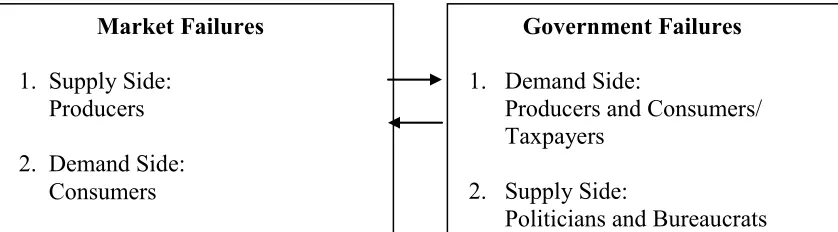
In figure 1 below, the arguments put forward above are put together in a model for analysing
Figure 1. Model for analysing technical standardisation
“
Imperfections” in the “Imperfections” in the
Economic System: Political System:
Welfare Economic Approach Rational Choice Approach
Source: Compiled by the author.
Market Failures
1. Supply Side:
Producers
2. Demand Side:
Consumers
Government Failures
1.
Demand Side:
Producers and Consumers/
Taxpayers
2.
Supply Side:
Politicians and Bureaucrats
In figure 1, it is assumed that there are a number of economic interests in the political system that
try to build coalitions because various forms of political decision-making or non-decision-making
lead to different benefits and costs for the various actors in society.
The arrows between the boxes in the figure indicate structural causal relations between the two
boxes in the theoretical model. It is also assumed that there is equilibrium between the politicians’
and the bureaucrats’ supply of political decisions, on the one hand, and the producers’ and
consumers’ demand on the other hand. At the same time, this equilibrium is biased or asymmetric
non-intervention (strong demand = strong political voices), while the consumers as a whole only have
few claims (weak demand = weak political voices) or a low level of interest in the technical
standardisation process (cf. also Hirschman, 1970).
Following the methodological individualism of the rational choice theory, the starting point of the
theoretical model is the individual producer generating not yet technically standardised products for
the consumer. Potentially, this will bring him or her in contact with political decision-makers.
However, as always there is collective action problems involved when individual actors wants to
influence the political decision-making process.
Both in the United States and in Europe the collective action problems are minimized in the
technical standardisation process as far as the producers are concerned. In the United States the
collective action problems are minimized due to the dominance of monopolistic and
quasi-monopolistic producers on many products markets. Often, this means that a few producers can
determine the mode of technical standardisation at relatively low costs. In Europe, the colective
action problems as far as the mode of technical standardisation is concerned are minimized due to
the large number of possibilities offered by the extensive public sector, both a European and a
national layer of access possibilities for producers and a long tradition for corporatism.
5. Market failures and the supply side: Producers
As mentioned previously, market failures cover situations when the full competitive market model is
not welfare-economically optimal due to increasing returns. These kinds of market failures may
imply incentive problems for the firms as far as technical standardisation is concerned.
Therefore, generally, firms are faced with insecurity problems when it comes to development of new
standardized products. One way to reduce the fundamental insecurity (and transactions costs) in
the technical standardisation process is to engage in cooperation with other firms and public
authorities as far as the development of technical (and legal) standards is concerned. Hence,
standard-setting justified by the argumentation that it will prevent potential blockages vis-à-vis a
technical standardisation process from becoming effective and, thereby, avoid a sub-optimal
prisoners’ dilemma among private actors (Elsner, 2005).
However, at the same time, firms may also have an interest in putting pressure on political
decision-makers not to intervene in the technical standardisation process. If firms have a monopolistic or
semi-monopolistic position on the relevant product market, i.e. sell products that are based upon de
facto standards, they probably do not have an interest in having these technical standards
transformed into legal standards, which would become technical standards that all firms are free to
use. In other words, the political asymmetry in this situation is biased in favour of non-intervention
as this corresponds to the preferences of the strongest voices on the political market.
In figure 2, the various possibilities resulting from the technical standardisation process are
presented. Technical standardisation can either be market based or a result of public intervention.
In both cases, government failures (G) might exceed market failures (M), i.e. G >M, or market
failures might exceed potential government failures, i.e. G < M. The “yes” and “no” in figure 2 is an
answer to the question on whether or not the chosen path is most optimal from a welfare economic
point of view.
It is evident from figure 2 that nothing definite can be said a priori about the welfare economic
implications of applying either a market based or a public intervention based mode of technical
standardisation even though, as mentioned, in high-tech areas going throgh a rapid technological
development, government failures are probablyb higher than market failures. Both modes of
technical standardisation might lead to welfare economic sub-optimal solutions depending on the
size of market failures and government failures. Hence, in order to reduce the size of governmental
failures, a better solution would be to correct the political asymmetry that is responsible for the
government failures. One logical solution would be to empower the weak part in the economic
increase the collective action problems, i.e. to liberalize markets, tigthen up competion policy and/or
eliminate traits of corporatism in the standardisation policy.
Figure 2. Technical standardisation: Market based or public intervention based?
Technical standardisation
Market based Public intervention based
G < M G > M G < M G > M
Yes No Yes No
Source: Compiled by the author.
When it comes to market failures on the supply side, network externalities are some of the most
common market failures. Here, the prognosis is that the existence of huge network externalities
means that standards should be decided upon by public intervention or by close cooperation
among the actors on the market. Hereby, the tendency in direction of excessive inertia is prohibited
and, at the same time, information on transaction costs is reduced. However, as always, there is a
risk that the product diversity is reduced and that a dominant actor set the standard, which
increases the risk of market failures through monopolisation.
At the same time, there might also be efforts to avoid public intervention which might be a result of
political rent-seeking for “intellectual property rights” in the interest of the most powerful firms
(Elsner, 2005) because rent-seeking is used both to promote public intervention in the technical
standardisation process and avoid public intervention in the technical standardisation process.
6. Market failures and the demand side: Consumers
Asymmetric information on a market implies a potential market failure that is strongly relevant for
consumers. Asymmetric information means that consumers are not aware of all risks involved in
buying products. Public authorities take care of these risks by setting standards that are aimed at
avoiding health and safety problems. However, technical standardisation concerning health and
safety can be manipulated and, for example, used as a protectionist weapon against foreign
products and against products from domestic rival firms. The so-called Cassis-de-Dijon Ruling of
the Court Justice of the European Union showed that Germany exploited a health and safety
standard in order to protect German producers of spirits (ECJ, c 120/78, 1979).
However, consumers are also hurt by market failures in the technical standardisation process
through the so-called network externalities. Generally, in the literature on industrial economics the
problem of technical standardisation, as seen from the perspective of consumers, is treated as part
of the analysis of network externalities. Network externalities can be treated from the demand side
as well as from the supply side. As far as the demand side is concerned, users must get information
in order to foresee what technical standards other users want to use. This implies coordination
problems as the various users probably have different preferences. As a result, there is a risk of
one or two forms of sub-optimal situations: extreme inertia or excessive haste as far as technical
standardisation is concerned.
Positive network externalities arise when an increasing number of consumers use the same product
standard, e.g. the usefulness of a PC with specific technical standards increases when many other
consumers have bought a PC with the same technical standards because the result is that there is
more useful software available on the market.
In other words, the excessive inertia arises when users are waiting too long to use the new
technological standards. The reason is that they are waiting to buy a product until many other users
are doing the same thing. Therefore, potential users are holding back each other from using the
The excessive haste arises when users are rushing to acquire the newest technology even though
the technical standards are far from fully developed.
7. Government failures and the demand side: Producers and consumers
As mentioned before, market failures in technical standardisation are partly due to a fundamental
insecurity in production of technical standards. This situation creates an incentive among producers
that it is legitimate to use the political system alone or through collective action as an alternative
way to pursue their own interest in having or not having public intervention in the technical
standardisation process. Stated in the terms of the rational choice theory, producers see that their
economic profit seeking in the market is insecure. Therefore, they put pressure on political
decision-makers in order to reduce the level of insecurity. However, just to have an incentive to become a
political rent-seeker is not enough.
In order to be rational, when an economic actor decides to become a political rent-seeker, he or she
has to judge whether the potential benefits exceed the foreseeable costs. Costs are incurred by the
administration and co-ordination that is necessary in order to acquire political influence. If an
economic actor belongs to a group (e.g. a group of firms wanting the same technical standards as
legal standard) with structural features, which imply few organizational costs, this group must be
expected to be easily organised in order to put pressure on relevant political decision-makers.
However, at the same time, firms run the risk of some other firms’ free-riding when they organise
themselves in order to acquire political influence with the aim of enhancing their interests. Political
influence has many features in common with public goods since it is impossible to exclude
non-participating producers from benefiting from the efforts made by the rent-seeking producers unless
the resulting technical standards are more suited for the participating firms. This is the selective
incentive for firms to participate in public-private standardisation processes that Olson (1965) was
the first to point out as a necessity if individuals are to participate in a collectively beneficial activity
In the technical standardisation process, consumers are expected to have opposite interests
vis-à-vis rent-seeking firms.
When firms are demanders of public interventions, the demand of the consumers is expected to pull
in the opposite direction. When firms are in opposition to public intervention in the technical
standardisation process, the demand of the consumers is again, ideally expected to pull in the
opposite direction.
In this light, the actual public intervention in the technical standardisation process can be regarded
– according to the proposed theoretical model - as a function of the investment made in political
influence on behalf of the firms and consumers respectively. The result is assumed to be an
equilibrium situation between opponents and supporters of intervention in the specific technical
standardisation process against the background of calculations of the marginal benefits,
respectively the marginal costs, of the investments made in political influence.
The equilibrium situation in the political market is asymmetric because the producers are able to
press the slope of their lobby-curve downwards due to the selective incentives stemming from
ex-post technical standards being similar to their-ex ante technical standards, no matter whether the
aim of rent-seeking is public intervention or non-intervention. The potential opponents of the
producers are consumers, but they are seldom organised at all.
8. Government failures and the supply side: Politicians and bureaucrats
The organisational strength of producers (relative to other groups) and the consumers’ relatively
weak organizational strength are necessary conditions for political decisions being pro-producer in
a status quo perspective. Besides, political decision-makers (politicians and bureaucrats) are
In this context, it is a widespread notion that politicians and bureaucrats in a democratic society
make decisions reflecting the wishes, attitudes and preferences of the people, in particular, the
political goals that are common among a majority within the electorate and that these decisions are
assumed to make up the foundation of the political decisions of society.
According to the rational choice theory, however, the existence of such correspondence between
the democratic, collective decisions and policy objectives based on individual preferences is a
much too optimistic, although long lasting, democratic theory. Because the gain from leaving
technical standardisation to the market in favour of consumers or intervening in favour of
consumers is spread collectively among all consumers, extraordinary incentives are needed to
mobilise consumers in the political process, and more fundamentally, the selective incentives are
lacking. Consumers are a loosely organised group who are confronted with a smaller, but much
more homogeneous group of producers who enjoy the benefits of political intervention or lack of
political intervention. The gains and losses of this group are concentrated and private in character
(Grossman & Helpman, 1994).
Normally, politicians decide on a political issue (like whether to have public intervention in the
technical standardisation process) according to how voters will react. Voters, on the other hand,
have to consider the costs in time and money when they form their preferences and transmit them
to the politicians. If the voter is rational, a minimum of benefits for him or her is necessary if he or
she wants to pay the costs of collecting information and transmitting preferences to the political
decision-makers (Nello, 1984). As mentioned above, just getting information about the impact and
size of public intervention (or the opposite) in the technical standardisation process is difficult and
costly because very often either the actual content of the public intervention is ”hidden” in the prices
or “hidden” in bureaucratic measures.
In the theory of rational choice - where “the political market” is used as a metaphor - it is assumed
Re-election depends on various factors: the number of voters affected by the political decisions, how
voters are affected by political decisions, the political influence of the affected voters, whether the
politicians regard it as acceptable that certain groups of voters get benefits, the possibility that the
affected group of voters will punish the politicians for a bad political result and whether a bad
political result for an affected group will have an impact on public opinion (Nedergaard, 2006).
Alongside the politicians, the bureaucrats are important suppliers of technical standardisation
decisions whether it implies public intervention or non-intervention. In the rational choice theory it is
assumed – even though politicians formally take the political decisions under counselling by the
administration – that bureaucrats are also independent actors who are maximising utility by
preserving or expanding their power base, their career possibilities, etc. In the technical
standardisation area, bureaucrats probably have quite a considerable amount of influence in the
technical standardisation policy area because this area is characterised by a lot of technicalities
and many specific rules. A result of the technical character of technical standardisation processes is
that politicians avoid dealing directly with the many regulatory and distributive questions in
standardisation policy. When technical standardisation political decisions are transformed into
quasi-political and bureaucratic-technical questions, technical standardisation policy takes on a
seemingly objective character.
In conclusion, both politicians and bureaucrats are expected to be tuned into giving into demands
from producers with an interest in technical standardisation, no matter whether the interest is public
intervention in the technical standardisation process (e.g. in order to avoid insecurity) or avoiding
public intervention in the technical standardisation process (e.g. if the firm already has the de facto
standard on the product market).
9. Conclusion
This paper analyses the basic problems of technical standardisation: How can we analytically
mode of technical standardisation? What are the possible implications of these two ways of
organizing technical standardisation seen from an economic and political point of view?
The proposed theoretical model is an interdisciplinary model drawing on elements from economics
and political science. As argued by several scholars, such a theory should build on individual
choices because this theoretical approach is logically consistent. Hence, methodological
individualism is a starting point of the proposed theoretical model.
The next point of departure for the proposed theoretical model for technical standardisation is the
existence of a number of market failures which might potentially bring producers in contact with
actors in the political system (i.e. politicians and bureaucrats) in order to either promote public
intervention (the dominant European mode of technical standardisation) or to avoid public
intervention (the dominant American mode of technical standardisation).
Fundamentally, both in Europe and in the United States, technical standardisation is – according to
the model – framed by the asymmetry of the political market where producers have gained the
upper hand in the rent-seeking process vis-à-vis other actors. Within this frame, it is the calculations
of cost and benefits at the level of the individual firms that determines the final mode of technical
standardisation.
Of course, there are variations in this overall tendency, due to the kind of product that is analysed,
but the general picture is clear.
At the same time, there is no clear evidence of which mode of technical standardisation that has to
be judged as the most optimal from a welfare economic point of view as it would mean that we
knew all economic costs as a result of both the involved market failures and the involved
If the present producer-biased mode of technical standardisation had to be changed, a solution
according to the model would be to decrease the collective action problems through an
empowerment of the group of consumers in the technical standardisation process, i.e. through the
allocation of public subsidies to consumer organisations in order to take part in the technical
standardisation process. To a certain extent this is also a model that has been applied in the Nordic
countries as far as technical standardisation is concerned.
Another way to change the producer-biased mode of technical standardisation would be to increase
the collective action problems for producers, i.e. to liberalize markets, tighen up competion policy
and eliminate traits of corporatism in the standardisation policy.
References
Alchian, A.A. (1965) “Some Economics of Property Rights,” 30 Il Politico 816-829.
Arthur, W.B. (1994) Increasing Returns and Path Dependence in the Economy. Ann Arbor: University of Michigan Press.
Buchanan, J.M. and G. Tullock (1962) The Calculus of Consent: Logical Foundation of
Constitutional Democracy. Ann Arbor: Ann Arbor Paperbacks.
Buchanan, J.M. (1979) What Should Economists Do? Indianapolis: Liberty Press.
Campbell, J.L. (2004) Institutional Changes and Globalisation. Princeton and Oxford: Princeton University Press.
Coase, R.H. (1960) “The Problem of Social Cost,” 3 Journal of Law and Economics 1-44. Elsner, W. (2005) “The ‘new’ Economy: Complexity, Coordination and a Hybrid Governance
Approach.” Paper presented at a conference at Roskilde University Center on Institutional Theory, 28-29 April 2005.
Financial Times.
Grossman, G.M & E. Helpman (1994) Electoral Competition and Special Interest Politics. Cambridge, MA: National Bureau of Economic Research.
Hirschman, A.O. (1970) Exit, Voice and Loyalty: Responses to Decline in Firms,
Organizations and States. Harvard: Harvard University Press.
Keohane, R.D. (1984) After Hegemony: Cooperation and Discord in World Politics, Princeton, NJ. Princeton University Press.
Kristensen, T. (1988) ”Tekniske standarder som institutioner – nogle teoretiske overvejelser,” in C. Knudsen, ed., Institutionalismen i samfundsvidenskaberne. Copenhagen: Samfundslitteratur. Miller, E.S. (2002) “The Impact of Technological Change on Market Power and Market Failure in
Telecommunication,” XXXV Journal of Economic Issues 385-93.
Nedergaard, P. (2006) “Market Failures and Government Failures: A Theoretical Model of the Common Agricultural Policy,” Journal of Public Choice (Forthcoming).
Nedergaard, P. (1994) Internationale standarder. Copenhagen: Handelshøjskolens Forlag. Niskanen, W.A. (1971) Bureaucracy and Representative Government. Chicago: Aldine Atherton. North, D.C. (1990) Institutions, Institutional Change and Economic Performance. Cambridge:
Cambridge University Press.
Olson, M. (1965) The Logic of Collective Action: Public Goods and the Theory of Groups. Cambridge, Mass.: Harvard University Press.
Pierson, P. (2000) “Increasing Returns, Path Dependence, and the Study of Politics,” 94 American
Political Science Review 251-267.
Samuelson, P. (1954) “The pure theory of public expenditures,” 36 Review of Economics and Statistics 387-389.
Schmidt, S.K & Werle, R. (1993) Technical Controversy in International Standardisation. Max-Planck-Institut f¨r Gesellschaftsforschung. Cologne. Discussion Paper 93/5.
Tirole, J. (1992) The Theory of Industrial Organization. The MIT Press, Cambridge, Mass.
Notes
1
I am grateful to Monica Thurmond, Thomas Horn and Kasper Lindskow for research assistance on
this paper. I have recieved helpful comments on earlier drafts from Lars Bo Kaspersen, Chritian
Bjørnskov and Otto Brøns-Petersen.
2
Technical standards are a part of the group of all standards, which, however, also includes basic
standards like the metric system, terminological standards, security standards, etc. I define technical
standards as standards that are invented as part of the construction of technologies, e.g.
telecommunication products, arms, mechines, television sets etc.
3
The scolarly discussion on the implication of patents in the relation to the analysis of technical
standardisation, however, is not the same thing. Technical standards are part and parcel of all
patented products, but they are much more fundamental than patented products.
4
In fact, the theoretical model of this paper is a model of the mode of technical standardisation.
5