City, University of London Institutional Repository
Citation
:
Michie, S., Richardson, M., Johnston, M., Abraham, C., Francis, J., Hardeman, W., Eccles, M. P., Cane, J. and Wood, C. E. (2013). The Behavior Change Technique Taxonomy (v1) of 93 Hierarchically Clustered Techniques: Building an International Consensus for the Reporting of Behavior Change Interventions. Annals of Behavioral Medicine, 46(1), pp. 81-95. doi: 10.1007/s12160-013-9486-6This is the accepted version of the paper.
This version of the publication may differ from the final published
version.
Permanent repository link: http://openaccess.city.ac.uk/3293/
Link to published version
:
http://dx.doi.org/10.1007/s12160-013-9486-6Copyright and reuse:
City Research Online aims to make research
outputs of City, University of London available to a wider audience.
Copyright and Moral Rights remain with the author(s) and/or copyright
holders. URLs from City Research Online may be freely distributed and
linked to.
The Behavior Change Technique Taxonomy (v1) of 93 hierarchically-clustered
techniques: building an international consensus for the reporting of behavior change
interventions
Susan Michie1, Michelle Richardson2, Marie Johnston1,3 Charles Abraham2, Jill Francis4,
Wendy Hardeman5, Martin P Eccles6, James Cane7 & Caroline E Wood1
1 University College London, 2University of Exeter Medical School, 3 University of Aberdeen, 4 City University London, 5University of Cambridge, 6 Newcastle University, 7University of Kent
Correspondence address:
Professor Susan Michie, Centre for Outcomes Research Effectiveness, Research
Department of Clinical, Educational and Health Psychology, University College London, 1-19
Torrington Place, London, WC1E 7HB.
Email: [email protected]
Acknowledgements
The present work carried out as part of the BCT Taxonomy project was funded by the
Medical Research Council. We are grateful to the very helpful input from Felicity Roberts,
Members of the BCT Taxonomy project International Advisory Board (IAB) and expert
Abstract
Background
CONSORT guidelines call for precise reporting of behavior change interventions: we need
rigorous methods of characterizing active content of interventions with precision and
specificity.
Objectives
To develop an extensive, consensually agreed hierarchically structured taxonomy of
techniques (BCTs) used in behavior change interventions.
Methods
In a Delphi-type exercise, 14 experts rated labels and definitions of 124 BCTs from six
published classification systems. Another 18 experts grouped BCTs according to similarity
of active ingredients in an open-sort task. Inter-rater agreement amongst 6 researchers
coding 85 intervention descriptions by BCTs was assessed
.
Results
This resulted in 93 BCTs clustered into 16 groups. Of the 26 BCTs occurring at least 5 times,
23 had adjusted Kappas of 0.60 or above.
Conclusions
“BCT taxonomy v1”, an extensive taxonomy of 93 consensually agreed, distinct BCTs, offers
a step change as a method for specifying interventions, but we anticipate further
development and evaluation based on international, interdisciplinary consensus.
Introduction
Interventions to change behavior are typically complex, involving many interacting
components [1]. This makes them challenging to replicate in research, to implement in
practical applications and to synthesize in systematic literature reviews. Complex
interventions also present challenges for identifying the active, effective components within
them. Replication, implementation, evidence synthesis and identifying active components
are all necessary if we are to better understand the effects and mechanisms of behavior
change interventions and to accumulate knowledge to inform the development of more
effective interventions. However, the poor description of interventions in research protocols
and published reports presents a barrier to these essential scientific and translational
processes [2, 3]. A well-specified intervention is essential before evaluation of effectiveness
is worth undertaking: an under-specified intervention cannot be delivered with fidelity and, if
evaluated, could not be replicated.
The CONSORT statement for randomized trials of ‘non-pharmacological’
interventions recommends precise specification of trial processes, including some details of
the delivery of interventions and “description of the different components of the interventions”
[4]. As currently constituted, CONSORT gives no guidance as to what this description or
components should be. Intervention components have been identified by Davidson et al. [3]
as: who delivers the intervention, to whom, how often, for how long, in what format, in what
context and with what content
.
These are mainly procedures for delivery (often referred toas “mode” of delivery), except for the key intervention component, “content”, i.e. the active
ingredients that bring about behavior change (the “what” rather than the “how” of
The content, or active components of behavior change interventions, are often
described in intervention protocols and published reports with different labels (e.g.,
‘self-monitoring’ may be labeled ‘daily diaries’); the same labels may be applied to different
techniques (e.g., ‘behavioral counseling’ may involve ‘educating patients’ or ‘feedback,
self-monitoring, and reinforcement’ [5]). This may lead to uncertainty and confusion. For
example, behavioral medicine researchers and practitioners have been found to report low
confidence in their ability to replicate highly effective behavioral interventions for diabetes
prevention [6]. The absence of standardized definitions and labels for intervention
components means that systematic reviewers develop their own systems for classifying
behavioral interventions and synthesizing study findings [7, 8, 9, 10]. This proliferation of
systems is likely to lead to duplication of effort and undermines the potential to accumulate
evidence across reviews. It also points to the urgent need for consensus. Consequently, the
UK Medical Research Council (MRC)’s guidance [1] for developing and evaluating complex
interventions calls for improved methods of specifying and reporting intervention content in
order to address the problems of lack of consistency and consensus.
A method recently developed for this purpose is the reliable characterization of
interventions in terms of behavior change techniques (BCTs) [11]. By BCT, we mean an
observable, replicable and irreducible component of an intervention designed to alter or
redirect causal processes that regulate behavior; that is, a technique is proposed to be an
‘active ingredient’ (e.g., feedback, self-monitoring, reinforcement) [12, 13]. BCTs can be
used alone or in combination and in a variety of formats. Identifying the presence of BCTs in
intervention descriptions included in systematic reviews and national datasets of outcomes
has allowed the identification of BCTs associated with effective interventions. Effective
BCTs have been identified for interventions to increase physical activity and healthy eating
[14]and to support smoking cessation [15, 16], safe drinking [17], prevention of sexually
Abraham and Michie [11] developed the first cross-behavior BCT taxonomy, building
on previous intervention content analyses [7, 8]. These authors demonstrated reliability in
identifying 22 BCTs and 4 BCT packages across 221 intervention descriptions in papers and
manuals. This method has been widely used internationally to report interventions,
synthesize evidence [14, 20, 21, 22, 23] and design interventions [6, 24]. It has also enabled
the specification of professional competences for delivering BCTs [25, 26] and as a basis for
a national training program (see www.ncsct.co.uk). Guidance has also been developed for
incorporating BCTs in text-based interventions [27].
Although the subsequent development of classification systems of defined and
reliably-identifiable BCTs has been accompanied by a progressive increase in their
comprehensiveness and clarity, this work has been conducted by only a few research
groups. For this method to maximize scientific advance, collaborative work is needed to
develop agreed labels and definitions and reliable procedures for their identification and
application across behaviors, disciplines and countries.
Previous classification systems have either been in the form of an unstructured list or
have been mapped to, or structured, according to categories (e.g. theory [7, 11], theoretical
mechanism [25, 26]) judged to be the most appropriate by the authors. In addition, they have
mainly been developed for particular behavioral domains (e.g. physical activity, smoking, or
safer sex). A comprehensive taxonomy will encompass a greater number of BCTs and
therefore require structure to facilitate recall and access to the BCTs and thus to increase
speed and accuracy of use. A true, i.e. hierarchically structured, taxonomy provides the
advantage of making it more coherent to, and useable by, those applying it [28]. As the
number of identified BCTs has increased, so also has the need for such a structure, to
Simple, reliable grouping structures have previously been used by three groups of
authors. Dixon and Johnston [26]grouped BCTs according to “routes to behavior change”,
‘Motivation’, ‘Action’ and ‘Prompts/Cues’; Michie et al [15] grouped according to “function” in
changing behavior, ‘Motivation’, ‘Self-regulation Capacity/ Skills’, ‘Adjuvant’ and ‘Interaction’;
and Abraham, Good, Warren, Huedo-Medina and Johnson [18] grouped according to
“change target”, that is, Knowledge, Awareness of own behaviour, Attitudes, Social Norms,
Self-efficacy, Intention Formation, Action control, Behavioural maintenance, and Change
facilitators. However there is a need for a basic method of grouping which does not depend
on a theoretical structure. We therefore adopted an empirical approach to developing an
international consensus of BCT groupings.
Potential benefits
There are at least five potential benefits of developing a cross-domain, internationally
supported taxonomy. First, it will promote the accuratereplication of interventions (and
control conditions in comparative effectiveness research), a key activity in accumulating
scientific knowledge and investigating generalizability across behaviors, populations and
settings. Second, specifying intervention content by BCT will facilitate faithful implementation
of interventions found to be effective. Third, systematic reviews will be able to use a reliable
method for extracting information about intervention content, thus identifying and
synthesizing discrete, replicable, potentially active ingredients (or combinations of
ingredients) associated with effectiveness. Earlier BCT classification systems, combined with
the statistical technique of meta-regression, have allowed reviewers to synthesize evidence
from complex, heterogeneous interventions to identify effective component BCTs [6, 14, 22,
29, 30]
.
Fourth, intervention development will be able to draw on a comprehensive list ofinterventions and it will be possible to report the intervention content in well-defined and
detailed ways. Fifth, linking BCTs with theories of behavior change has allowed the
investigation of possible mechanisms of action [14, 30, 31].
The work reported here represents the first stages of a program of work to develop an
international taxonomic classification system for BCTs, building on previous work. The aims
of the work reported in this paper are as follows.
1) To generate a taxonomy that:
a) comprises an extensive hierarchical classification of clearly labeled, well
defined BCTs with a consensus that they are proposed active components of
behavior change interventions, that they are distinct (overlapping,
non-redundant) and precise, and that they can be used with confidence to
describe interventions,
b) has a breadth of international and disciplinary agreement
2) To assess and report the reliability of using BCT labels and definitions to code
intervention descriptions
Method
Design
The work involved three main tasks. The first involved the rigorous development of a list of
distinct BCT labels and definitions, using Delphi methods, with feedback from a
multidisciplinary International Advisory Board and members of the study team. The
inter-rater reliability of coding intervention descriptions using the list of BCTs was then assessed
in two rounds of reliability testing. The third task was the development of a hierarchical
Participants
Participants were international behavior change experts (i.e. active in their field and
engaged in investigating, designing and/or delivering behavior change interventions) who
had agreed to take part in one or more of the study phases, members of the International
Advisory Board and the study team (including a ‘lay’ person). All Board members, as leaders
in their field, were eligible to take part as a behavior change expert. However, in light of their
advisory role commitments, members were not routinely approached for further participation
unless it would help widen participation in terms of country, discipline and behavioral
expertise.
For the Delphi exercise, 19 international behavior change experts were invited to
take part. Experts were identified from a range of scientific networks on the basis of breadth
of knowledge of BCTs, experience of designing and/or delivering behavior change
interventions, and of being able to complete the study task in the allotted time. Recruitment
was by email, with an offer of an honorarium of £140 (approx. US$200) on completing the
task. Of the 19 originally approached, 14 agreed to take part (response rate of 74%). 10
participants were female, with an age range of 37 to 62 years (M = 50.57; SD = 7.74). Expert
participants were from the UK (8), Australia (2), Netherlands (2), Canada (1) and New
Zealand (1). Eleven were psychologists (six health psychologists, one clinical psychologist,
three clinical and health psychologists and one educational psychologist); one a cognitive
behavior therapist and two had backgrounds in health sciences or community health. Eleven
were active practitioners in their discipline. Eleven had research or professional doctorates
and two had registered psychologist status. There was a wide range of experience of using
BCTs, with all having used at least six BCTs, more than half having used more than 30
BCTs and four having used more than 50 BCTs for intervention design, delivery and training
For the international feedback phase, 16 of the 30 International Advisory Board
members (see: http://www.ucl.ac.uk/health-psychology/BCTtaxonomy/collaborators.php)
took part in discussions to comment on a prototype BCT classification system. Advisory
Board members were identified by the study team as being leaders in their field within the
key domains of interest (e.g., types of health-related behaviors, major disease types,
disciplines such as behavioral medicine) following consultation of websites, journals and
scientific and professional organizations. Advisory Board members were from the USA,
Canada, Australia, UK, the Netherlands, Finland and Germany. Feedback was also provided
by members of the study team, who had backgrounds in psychology and/or implementation
science and a ‘lay’ person with a BA (Hons) in English but no background in psychology or
behavior change.
Five members of the UK study team conducted the first round of reliability testing and
six the second round. Eighteen of 19 participants approached from the pool of experts in
behavior change interventions completed the open-sort grouping task. Eight were women,
10 men with an age range of 27 to 67 years (M = 43.94) 16 were from the UK and two were
from Australia.
Procedure
Participants recruited for the Delphi exercise and open-sort grouping task provided
written consent and were assured that their responses would remain confidential. All
participants were asked to provide demographic information (i.e. age, gender and
nationality). Delphi exercise participants were also asked to provide their professional
background (i.e. qualifications, registrations, job title and area of work) and how many BCTs
they had used professionally in intervention design, face-to-face delivery and training
A prototype classification system was developed by the study team based on all
known published classifications of BCTs following a literature review [28] (Step 1). An online
Delphi-type exercise (see Pill [32]) with two ‘rounds’ was used for initial evaluation and
development of the classification system. Participants worked independently and rated the
prototype BCT labels and definitions on a series of questions designed to assess omission,
overlap and redundancy (Step 2). The results of Step 2 subsequently informed the
development of an improved BCT list which was sent to the Delphi participants for round 2.
They were asked to rate BCTs for clarity, precision, distinctiveness and confidence of use
(Step 3). The resulting list of BCTs was then scrutinized by the Advisory Board, who
submitted verbal and written feedback, and was assessed by the lay and expert members of
the study team (Step 4). Following each of Steps 2, 3 and 4, the results were synthesized by
SM and MJ in preparation for the next step. Using the developed BCT list, members of the
study team coded published descriptions of interventions, and inter-rater agreement for the
presence of each BCT was calculated (Step 5). An open-sort grouping task was then carried
out to generate reliable and stable groupings and create a hierarchical structure within the
taxonomy (Step 6).
Step 1: Developing the prototype classification system
The labels and definitions of distinct BCTs were extracted from six BCT classification
systems identified by a literature search (the relevant papers are marked with an asterisk in
the reference section). For BCTs with two or more labels (n = 24) and/or definitions (n = 37),
five study team members rated their preferred labels and definitions. Where there was
complete or majority agreement the preferred label and/or definition was retained. Where
there was some, little or no agreement, new labels and definitions were developed by
synthesizing the existing labels and definitions across classification systems. Definition
wording was modified to include active verbs and to be non-directional (i.e., applicable to
Step 2: Delphi exercise first round
Participants were provided with the study definition of a BCT [13](i.e. having the
following characteristics: a) aim to change behavior, b) are proposed "active ingredients" of
interventions, c) are the smallest components compatible with retaining the proposed active
ingredients, d) can be used alone or in combination with other BCTs, e) are observable and
replicable, f) can have a measurable effect on a specified behavior/s, g) may or may not
have an established empirical evidence base. It was explained that BCTs could be delivered
by someone else or self-delivered.
The BCTs (labels and definitions) from Step 1 were presented in a random order and
participants were asked five questions about each of them:
(i) Does the definition contain what you would consider to be potentially active
ingredients that could be tested empirically? Participants were asked to respond
to this question using a five-point scale (‘definitely no’, ‘probably no’, ‘not sure’,
‘probably yes’ and ‘definitely yes’)
(ii) Please indicate whether you are satisfied that the BCT is conceptually unique
or whether you consider that it is redundant or overlapping with other BCTs.
(with forced choice as to ‘whether it was conceptually unique, redundant, or
overlapping’).
iii) If participants indicated that the BCT was ‘redundant’, they were asked to state
why they had come to this conclusion.
iv) If they indicated that the BCT was ‘overlapping’, they were asked to state: a) with
which BCT(s) and b) whether they can be separated (‘Yes’ or ‘No’)”
v) If the BCTs were considered to be separate, participants were asked how the
label or definition could be rephrased to reduce the amount of overlap or, if not
Participants were given an opportunity to make comments on the exercise and to
detail any BCTs not included on the list. They were asked, ‘does the definition and/or label
contain unnecessary characteristics and/or omitted characteristics?’ This question item was
open-ended. The exercise was designed to take two hours; follow-up reminders were sent to
participants after two weeks and all responses were submitted within one month of the initial
request.
Frequencies, means and/or modes of responses to questions (i) and (ii) were
considered for each BCT. Based on the distribution of responses, BCTs for which a) more
than a quarter of participants doubted that they contained active ingredients and/or b) more
than a third considered them to be overlapping or redundant were flagged as ‘requiring
further consideration’. These data, along with the responses to questions (iii) to (v), guided
the rewording of BCT labels and definitions and the identification of omitted BCTs. The BCTs
for re-consideration and the newly identified BCTs were presented in the second Delphi
exercise round.
Step 3: Delphi exercise second round
The BCTs identified as requiring further consideration were presented; the rest of the
BCTs were included for reference only, to assist judgments about distinctiveness. For each
BCT, participants were asked three questions and asked to respond using a five-point scale
(‘definitely no’, ‘probably no’, ‘not sure’, ‘probably yes’ and ‘definitely yes’)
(i) If you were asked to describe a behavior change intervention in terms of its
component BCTs, would you think the following BCT was a) clear, b) precise,
c) distinct?
(ii) Would you feel confident in using this BCT to describe the intervention?
(iii) Would you feel confident that two behavior change researchers or
If participants responded ‘probably no’, ‘definitely no’, or ‘not sure’, to any question, they
were asked to state their suggestions for improvement.
Frequencies, means and/or modes were calculated for all questions for each BCT.
BCTs for which more than a quarter of participants responded ‘probably no’ or ‘definitely no’,
or ‘not sure’, to any question were flagged as needing to be given special attention. Using
information on the distribution of ratings, the modal scores and suggestions for improvement,
SM and MJ amended the wording of definitions and labels. This included changes to make
BCTs more distinct from each other where this had been identified as a problem and to
standardize wording across BCTs. Where it was not obvious how to amend the BCT from
the second round responses, other sources [33] were consulted for definitions of particular
words or descriptions of BCTs.
Step 4: Feedback from the International Advisory Board
16 of the 30 members of the Advisory Board took part in 1 of 3, two-hour long
teleconferences to give advice to the study team, and the BCT list was refined based on
their feedback.
Step 5: Reliability testing round 1
Five members of the study team coded 45 intervention descriptions. The descriptions
were selected from Implementation Science, BMC Public Health Services and BMC Public
Health in 2009 and 2010 using quota sampling to ensure spread across preventive, illness
management and health professional behaviors. The study team then discussed reasons for
discrepancies in round 1 and amended the BCT list as needed.
Step 6: Investigating hierarchical structure of the BCT list
An open-sort grouping task was delivered via an online computer program.
24) of their choice and to label the groups. They were asked to “group together BCTs which
have similar active ingredients i.e. by the mechanism of change, NOT the mode of delivery”.
BCTs were presented to participants in a random order and definitions for each BCT were
made available.
For data analysis, a binary dissimilarity matrix containing all possible BCT x BCT
combinations was produced for each participant, where a score of 1 indicated BCTs which
were not sorted into the same group and a score of 0 indicated items which were sorted into
the same group. Individual matrices were aggregated to produce a single dissimilarity matrix
which could be used to identify the optimal grouping of BCTs using Cluster Analysis. Using
Hierarchical Cluster Analysis (HCA), the optimal number of groupings (2-20) were examined
for suitability using measures of Internal Validity (Dunn’s Index) and Stability (Figure of Merit,
FOM) [34]. Bootstrap methods were used in conjunction with the HCA, whereby data were
resampled 10,000 times, to identify which groupings were strongly supported by the data.
The Approximately Unbiased (AU) p-values yielded by this method indicated the extent to
which groupings were strongly supported by the data with higher AU values (e.g. 95%)
indicating stronger support for the grouping [35].
The words and phrases used in the labels given by participants were analyzed to
identify any common themes and to help identify appropriate labels for the groupings. For
each grouping, labels were created based on their content and, where applicable, based on
the frequency of word labels given by participants. After the labels were assigned to relevant
groupings the fully labeled groups with the word frequency analysis were sent out to a
subset of five of the original participants for refinement.
Step 7: Reliability testing round 2
An additional member of the study team was recruited for the second round of
reliability testing. The team coded 40 intervention descriptions using the amended list. The
For both rounds, each intervention description was coded independently by two team
members and inter-rater agreement by BCT was assessed using Kappa’s adjusted for
prevalence and bias effects [36, 37]. Conventionally, a Kappa of <0.60 is considered poor to
fair agreement, 0.61-0.80 strong, and more than 0.80 near complete agreement [38]
.
Themore frequent the BCTs, the greater the confidence that the Kappa is a useful indicator of
reliability of judging the BCT to be present. We therefore only report the Kappa scores for
BCTs which were observed at least five times by either coder in the 40 intervention
descriptions.
Step 8: Feedback from study team members
The BCT definitions were checked to ensure that they contained an active verb
specifying the action required to deliver the intervention [39].The ‘lay’ member of the study
team (FR) read through the list to ensure syntactic consistency and general
comprehensibility to those outside the field of behavioral science. Subsequently, the study
team members made a final check of the resulting BCT labels and definitions.
Full details of the Procedure are available in Electronic Supplementary Materials Table 2.
Results
The evolution of the taxonomy at the different steps of the procedure is summarized in
Electronic Supplementary Materials Table 2.
Step 1: Developing the prototype classification system
Of the 124 BCTS in the prototype classification system, 32 were removed: five
composite BCTs and 26 BCTs overlapping with others were rated to have better definitions.
One additional BCT was identified, given a label and definition informed by other sources
Step 2: Delphi exercise first round
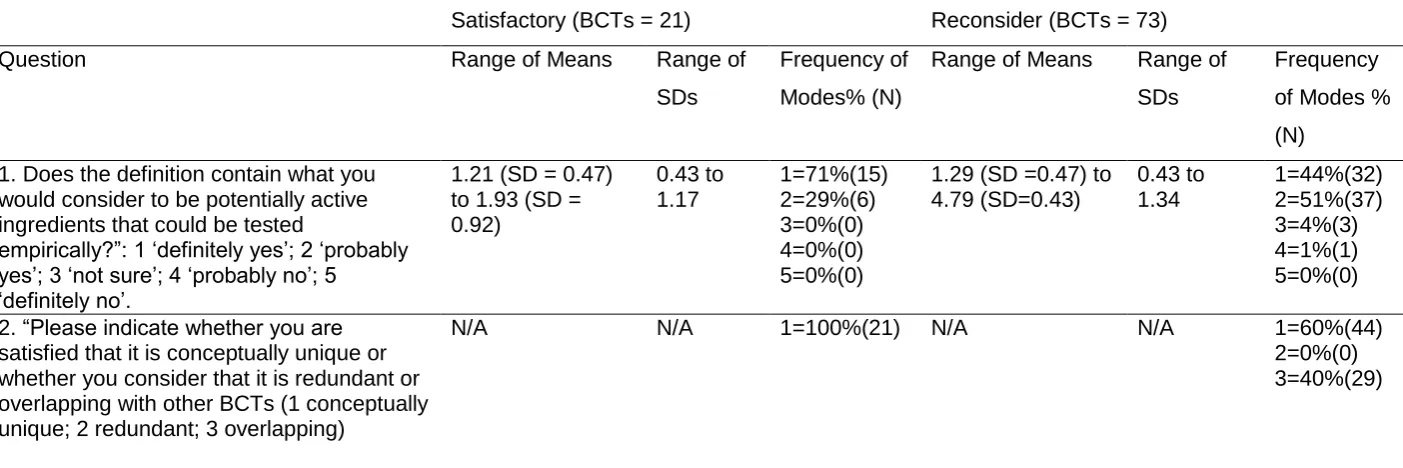
The means, modes and frequencies of responses to the Delphi exercise first round
questions are shown in Table 1. On the basis of these scores, 21 BCTs were judged to be
‘satisfactory’ and 73 ‘requiring further consideration’. Of the 73 reconsidered BCTs, four
were removed, four were divided, and one BCT was added (see Electronic Supplementary
Materials Table 2 for more details of changes at each step), giving 70 BCTs. During this
process, one reason for overlap became evident: there was a hierarchical structure meaning
that deleting overlapping BCTs would end up with only the superordinate BCT and a loss of
specific variation (for example, adopting the higher order BCT ‘Consequences’ would have
deleted ‘Reward’).
Step 3: Delphi exercise second round
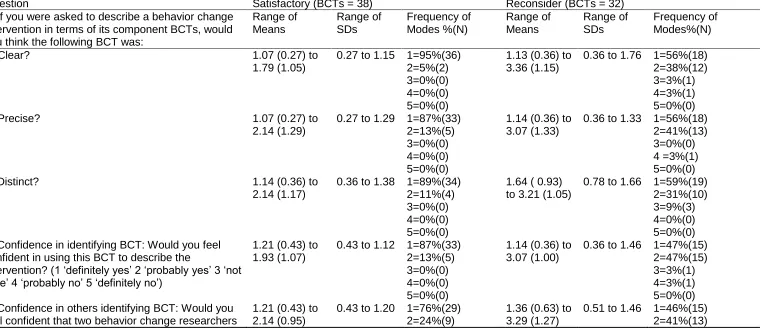
The means, modes and frequencies of responses to the five Delphi exercise second
round questions are shown in Table 2. On the basis of these scores, 38 BCTs were judged
to be ‘satisfactory’ and 32 ‘requiring further consideration’. Of the reconsidered BCTs,seven
labels and 35 definitions were amended and seven BCTs were removed (see Electronic
Supplementary Materials Table 2 for more details), giving 63 BCTs. Together with the 21
BCTs judged to be ‘satisfactory’ in the first round, there were 84 BCTs at the end of the
Delphi exercise. Some further standardization of wording across all BCTs was made by
study team members (e.g. specifying ‘unwanted’ or ‘wanted’ behaviors rather than the more
generic ‘target’ behaviors and ensuring that all definitions included active verbs).
Step 4: Feedback from the International Advisory Board
The Advisory Board members made two general recommendations: First, to make
the taxonomy more usable by empirically grouping the BCTs and secondly, to consider
would achieve a balance between stability/usability and change/evolution. Feedback from
members led to the addition of two and the removal of four BCTs. Further refinement of
labels and definitions resulted in a list of 82 BCTs.
Step 5 and 7: Reliability testing round 1 and 2
Inter-rater agreement for BCTs is shown in Table 3. For the first round of reliability
testing 22 BCTs were observed five or more times and therefore could be assessed.
Adjusted Kappa scores ranged from 0.38 to 0.85, with three scores below 0.60. Results
from the first round of reliability testing led to the addition of five and the removal of one BCT
resulting in a list of 86 BCTs.
For the second round of reliability testing 15 BCTs were observed five or more times.
Adjusted Kappa scores ranged from 0.60 to 0.90. In all, 26 BCTs were tested for reliability,
23 of which achieved Kappa scores of 0.60 or above and met our criteria of a BCT (see
Table 3).
Step 6: Investigating hierarchical structure of the BCT list
Participants created an average of 15.11 groups (SD = 6.11; range 5-24 groups).
Measures of internal validity indicated that the maximum internal validity Dunn Index value
(.57) was for a 16-cluster solution using hierarchical cluster analysis (see Figure 1), with no
increase in internal validity on subsequent cluster solutions (>16). Similarly, FOM values
showed greater stability in the 16-cluster solution compared to the 2-15 cluster solutions and
there was negligible increase in stability over cluster solutions 17-20. Therefore, hierarchical
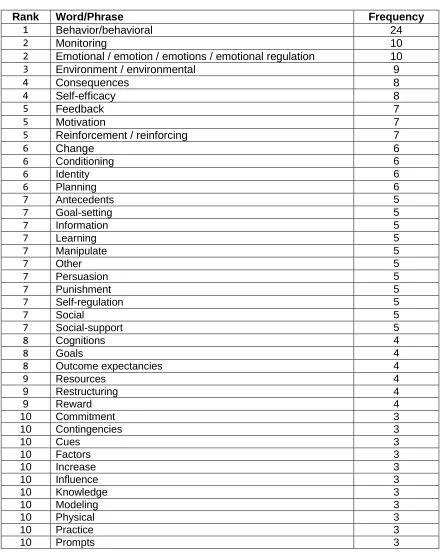
clustering methods identified the 16-cluster solution as the optimal solution. The frequency of
the words and phrases used in the labels given by participants is shown in Table 4. On the
basis of participant responses, the groups were assigned the following labels (number of
component BCTs in brackets): Reinforcement (10), Reward & Threat (7), Repetition &
Consequences (6), Feedback & Monitoring (5), Goals & Planning (9), Social Support (3),
Comparison of Behavior (3), Self-belief (4), Comparison of Outcomes (3), Identity (5),
Shaping Knowledge (4), Regulation (4). Three of these labels were modified to facilitate
comprehensibility across disciplines: ‘Reinforcement’ was changed to ‘Scheduled
Consequences’ and ‘Associative Learning’ was changed to ‘Associations’. ‘Consequences’
was then changed to ‘Natural Consequences’ to distinguish it from ‘Scheduled
Consequences’.
The final results of the cluster analysis are shown in Table 5. Seven of the 16
clusters (clusters 3, 4, 5, 8, 10, 15, and 16) showed AU values greater than 95%, indicating
that these groupings were strongly supported by the data. Clusters 1, 2, 9, 12, and 13 had
AU values between 90% and 95% and clusters 6, 7, 11, and 14 had AU values less than
90%, these were 73%, 85%, 83%, and 86% respectively. The Standard Errors (SE) of AU
values for all clusters were less than 0.009.
Step 8: Feedback from study team members
Feedback from study team members, led to the addition of three BCTs, the division
of one BCT and further refinement of labels and definitions. This resulted in a taxonomy of
93 BCTs.
Discussion
An extensive hierarchically organized taxonomy of 93 distinct BCTs has been
developed in a series of consensus exercises involving 55 experts in delivering and/or
designing behavior change interventions. These experts were drawn from a variety of
disciplines including psychology, behavioral medicine and health promotion and from seven
countries. The resulting BCTs therefore have relevance among experts from varied
from which they were drawn. The extent to which we can generalize our findings across
behaviors, disciplines and countries is an important question for future research. Building on
a preliminary list generated from six published BCT classification systems, BCTs were
added, divided and removed and their labels and definitions refined to capture the smallest
components compatible with retaining the proposed active ingredients with the minimum of
overlap. This resulted in 93 clearly defined, non-redundant BCTs, grouped into 16 clusters,
for use in specifying the detailed content of a wide range of behavior change interventions.
Of the 26 BCTs which could be assessed for inter-rater reliability, 23 had Kappa scores of
0.60 or above and met our definition of a reliable BCT. BCT Taxonomy v1 is the first
consensus-based, cross-domain taxonomy of distinct BCTs to be published, with reliability
data for the most frequent BCTs. The process of building a shareable consensus language
and methodology is necessarily collaborative and will be an ongoing cumulative and iterative
process, involving an international network of advisors and collaborators (see
www.ucl.ac.uk/health-psychology/BCTtaxonomy/).
The methodologies used here represent an attempt to get a basic version of a
taxonomy, a foundation on which to build future improvements. Like other classificatory
systems, e.g. Linnaeus’s classification of plants, or even systems based on consensus such
as DSM [40]or ICD [41], we anticipate and plan to continue to work on improvements.
There is no agreed methodology for this work and there are limitations to the methods we
have used. The purpose of the Delphi exercise was to develop a prototype taxonomy on
which to build. It was one of a series of exercises adapted to develop the taxonomy. Our
Delphi-type methods involved 14 individuals, an appropriate number for these methods [32],
but a number that makes the choice of participants important. We attempted to ensure
adequate coverage of behavior change experts (See Electronic Supplementary Materials
Table 1). Whilst we had some diversity of expertise, we acknowledge the predominance of
European experts from a psychological background within our sample. At various stages we
the minimum frequency of occurrence of BCTs for reporting reliability. In the absence of
agreed standards for such decisions, we were guided by the urgent need to develop an
initial taxonomy which was fit for purpose and would therefore form a basis for future
development. Our amendments of the BCT labels and definitions also depend on the
expertise available and we therefore based our amendments on a wide range of inputs: the
data we collected from Delphi participants and coders, expert modification, international
advice and lay user improvements.
Compared with many of the previous “taxonomies” which are more accurately
described as “nomenclatures”, BCT Taxonomy v1 is not only a list of reliable, distinct BCTs;
it also has a hierarchical structure. Such a structure has been shown to improve processing
of large quantities of information by organizing it into “chunks” [42]that compensates for
human memory limitations. In turn, this enables the user to attend to and recall the full
range of BCTs available when reporting and designing interventions.
Use of an open-sort grouping task is an improvement on previous efforts to develop
hierarchical structure in that it allowed for the individual groupings defined by participants to
hold equal weight within the final solution, rather than using consensus approaches amongst
small groups of participants. Second, the groupings increase the practical use of BCTs by
aiding recall. Distinct sets of individual items with semantic similarity can be more easily
recalled than a single list of individual items both in the short-term and in the long-term,
particularly when the semantic category is cued [43, 44, 45]. The hierarchical structure
shown in the dendrogram (See Figure 1) gives an indication of the distance between clusters
of BCTs and can be used as a starting point to compare the conceptual similarities and
differences between BCTs. Sixteen clusters are too many for easy recall and a higher level
cluster would be desirable. A simpler, higher level structure of grouping BCTs has been used
by Dixon and Johnston [26] and Michie, Churchill and West [25]. However, such a structure
was not apparent in our data and points to the need for further research to refine the
Other advantages of v1 are that it is relevant to a wide range of behavior rather than
being restricted to a single behavioral domain, it provides examples of how the BCTs can be
implemented and gives users enough detail to operationalise BCTs.
The results indicated that using the taxonomy to code intervention descriptions was
generally reliable for those BCTs occurring relatively frequently. However it was not possible
to assess reliability for the 62 BCTs occurring with low frequency in the 85 coded
intervention descriptions. Of the BCTs which could be assessed, three had Kappa scores
below 0.60 (‘Instruction on how to perform the behavior’, ‘Tailored personal message’, and
‘Goal setting (behavior)’. Exploring reasons for discrepancies between coders may help to
identify where further refinement of BCT labels/definitions and training may be required. For
example, users reported difficulties distinguishing between ‘Goal setting (behavior)’ (i.e.
when goal is unspecified, the most general BCT in the grouping should be coded) and other
goal-related BCTs, and between ‘Instruction on how to perform the behavior’ and
‘Demonstration of the behavior’. In considering reasons for discrepancies, we agreed that
‘Tailored personal message’ was a mode of delivery rather than a BCT and therefore
removed it from the taxonomy. Since high reliability depends on both the content of the
taxonomy and the training of the user to use it, we are currently evaluating methods of BCT
user training and conducting more detailed analyses of reliability of application of the v1
classification system.
Future developments
This is a fast-moving field: the first reliable taxonomy of BCTs was published only
four years before the current one [11]; whilst widely cited and influential, this ‘taxonomy’
included only 22 BCTs and 4 BCT packages so limiting the intervention content that could be
classified. We anticipate that further refinement and development of BCT Taxonomy v1 will
occur as a result of its use and feedback from primary researchers, systematic reviewers
Electronic Supplementary Materials table 3 has been identified and will be included in future
revisions of the taxonomy). In order to continue the development of the taxonomy and to
further improve the accuracy and reliability of its use, training courses and workshops
involving researchers and practitioners from five countries, with varying scientific and
professional backgrounds and level of expertise, are being coordinated internationally. This
will facilitate the comparison of reliability across different populations (e.g., disciplinary
background, behavior and continent). A web-based users resource, including the most
recent version of the taxonomy, guidance on its use, and a discussion board for questions,
comments and feedback, has been developed to facilitate collaboration and synthesis of
feedback (see www.ucl.ac.uk/health-psychology/BCTtaxonomy/).
Research is needed to link BCTs to theories of behavior change, for both designing
and evaluating theory-based interventions. Preliminary attempts have been made to link
BCTs to domains of theoretical constructs [46, 18]and this is part of an ongoing program of
research. Guidance on developing interventions informed by considering theoretical
determinants of behavior can be found in Kok et al. [47]and used in combination with the
taxonomy. Work has also begun to link BCTs to a framework of behavior change
interventions designed for use by policymakers, organizational change consultants and
systems scientists [48]. While some of the BCTs such as those dealing with incentives or
environmental changes might be used in large scale interventions, including health policy
interventions, many would only be appropriate for smaller scale, personally delivered
interventions.The current BCT Taxonomy v1 is a methodological tool for specifying
intervention content and does not, itself, make links with theory.
The aim is to produce a consensual “core” BCT Taxonomy that may be extended
and/or modified according to context e.g. target behavior, country, specific setting. The BCT
Taxonomy project will encourage authors to report how they have amended the core
taxonomy so that other researchers can identify the links between the version used and the
and cultural contexts in which BCTs are used would help to elucidate the extent to which
BCT Taxonomy v1 is relevant across contexts, countries and cultures and the extent to
which specific adaptations will be needed. To date, the taxonomy and coded interventions
have predominantly focused on interventions delivered to the individuals whose behavior
change is targeted. Further work needs to be done to extend it to the BCTs relevant to
community and population-level interventions [48].
BCT Taxonomy v1 thus lays the foundation for the reliable and systematic
specification of behavior change interventions. This significantly increases the possibility of
identifying the active ingredients within interventions components and the conditions under
which they are effective, and of replicating and implementing effective interventions, thus
advancing the science of behavior change. Historically it has often been concluded that how
behavior change techniques are delivered may have as great or larger impact on outcomes
as the techniques themselves [49]. Dimensions of behavior change interventions other than
content, such as mode and context of delivery [5] and competence of those delivering the
intervention [25, 26] would thus also benefit from being specified by detailed taxonomies.
Elucidation of how content, mode and context of delivery interact in their impact on
outcomes is a key research goal for the field of behavioral science.
In summary, the work reported in this paper is foundational for our long-term goals of
developing a comprehensive, hierarchical, reliable and generalizable BCT Taxonomy as a
method for specifying, evaluating, and implementing behavior change interventions that can
be applied to many different types of intervention, including organizational and community
interventions, and that has multidisciplinary and international acceptance and use.The work
reported here is a step toward the objective of developing agreed methods that permit and
facilitate the aims of CONSORT and UK MRC guidance of precise reporting of complex
BCT Taxonomy v1 across different behaviors and populations and to set up a system for its
continuous development guided by an international, multidisciplinary team.
Table 1.
BCTs judged to be satisfactory and those requiring further consideration in Delphi exercise Round 1 (step 2): Means, Modes and Frequencies of responses to questions
Satisfactory (BCTs = 21) Reconsider (BCTs = 73)
Question Range of Means Range of
SDs
Frequency of Modes% (N)
Range of Means Range of
SDs
Frequency of Modes % (N)
1. Does the definition contain what you would consider to be potentially active ingredients that could be tested
empirically?”: 1 ‘definitely yes’; 2 ‘probably yes’; 3 ‘not sure’; 4 ‘probably no’; 5
‘definitely no’.
1.21 (SD = 0.47) to 1.93 (SD = 0.92)
0.43 to 1.17
1=71%(15) 2=29%(6) 3=0%(0) 4=0%(0) 5=0%(0)
1.29 (SD =0.47) to 4.79 (SD=0.43)
0.43 to 1.34
1=44%(32) 2=51%(37) 3=4%(3) 4=1%(1) 5=0%(0)
2. “Please indicate whether you are satisfied that it is conceptually unique or whether you consider that it is redundant or overlapping with other BCTs (1 conceptually unique; 2 redundant; 3 overlapping)
N/A N/A 1=100%(21) N/A N/A 1=60%(44)
1
Table 2.
BCTs judged to be satisfactory and those requiring further consideration in Delphi exercise Round 2 (step 3): Means, Modes and Frequencies of responses to questions
Question Satisfactory (BCTs = 38) Reconsider (BCTs = 32)
1. If you were asked to describe a behavior change intervention in terms of its component BCTs, would you think the following BCT was:
Range of Means Range of SDs Frequency of Modes %(N) Range of Means Range of SDs Frequency of Modes%(N)
a) Clear? 1.07 (0.27) to
1.79 (1.05)
0.27 to 1.15 1=95%(36) 2=5%(2) 3=0%(0) 4=0%(0) 5=0%(0)
1.13 (0.36) to 3.36 (1.15)
0.36 to 1.76 1=56%(18) 2=38%(12) 3=3%(1) 4=3%(1) 5=0%(0)
b) Precise? 1.07 (0.27) to
2.14 (1.29)
0.27 to 1.29 1=87%(33) 2=13%(5) 3=0%(0) 4=0%(0) 5=0%(0)
1.14 (0.36) to 3.07 (1.33)
0.36 to 1.33 1=56%(18) 2=41%(13) 3=0%(0) 4 =3%(1) 5=0%(0)
c) Distinct? 1.14 (0.36) to
2.14 (1.17)
0.36 to 1.38 1=89%(34) 2=11%(4) 3=0%(0) 4=0%(0) 5=0%(0)
1.64 ( 0.93) to 3.21 (1.05)
0.78 to 1.66 1=59%(19) 2=31%(10) 3=9%(3) 4=0%(0) 5=0%(0) 2. Confidence in identifying BCT: Would you feel
confident in using this BCT to describe the
intervention? (1 ‘definitely yes’ 2 ‘probably yes’ 3 ‘not sure’ 4 ‘probably no’ 5 ‘definitely no’)
1.21 (0.43) to 1.93 (1.07)
0.43 to 1.12 1=87%(33) 2=13%(5) 3=0%(0) 4=0%(0) 5=0%(0)
1.14 (0.36) to 3.07 (1.00)
0.36 to 1.46 1=47%(15) 2=47%(15) 3=3%(1) 4=3%(1) 5=0%(0) 3. Confidence in others identifying BCT: Would you
feel confident that two behavior change researchers
1.21 (0.43) to 2.14 (0.95)
0.43 to 1.20 1=76%(29) 2=24%(9)
1.36 (0.63) to 3.29 (1.27)
2 or practitioners would agree in identifying this BCT?
(1 ‘definitely yes’ 2 ‘probably yes’ 3 ‘not sure’ 4 ‘probably no’ 5 ‘definitely no’)
3=0%(0) 4=0%(0) 5=0%(0)
3
Table 3. Inter-rater agreement for each BCT a: adjusted Kappas for two rounds of reliability testing (Some BCT labels differ as a result of the consensus exercises; number in [ ] indicates related BCT in Electronic Supplementary Materials table 3)
a Reliability shown for BCTs observed at least five times; b BCT not in taxonomy v1
Round 1 and 2 Adjusted
kappa
Round 1 only Adjusted
kappa
Round 2 only Adjusted
kappa
Pharmacological support [11.1] 0.87, 0.85 Non-specific encouragement b 0.82 Social comparison [6.2] 0.90
Self-monitoring of behavior [2.3] 0.82, 0.75 Review of outcome goal [1.7] 0.78 Material reward [10.2 and 10.10]
0.85
Restructuring of the physical environment [30]
0.82, 0.85 Discrepancy between current behavior [1.6]
0.73 Incentive [10.1] 0.80
Social support (practical) [3.2] 0.78, 0.70 Self-monitoring of outcome of behavior [2.4]
0.73 Monitoring outcome of behavior by others without
feedback [2.5]
0.70
Behavioral practice/rehearsal [8.1] 0.78, 0.70 Health consequences [5.1] 0.69
Problem solving/coping planning [1.2] 0.73, 0.75 Feedback on behavior [2.2] 0.69
Persuasive argument [9.1] 0.73, 0.60 Action planning (including implementation intentions) [1.4]
0.64
Review behavior goal(s) [1.5] 0.69, 0.75 Social support (general) [3.1] 0.60
Goal setting (outcome) [1.3] 0.64, 0.85 Goal setting behavior [1.1] 0.56
Prompts/cues [7.1] 0.42, 0.70 Tailored personalized message
b 0.50
Demonstration of the behaviour [6.1] 0.87, 0.75 Instruction on how to perform the behavior [4.1]
4
Table 4. Hierarchical structure labeling (step 6): Frequency of words from labels given by participants (conjunctions removed)
Note. Table shows most frequently used words ranked from 1-10
Rank Word/Phrase Frequency
1 Behavior/behavioral 24
2 Monitoring 10
2 Emotional / emotion / emotions / emotional regulation 10
3 Environment / environmental 9
4 Consequences 8
4 Self-efficacy 8
5 Feedback 7
5 Motivation 7
5 Reinforcement / reinforcing 7
6 Change 6
6 Conditioning 6
6 Identity 6
6 Planning 6
7 Antecedents 5
7 Goal-setting 5
7 Information 5
7 Learning 5
7 Manipulate 5
7 Other 5
7 Persuasion 5
7 Punishment 5
7 Self-regulation 5
7 Social 5
7 Social-support 5
8 Cognitions 4
8 Goals 4
8 Outcome expectancies 4
9 Resources 4
9 Restructuring 4
9 Reward 4
10 Commitment 3
10 Contingencies 3
10 Cues 3
10 Factors 3
10 Increase 3
10 Influence 3
10 Knowledge 3
10 Modeling 3
10 Physical 3
10 Practice 3
5 and standard errors
Cluster Label and Component BCTs
Some BCT labels differ as a result of the consensus exercises
(Number in [ ] indicates related BCT in Electronic Supplementary Materials table 3) AU % (SE) a
1. SCHEDULED CONSEQUENCES
91 (.004) Punishment [14.2]
Response cost [14.1]
Chaining [14.5]
Extinction [14.3]
Discrimination training [14.6]
Shaping [14.4]
Negative reinforcement [14.10]
Counter-conditioning [14.7]
Thinning [14.9]
Differential reinforcement [14.8]
2. REWARD & THREAT
90 (.005) Social Reward [10.4]
Material Reward [10.2]
Self-reward [10.9]
Non-specific Reward [10.3]
Threat [10.11]
Anticipation of future rewards or removal of punishment [14.10]
Incentive [10.1]
3. REPETITION & SUBSTITUTION
97 (.002) Behavior substitution [8.2]
Habit reversal [8.4]
Habit formation [8.3]
Graded tasks [8.7]
Overcorrection [8.5]
Behavioral rehearsal /practice [8.1]
Generalization of a target behavior [8.6]
6 Restructuring the physical environment [12.1]
Restructuring the social environment [12.2]
Avoidance/changing exposure to cues for the behavior [12.3]
Distraction [12.4]
5. ASSOCIATIONS
97 (.002) Discriminative (learned) cue [7.2]
Time out [7.4]
Escape learning [7.5]
Satiation [7.6]
Exposure [7.7]
Classical conditioning [7.8]
Fading [7.3]
Prompts/cues [7.1]
6. COVERT LEARNING
73 (.008) Vicarious reinforcement [16.3]
Covert sensitization [16.1]
Covert conditioning [16.2]
7. NATURAL CONSEQUENCES
85 (.006) Health consequences [5.1]
Social and environmental consequences [5.3]
Salience of consequences [5.2]
Emotional consequences [5.6]
Self-assessment of affective consequences [5.4]
Anticipated regret [5.5]
8. FEEDBACK & MONITORING
97 (.002) Feedback on behavior [2.2]
Biofeedback [2.6]
Other(s) monitoring with awareness [2.1 and 2.5]
Self-monitoring of outcome of behavior [2.4]
Self-monitoring of behavior [2.3]
9. GOALS & PLANNING
7 Problem solving/coping planning [1.2]
Commitment [1.9]
Goal setting (outcome) [1.3]
Behavioral contract [1.8]
Discrepancy between current behavior and goal standard [1.6]
Goal setting (behavior) [1.1]
Review behavior goal(s) [1.5]
Review of outcome goal(s) [1.7]
10. SOCIAL SUPPORT
100 (.001) Social support (practical) [3.2]
Social support (general) [3.1]
Social support (emotional) [3.3]
11. COMPARISON OF BEHAVIOR
83 (.006) Modeling of the behavior [6.1]
Information about others’ approval [6.3]
Social comparison [6.2]
12. SELF-BELIEF
92 (.005) Mental rehearsal of successful performance [15.2]
Self-talk [15.4]
Focus on past success [15.3]
Verbal persuasion to boost self-efficacy [15.1]
13. COMPARISON OF OUTCOMES
90 (.005) Persuasive argument [9.1]
Pros and cons [9.2]
Comparative imagining of future outcomes [9.3]
14. IDENTITY
86 (.006) Identification of self as role model [13.1]
Self-affirmation [13.4]
Identity associated with changed behavior [13.5]
Reframing [13.2]
Cognitive dissonance [13.3]
8 Reattribution [4.3]
Antecedents [4.2]
Behavioral experiments [4.4]
Instruction on how to perform a behavior [4.1]
16. REGULATION
98 (.001) Regulate negative emotions [11.2]
Conserving mental resources [11.3]
Pharmacological support [11.1]
Paradoxical instructions [11.4]
10
Figure 1
11
Electronic Supplementary Materials Table 1.
Participants in Delphi exercise (N=14) (steps 2 and 3). Number of BCTs participants have previously used (number of participants in brackets):
In intervention design (N) In face to face delivery (N) In training (N)
0 (0) 0(0) 0(2)
1-5(0) 1-5(1) 1-5 (0)
6-10(1) 6-10(1) 6-10(1)
11-15(2) 11-15(1) 11-15(1)
16-20(2) 16-20(1) 16-20(2)
21-25(1) 21-25(1) 21-25(0)
26-30(0) 26-30(1) 26-30(1)
31-35(1) 31-35(2) 31-35(0)
36-40(2) 36-40(1) 36-40(2)
41-45(1) 41-45(1) 41-45(1)
12
Electronic Supplementary Materials Table 2. Evolution of the taxonomy: labels and definitions of BCTs modified (added, split or removed at each of 8 steps in the development).
Step number
Step description
Label Definition Added, split or removed.
1 Prototype classification
Conduct motivational interviewing Adopt a formal motivational interviewing protocol Removed
Facilitate relapse prevention/ coping planning Help the client understand how lapses occur and how they lead to relapse and to develop specific strategies for preventing lapses or avoiding lapses turning into relapse
Provide rational emotive therapy Rational Emotive Therapy
Providesocial skills training Teach effective social interaction in specific situations (e.g. job interviews, eating out), may include techniques such as: behavior rehearsal, cognitive rehearsal, and assertiveness training
Provide assertiveness training Teaching people to honestly express their needs and desires in a non-aggressive but
confident manner
Desensitization Identify and provide exposure to threatening
13 Systematic desensitization Provide graded exposure to increasingly
threatening experiences
Stress inoculation For clients experiencing stress consider using
Stress-Inoculation Training (SIT): A four-phase training program for stress management often used in cognitive behavior therapy. Phase 1 entails the identification of reactions to stress; Phase 2 involves learning relaxation and self-regulation techniques; Phase 3 consists of learning coping self-statements; Phase 4 involves assisted progression through a series of
increasingly stressful situations
Step number
Step description
Label Definition Added, split or removed.
Anger control training A combination of techniques that are used to enable the client to control anger (e.g. a client who uses alcohol in response to anger might be trained to control anger in order to reduce alcohol
consumption.)
Prompt fear arousal Present information to highlight negative
14
Flooding Expose client directly to a maximum-intensity
anxiety-provoking situation or stimulus, either in the imagination or in reality. Flooding techniques aim to reduce anxiety that is interfering with desired behavior e.g. taking client to a gym to overcome anxiety about engaging in physical activity
Implosive therapy Repeatedly encourage client to imagine an
anxiety-arousing situation, and to experience anxiety as intensely as possible while doing so. Since there is no actual danger in the situation, the anxiety response is not reinforced and therefore is gradually extinguished
Coping strategies Identify behaviors to be undertaken to avoid or
reduce stressors
Provide normative information about others behavior and experience
Give information about how the client’s experience compares with other people’s experiences
15
Coping planning Identify and plan ways of overcoming barriers
(note, this must include identification of specific barriers e.g. “problem solving how to fit into weekly schedule” would not count)
Step number
Step description
Label Definition Added, split or removed.
Provide information on where and when to perform the behavior
Involves telling the person about when and where they might be able to perform the behavior e.g. tips on places and times participants can access local exercise classes. This can be in either verbal or written form
Provide information on material consequences Information focusing on what will happen if the person performs the behavior including the benefits and costs (or negative consequences) of action or inaction, including perceived severity of symptoms
Provide information about personal susceptibility to negative consequences
Personalized information about negative
16 Negotiation skills training Teaching people to understand others
perspectives and seek compromises that allow people with conflicting needs or desires to find solutions that optimize achieving what everyone wants
Guided imagery to alter mood Teach the person to use images of place, emotion and achievement to enhance positive mood and confidence.
Comparison Provide comparative data (cf standard behavior,
person’s own past behavior, others’ behavior)
Role play Provide opportunities for client to perform behavior
in simulated situation
Imagery Use planned images (visual, motor, sensory) to
implement behavior change techniques (Inc. mental rehearsal)
Cognitive restructuring Change cognitions about causes and
consequences of behavior
Behavioral information Provide information about antecedents or consequences of the behavior, or connections between them, or behavior change techniques
Step number
Step description
17
Decision making Generate alternative courses of action, and pros
and cons of each, and weigh them up
Social support (non-specific) Provide and/or identify sources of non-specific social support
Environmental change Change the environment in order to facilitate the target behavior (other than prompts, rewards and punishments, e.g. choice of food provided)
General problem solving Engage client in general problem-solving
Stress management Behaviors undertaken to reduce stressors or
impact of stressors
Comparative imagining of future outcomes Facilitate imagining and comparing alternative future outcomes as a means of changing behavior
Added
2 Delphi
exercise Round 1
Time out Separate person from situations in which they can
be reinforced in order to reduce unwanted behavior
18 Antecedents and consequences Record/provide information about antecedents
and consequences of behavior (e.g. social and environmental situations and events, emotions, cognitions)
Spit into Antecedents and Consequences, below
- Consequences Record/provide information about consequences
of behavior (e.g. social and environmental situations and events, emotions, cognitions) that reliably follow the behavior
- Antecedents Record/provide information about antecedents
(e.g. social and environmental situations and events, emotions, cognitions) that reliably predict performance of the behavior
Step number
Step description
Label Definition Added, split or removed.
Information on consequences of the behavior in general
Give, or make more salient, information about the good and bad consequences of changing the behavior
Split into General information and Salience of
consequences, below - General information on consequences Give information about the consequences of
changing the behavior in general
19 Emotional control techniques Teach set of specific techniques that do not target
the behavior directly but seek to reduce anxiety and stress to facilitate the performance of the behavior by controlling emotions, e.g., anxiety management, anger control and fear arousal. It might also include techniques designed to
increase positive emotions that might help with the performance of the behavior
Split into Regulate negative emotions and Regulate positive emotions, below.
- Regulate negative emotions Teach methods of reducing anxiety, stress and/or anger to facilitate performance of target behavior
- Regulate positive emotions Facilitate the performance of the behavior by teaching methods to increase the frequency and/or intensity of positive emotions
Environmental restructuring Change the environment in order to facilitate, or create barriers to, the target behavior (other than prompts, rewards and punishments)
Split into Environmental restructuring and Social restructuring, below
- Environmental restructuring Change the physical environment in order to facilitate, or create barriers to, the target behavior (other than prompts, rewards and punishments)
20 Behavioral rehearsal Advise how to identify opportunities to repeatedly
perform or avoid performing the behavior, including by role play
Removed
Step number
Step description
Label Definition Added, split or removed.
Changing routine Advise on ways of changing daily or weekly
routines to limit exposure to behavioral cues
Normative information about others’ behavior Providing information about what other people are doing i.e., indicates that a particular behavior or sequence of behaviors is common or uncommon amongst the population or amongst a specified group
Contingent reward Give praise or reward when specified actions are
performed
3 Delphi
exercise Round 2
Self-recording Help to establish a routine of recording information
useful for behavior change (e.g. situations or times when urges to relapse are strong and less strong), excluding self-monitoring of behavior
Removed
Restructure social life Choose social interactions so that they support, rather than interfere with, the behavior
21 Removal of a valued consequence (omission) Identify and remove a contingent valued
consequence of an unwanted behavior
Give tailored information on consequences of behavior
Provide tailored information about the benefits and costs of action or inaction to the individual or group based on their characteristics
Review of goal(s) Review of previously set goals (outcome or
behavior) and modify goal or behavior change strategy in light of achievement
Regulate positive emotions Facilitate the performance of the behavior by teaching methods to increase the frequency and/or intensity of positive emotions
4 Feedback
from IAB
Monitoring outcome of behavior by others without feedback
Observe or record outcomes of behavior (e.g.,
e.g., blood pressure, blood glucose, weight loss,
physical fitness) with the person’s knowledge
Added
Step number
Step description
Label Definition Added split and
removed.
Body changes Altering body structure, functioning or support to
22
Time management Instruct how to manage time in order to create
opportunities when the wanted behavior could be performed
Removed
Non-specific encouragement Praise or reward for effort or performance without making this contingent on specific behavioral performance
Tailored personalized message Tailor the message, verbal or written, provided to the individual or group, based on their
characteristics
Anticipation of future rewards or removal of punishment
Inform that future rewards or removal of future punishment will be contingent on performance of behavior
Removed
5 Reliability testing Round 1
Review of outcome goal(s) Review outcome goal(s) and modify goal in light of achievement
23
Material reward Provide money, vouchers or other valued objects if
and only if there has been effort and/or progress made towards performing the behavior
Other monitoring with awareness Observe or record behavior with the person’s knowledge
Incentive Inform that performance will be rewarded
contingent on behavior the future
Non-specific Reward Reward if and only if there has been effort and/or progress made towards performing the behavior
Token economy Reinforce the wanted behavior by offering tokens
that can be exchanged for valued commodities
Removed
Step number
Step description
Label Definition Added, split or removed.
8 Feedback
from study team members
Material reward (outcome) Arrange for the delivery of a reward if and only if there has been effort and/or progress made towards achieving the behavioral outcome.
Added
![Table 3. Inter-rater agreement for each BCT a: adjusted Kappas for two rounds of reliability testing (Some BCT labels differ as a result of the consensus exercises; number in [ ] indicates related BCT in Electronic Supplementary Materials table 3)](https://thumb-us.123doks.com/thumbv2/123dok_us/1551449.107702/29.954.39.778.130.486/agreement-reliability-consensus-exercises-indicates-electronic-supplementary-materials.webp)