How to cite this paper: SambaG. and Nganga, D. (2014) Temperatures Minimum and Maximum Trends in Congo-Brazza- ville: 1932-2010. Atmospheric and Climate Sciences, 4, 404-430. http://dx.doi.org/10.4236/acs.2014.43040
Email: *[email protected]
Received 1 April 2014; revised 1 May 2014; accepted 30 May 2014
Copyright © 2014 by authors and Scientific Research Publishing Inc.
This work is licensed under the Creative Commons Attribution International License (CC BY). http://creativecommons.org/licenses/by/4.0/
Abstract
Maximum and minimum temperatures time series of Congo-Brazzaville are analyzed for trend and discontinuities over the period 1932 to 2010. Temperatures series show an irregular increase. A total of 8 synoptic stations show positive trends in their annual mean maximum temperature se-ries, and 7 of them are significant, with higher trends for urban stations. Annual mean minimum temperature showed 6 stations having positive trends. This increase is in relation with observa-tions at regional scale. However, the differences are observed between large towns (Brazzaville and Pointe-Noire), and small or rural towns (Dolisie, Sibiti, Impfondo, Djambala). Trends in diur-nal temperature range (DTR) are large positive trends in maximum temperature that are mainly observed in cities. The curve of DTR shows a decreasing trend which indicates the increasing of minimum temperatures. The effects of urbanization on temperature trends are investigated. Most stations regarded as urban stations are still useful for trend analysis; being situated on the sub-urban of the studied cities, they are therefore, not substantially influenced by the sub-urban heat isl-and.
Keywords
Congo Republic, Temperatures Maximum and Minimum, Temperature Trends
1. Introduction
This study assesses trends of minimum and maximum temperature in the Congo-Brazzaville from 1932 to 2010, a period for which reliable temperatures database are available. A large number of studies documented climate variations and changes across the 20th century in West Africa, e.g., [1]-[7], Southern Africa, e.g., [8] [9] and
G. Samba, D. Nganga
Eastern Africa, e.g., [10]-[14]. Mpounza et al. [15] have shown a rise of temperature of about 1˚C in Brazzaville for the period 1960-1990, with values ranging from 0.6˚C to 1.6˚C across the rest of the country. Studies on minimum and maximum temperature trends in the Congo basin forest are scare [16]; they concern all the Africa countries [17]-[21] and give an indication of evolutions of the Congo-Brazzaville temperatures of the last half of 20th century. This study compares the different data of urban and non-urban stations. We examine the effect of urbanization on temperature trends. It is important to conduct an assessment of the severity of urban contamina-tion of climate data, especially when assessments of the historical variability and changes of climate are made. The effect of urbanization on the minimum and maximum temperature trends was investigated for the urban sta-tions by comparing their trends with those of non-urban stasta-tions. According to IPCC [22], the global warming is a reality. It would be caused by natural variability and accented by anthropogenic activities [18] [23]-[25]. It is important to be informed and regularly updated on observed regional temperature trends. These results also can be obtained by using the climate model studies, which in turn will assist with planning for agricultural develop-ment.
The climate variables (temperature, rainfall, insolation, wind, etc.) are important components on agriculture development process. The rural economy in Congo relies essentially on agriculture, which in turn depends on weather and climate. In the same way climate components (e.g., air temperatures) play an important role in the water balance for the crops. However, successful agriculture yield requires suitable combinations of various factors like soil, crop, water, regime of temperature, etc. Therefore climate plays a crucial role in the growth and production of crops. It is then important to know the influence of climate parameters on plant growth and agri-culture yield. The aim of analysing climate components (e.g., air temperatures) is to understand the effect of climate factors on agriculture. This analysis can provide global trend on temperature to detect the period of drought, during which air temperatures play a crucial role. The air temperature is the most important weather parameters because of physical and chemical for evolution within plants. Each crop has its own lethal maximum, minimum limits and the optimum temperature for its normal growth and reproduction.
The aim of this paper is to identify fluctuations and possible changes (trends or abrupt shifts) in the air tem-perature series across the country on annual and seasonal scales. In particular, one will examine whether the warming trend found in some parts of the region since the 1970s or 1980s in previous studies [19] [26] has con-tinued in the 1990s. The spatial distribution of the temperatures variations and changes will also be discussed, with the aim to assess the role played by regional and local geographic factors and anthropogenic activities.
The Section 1 is the introduction; data have been presented and average temperature in Section 2. In Section 3, we describe the methods used. In Section 4, we describe the temperatures trends. The Section 5 is reserved for the discussion of the different resultants. In conclusion, we examine some environments impacts of the area study.
2. Data
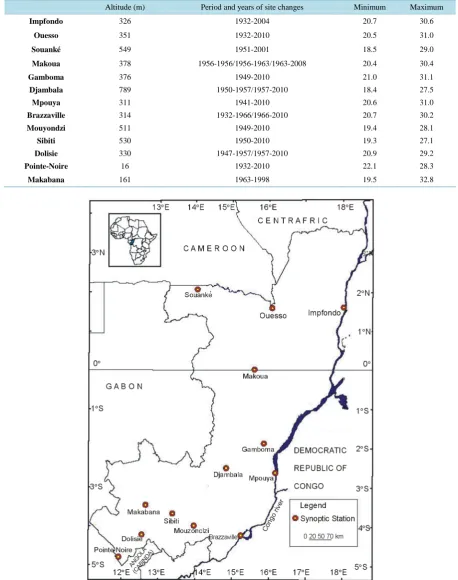
The data used in this study come from the archives of the “Direction Météorologie Nationale” of Congo-Braz- zaville. These dataset are extracted from the database of the Centre de Recherche et d’Etude sur l’Environne- ment (CR2E) of the Marien Ngouabi University. The database concerns the temperature of the air on a monthly time scale, from 1932 to 2010 of thirteen synoptic stations (Figure 1, Table 1). The station time-series are un-fortunately characterized by missing data. The data series of each station were scrutinized for possible moves and changes of instruments. After deleting the stations with missing data, a total of 12 synoptic stations re-mained that had sufficiently complete datasets, and which were deemed to not have moved substantially to in-fluence the homogeneity of their time series. Most meteorological stations have incurred no site far-reaching changes during the period under study (Table 1). The station of Brazzaville was relocated in 1966, Djambala in 1957, Loubomo in 1957 and Makoua in 1956 and in 1963.
3. Statistical Methods
Dolisie 330 1947-1957/1957-2010 20.9 29.2
Pointe-Noire 16 1932-2010 22.1 28.3
Makabana 161 1963-1998 19.5 32.8
[image:3.595.82.541.112.693.2]G. Samba, D. Nganga
Temperatures are transformed in absolute temperatures before their analysis. The annual and seasonal mean ab-solute temperatures at each station are standardized to obtain the annual and seasonal mean temperatures anomalies according to the relation:
ij i ij
i x x X
σ −
= (1)
where xij is the monthly or annual mean absolute temperatures for the station i in the year j, xi, the mean monthly or annual mean absolute temperatures for station i, and σi the standard deviation of annual totals.
Standardized time-series climate were used by many authors such as [27]-[29], to document interannual mean temperature variability. In this study, we also used the Expression (1) to depict the annual regime (Figure 2). This method was used to reduce the local climatic peculiarities. The normalized series are then averaged spa-tially.
The 12 synoptic stations were subjected to two non-parametric Mann-Kendall and Pettitt tests to detecting trends and abrupt changes in time-series over the period 1932-2010. The principles of this test have been largely described by Sneyers [30] and Vandiepenbeeck [31]. In the Mann-Kendall test, for each element
x i
i(
=
1
n
)
of a series y of length n, ni is the number of elements j which precede i (i > j) such as xi > xj. The trend statistic t of the test is computed as follows:1 n
i i
t n
=
=
∑
(2)The distribution of t, under the null hypothesis, is practically a normal distribution with the average and the variance given by the following Expressions (3) and (4):
( )
(
1)
4 n n
E t = − (3) and
( )
(
1 2)(
5)
72
n n n
Var t = − + (4)
[image:4.595.128.501.397.695.2]The reduced statistics of the test, given by u t
( )
, is thus compared to a normal distribution law.i
trend in the series. When values of
u t
( )
are significant, one concludes to a rising or decreasing trend, for( )
u t
> 0 oru t
( )
< 0, respectively.Another Figure of instability of the series results from an abrupt change of the series. This can put out by means of the test of Pettitt [32] applied by Démarée [33], Vanistsem and Démarée [34], Coops [35] of which the hypothesis does not consist of the equality of the averages of two sub-series from the initial series.
We consider xi, i = 1, 2, …, n, the terms of a continuous chronological series. For every t, t = 1, 2, …, n, we calculate the statistics:
Utn = 2Wt – t(n+1) with t 1 W = t j j R =
∑
where Rj is the rank of the element xj in the series lined un increasing order.Under the no hypothesis of the unpredictable character, the Wt are distributed according to a normal law with average and variance as:
( ) (
t)
1 E W =
2 t n+
(6) and var W =
( ) (
t 6)(
1)
12 t n− n+(7)
The probability UE associated with the statistics is given by:
(
)
(
)
( )
2(
3 2)
E
P U<UE = P U>UE exp−6 * U n +n
when we calculate the various statistics utn for t from 1 to n we can, in this series, look for the extreme values of utn. The critical value at the level of α = 0.05 is given by:
(
3 2)
(
) ( )
c
U − n +n * log 0.05 −6
The value of t such as
U
E > Uc is the estimation of a change. This change is in the increasing or decreasing sense as UE < 0 or UE > 0. The application of the test in the sub-series delimited to the point t can determine the stability of the sub-series.Different sub-periods from 1932 to 2010 were compared to examine if there was any change in temperature trends throughout the period of investigation. A change was detected and dated. A comparison between the two sub-periods was carried out using the t-test (8). Trends are indicated to be significant in the discussions of results. It is only when the “t”-test is significant that the shift in the average climate is validated. In the t-test, if we sup-pose that two sub-samples are different the observed difference between the averages of two sub-samples is sig-nificant.
Here is the analytical expression of “t”-test:
1 2
2 2
1 1 2 2
1 2 1 1 x x t n n n n
σ
σ
ν
− =+ × + (8)
G. Samba, D. Nganga
the first and second sub-samples; σ1 and σ2 the standard-deviations of the first and second sub-sample and
2
1 2
n
n
ν
= +
−, the degree of freedom. t follows a Student distribution.
Next section relating to the results our analyses are about on the determination of the trends.
4. Results
4.1. Average Monthly Temperatures
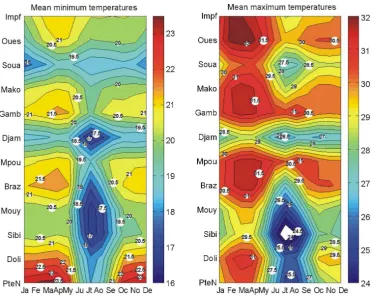
Our analyses of monthly trends of all stations point out large temporal differences in trends between months for individual stations. The monthly minimum and maximum temperatures average have been standardized and plotted for every station (Figure 2). The standardized monthly temperatures averages were used to study regime in Congo-Brazzaville. The main minimum and maximum temperatures average regimes of Congo-Brazzaville are displayed as a standardized monthly minimum and maximum temperatures average for every station (Figure 2). All stations are characterized by a bimodal regime; most of them show two peaks which are associated to three-month periods of March to May (MAM) and September to November (SON).
Figure 2 shows the monthly minimum and maximum temperatures spatial variability. This variability is characterized by a discontinuity of higher (red colour) or lower (blue colour) of the monthly temperatures in the inter-station. The monthly trends of each station were plotted and investigated after standardized monthly values. Figure 2 points out that stations in the same vicinity presented, similar monthly differences, similar increases and decreases in trend from one month to another, as well as monthly minimum and maximum trend.
4.2. Variability Times Series of Mean Annual Maximum and Minimum Temperatures
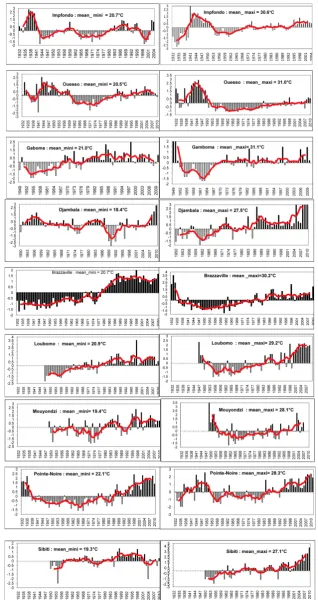
Figure 3 shows standardized time series of mean annual minimum and maximum temperatures at different sta-tions. It again shows, time series plots of the annual mean annual minimum and maximum temperatures evolu-tion over the Congo-Brazzaville. By linking anomalies and 5-years moving average we determine different pe-riods of the mean annual minimum and maximum temperatures evolution. Most of stations of Congo-Brazza- ville recorded mean annual minimum temperatures series with majority of negative anomalies during the 1930s, 1950s and 1960s. The decade 1950 shows a majority of negative anomalies. The 1970s, 1980s, 1990s and 2000s are characterized by mean annual minimum and maximum temperatures excess on the whole country. The 1980s and 1990s knew the most important mean annual maximum positives anomalies temperatures. The transi-tion between positive and negative anomalies decades is not uniform on the whole country. It appears either at the end of the 1960s, or during the 1970s for means annual minimum temperatures. The evolution of the mean annual minimum temperatures in Brazzaville is predominant, although there are important positive abnormali-ties during the 1990s. The increase annual temperatures begin at minimum temperatures of the 1960s, or during the 1970s before maximum temperatures after 1980s, 1990s.
The southern Congo-Brazzaville shows consecutive year periods with positives anomalies during the last year, whereas the northern have shown non-persistent mean annual minimum and maximum temperatures since the late 1970s. The major warming covered the whole Congo-Brazzaville. During the two last decades 1990s and 2000s, the mean annual minimum and maximum temperatures in all regions were above average.
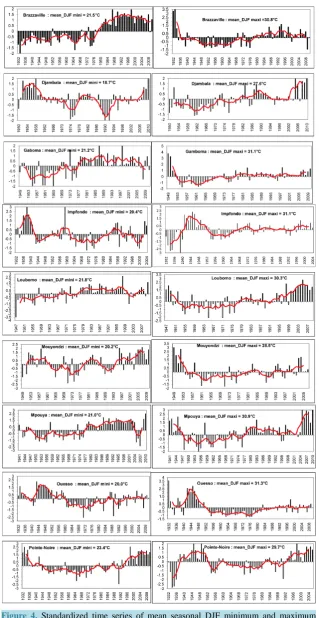
The season DJF is characterized by the warm months in major stations of Congo-Brazzaville. The time series of the DJF mean seasonal minimum and maximum temperatures (Figure 4) shows evolution characterized by alternating negative the decades 1950s and 1960s and positive anomalies the decades 1980s and 1990s. How-ever, we note some peculiarities in the evolution of the minimum and maximum temperatures by the lower posi-tive anomalies that appear during the 1980s.
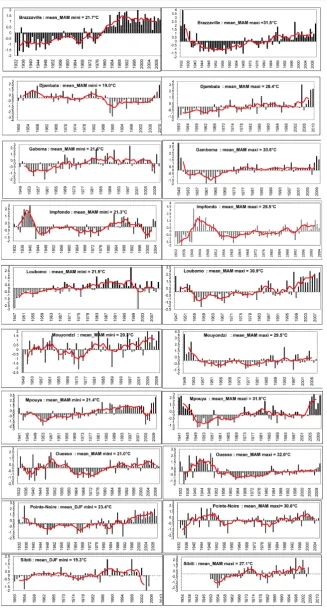
The season MAM is the period with higher warming months in the annual cycle at all stations over the coun-try. It’s the first warming peak over annual. The time series of the MAM mean seasonal minimum temperatures (Figure 5) shows the same temperatures evolution associated with every station that is characterized by negative and positive anomalies. Not peculiarities exist over the evolution of the temperatures between stations.
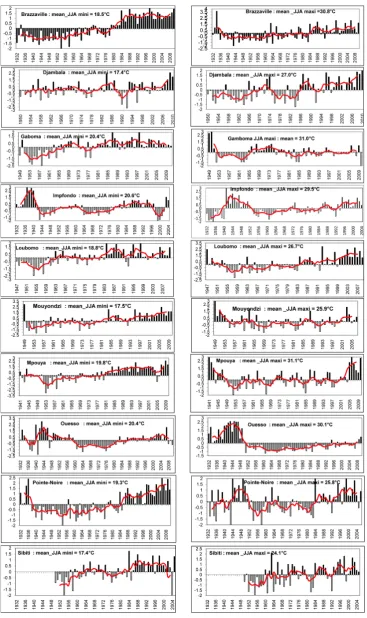
The time series of the JJA mean seasonal minimum temperatures (Figure 6) show the same temperatures evolution with positive anomalies in all stations during the decades 1950s and 1960s, and the 1980s and 1990s. On this season JJA the particularities is the minimum temperatures increases.
G. Samba, D. Nganga
G. Samba, D. Nganga
G. Samba, D. Nganga
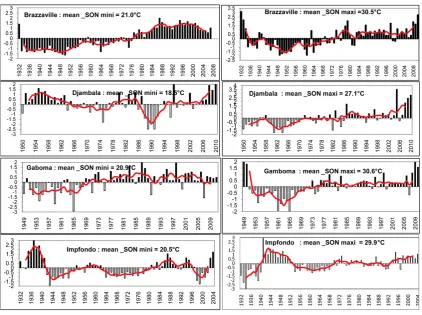
Figure 7. Standardized time series of mean seasonal SON minimum and maximum temperatures (bars) and 5-year moving averages (lines) with coefficient of variation over the period.
With regard to what precedes, the evolution of the mean minimum and maximum temperatures is recorded in different ways over the country. This evolution is marked by predominance of the positive anomalies over the two last decades in the second half of the 20th century and the start decade for 21st century.
4.3. Trends and Changes in the Mean Annual Maximum and Minimum Temperatures
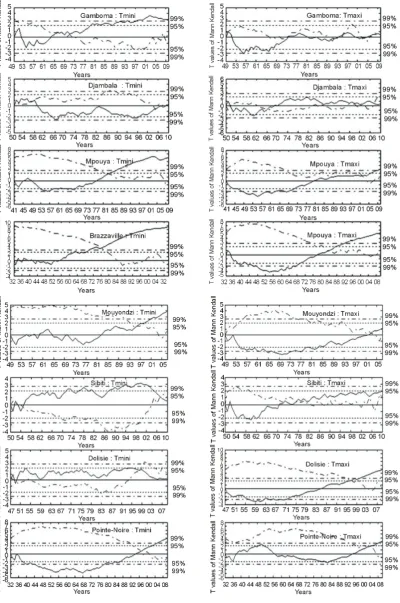
The non-parametric tests Mann-Kendall and Pettitt applied on the annual maximum and minimum temperatures series data showed an increase over major stations in Congo-Brazzaville (Figure 8). The Figure 8 shows an in-creasing trend of the temperatures series of the 12 stations. The results of the study showed spatial variability and indicate general warming over the study area (Figure 8). At national level, maximum and minimum tem-peratures showed a warming trend. Two warm phases were identified: the first was from the early in 1930s and late in 1940s, and the second was from the early in 1980s to the end of the period of study. All these studies, however, do not include the middle and the end of 1970s. From the middle to the end of 1990s, in general data showed a continued increase trend of the global temperatures. The Figure 8 points out the annual average minimum and maximum temperatures. Some other stations Brazzaville, Sibiti, Pointe-Noire… showed a posi-tive trend, with 7 of them significant. The effects of urbanization likely affect the temperature trends of these stations because of their location especially Brazzaville, Pointe-Noire, Dolisie and Ouesso stations. From the results above, it is evident that there is a general predominance of the positive trend in the times-series, although not always significant, for the period 1970 to 2010 over Congo-Brazzaville.
It also is interesting to note that 5 of the stations showed significant positive trends. It is already established that most stations showed a significant increase in maximum and minimum annual temperature for the period 1932 to 2010, as shown in Figure 8.
G. Samba, D. Nganga
We can conclude that there is gradual increase in annual mean temperature trends from 1960 to 2010. These results are consistent with those of Mpounza et al. [15] and Samba et al. [16]. A larger percentage of stations show significant increase trends which indicates a continuation of positive temperature trends for the decades 1980 and 1990. Those results obtained resemble with those of the global scale [35].
To investigate if there was an abrupt increase in annual mean maximum and minimum temperatures on a shorter time scale. The time series was subject to a Student’s t-test for the differences in mean of annual mean temperatures between the period from 1932 to a specific year and the period after that year to 2010. The higher the absolute value of the test statistic, the larger the difference is deemed to be in mean temperature between the period before a specific year and the period after that year, for the number of years utilized for each period. The change in the t-test statistic is shown in Table 2and Table 3. If the trend in annual mean temperature stays more or less constant, and if there had been a gradual increase in temperature trend throughout the whole period from 1950 to 2010, then the graph would have shown a gradual decrease in the values of the time series of the t-test statistic, but this is not the case. From 1980, with some exceptions, there is, rather, an increase in the test statistic from year to year, indicating a change in trend.
[image:14.595.91.537.354.721.2]Student’s test applied on two sub-samples allowed us to quantify the average difference in trends of mean annual temperatures, between the periods 1930 to 1970/1980 and 1980 to 2010 (Table 2, Table 3). The differ-ence between the two averages of two sub-period for 1930 to 1970/1980 and 1980 to 2010 has an average an-nual maximum and minimum temperature of a trend of +0.2˚C and +1.4˚C for the 6 stations. Though in the same period some stations has an average temperature of a decrease trend between −0.2˚C and −1.5˚C (Table 2, Table 3).
Table 2. Test of Student on sub-periods defined by Mann-Kendall and Pettitt test; corresponding unlike Temperatures minimum between two sub-periods (over the period 1932-2010).
Stations
DJF MAM JJA SON Years
P M (˚C) ∆ (˚C) P M (˚C) ∆ (˚C) P M (˚C) ∆ (˚C) P M (˚C) ∆ (˚C) P M (˚C) ∆ (˚C)
Impfondo 1932-1966 1967-2004
20.7 20.2 −0.5
1932-1940 1941-1966 1967-2004 22.2 21.0 21.2 −1.2 +0.2 1932-1946 1947-2004 20.9 20.5 −0.4
1932-1948 1949-2004
20.8 20.4 −0.3
1932-1948 1949-2004
21.0 20.6 −0.4
Ouesso 1932-1940 1941-2010
20.3 19.9 −0.4
1932-1980 1981-2010
20.8 21.3 0.5
1932-1972 1973-2010
20.5 20.4 −0.1
1932-1942 1943-1950 1950-2010 20.4 21.4 20.3 +1.0 −1.1
Souanké 1951-1981 1982-2001
18.0 17.8 −0.2
1951-1959 1960-1983 1984-2001 18.7 19.1 18.9 +0.4 −0.2 1951-1959 1960-2001 18.4 18.7 +0.3
1951-1959 1960-2001
18.6 18.7 +0.1
1951-1958 1959-1978 1979-2001 18.3 18.7 18.5 +0.4 −0.2
Gamboma 1949-1977
1978-2010 21.4 21.8 +0.4
1949-1979 1980-2010
20.8 21.2 +0.4
Djambala 1950-1962 1963-2010
19.1 18.6 −0.5
1950-1965 1966-2010
19.3 18.9 −0.4
1950-1954 1955-2010
18.6 18.5 -0.1
1950-1964 1965-2010
18.6 18.4 −0.2
Mpouya 1941-1987 1988-2010
20.9 21.4 +0.5
1941-1981 1982-2010
21.2 21.8 +0.6
1941-1985 1986-2010
19.5 20.4 +0.9
1941-1981 1982-2010
20.7 21.3 +0.6
1941-1984 1985-2010
20.6 21.2 +0.6
Brazzaville 1932-1980 1981-2010
21.1 22.3 +1.3
1932-1976 1977-2010
21.2 22.4 +1.2
1932-1980 1981-2010
17.7 19.9 +2.1
1932-1972 1973-2010
20.4 21.7 +1.3
1932-1988 1989-2010
20.3 21.7 +1.4
Mouyondzi 1949-1974 1975-2010
20.1 20.3 +0.2
1949-2005 2006-2010
20.3 20.7 +0.4
1949-1990 1991-2010
17.3 18.0 +0.7
1949-2007 2008-2010
19.7 20.1 +0.4
1949-1998 1999-2010
19.3 19.7 +0.3
Sibiti 1950-2007
2008-2010 20.3 20.0 −0.2
1950-1966 1967-2010
19.3 19.4 +0.1
1950-1970 1971-2010
19.1 19.3 +0.2
Dolisie 1947-1993 1994-2010
21.8 22.0 +0.2
1947-1963 1964-2010
20.8 21.2 +0.4
1950-1994 1995-2010
20.8 21.3 +0.5
Pointe-Noire 1932-2005 2006-2010
23.5 24.3 +1.0
1932-2002 2003-2010
23.3 24.3 +1.0
1932-1992 1993-2010
18.9 20.5 +1.6
1932-2000 2001-2010
22.4 23.4 +1.0
1932-2000 2001-2010
22.0 23.2 +1.1
Makoua 1956-1974 1975-1994 1995-2010 20.4 20.5 20.4 +0.1 −0.1 1956-1996 1997-2010 21.0 20.9 −0.1
1956-1973 1974-2010
Mpouya 1941-1987 1988-2010 30.8 32.1 +1.3 1941-2006 2007-2010 31.9 33.0 +1.2 1941-2005 2006-2010 30.7 32.1 +1.4 1941-2005 2006-2010 31.1 32.3 +1.2
Brazzaville 1932-1991 1992-2010
30.7 31.0 +0.3
1932-1991 1992-2010
31.4 32.1 +0.7
1932-1994 1995-2010
27.9 28.6 +0.8
1932-1986 1987-2010
30.3 31.0 +0.7
1932-1976 1977-2010
30.0 30.6 +0.6
Mouyondzi 1949-1956
1957-2010 30.2 29.4 −0.8
1949-2000 2001-2010
28.3 28.7 +0.4
Sibiti 1950-1982
1983-2010 23.9 24.4 +0.5
1950-2003 2004-2010
27.1 28.1 +1.0
Dolisie 1947-2000 2001-2010
30.2 31.0 +0.8
1947-2002 2003-2010
30.8 31.9 +1.1
1947-1999 2000-2010
26.5 27.9 +1.4
1947-1996 1997-2010
29.0 30.1 +1.1
1947-1999 2000-2010
29.1 30.2 +1.1
Pointe-Noire 1932-1944 1945-2010
29.5 29.8 +0.3
1932-2000 2001-2010
25.7 26.3 +0.6
1932-2006 2007-2010
28.3 29.4 +1.1
Makoua 1956-1976 1977-2010 Ns 1956-1964 1965-2010 30.6 30.8
+0.2
1956-2000 2001-2010
31.5 31.9 +0.4
1956-2000 2001-2010
29.2 29.6 +0.4
1956-1961 1962-1994 1995-2010 30.5 30.4 30.8 −0.1 +0.4
Annual mean minimum temperatures know the first increase after period 1970 and after 1970 (between +0.2˚C and +1.4˚C). However, trends of annual mean minimum temperature showed clear and significant changes, for comparison with the results of this study. Maximum temperatures increased between +0.5˚C and +1.5˚C.
Temperatures increase is more important in urban (big Town) stations than non-urban (small Town). For ur-ban stations the minimum temperatures have increase trend more +1.0˚C on average and for non-urban stations a trend of under +1.0˚C.
4.4. Trend Analysis Seasonal Minimum and Maximum Temperatures
The results of the above seasons are shown in Figure 9, Figure 10, Figure 11 and Figure 12respectively for the season December to February (DJF), March to May (MAM), June to August (JJA) and September to No-vember (SON). Those results indicate clearly the increase of temperature trends after 1970s with many nuances between season’s temperatures in stations.
The non-parametric Mann-Kendall trend test results, shows a significant trend in the seasonal minimum and maximum temperatures average in the Congo-Brazzaville over the period 1932-2010. The Figure 9, Figure 10, Figure 11and Figure 12 related to seasonal minimum temperatures average in northern stations point out stable evolution (Ouesso, Impfondo) and show significant decreases. Those Figures give the graphical result of the Mann-Kendall trend test, indicating a significant decline in mean minimum temperatures from the 1940s, 1950s and 1960s. So, in the whole country we can identify two sub-periods: before (first period) and after (second pe-riod) the 1980s.
G. Samba, D. Nganga
G. Samba, D. Nganga
G. Samba, D. Nganga
From the t-test student the decline was compared between two sub-periods revealed by Mann-Kendall (Table 2, Table 3). The southern stations (e.g., Brazzaville) show a significant warming in the mean MAM seasonal minimum and maximum temperatures, from +1.0˚C to +1.2˚C. The mean MAM seasonal minimum and maxi-mum temperatures in Dolisie increased from +1.1˚C and in Pointe-Noire it increased from +1.0˚C. We note an opposition of evolution of minimum and maximum temperatures at the annual scale and the level of the season MAM between the north and the south. This opposition of minimum and maximum temperatures is not observed for the season SON (Figure 12). Indeed, the majority of the stations show a significant increase of rains during the season SON.
4.5. Diurnal Temperature Range (DTR)
The global trend is for the DTR trend to be negative over the last half century due to the fact that, trends of minimum temperatures are higher than trends in maximum temperature (Figures 13-14). Four stations showed positive DTR trends, with five of them significant, and six stations showed negative trends. The stations in the southern showed high positive trends due in part to the high trends in annual mean maximum temperature, also because of the small negative trends in annual mean minimum temperatures for some of the stations. Other sta-tions with the same tendency are situated in the northern, but their trends in DTR were much smaller, although significant for Mpouya station. Most some of these stations with negative or positive trends showed a substantial significant increase in minimum temperatures, whatever the trends in maximum temperatures. The results ob-tained are similar with those of the other studies on the in country Africa [36] or global scale [35].
4.6. Effects of Urbanization on Temperature Trends
In this section we compare the temperature trends of the urban stations with the rest of stations in small cities. The stations that knew substantial increase of urbanization in their vicinities during the study period are Brazza-ville, Pointe-Noire and Dolisie. All these stations of big town knew an increase of the trends maximum and minimum temperatures more than +1.0˚C. Although, the stations in small towns in the forest zone (Sibiti, Imp-fondo, Makoua), show a increasing of trends trends maximum and minimum temperatures. By contrast, the trends maximum and minimum temperatures of Brazzaville, Pointe-Noire and Dolisie, differ strongly to other stations, which are located in the small towns. This is due certainly by the effect of urbanization. These stations show a significant increase in mean annual minimum temperature more than +1.0˚C compared with +0.2˚C to +0.7˚C, in the small city.
In the average annual minimum temperature trends, the urban stations (Brazzaville, Pointe-Noire) show, on average, a significant positive trend of +1.1˚C and +1.4˚C compared with a significant +0.4˚C or +0.6˚C for non-urban stations (Impfondo, Sibiti, Mouyondzi); for average annual maximum temperature trends is a signifi-cant +0.6˚C, at +1.1˚C (urban) compared with a significant more than +1.1˚C (non-urban).
By splitting urban stations and non-urban, in general the average minimum annual temperatures trends of urban stations showed more positive trend than non-urban stations. This means that there might be a strong increase in minimum temperatures compared with maximum temperatures for urban stations than the non-urban stations.
The reason for the difference in trends seems to be the increase of the mean minimum temperature for urban stations than the non-urban stations, although the differences in mean maximum temperature between urban and non-urban station also seem to play a role to a certain point.
5. Discussion and Conclusions
G. Samba, D. Nganga
urbanization zones seems to be a sign of sensitivity space of Congo to the global climate change.
However, there does not seem to be much spatial coherence in the results of temperature trends for other sea-sons. Temperature trends were also found not to be consistent between seasons, with MAM being the season of highest temperature trends on average and DJF being the season of lowest trends. DTR trends mean annual minimum and maximum temperature trends; many stations showed positive trends.
The conclusions are as follows:
• It is possible to establish a general increase of temperatures for all stations, and the annual temperature is characterised by a rise of temperatures quasi generalized to all stations; all series show a relative precipita-tion amount in the course of decades 1970 and 1990 compared to other decades. However, temperatures seem to begin a rise from the 1990s.
• It was found that there was rather a relatively increase minimum temperatures in the early 1970s, this being the main cause of the general increase average temperatures over the whole period from 1932 to 2010.
Acknowledgements
The authors wish to thank the Direction de la Météorologie nationale du Congo-Brazzaville for providing the data used in this study.
References
[1] Motha, R.P., Leduc, S., Steyeart, L.T., Sakamoto, C.M. and Strommen, N.O. (1980) Precipitations Patterns in West Africa. Monthly Weather Review, 108, 1567-1578.
http://dx.doi.org/10.1175/1520-0493(1980)108<1567:PPIWA>2.0.CO;2
[2] Janicot, S.(1992) Spatiotemporal Variability of West African Rainfall. Part 2: Associated Surface and Air Mass Cha-racteristics. Journal of Climate, 5, 499-511.
http://dx.doi.org/10.1175/1520-0442(1992)005<0499:SVOWAR>2.0.CO;2
[3] Janicot, S. and Fontaine, B. (1993) L’évolution des idées sur la variabilité interannuelle récente des précipitations en Afrique de l’Ouest. La Météorologie, Série XIII, 1,28-51.
[4] Fontaine, B., Janicot, S. and Moron, V. (1995) Rainfall Anomaly Patterns and Wind Field Signals over West Africa in August (1958-1989). Journal of Climate, 8, 1503-1510.
http://dx.doi.org/10.1175/1520-0442(1995)008<1503:RAPAWF>2.0.CO;2
[5] Mahé, G., L’Hôte, Y., and Olivry, J.C. (2001) Trends and Discontinuities in Regional Rainfall of West and Central Africa: 1951-1989. Hydrological Sciences, 46, 211-226. http://dx.doi.org/10.1080/02626660109492817
[6] Nicholson, S.E., Dezfuli, A.K. and Klotter, D. (2012) A Two-Century Precipitation Data Set for the Continent of Afri-ca. Bulletin of the American Meteorological Society, 93, 1219-1231. http://dx.doi.org/10.1175/BAMS-D-11-00212.1
[7] Nicholson, S.E. and Dezfuli, A.K. (2013) The Relationship of Rainfall Variability in Western Equatorial Africa to the Tropical Oceans and Atmospheric Circulation. Part I: The Boreal Spring. Journal of Climate, 26, 45-65.
http://dx.doi.org/10.1175/JCLI-D-11-00653.1
G. Samba, D. Nganga
http://dx.doi.org/10.1002/(SICI)1097-0088(19970315)17:3<291::AID-JOC120>3.0.CO;2-1
[9] Richard, Y., Camberlin, P., Fauchereau, N. and Mulenga, H. (2001) Cohérence inter-saisonnière de la variabilité pluviométrique interannuelle en Afrique du Sud. L’Espace Géographique, 31, 63-72.
[10] Ogallo, L.J. (1988) Relationship between Seasonal Rainfall in East Africa and the Southern Oscillation. Journal of Climate, 8, 31-43. http://dx.doi.org/10.1002/joc.3370080104
[11] Beltrondo, G. and Camberlin, P. (1993) International Variability of Rainfall in the Eastern Horn of Africa and indica-tors of Atmospheric Circulation. Journal of Climate, 13, 533-546. http://dx.doi.org/10.1002/joc.3370130505
[12] Camberlin, P. (1997) Rainfall Anomalies in the Source Region Nile and Their Connection with the Indian Summer Monsoon. Journal of Climate, 10,1380-1392.
http://dx.doi.org/10.1175/1520-0442(1997)010<1380:RAITSR>2.0.CO;2
[13] Smakhtina, O. (1998) Historical Changes in Rainfall Pattern in the Eastern Cape Province, South Africa. Proceedings of International Conference on Water Resources Variability in Africa During the 20thCentury, Côte d’Ivoire, 16-19 November 1998, 135-142.
[14] Mutai, C.C. and Ward, M.N. (2000) East African Rainfall and the Tropical Circulation/Convection on Intraseasonal to Interannual Timescales. Journal of Climate, 13, 3915-3939.
http://dx.doi.org/10.1175/1520-0442(2000)013<3915:EARATT>2.0.CO;2
[15] Mpounza, M. Samba, G. Biona B.C. and Massouangui-Kifouala, M. (2003) L’évolution des températures dans le sud du Congo-Brazzaville (1950-1998). Publication de l’ Association Internationale de Climatologie, 15, 428-433. [16] Samba, G., Nganga, D. and Mpounza, M. (2008) Rainfall and Temperature Variations over Congo-Brazzaville be-
tween 1950 and 1998. Theoretical and Applied Climatology, 91, 85-97. http://dx.doi.org/10.1007/s00704-007-0298-0 http://link.springer.com/article/10.1007/s00704-007-0298-0
[17] Hughes, S.H. and Balling, R.C. (1996) Urban Influences on South African Temperature Trends. International Journal of Climatology, 16, 935-940. http://dx.doi.org/10.1002/(SICI)1097-0088(199608)16:8<935::AID-JOC64>3.0.CO;2-V
[18] Unganai, L.S. (1997) Surface Temperature Variation over Zimbabwe between 1897 and 1993. Theoretical and Applied Climatology, 56, 89-101. http://dx.doi.org/10.1007/BF00863786
[19] Hulme, M., Doherty, R., Ngara, T., New, M. and Lister, D. (2001) African Climate Change: 1900-2100. Climate Re- search, 17, 145-168 http://dx.doi.org/10.3354/cr017145
[20] King’uyu, S.M., Ogallo, L.A. and Anyamba, E.K. (2000) Recent Trends of Minimum and Maximum Surface Tempe- ratures over Eastern Africa. Journal of Climate, 13, 2876-2886.
http://dx.doi.org/10.1175/1520-0442(2000)013<2876:RTOMAM>2.0.CO;2
[21] Kruger, A.C. and Shongwe, S. (2004) Temperature Trends in South Africa: 1960-2003. International Journal of Cli-matology, 24, 1929-1945. http://onlinelibrary.wiley.com/doi/10.1002/joc.1096/pdf
[22] IPCC (2007) Climate Change 2007: The Physical Science Basis. In: Solomon, S., Qin, D., Manning, M., Chen, Z., Marquis, M., Averyt, K.B., Tignor, M. and Miller, H.L., Eds., Contribution of Working Group I to the 4th Assessment Report of the Intergovernmental Panel on Climate Change of the Intergovernmental Panel of Climate Change, Cam- bridge University Press, Cambridge, 996 p.
[23] Kayane, I. (1960) Temperature Increase Due to the Expansion of Urban Area in Tokyo. Tenki, 7,269-274. [24] Sakakibara, Y. (1996) A Change of Air Temperature with Reurbanization in Tsukuda. Tenki, 43, 25-31.
[25] Sakakibara, Y. and Owa, K. (2005) Urban-Rural Temperature Differences in Coastal Cities: Influence of Rural Sites.
International Journal of Climatology, 25, 811-820. http://onlinelibrary.wiley.com/doi/10.1002/joc.1180/pdf http://dx.doi.org/10.1002/joc.1180
[26] Hubbard, K.G. and Lin, X. (2002) Real-Time Data Filtering Models for Air Temperature Measurements. Geophysical Research Letters, 29, 671-674. http://dx.doi.org/10.1029/2001GL013191
[27] Kraus, E.B. (1977) Subtropical Droughts and Cross-Equatorial Energy Transports. Monthly Weather Review, 105, 1009-1018. http://dx.doi.org/10.1175/1520-0493(1977)105<1009:SDACEE>2.0.CO;2
[28] Nicholson, S.E. (1986) The Spatial Coherence of African Rainfall Anomalies: Interhemispheric Teleconnections. Jour- nal of Climate and Applied Meteorology, 25, 1365-1381.
http://dx.doi.org/10.1175/1520-0450(1986)025<1365:TSCOAR>2.0.CO;2
[29] Osman, Y.Z. and Shamseldin, A.Y. (2002) Qualitative Rainfall Prediction Models for Central and Southern Sudan Us-ing El Niño-Southern Oscillation and Indian Ocean Sea Surface Temperature Indices. International Journal of Cli- matology, 22, 1861-1878. http://dx.doi.org/10.1002/joc.860
[30] Sneyers, R. (1975) L’analyse statistique des séries d’observations. Note Technique, 143, OMM, No. 415, 192 p.
[38] Mühlenbruch-Tegen, A. (1992) Long-Term Surface Temperature Variations in South Africa. South African Journal of Science, 88,197-205.
[39] Rosenblüth, B., Fuenzalida, H.A. and Aceituno, P. (1997) Recent Temperature Variations in Southern South America.
International Journal of Climatology, 17, 67-85.
http://dx.doi.org/10.1002/(SICI)1097-0088(199701)17:1<67::AID-JOC120>3.0.CO;2-G
Scientific Research Publishing (SCIRP) is one of the largest Open Access journal publishers. It is currently publishing more than 200 open access, online, peer-reviewed journals covering a wide range of academic disciplines. SCIRP serves the worldwide academic communities and contributes to the progress and application of science with its publication.
Other selected journals from SCIRP are listed as below. Submit your manuscript to us via either