CASO CLÍNICO
RESUMO
Febre e exantema são uma combinação comum de sintomas no jovem adulto. A investigação etiológica é geralmente direcionada para as doenças mais frequentes, mas apresentações atípicas de condições menos frequentes também devem ser recordadas. Apresentamos o caso clínico de uma mulher portuguesa de 44 anos que apresentou quadro caracterizado por febre, conjuntivite, tosse e exantema, evoluindo rapidamente para hepatite e pneumonia extensa com insuficiência respiratória. Embora afirmasse ter o programa nacional de vacinação actualizado, os achados clínicos e o resultado serológico foram conclusivos de pneumonia primária a sarampo típico. Contudo, algumas manifestações menos típicas tornaram o diagnóstico menos óbvio. Embora a forma rara de pneumonia primária a sarampo seja mais frequente nos doentes imunodeprimidos, a nossa doente era imunocompetente. A ausência de contágio, tal como neste caso, ocorre mais frequente no sarampo atípico. Este caso clínico pretende mostrar a importância da confirmação do estado vacinal nos adultos, sublinhando ainda algumas apresentações atípicas de sarampo típico.
Palavras-chave: Exantema; Febre; Sarampo
Fever and Rash: Revisiting Measles
Febre e Exantema: Recordar o Sarampo
Joana Rodrigues BARBOSA1,*, Ana Silva MARTINS2,*, Jorge RUIVO3, Leonor CARVALHO3 Acta Med Port 2018 Jun;31(6):341-345 ▪ https://doi.org/10.20344/amp.9776
ABSTRACT
Fever and rash are a common combination of symptoms in the young adult patient. The etiologic investigation is usually oriented towards the most common diseases, but atypical presentations of less frequent conditions should also be recalled. We describe the case of a 44 year-old Portuguese woman who presented with fever, conjunctivitis, cough and rash, rapidly evolving to hepatitis and extensive pneumonia with respiratory failure. Although she claimed to be vaccinated according to the national immunisation schedule, a final diagnosis of primary measles pneumonia was clinically made and confirmed by serology. However, some less typical features mislead us initially. Although the rare form of primary measles pneumonia is more prevalent among immunosuppressed patients, our patient was immunocompetent. Moreover, absence of contagiousness, as was the case, occurs more frequently in atypical measles. This case highlights the need to always confirm the alleged vaccination status in adults and raises attention to some unusual features of typical measles.
Keywords: Exanthema; Fever; Measles
* Co-primeiros autores.
1. Serviço de Pneumologia. Centro Hospitalar de Lisboa Norte. Lisboa. Portugal.
2. Serviço de Hematologia e Transplantação de Medula. Centro Hospitalar de Lisboa Norte. Lisboa. Portugal. 3. Serviço de Medicina 1. Hospital de Santa Maria. Centro Hospitalar de Lisboa Norte. Lisboa. Portugal. Autor correspondente: Jorge Ruivo. [email protected]
Recebido: 11 de outubro de 2017 - Aceite: 01 de março de 2018 | Copyright © Ordem dos Médicos 2018
INTRODUCTION
Fever and rash are a common combination of illness presenting symptoms in the adult patient. Etiologic investigation is usually oriented towards the most common diseases within the infectious, autoimmune or drug-related categories. However, less frequent entities should be kept in mind until properly ruled out. Furthermore, both rare and common entities can often be more challenging due to atypical presentations.
CLINICAL CASE
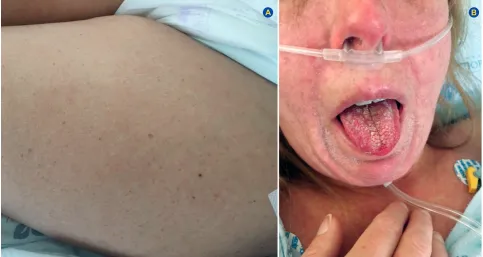
A 44-year-old Caucasian woman presented to the emergency department with fever, odynophagia and rash with caudal extension, accompanied by worsening dyspnoea, dry cough, myalgia, vomiting and diarrhoea over the week before (Fig. 1). The diagnosis of tonsillitis was assumed by her General Practitioner three days after fever onset and she was prescribed amoxicillin/clavulanic acid and nimesulide. She had a prior history of epilepsy (treated with topiramate for several years) and occasional smoking habits. She worked in an elderly care facility in a rural setting. She was exposed to cats but had no history of recent travelling, drug allergies, drug abuse or contact with other ill people.
CASO CLÍNICO
Figure 2 – Generalized maculopapular skin rash (A), including face and sparing perioral skin; edema, enanthema and flaking of the tongue (B)
A B
(Fig. 4).
Due to the worsening respiratory failure and rash progression, at that time with petechial areas, prednisolone was started assuming a possible DRESS syndrome (RegiSCAR score of 4) and she was admitted to the Intensive Care Unit for invasive mechanical ventilation. Bronchofibroscopy documented a lymphocytic alveolitis (45% lymphocytes; CD4/CD8 ratio of 0.1; 2% eosinophils). Extubation was possible on day three. Skin biopsy was suggestive of viral exanthem, leading to steroid
CASO CLÍNICO
Figure 3 – Radiological progression of the interstitial pulmonary infiltrate (A) First day after admission; (B) and (C) day 3 after admission (with a difference of 9 hours)
A B C
Barbosa JR, et al. Revisiting measles, Acta Med Port 2018 Jun;31(6):341-345
Table 1 – Laboratory data and diagnostic workup
Laboratory data
Hospital admission Hospital day 1 On discharge Reference Range, Adults
Hemoglobin (g/dL) 15.5 13.9 12.2 12.0 - 15.3
White-cell count (x109/L)
Neutrophils Lymphocytes Eosinophils Basophils Monocytes
9.270
92.6% / 8.58 4.6% / 0.43
0.2% / 0.02 0.5% / 0.05 2.1% / 0.19
7.700 91.6% / 7.05
5.9% / 0.45
0.7% / 0.05 0.2% / 0.02 1.6% / 0.12
13.330 79.1%/ 10.55
12.5%/ 1.67 0.1% / 0.01 0.1% / 0.01 8.2% / 1.09
4.0 - 11.0 1.9 - 7.5 1.0 - 4.8 0.0 - 0.5 0.0 - 0.2 0.1 - 1.0
Platelet count (x109/L) 227 196 675 150 - 450
Aspartate aminotransferase (U/L) 97 97 14 0 - 32
Alanine aminotransferase(U/L) 100 81 26 0 - 33
Y-Glutamyltransferase (UI/L) 150 141 110 0 - 40
Total bilirubin (mg/dL) 2.0 1.95 0.49 < 1.2
Alkaline phosphatase (U/L) 205 107 35 -105
Amylase (U/L) 55 496 13 - 53
Lactate dehydrogenase (U/L) 641 100 - 250
Albumin (g/dL) 2.8 3.5 - 5.2
Sodium (mmol/L) 132 138 139 135 - 154
Potassium (mmol/L) 3.1 3.9 3.5 - 5.1
C-reactive protein (mg/dL) 9.82 11.9 0.240 < 0.5
Erythrocyte sedimentation rate (mm) 33 ≤ 12
complicated by primary measles virus pneumonia and hepatitis was made. None of her relatives or friends had been infected. She was discharged with oral steroids and a complete clinical resolution was attained at follow-up.
DISCUSSION
Measles is a highly contagious disease caused by a RNA virus of the Paramyxoviridae family.1 Pneumonia is the most common severe complication and accounts for most measles-associated morbidity and mortality, presenting in two main forms: primary measles virus pneumonia and secondary bacterial/viral pneumonia, which is associated with the immunosuppression caused by the virus.1-3
Primary measles pneumonia, known as Hecht’s giant cell pneumonia, is caused by measles virus inclusions and
only occurs in 3% - 4% of infected individuals, mainly immunosuppressed.2,4 It occurs early in the disease course
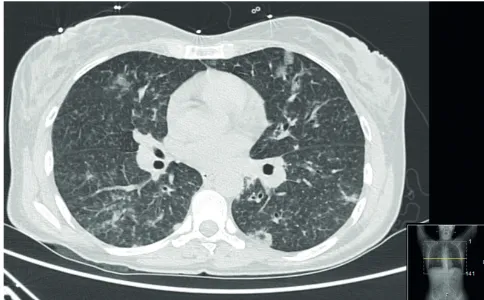
and is associated with mixed reticular opacities, air-space consolidation and lymph node enlargement on CXR.2 CT findings include ground-glass attenuation, air-space consolidation and small centrilobular nodules.2 Secondary pneumonia is mainly caused by bacterial infection, but viral infection is also possible, most frequently by adenovirus.1,3,5
It has a later onset and is characterized by a sudden exacerbation with symptoms and signs that usually begin 5 to 10 days after the rash, neutrophilic leukocytosis and lobar consolidation in the CXR.6,7
CASO CLÍNICO
admitted right at the beginning of the last reported outbreak in Portugal (February - May 2017). There were 28 confirmed cases during the epidemic, of which 16 were unvaccinated and 19 were adults.10
In Portugal, no endemic transmission had been reported since 2005 and the rate of immune individuals is estimated at 93.4%.10 The latter can be explained by the fact that measles
vaccine was introduced in the Portuguese mandatory immunisation schedule for all children aged 12 - 15 months in 1974.10 Therefore, the high levels of vaccination coverage
and immunity in Portugal led us to initially pursue other diagnostic hypotheses, including DRESS syndrome, given the recent drug exposure, eosinophilia, lymphadenopathy, rash, and hepatic and pulmonary involvement, even prompting us to start corticosteroids. However, our patient was not vaccinated for measles, as she was born in 1972 and was not a candidate for mandatory vaccination at the time. In addition, there were some less common features in the typical measles setting which also mislead us at the beginning. Although the rare form of primary measles pneumonia is more prevalent among immunosuppressed patients, our patient was immunocompetent. Moreover, the absence of contagiousness occurs more frequently in atypical measles.11 The fact that our patient did not infect any of her peers demonstrates the high levels of vaccination coverage in the Portuguese society. In this case, corticosteroids improved the final outcome since treatment with steroids has been reported as beneficial in severe measles.12 Currently, the recommended schedule
Figure 4 – Chest CT showing scattered and multifocal ground glass opacities and densities, septal thickening and micronodulation (day 1)
for adults born on or after 1970 without previous measles history is one single dose.10
To summarize, our unvaccinated immunocompetent patient presented typical symptoms of measles that evolved rapidly to a rare complication, highlighting the need to promptly diagnose measles in adults even in low incidence regions and to collect a thorough vaccination history.
PROTECTION OF HUMANS AND ANIMALS
The authors declare that the procedures were followed according to the regulations established by the Clinical Research and Ethics Committee and to the Helsinki Declaration of the World Medical Association.
DATA CONFIDENTIALITY
The authors declare having followed the protocols in use at their working center regarding patients’ data publication.
PATIENT CONSENT
Obtained.
CONFLICTS OF INTEREST
All authors report no conflict of interest.
FUNDING SOURCES
CASO CLÍNICO Barbosa JR, et al. Revisiting measles, Acta Med Port 2018 Jun;31(6):341-345
REFERENCES
1. Moss WJ. Measles. Lancet. 2016;390:2490-502.
2. Kim EA, Lee KS, Primack SL, Yoon HK, Byun HS, Kim TS, et al. Viral pneumonias in adults: radiologic and pathologic findings. Radiographics. 2002;22:S137-49.
3. Perry R, Halsey N. The clinical significance of measles: a review. J Infect Dis. 2004;189:S4-16.
4. Rafat C, Klouche K, Ricard JD, Messika J, Roch A, Machado S, et al. Severe measles infection - the spectrum of disease in 36 critically ill adult patients. Medicine. 2013;92:257-72.
5. Quiambao BP, Gatchalian SR, Halonen P, Lucero M, Sombrero L, Paladin FJ, et al. Coinfection is common in measles-associated pneumonia. Pediatr Infect Dis J. 1998;17:89-93.
6. Qi S, Jia C, Yin Y, Measles. In: Li H, editor. Radiology of infectious disease: Volume 1. Beijing: Springer; 2015. p. 515-40.
7. Lee F, Treanor J. Viral infections. In: Broaddus V, Mason R, Ernst J, King T, Lazarus S, Murray J, editors. Murray and Nadel’s textbook of respiratory medicine. 6th ed. Milton: Elsevier; 2016. p. 546-8.
8. World Health Organization. Distribution of measles cases by country and by month 2011-2017. Measles and rubella surveillance data. [consulted 2017 Aug 08]. Available from: http://www.who.int/immunization/ monitoring_surveillance/burden/vpd/surveillance_type/active/measles_ monthlydata/en/.
9. Direção Geral da Saúde. Resumo da atividade epidémica do sarampo na Europa, 30 de Maio de 2017. [consulted 2017 Aug 08]. Available from: https://www.dgs.pt/?cr=32983.
10. George F, Valente J, Augusto GF, Silva AJ, Pereira N, Fernandes T, et al. Measles outbreak after 12 years without endemic transmission, Portugal, February to May 2017. Euro Surveill. 2017;22:pll=30548. 11. Benharroch D. Atypical measles syndrome - a brief review. Ann Clin
Cytol Pathol. 2016;2:1039.