Munich Personal RePEc Archive
Regional social mobility as a factor
affecting small and medium-sized
enterprises’ development
Wach, Krzysztof
Cracow University of Economics
2007
Online at
https://mpra.ub.uni-muenchen.de/31600/
Department of Entrepreneurship and Innovation Cracow University of Economics
31-510 Kraków, ul. Rakowicka 27, Poland E-mail: [email protected]
REGIONAL SOCIAL MOBILITY AS A FACTOR AFFECTING SMALL
AND MEDIUM-SIZED ENTERPRISES’ DEVELOPMENT
Abstract
Regional circumstances play a crucial role in socio-economic situation of labour mar-ket. Its competitiveness depends not only on measurable factors, but also on soft factors. Nowadays more and more researchers and scientists pay their attention to the importance of social capital. Fragmentariness of scientific knowledge based on empirical investigation con-ducted in Polish reality, makes the author to prepare own empirical research in this field. The aim of the paper is to present the result of the research conducted in Southern Poland in late-2004. The region was defined as the area of two provinces Małopolska and Śląsk, but the choice was not stochastic. These provinces makes one region according to NUTS-1 nomclature. The research was conducted on a random sample of 109 small and medium-sized en-terprises localized in Southern Poland. Descriptive statistics (arithmetic average, median, mo-dal, quartile) as well as verifying tools (chi-square statistics, U Mann Whitney test) were used in order to verify the hypotheses.
Key words: regional labour markets(R23), geographic labour mobility (J61), regional eco-nomics (R19), personnel ecoeco-nomics (M59)
Introduction
Social mobility and - wider - social capital plays a very important role in modern economy, which is determined under the area of knowledge-based economy. Local and re-gional labour market can be perceived and investigated by many different points of view. One of the determinants of competitiveness of regional labour market resulting in good socio-economic situation of local and regional labour market is social mobility of local community. The aim of the paper is to present empirical verification of regional social mobility as a factor affecting enterprises’ development. During the conducted research the following hypothesis was tested: Social mobility in a region impacts small and medium-sized enterprises develop-ment.
Social mobility as a determinant of regional labour resources competitiveness
88 Krzysztof Wach
the basis of differences in socio-demographic variables and the regional industry structure. Entrepreneurial attitudes are to some extent dependent on the region of origin, but a number of questions concerning the regional influence still remain unresolved in a theoretical and empirical way (Bergman, 2002), and this was the inspiration of conducting this research. The empirical study was based on the modified GEM/REM model. The survey was based on the numerous questions which thematically can be divided into three groups: local business envi-ronment, the entrepreneurial attitude of the owner and the characteristics of the firm as well as the development of a firm. The modified model was based on the first three factors and then compared with the last one in order to verify the hypothesis. This thesis are quite interesting because there hasn’t been such research (Tamásy, 2002) so far. The factors based in regional business environment can be divided into two groups: stimuli and barriers. And this was one of the goals of the research, that is to identify the regional factors as stimuli and barriers for development of SMEs.
One of the regional factors affecting small and medium-sized enterprises’ develop-ment is social mobility. Human resources are the only kind of capital, which has autonomous ability to increase its value. Knowledge-based-economy is more often in focus of scientists’ interest. The skills of using and enriching knowledge in present reality is the basis of com-petitive advantage. Apart from comprehensive knowledge, basic subject of trainings should be ways of worker's behaviour during interactions as well as development of his psycho-social competences. The most important issue taking human resources into consideration is social mobility in a given region.
Social mobility being understood as readiness of local community to active participa-tion in economic processes determines entrepreneurial behaviours in a region. This factor is often defined as social capital (Westlund, Bolton, 2003, p. 77-113); (Fukuyama, 1997). To this group of factors such elements as local mass media, social associations, political parties, business as well as employers’ and entrepreneurs’ organizations should be counted. The val-ues and social norms, especially on regional level, which result in willingness to bearing the risk, susceptibility to planning. Regional values and norms are quintessence for entrepreneu-rial process resulting in growth of new firms. Attitudes of local and regional population (among others resourcefulness, entrepreneurship, creativity and modern thinking) create con-ditions for development of small and medium-sized enterprises on region level, and their lack makes the important barrier for development of small and medium-sized enterprises, as the positive opinion of entrepreneurship in human feelings favours spreading this phenomenon (Francik, 1996, p. 104). Thus, as main barriers it is necessary to point out first of all state-care expectations of a local community as well as others mental barriers. In this context Jewtuchowicz introduces the notion of new logic economic development, which seeks solu-tions enabling given community regional factors of growth to contribute to the mobilization of local and regional community (Jewtuchowicz, 1995, p. 48). Local authorities should create suitable and favourable conditions for functioning of firms in a region, and entrepreneurs’ task is to use them for their benefits. Creating a proper local culture, which is a necessary condition here, favours development of entrepreneurial and innovative attitudes among local communities (Francik, 2003, p. 75-78).
Methodological assumptions
as random sample using REGON database, and the second was chosen intentionally, that means all commune authorities form the region were chosen for research.
Manager perception was chosen as an operationalization method, thus it assures the ac-ceptable correctness and the reliability, and first of all tops other methods in relation to practi-cal usage, what is more it is applied in analogous research very often (Lyon, Lumpki, Dess, 2000, p. 1055-1085). This method was applied for all qualitative variables (Konecki, 2000, p. 86). Thus a survey (proceeded with a diagnostic pre-survey) was applied as a main investiga-tive technique, replenished with technique of observation. Each area was verified by asking from 5 to 7 questions. For quantitative variables as operationalization method data analysis was applied. In support of received and accepted variables the questionnaire of inquiry was constructed as a basic investigative tool. Qualitative approach in an inquiry was applied mainly, which is the most often applied approach in analogous investigations (Kokocińska, 1995, p. 40). Thus, for evaluation of regional environment variables as well as a ratio of firm’s development of studied enterprises 5-degree Likert scale with qualitative answers was applied.
Wide research forces the author to restrict his results presentation only to social mobility in here. There are two polar opposites. The degree of social mobility can be measured and then defined as:
• active versus passive;
• mobile community versus immobile community.
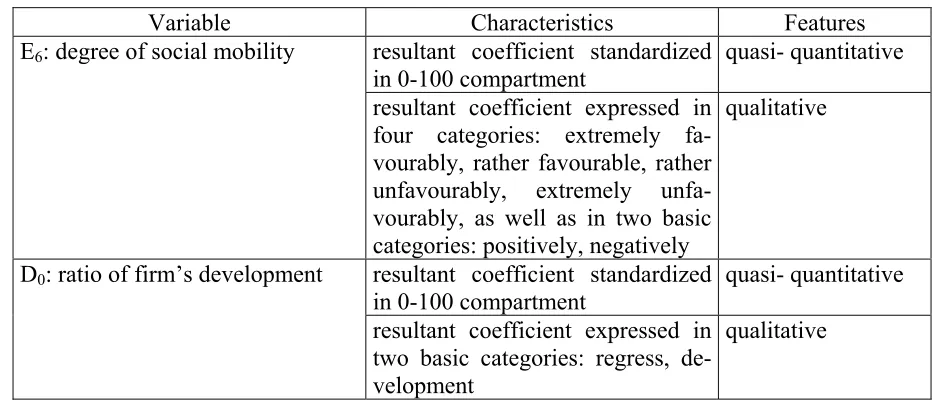
This means that the degree of social mobility in a region can be a barrier or a stimuli for small and medium-sized enterprises’ development. Two main variables were researching (table 1): degree of social mobility (E6) and ratio of small and medium-sized enterprises’
de-velopment (D0). In order to improve transparency of the text literal symbols as well as the
[image:4.595.59.525.483.684.2]shortened names for variables were applied. For needs of the investigation the level of signifi-cance p < 0,05 was accepted as a typical level to testing hypotheses, and p < 0,1 as an admis-sible level.
Table 1. Variables used in research
Variable Characteristics Features
resultant coefficient standardized in 0-100 compartment
quasi- quantitative E6: degree of social mobility
resultant coefficient expressed in four categories: extremely fa-vourably, rather favourable, rather unfavourably, extremely unfa-vourably, as well as in two basic categories: positively, negatively
qualitative
resultant coefficient standardized in 0-100 compartment
quasi- quantitative D0: ratio of firm’s development
resultant coefficient expressed in two basic categories: regress, de-velopment
qualitative
Source: own complilation
Evaluation of social mobility in southern Poland.Empirical results
90 Krzysztof Wach
as profitable, simultaneously the same evaluation is indicated by the most numerous group of entrepreneurs (Mo = 60). Taking the value of median (Me = 66,7) as well as the value the
up-per quartile (Q3 = 63,3) into account it can be inferred, that the majority of entrepreneurs
es-timated the feature E6 as profitable, specifying as extremely or rather profitable (figure 1).
This factor became negatively estimated only by the smallest enterprises, these employing up to 9 workers, which was confirmed by the value of chi-square statistics (χ2 = 6,9 at p = 0,07). These results prove the correlation between the variable E6 and the variable F2. This
depend-ence became also confirmed using chi-square statistics of the highest credibility at typical level of significance. With regard to four characteristics describing studied businessmen as well as four describing studied enterprises only one proved dependence was observed. The higher education level of entrepreneur is (variable O2) the bigger frequency of positive
an-swers is. This dependence was confirmed using ch-square statistics (χ2 = 19,7 at p = 0,05), as well as chi-square statistics of the highest credibility (at p = 0,01). The results of tests with regard to a sex of an entrepreneur (O1), the length of experience in enterprise management
(O3), as well as the entrepreneurial attitude of an entrepreneur (O4), the age of a firm (F1), the
sector in which it functions (F3) as well as the range of its activity (F4) there are not
[image:5.595.157.439.358.530.2]statisti-cally essential dependences, which means, that there are no bases nor to prove, nor to reject verifying hypotheses in this incident.
Figure 1. Entrepreneurs’ perception of social mobility degree in Southern Poland (in %)
0 5,26
71,58
23,16
0 20 40 60 80
extremly favourably
rather favourably
rather unfavourably
extremly unfavourably
Source: own complilation
Justifying not only regional attitudes to entrepreneurial values and norms, which is empha-sised by social capital theory, but also managers’ perception of social mobility in a studied area, seems to be very interesting. In opinions of entrepreneurs, majority of local society ad-mires entrepreneurial values, among them in opinion of (figure 2):
• 72,4% of studied entrepreneurs, local community considers taking self-employment as an exemplary and commendable path of professional career in a local society and aspires to it,
• 65,2% of studied entrepreneurs thinks that such features as independence, autonomy, in-dividualism and own initiative are highly assessed by local community,
Figure 2. Regional attitudes to social mobility characteristics in Southern Poland (in %)
62,4
22,8 22,1 28,5
5,5 72,4
65,2
9,1 12,0
0 20 40 60 80
independence, autonomy, individualizm and ow n
initiative
self-employment as a path of professional career
entrepreneurs as a social group
admired difficult to say disadmired
Source: own compilation
Regional values and norms clarify the quoted results evaluating the social mobility de-gree in a studied region, but implementation of entrepreneurial behaviour in a studied region seems to be more interesting as far as competitiveness of local labour market is concerned. In opinion of (figure 3):
• 37,8% of studied entrepreneurs, many examples of successful entrepreneurs are heard in a studied region,
• 28,5% of studied entrepreneurs, a lot of people has business experience, especially in starting-up and running their own businesses,
• 22,9% of studied entrepreneurs, local community is reported to be entrepreneurial, even more entrepreneurial than in other regions of Poland.
The quoted results are very interesting, because they not only show that entrepreneurial values and norms are admired by local and regional community, but what is more, local and regional community can easily implement those values and norms into being. It proves that Southern Poland is a mobile region, which can easily compete with others. Socio-economic situation of a studied region as far as regional labour market and human attitudes are concerned is praise-worthy.
Figure 3. Perception of social mobility in Southern Poland (in %)
37,8 49,5
28,5 22,9
36,7
33,5 34,8
28,7 27,6
0 20 40 60
entrepreneurial attitude business experience successful entrepreneurs
abundance difficult to say shortage
[image:6.595.112.481.563.739.2]92 Krzysztof Wach
Impact of social mobility on enterprise’s development. Empirical results
In order to verify the hypothesis of correlation between social mobility (E6) in a
re-gion, and the small the and medium-sized enterprises’ development (D0) the non- parametric
test of independence chi-square was used. Verified hypothesis is the thesis advocating, that between considered variables E6 and D0, there is dependence. After realization of suitable
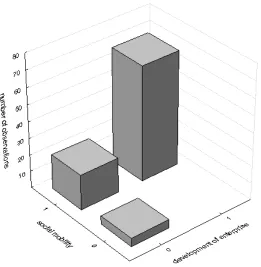
calculations the value of chi-square statistics was given χ2 = 14,3, at the number of liberty degrees amounting df = 4 as well as at the very strong significance amounting p = 0,006. The results testify, that the firms which estimate local social mobility favorably, simultaneously more often note development (percentage of such firms in an investigative test carries out 75,8%). On this basis the dependence between entrepreneurs’ opinion on social mobility and development of an enterprise is affirmed. It proves that regional factors connected with mo-bility of local population impacts development of small and medium-sized enterprises in a studied region (figure 4). In order to improve the approximation of chi-square statistics by reduction of ruthless value of differences among waited the and observed numbers, which is realized by increasing it by 0,5 before the operation rising to the square power (so called the correction of Yates) the chi-square with Yates correction statistics was applied. The obtained calculations were χ2Yatesa= 10,41 at the level of significance amounting p = 0,001. Using a
[image:7.595.171.432.401.668.2]test of differences between averages U Mann Whitney the inferred dependence was disclosed. Using computer statistics programme following results were got: U = 52,5, Z = 2,8 at the level of significance amounting p = 0,004. These results confirm legitimacy of received infer-ence.
Figure 4. The two-dimensional schedule of frequency of variables (D0) and (E6)
Source: own complilation
Conclusions
regional labour market has a positive affect on studied small and medium-sized enterprises’ development in Southern Poland. The conducted research allows to draw the following con-clusions:
• entrepreneurs’ perception of social mobility level in Southern Poland in huge majority is positive (94,74%),
• entrepreneurial values and norms in a local community of Southern Poland is reported to be above the average (from 62,4 to 72,4%),
• implementation of entrepreneurial attitude by a local community of Southern Poland is satisfying (from 22,9 to 37,8%),
• regional social mobility impacts enterprises’ development at very strong significance (p = 0,006).
REFERENCES:
1. Bergmann H., Japsen A., Tamásy Ch., (2002), Regionaler Entrepreneurship Monitor. Gründungsaktivitäten und Rahmenbedingungen in zehn deutschen Regionen. Universität zu Köln, Universität Lüneburg, Köln - Lünburg.
2. Francik A., (1996), Przedsiębiorczość na tle zasobów pracy w regionie in: Regionalne uwarunkowania rozwoju przedsiębiorczości, Akademia Ekonomiczna w Krakowie, Kra-ków.
3. Francik A., (2003), Sterowanie procesami innowacyjnymi w organizacji, Wydawnictwo Akademii Ekonomicznej w Krakowie, Kraków.
4. Fukuyama F., (1997), Zaufanie. Kapitał społeczny a droga do dobrobytu, Wydawnictwo Naukowe PWN, Warszawa.
5. Jewtuchowicz J., (1995), Restrukturyzacja regionalna i formy pomocy w rozwoju małych i średnich przedsiębiorstw w Polsce in: Uwarunkowania rozwoju sektora MSP w krajach Centralnej i Wschodniej Europy, ed. B. Piasecki, Z. Konieczny, Wydawnictwo Uniwer-sytetu Łódzkiego, Łódź.
6. Kokocińska K, (1995), Zastosowanie metody testu koniunkturalnego do badań regional-nych in: Uwarunkowania rozwoju sektora MSP w krajach Centralnej i Wschodniej Euro-py, ed. B. Piasecki, Z. Konieczny, Wydawnictwo Uniwersytetu Łódzkiego, Łódź 1995. 7. Konecki K., (2000), Studia z metodologii badań jakościowych. Teoria ugruntowana,
Wy-dawnictwo Naukowe PWN, Warszawa.
8. Lyon D.W., Lumpkin G.T., Dess G.G., (2000), Enhancing entrepreneurial orientation re-search: Operationalizing and measuring a key strategic decision making process, “Journal of Management”, no. 5.
9. Tamásy Ch., (2002), Determinanten des Überlebens neu gegründeter Betriebe. Working Paper, no. 3, University of Cologne, Department of Economic and Social Geography, Cologne.
10.Wach K. (2002), Szkoły wyższe w służbie dla rozwoju przedsiębiorczości lokalnej in: Prace Naukowe, no. 951, Wydawnictwo Akademii Ekonomicznej we Wrocławiu, Wro-cław.
11.Wach K., (2003), Identyfikacja otoczenia przedsiębiorstwa, Zagadnienia Techniczno-Ekonomiczne, vol. 48, no. 1, Kwartalnik Akademii Górniczo Hutniczej im. S. Staszica w Krakowie.
12.Wach K., (2003), Otoczenie małych i średnich przedsiębiorstw w kontekście integracji z Unią Europejską in: Regionalne uwarunkowania rozwoju przedsiębiorczości, ed. K. Safin, Państwowa Wyższa Szkoła Zawodowa w Legnicy, Legnica.
-94 Krzysztof Wach
dzanie przedsiębiorstwem w warunkach integracji europejskiej. Część 1: Zmiany w teorii i praktyce zarządzania, ed. A. Podobiński, Uczelniane Wydawnictwa Naukowo-Dydaktyczne Akademii Górniczo-Hutniczej, Kraków.
14.Wach K., (2004), Istota otoczenia regionalnego w funkcjonowaniu małych i średnich przedsiębiorstw, in: Prace Naukowe, no. 1023, ed. R. Brol, Wydawnictwo Akademii Eko-nomicznej we Wrocławiu, Wrocław.
15.Wach K., (2004), Rola państwa i samorządu terytorialnego w rozwoju małych i średnich przedsiębiorstw in: Prace i Materiały Wydziału Zarządzania Uniwersytetu Gdańskiego, no. 2, Uniwersytet Gdański, Sopot.
16.Wach K., (2005), Model badania wpływu otoczenia regionalnego na rozwój małych i średnich przedsiębiorstw in: Uwarunkowania rozwoju i konkurencyjności regionów, ed. Z. Zioło, Wyższa Szkoła Informatyki i Zarządzania w Rzeszowie, Kraków-Rzeszów. 17.Westlund H., Bolton R., (2003), Local social capital and entrepreneurship, „Small