Munich Personal RePEc Archive
Is corruption anti labor?
Roy, Suryadipta
Lawrence University
7 May 2007
Online at
https://mpra.ub.uni-muenchen.de/3199/
Is Corruption Anti Labor?
Suryadipta Roy
Lawrence University Department of Economics PO Box- 599, Appleton, WI- 54911.
Abstract
This paper investigates the effect of corruption on trade openness in low-income and high-income countries. The results suggest corruption is anti-labor, since it reduces trade in low-income countries and increases trade in high-income countries.
JEL Classification code: F0, F1, D73, C23, O17.
Keywords: Openness, corruption, Stolper-Samuelson effects.
---
Corresponding author:
Department of Economics, Lawrence University, PO Box- 599,
Appleton, WI -54911.
Email: [email protected] Phone: 920-832-7343.
1. Introduction
Global trade is beset with restrictions. These are more conspicuous in
underdeveloped countries which have higher trade protection compared to high-income
countries. A major explanation of these restrictions is that trade policies are designed at
the behest of special interest groups who benefit from such policies (e.g. Rodrik, 1995).
Recent literature has also highlighted the role of institutions in determining trade
openness and distribution of gains from openness. Anderson and Mercouiller (2004)
ascribed higher corruption and poor enforceability of contracts as important factors
limiting trade opportunities for developing countries. Given that factor proportions theory
of trade has clear distributional predictions about the effect of free trade vis-à-vis
protection, an obvious question in this context is: is effect of corruption on trade
openness any different between labor-abundant and capital-abundant countries? If
corruption is indeed anti-labor, then greater corruption would raise trade barriers in
low-income countries and reduce those in high-low-income countries, thereby adversely affecting
labor in both situations.
Marjit (2006) provides a theoretical argument on this asymmetric impact of
corruption. In his model, corruption is considered as labor-intensive activity diverting
labor away from productive activities, thereby working against the factor endowment bias
and restricting trade in labor-abundant countries. Similarly, it reinforces the relative
factor endowment bias in capital-abundant countries and hence promotes trade. Tavares
(2003) used Mayer’s (1984) median voter framework to show political rights as a proxy
for the median voter, and argued greater political rights would provide more political
corruption and political rights, (Chowdhury, 2004) greater corruption would imply
shifting of political rights away from capital-poor individuals to capitalists. This would
reduce openness in labor-abundant countries and increase openness in capital-abundant
countries. This paper sets out to test these predictions using cross-country data on
corruption, a trade policy indicator, and real percapita gross domestic product (GDP) as a
proxy for factor endowment. In the process, it (a) adds to the literature on the effect of
corruption on trade volumes across countries; and (b) comments on the income
distributional impact of corruption between labor and capital.
2. Econometric specification
Since corruption might be endogenous to trade openness, trade-GDP ratio of any
country was decomposed into exogenous measures of “natural” and “residual” openness.
This was done by estimating the expected level of openness of a country based on its
size, geographic, and linguistic characteristics using a gravity-type specification:
mmies LanguageDu i Population i moteness i GDP i import i ort + + = + )] ( log[ ) ( Re ] ) ( ) ( ) ( exp
log[ δ1 δ2
) (i e ummies GeographyD +
+ (1)
Wei (2000) refers to the predicted value from this regression as a country’s
exogenous “natural openness”1. The difference between actual trade-GDP ratio and this
“natural openness” captures openness determined by policy choices. This trade policy
1English, French, and Spanish used as language dummies. Geography dummies were a
indicator was used as the dependent variable in the regressions. The remoteness measure
is meant to capture the impact of distance on trade. It was constructed as follows:
∑
≠ = j i j i ce Dis j w imoteness( ) ( )log[ tan ( , )]
Re , where
∑
≠ = j k k trade j trade j w ) ( ) ( )( (2)
The following specification was used to test the main hypothesis:
it it
it t
j
it Corruption Corruption GDPpc
y =α +λ +γ +β1* +β2* *log
it
it z
GDPpc θ ε
β + +
+ 3*log * (3)
it
y - trade policy indicator for country i in period t; α- common intercept term; λj and
t
γ are region-specific and time-specific effects common to all countries; βi- parameters
associated with corruption, real percapita GDP, and their interaction; - other control
variables in the regression. Countries were divided into eight regional groupings based on
Easterly (2001). These regional groupings capture effects of regional trading agreements
between countries. Use of region-specific effects also allows time-constant variables in
the two-way fixed effects regression.
z
3. Results
If corruption is anti-labor (or anti-poor), then in equation (3), the statistical priors
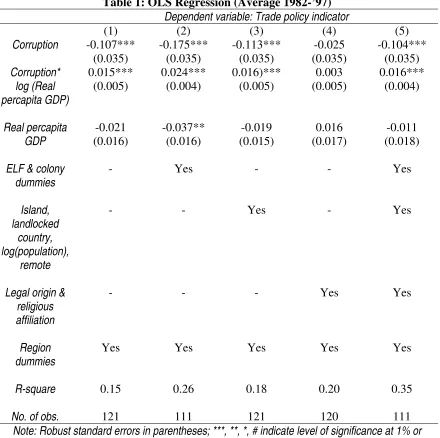
are β1 <0 andβ2 >0. Table 1 reports the ordinary least squares (OLS) estimates based
on cross-country means for the entire time period (1982-’97) for all variables.
International Country Risk Guide Ratings (ICRG) data were used as the corruption
measure. Both corruption and the interaction term are found to have the expected signs
and are statistically significant for the baseline specification in column (1). Thus
countries. For robustness check, other control variables were introduced in the regression.
An index of ethnolinguistic fractionalization (ELF) and colonial origins of countries
capture important structural features. Dummies for island and landlocked countries,
population size, and remoteness from other countries indicate geographical
characteristics. Legal system and religious affiliations represent cultural characteristics.
All regressions included the region dummies. The results are reported in columns (2)-(5).
In general, the main results remain quite robust and the asymmetric effect of corruption
on the trade policy indicator remains significant, except for specification (4). The effect
of percapita income on trade “policy-induced” openness seems to be sensitive to the
inclusion of the structural indicators in the presence of corruption and generally turns out
to be not significant.
Given that cross-country averages do not capture time dimension of the
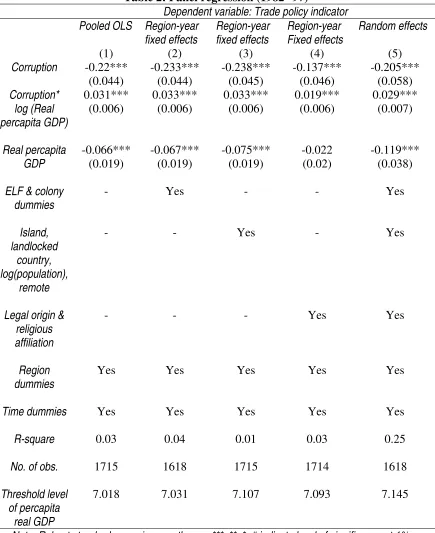
relationship, equation (3) was re-estimated as a panel. Three different panel data
estimators were considered: (a) pooled OLS; (b) two-way fixed effects; (c) random
effects regression with country-specific effects estimated by Generalized Least Squares.
The results are reported in table 2. The main hypothesis is upheld in every regression.
Inclusion of control variables does not change the basic results in any substantial way.
Percapita real GDP appears with a negative sign in all the specifications, which indicates
that trade for developed countries is mainly determined by “natural” factors rather than
policy-related issues. Indeed, percapita GDP appears to be positive and highly significant
in regressions with “natural openness” as dependent variable. The calculated threshold
level at which higher income reduces openness for different specifications is between
percapita income is found to be 7.467 indicating positive skewness in the income
distribution.
4. Other robustness checks
Other robustness checks were also conducted. Since corruption is highly
persistent for any country over time, the error terms might be serially correlated.
Following Wooldridge (2002), this was addressed by using a robust covariance matrix
adjusting for within-country correlation in the random effects regression. Moreover, since
corruption is subjective, the ICRG data might suffer from measurement error. This was
accounted for by using the Business International corruption measure used in Mauro
(1995) as proxy for the ICRG data in country average OLS regression. Since these data
come from another source, cover an earlier period (average from 1980-’83), and have
smaller country coverage (65 compared to around 120 for ICRG), measurement errors of
the two proxies are probably uncorrelated. The main results remained unchanged in both
situations2.
5. Conclusion
The basic conclusion of this paper is that an increase in corruption reduces trade
openness in low-income countries (income proxying for capital-labor ratio) and increases
openness in high-income countries. Given the median voter (generally with relatively low
labor ratio) will be pro-trade in labor-abundant countries and anti-trade in
capital-abundant countries, we can conclude that lesser corruption in low-income countries
2
should open up trade and benefit labor in those countries. A corollary to this is that
greater corruption should lead to income transfer from labor towards capitalists. It is not
far-fetched to argue that an increase in corruption would make policymakers lean more
towards the producers’ groups and enact policies in their favor in the lines of Grossman
and Helpman (2001). Thus a strong political argument can be made for improving
institutions in the developing countries since it should benefit the abundant factor in these
countries.
Appendix- Data sources
Corruption- Source: International Country Risk Guide (ICRG). Definition: Indicator of
corruption in government. Unit: 0-6, higher number denotes greater corruption.
Real per capita gross domestic product- Source: World Bank (2006). Definition:
Logarithm of real gross domestic product (GDP) divided by population. Unit: Constant
US dollars.
Trade-GDP ratio- Source: World Bank (2006). Definition: (Exports + imports)/GDP.
Unit: Percent.
Population- Source: World Bank (2006). Definition: Logarithm of population. Unit:
Absolute.
Island- Source: World Factbook 2003. Definition: Island countries indicator. Unit:
Dummy variable = 1 denoting island.
Landlocked- Source: Easterly (2001). Definition: Landlocked countries indicator. Unit:
Distance- Source: Center D’Etudes Prospectives Et D’Informations Internationales
(CEPII). Definition: Great circle distance between most populated cities. Unit:
Kilometers.
Colony- Source: CEPII. Definition: Colonial origin indicator. Unit: Dummy variables =
1 for British, French, or other colonial origin.
Fractionalization- Source: La Porta et al. (1999). Definition: Ethnolinguistic
Fractionalization, i.e. probability that any two randomly selected individuals within a
country belongs to the same religious and ethnic group. Unit: 0-1.
Legal origin- Source: La Porta et al. (1999). Definition: Dummy for origin of legal
system. Unit: Dummy variables = 1 for English, Socialist, French, German, or
Scandinavian legal origin.
Religious affiliation- Source: La Porta et al. (1999). Definition: Different religions
making up the population, divided into Protestant, Catholic, Muslim, and other
denominations. Unit: 0-1.
Region- Source: Easterly (2001). Definition: Regional groupings. Unit: Dummy
variables = 1 for East Asia & Pacific, East Europe & Central Asia, Middle East & North
Africa, South Asia, West Europe, North America, Sub-Saharan Africa, Latin America &
Caribbean regions.
References:
Anderson, J. E. and D. Marcouiller, 2002, Insecurity and the pattern of trade: an
Chowdhury, S., 2004, The effect of democracy and press freedom on corruption: an
empirical test, Economics Letters 85(1), 93-101.
Easterly, W., 2001, The lost decades: developing countries’ stagnation in spite of policy
reform 1980-1998, Journal of Economic Growth 6(2), 135-157.
Grossman, G. M. and E. Helpman, 2001, Special Interest Politics. (Cambridge and
London: MIT Press).
La Porta, R., F. Lopez-de-Silanes, A. Shleifer and R. Vishny, 1999, The quality of
government, The Journal of Law, Economics, & Organization 15(1), 222-279.
Marjit, S., 2006, Corruption, comparative advantage and missing trade, Working paper
series, City University of Hong Kong.
Mauro, P., 1995, Corruption and growth, Quarterly Journal of Economics 110(3), 681–
712.
Mayer, W., 1984, Endogenous tariff formation, American Economic Review 74(5),
970-985.
Rodrik, D., 1995, Political economy of trade policy, in: G. Grossman and K. Rogoff, eds.,
Handbook of International Economics, Vol. 3 (North-Holland: Amsterdam) 1457- 1494.
Tavares, J., 2003, Trade, factor proportions and political rights, Universidade Nova de
Lisboa, FEUNL Working paper series: 437.
Wei, S., 2000, Natural openness and good government, National Bureau of Economic
Research Working paper series: 7765.
Wooldridge, J., 2002, Econometric Analysis of Cross Section and Panel Data.
Table 1: OLS Regression (Average 1982-’97)
Dependent variable: Trade policy indicator
(1) (2) (3) (4) (5) Corruption -0.107***
(0.035) -0.175*** (0.035) -0.113*** (0.035) -0.025 (0.035) -0.104*** (0.035) Corruption* log (Real percapita GDP) 0.015*** (0.005) 0.024*** (0.004) 0.016)*** (0.005) 0.003 (0.005) 0.016*** (0.004) Real percapita GDP -0.021 (0.016) -0.037** (0.016) -0.019 (0.015) 0.016 (0.017) -0.011 (0.018)
ELF & colony dummies
- Yes - - Yes
Island, landlocked
country, log(population),
remote
- - Yes - Yes
Legal origin & religious affiliation
- - - Yes Yes
Region dummies
Yes Yes Yes Yes Yes
R-square 0.15 0.26 0.18 0.20 0.35
No. of obs. 121 111 121 120 111 Note: Robust standard errors in parentheses; ***, **, *, # indicate level of significance at 1% or
Table 2: Panel regression (1982-’97)
Dependent variable: Trade policy indicator Pooled OLS Region-year
fixed effects Region-year fixed effects Region-year Fixed effects Random effects
(1) (2) (3) (4) (5) Corruption -0.22***
(0.044) -0.233*** (0.044) -0.238*** (0.045) -0.137*** (0.046) -0.205*** (0.058) Corruption* log (Real percapita GDP) 0.031*** (0.006) 0.033*** (0.006) 0.033*** (0.006) 0.019*** (0.006) 0.029*** (0.007) Real percapita GDP -0.066*** (0.019) -0.067*** (0.019) -0.075*** (0.019) -0.022 (0.02) -0.119*** (0.038)
ELF & colony dummies
- Yes - - Yes
Island, landlocked
country, log(population),
remote
- - Yes - Yes
Legal origin & religious affiliation
- - - Yes Yes
Region dummies
Yes Yes Yes Yes Yes
Time dummies Yes Yes Yes Yes Yes
R-square 0.03 0.04 0.01 0.03 0.25
No. of obs. 1715 1618 1715 1714 1618
Threshold level of percapita
real GDP
7.018 7.031 7.107 7.093 7.145