Ranking of Hexagonal Fuzzy Numbers for Solving Multi
Objective Fuzzy Linear Programming Problem
Rajarajeswari. P
1,
1
Department of Mathematics, Chikkanna Government Arts College, Tirupur
Sahaya Sudha .A
22
Department of Mathematics, Nirmala College for Women, Coimbatore
ABSTRACT
In this paper a ranking Procedure based on Hexagonal Fuzzy numbers, is applied to a Multi-objective Linear programming problem (MOLPP) with fuzzy coefficients. By this ranking method any Multiobjective Fuzzy Linear Programming problem (MOFLPP) can be converted in to a crisp value problem to get an optimal solution. This method provides an insight for the planner due to uncertain environment in an organizational Economics. In an organization, where a number of alternatives and variables such as production, inventory, financial management, costing and various other parameters are involved, this ranking procedure serves as an efficient method wherein a numerical example is also taken and the inference is given.
Keywords
Ranking, Hexagonal fuzzy numbers, MOFLPP, Decision making.
1.
INTRODUCTION
Ranking fuzzy number is used in decision- making process in an economic environment. In an organization various activities such as planning, execution, and other process takes place continuously. This requires careful observation of various parameters which are all in uncertain in nature due the competitive business environment globally. In fuzzy environment ranking fuzzy numbers is a very important decision making procedure. The idea of fuzzy set was first proposed by Bellman and Zadeh[1], as a mean of handling uncertainty that is due to imprecision rather than randomness. The concept of fuzzy linear programming (FLP) was first introduced by Tanaka et al. [11, 12] Zimmerman [17] introduced fuzzy linear programming in fuzzy environment. Multi-objective linear Programming was introduced by Zeleny [16]. Lai Y.J –Hawng C.L [5] considered MOLPP with all parameters having a triangular possibility distribution. They used an auxiliary model and it was solved by MOLPP. Zimmerman [18] applied their approach to vector maximum problem by transforming MOFLP problem to a single objective linear programming problem. Qiu- Peng Gu, and Bing-Yuan Cao [7] solved Fuzzy linear programming problems based on Fuzzy numbers distance. Tong Shaocheng [13] focused on the fuzzy linear programming with interval numbers. Chanas [2] proposed a fuzzy programming in multi objective linear programming. Verdegay [14] have proposed three methods for solving three models of fuzzy integer linear programming based on the representation theorem and on fuzzy number ranking method. In particular, the most convenient methods are based on the concept of comparison of fuzzy numbers by the use of ranking functions. Nasseri [6] has proposed a new method for solving FLP problems in which he has used the fuzzy ranking method for converting the fuzzy objective function into crisp objective function.
2.
PRELIMINARIES
2.1Definition:
Let X be a nonempty set. A fuzzy set A in X is characterized by its membership function
A
:
X
0
,
1
, where A(x) is interpreted as the degree of membership of element x in fuzzy A for each x X .2.2 Interval Number
:
Let R be the set of real numbers. Then closed interval [a, b] is said to be an interval number, where a, b Є R, a≤ b.
2.3 Distance between interval numbers
:
Let a = [a1,a2], b= [b1,b2 ] be two interval numbers. Then the
distance between (a, b) denoted by d (a, b), is defined by
dx b b x b b a a x a a b a d
2 1
2 1
1 2 2 1 1 2 2
1 ( )
2 ) ( 2 )
, (
2.4 Fuzzy number:
A fuzzy set
A
~
of the real line R with membership function
0
,
1
:
)
(
~
x
R
A
is called fuzzy number ifi) A must be normal and convex fuzzy set;
ii) the support of
A
~
, must be boundediii)
A must be a closed interval for every
0
,
1
2.5 Support:
The support of a fuzzy set ,S (Ã), is the crisp set of all xЄX
such that ~
(
X
)
0
A
2.6 Distance between fuzzy numbers
:
Let A~,B~be two fuzzy numbers. Then the distance between the fuzzy numbers A~andB~is defined by
D
(
A
~
,
B
~
)
1
0
~
,
~
B
d
A
d
3.
HEXAGONAL FUZZY NUMBER
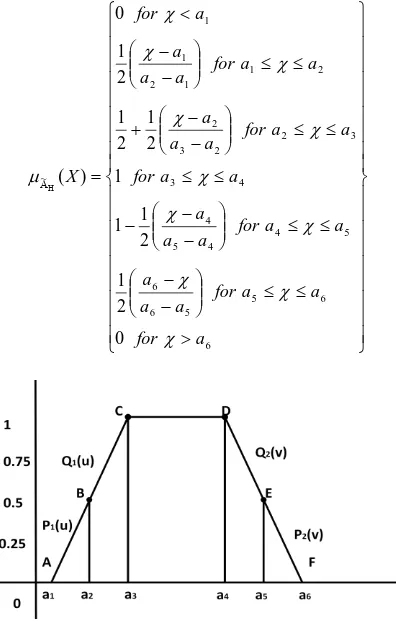
A fuzzy number A~H is a hexagonal fuzzy number denoted by
A
~
H(
a
1,
a
2,
a
3,
a
4,
a
5,
a
6)
where
(
a
1,
a
2,
a
3,
a
4,
a
5,
a
6)
6 6 5 5 6 6 5 4 4 5 4 4 3 3 2 2 3 2 2 1 1 2 1 1 ~ 0 2 1 2 1 1 1 2 1 2 1 2 1 0 ) ( a for a a for a a a a a for a a a a a for a a for a a a a a for a a a a for X
Figure 1 Graphical representation of a hexagonal fuzzy number
3.1 Arithmetic Operations on Hexagonal
Fuzzy numbers
Let
A
~
H
(
a
1,
a
2,
a
3,
a
4,
a
5,
a
6)
and
B
~
H
(
b
1,
b
2,
b
3,
b
4,
b
5,
b
6)
be two hexagonal fuzzy numbers, then
(i)
A
~
H(
)
B
~
H
(
a
1
b
1,
a
2
b
2,
a
3
b
3,
a
4
b
4,
a
5
b
5,
a
6
b
6)
(ii)
A
~
H(
)
B
~
H
(
a
1
b
1,
a
2
b
2,
a
3
b
3,
a
4
b
4,
a
5
b
5,
a
6
b
6)
(iii)
A
~
H(*)
B
~
H
(
a
1*
b
1,
a
2*
b
2,
a
3*
b
3,
a
4*
b
4,
a
5*
b
5,
a
6*
b
6)
3.2. Ranking of Hexagonal Fuzzy Numbers:
A number of approaches have been proposed for the ranking of fuzzy numbers. In this paper for a hexagonal fuzzy number
)
,
,
,
,
,
(
~
6 5 4 3 21
a
a
a
a
a
a
A
H
, a ranking method isdevised based on the following formula.
)
1
(
18
5
18
2
3
4
4
3
2
)
~
(
1 2 3 4 5 6
a
a
a
a
a
a
A
R
HLet
~
(
,
,
,
,
,
)
~
(
,
,
,
,
,
)
6 5 4 3 2 1 6 5 4 3 2
1
a
a
a
a
a
and
B
b
b
b
b
b
b
a
A
H
H
be two hexagonal fuzzy numbers then
A
~
H
B
~
H
R
A
~
H
R
B
~
H
A
~
H
B
~
H
R
A
~
H
R
B
~
H
A
~
H
B
~
H
R
A
~
H
R
B
~
H4. PROPOSED RANKING ALGORITHM
The above procedure (3.2) can be used to develop ranking for hexagonal fuzzy numbers. Based on this ranking procedure, a ranking algorithm is developed for a hexagonal fuzzy numbers. Moreover, it is applied to MOLPP under constraints with fuzzy coefficients.4.1 Algorithm:
Step1: Consider the fuzzy numbers
A
~
H&
B
~
H of hexagonal fuzzy numberStep2: Find Supremum M= Sup(s
A
~
H U s
B
~
H ), wheres
A
~
H =Support set ofA
~
H and s
B
~
H =Support set ofB
~
H .Step3: Take
)
,
,
,
,
,
(
~
)
,
,
,
,
,
(
~
6 5 4 3 2 1 6 5 4 3 21
a
a
a
a
a
and
B
b
b
b
b
b
b
a
A
H
H
ashexagonal fuzzy numbers
Step4: Calculate
18
2
3
4
4
3
2
)
,
~
(
A
M
M
a
1a
2a
3a
4a
5a
6D
H &
18
2
3
4
4
3
2
)
,
~
(
b
1b
2b
3b
4b
5b
6M
M
B
D
HStep5: If
A
HM
D
B
HM
then
A
HB
HD
~
,
~
,
~
~
A
HM
D
B
HM
then
A
HB
HD
~
,
~
,
~
~
A
HM
D
B
HM
then
A
HB
HD
~
,
~
,
~
~
Step 6: Stop.
5. METHOD OF SOLVING
MULTI-OBJECTIVE FUZZY LINEAR
PROGRAMMING PROBLEM
Maximize
z
1
c
1x
Minimize
z
2
c
2x
Subject to
A
~
HX
b
~
,
X
0
Where
c
ij
(
c
i1,
c
i2,....
c
in)
is an n- dimensional crisprow vector,
A
~
H
a
~
ij is an m x n fuzzy matrix,
Tm
b
b
b
b
b
~
~
1,
~
2,
~
3,...
~
is an m-dimensional fuzzy linevector and
X
(
x
1,
x
2,
x
3,
x
4....
x
n)
T is an n-dimensional decision variable vector.We now consider a bi-objective Fuzzy linear programming Problem with constraints having fuzzy coefficients is given by
Maximize
z
1
c
11x
1
c
12x
2
c
13x
3
...
c
1nx
nMinimize
z
2
c
21x
1
c
22x
2
c
23x
3
...
c
2nx
nSubject to
~
a
i1x
1
a
~
i2x
2
a
~
i3x
3
...
~
a
inx
n
b
~
im
i
x
x
x
x
1,
2,
3,...
n
0
,
1
,
2
,...
where fuzzynumbers are hexagonal, where
,
~
,
~
,
~
,
~
,
~
,
~
~
16 15 14 13 12 111 i i i i i i
i
a
a
a
a
a
a
a
26 25 24 23 22 212
~
,
~
,
~
,
~
,
~
,
~
~
i i i i i ii
a
a
a
a
a
a
a
……… ………,
~
,
~
,
~
,
~
,
~
,
~
~
6 5 4 3 21 in in in in in
in
in
a
a
a
a
a
a
a
6 5 4 3 2 1~
,
~
,
~
,
~
,
~
,
~
~
i i i i i ii
b
b
b
b
b
b
b
By the ranking Algorithm, the above MOFLPP is transformed into a MOLPP is as follows:
Maximize
z
1
c
11x
1
c
12x
2
c
13x
3
...
c
1nx
nMinimize
z
2
c
21x
1
c
22x
2
c
23x
3
...
c
2nx
nSubject to,
a
i11x
1
a
i21x
2
....
a
in1x
n
2
a
i12x
1
a
i22x
2
....
a
in2x
n
3
a
i13x
1
a
i23x
2
....
a
in3x
n
4
a
i14x
1
a
i24x
2
....
a
in4x
n
4
a
i15x
1
a
i25x
2
....
a
in5x
n
3
a
i16x
1a
i26x
2....
a
in6x
n
2
6 5 4 3 2
1
3
4
4
3
2
2
b
i
b
i
b
i
b
i
b
i
b
i
)
2
(
,...
2
,
1
,
0
...
,
,
2
3
1
x
x
x
i
m
x
n
Using (2), this can be converted into a single objective problem subject to the constraints with transformed crisp number coefficients and hence solved accordingly.
Similarly ,multi-objective problems with more than two objectives can also be solved using the above procedure, here in the very first stage itself the problem is transformed into a crisp problem and afterwards there will be no more fuzziness in the constraints as well as in the problem.
6. NUMERICAL EXAMPLE
The below mentioned example is taken fromRajarajeswari. P and SahayaSudha A [8] in a production planning process.
Maximize
Z
1
75
x
1
90
x
2Minimize
Z
2
60
x
1
75
x
2Subject to
,
0
~
~
~
~
~
~
2 1 2 2 2 2 1 2 1 1 2 1 2 1 1 1
x
x
b
x
a
x
a
b
x
a
x
a
Where
a
~
11
(
180
,
190
,
200
,
200
,
210
,
220
)
a
~
12
(
230
,
240
,
250
,
250
,
260
,
270
)
a
~
21
(
280
,
290
,
300
,
300
,
310
,
320
)
a
~
22
(
180
,
190
,
200
,
200
,
210
,
220
)
)
16000
,
15000
,
14000
,
14000
,
13000
,
12000
(
~
1
b
)
13500
,
13000
,
12500
,
12500
,
12000
,
11500
(
~
2
b
Maximize
Z
1
75
x
1
90
x
2Subject to
(
180
,
190
,
200
,
200
,
210
,
220
)
x
12
)
270
,
260
,
250
,
250
,
240
,
230
(
x
)
16000
,
15000
,
14000
,
14000
,
13000
,
12000
(
(
280
,
290
,
300
,
300
,
310
,
320
)
x
1
x
1,
x
2,
x
3,
x
4,
x
5,
x
6
0
By (2), this can be transformed into a crisp LPP as
Maximize
Z
1
75
x
1
90
x
2 ,Subject to
1
180
(
2
x
230
x
2)
3
(
190
x
1
240
x
2)
1
200
(
4
x
250
x
2)
4
(
200
x
1
250
x
2)
1
210
(
3
x
260
x
2)
2
(
220
x
1
270
x
2)
) 16000 ( 2 ) 15000 ( 3 ) 14000 ( 4 ) 14000 ( 4 ) 13000 ( 3 ) 12000 (
2
1
280
(
2
x
180
x
2)
3
(
290
x
1
190
x
2)
1
300
(
4
x
200
x
2)
4
(
300
x
1
200
x
2)
1
310
(
3
x
210
x
2)
2
(
320
x
1
220
x
2)
) 13500 ( 2 ) 13000 ( 3 ) 12500 ( 4 ) 12500 ( 4 ) 12000 ( 3 ) 11500 (
2
Case (i):
We consider the problem with the maximization objective
Maximize
Z
1
75
x
1
90
x
2Subject to
3600
x
1
4500
x
2
252000
5400
x
1
3600
x
2
225000
x
1,
x
2,
x
3,
x
4,
x
5,
x
6
0
The solution isx19.29,x248.57, and Max
z
1
5067
.
86
Next we proceed to solve the problem with minimization objectiveMinimize
Z
2
60
x
1
75
x
2Subject to
3600
x
1
4500
x
2
252000
5400
x
1
3600
x
2
225000
0
,
,
,
,
,
2 3 4 5 61
x
x
x
x
x
x
The solution isx19.29,x248.57, and Min
z
2
4246
.
43
Case (ii): Consider the problem with the maximization objective and an additional constraintMaximize
Z
1
75
x
1
90
x
2Subject to
252000
4500
3600
x
1
x
2
225000
3600
5400
x
1
x
2
88
.
5067
57
.
48
29
.
9
x
1
x
2
0
,
,
,
,
,
2 3 4 5 61
x
x
x
x
x
x
The solution is x19.29,x2 48.57and Maxz15067.86 Next we proceed to solve the problem with minimization objective with additional constraint
Minimize
Z
2
60
x
1
75
x
2Subject to
3600
x
1
4500
x
2
252000
5400
x
1
3600
x
2
225000
9
.
29
x
1
48
.
57
x
2
5067
.
88
x
1,
x
2,
x
3,
x
4,
x
5,
x
6
0
The solution is
x
1
9
.
29
,
x
2
48
.
57
and Minz24246.43 Case (iii):The feasibility of the solution will be explained as follows
When all the fuzzy numbers are in lesser priority values, the MOLPP becomes
Maximize
Z
1
75
x
1
90
x
2,Minimize
Z
2
60
x
1
75
x
2Subject to
59000 930
1430
63000 1180
930
2 1
2 1
x x
x x
0
,
,
,
,
,
2 3 4 5 61
x
x
x
x
x
x
The solution is x113.4,x242.82and Max
z
1
4859
.
64
,
Minz
2
4083
.
2
Case (iv):
When all the fuzzy numbers are in priority values, the MOLPP becomes
Minimize
Z
2
60
x
1
75
x
2Subject to
100000
1600
2400
112000
2000
1600
2 1
2 1
x
x
x
x
x
1,
x
2,
x
3,
x
4,
x
5,
x
6
0
The solution is x19.29,x2 48.57and Maxz15067.86, Min
z
2
4246
.
43
Case (v):
When all the fuzzy numbers are in the higher priority values, the MOLPP becomes
Maximize
Z
1
75
x
1
90
x
2,Minimize
Z
2
60
x
1
75
x
2Subject to
66000
1070
1570
77000
1320
1070
2 1
2 1
x
x
x
x
0
,
,
,
,
,
2 3 4 5 61
x
x
x
x
x
x
The solution is
x
1
5
.
10
,
x
2
54
.
20
and [image:5.595.69.268.486.686.2]Maxz15260.43, Min
z
2
4396
.
44
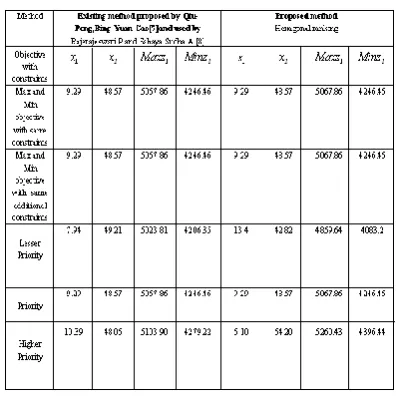
Table 6.1: Comparison of results obtained by using existing and proposed method.
7.
RESULTS AND DISCUSSIONS
As per the above Table (6.1), we have obtained the same results from both the existing as well as the proposed method and the feasibility of the solution is also from the lowest to higher intervals.
In the above problem the profit maximization is from [4859.64, 5260.43] and the cost of production ranges from [4083.2, 4396.44].This new method reduces the ambiguity in the solution. This forms an optimal solution for a manager to take a decision whether to produce a particular product or not, or else any alternate changes can be done .This method can be used where a particular problem cannot be solved by triangular or trapezoidal method. This method also can be used even if the number of variables and parameters are increased this method is far more efficient and easy when compared to the earlier method .This can be extended to any number of input parameters.
8. REFERENCES
[1] Bellman R.E and .Zadeh L.A, Decision making in a fuzzy environment, Management science17(1970), 141-164
[2] Chanas D., Fuzzy programming in multi objective linear programming-a parametric Approach, Fuzzy set and system29 (1989) 303-313.
[3] George J.klir, Boyuan, Fuzzy sets and Fuzzy logic Theory and Applications-Prentice-Hall Inc (1995) 574p
[4] Ishibuchi; Tanaka, Multi objective programming in optimization of the interval objective function, European journal of Operational Research48 (1990), 219-225
[5] Lai Y.J – Hawng C.L, Fuzzy mathematical programming, lecture notes in Economics and Mathematical systems, Springer-Verlag, (1992)
[6] S.H Nasseri,A new method for solving fuzzy linear programming by solving linear programming .Applied Mathematical Sciences, 2 (2008) ,37-46
[7] Qiu-Peng Gu., Bing-Yuan Cao Approach to linear programming with fuzzy coefficients based on Fuzzy numbers distance, IEEE Transactions, 447-450. (2005)
[8] Rajerajeswari.P and Sahaya Sudha A ,Multiobjective Fuzzy Optimization Techniques in Production Planning Process ,Proc.of the Heber International conference on Applications of Mathematics and Statistics, Tiruchirappalli,India(2012),370-374
[9] Rajerajeswari.P and Sahaya Sudha A and Karthika.R A new Operations on hexagonal fuzzy number International Journal of Fuzzy Logic Systems (IJFLS) Vol.3, No3, July2013
[10]Sophiya Porchelvi R., Nagoorgani .A. Irene Hepzibah .R An Algorthimic Approach to Multiobjective Fuzzy Linear Programming Problem
[11]Tanaka H., .Asai K., Fuzzy linear programming problems with fuzzy numbers, Fuzzy Sets and Systems13 (1984), 1-10.
[12]Tanaka H., .Okuda .T and Asai K., Fuzzy Mathematical Programming, Journal of Cybernetics and systems, 3(1973), 37-46
[13]Tong Shaocheng, Interval number and fuzzy number linear programming, Fuzzy Sets and systems 66 (1994), 301-306.
[14]Verdegay, J.L. A dual approach to solve the fuzzy linear programming problem, Fuzzy sets and Systems, 14(1984), 131-141
[16]Zeleny, M. Multiple criteria decision making. New York: McGraw-Hill Book Company, 1982
[17]Zimmermann H.J, Fuzzy programming and linear programming with several objective functions, Fuzzy sets and system1(1978), 45-55.
[18]Zimmermann H.J, Fuzzy mathematical programming, Computer Science &operations Research Vol.10, No4, (1983)291-298.
[19]Zimmermann H.J, (1985).Application of Fuzzy set theory to Mathematical Programming