Multi Hop Routing in Wireless Mobile Networks
using Ant Colony Optimization
Harminder Kaur
Student
Department of Electronics Technology, Guru Nanak Dev
University, Amritsar, Punjab, India
Ravinder Singh Sawhney
Sr.Lecturer
Department of Electronics Technology, Guru Nanak Dev
University, Amritsar, Punjab,
Rajan Vohra
Assistant Professor Department of Electronics Technology, Guru Nanak Dev
University, Amritsar, Punjab, India
ABSTRACT
Quality of Service is an indispensable parameter to evaluate the performance of any network, so research engrosseson valuing some important QoS parameters for mobile Adhoc network using AntHocNet routing algorithm. MATLAB software version R2011b is used for simulations due to its ease of node deployment and network set up. Simulation is done while varying the number of packets sent as 10, 30, 50, 70 and 90in a network scenario. It is analyzed that AntHocNet provides excellent performance for fewer hops 1, 2 and 3 whereas for increased number of hops9 and 10, it reveals from the routing metrics that use of AntHocNet is more advantageous over the other routing protocols like DSDV, AODV, DSR and TORA.The simulation enactment graphs shows better performance in terms of End-to-end delay, Delay jitter and superlative performance in terms of SINR with extended number of hops when the payload on the source node increases.
General Terms
MANET, Ant Colony Optimization, Hybrid Algorithm.
Keywords
AntHocNet,Mobile adhoc network, End-to-end delay, Delay Jitter, SINR
1.
INTRODUCTION
Since a few years researcher’s interest in MANEThas been growing to evolve innovative and efficient ideas in this field.Especially the design of MANET routing protocols has received a lot of attention [1-2]. One of the reasons is that routing in MANET is particularly challenging task. Due to the dynamic topology of the network, efficient paths quickly become inefficient or even infeasible [3-4]. Moreover as the bandwidth of the wireless medium is very limited, so control information flow in the network is very restricted [5-6].Since there is no infrastructure support for MANET and a destination node may be out of range of a source node. So, a routing procedure is always needed to find an optimal path to forward the packets between source and destination.Numerous routing protocols have been recommended in the existing literature. Some of these like DSDV, AODV, DSR, and TORA have been extensively simulated for various scenarios [7-10].
Ant colony optimization (ACO) is an optimization technique inspired by the exploratory behavior of ants while finding food
[11-12].The routing algorithm based on ants was developed by G. Di Carlo and M. Dorigo [13] and M. Gunes, U. Sorges and I.
Bouazizi in [14] and further discussed in [15]. In this paper, Ant colony optimization (ACO) based metaheuristic is used for optimum route innovation in wireless networks, which has taken aclue from Ant Colony Optimization (ACO) algorithm [16-18].It belongs to class of constructive algorithms that reflect the cooperative behavior of real ants to different optimization problems. The main purpose of the paper is to enrich the performance of routing parameters for mobile ad hoc networks using AntHocNet [19-21] routing algorithm.
2.
SIMULATION ALGORITHM
The algorithm proposed in this paper AntHocNet has been simulated using the MATLAB software version R2011b with 802.11 MAC protocol as wireless channel.MATLAB is a software package for high performance numerical computation and visualization. It provides an interactive environment with hundreds of built in functions for technical computation, graphics and animation. AntHocNet is a hybrid algorithm works in two phases; reactive path setup and proactive path maintenance and exploration [19-21].
2.1
Theory for Reactive Path Setup
Step 1. Source node demands a communication route to the destination.
Step 2. Source node broadcasts Reactive Forward ant.
Step 3. When reactive forward ant reaches at an intermediary node,
a. If duplicate discard
b. Else goto 4.
Step 4. Each intermediary node looks for routing information
for destination in forward ant routing table.
a) Ifno routing information available broadcast
reactive forward ant.
b) Ifrouting information available, reactive forward
ant choose its next hop with probability,
𝑃𝑟𝑜𝑏𝑛𝑑=(𝑇𝑛𝑑𝑝 )/ 𝑞∈𝑁𝑞𝑑𝑝 𝑇𝑛𝑑𝑝 (1)
𝑁𝑞𝑑𝑝 is the set of neighbors of node p, providing routing information to reach destination node d through the next hop n.
Step 5. Best reactive forward ant received at destination is converted into reactive backward ant that setup path from source to destination by retracing the list of visited nodes byreactive forward ant.
The reactive backward ant update the intermediary node’s routing table by calculating local estimate of time at each node. This estimate is used to calculate estimate of time required for an ant to reach from p to destination𝑇𝑑𝑝and then in turn source to destination, 𝑇𝑑𝑠.
𝑇𝑑𝑝= 𝑇𝑛+1𝑛 , where p ≤ n < d, n ∈ to list of visited nodes by the forward ant and d corresponds to destination node.
Through this process when the backward ant reaches at the sourcenode, the full path is setup. Now the source node is ready for communication with destination to send data on the discovered path[21].
2.2
Proactive
Path
maintenance
and
exploration
To maintain the established paths or to explore new ones,the source node brings into play proactive forward ants to update the information about the currently used paths to the destination.This Proactive mechanism is in the form of hello messages.The hello messages are periodically broadcasted. These are short messages broadcasted every 𝑻𝒉𝒆𝒍𝒍𝒐seconds by the nodes (e.g. 𝑻𝒉𝒆𝒍𝒍𝒐 = 1 seconds). If a node q receives hello message from a node p, q assumes that p is its neighbor and expects to receive hello message from p every 𝑻𝒉𝒆𝒍𝒍𝒐seconds. If qskips certain number of hello messages from p (e.g. 2 hello messages), it assumes that p is no longer its neighbor. Using these messages nodes has routing information about their immediate neighbours in their routing table. In AntHocNet, each node tries to maintain an updated view of its immediate neighbours at any time. When a node q receives
the hello messagefrom node p, it checks if it has an entry for destination over neighbor p in its routing table. If there is no entry, it is an indication of a possible new path from q to destinationthrough p. If it has entry for destination but over other intermediary node it is hint of potential alternate path to destination [19]. AntHocNet detects link failures by the presence or disappearance of the immediate neighbors. If a neighbor is assumed to have disappeared then all the associated entries of that neighbor are deleted from the routing table to clear path informationwith the link failure notification. If the link failure is detected by the failed transmission of a data packet and no other path is available for this data packet, then the node which detects link failure tries local repair of the path with route repair ant [20-21].The next section provides detailed simulation setup followed by results and discussion.
3.
SIMULATION STEPS
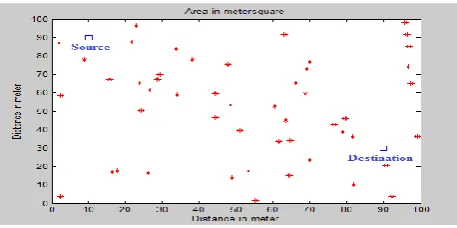
MATLAB software version R2011b is used for AntHocNet algorithm simulations due to its ease of node deployment and network set up.Matlab’s built in functions provide excellent tools for linear algebra computations, data analysis, signal processing, optimization etc. and many other types of scientific computations.With the help of MATLAB criticalanalysis of results is achieved by deploying wireless mobile nodes with random uniform distribution where the position of source and destination are [10, 90] and [90, 30] respectively.
3.1
Methodology
A service area of dimensions 100 m ×100 m is chosen for MANET infrastructure.
The service has a set of mobile nodes.
Each mobile node communicates with each other.
Each mobile node is moving randomly in some direction with some mobility rate.
To choose the shortest path an efficient form of AntHocNet algorithm is used in which TTL (time to live) is chosen as a threshold parameter for finding the path.
Here CBR (Constant Bit Rate) is chosen as the traffic type.
To run the simulation, 10 out of 50 mobile nodes are chosen randomly while the payload on source node is increased.
Table 1 briefly mentions the various simulation parameters and figure 1 shows the simulation scenario in MATLAB.
[image:2.595.318.547.640.754.2]Table 1. List of Simulation Parameters
S.No. Parameter Value
1 Geographical Area 100 ×100 m2
2 Number of Mobile nodes
Randomly Chosen 10,out of 50
3 Routing algorithm AntHocNet
4 Mobility model Random waypoint
5 MAC layer
Protocol
IEEE 802.11 DCF protocol
6 Packets Sent 10,30,50,70,90
7 Traffic Type CBR
8 Performance parameter
End-to-end delay, Delay jitter and SINR
3.2
Routing Metrics
3.2.1End-To-End Delay
This is the cumulative statistical measure of the delays experienced by the packets travelling between source and destination and calculated by using,
𝐶𝑜𝑠𝑡𝑝𝑞= (𝑄𝑚𝑎𝑐𝑝 + 1)𝐷𝑚𝑎𝑐𝑝
𝐷𝑚𝑎𝑐𝑝 ← Ɛ𝐷𝑚𝑎𝑐𝑝 + (1 − Ɛ)𝑡𝑚𝑎𝑐𝑝 , Ɛ ∈ [0,1] where
𝐶𝑜𝑠𝑡𝑝𝑞 is the cost metric when following the wireless link from pto its neighbor q.
𝐷𝑚𝑎𝑐𝑝 is the expected delay incurred by a data packet when following the wireless link from pto its neighbor q.
𝑄𝑚𝑎𝑐𝑝 is the number of packets to be sent that are currently in queue at the MAC layer.
𝑡𝑚𝑎𝑐 𝑝 is, calculated as a moving average of the time elapsed between the arrival of a packet at the MAC layer and the end of a successful transmission. It is indicated by an acknowledgement received from the next hop.
Ɛ is a parameter defining how quickly the moving average adapts to new observations (is kept on 0.7).
3.2.2Packet Delay Variance (Jitter)
[image:3.595.327.537.501.683.2]Jitter could be termed as the variation in delay or packet delay variation. Measuring jitter is critical element to determine the performance of network and the QoS offered by the network. Jitter is commonly used as an indicator of consistency and stability of a network. The jitter is calculated by the equation below:
𝑗𝑖𝑡𝑡𝑒𝑟 = |(𝑇𝑝 𝑘
𝑝=2
− 𝑇𝑝−1) − (𝑇𝑝−1− 𝑇𝑝−2)|
where
𝑇𝑝is the time of arrival of the 𝑝𝑡ℎ packet.
kis the total number of packets received by a destination during a communication session.
3.2.3 Signal-To-Interference-And-Noise Ratio
Signal-to-Interference-and-noise ratio is defined as power ratio between meaningful information and the background noise.
𝐶𝑜𝑠𝑡𝑝𝑞= 𝑐𝑜𝑛𝑠𝑡𝑎𝑛𝑡 > 1 , 𝑆𝐼𝑁𝑅 ≤ 𝑆𝐼𝑁𝑅1, 𝑆𝐼𝑁𝑅 > 𝑆𝐼𝑁𝑅𝑡ℎ 𝑡ℎ
When using SINR to delineate𝐶𝑜𝑠𝑡𝑝𝑞, AntHocNet does not engrossed about finevariations in the SINR level, but rather in a coarse grained distinction between thelinks on which the probability of successful reception is high and those on which it is low. Therefore,AntHocNet considers a simple approach using a critical SINR value.𝑆𝐼𝑁𝑅𝑡ℎas threshold, onwhich links with SINR value lower than 𝑆𝐼𝑁𝑅𝑡ℎare penalized. The cost value𝐶𝑜𝑠𝑡𝑝𝑑 is inverted, to calculate the pheromone value, using the moving average formula of equation given below:
𝑝𝑞𝑑 ←𝑝𝑞𝑑 + [(1 −)]𝑖𝑛𝑣(𝐶𝑜𝑠𝑡𝑝𝑑) , ∈ [0,1]
In thisequation is a parameter regulating the speed of adaptation of the pheromoneto new cost value. In the research, is taken as 0.7. The cost value 𝐶𝑜𝑠𝑡𝑝𝑑is inverted to calculate the pheromone value𝑝𝑞𝑑 , as pheromone indicates thegoodness of a route, rather than its cost.
4.
RESULTS AND DISCUSSIONS
4.1 End-to-End delay
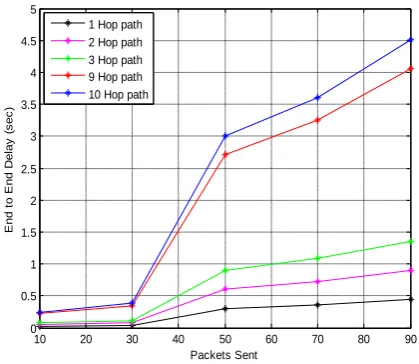
End-to-end delay is measured with respect tovarying payload as shown in figure 2. It is investigated that for few packets i.e. for 10 to 30 packets, the end-to-end delays possess a very small increase up to 3 hops path.When the number of hops proliferates to 9 or 10, again the delaysupsurges by a small amount.Owing to the ability of the algorithm to take stochastic verdicts to route the data packets, ability to detect link failures either with local path repair or by warning preceding nodes on the paths.
Fig 2: End-to-End delay vs. Number of Packets Sent
It is observed that as the number of packets sent increases from 30 to 50, delays upsurges linearly for the less number of hops. These linear upsurges become steeper with extended number of hops, owing to subsequent path repairing and new path exploration to avoid congestion and wireless channel
10 20 30 40 50 60 70 80 90
0 0.5 1 1.5 2 2.5 3 3.5 4 4.5 5
E
n
d
t
o
E
n
d
D
e
la
y
(
s
e
c
)
Packets Sent 1 Hop path
contention is also higher. So packets take more time to trace the network. From the figure 2, it is clear that for 10 hops path, there is difference of 2.618 seconds in end-to-end delay as the packets sent are increased from 30 to 50 whereas for the 3 hop path this difference is 0.7875 seconds.
For higher number of packets from 50 to 90, difference in end-to-end delay becomes 1.5 seconds for the 10 hops path and 0.45 seconds for the 3 hops path. Because here the system starts to saturate and becomes unable to serve any more packets.
Therefore, with the enactment of AntHocNet algorithm in the real world networks, it would be possible to saturate link delay, when the load on the network is more. Whereas in utmost protocols like DSDV, AODV, DSR and TORA delays upsurges as the load on the network increase.
[image:4.595.330.537.189.375.2]4.2Packet Delay Variance(Jitter)
Figure 3 demonstratesthe graph between jitter and number of packets sent. It is investigated that the value of jitter obtained is small amongst other routingprotocols like DSDV, AODV, DSR and TORA. It is due to the ability of the AntHocNet routing algorithm to temporary buffer data packets, if no good path between source and destination is available.
Fig 3: Delay Jitter vs. Number of Packets Sent
From the figure 3, it is examined that jitter upsurges linearly with the proliferation of packets from 10 to 50, rate of increase is sharp for the extended number of hops in comparison to few hops. This is due to the ability of AntHocNet routing algorithm, proactive route maintenance extends the lifetime of existing paths. As the assumed network scenario considers an omnidirectional antenna as a wireless interface.So the data traffic for all succeeding nodes needs to go over the same outgoing queue and experiencing the delays of other adjacent nodes also. Proceeding further, from the figure 3 it is clear that for the 3 hop path jitter upswings from 0.06 seconds to 1.125 seconds up to 50 packets and total difference of 1.065 seconds is observed, while it is 3.55 seconds for the 10 hop path.
From 50 to 70 packets these upsurges become somewhat stable, sinceat this time network approaches saturation withincreased number of packets. But with further proliferation in packets from 70 to 90,upsurges in delay becomes steeper for extended hops because each bidirectional
link used in the algorithm suffer conflicts due to high load of data packets and the control packets on that particular link.
4.3Signal-to-interference-and-noise ratio (SINR)
SINR is the well-known parameter for appraising the optimal data route, but the methodologies for measuring SINR are inadequate as the evidencesobtained at the physical layer are not sufficient. SINR surges withproliferating packets as algorithm has the ability to detect bad links and avoids them.
Fig 4: SINR vs. Number of Packets Sent
From figure 4, it is clear thatthere occurs an inverse relation between number of hops and SINR, whereas attenuation on the path increases as the distance traveled increase. It is alsodepicted from figure 4 that for each hop path,risein SINR is constant with value of 4 dB. For 1 hop path SINRupsurgesfrom 19dB to 23dB with improvement of 4dB and for the 10 hop path SINR upsurges from1dB to 5dB again with improvement of 4dB.As the simulation algorithm presumed constant cost value=1, for allthe considered paths whose SINR for a specific path comes out to be more than the assumed threshold value.
5.
CONCLUSION
Simulation results validate the scalability of AntHocNet parallelto routing protocols like DSDV, AODV, DSR and TORA.It is concluded that AntHocNet presents outstandingresults in terms of SINR.It is the best quality of service parameter to regulate the performance of mobile ad hoc network. Simulation results shows improvement of 4dB for a particular path who’s SINR comes out to be more than the assumed threshold value withthe extended number of hops.In context of end-to-end delay AntHocNet achievesimproved performanceby saturating the link delay for the extended number of hops while the payload at the source node increases from 50 to 90 packets. Because, here the system becomes unable to serve any more packets. In terms of delay jitter, initially jitter increases linearly for few hops and becomes steeper for extended number of hops because the proactive route maintenance of the AntHocNet routing algorithm extends the lifetime of existing paths. With the proliferation of packets from50 to 70, these upsurges become somewhat stable, since at this time network approaches saturation with increased payload. But with further
10 20 30 40 50 60 70 80 90
0 1 2 3 4 5 6 7
D
e
la
y
J
it
te
r
(s
e
c
)
Packets Sent 1 Hop path
2 Hop path 3 Hop path 9 Hop path 10 Hop path
10 20 30 40 50 60 70 80 90
0 5 10 15 20 25
S
IN
R
(
d
B
)
Packets Sent
[image:4.595.72.273.344.530.2]proliferation of packets from 70 to 90, upsurges in delay becomes again steeper for the extended number of hops. Becausehere the bidirectional links used in the algorithm suffer conflicts due to high load of data packets and the control packets.These conflicts canbe reduced by implementing a priority concept at the node level where important packets can be sent first followed by the rest of the packets. This improvement may add up the scalability of the AntHocNet routing algorithm to make its performance even better.
6.
REFERENCES
[1] L. Wang, Y.T. Shu, O.W.W. Yang, M. Dong, and L.F. Zhang, “Adaptive multipath source routing in wireless ad hoc networks” , In Proc. of the IEEE Int. Conf. on Communications, 2001.
[2] M. Elizabeth, and T. Chai-Keong, “A Review of Current Routing Protocols for Ad Hoc Mobile Wireless Networks”, IEEE Personal Communications, 1999.
[3] J. Broch, D. A. Maltz, D. B. Johnson.-C. Hu, and J. Jetcheva,“A performance comparison of multi-hop wireless ad hoc network routing protocols” In Proceedings of the Fourth Annual ACM/IEEE International Conference on Mobile Computing and Networking (MobiCom), 1998.
[4] P Jacquet, P Muhlethaler, T Clausen, A Laouiti, A Qayyum, L Viennot, “Optimized link state routing protocol for ad hoc networks”, in Proceedings of the 5th IEEE International Multi Topic Conference (INMTC 2001), Le Chesnay, France (2001).
[5] Perumalsamy Deepalakshmi and Shanmugasundaram Radhakrishnan, “An ant colony-based multi objective quality of service routing for mobile ad hoc networks” ,in EURASIP Journal on Wireless Communications and Networking 2011, 2011:153
[6] R. Ramanathan and J. redi, “A Brief Overview of ad Hoc Networks: Challenges and Directions”, IEEECommunications Magazine, 2002.
[7] CE Perkins, P Bhagwat, “Highly dynamic destination sequenced distance vector routing (DSDV) for mobile computers”, Computer Communication Review,10(4), 234–244 (1994).
[8] Z Liu, MZ Kwiatkowska, C Constantinou, “A biologically inspired QoS routing algorithm for mobile ad hoc networks”,Int. Journal of Wireless and Mobile Computing4(2),64–
75(2010),doi:10.1504/IJWMC.2010.033054.
[9] David B Johnson and David A Maltz,“Dynamic sourcerouting in ad hoc wireless networks”, In Imielinski andKorth, editors, Mobile Computing, pages 153–181, Kluwer Academic Publishers, 1996.
[10]Shahram JAMALI, Sajjad JAHANBAKHSH2, “BA-TORA: A Multipath Routing Protocol for MANETs by Inspiration from Bee and Ant Colonies”, PRZEGLĄD
ELEKTROTECHNICZNY (Electrical Review), ISSN 0033-2097 R 87 NR 7/2011.
[11]Dorigo, Marco, Gianni Di Caro, and Luca M. Gambardella. "Ant algorithms for discrete optimization" Artificial Life 1999; 5(2):137–172.
[12]T. Stutzle & M. Dorigo, 2002, An Experimental Study of the Simple Ant Colony.
[13]G Di Caro, M Dorigo, “AntNet: distributed stigmergetic control for communications networks”, J. Artif. Intell. Res. 9, 317–365(1998).
[14] M. Gunes, U. Sorges, I. Bouazizi, 2002, “ARA - The Ant-Colony-Based Routing Algorithm for MANETs”, April 2002.
[15]Deepak Bansal, Ravinder Singh Sawhney and Ankur Bansal, “Routing Metrics Improvisation in Wireless Mobile Networks Using Ant Colony Optimization” International Conference on Recent Advances and Future Trends in Information Technology (iRAFIT2012) Proceedings published in International Journal of Computer Applications® (IJCA).
[16]D. Subramanian, P. Druschel and J. Chen, 2003, “Ants and Reinforcement Learning: A Case Study in Routing in Dynamic Networks”, May 2003.
[17] Deepak Bansal, Ravinder Singh Sawhney, “Performance Evaluation of Ant Colony Optimization in Mobile Ad Hoc Networks (ACONET) and Comparison of Different Ant Systems”, 2nd International Symposium on Information and Communication Technology, Hanoi, Vietnam, 13-14 Oct 2011.
[18]Sarbjeet Kaur, Ravinder Singh Sawhney and Rajan Vohra, “MANET Link Performance Parameters using Ant Colony Optimization Approach”,International Journal of Computer Applications (IJCA), Volume 47– No.8, June 2012.
[19]G.A. Di Caro, F. Ducatelle, andL.M., Gambardella. “AntHocNet: an ant-based hybrid routing algorithm for mobile ad hoc networks”,In Proceedings of PPSNVIII, volume 3242 of LNCS, pages 461–470 Springer, 2004. (Best paper award).
[20]G.A. Di Caro, F. Ducatelle, and L.M. Gambardella, “AntHocNet: an adaptive nature-inspired algorithm for routing in mobile ad hoc networks”, European Transactions on Telecommunications, 16(5):443–455, 2005.
[21]G.A. Di Caro, F. Ducatelle, and L.M. Gambardella, “Swarm intelligence for routing in mobile ad hoc networks” ,In Proceedings of the IEEE Swarm Intelligence Symposium, pages 76–83, Pasadena, USA,