http://dx.doi.org/10.4236/oje.2014.46027
Stable Isotope Sourcing Using Sampling
Erik B. Erhardt1, Blair O. Wolf2, Merav Ben-David3, Edward J. Bedrick41Department of Mathematics and Statistics, University of New Mexico, Albuquerque, USA 2Department of Biology, University of New Mexico, Albuquerque, USA
3Department of Zoology and Physiology, University of Wyoming, Laramie, USA 4Colorado School of Public Health, University of Colorado at Denver, Aurora, USA
Email: [email protected]
Received 4 April 2014; revised 24 April 2014; accepted 30 April 2014
Copyright © 2014 by authors and Scientific Research Publishing Inc.
This work is licensed under the Creative Commons Attribution International License (CC BY).
http://creativecommons.org/licenses/by/4.0/
Abstract
Stable isotope mixing models are used to estimate proportional contributions of sources to a mix- ture, such as in the analysis of animal diets, plant nutrient use, geochemistry, pollution, and foren- sics. We describe an algorithm implemented as SISUS software for providing a user-specified number of probabilistic exact solutions derived quickly from the extended mixing model. Our method outperforms IsoSource [1], a deterministic algorithm for providing approximate solutions to represent the solution polytope. Our method is an approximate Bayesian large sample proce- dure. SISUS software is freely available at StatAcumen.com/sisus and as an R package at cran.r-project.org/web/packages/sisus.
Keywords
SISUS, IsoSource, Mixing Model, Animal Ecology, Markov Chain Monte Carlo
1. Introduction
the analysis of stomach and fecal contents [4].
We introduce an algorithm and software, SISUS, for providing feasible source proportions of biomass con- sumed by a mixture using mass-balance mixing models. Our probabilistic method (SISUS) is preferred to the deterministic method (IsoSource [1]) because it quickly and randomly samples a user-specified number of exact solutions from the solution polytope. In Section 2, we describe the model, illustrate the geometrical relationship between isotopic ratio space and the solution polytope, and describe the competing methods to sample the solu- tion polytope. Section 3 describes the SISUS software. Section 4 provides results of a simulation study and an example. In Section 5, we discuss interpretation of results.
2. Material and Methods
2.1. Mixing ModelsThe isotope ratio, δ =1000
(
Rsample Rstandard−1)
‰
, is a normalized ratio of the number of rarer to common iso- topes in a sample, Rsample, relative to an international standard, Rstandard, given in parts per thousand (per mil, ‰)[6]. Carbon and nitrogen are among the most commonly used elements for diet sourcing.
The basic mixing model (BMM) is the simplest mass-balance mixing model. It assumes that the mean isotope ratio of the mixture equals the diet-weighted average of the mean discrimination-corrected isotope ratio compo- sition of the sources [2] [7] [8]. Assuming that I isotopes are measured and the consumer's diet consists of S sources, the defining equations can be written as
1 1
, for 1,..., , and 1 .
S S
i is i i
s s
i I
β δ π π
= =
′
=
∑
= =∑
(1)Coefficient βi is the mean isotope ratio for isotope i in the mixture. Each δis′ =δis+ ∆is is the isotope ra-
tio for isotope i from source s, δis, corrected by the addition of the discrimination, ∆is. Discrimination is
the difference of the isotope ratio in the diet source from the isotope ratio in the mixture's tissues as elements are ingested, excreted, or catabolized (e.g., trophic fractionation, [9] [10]). Mean diet
(
1)
T 2 , ,..., S
π π π
=
π is a
vec-tor restricted to the simplex, that is, each πi is nonnegative and the sum of the source proportions is 1. In
prac-tice βi and δis′ are estimated from data, an issue that we address in Section 5.
The extended mixing model (EMM) increases realism by recognizing that both consumer and sources exhibit variation, and that elemental concentration and assimilation efficiencies of consumers for different food types can vary considerably [3]. The EMM has the same linear form as the BMM, thus the discussion applies to this more general model. Here we restrict our attention to the BMM.
2.2. Alaskan Bear Example
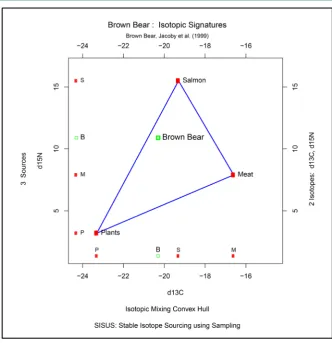
The summaries in Figure 1 reconstruct data from ([11]: Table 1). The goal is to determine the biomass contri- bution of salmon, terrestrial meat, and fruit to the diet of an average brown bear (Ursus arctos) from the Kenai Peninsula, Alaska, at a particular time of year [12]. Mean carbon and nitrogen isotope ratios are available from a sample of brown bear consumers, from samples of the three diet sources, as well as for the discrimination (i.e., difference between the consumer and each diet item) established from captive experiments. Figure 1 plots the discrimination-corrected isotope measurements for carbon/nitrogen pairs,
(
δ δ1′s, 2′s)
, for the three sources andmean carbon/nitrogen isotope ratio responses
(
β β1, 2)
for brown bears. The isotope ratio data plot also in- cludes the “convex hull” obtained by connecting the outermost sources with line segments. The data presented in Figure 1 can be described by the following matrix (2):1
2
3 Diet
Bear Salmon Meat Fruit
20.3 19.3 23.3 0.59
Carbon 16.6
.
10.9 15.5 3.2 0.10
Nitrogen 7.9
1 1 1 0.31
Simplex 1 π π π − − − − = = = = (2)
Figure 1. Convex hull plot of the Alaskan brown bear example. This plot represents the isotope ratio data space of discrimination-corrected carbon and nitrogen isotope ratios.
ture brown bear is not outside the convex hull, as shown in this example. Typically, the closer the isotope ratio values of the mixture are to a source’s discrimination-corrected isotope ratio values, the more similar the mix- ture is isotopically to that source, and the larger the contribution of that source can be to the mixture. Using both carbon and nitrogen, the solution for
(
π π π1, 2, 3)
in (2) is unique. The BMM estimates that brown bear tissues were derived (sourced) from 0.59 salmon, 0.10 meat, and 0.31 fruit. Both frequentist and Bayesian methods are available for estimation for unique solution situations [13] [14].Relationship between Data Space and Source Proportion Solution Spaces
In most studies the number of diet sources exceeds the number of isotopes plus one, S > +I 1, leading to an in- finite number of solutions to the BMM. The goal is to represent the solution space, or alternatively, to provide a set of “typical” solutions to the BMM. If S≤ +I 1, as in the brown bear example, there is at most one feasible solution.
The data consists of I discrimination-corrected isotope ratio means on each of S sources, thus, the iso-tope ratio data space is I-dimensional while the source proportion solutions,
(
π π1, 2,...,πS)
, are S-dimen- sional. Each of the linear equations in (1) defines an(
S−1)
-dimensional hyperplane in the proportion solution space. Assuming S≥ +I 1, the intersection of the simplex and these hyperplanes is an(
S− −I 1)
-dimensional convex polytope. This convex polytope defines the set of solutions to the BMM.In the brown bear data the
(
I =2)
-dimensional isotope ratio data space in Figure 1 maps to the(
S =3)
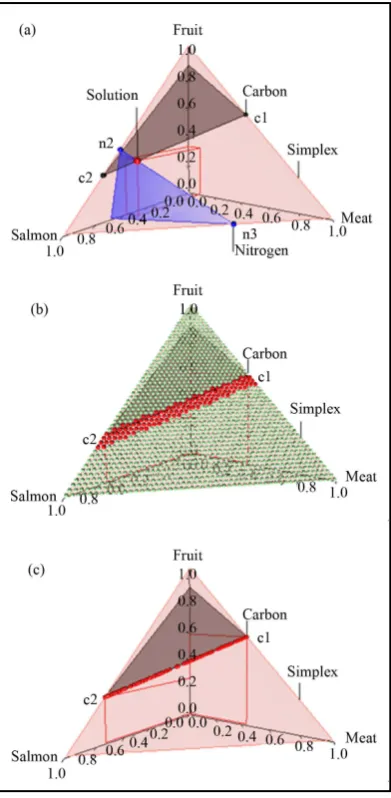
-di- mensional proportion solution space in Figure 2(a). The solution space axes represent biomass contributions of each source, π1, π2, and π3. The simplex equation is represented by the equilateral triangular plane inpoint labeled “solution” at (0.59, 0.10, 0.31). If we considered carbon only, then the solution polytope would be the intersection of the carbon and simplex planes, that is, all points on the line segment joining c1 to c2.
2.3. Algorithms for Feasible Solutions 2.3.1. Approximate Solutions Using IsoSource
[image:4.595.216.412.246.646.2]IsoSource is a popular deterministic algorithm used in stable isotope sourcing to represent the solution polytope from underconstrained linear mixing models where S> +I 1 [1] [15]. IsoSource evaluates a user-specified un- iformly-spaced lattice of points on the simplex, labeling a point a solution if it satisfies the BMM within a user- specified tolerance. These are points on or close to the solution polytope, consistent with all possible solutions being equally likely a priori. This is a brute force strategy because no information is used regarding the location of the solution polytope within the simplex. For a fixed tolerance, decreasing the increment of the grid space hyperexponentially increases the number of points evaluated, increasing both the number of solutions returned
and the time for the algorithm to execute. For a fixed increment, decreasing the tolerance increases the accuracy of the solutions by excluding points far from the solution polytope. Because the number of approximate solu- tions depends on the size of the solution polytope, the increment grid spacing, and the solution tolerance, it may be challenging to choose settings to balance the desire for many solutions, accurate solutions, and acceptable execution time.
Figure 2(b) illustrates the IsoSource sampling strategy, applied to the carbon-only brown bear example with a grid increment of 0.02 and tolerance of 0.10 where 114 of the 1326 points evaluated are approximate solutions. The points evaluated are uniform over the simplex, but the approximate solutions provided are only roughly uniform near the solution polytope.
2.3.2. Exact Probabilistic Solutions via SISUS
SISUS implements a two-step algorithm to sample exact solutions uniformly from the solution polytope. The first step is to determine the vertices and boundaries of the solution polytope. The method is complex to describe [16], but is already implemented [17]. The second step is the probabilistic sampling from the solution polytope, using the random directions symmetric mixing algorithm [18] [19]. There are three steps in this algorithm: (0) Choose a starting point inside the solution polytope, π( )0 ∈, and set counter r←0. (1) Generate a random direction d uniformly distributed over a direction set inside the solution polytope D⊆ ℜS, find the line set
( )
{
r ,}
L= π +ld l∈ ℜ , and generate a random point π(r+1) uniformly distributed over L. Descriptively, we draw a line segment through the current point π( )r to two edges of the polytope along the chosen direction, then generate the next point π(r+1) uniformly at random from that line segment. In this way we move around the po- lytope collecting a representative sample. (2) When we reach the desired number of samples, r=R, the compu- tation stops. Otherwise, the counter is incremented r← +r 1 and the procedure is repeated from to step (1). The sample is generated rapidly and converges to a uniform distribution over the solution polytope [20].
Figure 2(c) shows R=114 exact probabilistic solutions from SISUS for the carbon-only brown bear exam-ple, which are qualitatively similar to the deterministic approximate solutions of IsoSource.
3. Software
SISUS uses the random directions symmetric mixing algorithm in R package polyapost, function constrppprob [21]-[23]. The number of sources S and isotopes I may both be large, provided S≥ +I 1. Sample sizes of
1000
R= and 10000 appear reasonable for exploration and publication, respectively. Standard Markov chain Monte Carlo diagnostics are used to monitor convergence of the algorithm (sec. 11.11, [24]), though convergence issues are extremely rare and are typically due to random sampling rather than algorithmic issues.
SISUS software is freely available at StatAcumen.com/sisus and as an R package at cran.r-project.org/web/ packages/sisus. Data and parameter settings are input into a single OpenOffice.org-compatible MicroSoft Excel 2003 workbook. This workbook is then either uploaded to the website for processing or processed by a local in- stallation of the SISUS package in free statistical software R on Windows, Mac OSX, or Linux platforms. Speci- fied samples, summary tables, and plots in a variety of requested image formats are returned.
4. Results
4.1. Execution Time, Solution Predictability, and Solution Accuracy
There are three reasons why the probabilistic approach (SISUS) is preferred over the deterministic approach (IsoSource). These are (a) the relatively short execution time, (b) the predictability of the number of solutions, and (c) the solution accuracy. In Figure 2 we already touched on points (b) and (c). We use a fabricated exam- ple to further illustrate the differences in these approaches. We analyze subsets of the problem
1
2
10
0 1 1 0 2 2 0 5 6 3 1
0 2 1 1 2 0 3 4 2 5 6
0 3 1 1 2 3 4 0 5 2 7
.
0 4 2 1 1 2 3 4 6 0 5
0 5 1 3 4 5 0 2 2 6 1
1 1 1 1 1 1 1 1 1 1 1
π π π − − − − − − − − − − − = − − − − − − − −
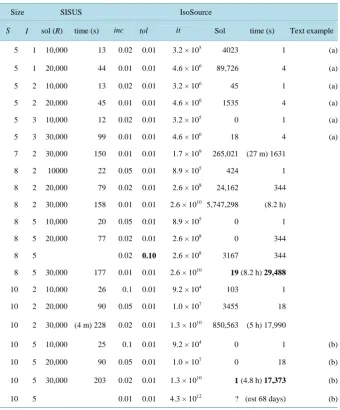
The full problem has S=10 sources and I=5 isotope ratios, as that is the extent of the problem size that IsoSource is programmed to solve. For each example, Table 1 specifies a given value for S and I , and the problem is defined by choosing the first S columns and first I rows plus the simplex constraint of (3). Table 1 reports the execution times for SISUS and IsoSource running on a PC (Dell Optiplex GX260 with Intel Pentium 4 2.40 GHz CPU with 512 MB RAM) without any additional significant processes run- ning.
For SISUS we obtain R exact solutions for each problem size by finding 100R solutions and keeping every 100th to increase the independence of the samples and to improve solution polytope coverage.
[image:6.595.129.470.312.723.2]From Table 1 it is clear that execution time for SISUS increases with S up to a few minutes while Iso- Source increases to hours. For SISUS the time to obtain a specified number of exact solutions grows nearly linearly with the number of sources S and quadratically with R. For IsoSource an increment and toler-ance are specified which determines a hyperexponentially growing number of iterations with S given by the Binomial coefficient (Equation (3), and (1))
Table 1. Comparison of execution time and number of solutions for SISUS and IsoSource. Column labels are number of sources S, number of isotopes I, number of SISUS solutions R, and time in seconds. IsoSource parameters are increment inc, tolerance tol, number of iterations it, number of solutions, and time in seconds, and two sets of cases are described in the text.
Size SISUS IsoSource
S I sol (R) time (s) inc tol it Sol time (s) Text example
5 1 10,000 13 0.02 0.01 3.2 × 10⁵ 4023 1 (a)
5 1 20,000 44 0.01 0.01 4.6 × 10⁶ 89,726 4 (a)
5 2 10,000 13 0.02 0.01 3.2 × 10⁶ 45 1 (a)
5 2 20,000 45 0.01 0.01 4.6 × 10⁶ 1535 4 (a)
5 3 10,000 12 0.02 0.01 3.2 × 10⁵ 0 1 (a)
5 3 30,000 99 0.01 0.01 4.6 × 10⁶ 18 4 (a)
7 2 30,000 150 0.01 0.01 1.7 × 10⁹ 265,021 (27 m) 1631
8 2 10000 22 0.05 0.01 8.9 × 10⁵ 424 1
8 2 20,000 79 0.02 0.01 2.6 × 10⁸ 24,162 344
8 2 30,000 158 0.01 0.01 2.6 × 10¹⁰ 5,747,298 (8.2 h)
8 5 10,000 20 0.05 0.01 8.9 × 10⁵ 0 1
8 5 20,000 77 0.02 0.01 2.6 × 10⁸ 0 344
8 5 0.02 0.10 2.6 × 10⁸ 3167 344
8 5 30,000 177 0.01 0.01 2.6 × 10¹⁰
19 (8.2 h) 29,488
10 2 10,000 26 0.1 0.01 9.2 × 10⁴ 103 1
10 2 20,000 90 0.05 0.01 1.0 × 10⁷ 3455 18
10 2 30,000 (4 m) 228 0.02 0.01 1.3 × 10¹⁰ 850,563 (5 h) 17,990
10 5 10,000 25 0.1 0.01 9.2 × 10⁴ 0 1 (b)
10 5 20,000 90 0.05 0.01 1.0 × 10⁷ 0 18 (b)
10 5 30,000 203 0.02 0.01 1.3 × 10¹⁰ 1 (4.8 h) 17,373 (b)
1 1 . 1 inc S it S − = − + (4)
Approximate solutions are then returned which are within the tolerance of exact solutions. Time scales roughly linearly with the number of iterations (about 1M/s). For small problems
(
S =5)
, IsoSource takes only a few seconds. But as the problem size increases, the time increases to hours. Two cases to note: a) For5
S= , as I increases
(
I =1, 2, 3)
and the solution polytope decreases in dimension(
d=3, 2,1)
the so- lutions become more difficult to find for IsoSource resulting in fewer or no approximate solutions. b) The largest example, S=10, I=5, inc=0.02, finds only 1 approximate solution after almost 5 hours of computation, and larger increments fail to find any solutions. Setting the increment to 1 will increase the running time to roughly 68 days. In each of these cases, SISUS provides 10,000 exact solutions in less than 30 seconds.4.2. Mink Example
We use published mink (Neovison vison) data [25] to further illustrate capabilities of SISUS. The BMM is given by
1
2
7 Diet
Mink Fish Mussels Crabs Shrimps Rodents Amphipods Ducks
15.11 14.23 21.38
Carbon 18.51 15.28 16.90 24.61 18.69
13.81 14.68 14.92
Nitrogen 10.74 12.20 12.96 10.07 15.00
1 1 1
Simplex 1 1 1 1 1
π π π − − − − − − − − = (5)
where the rows are for carbon, nitrogen, and the simplex. The left vector is the mixture mink and the columns of the matrix are for the S=7 sources of fish, mussels, crabs, shrimps, rodents, amphipods, and ducks. The con- vex hull of the discrimination-corrected sources includes the mink, thus there are feasible solutions. The solution polytope is a S− − = − − =I 1 7 2 1 4-dimensional object in S=7-dimensional proportion space.
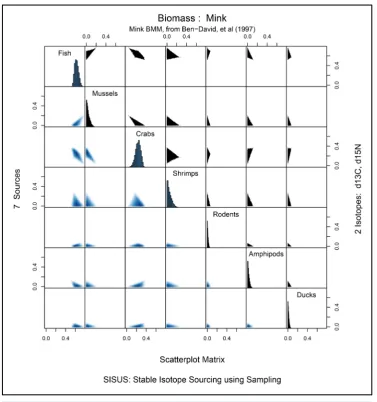
Figure 3 provides graphical summaries of the solution polytope returned by SISUS, based on 10,000 solu- tions. Time to compute the solutions is similar to that reported in Table 1 for S=7 sources and I =2 iso- topes. Marginal histograms of the 10,000 solutions for each source are given along the main diagonal. Two-di- mensional histograms for each pair of sources are given above the main diagonal of the plot while corresponding pairwise density plots are provided below the main diagonal. The one- and two-dimensional histograms show that the marginal and pairwise solutions are highly constrained within the unit interval and unit square, respec- tively.
5. Probabilistic Interpretation and Discussion
IsoSource [1], with nearly 1000 citations, is extensively used for inferences based on mixing models. The natu- ral interpretation of the IsoSource solutions is as samples from the Bayesian posterior distribution of the vector
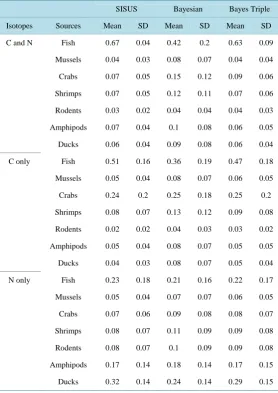
π of mixture proportions. As the components in the BMM defined in (1) are estimated from data but treated as fixed by IsoSource, it can be shown that random samples from the solution polytope are an approximate sample from the posterior distribution of π , assuming that the samples for estimating the isotope ratios and discrimina-tions are large, and that the prior distribution for π is uniform over the simplex. As SISUS generates random samples from the solution polytope rather than approximate solutions, we consider SISUS a better inferential tool. Thus in the mink analysis, the plots in Figure 3 summarize the univariate and bivariate large sample poste-rior distributions for the contribution of sources to mink diet. The samples may be used, for example, to estimate the posterior probability that Amphipods contribute to at least 10% of the mink diet, or to computing the (poste-rior) means for each proportion, which is a point estimate of the contribution of a source to the diet. Table 2 lists the posterior means and standard deviations for each source in the mink example. The SISUS large sample analysis suggests that fish comprises approximately 0.67 of mink diet, with each of the remaining six sources contributing to roughly equally.
Figure 3. Mink BMM example marginal histograms along diagonal, scatter plot of paired source con- tributions on the upper diagonal, and corresponding two-dimensional density histograms on the lower diagonal.
researchers have developed Bayesian models for inference using the BMM [26]-[28]. These models are some- what restrictive as they assume that the source isotope ratios or discrimination are estimated without error, or that the multivariate isotope ratio data have independent components. For a realistic assessment of SISUS, we considered a Bayesian model for the mink data that assumes independent multivariate normal distributions for correlated isotope ratio responses from the mink mixture, the seven sources, and for estimating discrimination from two diet experiments [14]. In a second Bayesian analysis, we considered the effect of tripling the sample sizes but keeping all other sample summaries the same. Diffuse but proper prior distributions were used throughout.
Table 2 gives estimated posterior means and standard deviations for the seven components of mink diet. One analysis uses both isotopes. The other two analyses consider carbon and nitrogen separately. Considering the analysis based on the original data, the posterior means based on SISUS tends to identify the major and minor sources of mink diet, but the estimates of the dominant sources are somewhat inaccurate. The SISUS summaries also tend to underestimate uncertainty in the marginal posterior distributions, which is expected. The SISUS means and standard deviations for analyses based on a single isotope are much more accurate, as are the summa- ries for analyses in which the sample size was tripled.
Table 2. Selected numerical summaries for the mink example based on SISUS, fully Bayesian analyses, and Bayesian analyses with triple the sample size. Values represent feasible source contributions of biomass to mink.
SISUS Bayesian Bayes Triple
Isotopes Sources Mean SD Mean SD Mean SD
C and N Fish 0.67 0.04 0.42 0.2 0.63 0.09
Mussels 0.04 0.03 0.08 0.07 0.04 0.04
Crabs 0.07 0.05 0.15 0.12 0.09 0.06
Shrimps 0.07 0.05 0.12 0.11 0.07 0.06
Rodents 0.03 0.02 0.04 0.04 0.04 0.03
Amphipods 0.07 0.04 0.1 0.08 0.06 0.05
Ducks 0.06 0.04 0.09 0.08 0.06 0.04
C only Fish 0.51 0.16 0.36 0.19 0.47 0.18
Mussels 0.05 0.04 0.08 0.07 0.06 0.05
Crabs 0.24 0.2 0.25 0.18 0.25 0.2
Shrimps 0.08 0.07 0.13 0.12 0.09 0.08
Rodents 0.02 0.02 0.04 0.03 0.03 0.02
Amphipods 0.05 0.04 0.08 0.07 0.05 0.05
Ducks 0.04 0.03 0.08 0.07 0.05 0.04
N only Fish 0.23 0.18 0.21 0.16 0.22 0.17
Mussels 0.05 0.04 0.07 0.07 0.06 0.05
Crabs 0.07 0.06 0.09 0.08 0.08 0.07
Shrimps 0.08 0.07 0.11 0.09 0.09 0.08
Rodents 0.08 0.07 0.1 0.09 0.09 0.08
Amphipods 0.17 0.14 0.18 0.14 0.17 0.15
Ducks 0.32 0.14 0.24 0.14 0.29 0.15
BMM and EMM but tends to underestimate uncertainty. In our opinion, SISUS is especially useful for second- ary analyses of published data and in settings where individual level data needed for a complete Bayesian analy- sis may not be available.
Acknowledgements
EBE thanks Keith Hobson for initial support during this project.
References
[1] Phillips, D.L. and Gregg, J.W. (2003) Source Partitioning Using Stable Isotopes: Coping with Too Many Sources.
Oecologia, 136, 261-269. http://dx.doi.org/10.1007/s00442-003-1218-3
[2] Phillips, D.L. (2001) Mixing Models in Analyses of Diet Using Multiple Stable Isotopes: A Critique. Oecologia, 127, 166-170. http://dx.doi.org/10.1007/s004420000571
[4] Hobson, K.A. and Wassenaar, L.I. (Eds.) (2008) Tracking Animal Migration with Stable Isotopes. Academic Press.
[5] Ehleringer, J.R., Bowen, G.J., Chesson, L.A., West, A.G., Podlesak, D.W. and Cerling, T.E. (2008) Hydrogen and Oxygen Isotope Ratios in Human Hair Are Related to Geography. Proceedings of the National Academy of Sciences,
105, 2788. http://dx.doi.org/10.1073/pnas.0712228105
[6] Kendall, C. and McDonnell, J.J. (Eds.) (1998) Isotope Tracers in Catchment Hydrology. Elsevier, Amsterdam.
[7] DeNiro, M. and Epstein, S. (1978) Influence of the Diet on the Distribution of Carbon Isotopes in Animals. Geochimi-caet Cosmochimica Acta, 42, 495-506.
[8] Schwarcz, H.P. (1991) Some Theoretical Aspects of Isotope Paleodiet Studies. Journal of Archaeological Science, 18, 261-275. http://dx.doi.org/10.1016/0305-4403(91)90065-W
[9] DeNiro, M. and Epstein, S. (1981) Influence of the Diet on the Distribution of Nitrogen Isotopes in Animals. Geo-chimicaet Cosmochimica Acta, 48, 341-351.
[10] Minagawa, M. and Wada, E. (1984) Stepwise Enrichment of 15N along Food Chains: Further Evidence and the Rela-tion between δ15
N and Animal Age. Geochimicaet Cosmochimica Acta, 48, 1135-1140.
[11] Koch, P.L. and Phillips, D.L. (2002) Incorporating Concentration Dependence in Stable Isotope Mixing Models: A Reply to Robbins, Hilderbrand and Farley. Oecologia, 133, 14-18.
http://dx.doi.org/10.1007/s00442-002-0977-6
[12] Jacoby, M.E., Hilderbrand, G.V., Servheen, C., Schwartz, C.C., Arthor, S.M., Hanley, T.A., Robbins, C.T. and Mich-ener, R. (1999) Trophic Relations of Brown and Black Bears in Several Western North American Ecosystems. Journal of Wildlife Management, 63, 921-929. http://dx.doi.org/10.2307/3802806
[13] Erhardt, E.B. and Bedrick, E.J. (2014) Inference for Stable Isotope Mixing Models: A Study of the Diet of Dunlin.
Journal of the Royal Statistical Society: Series C, online. http://dx.doi.org/10.1111/rssc.12047
[14] Erhardt, E.B. and Bedrick, E.J. (2013) A Bayesian Framework for Stable Isotope Mixing Models. Environmental and Ecological Statistics, 20, 377-397. http://dx.doi.org/10.1007/s10651-012-0224-1
[15] Phillips, D.L. (2006) IsoSource (Version 1.3.1).
www.epa.gov/wed/pages/models/stableIsotopes/isosource/isosource.htm
[16] Fukuda, K. and Prodon, A. (1996) Double Description Method Revisited. Lecture Notes in Computer Science, 1120, 91-111. http://dx.doi.org/10.1007/3-540-61576-8_77
[17] Fukuda, K. (2005) C-Library Cddlib (Version 0.94f). http://www.ifor.math.ethz.ch/~fukuda/cdd home/cdd.html [18] Boneh, A. and Golan, A. (1979) Constraints’ Redundancy and Feasible Region Boundedness by Random Feasible Poi-
nt Generator (rfpg). 3rd European Congress on Operations Research (EURO III), Amsterdam, 9-11 April 1979. [19] Smith, R.L. (1980) Monte Carlo Procedures for Generating Random Feasible Solutions to Mathematical Programs.
ORSA/TIMS Conference, Washington DC.
[20] Smith, R.L. (1984) Efficient Monte Carlo Procedures for Generating Points Uniformly Distributed over Bounded Re-gions. Operations Research, 32, 1296-1308. http://dx.doi.org/10.1287/opre.32.6.1296
[21] R Development Core Team (2006) R: A Language and Environment for Statistical Computing. R Foundation for Sta-tistical Computing, Vienna.
[22] Lazar, R. and Meeden, G. (2003) Isipta’03, Proceedings of the 3rd International Symposium on Imprecise Probabilities and Their Applications. In: Bernard, J.M., Seidenfeld, T. and Zaffalon, M., Eds., ISIPTA, Proceedings in Informatics, Vol. 18, 361-371.
[23] Meeden, G. and Lazar, R. (2006) Polyapost: Simulating from the Polya Posterior. R Package Version 1.1.
[24] Gelman, A., Carlin, J.B., Stern, H.S. and Rubin, D.B. (1995) Bayesian Data Analysis. Chapman and Hall, London.
[25] Ben-David, M., Hanley, T.A., Klein, D.R. and Schell, D.M. (1997) Seasonal Changes in Diets of Coastal and Riverine Mink: The Role of Spawning Pacific Salmon. Canadian Journal of Zoology, 75, 803-811.
http://dx.doi.org/10.1139/z97-102
[26] Moore, J.W. and Semmens, B.X. (2008) Incorporating Uncertainty and Prior Information into Stable Isotope Mixing Models. Ecology Letters, 11, 470-480. http://dx.doi.org/10.1111/j.1461-0248.2008.01163.x
[27] Parnell, A. and Jackson, A. (2008) Siar: Stable Isotope Analysis in R. R Package Version 3.3.