
Topology Control in Wireless Sensor Network:
An Overview
Ashwini V. Nagpure
PG Student IV Sem WCC, Dept. of CSE
TGPCET RTMNU,Nagpur,India
Sulabha Patil
Assistant Professor Dept. of CSE
TGPCET RTMNU,Nagpur,India
ABSTRACT
Energy saving and improve the life time of the sensor node is main focus in the recent years. The most important technique used in wireless sensor networks to reduce energy consumption is Topology Control (i.e. control the topology by maintaining the communication links between network nodes to maintain the connectivity). In this article, first we overview the recent topology control techniques including future directions followed by performance metrics. Further, our overview help to identify a number of issues for achieving energy efficiency and network lifetime through topology control.
General Terms
Wireless sensor network, Topology Control
Keywords
Wireless sensor network, Connectivity, Energy Consumption, Network Lifetime
1.
INTRODUCTION
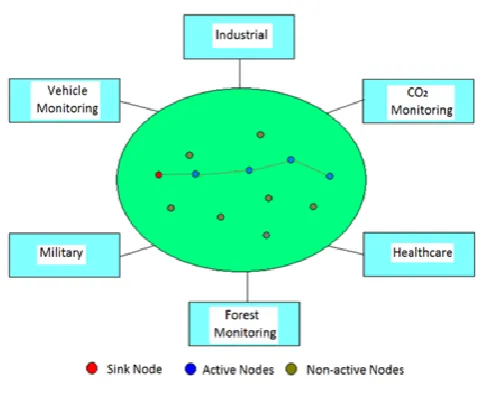
[image:1.595.318.561.224.425.2]Wireless Sensor Networks (WSN) are used in variety of application areas as shown in figure 1, which include military, vehicle monitoring, forest monitoring, environmental, healthcare, biological, industrial and other commercial applications[1]. The important innovations in the field of sensor technology, is the Network of sensors, which is composed of sensor nodes which are capable of sensing, and transmitting the collected information, have made remarkable impact in variety of application [1]. The main component of WSN is battery-powered sensor nodes having low-cost and power. Hence in order utilize limited energy resources, it has to be managed carefully in order to extend the lifetime of the network [1]. The sensor nodes communicating with each other using the various types of topology like mesh, tree, chain etc. Therefore it is important to form, the efficient topology which ensures neighbors at a minimum distance, reduces message being lost between sensors, reduces the interference, thus reducing the waiting time for sensors to transmit data. Similarly the data aggregation performed by topology, help to reduce the amount of energy i.e. it gives a longer lifetime for the sensor network. Additionally topology characterizes the group, and addition/deletion of nodes in the group. A radio transmission range and scheduling of nodes alter the topology of sensor network. Therefore, more energy can be saved if the controlling of topology is possible. Hence Topology control plays important role in energy conservation and increase the life time of overall network.
Fig 1: Overview of WSN applications with Topology Control
Many Researchers proposes algorithms for topology control, to reduce energy consumption and to enhance the lifetime of the network by keeping in mind sensors limitations in terms of energy, bandwidth, & memory. The rest of this paper is organized as follows: Section 2 explains about topology control classification, section 3 describes related work, section 4 elaborate, measures and metrics of topology control, section 5 describes some open issues for topology control and Section 6 concludes.
2.
TC CLASSIFICATION
The transmitting power, as well as the neighbours of each node in the network decides the type of topology control used in a wireless network. The main concept behind the topology control (TC) is to minimize the set of nodes that are considered to be the neighbours of a given node. A Taxonomy of TC as shown in figure 2, describe about the different approaches to topology control.
2.1
Homogeneous
2.2
Non Homogeneous
[image:2.595.55.286.192.368.2]Nodes are allowed to select different and individual transmitting powers up to a certain level that they can support i.e. they will have different transmitting ranges. The encountered problem is related to assigning the range and this can be tackle by using the computational geometry. The concept of graph theory provides the solution for this type of approach. Topology control can also be subcategorized [3] according to the type of information that is used to generate the topology (Location based, direction based and neighbour based).
Fig 2: Taxonomy of approaches to topology control [2, 3]
2.3
Centralized
A network topology is estimating based on the particular node & locations of the other network nodes, hence it can provide global information of nodes but their implementations are expensive due to communication overheads, especially in a network consisting of a large number of sensor nodes [3]. In addition, centralized algorithms require one or more nodes with additional resource capabilities to act as a centralized administrator to form a global network topology, whereas sensor networks typically lack a centralized administration. Similarly, the location information along with the transmission range of the individual nodes is used to form a link between a node pair. If the mobility will be considered during the operation of topology control it requires a considerable message overhead to recompute the topology under moderate and high mobility.
2.4
Distributed
A distributed topology control permits the sensor nodes to independently generate and preserve energy- efficient links with better reliability. There are two types mainly classified connectivity aware and capacity aware [3]. The approach followed in the connectivity based topology control algorithms is to adjust the neighbour count to maintain connectivity and stability while the each node maintains its neighbour information. The transmission range of the nodes decides the neighbour list and such neighbour information is periodically updated when a node moves out/in the communication range. The approach followed by Capacity based topology control accounting the network nodes cause interference which mainly impacts the communication of other nodes in domain. The transmission of surrounding nodes affects the signal to noise ratio of other network communications. The s/n ratio of an ongoing communication increases with the number of neighboring communications therefore interference increases.
3.
RELATED WORK
Topology control is the important technique in the domain of wireless sensor network. Most researchers contributing in this area and some of works are discussed here shortly including its summary as shown in Table-1. Xiaoyu Chu and Harish Sethu [4] introduce a topology control algorithm (CTCA) that dynamically adapts to current energy levels at different nodes. A game-theoretic approach employing to maps the problem of maximizing the network’s lifetime into an ordinal potential game. The energy consumption at another node is reduced by increasing the transmission power. For the connectivity of nodes, concept of graph theory is not sufficient due to heterogeneous traffic in WSN. Hence a path- implementability of sensor nodes to relay traffic along a given direction field is good representation [5].
CDS-based topology control technique, based on formation of virtual backbone to allow communication between any arbitrary pair of nodes in the network. Topology control using localized protocols [6] constructed k-connected k-dominating set (k-CDS) as a virtual backbone of wireless networks. The basic extension of dominating set consider by Jie Wu at el. [7] where each node in an ad hoc network is covered by either a dominating neighbor or several 2-hop dominating neighbors based on cooperative communication but it transmit independent copies of a packet , which create effects of fading. A simple, distributed and suboptimised CDS based technique A3 [8] off unnecessary nodes while keeping the network connected and providing complete communication coverage. The A3 algorithm performed well in terms of number of active nodes needed, message complexity, and energy efficiency. Sajjad at el. [9], further optimize the virtual backbone using A1 algorithm and it perform better in terms of message overhead, connectivity under topology maintenance and sensing coverage.
Paolo Costa et al. [10] proposes a cooperative distributed approach which dynamically adjusts the transmission power of sensor nodes to match connectivity constraints. The optimal solution for topology control in distributed environment is obtained by the formulation of mathematical programming. Real-life test-beds of small-scale indoor and outdoor wireless sensor network give actual metrics on local and multi-hop connectivity, convergence time and emitted power. By considering implementation on two tier architecture, S. Emalda Roslin et al. [11] proposes HCT based algorithm to overcome the oscillatory behavior faced in the conventional cooperative approach.
Sink node and its placement is important in WSN for minimal energy utilise by nodes. Haidar Safa et al. [12] efficient meta-heuristic algorithm uses the DPSO to solve the problem of sink placement, number of sinks required and their locations. Traffic Flow Analysis based approach for multiple sink is also experimented for calculating the maximum worst case delay.
article presented by M. A. Khan et al. [15] minimises the energy loss in dense WSNs using a Color Based Topology Control (CBTC) algorithm. This approach removes the coverage holes problem and minimizes energy consumption.
For the real world application topology maintenance is also important for topology control in WSN. Chao-Yang Lee et al [16] distributed and reliable energy- efficient topology control (RETC) algorithm increases network reachable probability in the topology construction phase. A novel topology maintenance scheme based on multilevel thresholding is used to balance energy consumption. The reliability and Energy efficiency of link independently maintain by the RETC. Simulation and evaluation using cellular autometa is proposed by S. Athanassopoulos at el. [17] for topology control algorithms in WSN using Matlab, Java and Python programming. To increase network lifetime, connectivity and coverage, the subset of sensor node should remain active. Moore, Weighted Margolus or Slider neighbouring schemes is used to get the information about wider neighbourhoods.
The network interference leads to the loss in packets and hence topology control with channel plays significant role. The level of interference cannot be evaluated on the basis of interfering nodes, hence, no one can assure high packet reception ratio. The combine approach of topology control and channel assignment is proposed by Dawei Gong at el. [18] to improve the PRR of each link in the network. The construction of a maximum PRR spanning tree adjusted the transmitting power and channel of sensor nodes improve the links. Hence minimizes retransmission and improve network throughput, energy efficiency and end-to-end packet delay.
For the physical topology, assigning node id is important hence, Junghun Ryu at el.[19] Borel Cayley graphs approach minimizing communication distance between nodes, maximizing the number of edges of the graph. This proposed consensus protocols give better performance for the problem of ID assignments.
The change in transmitting power of sensor directly affects on the topology & hence it can be controlled by varying the transmission. R. Wattenhofer at el. [20] simple distributed cone based algorithm assured total connectivity based on local decisions about its transmission power. The directional information, is consider for a node to grow its transmission power until it finds a neighbor node in every direction and the validity of the algorithm is prove using NS-2 simulation. More number of neighbors or huge transmission range may increase interference and energy consumption hence to reduce the number of neighbors for this two possible solution are to adjust the transmission power and adjust the antenna. The integrating mechanism is a good solution to control topology [21].
Two tiered WSN is good initiative to control topology process & Application nodes and Base Stations, usually resides in the upper layer. This arrangement mainly focused on BS location and inter-AN relaying optimization, to maximize the topological network lifetime of the WSN [22]. The Computational Geometry is used to derive the optimal BS locations for mission criticality and the efficacy of topology control validates the optimality.
The traditional methods face the problem of high redundancy in connectivity therefore the heuristics approach of PSO optimization is used to control topology [23]. A non dominated discrete particle swarm optimization (NDPSO) has been design by transforming the problem into mcd-MST. This approach provides consumption of low power with high structural robustness and controllable communication effectively prolong the lifetime of WSNs.
[image:3.595.62.542.495.767.2]Homogeneous network have same transmitting power whereas heterogeneous network uses nodes with different transmitting power. Nanxi Luo and Jie Bao [24], distributed topology control based on pass-loss is applied on heterogeneous network with additional arrangement of slowly moving nodes.
Table 1: Summary of Topology Control literature [4-24]
Reference Technique/Protocol/Approach Problem Focused Future Scope
[4] Cooperative Topology Control with
Adaptation (CTCA) Network’s lifetime Developing and generalized version
[5] Jointly used MAC and routing protocol
Scheduling (Path-implementability
from source to destination) Make lightweight protocol stacks
[6] k-connected k-dominating set (k-CDS) as a backbone
Efficiency Balancing and fault
tolerance Multi hop CDS
[7] Extended MCDS AWF algorithm Node Power saving Backbone nodes to cover its 3-hop coverage area
[8] A3 algorithm Energy Saving and extend the
lifetime Protocol Optimization
[9] A1- A CDS based topology control algorithm
Save energy and extend the lifetime
of wireless sensor networks Topology maintenance with control
[10] Cooperative, lightweight and fully
distributed Match local connectivity constraints Node Mobility
[11] HCT (Hierarchical Cooperative
Technique) algorithm. Network energy efficiency
Optimization using genetic algorithm
[12] Discrete PSO (DPSO) with local
Search Sink placement Optimization Simulating proof of given results
[13] Energy-aware weighted dynamic
topology control (WDTC) algorithm Extend lifetime & Energy balancing
[14] Energy Balanced Topology Control (EBTC) algorithm
Energy Balancing & lifetime of the
network. Uniform node deployment
[15] Color Based Topology Control (CBTC) algorithm
Minimize, energy loss in dense WSN & removal of coverage holes
Application specific node deployment
[16] Reliable energy- efficient topology control (RETC) algorithm
Topology construction &
maintenance in Real application Node Mobility or Sink mobility
[17] Cellular automata Network lifetime, by maintaining connectivity and coverage
Consideration of more complex forms of randomization.
[18]
Centralized & distributed PRR maximization algorithm
Network throughput, energy efficiency & end-to-end packet
delay
Application specific node deployment
[19] Borel Cayley graphs based
algorithm Node ID assignment
Effects of interferences on BCG-based networks.
[20] Distributed cone-based topology
control algorithm Tackling the Network longevity
Node Mobility & Changing network topology
[21] Directional Topology Control algorithms
Increase effective network capacity & energy conservation
Directional Topology Control for WSN with Directional antenna
[22] Recursive algorithm Maximize the topological network lifetime for mission criticality
Node placement & partition techniques, impact on BS location &
internode communication arrangements
[23]
A nondominated discrete particle swarm optimization (NDPSO)
algorithm
High connectivity redundancy and low structure robustness
Improve the convergence efficiency of NDPSO
[24] PLTC algorithm Determine link quality Application specific node
deployment
4.
MEASURES & METRICS FOR TC
The various approaches are used to control the topology and these approaches[4-24] is judge on the basis of some evaluation parameters and these parameters include connectivity, energy efficiency, throughput and Network lifetime [25]
4.1
Connectivity
Logically nodes are connected through graph and a basic requirement for a TC algorithm is that it should not disconnect a connected graph [26]. If there is a multiple path between nodes then there should also be possible to maintain the connectivity between nodes to share a message
4.2
Energy efficiency
The energy consumed for a transmission and reception between nodes is directly proportional to the distance between nodes. The energy stretch factor and the hop stretch factor are considered to determine the energy efficiency [26].
4.3
Throughput
Topology control required a high throughput, where it tries to maintain a comparable amount of traffic as the original network topology before TC [26]. One of the throughput measures can be used [25] is the bit-meter. The throughput of the network is then the number of bit-meters transported per second.
4.4
Network lifetime
The overall lifetime of network is required to be high to maintain the connectivity and coverage of the network. As the node fail and not able to balance the energy, the overall lifetime of the network decreases.
5.
OPEN ISSUES
In order to mitigate problem of energy consumption and radio interference, wireless sensor network community increasing their attention towards topology control in recent years as witnessed by the considerable research in this field reported in articles [4-24]. However, several aspects related to topology control have not been carefully investigated yet. In this section, we outline some of them & we hope it will motivate researchers to undertake additional studies on this field.
5.1
Network lifetime
In the node communication reducing energy consumption and interference might be contradictory objectives. More investigation is needed [8, 9, 11, 14] in the domain of distributed topology control to reduce energy consumption and improve overall network lifetime of the node
5.2
Re-transmission
WSN is the lossy channel; hence, for this type of practical models, Medium Access Control is necessary for retransmission. The packet loss probability at the boundary of coverage is ideally zero but in real scenario packet loss probability is not zero, hence the consideration of different retransmission strategies needs to be investigated [18] from application point of view for topology control in WSN.
5.3
Node Deployment
Sensor node deployments are normally in the uniform/random pattern. Thus, the performance analysis of different network properties in the presence of unusual pattern [14,15,18,24] is another step in the direction of a more realistic characterization of sensor networks.
5.4
Mobility
[10,16,20] is needs to be done to find out the effect of mobility on topology control. Similarly in many applications movement of node is performed in groups. Thus, the impact of group mobility on topology control should also be need to investigate.
5.5
BCG Network
It is difficult to impose an entire logical graph to a physical network of finite radio range in WSNs; hence an efficient node ID assignment will allow more connections to be imposed in real scenario. A symmetric property of Borel Cayley Graph enables distributed routing & offers efficient coherent topologies for dense WSNs. So BCGs are good choice for topology control in WSNs, hence it needs additional investigation [19].
5.6
Neighbours Selection
Selecting the neighboring node which also improves the performance of the TC. The selection of neighbors node based on genetic algorithm can improve the performance of the network. So some investigation is also needed [11] for best selection of neighbours.
6.
CONCLUSION
The lifetime of a wireless sensor network operating on battery power is critical to its usefulness. Similarly network lifetime can be increased by efficiently managing the power consumption in each individual node belonging to the network hence topology control playing significant role. This work recognize some remarkable scope (i.e. mobility & optimization), & issues for Topology control in WSN, which will open the door for researchers to investigate these areas to further improve the performance of topology control.
7.
ACKNOWLEDGMENTS
We specially thanks to Prof. Lalit B. Damahe for his advice & support during writing this paper.
8.
REFERENCES
[1] D. J. Cook and S. K. Das, “Smart environments: technologies, protocols and applications”, New York: John Wiley, pp. 13-15, 2004.
[2] Paolo Santi,“Topology Control in Wireless Ad Hoc and Sensor Networks”, ACM computing surveys (CSUR), Volume 37, Issue 2, pp. 164-194, June 2005.
[3] Gaurav Srivastava, Paul Boustead, Joe F.Chicharo, “A Comparison of Topology Control Algorithms for Ad-hoc Networks”, Proceedings of the Australian Telecommunications, Networks and Applications Conference ATNAC03, Melbourne, Australia December 8, 2003
[4] Xiaoyu Chu; Harish Sethu, "Cooperative topology control with adaptation for improved lifetime in wireless ad hoc networks", INFOCOM, 2012 Proceedings IEEE , vol., no., pp.262,270, 25-30 March 2012
[5] Masoumeh Haghpanahi, Mehdi Kalantari, Mark Shayman, “Topology control in large-scale wireless sensor networks: Between information source and sink”, Ad Hoc Networks, Volume 11, Issue 3, pp.975-990, May 2013.
[6] Fei Dai, Jie Wu, "On Constructing Connected k-Dominating Set in Wireless Networks", Parallel and Distributed Processing Symposium, 2005. Proceedings.
19th IEEE International , vol., no., pp.81a,81a, 04-08 April 2005
[7] J. Wu, M. Cardei, F. Dai; S.Yang, "Extended Dominating Set and Its Applications in Ad Hoc Networks Using Cooperative Communication", Parallel and Distributed Systems, IEEE Transactions on , vol.17, no.8, pp.851-864, Aug. 2006.
[8] P.M Wightman ,M.A. Labrador, "A3: A Topology Construction Algorithm for Wireless Sensor Networks," Global Telecommunications Conference, IEEE GLOBECOM 2008 , vol., no., pp.1,6, Nov. 30-Dec. 4, 2008.
[9] Sajjad Rizvi, Hassaan Khaliq Qureshi, Syed Ali Khayam, Veselin Rakocevic, Muttukrishnan Rajarajan, “A1: An energy efficient topology control algorithm for connected area coverage in wireless sensor networks”, Journal of Network and Computer Applications, Volume 35, Issue 2, pp. 597-605, March 2012
[10] Paolo Costa, Matteo Cesana, Stefano Brambilla, Luca Casartelli, A cooperative approach for topology control in Wireless Sensor Networks, Pervasive and Mobile Computing, Volume 5, Issue 5, pp. 526-541, October 2009.
[11] S. Roslin & C.Gomathy , "A Novel Topology Control Algorithm for Energy Efficient Wireless Sensor Network", International Conference on Network and Electronics Engineering IPCSIT vol.11, pp. 76-81, 2011.
[12]Haidar Safa, Wassim El-Hajj, Hanan Zoubian, “A robust topology control solution for the sink placement problem in WSNs”, Journal of Network and Computer Applications, Volume 39, pp.70-82,March 2014
[13] R. Sun, J. Yuan, I. You, X. Shan, and Y. Ren, “Energy-aware weighted graph based dynamic topology control algorithm,” Simulation Modelling Practice and Theory, vol. 19, pp. 1773–1781, 2011.
[14] X. Chu and H. Sethu ,“An Energy Balanced Dynamic Topology Control Algorithm for Improved Network Lifetime”, Computer Science Networking and Internet Architecture 12 sep 2013
[15] M. Khan, A. Khan, S. Shah, A. Abdullah” An Energy Efficient Color Based Topology Control Algorithm for Wireless Sensor Networks”, Wireless Sensor Network ,Vol. 5 Issue 1,pp.1-7, Jan 2013
[16]C. Lee , L. ChengShiu , F. TianLin , C. SingYang “Distributed topology control algorithm on broadcasting in wireless sensor network” Journal of Network and Computer Applications , Volume 36, Issue 4 , pp. 1186– 1195, July 2013.
[17] S. Athanassopoulos, C. Kaklamanis, G. Kalfountzos , P. Katsikouli , E. Papaioannou, “Simulation of Topology Control Algorithms in Wireless Sensor Networks Using Cellular Automata”, International Journal of Communications, Network & System Sciences, Vol. 6 Issue 7, pp. 333-345. 13p, Jul 2013
[19]Junghun Ryu, Jaewook Yu, Eric Noel, and K. Wendy Tang, “ Borel Cayley Graph based Topology Control for Consensus Protocol in Wireless Sensor Networks”, ISRN Sensor Networks, vol. 2013, Article ID 805635, 2013.
[20]R. Wattenhofer, Li Li , P. Bahl, Yi-Min Wang, "Distributed topology control for power efficient operation in multihop wireless ad hoc networks", INFOCOM 2001,Twentieth Annual Joint Conference of the IEEE Computer and Communications Societies. Proceedings. IEEE , vol.3, no., pp.1388-1397, 2001.
[21]Zhuochuan Huang, Chien-Chung Shen, Srisathapornphat, C., Jaikaeo C., "Topology control for ad hoc networks with directional antennas", Computer Communications and Networks, 2002. Proceedings. Eleventh International Conference on , vol., no., pp.16,21, 14-16 Oct. 2002
[22]Jianping Pan, Y. Thomas Hou, Lin Cai, Yi Shi and Sherman X. Shen, “Topology control for wireless sensor
networks,” ACM on Mobile Computing and Networking, pp. 286-299, Sep. 2003.
[23]W. Guo, B. Zhang, G. Chen, X. Wang, and Naixue Xiong, “A PSO-Optimized Minimum Spanning Tree-Based Topology Control Scheme for Wireless Sensor Networks”, Hindawi Publishing Corporation International Journal of Distributed Sensor Networks ,Volume, Article ID 985410, pp. 1- 14 , 2013.
[24]Nanxi Luo, Jie Bao, “A Topology Control Algorithm Based on Pass Loss for Wireless Sensor Network”, Applied Mechanics and Materials, Volumes 347 – 350, pp. 677-681, August, 2013.
[25]R. Rajaraman, “Topology Control and Routing in Ad hoc Networks: A Survey”, ACM SIGACT News, vol. 33, no. 1, pp. 60-73, 2002.
![Fig 2: Taxonomy of approaches to topology control [2, 3]](https://thumb-us.123doks.com/thumbv2/123dok_us/8047513.773062/2.595.55.286.192.368/fig-taxonomy-approaches-topology-control.webp)
![Table 1: Summary of Topology Control literature [4-24]](https://thumb-us.123doks.com/thumbv2/123dok_us/8047513.773062/3.595.62.542.495.767/table-summary-of-topology-control-literature.webp)
