Munich Personal RePEc Archive
Estimation of an Occupational Choice
Model when Occupations are
Misclassified
Sullivan, Paul
Bureau of Labor Statistics
October 2007
Online at
https://mpra.ub.uni-muenchen.de/9313/
Estimation of an Occupational Choice Model
when Occupations are Misclassi…ed
Paul Sullivan
Bureau of Labor Statistics
October 2007
Abstract
This paper examines occupational choices using a discrete choice model that accounts for the fact that self-reported occupation data is measured with error. Despite evidence from validation studies which suggests that there is a substan-tial amount of measurement error in self-reported occupations, existing research has not corrected for classi…cation error when estimating models of occupational choice. This paper develops a panel data model of occupational choices that corrects for misclassi…cation in occupational choices and measurement error in occupation-speci…c work experience variables. The model is used to estimate the extent of measurement error in self-reported occupation data and quantify the bias that results from ignoring measurement error in occupation codes when studying the determinants of occupational choices and estimating the e¤ects of occupation-speci…c human capital on wages. The parameter estimates reveal that 9% of occupational choices in the 1979 cohort of the National Longitudi-nal Survey of Youth are misclassi…ed. Ignoring misclassi…cation leads to biases that a¤ect the conclusions drawn from empirical occupational choice models.
JEL codes: J24, C25, C15
1 In
tr
oduct
ionOccupational choices have been the subject of considerable research interest by economists be-cause of their importance in shaping employment outcomes and wages over the career. Topics
of study range from the analysis of job search and occupational matching (McCall 1990, Neal 1999) to studies of the determinants of wage inequality
(Gould 2002
)to dynamic human capital models of occupational choices (Keane and Wolpin 1997). Despite the large amount of research into occupational choices and evidence from validation studies such as Mellow and Sider (1983) which suggests that as many as 20% of one-digit occupational choices are misclassi…ed, it is
surprising that existing research has not corrected for classi…cation error in occupations when
estimating models of occupational choice. The existence of classi…cation error in occupations is a
serious concern because in the context of a nonlinear discrete choice occupational choice model,
measurement error in the dependant variable results in biased parameter estimates.
The goal of this paper is to estimate a model of occupational choices that corrects for
classi…-cation error in occupation data when direct evidence on the validity of individualsself-reported occupations is unavailable. The approach taken in this paper is to specify a model of occupational
choices that incorporates a parametric model of occupational misclassi…cation. The parameters
of the occupational choice model and the parameters that describe the extent of misclassi…cation
in occupation data are estimatedjointly by simulated maximum likelihood. As is the case in all structural models, a limitation of this approach is that it requires the researcher to make
para-metric assumptions about objects in the model such as the functional form of the wage equation, the distribution of random variables that a¤ect occupational choices, and the process by which
occupations are misclassi…ed.
The classi…cation error literature consists of two broadly de…ned approaches to estimating
parametric models in the presence of classi…cation error.1 One approach uses assumptions about
the measurement error process along with auxiliary information on error rates, which typically
takes the form of validation or re-interview data, to correct for classi…cation error. Examples of
this approach to measurement error are found in work byAbowd and Zellner (1985
), Chua and Fuller (1987), Poterba and Summers (1995), Magnac and Visser (1999), and Chen, Hong, and Tamer (2005). The second approach to estimating models in the presence of misclassi…ed data
1
alternative approach to dealing with misclassi…cation derives nonparametric bounds under relatively weak assumptions about misclassi…cation. See, for example, Boll s study of mismeasurered binary independent variables in a linear regression, and Kreider and Pepps2 2 work on misclassi…cation in disability status.
corrects for misclassi…cation without relying on auxiliary information by estimating parametric
models of misclassi…cation. Examples of this approach are found in ausman, brevaya, and Scott-Morton 199, Dustmann and van Soest2001, and Li, Trivedi, anduo200.
The occupational choice model developed in this paper combines features of the two existing
approaches to misclassi…cation. Instead of relying on the availability of auxiliary information
that provides direct evidence on misclassi…ed occupational choices, information about
misclassi-…cation is derived from observed wages. This approach takes advantage of the fact that observed
wages provide information about true occupational choices because wages vary widely across
occupations. Intuitively, the occupational choices identi…ed by the model as likely to be
misclas-si…ed are the ones where the observed wage is unlikely to be observed in the reported occupation.
lso, the model developed in this paper uses additional information provided by the fact that true occupational choices are strongly inuenced by observable variables such as education to draw inferences about the extent of misclassi…cation in the data.
One methodological contribution of this work is that it develops a method of dealing with the
problems created in panel data models when misclassi…cation in the dependant variable creates
measurement error in the explanatory variables in the model. Misclassi…cation in occupation
codes creates measurement error in lagged occupational choices and occupation speci…c work
experience variables, so the true values of these variables are unobserved state variables.
Ex-isting research into occupational choices and misclassi…cation in general has not addressed this
problem.2 This work addresses the problem by using simulation methods to approximate the
otherwise intractable integrals over the unobserved state variables that appear in the likelihood
function.
The simulation algorithm developed in this paper is applicable in a wide range of
settings beyond occupational choice models.
The parameter estimates provide evidence that a substantial fraction of occupational choices
are misclassi…ed in the NLSY data, and suggest that ignoring misclassi…cation leads to
bi-ases that a¤ect the qualitative and quantitative conclusions drawn from estimated occupational
2The only other paper to examine the connection between misclassi…cation in the dependant variable and meaurement error in explanatory variables is Keane and Sa s 6 study of female labor supply that examines misclassi…cation in reported labor force status. Keane and Sauer 6 estimate their model using the simulation procedure developed by Keane and olpin ! to deal with the problem of unobserved state variables in dynamic models.
"
This application of simulation methods adds to a growing literature that uses simulation methods to solve problems created by missing data and measurement error. #or example, Lavy, Palumbo, and Stern !$ $ 9 and Stinebrickner !$ $$ use simulation methods to solve estimation problems created by missing data, and Stinebrickner and Stinebrickner % develop a model of college outcomes that uses simulation methods to correct for measurement error in self-reported study time.
choice models. Estimates of the transferability of human capital across occupations appear to
be particularly sensitive to the false occupational transitions created by misclassi…cation. The
results also suggest that the extent of misclassi…cation varies widely across occupations, and that
observed wages provide a large amount of information about which occupational choices in the
data are likely to be a¤ected by misclassi…cation. &or example, the model predicts that high wage workers who are observed as professionals are very likely to be correctly classi…ed, but low
wage workers observed as professionals are likely to be misclassi…ed.
The remainder of the paper is organized as follows. Section 2 describes the data and discusses the possible sources of measurement error in occupation codes. Section' presents the model of occupational choices and misclassi…cation and discusses how the model is estimated. Section
4 presents the parameter estimates, and Section 5 analyzes the patterns in misclassi…cation predicted by the model using simulated occupational choice data. Section *concludes.
+ D
ata
The National Longitudinal Survey of Youth ,NLSY- is a panel dataset that contains detailed information about the employment and educational experiences of a nationally representative
sample of young men and women who were between the ages of 14 and 21 when …rst interviewed
in 1979. The employment data contain information about the durations of employment spells
along with the wages, hours, and three-digit 1970 U.S. Census occupation codes for each .ob. This analysis uses only white men ages 1/ or older from the nationally representative core sample of the NLSY. The weekly labor force record found in the work history …les is aggregated
into a yearly employment record for each individual. &irst, a primary .ob is assigned to each month based on the number of weeks worked in each.ob reported for the month. 0n individual4s primary .ob for each year is de…ned as the one in which the most months were spent during that year. The yearly employment record is used to create a running tally of accumulated work
experience in each occupation for each worker. This analysis considers only full time employment,
which is de…ned as a .ob where the weekly hours worked are at least 20.
Descriptions of the one-digit occupation classi…cations along with average wages are presented
in Table 1a. The highest paid workers are professional and managerial workers, while the lowest
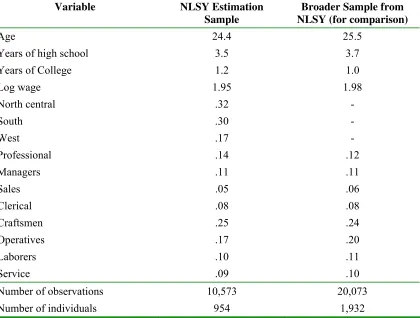
paid workers are found in the service occupation. Descriptive statistics are presented in Table 1b.
to the data. 5ppendix 5 contains further details about the data used to estimate the model, including the details of how the sample is selected, and a discussion of the representativeness of
the …nal sample.
7:; Me
as
<r
eme=t
Err
>r
?= Occ
<pat
?>= C>@es
The NLSY provides theB.S. Census occupation codes for eachJob. Interviewers question respon-dents about the occupation of each Job held during the year with the following two questions:
Khat kind of work do you doL That is, what is your occupationL Coders use these descriptions to classify each Job using the three-digit Census occupation coding scheme. Misclassi…cation of occupation codes may arise from errors made by respondents when describing their Job, or from errors made by coders when interpreting these descriptions. Evidence on the extent of
misclassi…cation is provided by Mellow and SiderN19PQR, who perform a validation study of oc-cupation codes using ococ-cupation codes found in the CPS matched with employer reports of their
employeeSs occupation. They …nd agreement rates for occupation codes of 5P% at the narrowly de…ned three digit level andP1% at the more broadly de…ned one digit level. 5dditional evidence on measurement error in occupation codes is presented by MathiowetTN1992R. MathiowetTN1992R independently creates one and three-digit occupation codes based on occupational descriptions
from employees of a large manufacturing …rm and Job descriptions found in these workerSs per-sonnel …les. The agreement rate between these independently coded one-digit occupation codes
is 76%, while the agreement rate for three-digit codes is only 52%. In addition to comparing
the three and one-digit occupation codes produced by independent coding, MathiowetT N1992R also conducts a direct comparison of the company record with the employeeSs occupational de-scription to see if the two sources could be classi…ed as same three-digit occupation. This direct
comparison results in an agreement rate of 87% at the three-digit level.
In general, papers examining occupational choices and the returns to occupation speci…c work
experience have not dealt with the di¢ cult issues raised by measurement error in occupation codes even though it is widely believed that occupation codes are quite noisy. Kork by Kambourov and Manovskii N2007R is a notable exception to this trend. They exploit the fact that the Panel Study of Income DynamicsNPSIDRoriginally coded occupations using an approach similar to the NLSY in which occupation coders translated workerSs verbatim descriptions of their occupation into an occupation code separately in each survey year. The PSID later released retrospective
occupation data …les where occupation coders were instead given access to a workerSs complete
sequence of occupational descriptions over his career. Kambourov and Manovskii X2007Y show that occupational mobility is lower in the retrospective …les, which is consistent with the
hypoth-esis that coders introduce measurement error into occupation codes when they interpret workers[ verbatim\ob descriptions. ]owever, it is important to note that while this type of retrospective coding is likely to reduce the number of false occupational transitions found in the data, it does
not provide any additional information about a worker[s true occupation. ^iven this limitation of the PSID data, Kambourov and ManovskiiX2007Y estimate the returns to occupation speci…c work experience, but they are not able to allow the wage equation to vary across occupations,
or to estimate the importance of cross occupation experience e¤ects.
_ `
cc
bcat
fgha
k qrgfc
s tgvsk wft
r tfsc
kass
fcat
fghxy{
A
|as
}~} }~ sc
~ass
cat
The model of occupational choices developed in this paper builds on previous models of sectoral
and occupational choices such as ]eckman and SedlacekX19
5, 1990 Y and
^ould
X2002Y. These models are all based on the framework of self selection in occupational choices introduced byoy
X1951Y. LetV
iqt represent the utility that workerireceives from working in occupation qat time
period t. Let N represent the number of people in the sample, let T(i) represent the number
of time periods that person i in the sample, and let Q represent the number of occupations.
ssume that the value of working in each occupation is the following function of the wage and non-pecuniary utility,
Viqt =wiqt+Hiqt+"iqt; X1Y
wherewiqt is the log wage of person i in occupationq at timet; Hiqt is the deterministic portion
of the non-pecuniary utility that person i receives from working in occupation q at time t, and
"iqt is an error term that captures variation in the utility ow from working in occupation q caused by factors that are observed by the worker but unobserved by the econometrician.
The log wage equation is
wiqt = iq+Zit q+ Q X
k=1
qkExpikt+eiqt; X2Y
where iq is the intercept of the log wage equation for person i in occupation q, Zit is a vector
of explanatory variables, and Expikt is person i[s experience at time t in occupation k. This
speci…cation allows for a full set of cross-occupation experience e¤ects, so the parameter estimates
provide evidence on the transferability of skills across occupations. The …nal term,eiqt, represents
a random wage shock. The deterministic portion of the non-pecuniary utility ow equation for personi is speci…ed as
Hiqt =Xit q+ Q X
k=1
qkExpikt+ Q X
k=1
qkLastoccikt+ iq;
where Xit is a vector of explanatory variables and Lastocciktis a dummy variable equal to 1 if
personiworked in occupationkat timet 1. This variable allows switching occupations to have
a direct impact on non-pecuniary utility, as it would if workers incur non-pecuniary costs when
switching occupations. The …nal term, iq; represents person is innate preference for working in occupation q. In general, sectoral choice models of this type are identi…ed even if the same
explanatory variables appear in both the wage equation and the non-pecuniary utilityow equa-tion. owever, it is normally considered desirable to include a variable that impacts occupational choices but does not directly impact wages. In this application lagged occupational choice
dum-mies and high school and college diploma dumdum-mies are included in the non-pecuniary equation
but excluded from the wage equation. The exclusion of the lagged occupational choice dummies
from the wage equation assumes that individuals incur psychic mobility costs when switching
occupations, but there is no direct monetary switching cost. owever, because occupation spe-ci…c experience e¤ects vary across occupations, when an individual switches occupations his
accumulated skills may be valued less highly in his new occupation.4
Let Oit represent the occupational choice observed in the data for person i at time t. This
variable is an integer that takes a value ranging from1toQ. persons true occupational choice may di¤er from the one observed in the data if classi…cation error exists. Let Obit represent the
true occupational choice, which is simply the occupation that yields the highest utility,
b
Oit =q if Viqt = maxfVi1t; Vi2t; :::; ViQtg: 4
The model of misclassi…cation allows the probability of misclassi…cation to depend on the
value of the latent variable Viqt. The misclassi…cation probabilities are denoted as
jk = Pr(Oit =j j Obit=k); for j = 1; :::; Q; k= 1; :::; Q: 5 4
That is, jk represents the probability that the occupation observed in the data isj, conditional
on the actual occupational choice being k. The s are estimated ointly along with the other parameters in the model. The jjterms are the probabilities that occupational choices are
correctly classi…ed. There areQ Qmisclassi…cation probabilities, but there are only[(Q Q) Q]
free parameters because the misclassi…cation probabilities must sum to one for each possible
occupational choice,
Q X
j=1
jk = 1; for k = 1; :::; Q:
ollowing existing parametric models of misclassi…cation, the model assumes that the mis-classi…cation probabilities f jk : k = 1; ::; Q; j = 1; :::; Qg depend only on j and k, and not on
the other explanatory variables in the model. One possible shortcoming of this baseline model
of occupational misclassi…cation is that it rules out person speci…c heterogeneity in the
propen-sity to misclassify occupations that may be present in panel data such as the NLSY. Section
.4 of this paper presents an extension of the model that allows for this type of within-person correlation in misclassi…cation rates.
It is necessary to specify the distributions of the error terms in the model before deriving the
likelihood function. ssume that "iqt iid extreme value and eiqt N(0;
2
eq). Let i represent
a Q 1 vector of personis preferences for working in each occupation, and let
i represent the
Q 1 vector of person is log wage intercepts in each occupation. Let F( ; ) denote theoint distribution of the wage intercepts and occupational preferences.
Let represent the vector of parameters in the model, =f k; kj; kj; kj; k; jk; ek; F( ; ) :
k = 1; :::; Q; j = 1; :::; Qg: or brevity of notation, when it is convenient I suppress some or all of the argumentsf ; Zit; Xit; Expikt; Lastoccikt; wobsit gat some points when writing equations for
probabilities and likelihood contributions, even though the choice probabilities and likelihood
contributions are functions of all of these variables. De…ne Pbit(q; wobsit ) as the oint probability that personi chooses to work in occupationq in time period t and receives a wage ofwobs
it . The
outcome probability is
b
Pit( q; wobsit j ; ) = Pr(Viqt = maxfVi1t; Vi2t; :::; ViQtg jwiqt =wobsit ) Pr(wiqt =witobs): 7
There is no closed form solution for this probability, so it is approximated using simulation
meth-ods. This involves taking random draws from the distribution of the errors, and computing the
mean of the simulated probabilities.5 The likelihood function for the observed data is constructed
5
using the misclassi…cation probabilities and the true choice probabilities. De…ne Pit(q; wobsit ) as
the probability that person i is observed working in occupation q at time period t with a wage
ofwobs
it . This probability is the sum of the true occupational choice probabilities weighted by the
misclassi…cation probabilities,
Pit(q; witobs j ; ) = Q X
k=1
qkPbit(k; wobsit j ; ): £¤¥
Note that the outcome probability imposes the restriction that the observed wage is drawn
from the worker¦s actual occupation, which rules out situations where a worker intentionally misrepresents his occupation and simultaneously provides a false wage consistent with the false
occupation. The likelihood function is simply the product of the probabilities of observing the
sequence of occupational choices observed in the data for each person over the years that they
are in the sample,
L( ) =
N Y
i=1
Z TY(i)
t=1
Q X
q=1
1fOit =qgPit(q; witobs j ; )dF( ; ) £9¥
=
N Y
i=1
Z
Li( j ; )dF( ; ); £10¥
where 1f g denotes the indicator function which is equal to 1 if its argument is true and 0
otherwise. The likelihood function must be integrated over the §oint distribution of skills and preferences, F( ; ). ¨ollowing ©eckman and Singer £19¤4¥, this distribution is speci…ed as a discrete multinomial distribution.ª
Suppose that there areM types of people, each with a Q 1
vector of wage intercepts mandQ 1vector of preferences m. Let
!mrepresent the proportion
of the mth type in the population. The unconditional likelihood function is simply a weighted
form solution. « ¬ a result it is straightforward to use a smooth simulator for the probabilities in the likelihood function. During estimation, ® draws from the distribution of the errors are used to simulate the integral. « ¯tithetic acceleration is used to reduce the variance of the simulated integral. « ¬a check on the sensitivity of the estimates to the number of simulation draws the° ±² ³ ´³ µ ¶²ion routine was re-started using ® ® draws. The parameter estimates· ¶¯¸ value of the likelihood function at the maxim¹ ´º were essentially unchanged by this increase in the number of simulation draws.
»
average of the type speci…c likelihoods,
L( ) =
N Y
i=1
Z
Li( j ; )dF( ; )
=
N Y
i=1
M X
m=1
!mLi( j i = m
; i = m
)
=
N Y
i=1
Li( ) ¿11À
ÁÂÃ ÄÅ
a
ÆÇat
ÈÉÊt
ËÌ ÍÈ ÎÌÆÈ ËÏÏÐ ÑÇÉct
ÈÏÉThe maÒor complication in evaluating the likelihood function arises from the fact that classi…ca-tion error in occupaclassi…ca-tion codes creates non-classical measurement error in the observed occupaclassi…ca-tion
speci…c work experience variables and previous occupational choice dummy variables that
de-scribe an individualÓs state. This implies that the true state of each agent is unobserved. Previous research into occupational choices has not addressed this issue. The key to understanding the
so-lution to this problem is to realiÔe that the model of misclassi…cation implies a distribution of true values of occupation speci…c work experience and lagged occupational choices for each individual
in each time period. Estimating the parameters of the model by maximum likelihood involves
integrating over the distribution of these unobserved state variables. Õowever, there is no closed form solution for this integral, and, more importantly, the distribution is intractably complex.
These problems are solved by simulating the likelihood function. The algorithm involves
recur-sively simulating R sequences of occupation speci…c work experience and lagged occupational
choices that span a workerÓs entire career. The individualÓs likelihood contribution is computed for each simulated sequence, and the path probabilities are averaged over the R sequences to
obtain the simulated likelihood contribution. Ö detailed description of the simulation algorithm is presented in Öppendix B.
ÁÂ Á
×ÐÌÉ
t
ÈØcat
ÈÏÉThis section presents the identi…cation conditions for the occupational choice model with
mis-classi…cation and discusses several related issues.
ÙÚÙÚÛ ÜÝÞßtàácatàâß ãâßÝàtàâ ßs
The identi…cation conditions for a model of misclassi…cation in a binary dependant variable are
presented by äausman, åbrevaya, and Scott-Morton æ199çè. This condition is extended to the case of discrete choice models with more than two outcomes byéamalhoæ2002è. The parameters of the model are identi…ed if the sum of the conditional misclassi…cation probabilities for each
observed outcome is smaller than the conditional probability of correct classi…cation. In the
context of the occupational choice model presented in this paper this condition amounts to the
following restriction on the misclassi…cation probabilities,
X
k6=j
jk < jj; j = 1; :::; Q: æ12è
This condition implies that it is not possible to estimate the extent of misclassi…cation along
with the rest of the parameter vector if the quality of the data is so poor that one is more likely
to observe a misclassi…ed occupational choice than a correctly classi…ed occupational choice.
ÙÚÙÚê ëàscìssàâß
Estimating the extent of classi…cation error in the NLSY occupation data along with the
parame-ters of the occupational choice model is only possible if one is willing to adopt a parametric model
along with the associated functional form and distributional assumptions.7 It is worthwhile to
consider at an intuitive level how the parametric occupational choice model and misclassi…cation
model are linked together. Let e represent the parameter vector for the occupational choice model, and let e represent the vector of misclassi…cation parameters. íiven e, the parametric model of occupational choices provides the probability that each occupational choice and wage
combination observed in the NLSY is generated by the model. Taking e as given, one could choose the value of e that maximiîes the probability of observing the NLSY occupation and wage data. Broadly speaking, this will happen when the combinations of occupational choices
and wages that are unlikely to be generated by the model at the parameter vector eare assigned a relatively high probability of being a¤ected by misclassi…cation. During estimation, e is not …xed, it is estimated simultaneously with e, so estimating the model amounts to choosing the value of ethat best …ts the data, with the added consideration that the chosen value of e allows misclassi…cation to account for some of the observed patterns in the data.
7It should be noted that as is the case with all parametric models of this type, if the model is mis-speci…ed, parameter estimates will be biased.
Existing parametric models of misclassi…cation estimate misclassi…cation rates using discrete
choice models, while in contrast this paper ïointly models discrete occupational choices along with wages. The advantage of this approach is that to the extent that wages vary across
occupa-tions, observed wages provide information about which observed choices are likely to be a¤ected
by misclassi…cation.ð
This approach uses information about the relationship between observable
variables ñsuch as educationò and occupational choices, along with information about the con-sistency of observed wages with reported occupations to infer the extent of misclassi…cation in
the data. It should be noted that when occupations are measured with error, it is not possible
to nonparametrically determine the exact relationship between true occupational choices, wages,
and observable variables such as education. óowever, within a particular parametric model of occupational choices and wages, these parameters can be estimated. 9
The availability of validation data on occupations from an outside data source would, in
principle, allow one to relax some of the parametric assumptions adopted in this paper. ôor example, if another data set contained information about reported occupations, true occupations,
and possibly other explanatory variables, this information could be used to integrate out the e¤ect
of measurement error. Of course, this approach relies on the assumption that the measurement
error process is identical in the two sources of data. õhile this approach appears promising and is certainly worth pursuing in future research, on a practical level adopting this approach
would most likely require additional data collection that was targeted speci…cally at validating
occupation codes.10 One possible approach would be to validate an individual
ös occupation by ÷
In the extreme case where the wage distribution is identical across occupations observed wages do not pro-vide any additional information about misclassi…cation. øowever, even if the unconditional wage distribution is identical across occupations, if the wage distribution in each occupation is a function of observable characteristics
ùú ûch as education and occupation speci…c experienüýþ ÿ and the e¤ects of these variables on wages vary across occupations, then observed wages will still provide information about misclassi…cation.
9
Ahough panel data is used to estimate the model, it is also possible to estimate this type of model using cross sectional data. Aúan experiment, I randomly selected a cross section of workers from the panel data NLSY sample and re-estimated the model. The estimated level of misclassi…cation in the cross sectional version of the model was 8ÿ compared to 9% in the panel data version. The fact that these estimates are so close suggests that misclassi…cation rates are primarily identi…ed by the consistency of an indiv ûs reported occupation with the cross sectional distribution of choices, wages, and observable variables, rather than by the extent to which an observed occupational choice is consistent with an individual workers observed sequence of career choices.
10The ma
jor problem is that existing validation studies, such as the 1977 supplement to the CPS, question respondents about their occupation and then attempt to validate the reported occupations by surveying employers. In general there is no reason to be con…dent that the employer surveys provide occupation data that is free from error. Depending on the information contained in personnel …les and the system that an employer uses to categorize employees, the responses provided by …rms could in fact be noisier than those provided by individuals. Aú a result, it is generally accepted that these validation studies provide an upper bound on the extent of measurement error. In contrast, validating wage data appears to be a much simpler task, since one would expect that …rms could normally provide accurate salary information from their payroll records.
questioning his supervisor, since presumably supervisors know the type of work performed by
workers that they manage. This approach would circumvent some of the problems associated
with validating occupation codes using personnel records, which may or may not contain ob descriptions that accurately reect occupations.
3.4
A
n Ext
ended Model: Het
er
ogeneit
y in Misc
lass
icat
ion Rat
es
The model of misclassi…cation presented in Section .1 assumes that all individuals have the same probability of having one of their occupational choices misclassi…ed. In a panel data
setting such as the NLSY, it is possible that during the yearly NLSY interviews some individuals
consistently provide poor descriptions of their obs that are likely to lead to measurement error in the occupation codes created by the NLSY coders. On the other hand, some workers may
be more likely to provide accurate descriptions of their occupations that are extremely unlikely
to be misclassi…ed. The remainder of this section extends the occupational choice model with
misclassi…cation to allow for time persistent misclassi…cation by using an approach similar to the
one adopted by Dustmann and van Soest (2001) in their study of misclassi…cation of language
uency.
The primary goal of the extended model is to allow for person-speci…c heterogeneity in
mis-classi…cation rates in a way that results in a tractable empirical model. Suppose that there
are three subpopulations of workers in the economy, and that these subpopulations each have
di¤erent probabilities of having their occupational choices misclassi…ed. De…ne the occupational
choice misclassi…cation probabilities for subpopulationy as
jk(y) = Pr(Oit=jjObit=k); j = 1; :::; Q; k = 1; :::; Q; (1)
Q X
j=1
jk(y) = 1; k= 1; :::; Q; y= 1;2;3: (14)
Denote the proportion of subpopulationyin the economy as (y);wherey= 1;2;3and
3
X
y=1
(y) =
1:This speci…cation of the misclassi…cation rates allows for time-persistence in misclassi…cation,
since the jk(y)s are …xed over time for each subpopulation. During estimation the (y)s and
jk(y)s of each subpopulation are estimated along with the other parameters of the model, so it is necessary to specify the misclassi…cation model in such a way that the number of parameters
in the model does not become unreasonably large. In order to keep the number of parameters
at a tractable level, the number of subpopulations is set to a small number , and the
mis-classi…cation probabilities are restricted during estimation so that the occupational choices of
subpopulation 1 are always correctly classi…ed.11
This model of misclassi…cation incorporates the key features of heterogeneous
misclassi…ca-tion rates in a fairly parsimonious way. Some fracmisclassi…ca-tion of the populamisclassi…ca-tion (1)is always correctly classi…ed, and the remaining two subpopulations are allowed to have completely di¤erent
mis-classi…cation rates, so that both the overall level of mismis-classi…cation and the particular patterns
in misclassi…cation are allowed to vary between subpopulations.
The likelihood function presented in section.1 can be modi…ed to account for person-speci…c heterogeneity in misclassi…cation. The observed choice probabilities are easily modi…ed so that
they are allowed to vary by subpopulation,
Pit(q; witobs j ; ; y) = Q X
k=1
qk(y)Pbit(k; wobsit j ; ); 15
wherey= 1;2;3indexes subpopulations. Conditional on subpopulations, the likelihood function
is
L( jy) =
N Y
i=1
Z TY(i)
t=1
Q X
q=1
1fOit=qgPit(q; witobs j ; ; y)dF( ; ) 16
=
N Y
i=1
Z
Li( j ; ; y)dF( ; ); 17
The subpopulation that a particular person belongs to is not observed, so the likelihood function
must be integrated over the discrete distribution of the type-speci…c misclassi…cation rates,
L( ) =
N Y
i=1 3
X
y=1
M X
m=1
(y)!mLi( jy; i = m;
i =
m) 1
=
N Y
i=1
Li( ):
P
ara
mt
r
st
mat
s
This section presents the simulated maximum likelihood parameter estimates for the occupational
choice model. First, the parameters that reveal the extent of classi…cation error in reported occu-pations are discussed, and then the parameter estimates from the occupational choice model that
11This version of the model already has 421 parameters that must be estimated, so in order to keep the model tractable it was never estimated with more than three subpopulations.
corrects for classi…cation error and allows for person-speci…c heterogeneity in misclassi…cation
are compared to the estimates from a model that does not correct for measurement error. Next,
the sensitivity of the estimates to measurement error in wages is examined. inally, the model is used to simulate data that is free from classi…cation error in occupation codes.
1 Th
t
t
fas
ur
t
rr
r
Occ
upat
Cs
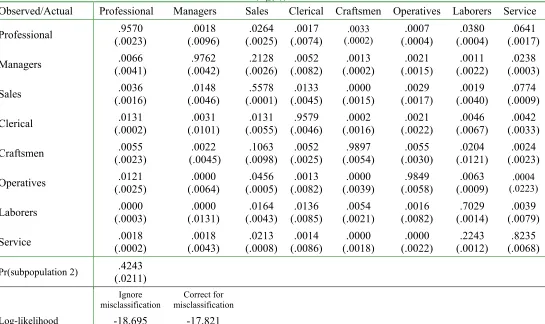
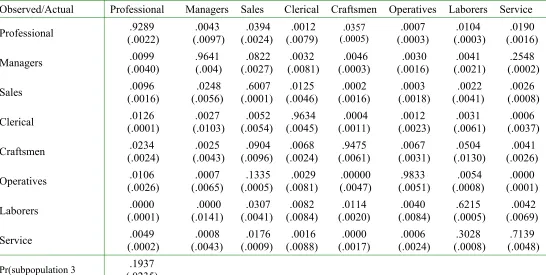
The estimates of the misclassi…cation probabilities for subpopulations 2 and along with the estimated proportions of each type in the population are presented in Panels and B of Table
. The bottom row of panel shows that correcting for classi…cation error results in a large improvement in the …t of the model, since the likelihood function improves from 18;695 when
classi…cation error is ignored to 17;821 when classi…cation error is corrected for. The
proba-bility in row i, column j is the estimate of ij(y), which is the probability that occupation i is
observed in the data conditional on occupation j being the actual choice for a person in
subpop-ulationy. or example, the entry in the third column of the …rst row indicates that condition of being a member of subpopulation 2, there is a2:6% chance that a person who is actually a sales
worker will be misclassi…ed as a professional worker. The diagonal elements of the two panels
of Table show the probabilities that occupational choices are correctly classi…ed. veraged across all occupations, the probability that an occupational choice is correctly classi…ed is .868
for subpopulation 2 and:840 for subpopulation. One striking feature of the estimated misclas-si…cation probabilities is that they provide substantial evidence that misclasmisclas-si…cation rates vary
widely across occupations. or example, in subpopulation 2 the probability that an occupational choice is correctly classi…ed ranges from a low of :56for sales workers to a high of :99for
crafts-men, while in subpopulation the probability that an occupational choice is correctly classi…ed ranges from a low of:60 for sales workers to a high of :98for operatives.
The estimates of the probabilities that a person belongs to subpopulations 2 and are42% and 19%, which leaves an estimated 38% of the population belonging to subpopulation 1, the
group whose occupational choices are never misclassi…ed. The fact that a substantial fraction of
the population belongs to the subpopulation whose occupational choices are never misclassi…ed
highlights the importance of allowing for person-speci…c heterogeneity in misclassi…cation rates.
When averaged over subpopulations, the subpopulation-speci…c misclassi…cation rates indicate that 91% of one-digit occupational choices are correctly classi…ed. This estimate of the overall
extent of misclassi…cation in the NLSY data is lower than the misclassi…cation rates reported in
validation studies based on other datasets. or example, Mellow and Sider 19!"# …nd an agree-ment rate of81% at the one-digit level between employee$s reported occupations and employer$s occupational descriptions in the January 1977 Current Population Survey CPS#. Mathiowet% 1992# …nds a 76% agreement rate between the occupational descriptions given by workers of a single large manufacturing …rm and personnel records.12
One possible explanation for the lower misclassi…cation rate found in this study compared to
the validation studies is that the NLSY occupation data is of higher quality than both the CPS
data and the survey conducted by Mathiowet% 1992#. It appears that the procedures used by the CPS and NLSY in constructing occupation codes are quite similar, so it is not clear that one
should expect the NLSY data to have a lower misclassi…cation rate than the CPS.&n alternative explanation is that the employer reports of occupation codes that are assumed to be completely
free from classi…cation error in validation studies are in fact measured with error.1'
If this is true,
then comparing noisy self reported data to noisy employer reported data would cause validation
studies to overstate the extent of classi…cation error in occupation codes. The idea that this
type of validation study may result in an overstatement of classi…cation error in occupation or
industry codes is not a new one. or example, Krueger and Summers 19!!# assume that the error rate for one-digit industry classi…cations is half as large as the one reported by Mellow
and Sider 19!"# as a rough correction for the overstatement of classi…cation error in validation studies.
The wide variation in misclassi…cation rates across occupations along with the patterns in
misclassi…cation suggest that certain types of *obs are likely to be misclassi…ed in particular directions. In addition, the misclassi…cation matrix is highly asymmetric. or example, there is only a 1.4% chance that a manager will be misclassi…ed as a sales worker, but there is a 21%
chance that a sales worker will be misclassi…ed as a manager. +eading down the laborers column of panel & of Table " shows that laborers are frequently misclassi…ed as service workers 22%#, but service workers are very unlikely to be misclassi…ed as laborers ."9%#. urther evidence of asymmetric misclassi…cation is found throughout Table ".
12This study is the …rst to estimate a parametric model of occupational misclassi…cation, so the validation studies provide the only basis for comparison for the estimated misclassi…cation rates.
1,
It is widely acknowledged that although validation studies are frequently based on the premise that one source of data is completely free from error, in reality no source of data will be completely free from measurement error. See Bound, Brown, and Mathiow-/ 025 7 7 9 ;for a discussion of this issue.
<=> ?
cc
@Bat
DGIa
J KLGDc
N QGSNJ Uara
VNt
Nr
Xst
DVat
Ns
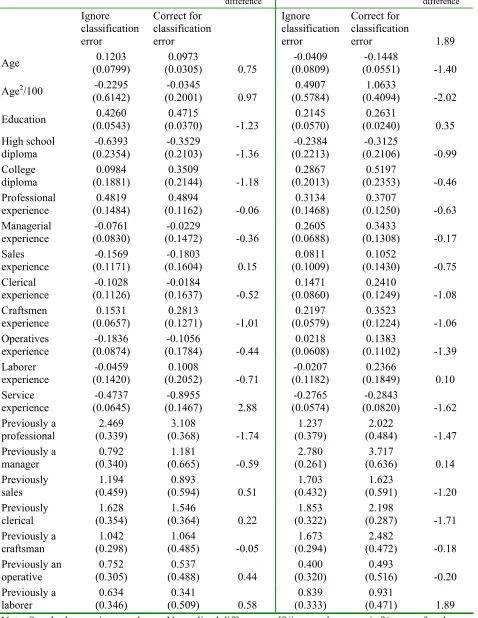
The parameter estimates for the occupational choice model estimated with and without correcting
for classi…cation error are presented in Table 4. In addition, this table presents a measure of
the di¤erence between each parameter in the baselineY
bZ and classi…cation error Y
ceZmodels,
( b ce)=se( ce); where se( ce) is the standard error of ce. In the remainder of the paper
this standard error normali[ed di¤erence will be referred to as the normali[ed change in the parameter.
\]^]_ `aab cqkatrst
while theoretical results regarding the e¤ects of measurement error in simple linear models have been derived, there are no clear predictions for nonlinear models such as this occupational choice
model. Broadly speaking, one would expect the patterns of misclassi…cation present in the data
to be a key determinant of the magnitude and direction of the resulting bias. Due to the large
number of wage equation parameters, this discussion focuses on a small subset of parameter
estimates with the goal of demonstrating that classi…cation error is something that needs to be
accounted for when estimating occupation speci…c wage equations. In addition, this discussion
will attempt to highlight the type of questions in general that one might receive misleading
answers to if one examines occupational choices and ignores misclassi…cation.
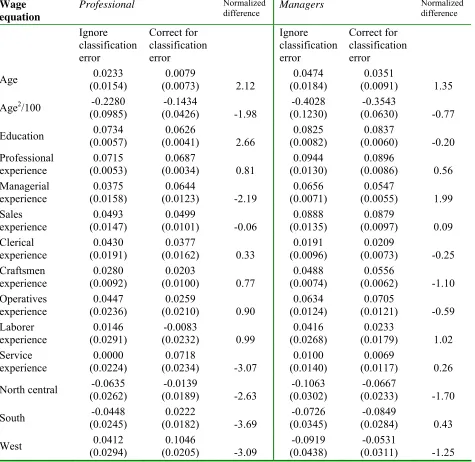
The wage equation parameter estimates are presented in Panel { of Table 4. The estimates of the wage equation for the professional occupation show a number of large changes in the
es-timated e¤ects of occupation speci…c work experience on wages between the model that ignores
classi…cation error in occupations and the one that accounts for classi…cation error. |or ex-ample, the e¤ect of a year of managerial experience on wages in the professional occupation
is biased downward by 42% from :064 to :037 when misclassi…cation is ignored. The standard
error normali[ed di¤erence for this parameter is -2.19, so the bias appears relatively large rel-ative to the standard error. The bias in this particular parameter is also interesting because
the estimated misclassi…cation probabilities show that professionals are rarely misclassi…ed as
managers Y 21(2) =:0066; 21(3) =:0099Z, and managers are rarely misclassi…ed as profession-als Y 12(2) = :0018; 12(3) = :0043Z. The low misclassi…cation rates between these occupations combined with the large bias in the experience coe¢ cient illustrates the point that even a small amount of misclassi…cation can produce large biases in estimates of the transferability of human
capital across occupations.
Sales workers are the most frequently misclassi…ed workers in both subpopulations 2 and ~.
veraged across all three subpopulations, only 72% of sales workers are correctly classi…ed. In the most common subpopulation, sales workers are most likely to be misclassi…ed as managers
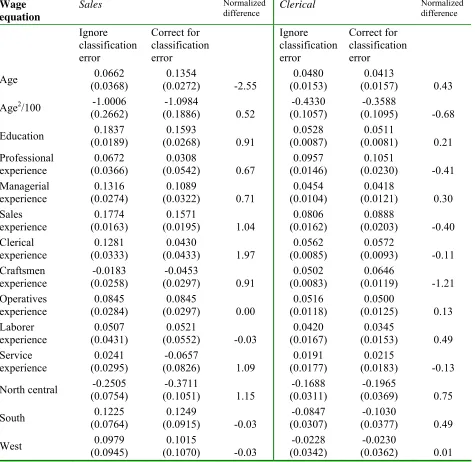
23(2) =:21, so one might expect signi…cant bias in estimates of the parameters of the man-agerial and sales wage equations. The estimates show that ignoring classi…cation error causes
the value of experience as a manager in the managerial occupation to be overstated by 19%
normalied change 1.99. In addition, ignoring classi…cation error leads to the misleading conclusion that one year of clerical experience increases wages by nearly 1~% in the sales occupa-tion, and this e¤ect is statistically signi…cant at the 5% level. owever, once classi…cation error is corrected for, the estimated e¤ect of clerical experience on sales wages falls by 2~, and the e¤ect is not statistically di¤erent at conventional levels. Similarly, ignoring classi…cation error
leads to an overstatement in the value of professional experience in the sales occupation .072 vs. .0~0, although the normalied di¤erence for this parameter is only .7.
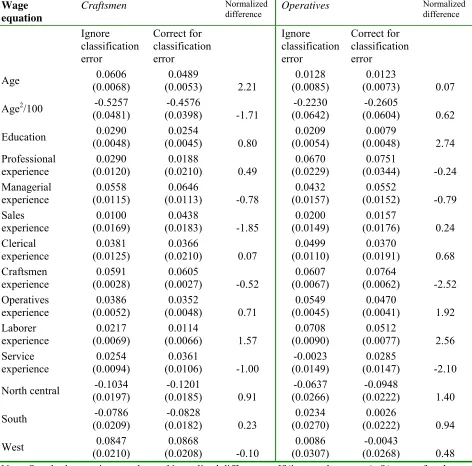
urther evidence of large changes in estimates of the transferability of human capital across occupations is found in the craftsman occupation. The model that does not correct for
classi…-cation error implies that a year of professional experience increases a craftsmans wages by2:9%, and this e¤ect is statistically signi…cant at the 5% level: Once classi…cation error is accounted
for this e¤ect falls to 1:8% and it is not statistically di¤erent from ero at the 5% level. This …nding suggests that the type of skills accumulated during employment as a professional have
little or no value in craftsmanobs. It appears that the false transitions created by classi…cation error lead to an overstatement of the transferability of human capital between the professional
occupation and this seemingly unrelated lower skill occupation.
nother way of comparing the wage equations in the baseline and measurement error model is to determine the number of hypothesis tests where the results of the test change between
the baseline and classi…cation error models. or example, one hypothesis that is commonly of interest is the null hypothesis that the e¤ect of each individual explanatory variable on wages
equals ero. Comparing the results of these hypothesis tests for the baseline model and the classi…cation error model shows that the reection or acceptance of the null hypothesis at the 5% level changes for17 variables in the wage equation between the two models. In other words,
ignoring classi…cation error would cause one to mistakenly accept or reect the null hypothesis that the e¤ect of an explanatory variable equalsero for 17 wage equation variables.
The …nal parameters of the wage equation are the standard deviations of the random shock
to wages in each occupation, eq, for q = 1; :::;8. The estimates of these standard deviations
show that randomuctuations in wages are overstated in six out of the eight occupations in the model that ignores classi…cation error. The intuition behind the direction of this bias is that the
model must provide an explanation for the large number of short duration occupation switches
that occur in the data. hen classi…cation error is ignored, the model accomplishes this through relatively large transitory wage shocks.
The determinants of occupational choices have been the subect of considerable research interest, and several recent papers have examined the related question of the role of occupation
speci…c human capital in determining wages. lthough labor economists have typically focused on determining the roles of …rm tenure and general work experience in determining wages, new
evidence suggests that in fact occupation speci…c skills play an important role in determining
wages.14 Comparing the estimates of the wage equation found in this paper to existing estimates
is di cult for a number of reasons. irst, there is no existing paper that estimates directly comparable occupation speci…c wage equations at the one-digit level. Second, existing papers
that estimate wage equations that are similar in some respects do not allow for the type of
cross-occupation experience e¤ects found in this study.15
owever, overall the wage equation estimates appear to be broadly consistent with existing research in this area. or example, Both Kambourov and Manovskii 2007 and Sullivan 2007 …nd that while experience in a workerscurrent occupation has as an important e¤ect on wages, wages are strongly impacted by total work experience. This …nding is consistent with the relatively large cross occupation
experience e¤ects reported in this paper. Keane and olpin 1997 also …nd relatively large cross occupation experience e¤ects between blue collar and white collar employment, which is
again broadly consistent with the wage equation estimates reported in this paper. It is also
possible to get a rough sense of how the magnitudes of the estimated e¤ects of occupation
speci…c work experience on wages in this paper compare to existing research. The estimates in
this paper suggest that when classi…cation error is ignored, averaged across all occupations one
year of occupation speci…c work experience increases wages by approximately 7%. Kambourov
and Manovskii 2007 do not report a parameter estimate that is directly comparable to this number, but combining the di¤erent parameter estimates that they report suggest that wages
14See, for example, Kambourov and Manovskii
and Sullivan 15Kambourov and Manovskii
and Sullivan consider the special case of the wage equation estimated in this paper where all of the cross occupation experience e¤ects are equal. owever, these studies also consider …rm tenure and industry speci…c work experience. Keane andolpin ¡¡ allow for cross occupation experience e¤ects, but their work uses occupation codes aggregated to the level of blue and white collar£obs.
grow by approximately 5%-¥% with each year that a worker spends in an occupation.
¦§¨§¨ ©ª«¬®c¯«°ar± ²t°³°t± ´³ªµs ¶ ²«ªbs®r·®¸ ¹®t®rªº®«®°t±
The occupational choice model presented in this paper allows occupational choices to depend
on non-pecuniary utility »ows as well as wages. The importance of modelling occupational choices in a utility maximi¼ing framework rather than in an income maximi¼ing framework is demonstrated in work by Keane and½olpin ¾1997¿and Àould ¾2002¿. The parameter estimates for the non-pecuniary utility»ow equations for the models estimated with and without accounting for classi…cation error are presented in Panel B of Table 4. These results show that ignoring
classi…cation error leads to signi…cant biases in estimates of the e¤ects of variables such as age,
education, and work experience on occupational choices.
The non-pecuniary utility »ow parameters are all measured in log-wage units relative to the base choice of service employment. Áor example, the estimate of the e¤ect of working as a pro-fessional in the previous time period on the propro-fessional utility »ow is 2:469 in the model that ignores classi…cation error. This means that a person who previously worked as a professional
re-ceives utility that is2:469log wage units higher than a person who was previously employed as a
service worker but is currently employed as a professional. The e¤ect of previous professional
em-ployment on the professional utility»ow is biased downwards by21%when classi…cation error is ignored¾normali¼ed di¤erenceÂ-1.74¿. It appears that the false transitions between occupations created by classi…cation error lead to an understatement of the importance of state dependence
in professional employment. Overall, the estimates of the e¤ects of lagged occupational choices
on current occupation speci…c utility»ows are fairly sensitive to classi…cation error.
Ãs is the case with the wage equation, another way of examining the consequences of not correcting for misclassi…cation is to determine the number of hypothesis tests where the results of
the test at the 5% level change between the baseline and classi…cation error models. Comparing
the results of these hypothesis tests for the baseline model and the classi…cation error model show
that the reÄection or acceptance of the null hypothesis that the e¤ect of each variable equals¼ero changes for 22variables in the non-pecuniary utility »ow equation between the two models. In other words, ignoring classi…cation error would cause one to mistakenly accept or reÄect the null hypothesis that the e¤ect of an explanatory variable on non-pecuniary utility equals ¼ero for 22 variables.
The estimates of the wage intercepts ¾ Ås¿ and non-pecuniary intercepts ¾ Ås¿ for the three
types of people in the model are presented in Panel C of Table 4. These parameter estimates
reveal the extent of unobserved heterogeneity in skills and preferences for employment in each
occupation. The …nal section of Panel C of Table 4 shows the averages of the wage and
non-pecuniary intercepts across the three types of people for the models that correct for and ignore
classi…cation error in occupation codes. The largest bias among these parameters occurs in
parameters that measure preferences for employment in each occupation Æ ÇsÈ. Éor example, the average preference for working as a craftsman changes from :048 in the model that ignores
classi…cation error to :23 in the model that corrects for classi…cation error. Biases of similar
magnitudes are found in the average preferences for employment as operatives and laborers. The
relatively large biases in estimates of preference parameters caused by ignoring classi…cation error
occurs because unobserved heterogeneity in preferences helps explain occupational transitions
that are not well explained by the other parts of the model. Êhen classi…cation error is ignored and all occupational transitions are treated as true occupation switches, the model attempts to
explain transitions that are not well explained by wages or the deterministic portion of
non-pecuniary utility Ëows in part through preference heterogeneity.
Ì ÍÎÏÐÑ
at
ÎÒÓ Ôata t
Õat
Îs
Ör
×× Ør
ÙÏ ÚÎsc
Ñass
ÎÛcat
ÎÙÒOne application of the model presented in this paper is that the estimated model can be used
to simulate occupational choice data that is free from classi…cation error. The simulated data is
used to examine which workers tend to be identi…ed as misclassi…ed by the model, the predicted
patterns in misclassi…cation over workersÇcareers, and the predicted relationship between wages and misclassi…cation.
ÜÝÞ ßàáâã
at
äå æcc
âçat
àèéa
ã êëèàc
äs
ìíîíî ïðñcð ïòróôrs arô õñscöassñ÷ôøù
One explanatory variable that is of central importance when investigating occupational choices
is education, since there is strong sorting across occupations based on completed education.
úiven this fact, it is useful to see how completed education levels vary between choices that are identi…ed as misclassi…ed choices in the simulated data compared to choices that are identi…ed
as correctly classi…ed choices.
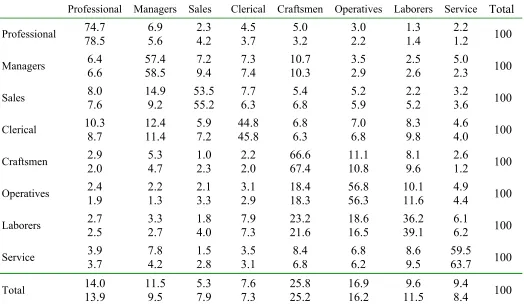
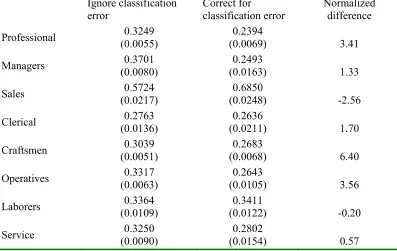
Table 5 shows the distribution of completed education for correctly classi…ed and misclassi…ed
occupational choices, disaggregated by occupation. ûor example, the table shows that the model predicts that 10.ü% of those workers who are correctly classi…ed as professionals have not com-pleted any years of college, while 4ü.ý% of workers who are misclassi…ed as professionals have not completed any years of college. þ correctly classi…ed professional has a 71.ü% change of being a college graduate, while a worker misclassi…ed as a professional has only aÿ0.2% chance of being a college graduate. Clearly, education serves as a strong predictor of which observations are likely
to be true professionals as opposed to observations that are falsely classi…ed as professionals.
These results are consistent with the fact that thejobs located in the professional occupation are overwhelmingly ones that require a college degree, or at least some amount of completed higher
education.
þcross the other occupations, similarly strong and sensible relationships exist between ed-ucation and misclassi…cation. ûor example, in blue collar occupations, one would expect to see the opposite relationship between misclassi…cation and education from the one found in the
professional occupations. This is in fact what the results in Table 5 show. ûor example, the percentage of correctly classi…ed workers who have graduated from college is 2.1% for craftsmen,
2.5% for operatives, andÿ.2% for laborers. In contrast, for workers who are falsely classi…ed in these occupations the percentage of workers who are college graduates is 1ü.7% for craftsmen, 21.5% for operatives, and 11.7% for laborers. In general, the model tends toag workers as mis-classi…ed who have reported education levels that appear to be inconsistent with their reported
occupation.
5.1.2 The Frequency of Misclassi cati on Over an Indivi duals Career
Given the panel nature of the data, the simulated occupational choice data can be used to examine how often occupational choices are misclassi…ed over a typical individual s career. Table
ýpresents the distribution of the total number of times that occupational choices are misclassi…ed over the course of a person s career. The majority of workers never experience misclassi…cation
(57.2%), 17.ý% of workers are misclassi…ed once over their career, and very few workers are misclassi…ed more than …ve times over their career (4.ÿ%). Table ý also provides information about the distribution of the lengths of misclassi…cation spells. ûor example, the …rst entry in the …nal column of Tableýshows that conditional on an occupational choice being misclassi…ed, there is a 72.9% chance that the person will be correctly classi…ed in the next survey. Conditional on
being misclassi…ed, there is an 18.3% chance that a person will be misclassi…ed in two consecutive periods, and there is only a 5.2% chance that a person will be misclassi…ed in three consecutive
periods.16
r ccpat a cs, bsr cs, a Wags
Table 7 shows the average true occupational choice probabilities conditional on observed choices
and observed wages that are predicted by the empirical model. This analysis shows how the
classi…cation error rates generated by the model vary with observed wages and provides a more
detailed analysis of the type of occupational choice and wage combinations that are likely to be
a¤ected by classi…cation error.
Observed occupational choices are listed in the far left column of Table 7, while actual
oc-cupational choices are listed in the top row. Conditional on the observed choice and wage and all of the other explanatory variables, the model is used to calculate the conditional probability that the actual choice is each of the eight occupations for each occupational choice observed in
the data. The average of each probability for each occupation is presented in Table 7.
Proba-bilities are disaggregated by the percentile of the observed wage in the wage distribution of the
observed occupation to show how misclassi…cation rates vary with observed wages. or example, the top left cell of Table 7 shows that a worker observed in the data as a professional worker
with a wage in the top 10% of the professional wage distribution has a 90.9% chance of being
correctly classi…ed as a professional worker. However, a worker observed as a professional with a wage in the bottom 10% of the professional distribution has only a 75.7% chance of actually
being a professional worker. People observed in the data as low wage professional workers are
primarily service workers 9.5%.
Similar patterns of misclassi…cation are found in the sales and clerical occupations, where
workers in certain areas of the wage distribution are more likely to be misclassi…ed than those in
other areas of the wage distribution. or example,91:6%of clerical workers in the top10%of the clerical wage distribution are correctly classi…ed, but3:9%of those observed as high wage clerical
workers are actually professionals. However, the unconditional probability that a professional is misclassi…ed as a clerical worker is much lower 41(2) =:013; 41(3) =:013.
1
One implication of the relatively short durations of misclassi…cation spells is that the model does not tend to repeatedlyag individuals as misclassi…ed who have consistently highor lowwages for their reported occupation over the course of their entire career.
S
s
t
t
A
a
s
s
: !as
"r
mt
Err
#r
$a
%s
One important question regarding the model presented in this paper is the sensitivity of the
results to the existence of measurement error in wages. One way of addressing this question is
to simulate noisy wage data, re-estimate the model using the noisy wage data &leaving the rest of the NLSY data unchanged', and see how the estimates of misclassi…cation parameters change when the noisy wage data is used in place of the actual wages found in the NLSY data. The
noisy wages (wme
it )are generated using the following equation,
wmeit =w obs
it + it; where it N(0; 2): &19'
Recall thatw
obs
it is a log wage, so the extent of measurement error in the noisy log wage data
is captured by 2.
A number of validation studies have quanti…ed the extent of measurement error in wages, see Bound, Brown, and Mathiowetz&2001'for a thorough survey of this literature.
Actual estimates of
2 do not exist for the NLSY, so in simulating the noisy data the measurement
error term is set towards the upper end of the reported estimates found in the literature based
on other data sources. The exact value used is 2 =:10:This value of 2 creates a substantial
amount of measurement error in the noisy wage data, since in the noisy data, measurement error
accounts for approximately one third of the total variation in log wages.
Rather that presenting a complete set of parameter estimates for the misclassi…cation model estimated using the noisy data, it is su¢ cient to summarize the overall e¤ect that the noisy wage data has on the parameter estimates. *hen the noisy wage data is used in place of the NLSY wage data the average parameter in the model changes by approximately 2%, so it
appears that the overall bias introduced by measurement error is relatively small. The primary
concern about measurement error in wages is that it may impact the estimates of the extent of
measurement error in occupation codes. The overall extent of misclassi…cation is summarized by the diagonal elements of the misclassi…cation rate matrices for subpopulations two and three,
jj(y); j = 1; :::; Q; y = 2;3. Across both subpopulations, the use of noisy wage data results in the average probability of correct classi…cation decreasing by only :006 from :8546 to :8486.
Adding measurement error slightly increases the overall estimated rate of misclassi…cation, but the magnitude of the increase is quite small. The corresponding average absolute change in
the probability of correct classi…cation is only :008, and the average change in the o¤-diagonal
elements is only :0015, so it appears that estimates of the overall extent of misclassi…cation in
the NLSY occupation data are quite robust to measurement error in wages.
There are a number of reasons why the estimates of the misclassi…cation parameters are
robust to a relatively large amount of measurement error in wages. The …rst reason is that,
as discussed earlier in the paper, wages are not the only source of information that the model
uses to infer that an occupational choice is misclassi…ed. -nother key point is that many of the occupational choices that are /agged in the simulations as misclassi…cations are associated with extremely large di¤erences between the reported wage and the average wage in the reported
occupation. Di¤erences of this magnitude are unlikely to be generated in large numbers by a
reasonable amount of measurement error in wages. 0or example, the median wage for workers who are identi…ed in the simulations as falsely classi…ed professionals is45.59, while the median wage for workers who are correctly classi…ed as professionals is 410.72.
9 ;<=
c
>?s
@<=-lthough occupational choices have been a topic of considerable research interest, existing re-search has not studied occupational choices in a framework that addresses the biases created by
classi…cation error in self-reported occupation data. This paper develops an approach to
estimat-ing a panel data occupational choice model that corrects for classi…cation error in occupations
by incorporating a model of misclassi…cation within an occupational choice model. Estimating
this model provides a solution to the problems created by measurement error in the discrete
de-pendant variable of an occupational choice model. Methodologically, this approach contributes
to the literature on misclassi…cation in discrete dependant variables by demonstrating how
sim-ulation methods can be used to address the problems created in a panel data setting where
measurement error in a discrete dependant variable creates measurement error in explanatory
variables. The simulation technique is applicable to any discrete choice panel data model where
misclassi…cation in a current period dependent variable creates measurement error in future
ex-planatory variables. This paper also contributes to the literature on misclassi…cation by using
observed wages within the framework of an occupational choice model to obtain information
about misclassi…ed occupational choices.
The main …ndings of this paper are that a substantial number of occupational choices in the
NLSY are a¤ected by misclassi…cation, with an overall misclassi…cation rate of 9%. The results
also suggest that person-speci…c heterogeneity in misclassi…cation rates is an important feature
of the data. -n estimated7B% of the population never experiences a misclassi…ed occupational choice, and the remaining two subpopulations have substantially di¤erent propensities to have
their occupational choices misclassi…ed in particular directions. The parameter estimates also
indicate that misclassi…cation rates vary widely across occupations, and that the probability of
a worker being misclassi…ed into each occupation is strongly inDuenced by the workerJs actual occupation. Most importantly, this paper demonstrates the large bias in parameter estimates
that results from estimating a model of occupational choices that ignores the fact that
occupa-tions are frequently misclassi…ed. Consistent with existing research in the area of misclassi…ed
dependant variables, the results show that even relatively small amounts of misclassi…cation
cre-ates substantial bias in parameter estimcre-ates. Especially large biases are found in parameters
that measure the transferability of occupation speci…c work experience across occupations, since
these parameters are quite sensitive to the false occupational transitions created by classi…cation
error.
Overall, the results indicate that one should use caution when interpreting the parameter
estimates from occupational choice models that are estimated without correcting for classi…cation
error in self-reported occupations. In addition, these results suggest that similar bias may arise
when occupation dummy variables are used as explanatory variables, as is commonly done in a
wide range of studies. K possible avenue for future research would be to investigate the e¤ects of classi…cation error in occupation codes on parameter estimates in this wider class of models,
such as simple wage regressions that make use of self-reported occupation data.
Table 1a: Description of Occupations
One-Digit Occupation Mean Wage Example Three-Digit Occupations Professional, technical & kindred
workers $11.19
Accountants, chemical engineers, physicians, social scientists
Managers & administrators $12.89 Bank officers, office managers, school administrators
Sales workers $9.05 Advertising salesmen, real estate agents, stock and bond salesmen, salesmen and sales clerks Clerical & unskilled workers $7.48 Bank tellers, cashiers, receptionists, secretaries
Craftsmen & kindred workers $8.53 Carpenters, electricians, machinists, stonemasons, mechanics
Operatives $7.20 Dry wall installers, butchers, drill press operatives, truck drivers
Laborers $7.01 Garbage collectors, groundskeepers, freight handlers, vehicle washers
Service workers $6.34 Janitors, child care workers, waiters, guards and watchmen
Notes: Based on the U.S Census occupation codes found in the 1979 cohort of the NLSY. Wages are in 1979 dollars.
Table 1b: Descriptive Statistics
Variable NLSY Estimation
Sample
Broader Sample from NLSY (for comparison)
Age 24.4 25.5
Years of high school 3.5 3.7
Years of College 1.2 1.0
Log wage 1.95 1.98
North central .32 -
South .30 -
West .17 -
Professional .14 .12
Managers .11 .11
Sales .05 .06
Clerical .08 .08
Craftsmen .25 .24
Operatives .17 .20
Laborers .10 .11
Service .09 .10
Number of observations 10,573 20,073 Number of individuals 954 1,932
[image:28.612.93.513.385.703.2]