Pixel-QUAD based Reversible Data Hiding for High
Embedding Capacity
Rushikesh Borse
PhD Research Scholar, Vision and Image Processing lab
Department of Electrical Engineering, Indian Institute of Technology Bombay Mumbai-400076, India
ABSTRACT
Embedding capacity and Perceptibility are prime issues in relation to data hiding techniques. There had been techniques for hiding data in reversible fashion. A new term ‘Pixel-QUAD’ is coined in this paper, instead of commonly used ‘Pixel-Pair’ for embed-ding the watermark data. This paper presents a high embedembed-ding capacity technique for reversible data hiding based on a Pixel-Quad approach. The proposed methodology for the technique is quite general and is applicable to any reversible watermarking scheme; Demonstration is done for a class of reversible watermark-ing schemes which operate on a disjoint group of pixels. An attempt is also made to propose algorithm to estimate the embedding capac-ity iteratively for a multi-pass scheme.
Keywords:
Data hiding, Reversible watermarking, Embedding capacity, Pixel-Quad, Capacity estimation.
1. INTRODUCTION
Reversible Watermarking [4] is a technique used to preserve the copy-right of digital data (image, audio and video), while at the same time it ensures exact recoverability of the watermark as well as the cover image. This finds application in few cases wherein along with the watermark, the cover image is also to be retrieved after watermark retrieval. There had been many techniques of re-versible data hiding proposed in literature.
Various reversible data embedding techniques could be cate-gorized under the heads of: histogram bin shifting [15], loss-less data compression [12], expansion and mapping based tech-niques [9],[1],[6],[5] and prediction based techtech-niques [11],[14]. Rovertoet al. [13] and Fenget al.[7] wrote decent survey pa-pers on different reversible watermarking techniques. Of all these techniques, difference expansion based techniques are prominently used for their advantage of high embedding capacity and less com-putational cost. In this regard, the general trend is to hide watermark data (a bit of data) into pixel pair of the cover image and this has been proposed by Tian [9], wherein the basic wavelet lifting trans-form (based on difference expansion) embed a bit of watermark into the LSB of a pixel pair. The inverse transform assures recover-ability of watermark bit as well as the pixel pair values. This idea of reversible data hiding was soon generalized by Alattar [1]. Since
then many researchers have worked on this concept of difference expansion (DE) and proposed various difference expansion based techniques.
1.1 Embedding capacity
Embedding capacity is an important issue for reversible water-marking as one can hide more data with fewer computations and with a reasonably good perceptual quality. It is therefore that, re-versible watermarking is also called rere-versible data hiding tech-nique. Loosely speaking, the embedding capacity of an image can be described as the size of the largest watermark which can be em-bedded into that image. Each watermarking technique has a maxi-mum possible embedding capacity over a single pass, and hence of-ten it is necessary to go for multiple passes to embed a much larger watermark into the given image. Recall that multipass embedding involves at every stage, successively embedding the watermark bits into the already watermarked image from the previous stage. Several researchers had proposed various watermarking schemes to achieve higher embedding capacities. But obvious, every scheme has its own computational cost and memory usage which decides its application and usability. Tian [9] was the first to propose a differ-ence expansion based watermarking scheme which work on a pair of pixel to embed a bit of data. Later on this concept was extended by Alattar [1] to triplets and quadruplets. Both this techniques re-quire location map to achieve reversibility. This location map fur-ther reduces the embedding capacity. Later Coltucet al. [5],[6] proposed a difference expansion based reversible data hiding tech-nique which does not require a location map thus making it simple to implement with advantage of modest embedding capacity. The technique proposed by Coltucet al.[6] is discussed in detail in section 2.1.
1.2 Contribution of the paper
The intent of this paper is not to propose a new watermarking scheme rather describe an approach for achieving higher em-bedding capacity for the existing watermarking scheme. This is achieved by using Pixel-Quad approach instead of commonly used Pixel-Pair.
wa-Reversible Watermarking Process Conventional Watermarking Process
Cover Image
Cover Image
Watermark
Watermark marking
Water-Scheme
Water-marking Scheme
Water-marking Scheme
Water-marking Scheme
Watermark
Watermark Cover Image Watermarked
Image
Watermarked Image
Suspected Image
Channel Channel
[image:2.595.123.489.73.338.2]Suspected Image
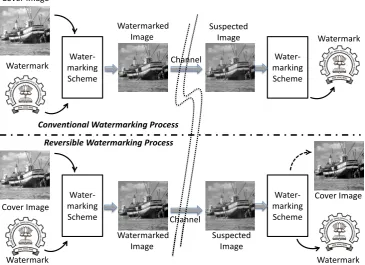
Fig. 1: Conventional and Reversible Watermarking scheme
termarking application would require an estimation of the number of passes of watermarking possible as well as an analysis of the feasibility of inserting a watermark of specific length into a given image. For this purpose it is necessary to calculate the embedding capacity beforehand. In practical settings, it may be necessary to find such estimates repeatedly for different configurations of the watermark and the cover image. Hence it may not be feasible to actually embed the watermark in a given image, and to check if the watermark and the cover image are compatible for watermarking. The paper addresses these two issues.
Although the mathematics discussed in quite general in its sense and is applicable to any watermarking scheme which work on dis-joint pixel pair, experimentation of these algorithms are done on RCM scheme (reversible contrast mapping) as proposed by Coltuc et al.[6]. Next Section describes the Methodology for data em-bedding for Quad. Section 3 discusses a very important issue i.e estimating the embedding capacity for this Quad representation. Results are provided in Section 4 which justifies the concept. The paper concludes in Section 5. As far as this paper is concerned, the word watermarking, data hiding and data embedding means the same unless stated otherwise in this paper.
2. PROPOSED METHODOLOGY
As mentioned previously, reversible watermarking in general is a data hiding technique for exact recovery of both watermark and the cover image at receiver. This can be seen from Figure 1. As the name speaks ‘reversible’, one would be interested to hide more and more data into the cover image. Of various data hiding techniques [1],[9],[15],[12],[6],[10] difference expansion based techniques are popular because they can hide ample amount of data with mini-mal visual distortion. For obtaining higher embedding capacity,
re-searchers devised multi-pass embedding technique, wherein water-marking is done in consecutive passes to the cover image and then to the watermarked image. The author has addressed this subject in [3]. All this techniques are based on Pixel-Pair approach. Taking the motivation further, A Pixel-Quad based embedding scheme is proposed. A quad is composed of 4 pixels as can be seen in Figure 2a. This can be viewed as a combination of two pixel pairs and the watermarking (data embedding or data hiding) could be done vertically or horizontally as seen in Figure 2b and c. Thus a quad can embed a maximum of 2 bits of data (If both the pixel pairs satisfy the constraint condition).
2.1 Pixel-QUAD for data hiding
A Pixel-Quad can be seen as a combination of two pixel-pairs, thus the technique of data hiding for quad is closely associated with pair. The proposed framework is quite general and applicable to any wa-termarking schemes working on disjoint pixel pair. The proposed algorithm is evaluated on well known Reversible Contrast Map-ping (RCM) based watermarking scheme [6],[5]. Let’s recall the generalized form of the method as mentioned by Coltucet al.[5]: For a pixel pair(x, y), the forward mapping transforms them into another pair(x0, y0)
x0= (n+ 1)x−ny, y0=−nx+ (n+ 1)y (1)
while the inverse transform(x, y) = T−1(x0, y0)can be obtained
as:
x= (n+ 1)x
0+ny0
2n+ 1 , y=
nx0−(n+ 1)y0
Fig. 2: Directions of data embedding in Pixel-Quad
Fig. 3: A simple Quad for explaining difference expansion after forward transform.
Specifically dealing with the casen= 1, above equations reduces to:
x0= 2x−y, y0= 2y−x (3)
while the inverse transform is becomes:
x=d2 3x
0
+1 3y
0e
, y=d1 3x
0−2
3y
0e
(4)
wheredxeis called as the ceil function.
Because of equation (2), the original pixel values can be recov-ered from the transformed one, even if their LSB’s are lost or al-tered. (Except for the case where LSB’s of both original pixel pairs are odd, where few adjustments are done). Taking the advantage of this condition, one can embed a bit of information in LSB’s of transformed pairs.
To avoid ambiguity and to prevent overflow and underflow, the gray scale values of transformed pixel pairs are restricted within a sub-domainSrdefined as
Sr={(x0, y0)|x0∈[0, L), y0∈[0, L)} (5) This is constraint equation, where L is the number of graylevels (In this paper,8-bit gray scale imageis condisered;L=28=256).
2.2 Difference Error over Multipass Embedding
As the name RCM dictates, there is contrast expansion after for-ward transform (equation (3)). Although this expansion is re-versible (equation (4)), lets say this as difference error, which is represented as:
De=|x
0
−y0|= 3|x−y|= 3∆ (6)
This increase in contrast leads to the reduction of PSNR in the wa-termarked image. Lets extend this to Quad. Consider the quad as shown in Figure 3, where horizontal pixel-pairing is considered. For the sake of simplicity, leys say:ak=x,bk=x+∆1,ck=x+ ∆2anddk=x+∆3. Applying RCM transform equation (3) for the first pair(ak, bk)and second pair(ck, dk)would result into:
a0k= 2x−(x+ ∆1), b
0
k= 2(x+ ∆1)−x (7) &
c0k= (2x+2∗∆2)−(x+∆3), d
0
k= (2(x+∆3)−(x+∆2) (8) The corresponding error for both the transformed pairs with respect to original pairs would be:
De1=|a
0
k−b
0
k|= 3|ak−bk|= 3∆1 (9) &
De2=|c
0
k−d
0
k|= 3|ck−dk|= 3(∆2−∆3) (10) The error so obtained in these equations is in accordance with equa-tion 6. So the effective error after first pass is3∆. Considering the same pixel pairs inside the quad (this means embedding in same horizontal direction), the difference error after second pass of data embedding would be9∆and this goes on increasing in further pass. This results in reduction of embedding capacity in further passes as most of the pixels pairs may not be eligible for data embedding af-ter 2-3 passes. Hence the embedding capacity get exhausted earlier. A theorem is proposed in this regard in [3]. Thus the over error after n passes of watermarking, would be(3∆)n.
result a increase in the difference error but the rate of increase of er-ror would be relatively lower. After two passes it would be less than
6∆. A generalized error equation for alternate passes of embedding is derived in [2]. Thus the pixel quad will survive more passes and embed more data, resulting into a high data embedding scheme at same PSNR. It is thus learned that data embedding in pixel quad be done in alternate direction for multiple passes and not in a same di-rection. Results for Pixel-Quad embedding are shown in Section 4, where this proposal is experimentally verified that final embedding capacity obtained for alternate direction of watermarking results in higher embedding capacity.
2.3 How to decide the direction of first pass?
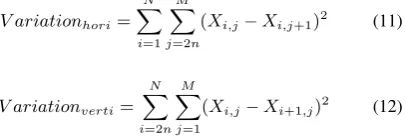
Coming to the understanding that watermarking is done in alternate direction of pairing of pixels, but how to choose the direction at the first pass?. It may be vertical or horizontal. A simple mathematics of finding the variation of data set along vertical and horizontal direction would be sufficient.
V ariationhori= N X i=1 M X j=2n
(Xi,j−Xi,j+1)2 (11)
V ariationverti= N X i=2n M X j=1
(Xi,j−Xi+1,j)2 (12)
Where X is the input image (data set).
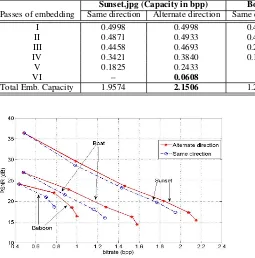
The lowest of the two reflects the variation is less in that direction, thus suitable for data embedding for first pass. After first stage, the direction for embedding the data for consecutive passes is alternate and it is observed from practical implementation that the embed-ding capacity is improved. In fact in some cases, there has been sufficient space to allow one more pass of embedding, thus result-ing into an higher embeddresult-ing capacity. This is discussed in results section and the values are reported in Table 1.
3. ESTIMATION OF EMBEDDING CAPACITY FOR PIXEL-QUAD
Having proposed a Pixel-Quad based methodology for data embed-ding, an attempt is made to provide an estimate for the embedding capacity. Estimate in general sense means that one would be able to know the amount of embedding capacity that is available for a given cover image in advance. Thus one could choose the cover image or reject it based on the available watermark. All this is ob-tained without having to do actual watermarking.
3.1 Algorithms Involved
The estimation algorithm is based on two prominent algorithms: 1. Co-occurrence matrix based algorithm and 2. Tree based algorithm. Both these algorithms are elaborately discussed in [2], lets describe them in short.
DEFINITION 1. (Pair-wise co-occurrence Matrix). The
pair-wise co-occurrence matrixCof sizeL×L, is similar to the con-ventional co-occurrence matrix [8], and is definced as the popu-lation (distribution) of co-occurring pixel pairs in an Image. In this context, it represents a count of the number of times a pixel
pair occurs in the image. Thus given the disjoint pairs of pixels Ξ ={ξ1, ξ2, . . . , ξN}. It can be mathematically described as:
C(ξ) = N X
j=1
I(ξ=ξj), where I(.) is the indicator function. (13)
Co-occurrence based method is an iterative procedure similar to any watermarking scheme. It is however computationally much more efficient than any stage-wise watermarking scheme because of less computations and sparse matrix representation. Thus gives an faster estimate.
DEFINITION 2. (Pixel-pair tree): The pixel-pair tree for a pair
ξis defined as a tree which starts with the pixel pairξand traces a specific path based on the subsequent embedded bits as this pixel pair evolves and represents all feasible paths of watermarking for a given number of passes.
[image:4.595.91.294.259.329.2]As mentioned earlier, a quad is nothing but a combination of two pixel pairs, the algorithm and mathematics for quad is just an exten-sion for that of pair. A pixel pair tree for a pixel pair(50,55)using the RCM based watermarking scheme of Coltuc [6], is shown in Figure 5. This tree concisely represents the entire life cycle of a particular pixel pair uptoP passes. It can be seen that the entire embedding exhausts after 3 passes.
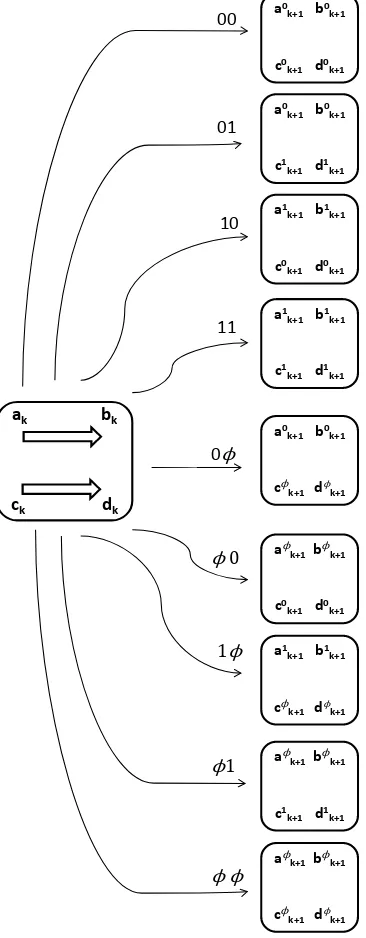
For any pixel pair there could be three possibilities of embedding: (i) either a bit ’1’ is embedded, (ii) or a bit ’0’ is embedded, (iii) or nothing is embedded, if the pixel pair doesn’t satisfy the con-straint equation 5. Let’s say this isφ. Extending this to a Pixel-Quad, where one could embed a maximum of two bits, there are 9 possibilities. This is explained in pictorial form in Figure 4.
3.2 Capacity Estimation
The formulations for pixel-pair are derived in [2]. General nota-tions, terms and basic math continues from there. Lets extend this to Pixel-Quad. In general, letpsdenote the path specific probabil-ity of the path s. It represents the probability that the pixel pair will evolve through the specific paths. Then clearly, one can write
ps = P−1
Q k=0
ps[k], whereps[k] denotes the probability of transition
froms[k]tos[k+ 1]given whethers[k]is embeddable. Thus
ps[k]=
p , ifis[k]= 1&s[k]∈DI
1−p , ifis[k]= 0&s[k]∈DI
1 , ifs[k]∈/DI
(14)
The equation above represents the probability for going to further pass, whereDIrepresents the domain where the transformed pixel
satisfy the constraint equation 5.
Letη(s,B) represent the size of the bitstream obtained through a specific path configurations = {s1, s2,· · ·, sN}. Further let
η(ξ, s,B) denote the total number of bits contributed by a spe-cific pixel pairξthrough the paths. In other wordsη(ξ, s,B) = P−1
P k=0
η(bs[k]) and η(s,B) = N P j=1
η(ξj, sj,B). The estimate of
the length of the bitstream B can then be given as η(B) = Es∈S(η(s,B)), whereEs∈S(η(s,B))represents the total expected
size ofBby considering every possible path configurations1 ∈
a0 k+1 b0k+1
c0 k+1 d0k+1
ak bk
ck dk
00 01 10 11 0ϕ ϕ 0 1ϕ ϕ1 ϕ ϕ a0 k+1 b0k+1
c1 k+1 d1k+1
a1 k+1 b1k+1
c0 k+1 d0k+1
a1 k+1 b1k+1
c1 k+1 d1k+1
a0 k+1 b0k+1
cϕk+1 dϕk+1
aϕk+1 bϕk+1
c0 k+1 d0k+1
a1 k+1 b1k+1
cϕk+1 dϕk+1
aϕk+1 bϕk+1
c1 k+1 d1k+1
aϕk+1 bϕk+1
[image:5.595.326.547.70.262.2]cϕk+1 dϕk+1
Fig. 4: An Illustration of possible combination of embedding bits for a Pixel-Quad.
The expressions forEηP(ξ,B)(forP >1) is as:
EηP(ξ,B) =
η(bξ) +pEηP-1(ξ
1,B) , ifξ∈ DI
+(1−p)EηP-1(ξ0,B)
η(bξ) +E η
P-1(ξφ,B) , ifξ /∈DI
(15)
with the base case:Eη
1(ξ,B) = η(bξ). Refering to Figure 4, it is understood that a quad can embed maximum up to 2 bits, lets
Fig. 5: An example of pixel-pair tree for (50,55)
extend equation 14 for the case of Pixel-Quad as:
ps[k]=
p2 , ifi
s[k]= 1,1&s[k]∈DI
p(1−p) , ifis[k]= 1,0&s[k]∈DI
(1−p)p , ifis[k]= 0,1&s[k]∈DI
(1−p)2 , ifi
s[k]= 0,0&s[k]∈DI
p , ifis[k]= 1, φorφ,1 &s[k]∈DI
(1−p) , ifis[k]= 0, φorφ,0 &s[k]∈DI
1 , ifis[k]=φ, φ&s[k]∈/DI
(16)
In similar regards, equation (15) can be extended to quad as:
EηP(ξ,B) =
η(bξ) , if 2 bits are embedded &ξ∈DI
+(1−p)2Eη
P-1(ξ00,B) +(1−p)p{EηP-1(ξ01,B) +EηP-1(ξ10,B)} +p2Eη
P-1(ξ 11,B)
η(bξ) , if 1 bit is embedded &ξ∈DI
+p{EηP-1(ξ1φ,B) +EηP-1(ξφ1,B)} +(1−p){EηP-1(ξφ0,B) +EηP-1(ξ0φ,B)}
η(bξ) +E η P-1(ξ
φφ,B) , if no bits are embedded &ξ /∈ DI
(17) with the base case:Eη
1(ξ,B) =η(bξ).
It is clear from equation (17) thatEηP(ξ,B)or the total expected number of bits for a given pixel pair is a polynomial equation in
[image:5.595.82.265.75.544.2]coef-(a) (b) (c)
Fig. 6: A few sample images of varying textural contents for watermark embedding purposes.
(a) (b)
Fig. 7: Watermarked copies ofBoatimage after multiple passes of embedding. These are results of watermarking in same direction (fig a) and watermarking in alternate direction (fig b). These images are of (i) First pass, (ii) Second pass, (iii) Third pass and (iv) Fourth pass.
ficients to computeEηP(ξ,B) for any givenpwithout having to recompute them every time.
Thus there are two stages of computation, i.e the online stage and offline. The offline stage is image independent where one compute the coefficients of the polynomials, as described in equation (17). These can be iteratively computed for various values ofPin linear time. The online stage consists of just a single iteration to use the values ofEηP(ξ,B)which has to be estimated.
Hence the total embedding capacity can be figured out as:
η(E) =η(I)−η(A) (18)
WhereI is the total embeddable bit stream andAis the auxiliary data bits that comprises of LSB’s of pixel pairs that does not satisfy constriant equation (eqn 5) are are thus not eligible candidate for embedding. These are required to recover the original pixel values at the receiver side.
This sub-section discussed method of estimating embedding capac-ity based on tree based algorithm. Another method of estimating embedding capacity is based on co-occurrence matrix based. This is elaborately discussed in [2]. A competitive analysis of both these algorithms is also provided thither.
4. RESULTS AND DISCUSSION
[image:6.595.133.479.217.402.2]Table 1. : Comparison of stage wise embedding capacity for data hiding in different direction
Sunset.jpg (Capacity in bpp) Boat.png (Capacity in bpp) Baboon.gif (Capacity in bpp)
Passes of embedding Same direction Alternate direction Same direction Alternate direction Same direction Alternate direction
I 0.4998 0.4998 0.4842 0.4842 0.4471 0.4472
II 0.4871 0.4933 0.4033 0.4456 0.2580 0.3328
III 0.4458 0.4693 0.2821 0.3552 0.0799 0.1750
IV 0.3421 0.3840 0.1035 0.2453 – 0.0480
V 0.1825 0.2433 – 0.0518 – –
VI – 0.0608 – – – –
Total Emb. Capacity 1.9574 2.1506 1.2732 1.5821 0.7852 1.0051
Fig. 8: Cumulative PSNR-bpp curve for different images.
that capacity is exhausted at that location and there is no possibility of data embedding any more (as most of the pixel-pairs does not satisfy constraint equation 5 and thus the available embedding ca-pacity is been eaten up to store LSBs of these pixel-pairs and this contribute to auxiliary data bitsA).
In general, the over all embedding capacity after all passes is al-ways higher for data embedding when done in alternate direction. It can also be seen that although the stage wise embedding capacity reduces in every further pass of watermarking, the over all embed-ding capacity always rises as one goes for further passes of em-bedding. A cumulative plot for varying textured images (Baboon -highly textured image,Sunset-low textural image) is plotted in Fig-ure 8. The embedding capacity and PSNR for alternate direction watermarking is always higher as compared to when done in same direction.
As far as estimation of embedding capacity is concerned, it is done in [2] for a pair of pixels. This is based on a Look Up Table(LUT) concept. The idea is to create a memory table for every pair and its all possible embedding options (tree) for many further passes. This is done for all possible pixel pairs. i.e from(0,0)to (255,255). This would be around2256by2256combinations (considering an eight bit image). This all is stored in a LUT. This is computed off-line, and one has to just get pixel-pair online for which he can get the embedding capacity as per the LUT. Now this same idea is to be extended to Pixel-Quad, but the LUT creation may suffer from the limitation of computational resources both in terms of time and memory, as it would require4256by 4256 combinations. All this is possible with a high end computationally efficient machine. The mathematics for quad estimation as derived in Section 4 is then applicable as it is for estimation of embedding capacity.
5. CONCLUSION
This paper is focused around providing a Pixel-Quad based solu-tion for achieving high embedding capacity in any reversible wa-termarking scheme. It is proved from the experimental results that alternate direction of watermarking in consecutive passes would al-ways result in a higher embedding capacity. Besides this, an effort is made to derive mathematics related to embedding capacity es-timation of Pixel-Quad. This estimate is based on the tree based algorithm.
6. ACKNOWLEDGEMENT
The Author is very thankful to Rishabh Iyer of University of Wash-ington, Seattle, USA for helping in the initial understanding of quad based approach.
7. REFERENCES
[1] A.M.Alattar. Reversible watermark using the difference ex-pansion of a generalized integer transform.IEEE Trans. Im-age Processing, 13(8):1147–1156, August 2004.
[2] Rushikesh Borse. Embedding Capacity Estimation for Re-versible Watermarking Schemes and Data Security in H.264 Video. PhD thesis, Indian Insitute of Technology Bombay, Mumbai, India, 2013.
[3] Rushikesh Borse and Subhasis Chaudhuri. Computation of embedding capacity in reversible watermarking schemes. Proceedings of the ACM’s ICVGIP-10, Chennai, India, 2010. [4] Ingemar Cox. Digital Watermarking and Steganography.
Morgan Kaufmann,Second Edition, New York, 2008. [5] D.Coltuc and J-M Chassery. High capacity reversible
water-marking.Proceedings of the IEEE International Conference on Image Procesing ICIP, pages 2565–2568, 2006.
[6] D.Coltuc and J-M Chassery. Very fast watermarking by re-versible contrast mapping. IEEE Signal processing Letters, 14(4):255–258, 2007.
[7] J.B. Feng, I.C. Lin, C.S. Tsai, and Y.P. Chu. Reversible water-marking:current status and key issues.International Journal of Network Security, 12(3):161–170, 2006.
[8] R.M. Haralick, K. Shanmugam, and I.H. Dinstein. Textural features for image classification.IEEE Transactions on sys-tems, man and cybernetics, 3(6):610–621, 1973.
[image:7.595.60.315.90.348.2][10] C.-T. Li. Reversible watermarking scheme with image-independent embedding capacity.IEE Trans on Vision, Image and Signal Processing, 152(6)(779-786), 2005.
[11] L.Kamastra and H.Heijmans. Reversible data embedding into images using wavelet techniques and sorting.IEEE Trans. Im-age Processing, 14(12):2082–2090, December 2005. [12] M.U.Celik and G.Sharma. Lossless generalized-lsb data
embedding. IEEE Transactions on Image Processing, 14(2):253–266, 2005.
[13] C. Roberto, F. Francesco, and B. Rudy. Reversible wa-termarking techniques: An overview and a classification. EURASIP Journal on Information Security, 2010.
[14] Vasiliy Sachnev. Reversible watermarking algorithm using sorting and prediction. IEEE Trans. Circuits Systems for Video Technology, 19(7):989–999, July 2009.