Evaluation of Cuckoo Search Usage for Model
Parameters Estimation
Walid Mohamed Aly
College of Computing and Information Technology Arab Academy for Science, Technology & Maritime Transport
Alexandria, Egypt
ABSTRACT
Cuckoo Search is gaining a lot of attention as a new soft comput-ing technique inspired by nature,in this research the application of Cuckoo Search for solving the problem of estimating the parame-ters of a nonlinear model is investigated from both aspects of effi-ciency and robustness. Using a case study of estimation of param-eters of a nonlinear model for the cutting tool temperature in an industrial metal cutting system, Cuckoo search was proved to be efficient in comparison to other approaches like genetic algorithms and particle swarm optimization. The paper also investigates the sensitivity of the Cuckoo Search performance to the variation of its tuning parameters, results showed the high efficiency and robust-ness of Cuckoo Search when applied to the problem of parameter estimation of a nonlinear model.
Keywords:
Cuckoo Search , Parameter estimation, Nonlinear systems
1. INTRODUCTION
Nature inspired algorithms use inexact approaches to solve com-putationally hard problems, they include different approaches like genetic algorithms(GAs), neural networks(NN) , particle swarm optimization(PSO)[1], Bat Algorithm [2], Water drops algorithm [3], fuzzy logic [4] and Cuckoo Search(CS).
As theses algorithms proved to be efficient, a lot of researches in-vestigated their usage to solve various complex industrial and en-gineering problems, among these problems is the system modeling problem. System modeling is the concept of representing the be-havior of a system by a mathematical equation or a set of mathe-matical equations. Parameter estimation of a model is a complex optimization problem that standard analytic approaches might fail to solve [5].
To estimate these parameters, search procedures like least square estimation, likelihood and instrumental variable methods [6] can be applied, these procedures aim to minimize the error between the actual model and the predicted model, although they can usually provide good results, they have no exact solution and they suffer from efficiently reduction in the presence of noise.
As traditional techniques would fail to reach satisfactory solutions for the parameter estimation problem, different nature inspired al-gorithms have been investigated in this area; Multi-objective Ge-netic Algorithm (MOGA) was applied to estimate the parameters
of pressure swing adsorption model [7], PSO was used to build a model to predict the thickness and surface roughness of printed patterns in roll-to-roll printing systems which is a nonlinear system with complicated dynamics [8]. Fuzzy classification was used to build a model for the nebulization quality of oil flames [9] which is an important characteristic exhibited by combustion processes of petroleum refinery furnaces
This paper investigates the use of Cuckoo search as a nature in-spired algorithm for solving the problem of parameter estimation of a nonlinear model, a real case study for modeling the cutting tool temperature in an industrial metal cutting system is also presented. After the current introductory section the paper is organized as fol-lows, a section is presented to elaborate the system modeling prob-lem followed by a section on cuckoo search. After that another sec-tion shows a case study of the applicasec-tion of a cuckoo search to estimate the parameters of a nonlinear model for the cutting tool temperature.
2. SYSTEM MODELING
System modeling has two main stages, the first stage is to estimate the structure of the model according to the system dynamics and the second stage is to estimate the unknown parameters of the model.
2.1 System Modeling Procedure
A conventional system modeling process can be applied using the following
steps:-Step1: Collect real input and output data from the process to be identified, usually 70% of the available data-set is considered as training data, the rest is the validation data.
Step2: Define a number of candidate model structures. Step3: Select a model structure hypothesishθ.
Step4: Estimate the model parameters using the training data. Step5: Validate the model using the set of validation data. The flowing sections elaborate some of the main concepts within these steps.
2.2 Model Structure Hypothesis
For model with numeric output, the following approaches can be used to select a model structure hypothesis:
(2) Polynomial Regression (3) Nonlinear Regression
2.2.1 System Modeling using Linear Regression:. Linear regres-sion is used if the system to be modeled is considered linear. A linear hypothesis is developed to predict the output of a linear sys-tem for a given input. The hypothesis equation for linear regression is declared as follows:
hθ(x) =θ0+
n
X
i=1
xiθi (1)
where:
hθ(x): predicted output value for the x input vector. n:number of system inputs.
x:input vector[x0x1x2x3...xn],x0= 1
θ :the parameters that need to be determined, [θ0θ1θ2...θn].
2.2.2 System Modeling using Polynomial Regression:. Polyno-mial regression models a system using polynoPolyno-mial equation. A polynomial equation is formed from variables and constants and using only the operations of addition, subtraction, multiplication to form a polynomial model.
A polynomial model can be rewritten as a linear model by defining terms likex2,x3as distinct independent variables in a multiple
lin-ear regression model. For example the hypothesis of a polynomial model with a single inputx1can be written as
follows:-hθ(x) =θ0x0+θ1x1+θ2(x1)2+θ3(x1)3 (2)
Defining new inputs as the square and cube ofx1 will enable as
to solve the modeling problem exactly as if it is a linear regression problem.
2.2.3 System Modeling using Nonlinear Regression:. Most com-plex systems are by nature nonlinear, a nonlinear model will have at least one of its parameters appears nonlinear, linear regression or polynomial regression will fail to represent the system.
A nonlinear model can take various nonlinear structures, however the problem of parameter estimation of a nonlinear model becomes very complex. In the case study included in this research, modeling of the cutting tool temperature is done using a nonlinear model
2.3 Cost Function
A cost functionJ(θ)represents the difference between the actual values of outputs and the predicted value calculated usinghθ(x).
Different equations can be used as a cost function, among them are residual standard deviation and sum of square error(SSE). SSE is declared forninputs (wherex0= 1) as follows:
J(θ) := 1 m
m
X
i=1
(hθ(x(i))−y(i))
2
(3)
whereJ(θ)is the cost function;xiis the training data.irepresents
the training sample.yiis actual known output.mis the number of
training examples. The cost functionJ(θ)represents the calculated error of the model based on certain values ofθ.
θcan be estimated by solving the minimization problem ofJ(θ). Traditional techniques like normal equation can be applied when the size of the input vector is not large otherwise iterative tech-niques like gradient decent would be more efficient.
The cost function of linear regression is always a convex function, gradient decent will always reach an optimum solution without be-ing affected by the choice of initial solution. Regularization modi-fication can be applied to the cost function to prevent over fitting, where the proposed hypothesis fit the training set very well but fail to generalize to new examples.
When solving the regression problem of nonlinear systems, the minimization of the cost function will produce normal equation with nonlinear parameters that does not have an exact solution, al-though iterative procedures like Taylor series, steepest descent and Levenberg-Marquardt methods could be applied to solve the prob-lem, these procedures are not optimal, they suffer from slow con-vergence and the sensitivity to the initial solution.
To get a sense of the complexity of the parameter estimation of a nonlinear model problem, the following hypothetical nonlinear system is defined:
y(x) = 4∗cos(45∗x)−2∗sin(10∗x) (4)
Assuming that the structure of this hypothetical model is already known but without the values of the parameters, the hypothesis function (hθ(x))can be declared as follows:
hθ(x) = 4∗cos(θ0∗x)−2∗sin(θ1∗x) (5)
The role of parameter estimation is to figure out the values ofθ0and
θ1,assuming that the exploration range for these values is from 0
to 50, the search space for minimizing the cost functionJ(θ)-as shown in figure 1- is a non-convex search space. The quality of a solution proposed by a traditional technique for such a problem will be affected by the arbitrary staring search point and can be easily trapped in local optima.
To overcome the complex difficulties of parameter estimation of nonlinear models, Nature-Inspired learning algorithms had been applied to solve the nonlinear regression problem [10]. In this re-search, Cuckoo Search as one of these algorithms is applied to solve this complex problem.
3. CUCKOO SEARCH
3.1 Introduction to Cuckoo Search
Cuckoo Search is a search algorithm inspired the breeding behav-ior of cuckoos, cuckoo breeding can be described as an act of par-asitism, a cuckoo bird lay its egg in other birds nests and relay on that bird for hosting the egg, sometimes the other bird discover that an egg is not their own, it might demolish the alien egg or just move to another nest.
To protect its egg from being discovered, a cuckoo might imitate the shape, size and color of the host eggs, some cuckoos might take an aggressive action and remove other native eggs from the host nest to increase the hatching probability of their own eggs, a hatched cuckoo chick will also throw other eggs away from nest to improve its feeding share [11].
Fig. 1. Error surface for the system given in Equation 5
CS depends on L`evy flight as the random walk used to generate new solution(cuckoos) from current solution according to the following
equation:-cuckooi(t+1)=cuckooi(t)+α⊕L´evy(λ), (6)
wherecuckoo(it+1) is the value of the ith Cuckoo at instance t, α:step size, usually chosen to be equal to one,λ: L`evy distribution coefficient(1< λ <3)
Some of new solutions are produced from best current solutions by Lvy walks, this give CS the capabilities of local search with the ability of self-improvement as in memetic algorithms. Also some of the new solutions are produced away from the best current solu-tions, this decreases the opportunity to be trapped in local minima, and enrich the versification of search as in Tabu search. The imple-mentation of CS also ensures elitism as the best nest will be kept from iteration to another.
The main advantage of Cuckoo search is its simplicity of applica-tion as CS has fewer parameters that need to be tuned before start-ing the search compared with other techniques, in contrast, PSO needs tuning of mainly three parameters: Inertia weight, effect of self-confidence and effect of social impact, the range of tuning pa-rameters of PSO affect the quality of search dramatically [12]. GA needs to tune the crossover rate and mutation rate and to choose between various selection methodologies.
3.2 Cuckoo Search Scheme
The following procedures list the outlines for application of Cuckoo SearchProcedure Cuckoo Search ()
-Begin
-Call Initial Setup() -Call Initial population() -Call Update Population() -Display output results End
Procedure Initial Setup() -Begin
-Set the number of dimensions :dim -Set upper and lower bounds :ub ,lb -Set the number of nests :n -Set Maximum Iteration:maxIter -Define your hypothesis function:hθ(x)
-Define the cost function:J(θ) -Set the parameters of Levy flights:β -Set Discovery rate of alien eggs/solutions :pa End
Procedure Create Initial population() Begin
-Create random n nests (initial population) of dimension dim without violating ub ,lb
-Set initial minimum cost to a very high value -Evaluate cost of initial population usingJ(θ) -Set minimum cost to the cuckoo with minimum cost End
Procedure Update Population() Begin
-Loop from 1: maxIter
-create proposed nests using current nests values and Levy flights withβwith following constraints
best nest is not altered all solutions within bounds
-Evaluate cost of the proposed nests usingJ(θ) -Perform elitism
-Create new nests by mutating current nests randomly based on pa -evaluate fitness of the proposed nests usingJ(θ)
-preform elitism End Loop End
4. APPLICATION OF CUCKOO SEARCH TO NONLINEAR MODEL PARAMETERS ESTIMATION
4.1 Case study:Nonlinear Model of Cutting Tool Temperature
Machining is cutting a piece of raw material into a desired form and size by a controlled process of material removal, the cutting forces of this process is converted into heat and the cutting tool suffers from very high temperature. The high temperature of the cutting tool decreases the tool life and affects the surface finish and geometrical dimensions of the product and thus the quality of the whole process.
Researches regarding finding the model for the cutting temperature have shown that the value of this temperature is mainly dependent on the following three variables:
Moreover, An empirical model exits for cutting temperature [13],the model is declared as follows:
hθ(x) =θ0∗xθ01∗x
θ2
1 ∗x
θ3
2 (7)
wherex0,x1,x2are the depth of cut, cutting feed rate and cutting
speed respectively.
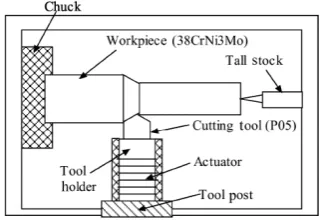
[image:4.595.333.575.157.391.2]The case study of this research will be to estimate the parameters for the nonlinear model of cutting tool temperature.The data mea-sured experimentally for the cutting tool PO5 with the 38CrNi3Mo metal of the workpiece is used, the system is shown in figure 2.
Fig. 2. Metal Cutting Machine
4.2 Cost Function
For the case study, the cost functionJ(θ)aims to minimize will be the residual standard deviation declared as follows:
J(θ) :=
v u u t
m
P
i=1
(hθ(x(i))−y(i))
2
n−2 (8)
whereJ(θ)is the cost function,yis actual known output andm is the number of training examples. Solving this parameter estima-tion problem means finding values for the model parameters which will minimize the error between outputs from predicted model and actual outputs. The data set used for learning about the model is the same as declared in [13] which is acquired experimentally.
4.3 Setting up Cuckoo search Algorithm for Parameter Estimation
Table 1 presents the parameters used for the applied cuckoo search
Table 1. Tuning Parameters.
Parameter value
Number of nests 10
Discovery rate of alien solutions (pa) 0.25
Levy exponent (β) 1.5
Maximum Iteration 300
Number of dimensions 4
Lower bounds [0, -10, -10, -10]
Upper bound [1000, 10, 10, 10]
4.4 Results
CS succeeded in estimating the parameters of the temperature model, by the end of search the Residual standard deviation reached 5.129. Table 2 shows the outputs of the CS.
Figure 3 shows the actual temperature versus the temperature calcu-lated using the estimated parameters by CS for the nonlinear model. Figure 4 shows the reduction of the cost from iteration to another.
Table 2. Cuckoo Search Results.
Parameter value
θ0 1410.29
θ1 0.032
θ2 0.082
θ3 0.158
Residual standard deviation 5.129
[image:4.595.58.220.209.319.2]Fig. 3. Actual Temperature vs. predicted Temperature
Fig. 4. Minimum cost vs. Iteration
4.5 Effect of Tuning Parameters on Efficiency of Results
One of the very important aspects of a search algorithm is how much it is vulnerable to variations in the tuning parameters, to check the robustness of cuckoo search, a number of searches are initiated with different tuning parameters and results are recorded. The effects of the variation ofβ , nand pa are investigated by
executing a100different searches for the each of the following cases:
(1) 1.1< β <2, n=20 andpa= 0.1
(2) beta= 1.5, n=20 and0.1< pa<0.5
[image:4.595.333.579.412.513.2]For each case the values for the minimum cost, maximum cost and average cost were recorded. Table 3 shows the output of the CS search when running using different values for tuning parameters, figure 5 shows the convergence of the Cuckoo Search using differ-ent values of nests, figure 6 shows the Effect of pa on quality of CS.
[image:5.595.77.298.313.379.2]Fig. 5. Convergence of the CS evolutionary process
Fig. 6. Effect of pa on quality of search
4.6 Discussion
As shown from the results, CS succeeded in finding values for the parameters of the nonlinear model.
The same problem of consideration has been attempted by different researchers using different techniques [14] like least square, GAs and PSO .To prove the efficiency of using CS for nonlinear pa-rameter estimation. Table 4 shows a comparison between residual standard deviation for the models produced by these techniques and CS.
Table 4. Comparison of Results of different procedures
Search Procedure Residual standard deviation
Cuckoo search 5.129
Particle Swarm Optimization 5.129
Genetic algorithms 5.187
Least square 5.695
It is also clear from the results that it is easy to tune CS, the results were not affected much with the variation of tuning parameters , howeverpashould be chosen less than 0.25,this is demonstrated
by figure 6 which shows a decline in the quality of the solution for pa>0.3.
5. CONCLUSION
Cuckoo Search is a powerful search algorithm that it inspired by the breeding behavior of cuckoos. It has been used successfully in many areas. In this research, the usage of Cuckoo Search in solving the parameter estimation problem for nonlinear systems is inves-tigated. This problem typically presents difficulties to traditional parameter estimation techniques which basically depend on lin-earizing the system in order to apply available algorithms for linear systems, also as most of these traditional techniques are based on gradient descent technique, the search might be trapped at a local optimal solution.
Cuckoo Search succeeded in estimating the values of the parame-ters for the nonlinear model for the cutting tool temperature in a cutting machine. CS reached a better solution than genetic algo-rithms and least square and although the result acquired by Particle Swarm Optimization is the same as CS. CS has a very better ad-vantage that it does not need exhaustive tuning like Particle Swarm Optimization. Moreover, the research also investigated the effect of variation of the tuning parameters of Cuckoo Search on the quality of search,it has been shown that within a wide range, CS can be an efficient search algorithm. It is anticipated that Cuckoo Search will play a very important role in solving complex optimization prob-lems.
6. REFERENCES
[1] Nasko Atanasov and Alexandar Ichtev. Closed-loop system identification with recursive modifications of the instrumental variable method.Informatica, 22(2):165–176, April 2011. [2] A. T. Fleury, F. C. Trigo, and F. P. R. Martins. A new approach
based on computer vision and non-linear kalman filtering to monitor the nebulization quality of oil flames. Expert Syst. Appl., 40(12):4760–4769, September 2013.
[3] I. Kamkar, M.-R. Akbarzadeh-T, and M. Yaghoobi. Intelli-gent water drops a new optimization algorithm for solving the vehicle routing problem. InSystems Man and Cybernetics (SMC), 2010 IEEE International Conference on, pages 4142– 4146, 2010.
[4] Sameh Kessentini, Dominique Barchiesi, Thomas Grosges, Laurence Giraud-Moreau, and Marc Lamy de la Chapelle. Adaptive non-uniform particle swarm application to plas-monic design.Int. J. Appl. Metaheuristic Comput., 2(1):18– 28, January 2011.
[5] Yang Liu and Fan Sun. Parameter estimation of a pres-sure swing adsorption model for air separation using multi-objective optimisation and support vector regression model. Expert Syst. Appl., 40(11):4496–4502, September 2013. [6] Gin´es Moreno and Vicente Pascual. Programming with fuzzy
logic and mathematical functions. InProceedings of the 6th international conference on Fuzzy Logic and Applications, WILF’05, pages 89–98, Berlin, Heidelberg, 2006. Springer-Verlag.
[7] Triet Nguyen-Van and N. Hori. New class of discrete-time models for non-linear systems through discretisation of inte-gration gains.Control Theory Applications, IET, 7(1):80–89, 2013.
[image:5.595.35.315.564.617.2]Table 3. Effect of CS Tuning Parameters on quality of search
β n pa Minimum Cost Maximum Cost Average Cost
1.1< β <2 20 0.1 5.129 5.129 5.129 1.5 20 0.1< pa<0.5 5.129 16.801 9.061 1.5 10< n <30 0.1 5.129 5.199 5.133
Stevens Point, Wisconsin, USA, 2009. World Scientific and Engineering Academy and Society (WSEAS).
[9] Dongyong Yang, Jinyin Chen, and N. Matsumoto. Particle swarm optimization with adaptive parameters. In Software Engineering, Artificial Intelligence, Networking, and Paral-lel/Distributed Computing, 2007. SNPD 2007. Eighth ACIS International Conference on, volume 1, pages 616–621, 2007. [10] Xin-She Yang. Nature-Inspired Metaheuristic Algorithms.
Luniver Press, 2008.
[11] Xin-She Yang. Metaheuristic algorithms for self-organizing systems: A tutorial. InSelf-Adaptive and Self-Organizing Sys-tems (SASO), 2012 IEEE Sixth International Conference on, pages 249–250, 2012.
[12] Xin-She Yang and S. Deb. Cuckoo search via levy flights. In Nature Biologically Inspired Computing, 2009. NaBIC 2009. World Congress on, pages 210–214, 2009.
[13] Liu Yi-jian, Zhang Jian-ming, and Wang Shu-qing. Param-eter estimation of cutting tool temperature nonlinear model using pso algorithm.Journal of Zhejiang University Science A, 6(10):1026–1029, 2005.
[14] J.X. Zhou. Ga algorithm for cutting experiment data draw-ing.Journal of Southwest Petroleum Institute, 29(3):1062–63, 1998.