Volume 73 - No. pxc3889883, July 2013
OSC: solving the multidimensional multi-choice
knapsack problem with tight strategic Oscillation using
Surrogate Constraints
Skander HTIOUECH
Sys-com, National Engineering School of Tunis UR-CSE. Tunisia Polytechnic School
University of Carthage-Tunisia B.P. 743. 2078 La Marsa. Tunisia [email protected]
Sadok BOUAMAMA
Hana Lab, National School of Computer Science of Tunisia [email protected]
Rabah ATTIA
UR-CSE. Tunisia Polytechnic School.
University of Carthage-Tunisia B.P. 743. 2078 La Marsa. Tunisia [email protected]
ABSTRACT
The multidimensional multi-choice knapsack problem (MMKP) is one of the most complex members of the Knapsack Problem (KP) family. It has been used to model large problems such as telecom-munications, quality of service (QoS), management problem in computer networks and admission control problem in the adap-tive multimedia systems. In this paper, we propose a new approach based on strategic oscillation using surrogate constraint informa-tion. We introduce new rules to control oscillation process to solve the MMKP. The main idea is to explore both sides of the feasibility border that consists in alternating both constructive and destructive phases in a strategic oscillating manner. In order to strengthen the surrogate constraint information, we enhance the method with con-straints normalization. This may improve the computational results. Numerical results show that the performance of this approach is competitive with previously published results. Performance analy-sis of the method shows the merits of its using in this problem class.
General Terms:
Metaheuristic, knapsack problem
Keywords:
Combinatorial optimization, multiple choice, knapsack problem, tabu search, surrogate constraints
1. INTRODUCTION
The MMKP is a NP-hard problem [7] as it generalizes the stan-dard knapsack problem (KP), a combinatorial optimization prob-lem, one of the most complex members of the knapsack problem family. Unlike the majority variants of the knapsack problem, the MMKP is very difficult to solve in practice. This is partly due to its choice constraints. Furthermore, even finding a feasible solution
for the problem is NP-hard. Consider a set of item groups. Each item has a particular value in the objective function and requires certain amount of resources. The goal of the MMKP is to pick ex-actly one item from each group such that the resource constraints are not violated and the revenue is maximized, as well. Mathemat-ical formulation of MMKP can be written as follows :
Maximise n X
i=1
ni
X
j=1
cijxij (1)
Subject to n X
i=o1
ni
X
j=1
akijxij≤b k
, k= 1, . . . , m (2)
ni
X
j=1
xij= 1, i= 1, . . . , n (3)
xij∈ {0,1}, i= 1, . . . , n, j= 1, . . . , ni (4)
where b=(b1, b2, . . . , bm)is the capacity vector of the multi-constrained knapsack resources, and a set ofndisjoint item groups N={N1, . . . , Ni, . . . , Nn}where each groupi,i=1, . . . , nhasni
items. Each itemj,j=1, . . . ni, of theithgroup has a non-negative profit valuecij, and requires an amount of resources represented by the weight vectoraij=(a1
ij, a2ij, . . . , akij). Note that weight terms ak
ij(with1≤k ≤m,1≤ i≤ n,1≤ j≤ni) are nonnegative. It is worthy to note thatxijtakes either 1 or 0, which means that itemjof theithgroup is picked or not, respectively. To eliminate trivial solutions, we assume that for all1≤j≤niwe have :
n X
i=1
min{ak ij} ≤b
k≤ n X
i=1
min{ak
ij} k= 1, . . . , m (5)
MMKP has been used to model the quality of service (QoS) man-agement problem in computer networks and the admission control problem in the adaptive multimedia systems [7][26][32]. Various other resource allocation problems can also be mapped directly to MMKP [28][33]. Multimedia server is also equivalent to the knap-sack with limited resources, e.g. CPU cycles, I/O bandwidth and memory. Applications of the UM are presented in [6][8]. The pre-cision of results provided by previously published heuristics de-signed for MMKP depends on the quality of the start solution usu-ally provided by another algorithm. This initial condition is harder to find for MMKP than for standard KP. The goal of this paper is to design a new oscillation heuristic to solve the MMKP which con-vergence is independent of the initial solution. This new heuristic involves tabu search techniques and starts by either feasible or not feasible solution without affecting the result quality at the cost of negligible computing time fluctuation. This property is induced by the oscillation nature of the proposed heuristic between both sides of feasibility border. This new heuristic shows competitive results compared to most recent published results and namely much lower computing time.
This paper is organized as follows; context for our study are given in section 2; Relevant related works on KP and MMKP are de-scribed in section 3. Section 4 presents our contribution details. First, choice rules based on surrogate constraint information are defined. Then, a constraint normalization scheme is utilized to strengthen the surrogate constraint used to implement the oscilla-tion based heuristic. The computaoscilla-tional results are reported in Sec-tion 5. SecSec-tion 6 summarizes the contribuSec-tions of this work and discusses directions for further works.
2. CONTEXT AND MOTIVATIONS
Many different classes of knapsack problems are found in the lit-erature [33][11], including multi-objective [11], multidimensional (MDKP)[2][3], multiple-choice (MCKP) [12][13], and bounded problems [14], and others. The classical knapsack problem (KP) aims to choose a subset from an infinite set of items. The latter should satisfy the capacity constraint. As cited in [11], KP has many practical applications such as cargo loading, cutting stock, capital budgeting and project selection applications. The 0-1 knap-sack problem (KP 0-1), using binary variables, is a special MDKP case. In this KP class, the capacity vector size m is equal to 1. KP 0-1 could be solved by pseudo-polynomial time function [2][3]. The MDKP extends the classical knapsack problem to m constraints. For example, if m=2, the MDKP becomes a bi-dimensional prob-lem. The MDKP makes up the framework to evaluate new meta-heuristics. The MCKP is an other extension of the KP in which the items are divided into several classes. In each class, only one item has to be selected [33]. The MMKP can be defined from the MCKP in the same way as the MDKP is derived from the KP. So, MMKP could be seen as the combination of MDKP and MCKP [7]. The MMKP is a variant of the MDKP where items are divided into classes, and exactly one item per class has to be selected. Be-cause of its choice constraints, MMKP is more difficult to solve. For these reasons, complete methods are thwarted by combinato-rial explosion. However, many metaheuristics could be used for its resolution. In this paper, we present a new metaheuristic for solv-ing MMKP. This approach introduces a new level where balancsolv-ing between intensification and diversification can be realized.
3. LITERATURE REVIEW
The classical KP is known as a special case of the MMKP [10]. In addition it is well known that MMKP is NP-hard [11]. The MMKP is also closely related to some other well known non-standard knapsack problems such as the multiple-choice knap-sack problem [12][13] and the multidimensional knapknap-sack prob-lem [2][3][23][24]. Actually, the MMKP is the combination of the MDKP and the MCKP [7][9]. Although very little literature is di-rectly related to the MMKP. In fact, most works deal with the multiple-choice knapsack problem (MCKP), a special case of the MMKP with only one resource constraint(m = 1)and a set of mutually disjoint multiple-choice constraints. Multiple-choice pro-gramming can also be traced back as done by Healy Jr [12]. Per-tinent details of multiple-choice programming fundamentals are given in [13][14]. A simple dominance concept has been widely used in the MCKP literature to eliminate dominated variables prior to the enumeration stage from each multiple-choice group [14]. Dyer and Walker [15] extended the dominance issue to the MMKP and showed that the expected proportion of nondominated variables in the MMKP is a function of the number of resource constraints and the cardinality of the multiple-choice sets. Another variant of the MMKP is the multidimensional knapsack problem (MDKP) (n = 1and eliminating the constraint(3)), which has a sizable literature [7]. The MDKP has a large domain of applications such as project selection [16], cargo loading [17], capital budgeting [18] and cutting stock [19]. A variety of approaches have been applied to the MDKP such as exact algorithms, greedy heuristic methods, bound based heuristics and approximate dynamic programming. The constraint aggregation techniques, such as Lagrangian relax-ation [20] and surrogate constraint informrelax-ation [21] and [22], have been extensively applied for solving the MDKP. More detailed in-formation for the MDKP literature can be found in [14][23][24] and [37]. Depending on the nature of the solution, the algorithms for MMKP can be divided into two families: complete methods and incomplete methods. First ones striving for exact solutions are, also, known as exact algorithms. Incomplete methods scarify completeness for efficiency and generate near-optimal solutions. Finding exact solutions is NP-hard [7][40]. Khan [7], Khanet al. [26] and Hifiet al.[25] designed exact algorithms for solving the MMKP. The latter uses Branch and Bound method with Linear Pro-gramming (BBLP) techniques. Sbihi [40], described a branch-and-bound algorithm that starts by computing a feasible solution using the heuristic proposed in [27]. In on hand, the branching scheme of this algorithm consists in fixing one item in the solution. In the other hand, it explores the search tree using a best-first strategy. Razzaziet al.[47] proposed a different branch-and-bound method in which the nodes are explored using a depth-first strategy, and upper bounds are obtained by solving a surrogate relaxation of the problem. In [46], Ghasemiet al.describes an exact algorithm for the MMKP based on an approximate core. The authors report on promising results for large uncorrelated instances and for correlated instances with up to 5 constraints.
pro-Volume 73 - No. pxc3889883, July 2013 gramming (LP) and mixed integer programming relaxations used in
[45]. Recently, Cherfiet al.[48] describes three new approaches for the MMKP. The patters are, respectively, based on a local branch-ing algorithm, on a hybrid algorithm combinbranch-ing local branchbranch-ing with column generation, and on a truncated branch-and-bound al-gorithm that embeds the previous hybrid method. Iqbalet al.[35] developed also an ant colony optimization approach for the MMKP. The authors improved the convergence of their approach by using a local search routine in their algorithm. More recently, Mansiet al.[49] describe a new linear programming relaxations based solu-tion which reduces the problem by fixing some its variables. These solutions are used to update the global lower and upper bounds.
4. OUR APPROACH : OSC 4.1 Foundation and basis
Glover and Kochenberger [2] introduced a critical-event tabu search approach which assumes that the memory structure is ar-ranged around the feasibility border of the MDKP. This heuristic (referred to GK) uses a strategic oscillation that navigates both sides of the border to achieve a balance between intensification and diversification procedures. A parameterspanis used to indi-cate the depth of the oscillation about the boundary, measured in terms of the number of variables added after crossing the boundary from the feasible side in a constructive phase and the number of variables dropped after crossing the boundary from the infeasible side in a destructive phase. Starting by a minimum value, the span is gradually increased to a maximum value. A series of construc-tive and destrucconstruc-tive phases is performed for each value of the span parameter. When the span reaches the maximum value, it is grad-ually decreased to the minimum value. Once the span decreases to the minimum value, it is again gradually increased to the maximum value, and this oscillation process continues [2]. Hanafi and Freville [3] also demonstrated special version of this method that balances the interaction between intensification and diversification strategies for the MDKP. Tabu search fundamentals and strategies are widely discussed in Glover and Laguna [1].
4.2 General oscillation strategy for MMKP
In tabu search methods [2], intensification forces the search to ex-amine attractive regions while diversification drives the search into new unexplored regions. The main goal is then to find an efficient balance between intensification and diversification strategies. Pro-posed by Glover [21], surrogate relaxation consists in replacing a problem constraints set by only one, called surrogate constraint [4][22]. Crossing and intensive exploration of the promising region is controlled by using information deduced from the surrogate con-straints and the memory of the search. We introduce an adaptive and flexible memory subdivided into short and long term by incor-porating recency-based and frequency-based memory. Algorithm 1 makes up the framework of our strategic oscillation method.
4.3 Surrogate constraint based choice rules
In order to determine which variables to add, drop or swap, our choice is based on using surrogate constraint information. Since MCKP is much easier to solve than the MMKP [7], we replace all knapsack constraints of equation (2) by surrogate constraints. So equation (2) is replaced by equation (6) as follows :
m X
k=1
µk n X
i=1
ni
X
j=1
akijxij≤ m X
k=1
bk (6)
Algorithm 1Oscillation for the MMKP 1. Initialization
Initialize tabu search and oscillation parameters Generate an initial solutionxto be feasible or infeasible 2. General Step
repeat
/ * Intensification* /
ifthe current solution is feasiblethen repeat
Intensification phase around the current solution to im-prove it. (swap move)
untilno improvement after anumbermaxof movements end if
/ * Diversification * / repeat
switch direction of research repeat
Constructive phase : add Move from the current zone to the infeasible region
span=span+ 1
untilspan=spanmax repeat
Destructive phase : drop move from the current solution to feasible region
span=span−1
untilspan=spanmin untilStop
Updating oscillation parameters and tabu search ifthe current solution is feasiblethen
go to 2. end if
untilthe stopping criterion is satisfied return best solution found
Where µ is an m-dimensional non-negative multiplier vector. Equation (6) can, then, be reformulated by equation (7). And so our reasoning on the variablesijbecome more easier.
n X
i=1
ni
X
j=1
sijxij≤s0 (7)
wheresij = Pmk=1µkak
ijands0 = Pmk=1µkbk. To generate a
surrogate constraint, we compute first a set of multipliers valuesλk as in [2].λkvalues are determined not only considering the sur-rogate constraint multipliers but also depending on the feasibility of the current solution. In addition to that, we consider the state of the search process. In all cases, we compute equation (8) for each constraintk= 1, . . . , m.
∆k=bk− n X
i=1
ni
X
{j/xij=1}
akij (8)
Thus ∆k (initially equal to bk) indicates the remaining right-hand-side (RHS) value after the current assignment for the kthconstraint. Note that this value is negative if the constraintkis violated. Each knapsack constraint is multiplied by its correspond-ing multiplier λk and the weighted sum provides the surrogate constraint. In the first case, when the solution is feasible, theλk for each constraint is always set up to(∆k)−1. In the second case,
λk=
(∆k)−1 if∆k>0
2+|∆k| if∆k≤0
In the last case, when the solution is infeasible and the search is in the destructive phase
λk=
(
0 if∆k≥0
(|∆k|+Pn i=1
Pni
{j/xij=0}a
k
ij)−1 if∆k<0 for all k = 1, . . . , m. When ∆k < 0, λk can be expressed as :(Pni=1
Pni
j=1akij−bk) −1.
The setting rules above focus on the influence of the most tight or violated constraints and, therefore, encourage the search around critical solutions. Recall that critical solutions are those obtained immediately before and after crossing the feasibility boundary. In the same way, critical events correspond to solutions generated by the constructive phase at the final moment prior to becoming infea-sible and by the destructive phase at the first moment after regaining feasibility.
Sinceµk≥0andak
ij≥0, it follows thatsij≥0. The choice rule for the constructive phase selects the variablexijto switch from 0 to 1 in order to
Maximise
rij= cij
sij|xij= 0
(9)
The choice rule for the destructive phase of our approach selects the variablexijto switch from 1 to 0 in order to
Minimise
rij= cij
sij|xij= 1
(10)
When the solution is feasible, swap moves are chosen to improve the quality of the current solution. We do this by selecting the vari-ablexijto switch from 0 to 1. Otherwise we select the variablexih to switch from 1 to 0. The feature considered in our choice ofxij andxihhave to
Maximise
rijh= cij/sij
cih/sih
|xij= 0, xih= 1
(11)
Where itemsjandhare in the same groupi.
4.4 Normalization for surrogate constraint
To strengthen the surrogate constraint we implement the normal-ization scheme developed by Glover [4]. The normalnormal-ization of each constraint depends on the state of the search and also the current so-lution (More detailed information about the normalization for sur-rogate constraint can be found in [2], [21] and [22].
—Case 1: in the constructive phase, firstly, we divide every k constraint in (2) by the updated (RHS) value to create a first-level normalization. Secondly, we multiply by the sum of the normalized left-hand-side(LHS)coefficients. This is done for every current unassigned variable, in order to create the second level normalization. Last of all, we sum up the second level normalization constraints to form a surrogate constraint. After consecutive levels of normalization,sijcan be expressed as :
sij=Pmk=1 Ak.e
(∆k)2a
k ij ands0can be expressed as :
s0=
Pm k=1
Ak.e
∆k , whereeis a unit vector and
Ak= (Pni=1Pni
j=1a
k
ij|xij= 0).
—Case 2: in the destructive phase, firstly, we divide everyk con-straint in (2) by the updated(RHS)value to create a first-level
normalization. Secondly, we divide by the sum of the normal-ized left-hand-side(LHS)coefficients. This is done for every current unassigned variable, in order to create the second level normalization. Last of all, we add a second level normalization constraints to form a surrogate constraint. After consecutive lev-els of normalization,sijands0can be expressed as :
sij= Pm
k=1
ak ij
Ak.eands0=
Pm k=1
∆k
Ak.e,
whereAk= (Pni=1Pni
j=1akij|xij= 1). 4.5 Add, drop and swap moves
4.5.1 Add move. The add move is the principal move of the con-structive phase of our approach. Adding a variable to the current solutionS (initially equal to 0) is equivalent to set it up to 1. In this current step, the object added maximizes the quantityrij as described in algorithm 2.
Algorithm 2procedure addMove(S)
G∗=ArgminPni
j=1xij|i∈G
ri∗j∗=max{rij|xij= 0, i∈G∗, j= 1, . . . , ni}
xi∗j∗= 1
S∗=S∗+xi∗ j∗
4.5.2 Drop move. The heuristic gradually chooses which vari-ables to drop during the destructive phase. Drop an object from the current solutionS(initially equal to 1) is equivalent to reset it to 0. In this step, the dropped object minimizes the quantityrijas described in algorithm 3.
Algorithm 3procedure DropMove(S)
G∗=ArgmaxPni
j=1xij|i∈G
ri∗j∗=min{rij|xij= 0, i∈G∗, j= 1, . . . , ni}
xi∗j∗= 0
S∗=S∗−xi∗ j∗
4.5.3 Swap move. When the solution is feasible, our approach improves, step by step, its quality. The improvement should respect the feasibility of the solution and it is done by swap moves. Algo-rithm 4 shows how the objects to be swapped from the same group maximizes the quantityrijh.
Algorithm 4procedure SwapMove(S)
ri∗j∗h∗=max{rijh|i∈G, j= 1, . . . , ni, h= 1, . . . , ni,}
such asxij= 0, xih= 1and Pn
i=1
Pni
j=1akijxij−aki∗h∗+aki∗j∗≤bk, k= 1, . . . , m,
andci∗j∗< ci∗j∗
xi∗j∗= 1
xi∗h∗= 0
S∗=S∗+xi∗
Volume 73 - No. pxc3889883, July 2013 4.6 Span control
The depth of oscillations on both sides of the boundary can be man-aged in several ways [30]. In Glover and Kochenberger [2], the depth of the oscillations is predetermined. It consequently confers periodic and symmetrical movements on both sides of the boundary of the feasible space. The oscillation about the feasibility boundary is controlled by the span parameterδcounting the add/drop moves and varying between 1 and an upper bound. The periodicity of the oscillations is controlled by the parametersp1andp2.δdepends primarily on the number of iterations and changes as follows : Increasing span: if the span value is in [1,p1] then allowp2×δ iterationsi.ewe increaseδby1.
If the span value is in [p1+1,p2] allowp2iterationsi.ewe increase the span by1. Whenδexceedsp2, we set it up back top2and start to decreasing the span parameter.
Decreasing span: if the span value is in [p2,p1+1] allowp2 itera-tionsi.ewe decrease the span by1.
If the span value is in [p1,1] allowp2×δiterationsi.ewe decrease theδby1.
When theδreaches0, we set up it back to1and start increasing the span parameter.
4.7 Memory management
In order to avoid local optima looping and neighborhoods, we de-termine the tabu state of a potential move by adding the recency-based and frequency-recency-based memory information. To slightly scramble the search using the recency information, we record last tsolutions in a tabu circular list. The latter is updated for each os-cillation iteration. Hence the recency tabu vectorRTis computed by summing up the lasttsolutions. It is tempting to note that if RTij>0then the variablexijis currently on the tabu list. There-fore, this variable should no longer change. Besides, the long term frequency information is captured by summing up all the collected solutions. The resulting vector is calledF T.
The flexibility is provided by introducing a penalty term when evaluating the ratiorij for each variable. Letrmax be the max-imum ratios value of all eligible variables andP enR (equal to rmax×RTij) the penalty coefficient associated with the recency information subtracted from the originalrij. In addition, we as-sociate another penalty term with the frequency information. This penalty term is subtracted from the originalrijto penalize the fre-quently appeared variables in current solutions. We calculate this value denotedP enFas indicated in equation (12):
rmax
index of the current iteration×C (12) Where C is a frequency penalty scalar.
Immediately after a ”turn around”, we apply these penalty terms in the firstkadds or drops. This manipulation aims to more fos-ter the diversity in the search process. The paramefos-terkstarts from
1, after 2t iterations (here t corresponds to the tabu list size). k is incremented tok+ 1. We continue the same process until kreaches kmax, the maximum value of k. Then k is decreased by 1 every 2t iterations until it becomes equal to 1 again and so on. Herecountvaris a number of adds or drops after a last ”turn around”. Leti∗j∗ the index of the next object to choose. In the constructive (respectively destructive) phase (xij = 0) (resp. xij = 1), we choose the objecti∗j∗ with max (respectively min) Evaluation(i, j)calculated as follow :
Ifcountvar > k, thenEvaluation(i, j) =rij Ifcountvar < k, then
[image:5.595.377.494.64.235.2]Evaluation(i, j) =rij−P enR×RTij−P enF×F Tij
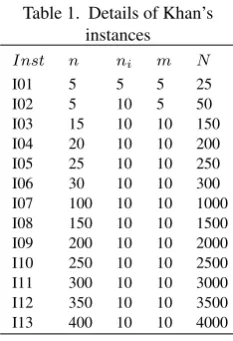
Table 1. Details of Khan’s instances
Inst n ni m N
I01 5 5 5 25
I02 5 10 5 50
I03 15 10 10 150
I04 20 10 10 200
I05 25 10 10 250
I06 30 10 10 300
I07 100 10 10 1000
I08 150 10 10 1500
I09 200 10 10 2000
I10 250 10 10 2500
I11 300 10 10 3000
I12 350 10 10 3500
I13 400 10 10 4000
5. EXPERIMENTATIONS AND TESTS 5.1 Experimental design
We compare the performance of our new appraoch (Osc) to other heuristic algorithms from the literature. The benchmarks data set on the MMKP are given in [30]. For each instance, we present in Table 1 the number of groupsn, the number of itemsniin each groupi, the number of constraintsmand the total numberN of variablesN = Pni=1 ni. We set up our approach parameters as follow:
—Span control : p1 = 3, p2 = 7 —Tabu list size t = 4
—kmax = 5
—frequency penalty scalar: 1000
—Initial solution: every variable is 0 (xij= 0for alli= 1, ..., n andj= 1, ..., ni)
—NumIter=n×ni: number of iterations. Iteration corresponds to a pass of both a constructive phase and a destructive phase. —IterAutorized=50 : number of iterations authorized without
ame-lioration
5.2 Experimental results
Table 2 shows the performance results of different approaches in-cluding ours. For each instance, it reports the obtained results by CPLEX, Khan [7], CPC [27], FanTabu [34], HIFI [29] and Ant [35].
We can clearly see that our approach gives the optimal solution for instances I01, I02, I05 and I06. In one hand, we come to this suc-cess thanks to the strategic oscillation which betters not only the diversification but also the intensification of the search process. Es-pecially it gives its proofs at the feasibility boundary regions. In the other hand, this good result could be explained by using sur-rogate constraints informations. This use guides the search process to worthy neighborhoods. Note that the normalization of surrogate constraint informations strengthens the optimization process. For the same reasons cited before, our approach improves the best literature results, although that it cannot attain CPLEX ones. In fact, for the instances I08, I09, I10, I11, I12 and I13 our approach outper-forms all the other well known approachesi.eHeu,Cpc,F.T abu, Hif iandAnt.
Table 2. Solution Quality Comparison
Inst Cplex Heu Cpc F.T abu Hif i Ant OSC
1 173 154 159 169 173 173 173
I02 364 354 312 354 364 364 364
I03 1602 1518 1407 1557 1602 1598 1594
I04 3597 3297 3322 3473 3569 3562 3514
I05 3905.7 3894.5 3889.9 3905.7 3905.7 3905.7 3905.7 I06 4799.3 4788.2 4723.1 4799.3 4799.3 4799.3 4799.3
I07 24587 - 23237 23691 24159 24170 24162
I08 36877 - 35403 35684 36401 36211 36405
I09 49167 - 47154 47202 48367 48204 48567
I10 61437 - 58990 58964 60475 60258 60858
I11 73773 - 70685 70555 72558 72240 73022
I12 86071 - 82754 81833 84707 84282 85284
I13 98429 - 94465 94168 96834 96343 97545
is tempting to note that the given result for these instances is ob-tained by using the same parameters values indicated in our exper-imental design. Moreover, if we change these parameters values, our approach will easily raise to the best results. Indeed, in these instances the oscillations should be minimized due to the relatively easiness of these instances.
OSCprovides solutions with total value on average equal to1.03%
close to the optimum and better performance than those obtained by Khan[7], Hifiet al.[29] and Iqbalet al.[35]. The surrogate con-straint approach achieves better solutions over 10 out of the 13 in-stances. The exceptions being for instances I03, I04 and I07 that achieve an objective function value1,73%close to optimum are due to the parameters choice. The insight here is that where ex-ploration area is comparatively small,OSC explores better areas and can give better solutions. But for large instances (I08, I09, I10, I11, I12 and I13) the exploration area is much larger. It should be noted that if we increase the number of iterations allowed to n2×ni, OSC algorithm finds the optimal solution for I03 and
I04. In the first six instances, our method is0,63%close to optima values given in [7]. However, the quality of the seven instances are improved (6 instances of 7) in average term by0,96%compared with the results published in [35] which are the best known solu-tions found after 100 runs. For instance I13 (which is a very large instance of MMKP; 4000 variables), note that our approach takes more lower computational time to reach its result which is0,89%
of the optimal solution . So our approach is very significant for large-scale real-time problems. Remember thatOSCstarts execu-tion with the trivial initial soluexecu-tion (every variablexij= 0), which can be not feasible, which increases the effort to find a good first feasible solutions. This is why we assume that a feasible solution starting provided by a fast algorithm like the one used in [43] can significantly improve the quality of solution or the run time.
6. CONCLUSION
In this paper, we have introduced a new oscillation approach which explores both sides of the feasibility border to solve MMKP. Sur-rogate constraint information is used to build the choice rules. A constraint normalization scheme was implemented to strengthen the surrogate constraint.OSC would be a very good candidate for time-critical applications such as adaptive multimedia systems where a near-optimal solution is acceptable, and fast computation is more important than guaranteeing the truly optimal value. To fur-ther improve our approach, a more sophisticated use of intelligent algorithms like in [50][51] can be investigated.
7. REFERENCES
[1] Glover.F, Laguna M. Tabu search. Boston: Kluwer Academic Publishers; (1998).
[2] Glover.F, GA.Kochenberger, Critical event tabu search for mul-tidimensional knapsack problems. In: Osman IH, Kelly JP, edi-tors. Metaheuristics: theory and applications. p. 407-27. (1996) [3] Hanafi.S, Freville.A, An efficient tabu search approach for the 0-1 multidimensional knapsack problem. European Journal of Operational Research ;106(23):659 75. (1998).
[4] Glover F. Surrogate constraints: tutorial notes. October (1998). [5] Moser M, Declarative scheduling for optimally graceful QoS degradation, in Proc. IEEE Int. Conf. Multimedia Computing Systems (ICMCS), pp. 86 93(1996).
[6] L. Chen, The utility model applied to layer-coded sources, Dept. of Computer Science, University of Victoria, Victoria, BC, Canada, (1998).
[7] Khan.S, Quality adaptation in a multisession multimedia sys-tem : Model, algorithms and architecture, Ph.D. dissertation, Department of Electrical and Computer Engineering, Univer-sity of Victoria, Canada (1998).
[8] Watson.R, The optimal admission and adaptation of service level agreements in packet networks: Applying the utility model, Masters thesis, Dept. of Electrical and Computer Engi-neering, University of Victoria, Victoria, BC, Canada, (2001). [9] Khan.S, K. F. Li and E.G. Manning, The Utility Model for
Adaptive Multimedia System. In International Workshop on Multimedia Modeling, pages 111-126 (1997).
[10] Garey.MR, Johnson.DS, Computers and intractability: a guide to the theory of NP completeness. San Francisco: Free-man; (1979).
[11] Martello.S, Toth.P, Knapsack problems. New York: Wiley; (1990).
[12] Healy Jr. WC, Multiple choice programming. Operations Re-search;12:122 38. (1964)
[13] Lin EYH. Multiple choice programming: a state-of-the-art review. International Transactions in Operational Research;1:409-421. (1994)
[14] Lin EYH. A bibliographical survey on some well-known non-standard knapsack problems.;36(4): 274 317 INFOR (1998) [15] Dyer.ME, Walker.J. Dominance in multi-dimensional
Volume 73 - No. pxc3889883, July 2013 [16] Weingatner.HM, Capital budgeting of interrelated projects:
survey and synthesis. Operations Research;12: 485-516. (1966)
[17] Peterson.CC, Computational experience with variants of the Balas algorithm applied to the selection of research and devel-opment projects. Management Science 13:736 50.(1967) [18] Gilmore.PC, Gomory.RE. The theory and computation of
knapsack functions. Operations Research;14: 1045 (1966) [19] Shih.W, A branch and bound method for the multi constraint
zero-one knapsack problem. Journal of Operations Research Society; 36978. (1979)
[20] Geo-rion.AM, Lagrangian relaxation for integer program-ming. Mathematical Programming Study 2:82114. (1974) [21] Glover F. Surrogate constraints. Operations Research;16:741.
(1968)
[22] Glover F. Heuristics for integer programming using surrogate constraints. Decision Sciences; 8:15666. (1977)
[23] Chu PC, Beasley JE. A genetic algorithm for the multidimen-sional knapsack problem. Journal of Heuristics;4: 6386. (1998) [24] Bertsimas D, Demir R. An approximate dynamic program-ming approach to multidimensional knapsack problems. Man-agement Science;48(4):550-565 (2002)
[25] Mhand Hifi, Slim Sadfi, Abdelkader Sbihi, An exact al-gorithm for the multiple-choice multidimensional knapsack problem. Cahiers de la MSE b04024, Maison des Sciences Economiques, University paris pantheon-Sorbonne. (2004) [26] Khan.S, Li KF, Manning.EG, Akbar.MM, Solving the
knap-sack problem for adaptive multimedia system. Studia informat-ica 2:161-82. (2002)
[27] Mhand Hifi, Michrafy.M, Sbihi.A, Heuristic algorithms for the multiple-choice multidimensional knapsack problem. Jour-nal of the OperatioJour-nal Research Society 55, 13231332 (2004) [28] Parra-Hemendez R, N.Dimopoulos, A New Heuristic for
Solving the Multi-choice Multidimensional knapsack problem. Systems, Man and Cybernetics, Part A: Systems and Humans, IEEE Transactions. Volume: 35 , Issue: 5 Page(s): 708- 717 (2005)
[29] Hifi M. M.Michrafy and A. Sbihi, A reactive local search-based algorithm for the multiple-choice multi-dimensional knapsack problem, Computational Optimization and Applica-tions, vol. 33, 271-285, (2006)
[30] Glover.F, Future paths for integer programming and links to artificial intelligence, Computers and Operations Research I9 (1986)
[31] Lee.C, Lehoczky.J, Rajkumar.R, Siewiorek.D. On quality of service optimization with discrete QoS options. In: RTAS’99: Proceedings of the fifth IEEE real-time technology and appli-cations symposium. Washington, DC, USA: IEEE Computer Society; 1999. p. 276.
[32] Sadid MWH, Islam MR, Hasan SMK, A new strategy for solving multiple- choice multiple-dimension knapsack prob-lem in pram model. In: Asian Applied Computing Conference. 2005.
[33] Kellerer H, Pferschy.U, Pisinger.D, Knapsack problems. Berlin: Springer; 2004.
[34] Chaitr S. Hire.M, Raymond. Hill2, New greedy heuristics for the Multiple-choice Multi-dimensional Knapsack Problem. In-ternational Journal of Operational Research Volume 2, 2007 Pages 495-512.
[35] Shahrear Iqbal, Md. Faizul Bari, M. Sohel Rahman, Solving the Multi-dimensional Multi-choice Knapsack Problem with the Help of Ants. ANTS Conference 2010: 312-323
[36] Beasley.J, OR-Library: Distributing test problems by elec-tronic mail. The Journal of the Operational Research Society 41(11), 10691072 (1990)
[37] Alaya.I, C.Solnon et K. Ghedira, Des fourmis pour le sac a dos multidimensionnel. Dans : 4mes Journes Francophones de Recherche Oprationnelle (Francoro 2004), Fribourg, Suisse, pp. 159-160, 2004
[38] Han I, Jimmy Leblet, Gwendal Simon, Hard multidimen-sional multiple choice knapsack problems, an empirical study, Computers Operations Research, (2010), 37, 172-181. [39] Cherfi.M, Hifi.M, A column generation method for the
multiple-choice multi-dimensional knapsack problem, Com-put. Optim. App. online first, Springer Netherlands (2008). [40] Sbihi.A, A best first search exact algorithm for the
multiple-choice multidimensional knapsack problem, Journal of Com-binatorial Optimization 13 (4) (2007) 337-351.
[41] Rad Mansia, Cludio Alvesa, J. M. Valrio de Carvalhoa and Said Hanafi. A hybrid heuristic for the multiple choice mul-tidimensional knapsack problem. Engineering Optimization. iFirst, 1-22 (2011)
[42] Romain Picot-Clmente, Florence Mendes, Christophe Cruz, Christophe Nicolle. TOURISM-KM, A variant of MMKP ap-plied to the tourism domain. ICORES 2012, Portugal (2012) [43] Ykman-Couvreur, Cliaiztal MEC, Leuven Nollet, Vincent,
Fast Multi-Dimension Multi-Choice Knapsack Heuristic for MP-SoC Run-Time Management. International Symposium on. Henk System-on-Chip, 2006 pages 1-4.
[44] I.Crevits, S.Hanafi, R.Mansi, and C.Wilbaut, Iterative semi-continuous relaxation heuristics for the multiple-choice mul-tidimensional knapsack problem. Computers and Operations Research, 2011.
[45] S.Hanafi, R.Mansi, and C.Wilbaut, Iterative relaxation-based heuristics for the multiple-choice multidimensional knapsack problem. volume 5818 of Lecture Notes in Computer Science, pages 7383. Springer Verlag, 2009.
[46] T.Ghasemi and M.Razzazi, Development of core to solve the multidimensional multiple-choice knapsack problem. Comput-ers and Operations Research, 60:349-360, 2010.
[47] M. Razzazi and T. Ghasemi, An exact algorithm for the multiple-choice multidimensional knapsack based on the core. Advances in Computer Science and Engineering, Communica-tions in Computer and Information Science, 6:275-282, 2008. [48] N. Cherfi and M. Hifi, Hybrid algorithms for the
multiple-choice multi-dimensional knapsack problem. International Journal of Operational Research, 5(1):89-109, 2009.
[49] Rad Mansi, Cludio Alves, J. M.Valrio de Carvalho and Said Hanafi, A hybrid heuristic for the multiple choice multidimen-sional knapsack problem. Engineering Optimization, 2012. DOI:10.1080/0305215X.2012.717072 .
[50] Gaige.W, Lihong.G, A Novel Hybrid Bat Algorithm with Harmony Search for Global Numerical Optimization, Jour-nal of Applied Mathematics, vol. 2013, 21pages, 2013. doi 10.1155/2013/696491