2019 International Conference on Artificial Intelligence, Control and Automation Engineering (AICAE 2019) ISBN: 978-1-60595-643-5
Design of the Reference Model of Smart Campus in Universities Based
on IoTs Technology under the Background of Big Data
Yao CHEN
*School of Statistics and Mathematics, Zhongnan University of Economics and Law, Wuhan, China
*Corresponding author
Keywords: Smart campus, Internet of Things technology, Big data, Reference model.
Abstract. With the development of information technology and communication technology, information technology has been integrated into the education industry, which has had a profound impact on the reform and development of education. The education industry has also entered the era of big data, and smart education has received more and more attention from universities. The development of smart education must rely on the construction of a smart campus. Based on the analysis of the development stage of informationization in colleges and universities in China, this paper puts forward the definition of smart campus in universities, and uses the Internet of Things technology to establish a conceptual model of smart campus in universities. This paper proposes the spatial architecture of colleges and universities' smart campus, establishes a modular framework model, and designs a modular architecture model including communication modules, environment modules, data modules and service modules, and initially forms a smart campus reference model based on Internet of Things technology.
Introduction
Three Stages of Informatization Development in Colleges and Universities in China
The first stage is the campus network (1984-2000), in the mid-1980s, China has only begun to build informatization in colleges and universities, computerization and campus network construction is the main task of this stage, mainly for computing and network communication [1]. The second stage is Digital Campus (2001-2015). This stage is mainly based on digital information and network. It is built on computer and network technology to collect, process, integrate, store, transmit and apply campus information such as teaching, scientific research, management, technical service, life service, etc. A virtual educational environment that fully optimizes the use of digital resources is to build a digital space based on a traditional campus. The third stage is the Windom Campus (2016-present), which integrates the work, study and life of the smart campus based on the Internet of Things technology in the big data environment. This integrative environment takes various application service systems as the carrier to fully integrate teaching, scientific research, management and campus life. Build a safe, stable, environmental protection and energy saving campus.
The Position and Goal of Colleges and Universities' Smart Campus
With the widespread application of emerging information technologies such as Internet of Things technology, mobile internet, big data, cloud computing, intelligent decision-making, knowledge management, artificial intelligence, and virtual reality in colleges and universities. It is necessary to have new ideas, plans and methods for the development of information technology in colleges and universities. The construction of smart campus has become the only way to develop. The main purpose of informatization in colleges and universities is to promote the reform and innovation of school teaching content, teaching methods and teaching methods, so that the smart campus can be combined with the whole staff and the whole process, so as to improve the level of education and improve the quality of running schools. The goal of building a smart campus in colleges and universities can be determined as the following four:
In the smart campus, relying on the support of knowledge management, campus social network, online education and other network platforms, the teacher prepares lessons to get rid of the individual limitations of time, space and personal knowledge. It can intelligently analyze the big data of teaching materials, teaching status, teaching evaluation and student learning feedback over the years, and prepare for teaching in a targeted manner. Students get rid of the passive learning mode of classroom teaching, and get timely and appropriate personalized guidance based on big data analysis. Teacher-student exchanges can be freely available anytime and anywhere. Various communication tools such as voice, video, text, and images can serve the teaching. The communication process can also automatically record and review the review as needed. Teaching evaluation is no longer a pure subjective scoring, but a multi-dimensional, dynamic, comprehensive and intelligent whole-process teaching evaluation based on the interaction between teachers and students and the big data of the student learning process, and guides the university to continuously improve teaching content, methods, means and models in accordance with the law of education.
(2) Intelligent scientific research
Scientific research with the support of big data, the smart campus will play a huge role in many aspects such as project declaration, scientific research, project completion, and research awards. In the project declaration process, researchers will provide personalized application proposals, help researchers automatically fill in personal basic information and research resumes, and actively recommend collaborators to make the research process declaration process convenient and fast. In the process of scientific research, help researchers to obtain research data conveniently, quickly and accurately.
(3) Intelligent service to the community
Serving the society is an important function of colleges and universities, but it has not received the attention it deserves in the construction of digital campuses. In order to better support the functions of colleges and universities to serve the society, it is necessary to use information technology to promote the combination of production, education and research, accelerate the transformation of scientific research results, and improve the ability of universities to serve economic and social development. Relying on information technology, the subject public education and science education And humanities education, improve the public scientific quality and humanity quality, promote the construction of a learning society. Use the accumulated massive data resources and big data analysis technology to conduct in-depth policy research, and actively play the role of the university's think tank and think tank, for the country and the local Governments at all levels contribute to scientific decision-making and democratic decision-making.
(4) Intelligent management decision-making
The smart campus must face the management and scheduling of university resources, and provide unified and unified management, scientific and financial management, and in-depth information support and collaborative school management support for all departments and departments of the school, and Inter-departmental business collaboration. Provide comprehensive information services, provide powerful information technology support for teachers and students' personal information association, business collaboration between management departments at all levels, and provide personalized integration, multi-dimensional and all-round information services for teachers and students. Provide scientific decision support, provide unified, hierarchical classification and authorization of statistical reports for daily business management and external data reporting of various departments, and provide strategic management decisions for school education and teaching quality improvement, high-quality talent training, high-end talent introduction, academic research and innovation. Provide scientific data support.
Conceptual Model of Smart Campus in Colleges and Universities
Generation of Smart Campus
technology on human economic and social activities, the information industry has translated Smart, Intelligent and Wisdom into smart. Smart education refers to the education of the development of students' intellectual ability under the support of information technology. As a high-end form of education informatization, wisdom education needs to be supported by a smart campus environment and system. Z.T.Zhu and R.H.Huang mainly put forward thinking from the perspective of the need for intelligent learning to support information technology, including the basic connotation, main tasks, basic characteristics and core technologies of the intelligent learning environment[4,5]. The smart campus is a concept with Chinese characteristics put forward by China's educational informationization researchers in order to comply with the development trend of education informationization and the characteristics of China's education industry. It is a complete set of technical solutions to support smart education under the condition of informationization from the perspective of informationization construction. This paper puts forward the idea of building a smart campus in colleges and universities for the overall information construction of schools in the stage of smart education.
China is paying more and more attention to the role of informatization in higher education. In 2010, the National Medium- and Long-Term Education Reform and Development Plan (2010-2020) and the Ministry of Education issued the "Decade of Education Informationization Development" in 2012. In the plan (2011-2020), it is explicitly required to accelerate the construction of educational information infrastructure and promote the informationization reform of the campus. In the "Guidelines on Actively Promoting "Internet +" Actions" issued by the State Council in 2015, it is explicitly required to accelerate the promotion of innovative applications of Internet, cloud computing, big data, Internet of Things and other related technologies. Implement the "Internet +" action plan and the national big data strategy to promote the open sharing of data resources[6].
Conceptual Model of Smart Campus in Colleges and Universities
Based on the above analysis, this paper proposes the basic definition of smart campus in colleges and universities: smart campus is a high-level expression of university informationization, and it is the further development and improvement of digital campus[7]. It uses Internet of Things technology, mobile internet, big data, cloud computing, Emerging information technologies such as intelligent decision-making, knowledge management, artificial intelligence, virtual reality, etc., comprehensively perceive campus physical space, intelligently identify learning, working situations and individual characteristics of teachers and students, establish campus virtual mapping in cyberspace, and integrate school physical space and The digital space is organically combined to grasp the campus operation rules and feedback and control the physical space in the calculation of cyberspace, to establish an intelligent and open educational and teaching environment for teachers and students, and to facilitate a comfortable living environment, and change the way teachers and students interact with university resources and environment, carry out people-oriented personalized innovation services, realize the university 's intelligent operation, and support schools to carry out smart education.
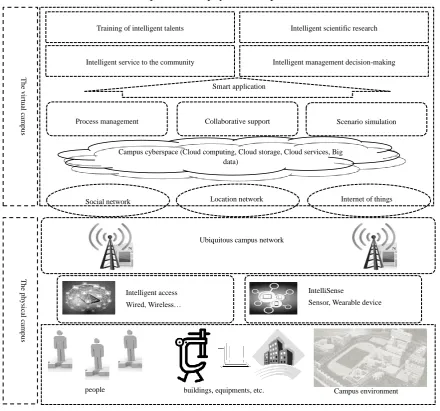
According to this definition, the conceptual model of the university's smart campus can be abstracted as shown in Figure 1. The details are as follows.
(1) Human-computer interaction: Apply intelligent sensing technology to collect state information of campus environment and equipment, apply wearable technology to collect activity information of people and people, obtain user input information through intelligent terminal and self-service device, and provide timely feedback and Control, realize physical information collection, environmental control and crowd interaction on campus.
(2) Ubiquitous Internet: The on-demand connection and information exchange between people, people and things, things and things through various wired and wireless networks, and information, location information and location information of people on campus The environmental information is mapped into the network space in time to construct an all-weather, fully-covered network application environment.
network to realize the interconnection of people, the interconnection of objects and the interconnection of space, the campus information physical system is constructed, and the seamless connection between the virtual campus and the physical campus is realized.
Figure 1. Conceptual model of smart campus in colleges and universities.
(4) Virtual mapping: build campus network space based on technologies such as cloud computing, cloud storage, cloud services, etc., assemble various structured, semi-structured and unstructured data generated in the campus, and establish campus virtual in network space. Comprehensively, accurately and timely reflect the operation of the physical campus.
(5) Comprehensive Cognition: Applying big data technology to analyze the campus virtual mapping in an all-round way, comprehensively grasp the running rules of the physical campus, and act on the physical campus through the campus information physics system to realize the intelligent interaction between teachers and students and school resources and environment. .
(6) Smart operation: Under the support of the smart campus, make scientific decisions on university operation management, resource scheduling, business activities, etc. based on operational rules, and support the smart operation of various businesses in the university through processes such as process management, collaborative support and scenario simulation, realize intelligent talent training, scientific research, social service and management decision-making, and achieve the purpose of supporting wisdom education through the construction of smart campus.
Spatial Structure and Framework Design of College and University Smart Campus
The essential difference between college smart campus and digital campus is that with the
Campus cyberspace (Cloud computing, Cloud storage, Cloud services, Big data)
Smart application
Social network
Process management Collaborative support Scenario simulation Training of intelligent talents
Intelligent service to the community Intelligent management decision-making Intelligent scientific research
people buildings, equipments, etc. Campus environment Ubiquitous campus network
Intelligent access Wired, Wireless…
IntelliSense
Sensor, Wearable device
T
h
e
v
irt
u
al
cam
p
u
s
T
h
e
p
h
y
si
ca
l cam
p
u
s
continuous integration of information technology and school business, the physical campus and virtual campus of colleges and universities will be integrated. In order to realize the integration of campus physical space and digital space, it is necessary to establish a smart campus information support platform[8]. The platform takes big data as the core, based on intelligent perception, and uses mobile internet as the medium, relying on smart applications to provide users with adaptive and personalized interaction, and realize the support for the smart operation of colleges and universities. Therefore, unlike digital campus construction, which focuses on information portal and business system construction, smart campus construction emphasizes space architecture and framework design. The various platforms, systems and applications of smart campus only follow the overall design of the technical architecture and the overall design of the technical framework. Only then can they be organically integrated to support the construction goals of the smart campus as a whole.
The Spatial Structure Model of Colleges and Universities' Smart Campus
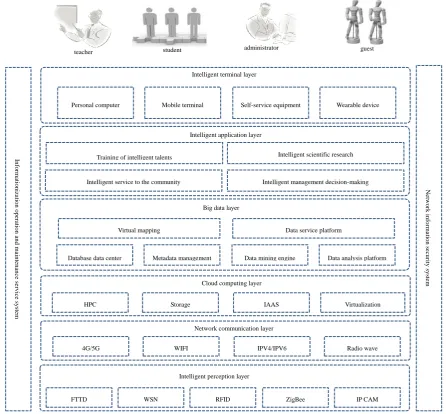
The spatial architecture of the smart campus is the overall planning of the smart campus technology system. From the technical perspective, it comprehensively plans the technical elements of the smart campus, the hierarchical structure of technical elements, and the logical relationship between technical elements. According to the general law of domain informationization, the spatial architecture of colleges and universities' smart campus adopts a hierarchical architecture consisting of intelligent sensing layer, network communication layer, cloud computing layer, big data layer, intelligent application layer and intelligent terminal layer, plus information[9]. The information security system and the information operation and maintenance service system required by the support platform itself, as well as the user groups of the smart campus, form the smart campus structure of the university as shown in Figure 2.
(1) Intelligent sensing layer: comprehensively use RFID, ZigBee, IP CAM and other intelligent sensing, network communication related Internet of Things technology, collect real-time data of various environments, resources and activities related to campus learning and life, and realize various facilities and facilities on campus. The running state, the trajectory of teachers and students learning and living, the interaction between teachers and students and the campus environment are comprehensively perceived, providing basic sensing support for comprehensive data collection and real-time feedback control of smart campuses.
(2) Network communication layer: comprehensively utilize communication technologies such as campus cable network, WIFI wireless network, 4G/5G mobile network, etc., to provide high-coverage transmission services for various environmental and activity data collected by the intelligent sensing layer, for teachers and students anytime, anywhere. The use of the Internet to provide high-speed access services, providing high-reliability access services for a variety of smart applications on campus, providing on-demand, ubiquitous communication support for smart campuses.
(3) Cloud computing layer: comprehensively utilize computing technologies such as virtualization, distributed computing, high-performance computing, centralized storage, distributed storage and other storage technologies to achieve efficient, transparent and reliable infrastructure cloud services, which is a large campus for smart campuses. Data processing and smart applications provide real-time, on-demand computing and storage support.
(4) Big data layer: comprehensively use data storage, data organization and management, data mining, data analysis and other technologies to gather various information such as environment, activities, business and interaction on campus, and build a network space and physical campus. Smart campus virtual mapping, and based on virtual mapping to carry out a comprehensive analysis, grasp the operating rules of the physical campus, provide scientific and comprehensive data support for various applications of smart campus.
The campus information service application provides comprehensive and appropriate functional services for the study and life of teachers and students and the management of the campus, thus providing comprehensive and personalized application support for the campus's intelligent management.
Figure 2. The spatial structure model of colleges and universities' smart campus.
(6) Intelligent terminal layer: a variety of terminal access technologies that integrate traditional personal computers, mobile terminals, self-service devices, and wearable devices, etc., based on the different environments in which users are located, providing users with no specific application scenarios. Sewing, adaptive, and personalized human-computer interaction mode, comprehensively enhance the user's experience of acquiring campus information services, and provide integrated and seamless access support for campus information applications.
(7) Supporting support system: Supporting the support system is the basis for the continuous high-quality service provided by the smart campus, including the information security system that guarantees the safe and reliable information of all kinds of campus information, and the information operation and maintenance service that guarantees the stable operation of the campus infrastructure and application system. The system provides a practical guarantee for the safe, stable and efficient operation of the smart campus.
Modular Framework Model of Colleges and Universities' Smart Campus
The construction of a smart campus in a university is complex system engineering. The construction of a smart campus should be based on the intelligent campus space architecture, and the overall design of each part should be designed to describe the technical details and implementation ideas of
Intelligent application layer
Big data layer Intelligent terminal layer
Informationization
operation
and
maintenance
service
system
Network communication layer Cloud computing layer
Intelligent perception layer
FTTD WSN RFID ZigBee IP CAM
4G/5G WIFI IPV4/IPV6 Radio wave
HPC Storage IAAS Virtualization
Data service platform Virtual mapping
Database data center Metadata management Data mining engine Data analysis platform Training of intelligent talents
Intelligent service to the community Intelligent management decision-making Intelligent scientific research Personal computer Mobile terminal Self-service equipment Wearable device
guest administrator
student teacher
Network
information
security
the technical elements in a more granular manner. This provides a design reference for subsequent concrete construction [10]. The modular framework model of the smart campus is the detailed design of each technical element in the technical structure, including the communication module, the environmental module, the data module and the service module. The communication module is the design of the intelligent sensing layer and the network communication layer, and the environment module. It is the design of the cloud computing layer, the data module is the design of the big data layer, and the service module is the design of the smart application layer and the intelligent terminal layer.
(1) Communication module: It is the transmission core of the modular framework system of the smart campus, which provides the basic support for the high-speed transmission and wide coverage of all kinds of information on the smart campus. It Includes wireless network modules that provide high-volume, high-concurrency data transmission services for businesses and activities. An Internet of Things module that provides high-frequency, high-coverage data transmission services for all types of sensors A location network module that provides campus physical location determination services for people, sensors, and the like.
(2) Environment module: It is the computing core of the smart campus modular framework system, providing basic computing, storage and internal transmission support for the instant and efficient processing of all kinds of information on the smart campus. It includes a high-availability virtualized computing support for management applications and a computing environment module that provides cloud computing support for teaching and research applications. A storage module that provides distributed storage support in response to the rapid growth of applications, A network environment module that provides support for high-speed data transfer and sharing between applications and a computer room environment module that guarantees stable operation of the infrastructure.
(3) Data module: It is the logical core of the modular framework of intelligent campus. It carries the virtual image of the main body of intelligent campus with data application and big data model. Including the construction of integrated, consistent, variable multi-dimensional data space data acquisition management module and data storage calculation module, the formation of on-line real-time data processing mechanism, the development of global, individual and group data multi-dimensional feature analysis data analysis module.
(4) Service module: It is the application core of modular framework system of smart campus. Only through the service layer can all kinds of services in smart campus be integrated organically, forming a flexible and evolvable application environment of smart campus, supporting the integration of existing systems into the service layer after service transformation, and realizing new services. The continuous integration of functions, while providing an open application system development framework to help developers quickly builds application systems. It includes user-oriented interactive module which provides unified interactive services, rule module which bears business rules and management processes, engine module which provides flexible customization support for applications, processes and data, and container module which provides support for integrating and encapsulating existing application functions.
Conclusion
Acknowledgement
This research was financially supported by the Graduate Innovation Project of the School of
Statistics and Mathematics, Zhongnan University of Economics and Law. (No.201811302)
References
[1] D. X. Jiang, X. L. Fu, Discussion on the Construction of Smart Campus under the Background of Big Data, J. Journal of East China Normal University(Natural Science), 3(2015)119-126.
[2] J. Chin, V. Callaghan, Educational Living Labs: A novel Internet-of-Things based Approach to Teaching and Research, J. Ninth International Conference on Intelligent Environments (IE 2013) 92-99.
[3] L. Zhang, Y. Liu, X. Zhan, Campus View: An Innovative Location and Context-Aware Video Sharing Application on Smart Phone, J. Wireless Personal Communications, 66(2012)493-509.
[4] Zh. T. Zhu, B. He, Smart education: a new realm of educational informatization, J. Audio-Visual Education Research, 12(2012)5-13.
[5] R. H. Huang, The Three Realms of Smart Education: From Environment, Model to System, J. Modern Distance Education Research, 6(2014)3-11.
[6] Y. Z. Li, Q. Zhou, J. Yan, Some Thoughts on the Construction of University's Smart Campus, J. China Electro-education Education, 372(2018),112-117.
[7] T. S. Joaquin, A. Joan, R. David, Enhancing integrated indoor/outdoor mobility in a smart campus, J. International Journal of Geographical Information Science, 29(2015)1955-1968.
[8] B. Valks, M. H. Arkesteijn, H. Den, Smart campus tools - adding value to the university campus by measuring space use real-time, J. Journal of Corporate Real Estate, 20(2018)103-116.
[9] J. S. Mounessa, S. L. Pagoto, K. Baker, Creating the first indoor tan-free skin smart college campus, J. Preventive medicine reports, 6(2017)44-46.