2018 International Conference on Modeling, Simulation and Analysis (ICMSA 2018) ISBN: 978-1-60595-544-5
A Management Decision Support Model of
Smart Campus Based on Big Data Center
Jian-dong ZHAO
1and Ming ZHAO
2,*1School of Computer Science, Guangdong Polytechnic Normal University, Guangzhou 510665,
Guangdong Province, China
2
School of Computing, Informatics, and Decision Systems Engineering, Arizona State University, Tempe, AZ 85281, USA
*Corresponding author
Keywords: Smart campus, Management decision support, Big data, Modeling.
Abstract. Smart campus is an important part of smart city. The modeling ideas of smart campus are discussed firstly. A management decision support model of smart campus is then put forward. It connects with other complex information systems through education data center in the framework of smart city. Based on a big data center and a decision support system for smart education management, it provides decision support for campus operation status monitoring, discipline construction, major settings, faculty and staff management, talents cultivation, teaching evaluation, scientific and technological innovation, financial management, resources utilization, and service guarantee. Finally, the composition of the big data center is also discussed which contains at least thirteen basic databases.
Introduction
The US innovation strategy, released by the White House in October 2015, points out that the "smart city" is one of the nine technical fields of concern. Smart campus is an important part of smart city. The positioning system implemented as a service in smart campus supports seamless indoor and outdoor navigation and wayfinding [1]. An smart campus guide android can recognizes the structure (a building and a statue, for example) in which a user is interested and displays useful information about the structure[2]. 3D modeling is an important piece of the smart campus system prototype[3]. Geographic information system are also used to improve the educational environment and the comprehensive management level of the smart campus[4]. A pervasive smart campus environment can support ubiquitous learning[5]. Smart campus can optimize teaching, research, management, and service[6]. Additionally, the smart campus system should has auxiliary decision-making, office management, device management, user management, and educational administration modules [7]. It collects data information of the school, provide intelligent services anytime and anywhere, and automatically generate data statistics table, and provide decision support [8]. How to model it from the perspective of management decision support is very worthy of research.
Modeling Ideas on Smart Campus
campus operation, campus security, financial situation, teacher situation, scientific research situation, student situation and so on. The core ideas of the smart campus top-level design include:
1. The top-level design of smart campus must consider the interaction with other intelligent and complex information systems. The essence of smart earth is made up of many smart cities. Smart city is a complex system composed of smart education, smart medical care, smart transportation, smart social security, smart infrastructure, etc. The smart campus is the concept of education informatization under the framework of "smart city", and provides the public with the space of education. Under the framework of smart city, the relationship between smart education and smart transportation, smart medical care, smart social security and other fields is the relationship between complex information systems. Being members of the smart city, students and teachers should be identified firstly in smart city under the framework for certification, keep the identity authentication in the smart campus environment, and be allowed to add and modify member education attributes. In the smart city framework, the education management departments are responsible for construction planning of smart campus, and health management department for smart medical care, and transportation management departments for smart transportation, and so on. The coordinated development of smart campus and other smart system should be given full consideration before the top-level design and construction planning.
academic units
administrators
teachers
staff
students
alumni
students’parents
general public
Demand for smart management
Demand for smart teaching
Demand for smart operation
Demand for smart learning
[image:2.595.183.412.327.496.2]Demand for smart communication
Figure 1. The eight principal demands of smart campus.
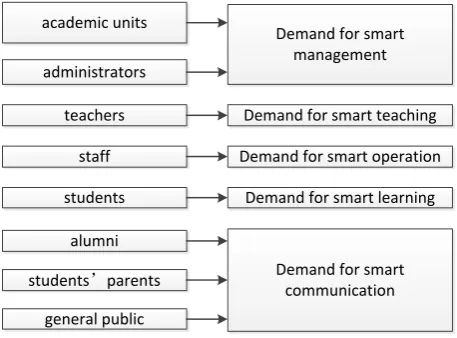
2. Smart campus is a demand-driven construction, including the needs of the eight main roles. It is built by the general public's urgent needs for smart education. In addition to teachers' and students' needs for information teaching and school administrators' needs for information management, we must meet other people's urgent needs for smart education. From the academic units, education administrators, teachers, staff, students, alumni, students' parents, and general public eight main perspective to consider, the demands of smart education are divided into demands for smart management, smart teaching, smart operation, smart learning and smart communication, as shown in figure 1.
3. The top-level design of smart campus must fully consider the integration and application relationship of the new generation of information technology. The current generation of information technology mainly includes big data, Internet of things, cloud computing, mobile application, social network, data mining, etc. The high speed and ubiquitous Internet is the foundation of smart campus. The technical framework of smart campus is based on the education of cloud services platform to build, on cloud services platform to build a big data center. Data mainly through mobile terminals, and even the future of the Internet of things terminal automatic data collection. Data mining is based on relationships of various kinds of data, including the social network relationship between subjects on campus, and excavates valuable relationships to promote learning, teaching and management.
needs of the main roles, and conduct data analysis of the main behavior, especially the application of data mining in the smart campus environment. The premise of this series is that data collection, data preservation, data disclosure, data analysis, data mining and data utilization have a complete set of mechanism in the smart campus environment. The data scale of future campus will develop into big data scale. So the top-level design of smart campus not only includes technical problems, but more important is the management mechanism under the big data environment. From Figure 1, we can see that "personalized teaching and management" is an important feature of smart campus. Therefore, we should pay more attention to the application of big data in smart campus, and pay more attention to the mechanism which encourages everyone participates in data creation and data sharing. Compared with data collection, data analysis and data mining, it is more important to establish a set of incentive mechanism or information disclosure mechanism to ensure timely submission of data and make data public. This needs to learn some successful experiences from e-government information disclosure.
5. The top-level design of smart campus must distinguish the focus of basic education, higher education and vocational education. Smart campus is a complex system. The complexity of the smart campus of colleges and universities is greater than that of primary and secondary schools. The smart campus of vocational education school has its own particularity. We must clarify the differences between the three, so as to establish the conceptual model of smart campus. Smart campus is an environment for providing smart education. The goal is to achieve personalized learning at anytime, anywhere, interactive, collaborative and inquiry teaching, timely home school communication and intelligent school management. There will be different emphasis on the construction of intelligent campus in the fields of basic education, higher education and vocational education. Higher education smart campus is relatively the most complex since it includes additional scientific research, social services and other functions. The smart campus in vocational education will highlight the application of digital resources, virtual reality and other technologies in experimental training. The basic education should focus on students' assisted learning, help students to learn actively and happily, and cultivate good study habits.
The Management Decision Support Model of Smart Campus
Other systems in smart city
A decision support system for smart education management Smart goverment
big data center of smart campus
national education data center provincial education data center
ca m p u s o p er at io n s ta te m o n ito rin g
Decision support for :
· discipline construction
· major setting
· faculty and staff management
· talent cultivation
· teaching evaluation
· scientific and technological innovations
· financial management
· resource utilization
· service guarantee smart public safty
smart finance
smart community
smart healthcare
Student database Admission database
Disciplines and majors database
Faculty and staff database
Course teaching database
Scientific research database Quality engineering database
Academic conference database Talent cultivation database
International exchange database Alumni database
Asset and equipment database
Education and technology database
In fo rm at io n s er vic e sy st em Ed u ca tio n m an ag em en t in fo rm at io n s ys te m smart transportation
Departments of education,
[image:4.595.73.521.75.327.2]Education administrators Teachers,Students, Staff, Alumni, Student parents, General public Teachers, Students, Logistics staff
Figure 2. The management decision support model for smart campus.
Three Characteristics of the Model
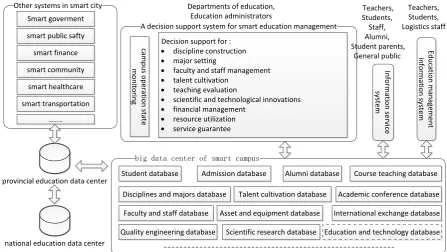
From the perspective of management decision-making, the smart campus can be regarded as a smart decision support system based on a big data center, and there is a data exchange relationship with other information systems in smart city. The three characteristics of MDSM are described as follows:
1. Each smart campus must consider docking with education management public service platform. At present, the national education management public service platform construction has initially established the management information system and basic database of education administrative departments at all levels and various schools at all levels. This provides technical and data support for strengthening education supervision, supporting education macro decision-making, and comprehensively enhancing education public service capacity. The whole platform is implemented according to the system of "two-stage construction and five-level application". At the ministry of education and provincial education administrative departments, the central and provincial level data centers are established respectively. The application environment of data centralization and system integration is built, and the five-level system of central, province, city, county and school of education management information system is constructed simultaneously. As shown in figure 2, the big data center of smart campus must first establish the docking with the provincial education data center, and the final data will be collected to the national education data center.
2. The smart campus is responsible for the confirmation and modification of personal education attribute data. The big data center of smart campus connects with other systems in smart city through the provincial education data center. The essence of smart city includes smart government, smart public security, smart finance, smart community, smart healthcare, smart transportation and so on. The big data association of every part can really form smart management at the urban level. For example, smart public security system and smart finance query and synchronize personal academic degree information through provincial education data center, which helps to confirm personal identity and credit rating.
example, students database, admission database, faculty and staff database, etc. The second type is the perceptual data collected automatically by the Internet of things. For example, the future use of the smart campus video to monitor the students' attendance data in the course teaching database. The third type is external data collected through internet, such as other school news, discipline construction cases, teaching video and so on in the education and technology database. At present, the first type of data is mainly collected by hand. The education and technology database is now less established by universities. In the future, with the intensification of the discipline construction and teaching research competition between colleges and universities, this database must be established in order to carry out the horizontal comparison. With the acceleration of the construction of smart campus, the three kinds of data automation collection ratio will be improved.
The Basic Composition of the Big Data Center of Smart Campus
Smart campus big data center in this model contains at least thirteen basic databases. The amount of data over time will continue to increase, and ultimately achieve a large scale data. It will also contain unstructured data, including network information data, audio, video, pictures, location information. Among these databases, we should pay attention to the thirteenth database. These thirteen databases are as follows:
1. Student database. It contains the unique identity of each individual and is unified with other information systems in smart city. Since the campus big data center connecting with provincial education data center, students' basic information can be obtained or updated during the students at school, such as native place, date of birth, home address and other information. The student contact information, home address, even the name can be updated according to the need. Unstructured data include electronic image scanning of materials such as winning certificates and graduation certificates during secondary school, and important video audio proof.
2. Admissions database. It contains the college entrance exam candidate's volunteer, admission score. Then we can analyze the first volunteer rate, adjustment rate and popularity of the undergraduate majors. Through association with employment data and Talents cultivation data, it allows colleges and universities to set up the enrollment plan reasonably, then adjust majors setting dynamically, and configure the teaching staff and optimize the school building equipment.
3. Disciplines and majors database. It contains all the undergraduate catalog, old and new undergraduate contrast, relationship between undergraduate and level of discipline, primary enrollments and professional enrollments in disciplines relationship, undergraduate and higher vocational professional docking, list of key disciplines, key support course list, etc.
4. Faculty and staff database. It contains the unique identity of individual identity and is unified with other information systems in smart city. The basic information of teachers can be obtained through association with smart police data. Unstructured data includes the teacher's various certificates proving electronic image scanning, important video audio proof.
5. Course teaching database. It contains training programs for professionals, curriculum, quality assessment of teachers' classroom teaching, student attendance, cheating records of course exams, etc. The unstructured data includes the scores of teachers' signature, performance analysis and other materials, such as the electronic image scanning parts of materials, and the students' attendance data recorded by the Internet of things.
6. Quality engineering database. It contains undergraduate and graduate professional comprehensive reform pilot project, the personnel training mode innovation, characteristics of outstanding talent training plan, professional, high-quality goods video courses, off-campus practice teaching base, the experimental teaching demonstration center, applied talents cultivation demonstration base, applied talents cultivation demonstration data, etc.
8. Alumni database. It contains graduate employment unit, file direction, alumni contact information, outstanding alumni news report, alumni membership information, alumni association organization structure and other data.
9. Scientific research database. It contains teacher paper works, project record, patents and software copyright, scientific research awards, cooperation platform between colleges, scientific research platform at all levels, scientific research institutions and other data.
10. Academic conference database. It contains the data of various meetings, conference processes, conference topics, topics and types of seminars held by the faculty. Unstructured data includes conference speech electronic documents, video, pictures, etc.
11. International exchange database. It contains the name and contact information of the institutions that have established cooperation with foreign countries, the whole process data of teachers to foreign visits, and the students' complete process data of the exchange and visiting.
12. Asset and equipment database. It contains the usable area of each school building, office equipment, equipment usage, daily entry, important precision instrument name, number, price, type, number of users, training number and so on.
13. Education and technology database. This database content is special, mainly through network and other information disclosure channels to obtain other school disciplines construction data, teaching cases and other data. Unstructured data is rich in content, including other schools' web news, new media data, electronic documents, video, compressed files, audio data, and so on.
Major Decision Support Functions
In addition to providing a whole campus operation status monitoring function, the MDSM model also provides at least nine decision support functions. The campus operation status monitoring function provides a graphical display of data and analysis, including the profile data, financial revenues and expenditures data, data of disciplines, faculty and staff, various types of students, students employment, and alumni information statistic, etc. These nine decision support functions are introduced respectively as follows:
1. Decision support for discipline construction. According to the state council graduate degree awarded catalogue (2011) and the professional degree category, it digitalized and graphically presents the trend of data and data in different disciplines, academic leaders, teachers, research teams, discipline platforms and graduate students. At the same time, we link the educational technology database to compare the discipline data of the same types of universities at home and abroad, and finally provided the analysis results and suggestions for the weakness of discipline construction.
2. Decision support for major setting. According to the Ministry of Education's "General Higher Education Undergraduate Directory (2012)", it collects the enrollment number of each major, the first volunteer on-line rate, the adjustment rate, the actual enrollment number, the employment rate and other data. At the same time, through association analysis with the talent cultivation database, faculty and staff database, disciplines and majors database, it provides decision support for the professional setting of universities and the scale of each majors enrollment.
3. Decision support for faculty and staff management. This model automatically analyzes the age structure, professional title structure, educational structure, double-division talents and key talents of the faculty and gives suggestions for improvement. Through correlation analysis this database with scientific research database and quality engineering database, it will give each teacher career development planning advice, and accurately point out the disadvantages of teaching and scientific research.
5. Decision support for teaching evaluation. Based on the course teaching database, the teaching quality evaluation of teachers should be carried out according to each disciplines, majors and courses, and assist teachers to improve the teaching quality. Teaching performance is analyzed through correlation with decision support results of cultivation of talents. It provides feedback on talent training programs and curriculum settings, which assist departments and schools as a whole to improve teaching quality.
6. Decision support for scientific and technological innovation. Based on the scientific research database, the classification statistics of scientific research achievements such as papers, projects, achievements and intellectual property rights are carried out. The performance of scientific and technological innovation are analyzed and compared according to each people, discipline, college and the whole university. Associating with education and technology database, the ability of science and technology innovation is compared horizontally with domestic and foreign countries universities. Finally the analysis result and promotion suggestions about scientific and technological innovation ability are provided.
7. Decision support for financial management. It statistics general budget allocations and funding, business income, operating income of fiscal revenue budget revenues. It also analyzes the basic expenditure, general goods and services, for individuals and families subsidy spending budget expenditure structure. Optimization and warning financial advice are given through classified statistics and timeline comparison analysis of personnel expenditure, infrastructure projects, campus energy consumption, office expenses, travel expenses, scholarships and other spending. Through associate with decision support result of discipline construction, the input of each department, discipline and major is accurately analyzed and compared. Finally financial optimization suggestions about each discipline input are also given.
8. Decision support for resources utilization. It statistics the school district office, classroom resources, equipment resources, activities, books and electronic literature resources and campus traffic resource usage (including the school bus and parking spaces), and monitor the energy consumption of the campus. It also puts forward optimization suggestions on low-carbon campus, school bus scheduling, equipment purchase and equipment use.
9. Decision support for service guarantee. The service guarantee includes functional service guarantee, teaching and auxiliary service guarantee and logistics service guarantee. The service conditions of functional departments, teaching assistant departments and logistics departments to teachers and students are respectively counted. Finally, it puts forward suggestions for optimizing the structure of functional departments, including the structure optimization of staff, the allocation of teaching assistants, the procurement of canteen services, the purchase of campus security services, and the construction of campus safety system.
Conclusion
Three important stages of informatization development in colleges and universities are digitization, service and smart. Smart campus provide considerate information services for academic units, education administrators, teachers, staff, students, alumni, students' parents and general public. It also provides a platform for business collaboration between school and departments. Besides, it should also provide decision support for education teaching quality improvement, top talent cultivation, excellent teacher recruitment, scientific and technological innovation and so on based on big data center.
Acknowledgement
References
[1] Torres-Sospedra, J., Avariento, J., Rambla, D., Montoliu, R., Casteleyn, S., Benedito-Bordonau, M., Gould, M. and Huerta, J., 2015. Enhancing integrated indoor/outdoor mobility in a smart campus. International Journal of Geographical Information Science, 29(11), 1955-1968.
[2] Yim, J., Joo, J., Lee, G. and Shim, K., 2014. Design and implementation of a smart campus guide android app. Appl Math Inf Sci, 8(1L), 47-53.
[3] Youliang Huang, Sajid Ali, Xiaoming Bi, et al. 2016. Research on Smart Campus Based on the Internet of Things and Virtual Reality. International Journal of Smart Home, 10, (Dec 2016), 213-220.
[4] Tianping Bi, Xuemei Yang, Meili Ren. 2017. The Design and Implementation of Smart Campus System. Journal of Computers, 12, 2(Nov 2017), 527-533.
[5] Atif, Y., Mathew, S.S. and Lakas, A., 2015. Building a smart campus to support ubiquitous learning. Journal of Ambient Intelligence and Humanized Computing, 6(2), 223-238.
[6] Liu D., Huang R., Wosinski M. 2017. Smart Learning in Digital Campus. Smart Learning in Smart Cities. Lecture Notes in Educational Technology. Springer, Singapore.
[7] Jiangjia Fu, Zhong Yong, Wang Yu-long, et al. 2013. Construction of Smart School System Based on the Educational Cloud. Modern Educational Technology, 23, 2(Feb.2013), 109-114 (In Chinese).